Teaching Guide with Activities and Discussion Questions for Maya Lin: Thinking With Her Hands by Susan Goldman Rubin

Share

Nonfiction Wednesday

Nonfiction Picture Book Wednesday is hosted by Kid Lit Frenzy and was started to help promote the reading of nonfiction texts. Most Wednesdays, we will be participating and will review a nonfiction text (though it may not always be a picture book).
Be sure to visit Kid Lit Frenzy and see what other nonfiction books are shared this week!
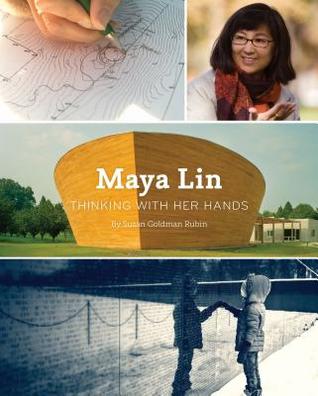
Maya Lin: Thinking With Her Hands
Author: Susan Goldman Rubin
Published November 7th, 2017 by Chronicle

Summary: In the tradition of DELICIOUS, WIDENESS & WONDER, and EVERYBODY PAINTS!, this is Susan Goldman Rubin’s extensively researched and very accessible biography of civic activist Maya Lin, most famous for her design of the Vietnam Veterans Memorial. The Vietnam Veterans Memorial in Washington, D.C., is one of the most famous pieces of civic architecture in the world. But most people are not as familiar with the reserved college student who entered and won the design competition to build it. This accessible biography tells the story of Maya Lin, from her struggle to stick with her vision of the memorial to the wide variety of works she has created since then. Illustrated extensively with photos and drawings, the carefully researched text crosses multiple interests–American history, civic activism, art history, and cultural diversity–and offers a timely celebration of the memorial’s 35th anniversary, as well as contributing to the current, important discussion of the role of women and minorities in American society.

Activities include: 

Pre-Reading

  • Building Historical and Scientific Background Knowledge: To better understand much of Maya Lin’s extensive work, background knowledge of certain historical and scientific events are needed. Before reading Maya Lin’s biography, separate the class into five groups and assign each group one of these events:
    1. Vietnam War
    2. Civil Rights Movement
    3. Chinese-American Immigration
    4. Endangered and threatened animals
    5. Lewis and Clark’s expedition and the effect on the Indigenous People of Washington State

    Have each group create a timeline using an interactive timeline creator that showcases their event chronologically.  Within the timeline, the students should not only have important dates but they should incorporate visuals, the impact of each event on history/science, and any other supplemental information/media that will increase the knowledge of their event.

    Students then will present their timelines to their classmates to allow for all students to possess knowledge of all five historical and scientific events before beginning Maya Lin’s biography.

Post-Reading

  • Symbolism: Unlike traditional minimalists, Maya Lin uses symbolism in her work. Begin with working with students on symbolism within familiar stories they know. Show students What is Symbolism? at https://www.youtube.com/watch?v=8Vwek28P9Gk then read the Story of William Tell (http://www.mainlesson.com/display.php?author=baldwin&book=fifty&story=tell) and discuss what the apple symbolizes. After this discussion tell students that symbolism in art is the same–symbolism is when a piece of art or an aspect of a piece of art represents something more than its literal meaning.Then, have students analyze her pieces of work for symbols within them. Students should then create a symbolism T-chart showing their found symbolism.Some examples:
    The ark shape of the Riggio-Lynch Chapel Symbolizes that the chapel is a safe place just as Noah’s Ark was.
    The water on the Civil Rights memorial Symbolizes the justice rolling down like waters and righteousness like a mighty stream mentioned in “I Have a Dream” speech by Martin Luther King, Jr.
  • Cumulative Writing Assignment: Legacy
    Maya Lin states, “You need to see me whole as an artist. What I’m doing is art, architecture, and memorials.” Have students write an informative essay explaining how Lin has fulfilled her legacy as an artist, architect, and memorial designer. Have students use evidence from the text, as well as other provided resources if you choose, to support their claim.Other resources:
    http://www.whatismissing.net/
    http://www.mayalin.com
    http://www.biography.com/people/maya-lin-37259
    http://www.theartstory.org/artist-lin-maya.htm

Discussion Questions include: 

  • From a young age, Maya Lin did not like the color red. Why does she not like the color red? What does red represent to her? The color red was included in the Museum of Chinese in America, however. Why was the color included in this project even though Maya Lin does not like it?
  • After completing the Vietnam War Memorial, Lin felt like she was boxed in as a “monument designer,” and refused many invitations to complete more memorials. Why do you think the Civil Rights Memorial was the work that she finally agreed to complete?
  • Maya Lin’s message of sustainability (avoiding the depletion of natural resources to maintain a balance within nature) reaches us through not only her What is Missing? project but through many of her other pieces of work. She states, “A lot of my work is not very glorious. If I succeed, you may never know I was here.” How did Maya Lin’s message of sustainability come through her works?
  • Susan Goldman Rubin’s chapter titles are very specific word choices. Looking at the titles (Clay, Granite, Water, Earth, Glass, Celadon, Dunes and Driftwood, Wood, and Memories), why do you believe the author choose these words to title each chapter?

Teaching Guide Created by Me (Kellee): 

You can also access the teaching guide through Chronicle’s website here.

Recommended For: 

readaloudbuttonsmall classroomlibrarybuttonsmall closereadinganalysisbuttonsmall

Kellee Signature

Review and Giveaway!: Listen: How Pete Seeger Got America Singing by Leda Schubert

Share

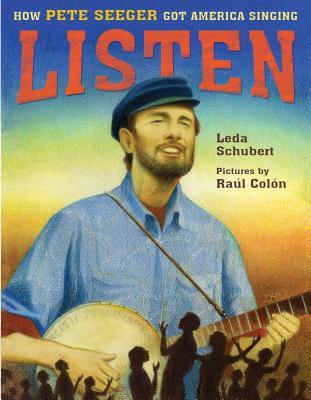
Listen: How Pete Seeger Got America Singing
Author: Leda Schubert
Illustrator: Raúl Colón
Published June 13th, 2017 by Roaring Brook Press

Summary: 

Listen.
There was nobody like Pete Seeger.
Wherever he went, he got people singing.
With his head thrown back
and his Adam s apple bouncing,
picking his long-necked banjo
or strumming his twelve-string guitar,
Pete sang old songs,
new songs,
new words to old songs,
and songs he made up.

In this tribute to legendary musician and activist Pete Seeger, author Leda Schubert highlights major musical events in Mr. Seeger’s life as well important moments of his fight against social injustice. From singing sold-out concerts to courageously standing against the McCarthy-era finger-pointing, Pete Seeger’s life is celebrated in this book.

Praise for Listen

★“Schubert and Colón ably demonstrate one of their book’s final assertions: ‘there really was nobody like Pete Seeger.’”—Kirkus Reviews (starred)

“A rousing tribute to a singular musician and activist who ‘walked the talk.’” —Publishers Weekly

“This inspiring picture book biography about one of America’s greatest folk heroes is sure to get a new generation of children singing.” —School Library Journal

“An inspiring and heartfelt tribute to, as Schubert calls him, a ‘true American hero.’” —Horn Book

About the Creators: 

Leda Schubert holds an MFA from Vermont College of Fine Arts in the Writing for Children and Young Adults and was a core faculty member until 2012. She is the author of many award-winning titles, including The Princess of Borscht, Ballet of the Elephants, and Monsieur Marceau, winner of the Orbis Pictus Award for Outstanding Nonfiction. Leda lives in Plainfield, Vermont, with her husband and two dogs. To learn more, and to download a curriculum guide, visit ledaschubert.com.

Raúl Colón has illustrated several highly acclaimed picture books, including Draw!; the New York Times-bestselling Angela and the Baby Jesus by Frank McCourt; Susanna Reich’s José! Born to Dance; and Jill Biden’s Don’t Forget, God Bless Our Troops. Mr. Colón lived in Puerto Rico as a young boy and now resides in New City, New York, with his family.

Kellee’s Review: Schubert’s narrative of Seeger’s life is so lyrical and poetic–it is a song accompanied by beautifully textured, light illustrations that bring the biography to life. I can tell that Schubert is a fan of Seeger because she told his story with gentleness and love honoring a man that is truly an American hero.

The more I read about Pete Seeger, the more I am intrigued. I have heard about Pete Seeger my whole life, but it wasn’t until I read Stand Up and Sing by Susanna Reich that I truly learned about HIM outside of just knowing his music. I truly wish that Pete Seeger was still around to help us in our current time. His story has shown me that one person can make a difference, that good can win and be honored, and that music can bring people together. I loved learning even more about Seeger through Schubert’s picture book.

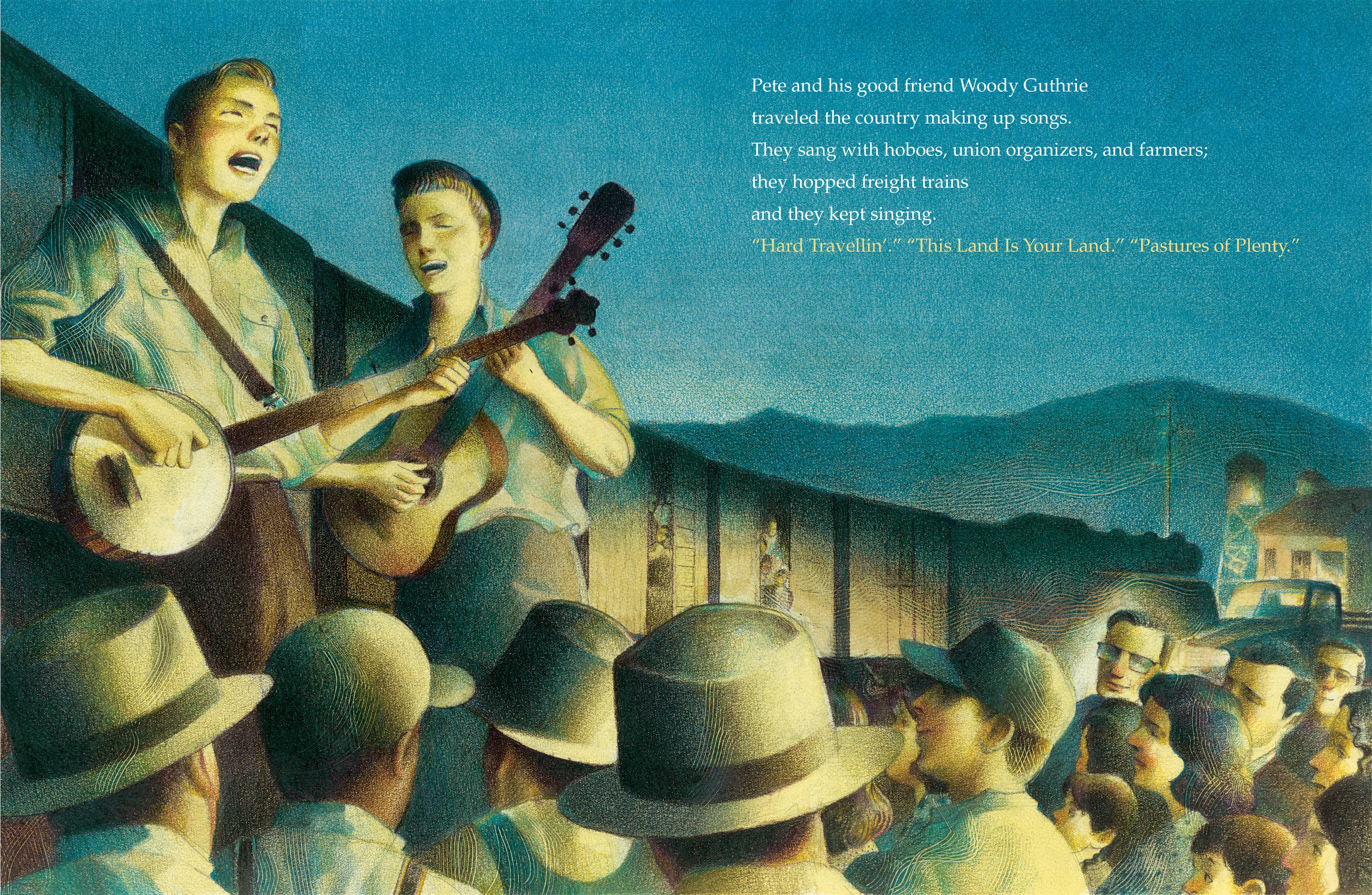
Ricki’s Review: Like Kellee, I didn’t know a lot about Pete Seeger until I read this book. I love reading texts that teach me more about a person. I didn’t realize that he traveled with Woody Guthrie! Too cool! Pete Seeger was a social activist, and his songs urge us to take action. This book will encourage readers to learn more about the singers that they listen to.

The author and illustrator bring great life to this book. It is very clear that they were inspired by his music, and the book truly comes alive. This is a book that teaches kids about an important man in our history and the power of music. It also reveals a lot of information about American History. I highly recommend this book to parents and teachers.

Teachers’ Tools for Navigation & Discussion Questions: A fabulous curriculum guide can be found here created by Leigh Courtney, Ph.D. and includes discussion questions and activities.

Example discussion questions:

  • Pete Seeger said, “Participation. That’s what’s gonna save the human race.” What do you think that means?
  • Pete Seeger found himself in trouble with the government at one point in his life. Which group questioned him? Why were they interested in him?
  • Encourage students to study the illustrations in Listen paying particular attention to the drawings of people in the story. Discuss what the people’s actions and expressions tell you about Pete Seeger’s impact on those who listened to his music.
  • Many view Pete Seeger as an American hero. Discuss why people might regard Seeger as an important figure in American history. Read aloud President Obama’s statement about Pete Seeger, made upon the musician’s death, found in the final timeline entry at the back of the book.

Some examples of activities include cause and effect, research, vocabulary, and some fun music activities.

Resources: Leda Schubert provides some great links to recordings and videos of Pete Seeger here.

Flagged Passages: 

Read This If You Love: Stand Up and Sing! by Suanna ReichWhen Bob Met Woody by Gary Golio, Jimi: Sounds Like a Rainbow by Gary Golio

Recommended For: 

classroomlibrarybuttonsmall 

GIVEAWAY!

a Rafflecopter giveaway

Signatureand 

**Thank you to Barbara at Blue Slip Media for providing the book for review!**

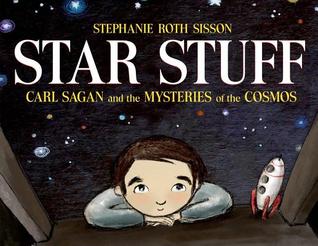
Star Stuff: Carl Sagan and the Mysteries of the Cosmos by Stephanie Roth Sisson

Share

Star Stuff: Carl Sagan and the Mysteries of the Cosmos
Author: Stephanie Roth Sisson
Published: October 14, 2014 by Roaring Brook Press

A Guest Review by Brittany Brown

Summary: A curious boy living in a small city apartment finds the world astonishing. He wants to know about light bulbs, inch worms, and rocket ships. Carl sets out on a journey to find answers, but finds bigger, even more powerful questions. Through his research and studies, Carl eventually earns the title of Dr. Carl Sagan and spends his life seeking knowledge and understanding about the universe. This young

boy’s contributions to science and education have inspired many children everywhere to question the world around them. His story will resonate every child who has ever wondered “how” or “why” or spent an evening looking up at the night sky.

Review: I am constantly looking for books which will inspire my students and get them excited about learning. This book, which is brought to life with beautiful illustrations and the great mysteries of the universe, did that for myself as an adult, too. After reading it, everyday life is once again imbued with the magic and novelty it had in childhood. In Sagan’s eyes, there is no phenomenon too mundane to investigate. The curiosity which most adults leave behind drove Sagan to be the lifelong learner that all teachers hope to foster in their students. Reading this book shows that science is all around us, that we all belong here in the universe, and that in everyone there is a scientist. I absolutely loved reading this book, and as a new teacher building my classroom library, this is the first one which I will be purchasing multiple copies of to share with my students.

Teachers’ Tools for Navigation: This story would pair well with any science or biography unit. It would also serve as a great example of narrative nonfiction.

The most obvious use for this story is in a science unit. I would love to use this book to open up a discussion at the beginning of a unit on the solar system. Not only would it generate excitement, it would also begin to build some vocabulary and background knowledge. It would make the information in the unit more personal and relevant to kids, and would be a great launching point to encourage students to come up with their own questions about how the world works.

This book is also a wonderful book to use for mini lessons in writing. Using this book as an example, a teacher could lead a discussion on how to choose which life events to include in a biography, how to sequence and organize it, and how to incorporate quotes from a historical figure into a writing piece. It also shows how to include facts and achievements in an engaging way, and how to demonstrate a person’s impact on history.

Finally, this book would also be a superb example of narrative nonfiction. Despite containing lots of scientific facts, it reads like a storybook and the illustrations do much of the talking. Students will be captivated with the descriptive narration, and discussions could explore their experiences as readers or how they may be able to attempt this style in their writing.

Discussion Questions: What are your big mystery questions? Where would you go to try to find answers to them? What character traits helped Carl on his journey? What impact did he have on the world? Who does he remind you of?

Book Trailer: 

Read This If You Loved: What Do You Do with an Idea? By Kobi Yamada, I Wonder by Annaka Harris, You Are Stardust by Elin Kelsey, On a Beam of Light: A Story of Albert Einstein by Jennifer Berne, The Boy Who Loved Math: The Improbable Life of Paul Edros by Deborah Heiligman, Look Up!: Henrietta Leavitt, a Pioneering Woman Astronomer by Robert Burleigh

Recommended For:
 classroomlibrarybuttonsmall

Thank you, Brittany!

RickiSig

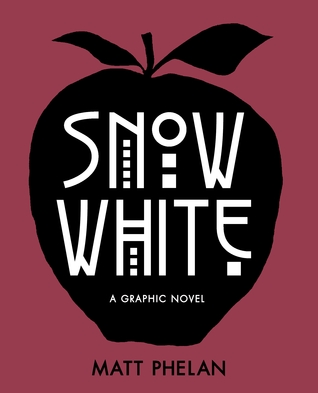
Snow White: A Graphic Novel by Matt Phelan

Share

Snow White: A Graphic Novel
Author: Matt Phelan
Published: September 21, 2016 by Candlewick

A Guest Review by Emily Baseler

GoodReads Summary: Award-winning graphic novelist Matt Phelan delivers a darkly stylized noir Snow White set against the backdrop of Depression-era Manhattan.

The scene: New York City, 1928. The dazzling lights cast shadows that grow ever darker as the glitzy prosperity of the Roaring Twenties screeches to a halt. Enter a cast of familiar characters: a young girl, Samantha White, returning after being sent away by her cruel stepmother, the Queen of the Follies, years earlier; her father, the King of Wall Street, who survives the stock market crash only to suffer a strange and sudden death; seven street urchins, brave protectors for a girl as pure as snow; and a mysterious stock ticker that holds the stepmother in its thrall, churning out ticker tape imprinted with the wicked words “Another . . . More Beautiful . . . KILL.” In a moody, cinematic new telling of a beloved fairy tale, extraordinary graphic novelist Matt Phelan captures the essence of classic film noir on the page—and draws a striking distinction between good and evil.

Review: Matt Phelan reinvented the “happily ever after” with this retelling. I identify as a Disney Classic enthusiast but I was pleasantly surprised with the ending. The illustrations are gorgeous with distinct intentionality. More mature themes such as death, assassination, murder were evaluated within a historical context to create an incredible murder mystery story at the level of a middle grade reader.

Teachers’ Tools for Navigation: This would be an excellent text to hand a more reluctant reader. There is limited text the reader is asked to interpret the illustrations and structure. In literature groups, students could potentially discuss the use of metaphor, oenomania, author/illustrator’s choice, and compare/ contrast the original fairytale with the retelling. This is also a text I would recommend to a student who has shown an interest in the graphic novel genre to read independently.

Discussion Questions: Why do you think the author choose to use red in selected illustrations? How did this choice influence you as a reader?; Why do you think the author choose to break apart the chapters this way?; Even though there were few words, how did you interpret the mood, tone, and voice of characters?; Did you find yourself needing to interpret the illustrations to understand the plot? What was that experience like for you as a reader?; How is this retelling of the classic fairy tale of “Snow White” different than the original? What did you notice is similar?

Flagged Passage: “My name is Snow White, but my mother didn’t call be that to be funny. She would say that the snow covers everything and makes the entire world beautiful” (Ch. 10)

Book Trailer: 

Read This If You Loved: Red: The True Story of Red Riding Hood by Liesl Shurtliff, Jack: The True Story of Jack and the Beanstalk by Liesl Shurtliff, Rump: The True Story of Rumpelstiltskin by Liesl Shurtliff

Recommended For:
 classroomlibrarybuttonsmall

Thank you, Emily!

RickiSig

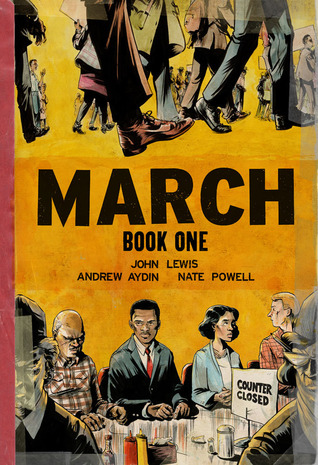
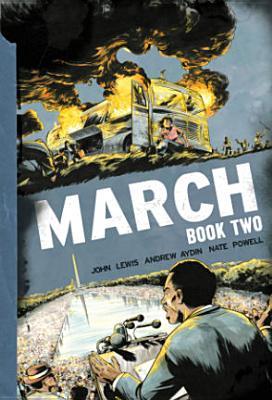
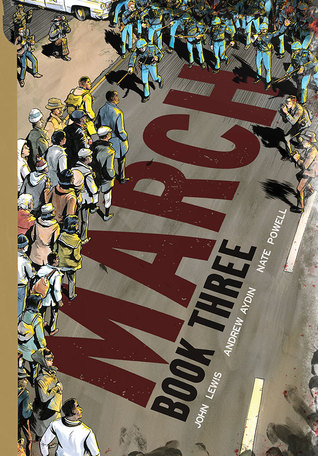
March Trilogy by John Lewis with Andrew Aydin (co-writer) and Nate Powell (illustrator)

Share

nfpb2017

Nonfiction Wednesday

Nonfiction Picture Book Wednesday is hosted by Kid Lit Frenzy and was started to help promote the reading of nonfiction texts. Most Wednesdays, we will be participating and will review a nonfiction text (though it may not always be a picture book).
Be sure to visit Kid Lit Frenzy and see what other nonfiction books are shared this week!

March Trilogy
Author: John Lewis and Andrew Aydin
Illustrator: Nate Powell
Published 2013, 2015, & 2016 by Top Shelf Productions

Summary: Congressman John Lewis (GA-5) is an American icon, one of the key figures of the civil rights movement. His commitment to justice and nonviolence has taken him from an Alabama sharecropper’s farm to the halls of Congress, from a segregated schoolroom to the 1963 March on Washington, and from receiving beatings from state troopers to receiving the Medal of Freedom from the first African-American president.

Now, to share his remarkable story with new generations, Lewis presents March, a graphic novel trilogy, in collaboration with co-writer Andrew Aydin and New York Times best-selling artist Nate Powell (winner of the Eisner Award and LA Times Book Prize finalist for Swallow Me Whole).

March is a vivid first-hand account of John Lewis’ lifelong struggle for civil and human rights, meditating in the modern age on the distance traveled since the days of Jim Crow and segregation. Rooted in Lewis’ personal story, it also reflects on the highs and lows of the broader civil rights movement.

Book One: Begins with John Lewis’ youth in rural Alabama, his life-changing meeting with Martin Luther King, Jr., the birth of the Nashville Student Movement, and their battle to tear down segregation through nonviolent lunch counter sit-ins, building to a stunning climax on the steps of City Hall.

Book Two: After the success of the Nashville sit-in campaign, John Lewis is more committed than ever to changing the world through nonviolence – but as he and his fellow Freedom Riders board a bus into the vicious heart of the deep south, they will be tested like never before. Faced with beatings, police brutality, imprisonment, arson, and even murder, the young activists of the movement struggle with internal conflicts as well. But their courage will attract the notice of powerful allies, from Martin Luther King, Jr. to Attorney General Robert F. Kennedy… and once Lewis is elected chairman of the Student Nonviolent Coordinating Committee, this 23-year-old will be thrust into the national spotlight, becoming one of the “Big Six” leaders of the civil rights movement and a central figure in the landmark 1963 March on Washington for Jobs and Freedom.

Book Three: Fall 1963, the Civil Rights Movement is an undeniable keystone of the national conversation, and as chair of the Student Nonviolent Coordinating Committee, John Lewis is right in the thick of it. With the stakes continuing to rise, white supremacists intensify their opposition through government obstruction and civilian terrorist attacks, a supportive president is assassinated, and African-Americans across the South are still blatantly prohibited from voting. To carry out their nonviolent revolution, Lewis and an army of young activists launch a series of innovative projects, including the Freedom Vote, Mississippi Freedom Summer, and a pitched battle for the soul of the Democratic Party waged live on national television. But strategic disputes are deepening within the movement, even as 25-year-old John Lewis heads to Alabama to risk everything in a historic showdown that will shock the world.

Many years ago, John Lewis and other student activists drew inspiration from the 1950s comic book “Martin Luther King and the Montgomery Story.” Now, his own comics bring those days to life for a new audience, testifying to a movement whose echoes will be heard for generations.

Review: No matter what I say in this review, I am not going to give this trilogy justice. I mean, Book Three won the National Book Award, Sibert Medal, Printz Award, Coretta Scott King Award, YALSA Excellence in Nonfiction, and the Walter Dean Myers Award. And it had SIX starred reviews, Book Two had FOUR starred reviews, and Book One had FIVE starred reviews. That is FIFTEEN between the three! And they all deserve whatever praise or recognition they have received.

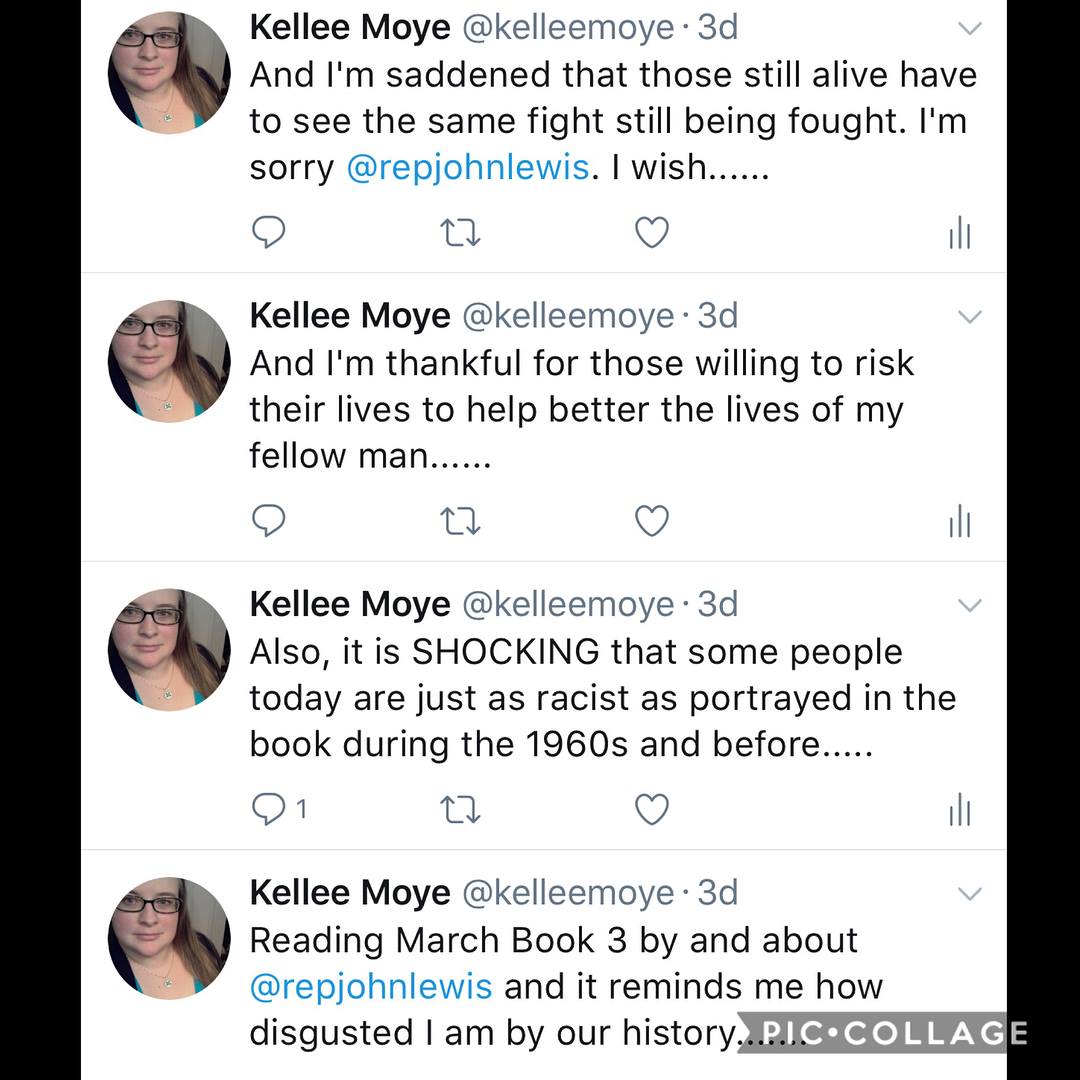
John Lewis’s story included many aspects of the Civil Rights movement I did know about; however, it gives insight into these events that no one else could give us as Lewis is the last of the March on Washington speakers to be with us. It also addresses aspects of the movement that are not taught in history books because it is ugly. Our history is ugly, but that is exactly why it needs to be talked about. There were times when reading where I had to put the book down (especially in Book Three) because this truth was harder to read than just any fiction I’ve encountered. These were my tweets as I was reading (read bottom to top):

But it is because of the shocking nature of our history that we must speak and read and learn about it. We are supposed to keep moving forward, and the only way to make sure we know which way that is, is to learn about what was in the past. John Lewis, with the help of his co-writer Andrew Aydin and the illustrator Nate Powell, have given us a gift with these books. A gift of a look into the past through the eyes of an insider.

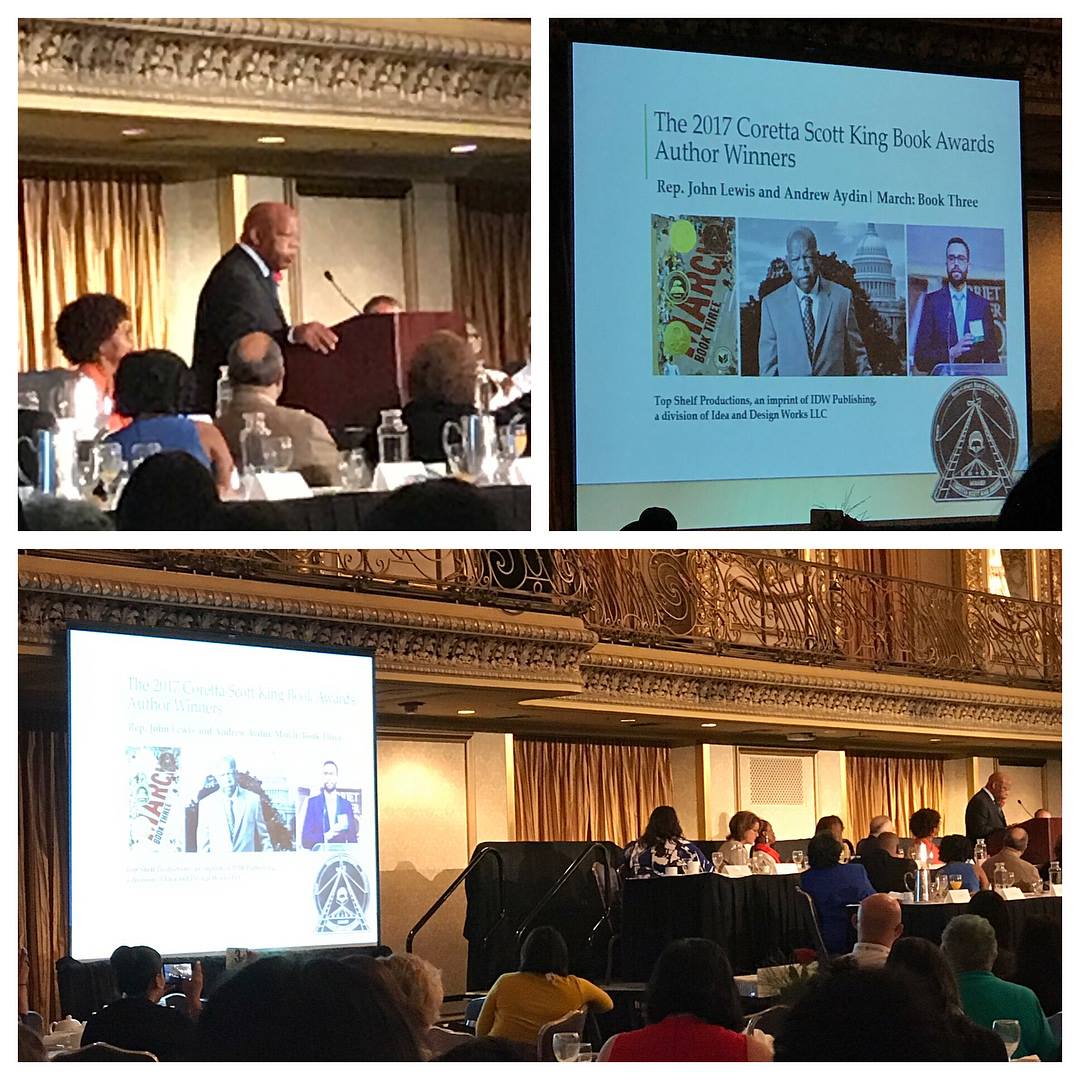
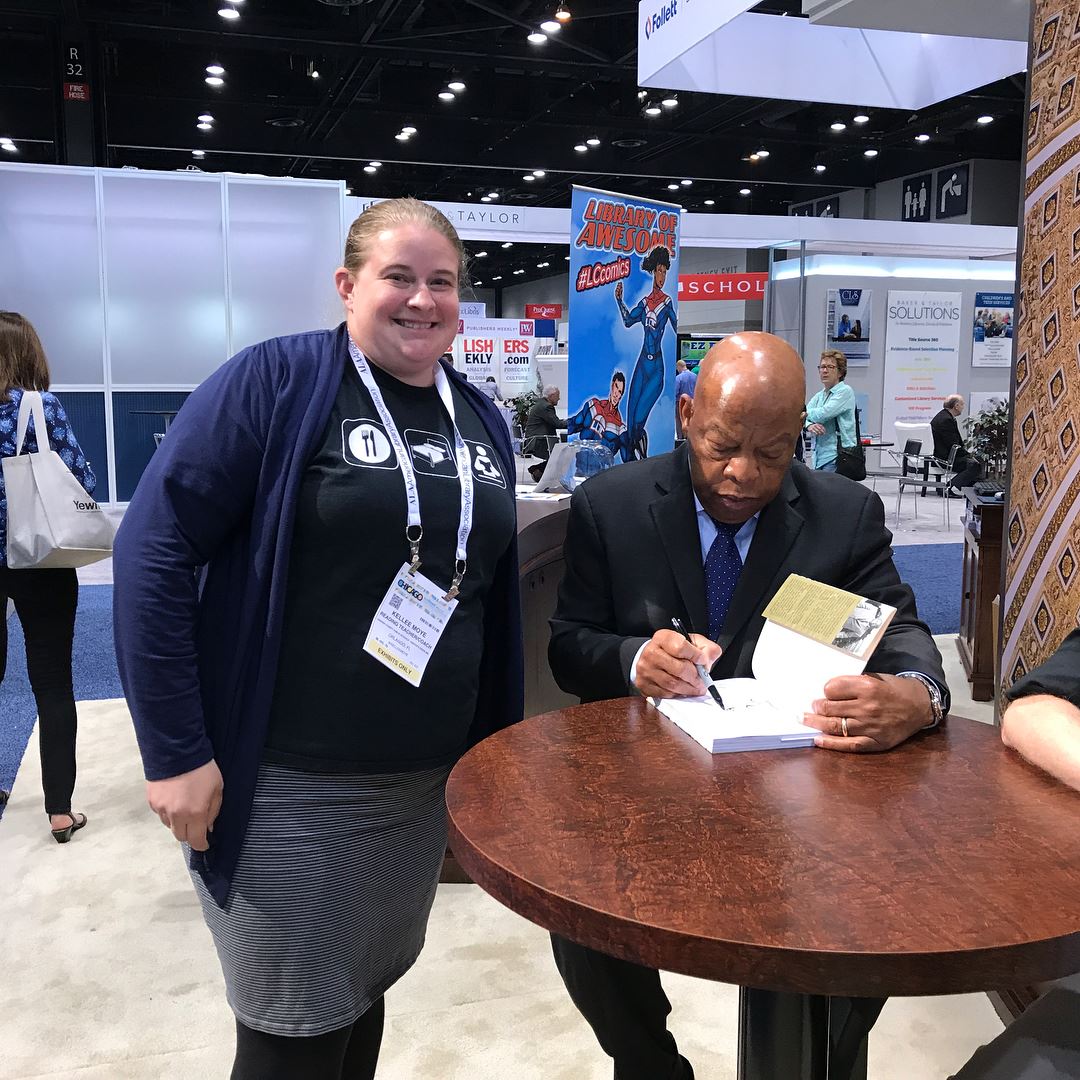
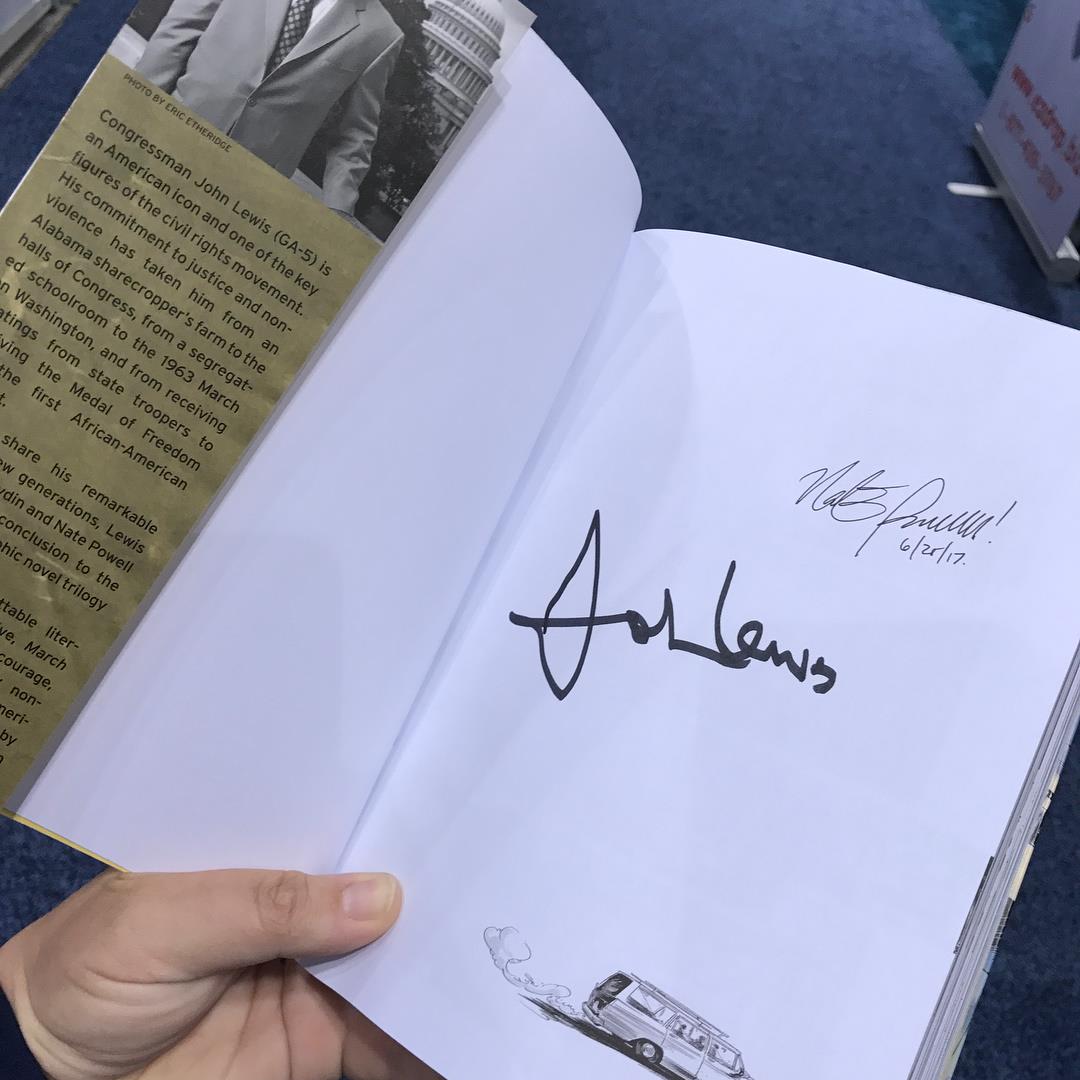
I’d also like to share how amazing it was to see John Lewis at ALA Annual in Chicago! I had the honor of hearing him speak twice: once at the Coretta Scott King Award breakfast and once in the Library of Congress pavilion. I also got to shake his hand (though the picture didn’t come out–boo!), thank him, and get my book signed by him and Nate Powell. I am still in awe of the experience!

Teachers’ Tools for Navigation: PLEASE put these in classrooms! U.S. History teachers, use these as your resource for teaching about Civil Rights. ELA teachers, use these as a nonfiction text in any unit. Anyone with a library for young adults, please put them in your collection. Everyone, read these with a young adult or get them to a young adult. Learning about John Lewis’s truth is how we keep history from repeating itself.

Discussion Questions: 

March Book One Teaching Guide

March Book Two Teaching Guide

March Book Three Example Lesson Plan

Flagged Passages: 

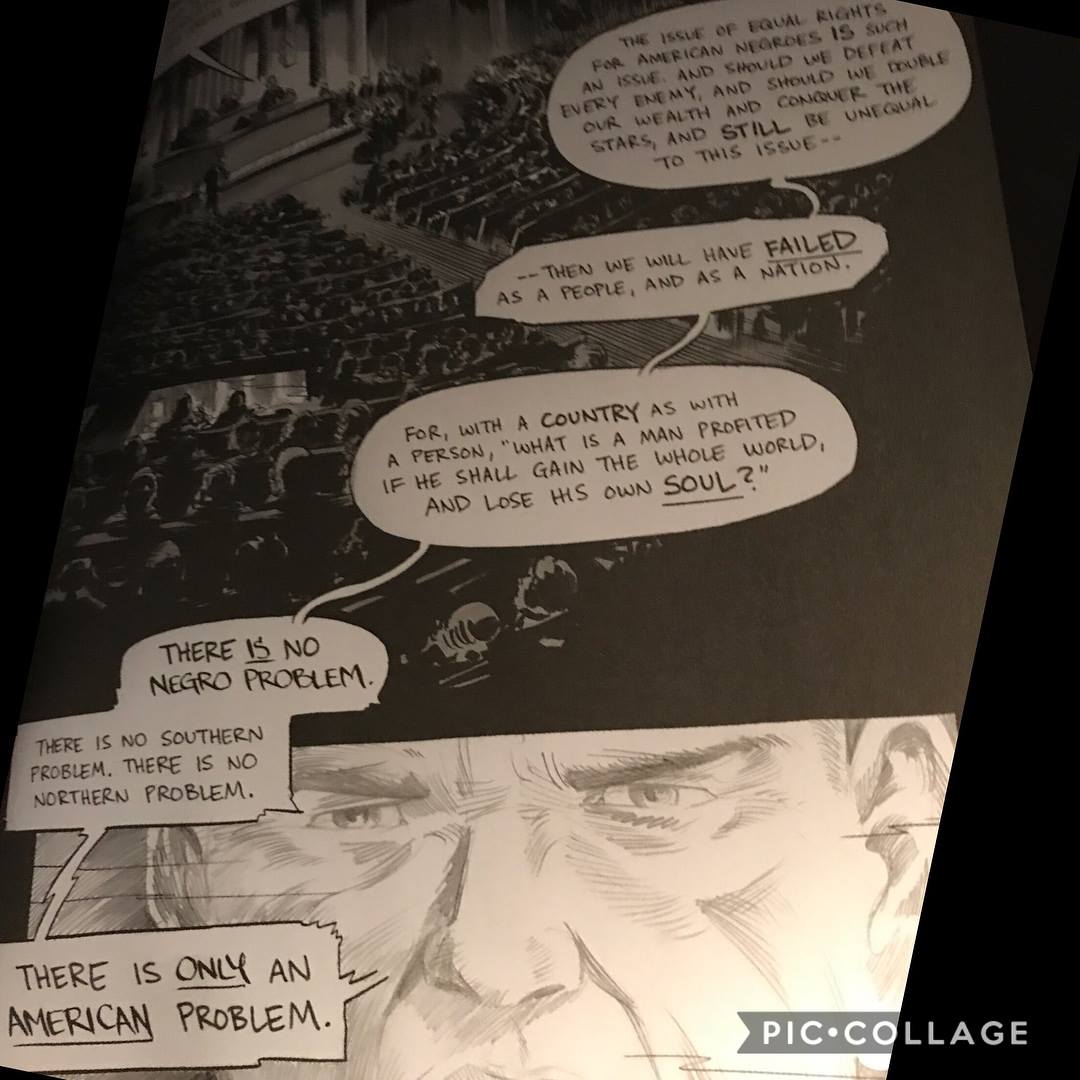
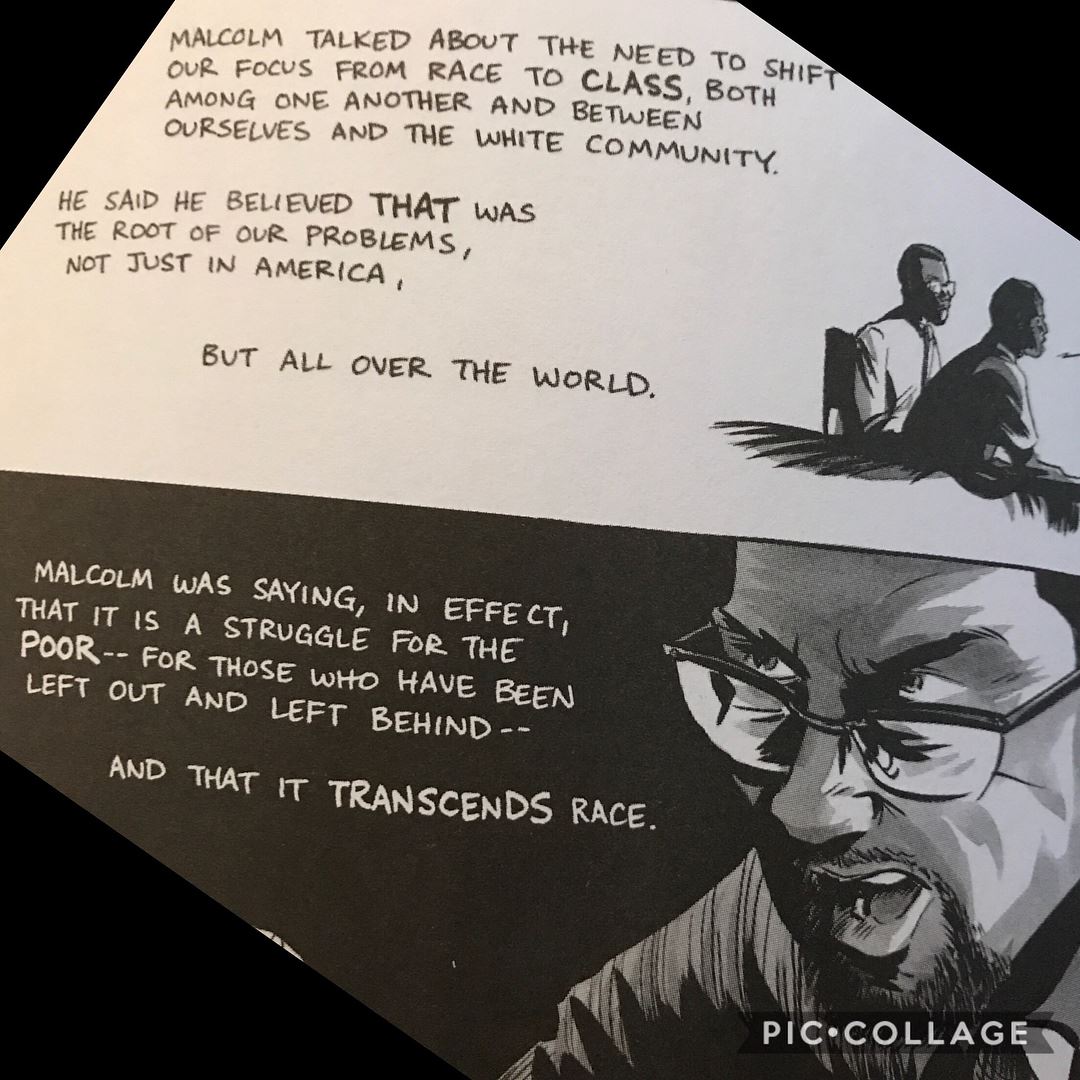
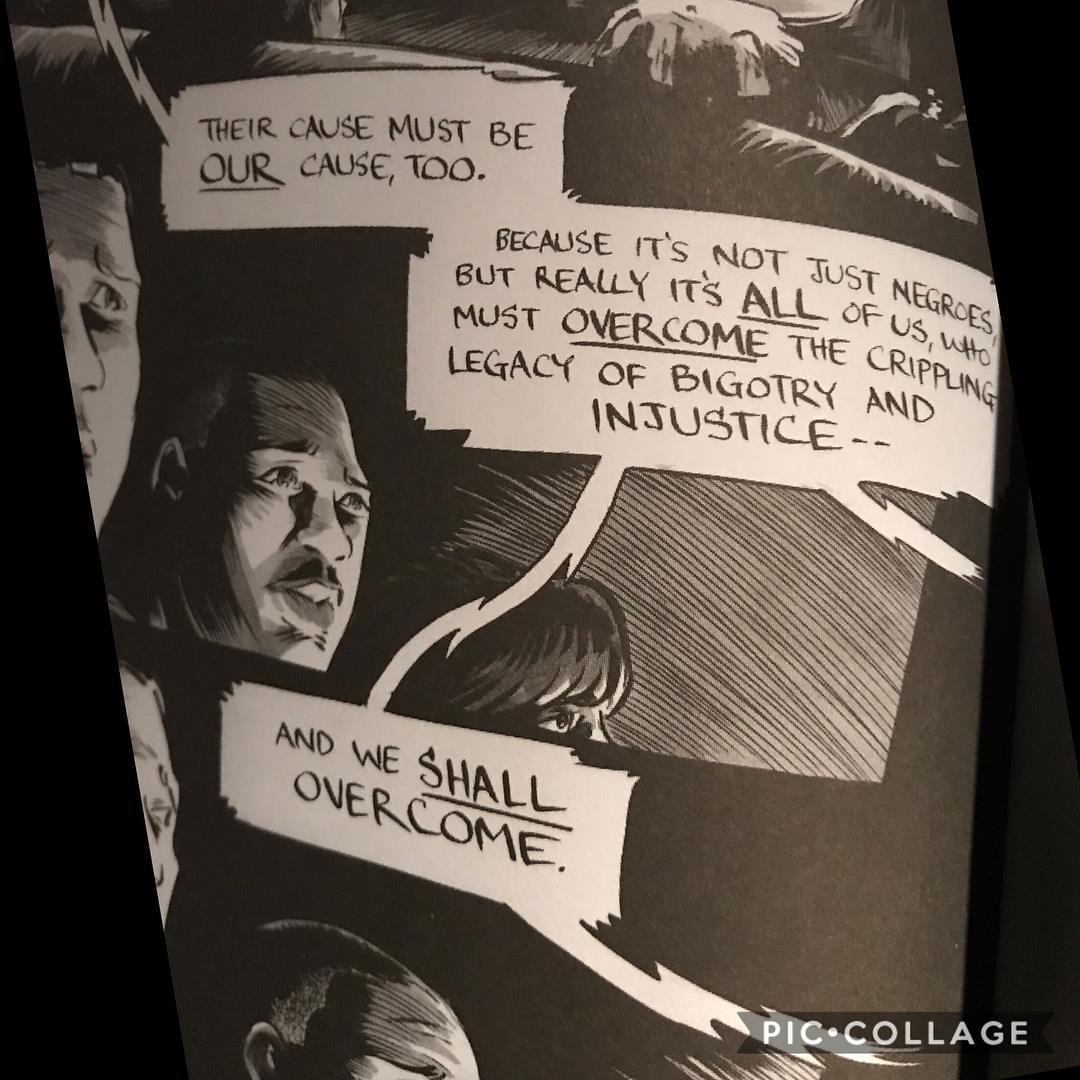
Here are three passages I took photos of because it shocked me how relevant they are to our society today. They may not be the best representation of John Lewis’s narrative; however, they do show the beautiful format and artwork as well as touch on some of the events in Book Three.

Read This If You Love: Just read these. I promise.

Recommended For: 
classroomlibrarybuttonsmall closereadinganalysisbuttonsmall 

Signature

Listen to the U.S. Constitution and Declaration of Independence This Fourth of July #WeThePeopleListen

Share

Penguin Random House Audio Urges Americans to Listen to the U.S. Constitution and Declaration of Independence This Fourth of July

The publisher will offer a free audio stream of both founding documents June 27‒July 31

NEW YORK, NY (June 23, 2017) – We can all agree that the Fourth of July is America’s most patriotic holiday, but how much do we really know about what we’re celebrating? Recent surveys indicate that most Americans lack basic civics knowledge—only 25% of U.S. adults can name all three branches of government, and more than 30% are unable to name even a single branch. This is a significant decline over previous years, according to a survey by the Annenberg Public Policy Center.

The common foundation laid out in the U.S. Constitution and the Declaration of Independence is precisely what unites us as Americans.In this divisive political climate, where debates about checks and balances saturate our daily news cycle, it is crucial that we all understand for ourselves how our government works.

To encourage all Americans to read and appreciate our founding documents, Penguin Random House Audio is joining with award-winning authors and like-minded partner organizations, including PEN America and the National Coalition Against Censorship, to stream audio recordings of both the U.S. Constitution, narrated by Boyd Gaines, and the Declaration of Independence, narrated by Frank Langella, under the banner “We the People Listen.”

On Tuesday June 27, numerous partner organizations and bestselling authors will support this inclusive campaign by sharing a link to the audio stream, using #WeThePeopleListen.

“For many of us, it’s been years, if at all, since we’ve read the Constitution or the Declaration,” says Amanda D’Acierno, SVP and Publisher, Penguin Random House Audio. “Taking a little time this early summer to listen to these talented narrators bring the text alive is something we all need to do as we celebrate Independence Day this year.”

Listeners can stream the recording of both the U.S. Constitution and the Declaration of Independence until July 31 atwww.penguinrandomhouseaudio.com/wethepeoplelisten.


About the Declaration of Independence:

We hold these truths to be self-evident, that all men are created equal…

Drafted by Thomas Jefferson in 1776 as an act of rebellion, the Declaration of Independence powerfully expresses the political principles of an emerging nation. As justification for severing ties with England, the Declaration of Independence presented a list of grievances against the King and declared the colonies to be sovereign states.

About the U.S. Constitution:

We the People of the United States, in Order to form a more perfect Union, establish Justice, insure domestic Tranquility, provide for the common defence, promote the general Welfare, and secure the Blessings of Liberty to ourselves and our Posterity, do ordain and establish this Constitution for the United States of America.…

Ratified in 1788, the U.S. Constitution remains a shining example of patriotism and compromise. In outlining the power of the three branches of government and establishing the rights of all Americans, the Constitution united the thirteen independent states and set forth the official viewpoint of a newly unified nation. Its most significant and insightful feature is that it can always be amended.

About Penguin Random House Audio:

As the premier publisher in the audiobook industry, Penguin Random House Audio is dedicated to producing top-quality fiction and nonfiction audiobooks written and read by the best in the business, including books by bestselling authors John Grisham, Dan Brown, Janet Evanovich, Kathryn Stockett, Khaled Hosseini, J.K. Rowling, and Rick Riordan, as well as Presidents Barack Obama, George W. Bush and Bill Clinton. Our audiobooks have won 14 Grammy® Awards, 74 Audie® Awards, and 17 Odyssey Awards and Honors. Random House Audio, and its sister imprints Penguin Audio, Listening Library and Books on Tape, are a division of Random House LLC, a Penguin Random House Company.

Teaching Guide for Hazardous Tales: Alamo All-Stars by Nathan Hale

Share

nfpb2017

Nonfiction Wednesday

Nonfiction Picture Book Wednesday is hosted by Kid Lit Frenzy and was started to help promote the reading of nonfiction texts. Most Wednesdays, we will be participating and will review a nonfiction text (though it may not always be a picture book).
Be sure to visit Kid Lit Frenzy and see what other nonfiction books are shared this week!

Hazardous Tales: Alamo All-Stars
Author and Illustrator: Nathan Hale
Published March 29th, 2016 by Abrams Books

Summary: “Remember the Alamo!” That rallying cry has been a part of Texas lore for generations. But who were the ragtag group of adventurers behind the famous slogan, and how did they end up barricaded in a fort against a Mexican army? Who survived, who died, and how? This sixth book in the bestselling Hazardous Tales series tracks the Lone Star State’s bloody fight for independence from the Mexican government. It features the exploits of the notorious Jim Bowie, as well as Stephen Austin, Davy Crockett, and other settlers and soldiers who made the wild frontier of Texas their home—all told with the inimitable style and humor for which Nathan Hale is known.

Teaching Guide with Discussion Questions and Activities from Abrams by ME!, Kellee Moye: 

How to use this guide

  • For Alamo All-Stars, opportunities to have discussions and complete activities across different content areas are shared. In the “Fun Across the Curriculum” section, these activities and discussion questions are split into subject areas and are written as if they are being asked of a student.
  • At the end of the guide, Common Core State Standards and Next Generation Science Standards are listed that can be met when the books are extended using the activities and discussion questions.

Fun Across the Curriculum

  • Language Arts
    • The title page and the cover show two different illustrations of the Alamo. Compare and contrast the illustrations. Using information from the text, when is the cover illustration from, and when is the title page illustration from?
    • Why would Alamo All-Star need two narrators, Nathan Hale and Vincente Guerrero, while all of the other Hazardous Tales books only needed Hale? How would the story have differed if only Hale had narrated the book? What about only Guerrero?
    • On page 10-11, Guerrero uses the metaphor of a set table to describe Texas in the 1820s. Why does he use this metaphor to describe the state of Texas at this time?
    • On page 18, Hale uses another metaphor of an explosive barrel to illustrate the situation Austin and his settlers were in. How does an explosive barrel and Austin’s situation relate to each other?
    • After researching cholera (science section), look at Hale’s personification of the disease on page 37. Why did he choose this creature to embody cholera?
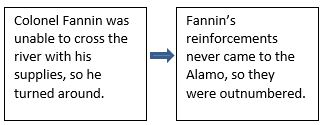
    • Many different events and problems caused Santa Anna’s army to be able to easily defeat the Texans at the Battle of the Alamo. Create a cause/effect graphic organizer showing the correlation between different events leading up to the Battle of the Alamo and the fall of the Alamo.
      • For example:
    • Much of what happened at the Alamo during the infamous battle as well as stories about Davy Crockett and Jim Bowie have become an American legend. What is a legend? Why has some parts of the story of the Alamo become a legend and not a complete factual part of history?
    • Throughout the book, Hale includes direct quotes from primary sources. How do these quotes enhance the story? How are primary sources more reliable when sharing historical events than secondary sources?
  • History/Social Studies
    • The page of Texas on the end sheets shares the different battles during the Texas revolution. Using Alamo All-Stars, convert the map into a timeline by graphing each battle on the date/year they were fought.
    • Using the text feature on pages 10-11 that shared the 1820s Texas settlers, answer the following: how did each settler threaten each other? Why was Texas such a treacherous place at this time? Who was the rightful settler of Texas?
      • Then, split the class up into 8 groups and assign a group of settlers to each group of students. They then should research the group, and determine how they ended up in Texas, why they felt they deserved to stay in Texas, etc.
    • Page 12 defines a filibuster and gives an example of one. What other famous filibusters have happened in history? Use the Wikipedia article “Filibuster (military)” and its resources to learn about other filibuster expeditions. Unlike the James Long Expedition, were any successful?
    • Throughout the book, Mexico goes through different types of governments: a monarch (inferred from p. 16), a republic (mentioned on p. 17), and a despotic (mentioned on p. 40). Compare and contrast the similarities and differences of the different types of governments.
    • Page 88 shows one of the many flags that have flown over Texas. Using the Texas State Historical Information article “Flags of Texas” and the Flags of the World website, learn about all of the different flags that Texas has flown. Why have so many flown over Texas? Where does the phrase “six flags of Texas” come from?
    • On page 104, Santa Anna compares himself to Napoleon. How are the two men similar? How do they differ?
    • On page 113, Hale jokes, “Don’t feel bad. Everyone forgets about Goliad.” Why do you think the Battle of the Alamo is remembered by so many while the massacre at Goliad is not?
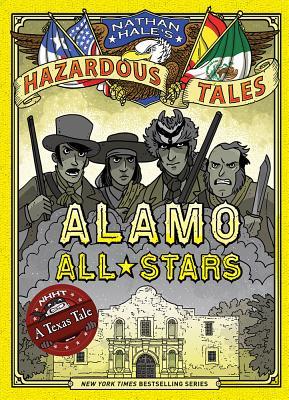
    • Why are Travis, Seguin, Bowie, and Crockett pictured on the front of Alamo All-Stars? Is this who you would consider the all-stars of the Alamo? If not, why not? If so, what did they do to deserve that title? Is there anyone else you would consider an Alamo all-star?
  • Science
    • Cholera killed tens of thousands in the summer of 1833 including Bowie’s wife and her family. What is cholera? How does it spread? Why did Bowie’s family try to travel north to escape it?
    • On page 47, Noah Smithwick was quotes sharing that one member of the Gonzales army had a nose bleed; however, he used scientific terms such as nasal appendage and sanguinary fluid. What do these terms mean?
  • Math
    • On page 31, Rezin Bowie mentions that they were outnumbered 14 to 1 during the battle. Using the illustrations and clues in the “Jim Bowie and the Lost Mine” section to determine how many men were on Bowie’s side and how many men they fought and defeated.
    • Santa Anna’s army outnumbered the Texans by a large amount. Using the information shared about the number of men in each side of the battle, determine an approximate ratio of the battle.
      • After you estimate using Alamo All-Stars, research the actual number of men at the battle and determine the ratio. How close was your estimate?
  • Foreign Language (Spanish and French)
    • Throughout the text, different Spanish words are used, many of which can be defined using context clues or connecting to the English language because they are cognates with a word you already know. Look through the book, and try to define all foreign language vocabulary. Some words throughout the book:
      • El Gran Libro Enorme de la Historia Mexicana (p. 6)
      • ejercito de las tres garantias (p. 9)
      • empresario (p. 12)
      • mucho (p. 16)
      • viva la revolución (p. 21)
      • fantástico (p. 31)
      • Dios y libertad (p. 36)
      • alcalde (p. 45)
      • fandangos (p. 72-84)
      • voy a firmarlo (p. 98)
      • mes amis (p. 103 | French)
        • Which words were easier to define? Why were they easier?
  • Music
    • At the Battle of the Alamo, both Santa Anna’s army and the Texas army played music (p. 91). Research to determine what music was played at the battle. Why would they play music while preparing for a battle?

The teaching guide, along with the other books in the series, can also be viewed at: https://www.scribd.com/document/326377929/NathanHale6-TeachingGuide or http://www.abramsbooks.com/academic-resources/teaching-guides/

Recommended For: 
classroomlibrarybuttonsmall closereadinganalysisbuttonsmall 

Signature