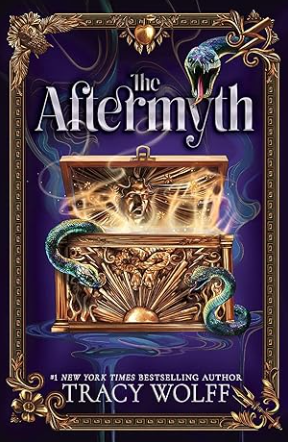
The Aftermyth by Tracy Wolff

Share

The Aftermyth
Author: Tracy Wolff
Published February 3rd, 2026 by Aladdin

Summary: In a world ruled by the tenets of Greek mythology, one girl’s fate is more than it appears in the first book in a new dark academia fantasy middle grade series from #1 New York Times bestselling author of the Crave series Tracy Wolff.

What’s your myth?

Penelope Weaver has spent her whole life preparing to attend Anaximander’s Academy, where students learn how to bring to life the stories of Greek mythology as well as discover the Greek god whose principles they most embody. Penelope knows she’s an Athena—all smart, practical, and rule-following girls who take part in stories that matter are Athenas.

But when Penelope and her twin brother Paris arrive at Anaximander’s, it appears fate has other plans. Penelope isn’t placed with Athena but with students who are anything but practical and who prefer parties to rules. And that’s just the beginning. She’s given the world’s worst muse, her assigned tasks feel impossible, and the magic of Anaximander’s is overwhelming. Not to mention, there are two very different boys making her new life even more confusing.

But as things go from bad to dangerously worse, one thing becomes in a world where everything is fated to happen a certain way, some stories need to be rewritten. As the world around her shifts and cracks, Penelope is asked to forget everything she thought she knew to help create a better story…even if that changes every plan and breaks every rule.

About the Author: Tracy Wolff is the #1 New York Times, #1 internationally, #1 Wall Street Journal, and USA TODAY bestselling author of the Crave series as well as many other novels. A lover of mythology, vampires, and getting lost in a great book, she’s spent her whole life asking “what if” and “what happens next”—questions being a writer has helped her answer again and again. At six, she wrote her first short story—something with a rainbow, a unicorn, and a shapeshifting prince—and at seven, she forayed into the wonderful world of middle grade literature with her first Judy Blume novel. A one-time English professor, she now devotes all her time to writing fun, action-packed, romantic stories with fantastical worlds and characters who leap off the page. She has written all her seventy-plus novels from her home in Austin, Texas, which she shares with her partner, her sons, and their three adorable dogs.

Review: There is so much that go on in this book, but I love that the author started directly with character development of Penelope followed by a wild event that helped the reader get to know the protagonist while also devleoping the plot. And this trend continues–each event allows the reader to get to know Penelope more while also moving along the plot simultaneously. It keeps the reader wanting to turn the page. The book has a quote: “Sometimes the goal isn’t really the point. Sometimes it’s how you get there that’s important.” This encompasses the book and Penelope’s journey.

This book is the exposition to a series that I look forward to following. I do have a lot of questions still about what is going on and why the mythology is how it is, so be ready for an open ended ending and so many questions swirling around in your head!

Educators’ Tools for Navigation: There is so much I wanted to do with this book!

  • Each god/goddess’s building has a banner, and it would be so much fun to have students make banners (after sorting them, of course!).
  • There are so many myths mentioned in the book: Hercules, Pandora, Muses, and Prometheseus specifically, so the parts that mention these would be great to look at when also reading the myths.
  • One main point of the book is looking at the point of view of myths, specifically Pandora in this book. Who is telling the myth? Who were those in power when the myth was written? How could the myth have been different when from another’s point of view?
  • The book also looks at how there are different versions of myths which is a great opportunity to talk about oral tradition and how stories were passed around before text.
  • I love the focus on constellations in the book and would be a fun way to have a science/oral tradition lesson!
  • Lastly, Fifi’s muse has pun-y muse shirts, and it would be so much fun to have students make their own.

Discussion Questions: Provided by Simon & Schuster (this is just a sample of the discussion questions on the reading guide; visit The Aftermyth page on Simon & Schuster):

  • 1. Describe Penelope’s family and background. What are her parents like? What is her social life like before the book opens? Why do she and Paris end up going to Anaximander’s Academy?
  • 2. Why is Penelope uncomfortable when Fifi starts to call her Ellie? What is Penelope’s image of herself and why is it important to her? Why is she anxious when Fifi wants to decorate the apple in front of Aphrodite Hall?
  • 3. How does Penelope grow throughout the story? Contrast her self-image and her values at the beginning of Aftermyth to how she is at the end.
  • 4. What is Penelope’s relationship like with her twin brother, Paris? In what ways are they close? How are they alike, and how are they different? How does their relationship change during their time at Anaximander’s? Who is Rhea, what is she like, and what role does she play in the changes between Penelope and Paris?
  • 5. What are some examples of Penelope’s courage and leadership? How does she deal with the eagle in Dr. Minthe’s class? Later, during that class, how does she help others when her group is looking for the key to the door? (Chapters 27–37)
  • 6. What is the purpose of Anaximander’s Academy? Describe the five halls, the gods to which they are each dedicated, and how the halls are different in spirit. Which hall does Penelope hope and expect to join? Which one does she end up in?
  • 7. On the way to Anaximander’s, Penelope and her family meet PT. What is he doing? How does he respond to Penelope blowing out the lantern fire? Who does PT turn out to be in Greek mythology? What is his role in the story about Pandora’s box? What effect do Penelope’s actions have on him and his story?
  • 8. How does Penelope initially feel about Fifi? Why does Fifi become, according to Penelope, “the best friend I’ve ever had”? (Chapter 41) What do they have in common? How are they different? How do they help each other?
  • 9. Describe Fifi’s personality and style. Discuss her statement about herself, “‘I’m not good at much except directions and people.’” (Chapter 20) What are examples that show she is right about her strengths? What else is she good at? When does she show leadership? Explain why Penelope thinks, “I’ve learned that Fifi is a force of nature.” (Chapter 38)
  • 10. What role do muses serve at Anaximander’s? What is Fifi’s muse, Frankie, like? How do they get along? Contrast Frankie with Penelope’s muse, Calliope. What is Calliope like? What is her role in Greek mythology? When do the muses help their students?

Flagged Passages: Read a sample of this book on its Amazon page.

Read This If You Love: Greek mythology

Recommended For: 

classroomlibrarybuttonsmall 

Signature

**Thank you to the publisher for providing a copy for review!**

The Case of the Scarlet Snakebite by Christyne Morrell

Share

The Case of the Scarlet Snakebite
Author: Christyne Morrell
Published February 24, 2026 by Delacorte Press

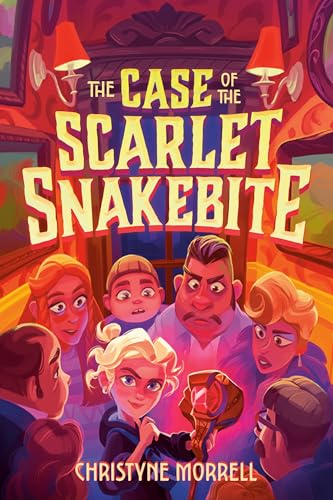
Summary: In this middle-grade mystery, a twelve-year-old obsessed with Agatha Christie suspects every guest at her mother’s bed-and-breakfast of hiding secrets. That is until a real crime rocks the quaint B&B, and her mother is framed for it.

When the wealthy Willoughby family checks into her mother’s bed-and-breakfast for the weekend, Amber Adler is certain a crime is going to be committed right under their roof. And she should know—she’s read every Agatha Christie novel in the library and her father is a world-famous detective. Sure, Amber has made a few false accusations (and once got the SWAT team sent to her math teacher’s house), but this time, she’s positive that one of their guests is up to no good.

So it comes as no surprise to Amber when someone steals a priceless ruby belonging to the crotchety Willoughby patriarch. But what she didn’t expect was for her mother to be framed for it. Now, Amber must call on everything she knows about solving mysteries to find the stone and catch the real culprit before the family checks out—and learn that sometimes, people are the greatest mystery of all.

About the Author: When she’s not writing for kids, Christyne Morrell is busy raising one. She is a corporate attorney, and in her spare time enjoys reading, baking, and watching House Hunters marathons. She lives with her family in Decatur, Georgia. Kingdom of Secrets is her debut novel. Visit her online at christynewrites.com and follow her on Twitter and Instagram @christynewrites.

Review: Amber is always looking for crimes to solve, even when there is no true crime, but when she overhears a phone conversation about a crime by someone staying at her bed and breakfast, she knows this time there is truly a crime, and she is going to be the one that solves it. But this crime is different than she guessed but still full of twists & turns.

My middle schoolers are always looking for murder mysteries, but so many of them are teen; I am so glad that there are more and more middle school ones coming out, including this one. A truly fun middle grade mystery!

Educators’ Tools for Navigation: This book has so much that educators can use to expand on it!

First, I love that the author/publisher included a suspect tracker in the end. I WISH I had noticed it at the beginning because I would have loved to have utilized it, so I want to make sure educators know about it because it would be so much fun to take notes along with Amber.

Second, there are so many fun word play times throughout the book. For example, Amber would hear “betrayal” when it was actually “bee trail.” There would be some fun word games that you could do with this.

Lastly, with Amber being obssessed with Agatha Christie, there were definitely allusions to Christie’s work throughout.

Discussion Questions: 

  • What predictions did you make while reading? What clues made you make these predictions? Were your predictions correct?
  • Do you think Amber’s mom has justification to be upset with Amber throughout the book?
  • What do you think is the biggest mistake that Amber made throughout her investigation?
  • Why do you think Amber didn’t want a sidekick?
  • Why do you think E.B. trusted Amber so much?
  • Do you think Amber really thought her father was a investigator like Sherlock Holmes or do you think she had tricked herself into believing it?

Flagged Passages/Spreads: 

Chapter 1
Friday, 12:00 p.m.
(16 hours earlier)

I nudge the door open, and it releases a long, slow wail. This building is hundreds of years old, and it acts its age—­everything creaks and moans and rattles. Everything makes a fuss. But all that racket makes my job easier, so I can’t complain.

I’m wearing all black, down to my ballet flats. The only glint of color comes from the gold name tag pinned to my shirt with Amber Adler etched in block letters. I creep silently into the room and flit from place to place, my toes barely grazing the floor as my eyes dart around, taking in every detail—­the disheveled bed, the damp towels strewn on lampshades, the bottles littering the desk, leaking sticky puddles of who-­knows-­what onto the antique wood.

I unzip the black faux leather pouch around my waist and remove a pair of latex gloves. I slide them onto my hands one at a time, snapping them at the wrists to make sure they’re good and tight. They release a puff of sterile powder into the air. I run a fingertip over every surface—nightstands, doorknobs, windowsills—­then examine the residue in the light. Messy, yes. But not criminal.

I make my way into the adjoining bathroom. Like the rest of the place, it’s in disarray. I shake my head, and as I do, something near the floorboards catches my eye. The light spilling out of the vintage sconces glints off a shard of metal.

“Well, well, well,” I mutter to myself. “What do we have here?”

I crouch down for a closer look. The object is small but incredibly sharp. I count four blades jutting from its squat handle, each one angled and gleaming. I know I shouldn’t smile—­not in the midst of an active crime scene—­but I can’t help myself. From my pouch, I remove a plastic evidence bag with a ziplock top. I carefully pluck the weapon from the floor and drop it inside. “Gotcha.”

I rise and spin on my heel, prepared to disappear as silently as I’d arrived. But first, for a split second, I’m confronted by my own reflection in the bathroom mirror—­reddish-­blond hair scraped back into a messy bun, with escaped strands waving around my face like Medusa’s serpents; an all-­black ensemble designed to escape notice; and permanently narrowed eyes overshadowed by two thick brows known to have a life of their own. It’s a good thing I work in the shadows.

And then I see something else in the reflection—­or rather, I don’t see something in the reflection—­and my eyes grow wide as I realize what’s missing. “Eep!” I squeal louder than I should. But that doesn’t matter now. The time for sneaking around has passed. On to my favorite part: the big reveal.

I burst out of the room and onto the landing at the top of the stairs. My entrance gets everyone’s attention, as it’s meant to. At the bottom of the staircase, three heads turn to face me, all wearing matching looks of confusion. I barrel toward them, not caring anymore if the decrepit wood snaps, crackles, and pops with every step.

“Amber?” says Mom. Her brief moment of confusion has passed. Now she’s giving me a silent warning with her eyes. Not again, she’s saying without saying it.

Excerpted from The Case of the Scarlet Snakebite by Christyne Morrell. Copyright © 2026 by Christyne Morrell

Read This If You Love: Secrets of the Broken House and all books by Taryn Souders, The World’s Greatest Detective by Caroline Carlson, Undercover Latina bby Aya de León, Shirley and Jamila Save Their Summer by Gillian Goerz

Recommended For: 

classroomlibrarybuttonsmall 

Signature

**Thank you to the author for providing a copy for review!**

Sofia’s YA Book Nook: The Lost Year by Katherine Marsh

Share

Sofia is a 13-year-old brilliant reader who aspires to be a book reviewer. Since she was 8 years old, on select weeks, Sofia shares her favorite books with other young people her age! She is one of the most well-read youth that we know, so she is highly qualified for this role!


Dear readers,

Let me introduce you to The Lost Year by Katherine Marsh, an incredibly moving historical tale about the story of three girls during the Ukrainian Holodomor. I picked this book off of the Nutmeg shelf at my local library, which is an award they give to children’s all the way to high school books in Connecticut. There are a few books selected each year in every age category and they tend to be great reads, but this time, I was not ready for the whirlwind of emotions that followed picking this book off the shelf. It is told in three perspectives, Mila, Helen, and Matthew. One day during COVID, Matthew is ordered by his mom to stop playing video games and to help his great grandmother declutter some of the boxes she has in her room. Matthew just wants to play on his Nintendo Switch but after realizing that isn’t an option, he reluctantly agrees to help. His grandmother has never really talked much about her life and all he knows is that she almost starved in some Ukrainian famine but as soon as he opens the first box, he learns much more. The past is told by Mila, who is the daughter of a Ukrainian Oligarch and Helen, who lives in New York as the daughter of Ukrainian immigrants. Both girls are living in the 1930’s while Ukraine was a part of the Soviet Union, which is where Mila lives. It was so exciting and heartbreaking to watch their stories unravel, I hope you read this important historical tale.

Goodreads Summary

A middle-grade survival story that traces a family secret back to the Holodomor, a terrible famine that devastated Soviet Ukraine in the 1930s. Thirteen-year-old Matthew is miserable. His journalist dad is stuck overseas indefinitely, and his mom has moved in his one-hundred-year-old great-grandmother to ride out the pandemic, adding to his stress and isolation. But when Matthew finds a tattered black-and-white photo in his great-grandmother’s belongings, he discovers a clue to a hidden chapter of her past, one that will lead to a life-shattering family secret. Set in alternating timelines that connect the present-day to the 1930s and the US to the USSR, Katherine Marsh’s latest novel sheds fresh light on the Holodomor – the horrific famine that killed millions of Ukrainians, and which the Soviet government covered up for decades. Inspired by Marsh’s own family history.

My Thoughts

Wow, wow, wow, that is all I can say after reading this masterpiece. This is a book about a horrible time but the story is told beautifully. I usually don’t cry when I read a book, even if they are really sad but I shed a few tears at the end of this novel. So many unexpected things happen and you find yourself on the edge of your seat the entire time, hoping that the characters will be okay. Marsh NAILED Mila’s perspective, making us understand how blinded by Soviet propaganda Mila was. Before this book, I had never even heard of the Holodomor, and it is so powerful that The Lost Year brings to light this disgusting period of human history, which everybody should know about.

Also, heads up, you should read the Author’s Note because it just makes the story so much more special and important. All in all, I think The Lost Year is a book everybody should read because of the beautiful writing and gripping story. I hope you enjoy this book!

I would recommend this book for ages 13+ because of the difficult topics including death, genocide, the Soviet Union and grief.

**Thanks so much, Sofia!**

Werewolf Hamlet by Kerry Madden-Lunsford

Share

Werewolf Hamlet
Author: Kerry Madden-Lunsford
Published February 18th, 2025 by Charlesbridge Moves

Summary: Humor, heart, and Shakespeare abound in this middle-grade novel about Angus, a 10-year-old theater fanatic, his struggling family, and his changing relationship with big brother Liam.

Perfect for fans of books that handle difficult subjects and family dynamics in a sensitive way, like Better Nate Than Ever and Rule of Threes.

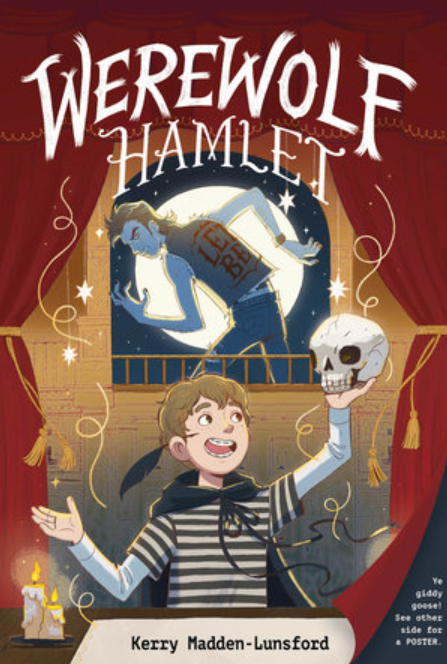
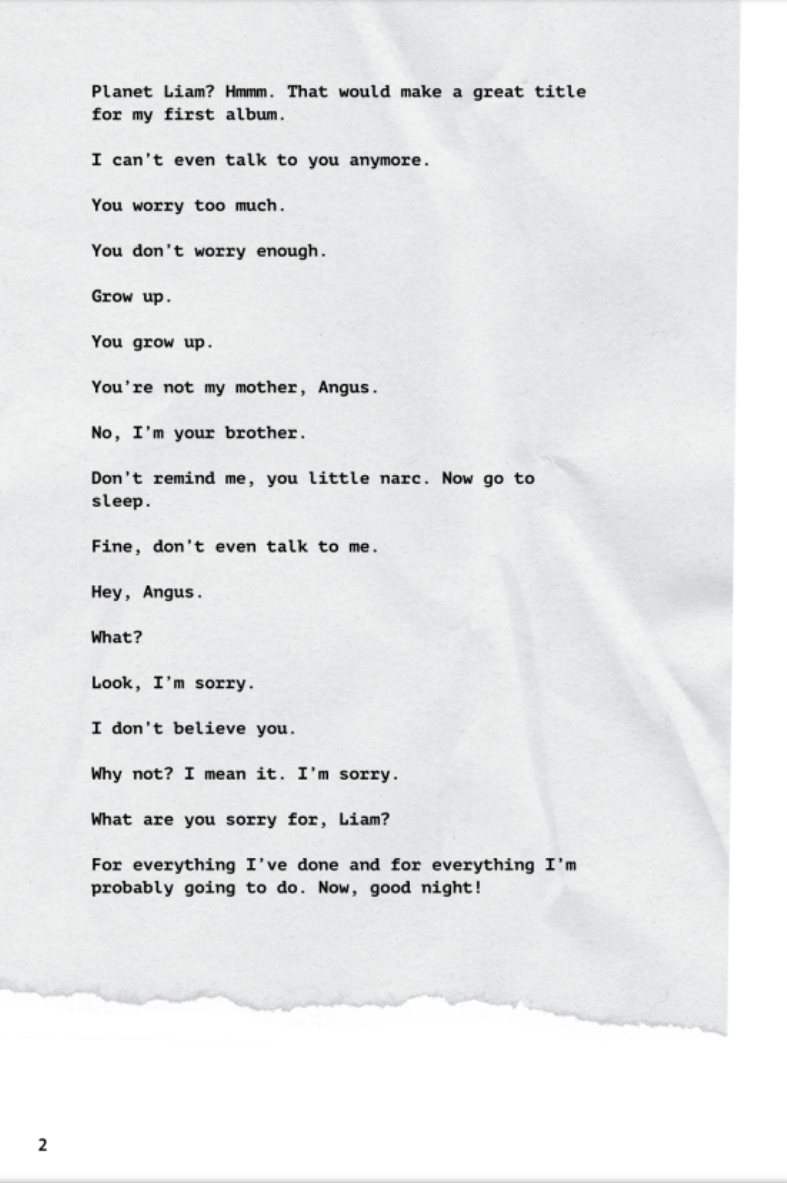
10-year-old Angus is unique. He quotes Shakespeare and wants to stage a Werewolf Hamlet play for his 5th grade legacy project. Angus’s 17-year-old brother, Liam, is like a werewolf now—Angus never knows if he’ll be nice or mean or when he’ll sneak out to get drunk or worse.

Meanwhile, tension continues to build for Liam’s family in Los Angeles. Mom and Dad are going to default on the mortgage. Older sister Hannah is fed up and ready to move herself to Maine, and little sister Sidney doesn’t really get what’s happening. Then Liam goes missing, and Angus decides he has to find him.

A realistic, heartfelt look at the complexities of family relationships and struggles. Along with Angus’s loveable charm, sense of humor, and desire to stage his original play, Werewolf Hamlet is sure to win its audience—on and off the page—over.

“A story that is rich in wise insights.”—Booklist (starred)

About the Author: Kerry Madden-Lunsford has been a regular contributor to the LA Times OpEd page. For several years, she directed the creative writing program at the University of Alabama at Birmingham, where she is still a professor, and she taught in Antioch University’s MFA program in Los Angeles for a decade. She is the author of the picture book Ernestine’s Milky Way. She also wrote the Maggie Valley Trilogy, which includes Gentle’s Holler, Louisiana’s Song, and Jessie’s Mountain. Her book, Up Close Harper Lee, was one Booklist’s Ten Top Biographies for Youth. Her first novel, Offsides, was a New York Public Library Pick for the Teen Age. Kerry is the mother of three adult children, and she now lives full-time in Birmingham, Alabama. Visit her at kerrymadden.com.

Check out Kerry Madden-Lunsford on social!
Bluesky
Threads
Substack

Review: As an educator, I have over the years sadly heard about so many different tough situations that my students were dealing with: being unhoused, divorce, death in the family, mental health struggles, etc. Too often, middle grade books stay away from tough topics because they are “too mature,” but anyone who has worked with middle graders has wished at different times that there was the perfect book to give to students at a certain moment of time but couldn’t find it–this book is going to be the perfect book at one of those times.

What an interesting mix within this book: Shakespeare, classic movies & movie stars, Los Angeles, growing up, foreclosure, runaway, pet wellness, friendship, and more. It seems like a lot, but it just works in this book because all of it is what makes Angus and his story come to life. Parts were hard to read, such as descriptions of Angus’s brother spiraling into addiction; Angus and his friends making more choices to find his brother; Angus’s families financial struggles and eviction; Angus’s dogs illness; and Angus’s struggles at school, but the author does a great job with including enough for emotional response and plot/character development and keeping the story developmentally relevant.

Educators’ Tools for Navigation: The publisher has created an amazing supplemental page for Werewolf Hamlet which will be perfect to use if teaching the book as a whole or if students are reading it in groups or independently! Visit https://www.charlesbridge.com/pages/werewolf-hamlet for resources about:

  • Insulting like Shakespeare
  • Geography and landmarks around Los Angeles
  • Classic films
  • Heroes of the silver screen
  • Hamlet

I also think that the book could be a great introduction to one-man plays, and students could take a story and transform it like Angus did with Hamlet.

Discussion Questions: 

There is a Reader’s Group Guide found on the publisher’s resource page, too!

Flagged Passages/Spreads: 

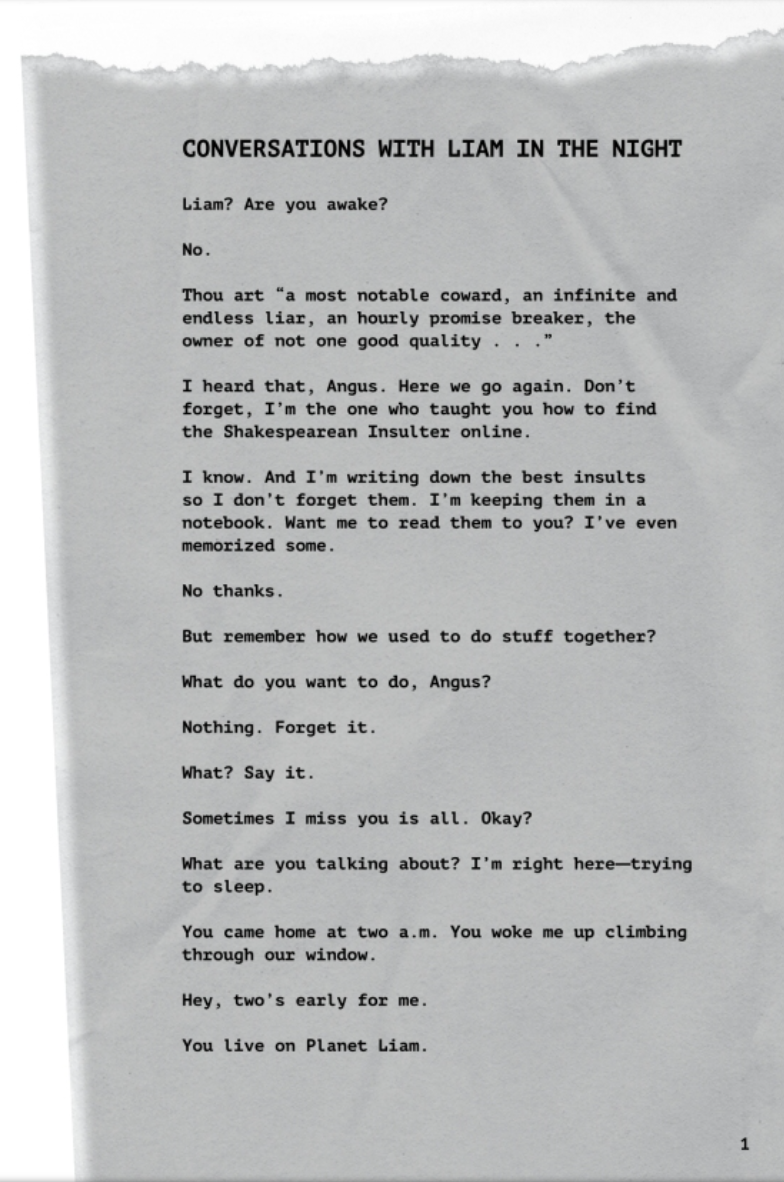
The Tar Feeling

Anybody can forget to wear shoes to school. Well, almost anybody. It’s an innocent mistake. And I didn’t forget my trumpet. Why doesn’t that count?

“Mom,” I say as she needles her way through crazy Los Angeles traffic to make it to the bus stop on time with all four of us kids in the car.

“People, I’m trying to sleep,” says my brother, Liam, who is seventeen and always sleeps on the way to school. That’s because he sneaks out at night. I’m not supposed to tell, and I’m going to make him quit doing it.

“We’re going to be late,” Hannah warns. She’s sixteen and thinks life would be perfect if only she’d been born in a hippie commune in the 1960s in Maine, the farthest state from California. She also loves sunflowers and paints them on her ceiling and makes us tiedye shirts. Mom and Dad call her a sunflower girl. She also loves an old-time singer, Joni Mitchell, and she plays her music loud to drown us out sometimes.

Sidney and I are who get dropped off at the bus stop first because we go to a magnet school far away. Sometimes we miss it, making Mom and Liam and Hannah late, and that means Mom grits her teeth and races to the next bus stop in hopes of still catching our bus. Those are not good mornings. After she drops us off, Mom drives to the high school where Liam and Hannah go, where she is the assistant girls’ volleyball coach and PE teacher. Their mascot is a tiger, so they are the Lady Tigers. Roar!

“Mom!” I yell again.

“What, Angus?” She blasts through a yellow light, eyes on the prize of the bus.

“I forgot my shoes at home.”

“We’re not turning around!” yells Hannah. “I have a test first period.”

Liam says, “Show some respect. I need to sleep. Geez.”

“Did you hear me, Mom?” I ask her.

Stony silence. From the look on her face in the rearview mirror, flaring nostrils like a bull and her fingers gripping the steering wheel, she hears me all right. But instead of turning around, she pulls up to the bus stop and says in a low voice, “Out. Now. Have a good day.”

“But Mom! I’m wearing only socks!” I stick a foot in the air.

Mom growls. Maybe more wolf than Lady Tiger, but for sure a growl.

My little sister, Sidney, tugs my arm. “Better forget it, Angus.”

“Fine! I’ll go shoeless! Who cares?” I climb out of the van, and then it happens. Mom yanks off her tennis shoes and hurls them out the window at my head while I’m standing in my socks on the curb with Sidney.

BAM! BAM!

Good thing I duck. Isn’t it against the law to throw shoes at your own children?

Read This If You Love: Sunny Side Up by Jennifer L. & Matthew Holm, The Seventh Wish by Kate Messner

Recommended For: 

classroomlibrarybuttonsmall

Signature

**Thank you to Blue Slip Media for providing a copy for review!**

Kaya of the Ocean by Gloria L. Huang

Share

Kaya of the Ocean
Author: Gloria L. Huang
Published January 7th, 2025 by Holiday House

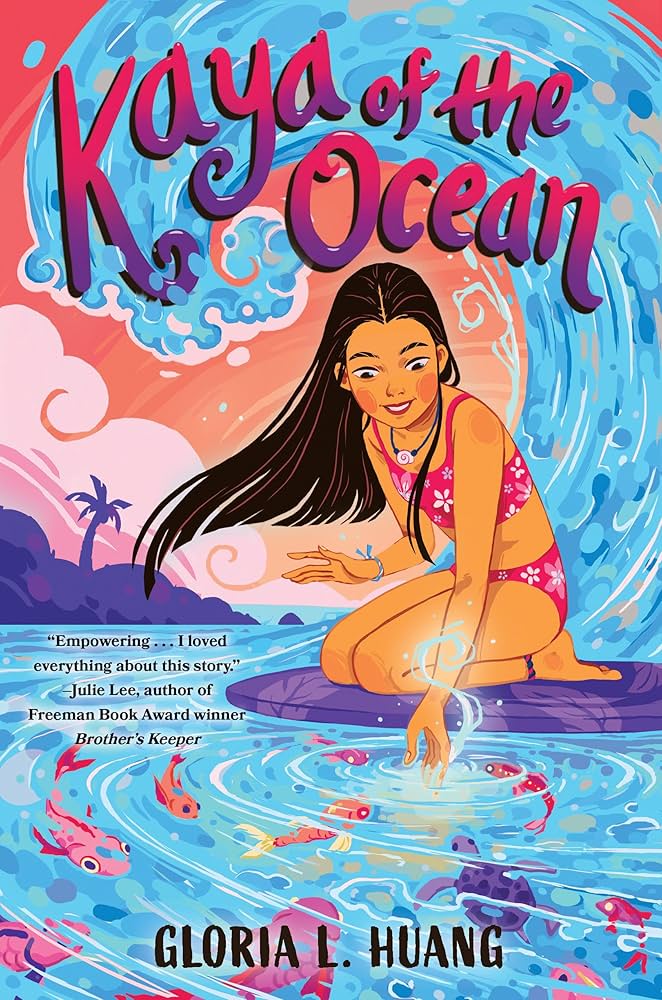
Summary: Anxious thirteen-year-old Kaya has always been afraid of everything—but when she learns she is the descendant of a Chinese water goddess, she’ll have to master herself to master her powers!

On the surface, thirteen-year-old Kaya leads a charmed life. She lives in beautiful, beachy Lihiwai. She has ride-or-die best friends. She’s ultrasmart and killing it at school. She even works with a super-cute boy at her parents’ restaurant.

But she also has anxiety—serious anxiety, the kind that makes you scratch and pick—and she’s always had bad luck around the ocean. It’s hard to enjoy Hawaiian beaches when you’ve almost drowned more than once.

But as stranger and stranger things happen to Kaya around the sea, she realizes that—wanted or not—she has a special connection to it. Waves rise when she’s angry. Surf smooths when she’s calm. Fish come when she calls them. And when she learns the truth about her family and her divine ancestor, Mazu, she knows that she will need to connect with her most difficult emotions ASAP—or her potent powers may become dangerous to the people she loves.

Kaya of the Ocean is an exciting, fresh, and beautiful middle-grade fantasy about embracing who you really are. This heartfelt adventure of sun, surf, and sand touches on mental health, the immigrant experience, and the complexities of growing up.

Praise: “This sweeping narrative will keep readers eager to learn what happens to Kaya, the child of Mandarin-speaking Chinese and Taiwanese immigrants, and her friends.” -Kirkus Reviews

“Huang explores one anxious tween’s relationship with the sea and her ancestry in this fantastical debut.” – Publishers Weekly

“Engaging…multi-layered…” – Bookworm for Kids

Indie Next Pick!
Junior Library Guild Gold Standard Selection
ALA’s Indies Introduce List spotlight debut

About the Author: Gloria L. Huang is a freelance writer. Her fiction has been accepted for publication in literary journals including Michigan Quarterly Review, The Threepenny Review, Chicago Quarterly Review, Witness Magazine, Massachusetts Review, Pleiades, Southern Humanities Review, Fiction Magazine, North American Review, Arts & Letters, Washington Square Review, The Chattahoochee Review, Gargoyle Magazine, Sycamore Review, and The Antigonish Review. She received her B.A. in English Literature from Stanford University.

Review: Kaya is a character that many readers will connect with: she struggles with meeting the expectations upon her, wants to be comfortable with who she is but also wants to fit in, and is trying to figure out herself while also just living her life. Her life is already a bit topsy-turvy when her cousin comes and visits and truly tips everything over and Kaya finds her mental health being negatively affected, and she feels like she has no one to go to. On top of that, she discovers she has some kind of magical powers which makes her feel even more disconnected from reality. Luckily for Kaya, the powers may be what can help her through this all.

In addition to the character development of Kaya and all that is affecting her, the author’s introduction to Chinese mythology will intrigue readers who are interested in world mythologies while also not ostracizing those who aren’t.

And oh, the setting is BEAUTIFUL and the author’s use of imagery takes the reader straight to Hawaii!

There is truly so much to talk about when it comes to this book: family, friendship, fears, anxiety, mythology, Hawaii, the ocean, and more!

Discussion Questions: 

  • How does Kaya’s parents’ choice to not tell her about their past cause her to feel disconnected?
  • Why do you think Kaya’s parents choose not to talk about their past?
  • How did Anne’s visit effect Kaya’s mental health?
  • Although Anne was quite a terror at the beginning, do you think that Kaya dealt with the situation correctly?
  • How did Kaya’s parents’ response to Kaya’s anxiety lead to her feeling like she had to hide everything?
  • Do you think it was okay for Naomi and Iolana to lie to Kaya?
  • Why do you think that the author chose to flashback a few times in the book to Kaya’s ancestors?

Flagged Passage: Chapter One

Maui, 2024

Though I’ve never been able to prove it, I’m certain the ocean is trying to drown me.

My first memory of feeling this way is more like a dream— my mom’s screaming face distorted through a wavery, watery lens; wisps of fear, of shock. I think I was about three. Whenever I asked Mom about this memory, she furrowed her brow and claimed not to remember. “You’re always making things up. So much imagination.”

When I was seven, I was playing on the shore when a sneaker wave overwhelmed me. In a split second, it washed me and my toys partially out to sea. I remember that vividly— the shock of digging in the sand one moment and tumbling through the water the next. Luckily, my dad ran over the wet sand to fish me out, but I clearly remember the sensation of the water towing on my legs as though trying to pull me under. My bucket and spade were a casualty of that warm summer day. “They swim with the fishes,” my dad said afterward with a grin. I didn’t think his joke was very funny.

Now I was thirteen, with several years of intense swim lessons behind me. And I tried not to think about my grim childhood conviction that the ocean was somehow… calling me home.

I really tried not to think about the little girl I sometimes saw under the water, the one my parents called my “imaginary friend” until I was too old to have imaginary friends anymore. It was my policy not to look directly into the ocean, because I knew I might see her if I did: a small five-year-old child, her hair in messy pigtails and her eyes haunted and sad, always reaching for her white blanket.

It was bad enough I suffered from anxiety so severe that my skin was raw and red from washing and scratching, that my mind was always filled with worries and my heart filled with dread. The last thing I needed was another problem, another fear.

So even though I lived on an island surrounded by millions of cubic miles of water, I built a box in my mind for my hydrophobia, put it inside, and tried not to think about the sea at all.

Read This If You Love: Coyote Queen by Jessica Vitalis; Lola Reyes is So Not Worried by Cindy L. Rodriguez; The Fire, the Water, and Maudie McGinn by Sally J. Pla; The Girl from the Sea by Molly Knox Ostertag

Recommended For: 

classroomlibrarybuttonsmall

Signature

**Thank you to Holiday House for providing a copy for review!**

The Firelight Apprentice by Bree Paulsen

Share

The Firelight Apprentice
Author: Bree Paulsen
Published October 29th, 2024 by Quill Tree Books

Summary: The bestselling author-illustrator of Garlic and the Vampire, Bree Paulsen, brings her fantastical storytelling and warm, sparkling artwork to this story that celebrates the bond between sisters.

In a city powered by magic and still recovering from a bloody war, Ada is concerned about her younger sister Safi’s developing powers. She understands that Safi could learn how to control her magic under the apprenticeship of a king’s magician. But with the memories of war still fresh, Ada is conflicted by this prospect—despite her knowing that she can’t keep Safi safely at home with the threat of deadly, power-thieving liches prowling the kingdom.

When a traveling group of magicians comes to the city to perform, they immediately recognize Safi’s talents and offer to take her on as an apprentice. Safi is thrilled about her new adventure—even if that means leaving behind Ada and their sickly father. And Ada is right to worry about her sister, for there may be monsters hiding behind friendly faces…

About the Author: Bree Paulsenis a SoCal writer and illustrator who loves spooky monsters, fashion history, and all things autumnal. After graduating from the Laguna College of Art and Design with a BFA in animation, she freelanced on a few independent animation and illustration projects before tuning her focus toward comics. She started her webcomic, Patrik the Vampire, in 2013 and self-publishes its printed volumes. Her first middle grade graphic novel, Garlic and the Vampire, received a starred review from The Bulletin of the Center for Children’s Books, which called it “folkloric…a down comforter of a graphic novel.” Garlic’s adventures continue in Garlic and the Witch.

Review: This graphic novel, on the surface, is about magic, but if you dig deeper, it is about the impact of war, hidden evils, balancing passion & family, and figuring out how to fit within the world.

The author does a wonderful job of spreading the narrative out between the two sisters so that the reader is aware of all aspects of what is going on. And since the sisters are so very different, it is interesting to experience the switch between the two. Also, though I predicted the twist at the end of the book, I think readers are going to be surprised! I also was impressed with how the author dealt with some tough themes, especially loss and anxiety, in such a developmentally relevant way.

I am hoping this story is a beginning of stories within this world because I want to know more about so much that happened in the past and how our characters move on into the future.

Educators’ Tools for Navigation: This graphic novel will be a huge hit with middle grade readers–it will be an asset to any school, classroom, or home library.

Discussion Questions: 

  • How does the author use color within the graphic novel?
  • Why did Ada and her father choose to send Safi away?
  • Who was destroying Ada’s letters?
  • Was there any signs of who the antagonist was before it was revealed?
  • If you were a magician, what magic would you like to learn how to do?
  • Would you rather there be a sequel or a prequel of this book?
  • How does Safi’s notice of Elba change his life?

Flagged Spreads: 


Read This If You Love: Cat’s Cradle series by Jo Rioux, Anzu and the Realm of Darkness by Mai K. Nguyen, Meesh and the Bad Demon series by Michelle Lam, Plain Jane and the Mermaid by Vera Brosgol, The Moth Keeper by Kay O’Neill

Recommended For: 

classroomlibrarybuttonsmall

Signature

**Thank you to Harper Collins Children’s Books for providing a copy for review!**

I, Too, Am Here by Morgan Christie, Illustrated by Marley Berot

Share

I, Too, Am Here
Author: Morgan Christie
Illustrator: Marley Berot
Published September 10th, 2024 by Second Story Press

Summary: The street a young girl lives on is made up of families from all over the world. Her family shares with her their stories of journey and struggle. Her own story begins here in this country, but she is sometimes made to feel she does not belong. She listens to her family’s voices. They tell her she will soar, they tell her she is beautiful. She listens and she says I, too, am here.

A multigenerational story of immigration, racism, and what it truly means to belong. Inspired by Langston Hughes’ poem, “I, Too.”

About the Author: 

Morgan Christie is the author of four poetry chapbooks, a short story collection, and a collection of essays. She has won the Arc Poetry Poem of the Year Contest, the Prairie Fire Fiction Prize, the Digging Press Chapbook Series Prize, and the Howling Bird Press Nonfiction Book Award. ‘I, Too, Am Here’ is her second picture book and she continues to work towards affecting change through reading and writing. Morgan is based out of Toronto.

Marley Berot is an illustrator with over ten years of combined personal and professional experience. Her portfolio includes cover art for Neuron, graphic design work for the Toronto International Film Festival, logo design, and book illustration. She runs her own online store called MarleysApothecary.com. Marley is very passionate about her work as an artist, and this can be seen in every piece she creates. She lives in the Toronto area.

Review: The author shares that, “In reading this story, she hopes young readers will learn to see the ways our words and actions can affect others,” and I truly believe they will. I don’t know how anyone could argue that the beautiful family in the story should have anything but happiness. I also love that the author “drew inspiration from Hughes’s poem to write this book because she wanted to remind everyone who’s been told or made to feel otherwise how much joy and wonder they bring to the people and places around them,” and this is a message that all young people, all PEOPLE, should hear loud and clear, which this picture book delivers in words and art.

Tools for Navigation: This picture book can be read along side Langston Hughes’s “I, Too” poem to look for similarities, how it was influenced, the themes of both, etc.

Discussion Questions: 

  • Why does the narrator not understand the racism that his family faced?
  • What character traits would you use to define each of the characters in the story?
  • What should you do if you hear someone being racist (or prejudice in another way) towards a peer?
  • How does the history of slavery and the Jim Crow south still affect America today?
  • How was the book inspired by Langston Hughes?

Flagged Spreads: 

Read This If You Love: Picture books about multigenerational families, anti-racism, immigration, Black history, poetry

Recommended For: 

classroomlibrarybuttonsmall 

Signature

**Thank you to Nicole Banholzer PR for providing a copy for review!**