Nonfiction Picture Book Wednesday is hosted by Kid Lit Frenzy and was started to help promote the reading of nonfiction texts. Most Wednesdays, we will be participating and will review a nonfiction text (though it may not always be a picture book). Be sure to visit Kid Lit Frenzy and see what other nonfiction books are shared this week!
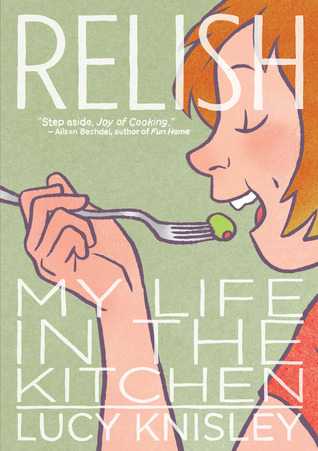
Relish: My Life in the Kitchen
Author: Lucy Knisley
Published April 2nd, 2013 by Macmillan
Summary: In this autobiographical graphic novel, Lucy Knisley reveals her love for food. Raised by foodies, Lucy recalls that all of her earliest memories are reflected in food that she was eating at the time. Brimming with recipes and stories told through taste, Relish is sure to please readers, even advanced chefs. From her recipe for “The Best Chocolate Chip Cookies” to an “exploded view” of Huevos Rancheros to a diagram of how to make sushi rolls to a “Cheese Cheat Sheet,” each chapter ends with an illustrated recipe that will make readers want to jump into the kitchen.
Review: Admittedly, I am obsessed with food (both cooking and eating). I can spend hours watching Food Network, so this was a sure-winner for me. It is easily one of the best graphic novels I have read. The illustrations made me laugh out loud, and I didn’t want to put it down–except to try out a few recipes (that were all delicious!). The book is a coming-of-age story. Lucy’s rebellious teenage years are reflected in the foods she ate, and she learns lessons from her dining experiences. While food is the center of this graphic novel, Kinsley shows how she grew as an individual from life-changing events like her parents’ divorce to a trip to Europe. She does a fantastic job showing passion–it reads like a beautiful love letter to food. Readers who don’t love food will still identify with her passion.
Teacher’s Tools for Navigation: We all have interests that shape our memories. For example, I can’t recall where I went on my trip to South Carolina, but I do remember the books I read on the beach that week. Students have interests like sports or hobbies that shape their memories. My husband can recall more soccer games than I care to count. Teachers might have students use this graphic novel as a model for students to illustrate how their interests have shaped their memories. The dialogue adds much to this book, so teachers could ask students to analyze how the dialogue shapes the story. As another option, I bet students would enjoy creating a graphic novel page of a step-by-step, illustrated recipe. This would lead to some great (and delicious) presentations.
Discussion Questions: What are your earliest food memories?; How has your family influenced your eating habits?; What is your favorite recipe? Why?; How has food shaped your life? Or, how has some other interest or passion shaped your life?
We Flagged: “I was a child raised by foodies. My parents probably don’t recall how old I was at my baptism, but they remember what I ate that day” (p. 8).
“When I got home, my mother, having heard about my rebellious breakfast, began a smear campaign to convince me that the hamburgers at McDonald’s were actually made of worm meat. Miraculously, I was undeterred. I remain undeterred to this day. It’s not often, but every once in a while, I need those fries. Say what you will…We wouldn’t be eating it if it didn’t taste good” (p. 49-50).
Please note: Our flagged passages don’t contain the gorgeous drawings and hilarious quote bubbles. Click on the “Look Inside” feature on the book cover to see samples from the graphic novel. We didn’t want to break copyright laws!
Read This If You Love: Graphic novels or food/cooking memoirs like Julie and Julia: 365 Days, 524 Recipes, 1 Tiny Apartment Kitchen by Julie Powell
Recommended For:


What did you think? Which recipe was your favorite?