Reflections on the Current State of the World

What prohibits schools from having an active school library? by Livie, 7th grade
Most schools around the United States have a library, but it’s even better if they have an active one. Libraries are essential for student growth in their education. There are many reasons that affect a school library’s ability to do this though. Currently in the United States, there have been many budget cuts and natural events that have had an impact on the library society. In this blog post, I will be discussing many aspects that have an effect on school libraries, and what an active school library consists of

Why Libraries are Important
We are all told that libraries are important at some point or another by various people but the question still remains: WHY? They boost student learning and help to build a closer school community. Libraries are fundamental in the growth of a student and their school career. Studies have proven this, from 2007-2008 having more school libraries that host events like literacy week and are an active part in the well-being of the school, test scores increased drastically, the typical student that would usually be seen getting a 70-80 on standardized literary tests was now seen getting a 90-100.

Defining the Term
What does it mean by active school library? Active school libraries are libraries that are taking part in school functions such as literacy night. It could also be things as little as taking into consideration what books students would want to read. By taking into consideration I mean having books in libraries that are not only new but also interesting. These are just many ways to define what an active school library really is.
Budget Cuts
A lot of libraries across America are suffering from budget cuts. This is not just limited to school libraries but does have an effect on them. On Monday, February 10th, 2025, President Trump signed an executive order at the White House that would mandate the reduction of seven governmental agencies, one of which included the IMLS (Institute of Museum and Library Systems) and the Department of Education. The IMLS is a government agency that regulates and funds the country’s libraries and museums while the Department of Education ensures that schools across the country are giving their students what they need. Reducing these agencies means making them smaller, which in turn would mean cutting libraries all across the U.S. This is very important to schools because some of their libraries fall under the category of being cut in the reduction. Seminole County Schools in Florida are primarily without librarians because of this. Yes, while the students still have access to libraries, many do not have an actual librarian or dedicated full-time staff in the library. This affects having an active school library because how can there be events if there is no dedicated librarian to set up events. On another note, because of the ILMS and DOE funding being cut, several school libraries are without a clerk, deeply affecting the library setting because now all jobs are placed on the librarian’s shoulders.
Expectations of Student Learning
While all of this is happening students are still expected to get high test scores. If students do not have the adequate resources at their usage how is it fair to expect this. It is scientifically proven that students with access to resources in a school library perform higher on tests. Many books in the library would have words a student may not have seen before and that is to their benefit; it leads them to ask questions or even look it up. This helps students grow their vocabulary and comprehension skills. Nonfiction books exist to inform people about the real world. While fiction is a great escape from reality… reality is still there and students, and especially adults, need to be informed. History books are especially crucial to make sure that history does not repeat itself (although that may be happening).
Expectations on Librarians Themselves
Sometimes, or rather most times, librarians are expected to be more than just a librarian. They are expected to host many events throughout the year, such as setting up picture day, distributing laptops, state testing, and even writing the school newsletter. These jobs by themselves wouldn’t be too much to ask of a staff member because most of them happen at different times throughout the year but to also expect librarians to maintain the inviting atmosphere of the library and be an educator within the school while doing these tasks every week/month is unreasonable. While picture day and distributing laptops is not a weekly thing, yearbooks and weekly newsletters are. The librarians may also be asked to sub for other classes if that class is without a sub thus leaving the library unable to be attended or open on that day. Essentially, librarians are being treated not as teacher with a daily job but as disposable. You shouldn’t ask a teacher to stop teaching that day’s lesson just because they needed some copies made or someone to handle behavior, but sadly that is what is happening to most librarians across the U.S. Most libraries are called a media center because the title makes it so that the librarians can be called media specialists, expanding the jobs they can be asked to do.
Statistics: Decrease in Librarians

Covid has had a big effect on the school librarian population. A study was done in 2020-2021 to reflect this and here are some of the facts from this study.
- 29.5% of schools across America reported not having librarians or not having a designated staff member for the library.
- Seven out of ten charter schools are without a full time librarian
- 37.8% of western schools were without librarians, while southern schools had 22.2% of schools without librarians.
- Smaller schools (less than 200 students) were more likely to have their library cut
- Bigger schools (2,000+ students) had an increase in the number of schools without librarians 10.8% to 16.3%
- 34.9% of city schools reported no librarian
- 29.5% of town schools had no librarian
- 57% of combined schools (k-8, k-12) had no librarian or library program at all
- 33.8% of hispanic schools had no librarians
- 32.5% of poverty serving schools (schools that their main population are students living in poverty) are without a librarian
- The states with the highest percentage of schools without librarians are: Alaska(55.2%), Minnesota(50.6%), Hawaii(50.2%), West Viginia(50%), Michigan(49.9%).
These facts are quite sad because literacy is an important part of student learning. Librarians are the fundamental base for a good library and without them libraries are unable to thrive as much as a library with a librarian.
Comparatives
Examples of an active school library and what it looks like:
Hunter’s Creek Middle School (the school I go to) has one of the most active school libraries I can think of and one of the most active school librarians. Yes, I am a little biased but there is evidence to support this. Every year we have an author visit the school, this year we had three, but we still have at least one every year. This is to “advertise” reading to the students. As students visit the author in their ELA classes they get an in person talk with the author. I, for one, have certainly been encouraged to read these authors’ books after I have seen them. Another example is that we host literacy night every year for the coming author to encourage their books. We have rooms set up around the campus that are related to the author’s books. This year, we invited the 5th graders from their elementary school so that they could walk around the school and get familiar with our campus. We also have a Google form where students can fill out what books they would like to see in our library. Although, it does take some time to get these books in the library, the books almost always end up in our library. On another note, there is a reading challenge called Eagle Super Reader that is a paper that you fill out with twenty-five books you’ve read throughout the year and get prizes plus an end of year party. This really encourages kids to read because who wouldn’t want to skip school for a day and hang out in the library? This is just a little bit of the whole lot Ms. Moye does for our library and our school. All of these things and events she sets up all help make reading a little more fun for the students. They help to encourage students to read more, expanding their vocabulary and making them more educated. This is one example of an active school library and its effect on the students of which it serves.


Conclusion
In a nutshell, active school libraries are an excellent resource to have but there are certain obstacles that lessen one’s ability to do so. Such as budget cuts and the absence of a full-time librarian. There are schools that have been able to pull this off though, and that has greatly impacted student learning and reading capabilities. All in all, having an active school library is an amazing thing that I hope more students will get the opportunity to have in their educational careers.
Is The Hunger Games our future? by Edie, 8th grade
After reading Layla N.s’ post from last year (https://www.unleashingreaders.com/29146) I was inspired to expand, in light of more recent events (mid 2025-now) like issues regarding much more pressing matters. Such as a major increase in wrongful/ unjust (no fair trial) or violent deportations and racism by ICE (Immigrations and Customs Enforcement), there has also been an increase homelessness and inadequate housing all over the world that was not discussed in the previous post. There has also been another development since the first post; the announced Patriot Games happening summer 2026, which provide many parallels to The Hunger Games universe. The Hunger Games is a dystopian book series converted into movies. Here is a short summary of the plot: There are 12 districts in the country of Panem (originally 13 districts, just like the original 13 colonies!). The Capitol controls all of the districts, in an elected dictatorship type of way, and Panem (the country with all the districts/where The Hunger Games take place) is run with an extremely tyrannical government. Each district provides something for the Capitol, however they cannot trade with other districts, and are forbidden to leave the one they were born in.. Except if they are reaped. The reaping was installed after the districts rebelled against the Capitol and failed, as a punishment for them. The reaping is a part of The Hunger Games, in which the reaping is how they get there. To remind them that the Capitol is always stronger, but also to remind them how “generous” they are. I will explain more of The Hunger Games in their comparison section to the upcoming Patriot Games, but for now that is where I will end the summary. The 3 topics during this post are: Law Enforcement, The Hunger Games vs. The Patriot Games, and Quality of Life.
Law Enforcement
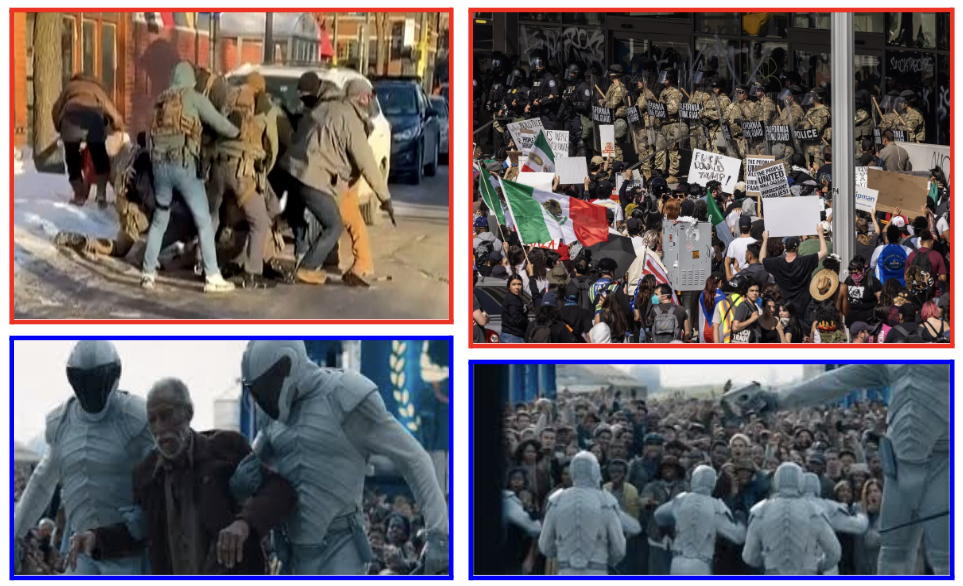
In this section of the post I will be showing and comparing the law enforcement in The Hunger Games vs. The law enforcement in the U.S.. Starting off, the image on the upper right shows people protesting against ICE (Immigration & Customs Enforcement). President Trump thought this was un-American and deployed the National Guard (to go against their own country!), just because of people simply exercising their 1st amendment rights. The image below shows a similar circumstance, but in The Hunger Games. Peacekeepers (who are the law enforcement in the books), are holding back people protesting against The Hunger Games (also fighting against their own country).
Continuing to the images on the left, both show law enforcement officers holding down protesters, who were later shot dead by those same officers. The one on top shows Alex Pretti, who was filming a detaining by ICE, and mere minutes later, was killed by them. He approached a vehicle with his phone, recording a conflict (he was not prior involved in) with ICE agents. After the person ICE was having a conflict with ran into Alex for safety during the protest, the ICE agent took him as a threat. The agent immediately pepper sprayed him to the ground, and more ICE agents held him and started hitting him. Once the agents removed his (Alex Prettis’) legal carrying firearm, they decided he was still a threat; beaten and bloodied. They then brought out one of their own guns and shot him 10 times.The image below that shows an unnamed man in The Hunger Games series being lifted up on stage, and later shot, because he used a sign of rebellion: lifting the 3 middle fingers and whistling a tune from their district (the same district where a 12 year old girl got murdered in The Hunger Games: District 11). The constitution most likely does not matter/ no longer exist in The Hunger Games universe and it was probably legal for Peacekeepers to do this. It is not legal today. Though the 2 situations are awfully similar: murdered because of protesting. Why are our Constitutional rights slowly disappearing?
The Hunger Games v.s The Patriot Games


“The Patriot Games” “The Hunger Games”. One. Word. Off. The Patriot Games is an event President Trump announced for 2026, to celebrate America’s 250th year of freedom from Great Britain. They require 1 male and 1 female tribute from each state. These tributes for being the top high school student athlete in the state (you read that right; high school; children). Then, they will go to the capital (D.C.) and fight for their (the Capitals) entertainment, and it is unstated whether this will continue annually. The Hunger Games was created by the capitol after the districts lost a rebellion/war to them. It was to show them that they were superior, and was like an annual punishment. The rules were that 1 male and 1 female (ages 12-18) will be reaped (chosen) from each territory. Reaping day was on July 4th/Americas’ Independence Day. The parallels are obvious. 1 male and 1 female child selected from each territory to go fight in the Capitol, for the Capitols enjoyment. Now what happens to the tributes in the Patriot games who do not win is unstated, whether they get anything, or just go home. Luckily it is not a fight to death scenario , but the winners are bathed in riches just as the victor in The Hunger Games. These rules play into what the Capitol stated in The Hunger Games, ruling that the games are used to show that they will always be more powerful, and then the winner being shown mercy and money is a reminder of their “generosity”.
Quality of Life

Next, quality of life in the world now versus quality of life in the districts. Starting off, world hunger is a very prominent issue and affects almost 1/10th of the population. Homelessness affects roughly 3% of the world population. These problems lead to awful living in many countries (as shown in the image on the upper right). In the districts from The Hunger Games, specifically district 12, we see lots of horrible living conditions along with many people starving. We even see this in the main character herself (Katniss Everdeen), nearly starving to death, simply because her district didn’t get enough rations for the winter. We also see people living on the streets, or in extremely small and damaged homes (upper left photo), much like present day poverty which affects 9% of the population. Through these we see many similarities with the way people live in these 2 worlds; on the worse side of it.
Now with people on the better side; I am going to compare citizens in the Capitol of Panem, and the billionaires of our world. The amount of rich people in Panem compared to the amount of people in the districts (living in lesser quality of life) is miniscule, yet they rule the country. They usually have ridiculously pricey houses, and outfits (lower left photo). The billionaires in our world are also extremely few (3000 out of more than 8 billion people!). Our billionaires normally have expensive extravagant clothing and homes (lower right), much like the capitol people. Though in small quantities, they have huge influences on our world, through them affecting political standpoints with money. The people who donate are in the 100s; yet every single one of them could obviously spare some of their money that could make a huge difference, but somehow, they are taxed less.
Conclusion
When reading or watching The Hunger Games( or if you haven’t read or watched the series, I hope this post convinced you to do so) you sided with the resistance to The Games/ Capitol right? Why are people still supporting the current state of our country and world when they can clearly see where we could be headed? The similarities between the two universes ( our Earth and The Hunger Games world) are apparent. As of right now, the amount of states in the U.S. who support this is decreasing, but there are still some who will do nothing but praise our way of life. Like in Mockingjay (3rd book in The Hunger Games) in District 2, where loyalty to the Capitol runs deep, they were the last one to surrender and join the rebellion, before the resistance stormed the Capitol. It will take time, but I believe eventually everyone will join the resistance just like in Mockingjay and overthrow our upcoming tyrannical government. Suzanne Collins ( author of The Hunger Games) has said, she only writes when she has something to say. Now this raises a lot of “when will” questions, when will everyone join the resistance? When will we start listening to Suzannes’ writings? When will The Hunger Games become our reality?
Thank you so much to my student voices today and their look at the state of our world!