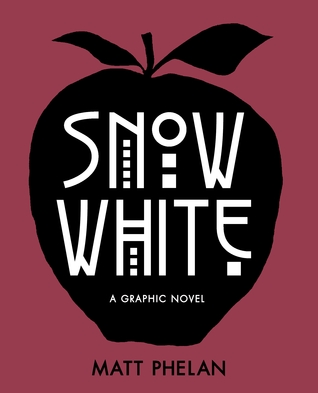
Snow White: A Graphic Novel Author: Matt Phelan
Published: September 21, 2016 by Candlewick
A Guest Review by Emily Baseler
GoodReads Summary: Award-winning graphic novelist Matt Phelan delivers a darkly stylized noir Snow White set against the backdrop of Depression-era Manhattan.
The scene: New York City, 1928. The dazzling lights cast shadows that grow ever darker as the glitzy prosperity of the Roaring Twenties screeches to a halt. Enter a cast of familiar characters: a young girl, Samantha White, returning after being sent away by her cruel stepmother, the Queen of the Follies, years earlier; her father, the King of Wall Street, who survives the stock market crash only to suffer a strange and sudden death; seven street urchins, brave protectors for a girl as pure as snow; and a mysterious stock ticker that holds the stepmother in its thrall, churning out ticker tape imprinted with the wicked words “Another . . . More Beautiful . . . KILL.” In a moody, cinematic new telling of a beloved fairy tale, extraordinary graphic novelist Matt Phelan captures the essence of classic film noir on the page—and draws a striking distinction between good and evil.
Review: Matt Phelan reinvented the “happily ever after” with this retelling. I identify as a Disney Classic enthusiast but I was pleasantly surprised with the ending. The illustrations are gorgeous with distinct intentionality. More mature themes such as death, assassination, murder were evaluated within a historical context to create an incredible murder mystery story at the level of a middle grade reader.
Teachers’ Tools for Navigation: This would be an excellent text to hand a more reluctant reader. There is limited text the reader is asked to interpret the illustrations and structure. In literature groups, students could potentially discuss the use of metaphor, oenomania, author/illustrator’s choice, and compare/ contrast the original fairytale with the retelling. This is also a text I would recommend to a student who has shown an interest in the graphic novel genre to read independently.
Discussion Questions: Why do you think the author choose to use red in selected illustrations? How did this choice influence you as a reader?; Why do you think the author choose to break apart the chapters this way?; Even though there were few words, how did you interpret the mood, tone, and voice of characters?; Did you find yourself needing to interpret the illustrations to understand the plot? What was that experience like for you as a reader?; How is this retelling of the classic fairy tale of “Snow White” different than the original? What did you notice is similar?
Flagged Passage: “My name is Snow White, but my mother didn’t call be that to be funny. She would say that the snow covers everything and makes the entire world beautiful” (Ch. 10)
Book Trailer:
Read This If You Loved: Red: The True Story of Red Riding Hood by Liesl Shurtliff, Jack: The True Story of Jack and the Beanstalk by Liesl Shurtliff, Rump: The True Story of Rumpelstiltskin by Liesl Shurtliff
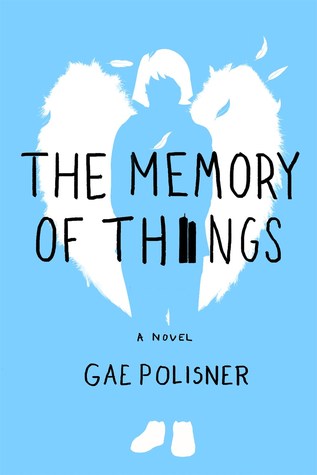
The Memory of Things
Author: Gae Polisner
Published: September 6, 2016 by St. Martin’s Griffin
GoodReads Summary: The powerful story of two teenagers finding friendship, comfort, and first love in the days following 9/11 as their fractured city tries to put itself back together.
On the morning of September 11, 2001, sixteen-year-old Kyle Donohue watches the first twin tower come down from the window of Stuyvesant High School. Moments later, terrified and fleeing home to safety across the Brooklyn Bridge, he stumbles across a girl perched in the shadows. She is covered in ash and wearing a pair of costume wings. With his mother and sister in California and unable to reach his father, a New York City detective likely on his way to the disaster, Kyle makes the split-second decision to bring the girl home. What follows is their story, told in alternating points of view, as Kyle tries to unravel the mystery of the girl so he can return her to her family. But what if the girl has forgotten everything, even her own name? And what if the more Kyle gets to know her, the less he wants her to go home? The Memory of Things tells a stunning story of friendship and first love and of carrying on with our day-to-day living in the midst of world-changing tragedy and unforgettable pain—it tells a story of hope.
Review: I read this book several weeks ago, and I still can’t thinking about it. As a few other bloggers have said, this is a book about 9/11—but it isn’t a book about 9/11. It is more a book about friendship, about growing up, and about being human. There are so many topics in this book that are worthy of discussion, and I think teachers will really appreciate its beauty. The writing is quiet yet powerful, and the book has a sort of shattering impact on readers. I loved the connections that Kyle makes in this book, and I particularly enjoyed the ways each of the individuals he interacts with tells the reader more about him. He grows from everyone in this book, and I’d love to discuss this growth with students.
Teacher’s Tools for Navigation: Teachers might ask students to research the many themes of this book to provide background information. They might look at disability/caregivers, PTSD, suicide, and 9/11—just to name a few. They could also look at the different stages of trauma to learn more about how each of the characters reacts differently to the tragic events that occurred on 9/11.
Discussion Questions: Is Kyle helping the girl, or is she helping him?; What do we learn from Kyle’s uncle? What does he teach us about disability and humanity?; In what ways does Kyle show strength, and in what ways does he show weakness? How does he grow from each experience of the text?
We Flagged: “So now I get it. Now I fully understand. Tuesday, and those planes, they’ve broken something. Permanently. And in the process, they’ve changed everything. And everyone.”
This is a quote from an advanced reader’s copy. Some quotes may change before publication.
Read This If You Loved: Extremely Loud and Incredibly Close by Jonathan Safran Foer; The Impossible Knife of Memory by Laurie Halse Anderson; Personal Effects by E.M. Kokie, The Things a Brother Knows by Dana Reinhardt, If I Lie by Corrine Jackson, Purple Heart by Patricia McCormick
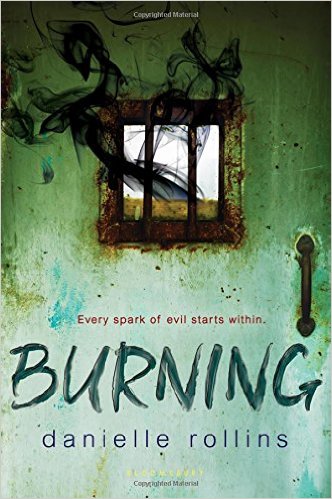
Burning Author: Danielle Rollins
Published: April 5, 2016 by Bloomsbury USA Children’s
Summary: After three years in juvie, Angela Davis is just a few months shy of release, and she’ll finally be free from the hole that is Brunesfield Correctional Facility. Then Jessica arrives. Only ten years old and under the highest security possible, this girl has to be dangerous, even if no one knows what she did to land in juvie. As strange things begin happening to Angela and her friends that can only be traced to the new girl’s arrival, it becomes clear that Brunesfield is no longer safe. They must find a way to get out, but how can they save themselves when the world has forgotten them?
Review: This book was the perfect balance between realistic, interesting characters and chilling, creepy fantastic characters. From the first moment that I met Jessica, my skin began to crawl. Angela, the narrator, is pushing a mop in Seg in the juvenile hall. Jessica is mysterious and quite scary. I was frightened right along with Angela! I love how the characters are developed. While the book is definitely fantastic, I felt genuinely connected with the characters and their stories. I’d use this book as a bridge to help students who love realistic fiction. It would help them explore different genres. The book ends with a hook, and I imagined that Rollins has a sequel in the works! I am very excited to read it!
Teacher’s Tools for Navigation: I imagine that this book will create genuine interest in juvenile halls. I’d ask students to explore and research their own juvenile halls. They might also examine privilege and how the characters’ home lives seems to play a role in the fact that they are in the correctional facility. This would offer an interesting class discussion.
Discussion Questions: Does Angela make good choices in this book? What are some of the choices she makes, and do you think she makes the right decisions? Is she a moral person?; Most of the characters in this book are female. Consider all of the male characters and determine what their role is. How do they add to the story?
We Flagged: “I’m so focused on the blinking red light that I don’t notice the skeletally thin girl in the cell to my left until she skitters across the floor on her hands and knees” (p. 51).
Read This If You Loved: The Mercilessby Danielle Vega, Anna Dressed in Blood by Kendare Blake, Anything by Stephen King; Juvie Three by Gordon Korman
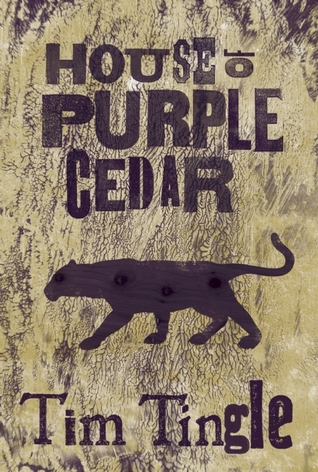
House of Purple Cedar
Author: Tim Tingle
Published: February 18, 2014 by Cinco Puntos Press
GoodReads Summary:“The hour has come to speak of troubled times. It is time we spoke of Skullyville.”
Thus begins Rose Goode’s story of her growing up in Indian Territory in pre-statehood Oklahoma. Skullyville, a once-thriving Choctaw community, was destroyed by land-grabbers, culminating in the arson on New Year’s Eve, 1896, of New Hope Academy for Girls. Twenty Choctaw girls died, but Rose escaped. She is blessed by the presence of her grandmother Pokoni and her grandfather Amafo, both respected elders who understand the old ways. Soon after the fire, the white sheriff beats Amafo in front of the town’s people, humiliating him. Instead of asking the Choctaw community to avenge the beating, her grandfather decides to follow the path of forgiveness. And so unwinds this tale of mystery, Indian-style magical realism, and deep wisdom. It’s a world where backwoods spiritualism and Bible-thumping Christianity mix with bad guys; a one-legged woman shop-keeper, her oaf of a husband, herbal potions, and shape-shifting panthers rendering justice. Tim Tingle—a scholar of his nation’s language, culture, and spirituality—tells Rose’s story of good and evil with understanding and even laugh-out-loud Choctaw humor.
My Review: It took Tingle fifteen years (and many experiences with a Choctaw storyteller) to write this story, and the thoughtfulness of the story makes this feel very true. While this book is marketed for adults, it most certainly has a young adult crossover audience. I was swept away by the lyrical beauty of the words. The book is quite magical. As I think back on the book, vivid scenes replay in my head. I had difficulty putting the book down because the characters were so real. I was wrapped in all of the subplots and did not want to leave the characters. It reminded me much of a John Steinbeck book—East of Eden, in particular.The evilness of Hardwicke in this book reminded me much of Cathy in East of Eden. When I came to the end of The House of Purple Cedar, I felt as if I’d read an epic—or something enormously important.The themes are left to the reader, they are varied, and they pour from the text. This complex story will remain with me for a long time.
Teachers’ Tools for Navigation: Most obviously, teachers could teach this book along with cultural stories from the Choctaw. They might look at reincarnation and its evolution in history and culture, too. Alternatively, teachers could ask students to examine age. What role does age play in this story, and how does it impact character? Teachers might have students read more about the Indian Boarding Schools and their impact on the Native American community.
Discussion Questions: What does Amafo teach us? Would you do the same in his position? How do his lessons impact the rest of the story?; How does Tingle vividly depict characters in ways that make this story come alive? What makes these characters feel so real?; What is Maggie’s purpose in the story? What does she teach us?; What role does family play in this text?
We Flagged: I am choosing a quote that shows just how beautiful Tingle’s language is: “His hand gripped her shoulder and strong fingers seized her upper arm. He flung her on her back and a hot river of strength surged through her. He was massive and his figure blocked the sky.”
Read This If You Loved: Books by Sherman Alexie, House Made of Dawn by M. Scott Momaday, Books by Louise Erdrich, East of Eden by John Steinbeck,
Nonfiction Picture Book Wednesday is hosted by Kid Lit Frenzy and was started to help promote the reading of nonfiction texts. Most Wednesdays, we will be participating and will review a nonfiction text (though it may not always be a picture book).
Be sure to visit Kid Lit Frenzy and see what other nonfiction books are shared this week!
**This book is technically historical fiction, but I felt it was pretty darn close to nonfiction**
Never Fall Down Author: Patricia McCormick
Published May 8th, 2012 by Balzer + Bray
Goodreads Summary: This National Book Award nominee from two-time finalist Patricia McCormick is the unforgettable story of Arn Chorn-Pond, who defied the odds to survive the Cambodian genocide of 1975-1979 and the labor camps of the Khmer Rouge.
Based on the true story of Cambodian advocate Arn Chorn-Pond, and authentically told from his point of view as a young boy, this is an achingly raw and powerful historical novel about a child of war who becomes a man of peace. It includes an author’s note and acknowledgments from Arn Chorn-Pond himself.
When soldiers arrive in his hometown, Arn is just a normal little boy. But after the soldiers march the entire population into the countryside, his life is changed forever.
Arn is separated from his family and assigned to a labor camp: working in the rice paddies under a blazing sun, he sees the other children dying before his eyes. One day, the soldiers ask if any of the kids can play an instrument. Arn’s never played a note in his life, but he volunteers.
This decision will save his life, but it will pull him into the very center of what we know today as the Killing Fields. And just as the country is about to be liberated, Arn is handed a gun and forced to become a soldier.
My Review: When I started Never Fall Down, I had no idea what I was getting myself into. I began it because Ricki recommended it to me, but I didn’t read the back or have any prior knowledge about the book. So, when I began, I had no idea how tough this book was going to be.
I also have to preface with my ignorance of the Cambodian Genocide. I blame my lack of world history education because this is a time of history that should be taught. It, along with the Holocaust and Armenian Genocide, was based in racism and the attempt to purify a country. Reading Arn’s story throws you right in the middle of the genocide, and Patricia McCormick doesn’t hold anything back. Every time you think nothing can get worse for Arn and the Cambodians, something does, but you also have such hope for Arn’s survival as you seen him overcome every obstacle he faces. Even though death actually stares him in the face throughout the book, this young boy somehow continues. He continues through starvation, excessive work, lack of sleep, and murder surrounding him. Arn stated in interviews with McCormick that music saved his life, but I think it was more about his willingness to do whatever was needed to survive and especially anything to help those he cared for to survive.
Patricia McCormick tells our story in a broken English dialect that was influenced by “Arn’s own beautiful, improvised English” that McCormick heard in her head after interviewing him and traveling with him to Cambodia over a couple of years. The extent that Ms. McCormick went to ensure that Arn’s story was a true representation of his trials and heroism is honorable.
Teachers’ Tools For Navigation: This would be a perfect cross-curricular text! It could be read in a world history class in full or in parts. Although it is McCormick’s writing, it is definitely Arn’s story, and Arn’s story is one that needs to be shared. This book could also be used in lit circles where each group has a different book about a piece of history or an individual who/that is not usually learned about (maybe with Between Shades of Gray by Ruta Sepetys, Sold,Caminar by Skila Brown, The Glass Collector by Anna Perera, Son of a Gun by Anne de Graaf, Inside Out & Back Again by Thanhha Lai, Guantanamo Boy by Anna Perera, A Long Walk to Water by Linda Sue Park, The Queen of Water by Laura Resau, orNow is the Time for Running by Michael Williams).
One of my amazing 8th grade students read this book recently, and she was as enthralled with it as I was. Immediately after finishing, she got online and started learning more about Arn and Cambodia. She came across an amazing video with both Patricia McCormick and Arn in it. It is 27 minutes long, but it is so worth watching:
Discussion Questions: What do you think ultimately helped Arn survive?; How did Sombo save Arn’s life at the orphan camp? When the war with the Vietnamese started? At the killing fields?; Do you think music is what saved Arn?; How were the Khmer Rouge able to make their prisoners do whatever they wanted them to?; Why did the Khmer Rouge kill all the educated Cambodians?; Why was Sombo so unsure about the Coca Cola?
We Flagged: “All the time now we hear girl screaming, girl running, girl crying. At night but also sometime in the daytime. All the tie, the Khmer Rouge they chase the girl, cut the hair. Sometime with scissor, sometime with knife. Chop short, to the chin, like boy. The girl, they cry and sometime they run. They run, it’s no good. The Khmer Rouge may shoot them, maybe take them to the bushes, do whatever they want. A lot of the girl afterward, they pull on their hair, pull like maybe they can stretch it, make it long, make it beautiful again.
My number two big sister, Maly, her hair like silk. Most proud thing about her, her hair. Shiny black, like blue, like a crow has. Every night she brush her hair, every morning. Sometime even she brush her hair not thinking, just dreaming maybe about the boy she love. One morning I wake up before everyone and see her making rice. Her neck, it’s bare now, her skin there is pale, never saw the sun, her long hair gone. Last night while I was asleep, the soldier, they cut her beauty. So now when she give me a bowl of rice soup, her eyes stay on the ground.” (p. 29-30)
Read This If You Loved: Titles listed above in Teachers’ Tools for Navigation
Nonfiction Picture Book Wednesday is hosted by Kid Lit Frenzy and was started to help promote the reading of nonfiction texts. Most Wednesdays, we will be participating and will review a nonfiction text (though it may not always be a picture book).
Be sure to visit Kid Lit Frenzy and see what other nonfiction books are shared this week!
This week, I did not review a picture book. This text, however, is an incredibly informative nonfiction text that will help teachers and students who are learning about the Holocaust. I wanted to feature it on Nonfiction Picture Book Wednesday because this is a topic that is taught in classrooms with students of all ages.
The Holocaust: A Concise History
Author: Doris L. Bergen
Published September 16, 2009 by Rowman & Littlefield Publishers, Inc.
GoodReads Summary: In examining one of the defining events of the twentieth century, Doris Bergen situates the Holocaust in its historical, political, social, cultural, and military contexts. Unlike many other treatments of the Holocaust, this history traces not only the persecution of the Jews, but also other segments of society victimized by the Nazis: Gypsies, homosexuals, Poles, Soviet POWs, the disabled, and other groups deemed undesirable. With clear and eloquent prose, Bergen explores the two interconnected goals that drove the Nazi German program of conquest and genocide purification of the so-called Aryan race and expansion of its living space and discusses how these goals affected the course of World War II. Including illustrations and firsthand accounts from perpetrators, victims, and eyewitnesses, the book is immediate, human, and eminently readable.
My Review and Teachers’ Tools for Navigation: I read this in preparation for a Teaching the Holocaust Workshop I attended.
I felt a gamut of emotions while reading this important text: anger, disappointment, disgust, and utter sadness. Bergen excellently balances the timeline of the Holocaust in this concise book of fewer than 300 pages. While many books that are taught in schools focus on concentration camps during the Holocaust, Bergen provides a wealth of information of the events both pre-war and post-war. I appreciated the ways in which she dispelled many myths that exist in books, textbooks, and the media. I’ve read over a hundred books about this time period, and while I considered myself an expert, this book was humbling to me. I was unaware of many aspects of the Holocaust that Bergen described, and she situates herself as an expert (and rightfully so, as she has received accolades for her work regarding the time period). I believe all teachers of history and English/language arts (at a minimum) should read this text. Moreover, it would pair well with any fiction or narrative nonfiction about the time period because it gives context of the events. Teachers might elect to use short portions to inform students and contextualize events in history.
I Recommed This Book If You: Teach any book that is set during the Holocaust
Just Call My Name Author: Holly Goldberg Sloan
Published: August 5, 2014 by Little, Brown Books for Young Readers
Summary: The happily-ever-after of Holly Goldberg Sloan’s acclaimed debut, I’ll Be There, is turned on its head in this riveting, emotional sequel about friends, enemies, and how those roles can shift in a matter of moments.
Emily Bell has it all. She’s in love with a boy named Sam Border, and his little brother has become part of her family. This summer is destined to be the best time of their lives–until a charismatic new girl in town sets her sights on Sam. Now Emily finds herself questioning the loyalty of the person she thought she could trust most.
But the biggest threat to her happiness is someone she never saw coming. Sam’s criminally insane father, whom everyone thought they’d finally left behind, is planning a jailbreak. And he knows exactly where to find Emily and his sons when he escapes…and takes his revenge.
Review:Holly Goldberg Sloan is an incredible writer. I enjoyed the first book in the series, but I liked this one even more. I appreciate the great depth of her characters. Often, coincidences are categorized as poor writing, but Sloan uses them intentionally and in a clever way—defying literary assumptions about quality writing. The book is quite suspenseful, and readers will have the urge to race through it to learn how the plot unravels. The way Sloan builds the plot details is very thoughtful and meticulous, and I found myself constantly reflecting about how intelligent she is. This sequel is well worth the read. It is a difficult one to put down! It reads like a very literary mystery and would be a great text for teachers to have in their classrooms. One aspect that I love about this series is it turns our concept of family on its head; it will teach readers about the power of a strong family unit—traditional or not.
Teacher’s Tools for Navigation: This would be a fantastic resource for teachers teaching plot, suspense, and foreshadowing. The way Sloan builds the events and details is admirable, and students would learn a lot from her design. While it is a sequel, I think this book could certainly stand alone. The ominous mood made my heart race! Check out more curricular connections here: Curricular Connections.
Discussion Questions: How does Sloan thoughtfully use coincidence to build her story?; What is Destiny’s role in the novel? How does Sam perceive her? Is he right? What does this tell us about Sam? Why does the author name her, “Destiny”?; How do the shifts in point-of-view add to your reading of the text?
We Flagged: “That happens to really happy people. They don’t notice the little things” (p.81).
Read This If You Loved: I’ll Be There by Holly Goldberg Sloan, We Were Liars by e. lockhart, YA Suspense/Mystery