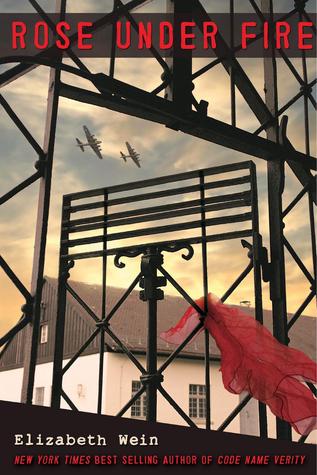
Rose Under Fire by Elizabeth Wein

Share

17262236
Title: Rose under Fire
Author: Elizabeth Wein
Expected Publication: September 10th, 2013 by Miramax (Disney)

Summary: While flying an Allied fighter plane from Paris to England, American ATA pilot and amateur poet, Rose Justice, is captured by the Nazis and sent to Ravensbrück, the notorious women’s concentration camp. Trapped in horrific circumstances, Rose finds hope in the impossible through the loyalty, bravery and friendship of her fellow prisoners. But will that be enough to endure the fate that’s in store for her?

Elizabeth Wein, author of the critically-acclaimed and best-selling Code Name Verity, delivers another stunning WWII thriller. The unforgettable story of Rose Justice is forged from heart-wrenching courage, resolve, and the slim, bright chance of survival.

Review: Out of the thousands of books I’ve read, this one is going to sit among my all-time favorites. There is a phenomenal balance of history and narrative that will engage readers while offering harrowing lessons in history. I am not an air and space girl. My husband loves planes, and he was giddy when we went to the Smithsonian Air and Space Museum in Washington D.C. As much as I want to love planes, I don’t find them to be interesting. This book changed my outlook.

Rose under Fire has many similarities with Wein’s Code Name Verity. They are both written in an epistolary format, involve pilots/airplanes, and are set during World War II. Both offer wonderfully complex themes about friendship, loyalty, and the strength of women. However, Rose under Fire focuses more on concentration camps, while Code Name Verity dealt more with the interrogation techniques used during World War II. Neither of these two elements drove the novels, but they are two plot features that make the texts quite different from one other. I found CNV to be a bit slow in the beginning (which isn’t the case with all readers), but I was hooked to Rose under Fire from the very first page. Wein writes characters so vividly that I still feel their presence in my life, long after I finish the books. I recommend this book to everyone. It will appeal to readers of all ages, backgrounds, genders, and interest levels.

Teacher’s Tools for Navigation: Teachers, this is a MUST-HAVE book. It is phenomenally written and shows the truly complexity of young adult literature. It can be used to teach elements like setting, character, dialogue, the epistolary format, imagery, voice, and theme. Students might write letters back to Rose, or they could analyze one of the many well-developed characters in this story. It would also make for a great research unit of topics like the Nuremberg Trials, female WWII pilots, flying bombs, or the experimentation on Holocaust prisoners. History teachers will also find this text to be invaluable.

Discussion Questions: What loyalties did the Holocaust prisoners have for each other? What are some examples of incidents that showed this loyalty?; Why were the Rabbits so important to the concentration camp? What did they add to the story as a whole?; How does Maddie’s friendship with Rose differ from her friendship with Julie?; Why was Nick’s character important throughout the story? How does his level of importance change, and why?; Rose has very different friendships with many of the characters. Describe how three of these friendships differ from one another.; Does the novel end in a hopeful way? Why or why not?

We Flagged: I marked so many passages that it is hard to choose just a few, so I selected two longer quotes that show the quality of Wein’s writing.

Incredible Imagery:

“…and the reason everyone in there was trying to get out in the rain was because they were dying of thirst.

Really dying of it, I think.

Hands and arms and heads stuck out anywhere there was a gap—cupped hands collecting rainwater, some holding bowls or even just a piece of cloth to collect moisture—I saw one woman lying on her back with her hair in the black cinder mud at the tent’s edge, her mouth open, letting a rivulet of water stream down the canvas and into her mouth.”

And Beautiful Figurative Language:

“Hope—you think of hope as a bright thing, a strong thing, sustaining. But it’s not. It’s the opposite. It’s simply this: lumps of stale bread stuck down your shirt. Stale gray bread eked out with ground fish bones, which you won’t eat because you’re going to give it away, and maybe you’ll get a message through to your friend. That’s all you need.

God, I was hungry.”

Please note: The above quotes are from the Advanced Reader Copy. The e-book (a galley) did not provide page or chapter numbers. The quotes may change when the book is published.

Read This If You Loved: Code Name Verity by Elizabeth Wein, Between Shades of Gray by Ruta Sepetys, Nazi Hunters by Neal Bascomb, Night by Elie Wiesel

Recommended For:

 litcirclesbuttonsmall closereadinganalysisbuttonsmall classroomlibrarybuttonsmall

026F3FBCC8C3913BD3A4D3F6920340D5

Thank you to NetGalley and Disney for sending me the Advanced Reader Copy!
Real Justice: Convicted for Being Mi’kmaq: The Story of Donald Marshall Jr. by Bill Swan

Share

NF PB 2013

Nonfiction Picture Book Wednesday

Nonfiction Picture Book Wednesday is hosted by Kid Lit Frenzy and was started to help promote the reading of nonfiction texts. Most Wednesdays, we will be participating and will review a nonfiction text (though it may not always be a picture book). Be sure to visit Kid Lit Frenzy and see what other nonfiction books are shared this week!

17198555

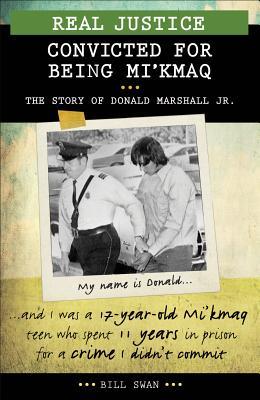
Real Justice: Convicted for being Mi’kmaq: The Story of Donald Marshall Jr.
Author: Bill Swan
Expected Publication: September 1st, 2013 by James Lorimer & Company

Summary: This book is part of the Real Justice series by James Lorimer & Company that shed light on young people who are wrongfully convicted of crimes. Donald Marshall Jr. spent eleven years in prison for a crime he never committed. He was the eldest son of the Grand Chief of the Mi’kmaw Nation, and racism certainly played a role in his conviction. It was a late night in Wentworth Park when Sandy Seale, a black teen, and Donald Marshall Jr. are waved over by two drunk men wanting cigarettes. One of the men stabs Sandy Seale in the side, and Donald Marshall Jr. runs for help. What he doesn’t know is that the police won’t believe his story, and they will do anything they can to convict him of the Seale’s death.

Review: I enjoyed the journalistic format of this book. Swan does an excellent job researching and depicting the facts of the case. He goes into depth when in his description of each witness’s story, and the reader gets a comprehensive background of the crime scene, investigation, and trial. As a Micmac Indian (the American version of this tribe), I was very interested in this story. Admittedly, I was a bit disappointed that aside from the comments about racism and a brief note toward the end of the book, there wasn’t much information about the Mi’kmaq Indians. I completely understand this, as the author chose to focus more on the investigation and trial, but I was secretly craving more information about Donald Marshall Jr.’s life background and customs. This text would make for a great nonfiction text to use in the classroom.

Teacher’s Tools for Navigation: I love teaching nonfiction units because there is so much variety. Teachers can offer myriad choices of memoirs and informational nonfiction for students to do research. After reading this story, students might research more about the case (if any other information is available) or they could compare and contrast this case with another example of injustice, particularly one that was impacted by racism. I have a feeling that students, like me, will want to research more about Marshall’s culture or the racial imbalance that existed at the time of the crime. I could also see this being paired with Black and White by Paul Volponi, an example of realistic fiction that also deals with injustice due to racism.

Discussion Questions: Does racism still exist today? In what ways did it impact the crime, investigation, and trial? What injustices did you see?; Do you think Marshall should have been compensated more for his eleven years in jail?; How does Marshall show incredible strength throughout his ordeal?

We Flagged: “‘Know what I think?’ MacIntyre added, as though on cue. ‘I think Marshall’s description of some old guy is a crock. The whole thing likely happened when that Indian, fueled up with fire water, got in an argument with the black kid'” (Chapter 5).

“When the reality hit [Donald Marshall Jr.], he cried the tears of childhood” (Chapter 15).

Please note: The above quotes are from the Advanced Reader Copy. Chapter numbers are included instead of page numbers because the e-reader did not provide page numbers. The quotes may change when the book is published.

Read This If You Loved: Hole in my Life by Jack Gantos, Black and White by Paul Volponi, other books in the Real Justice series, other books about Law and Order

Recommended For:

classroomlibrarybuttonsmall

RickiSig

The Fifth Wave by Rick Yancey

Share

16101128

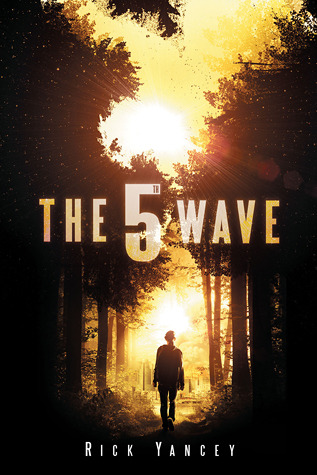
The 5th Wave
Author: Rick Yancey
Published May 7th, 2013 by Putnam Juvenile

Summary: Aliens (and not the green, one-eyed ones we see in movies) invade Earth in waves. When the novel begins, the fourth wave has happened, and only the unlucky remain. If they wish to survive, they can trust no one. Cassie is alone, and she believes she is destined to be alone forever until she encounters Evan Walker. He turns her world upside down, defying all beliefs she holds about the world since the fourth wave. Now, she isn’t sure what she believes anymore.

Review: If you buy one book for your classroom this summer, this is the one to buy. I foresee it becoming as popular as The Hunger Games series. It is extremely engaging and very well-written. There are many plot twists that caused me to gasp and look around the room to see if anyone else was just as shocked. (My husband was sleeping.) The plot twists make it very difficult to review this book without giving much away. This is one of those books that teachers can put in their classrooms and expect the students to do the work, recommending it to others.

Teacher’s Tools for Navigation: The themes of this book are complex, which would make for fantastic conversations in the classroom. This is not an empty science fiction–adolescents will learn about trust, loyalty, and integrity. It would be a great novel to teach students about what it means to be human. Teachers might ask students what Yancey’s purpose for writing this novel might be. Is he trying to teach what it means to be human or might he be offering an opinion about other-worldly threats? It would be an excellent model to teach shifting narration, as the book often shifts points-of-view, allowing readers to see a different glimpse of Yancey’s world. Each point-of-view is complex with rich characterization, and what I liked most was that the chapters didn’t alternate. Rick Yancey was a bit unconventional, in that he seemed to switch points of views when it best served his purpose. Each character didn’t get an even number of pages or chapters–the story took precedent over the structure.

Discussion Questions: Are we, as humans, innately selfish?; Should we trust others if it might be a risk to ourselves?; Are there limits to the lengths you would go to in order to survive?; How does this book differ from other literature in its depiction of aliens?; What does it mean to be human?; What was Yancey’s purpose in writing this novel?

We Flagged: “But if I’m it, the last of my kind, the last page of human history, like hell I’m going to let the story end this way. I may be the last one, but I am the one still standing. I am the one turning to face the faceless hunter in the woods on an abandoned highway. I am the one not running but facing. Because if I am the last one, then I am humanity. And if this is humanity’s last war, then I am the battlefield.”

“How do you rid the Earth of humans? Rid the humans of their humanity.”

Read This If You Loved: The Hunger Games series by Suzanne Collins, Divergent series by Veronica Roth, The Monstrumologist series by Ricky Yancey, The Host by Stephanie Meyer, Legend by Marie Lu

Recommended For:

litcirclesbuttonsmall closereadinganalysisbuttonsmall classroomlibrarybuttonsmall

Happy 4th of July, everyone! This text is sure to set off fireworks in your classroom (insert cheesy grin here).

Have you read it yet? Please, please share your thoughts!

026F3FBCC8C3913BD3A4D3F6920340D5