Q&A with Nadine Presley, Author of A Ramadan Night

Share

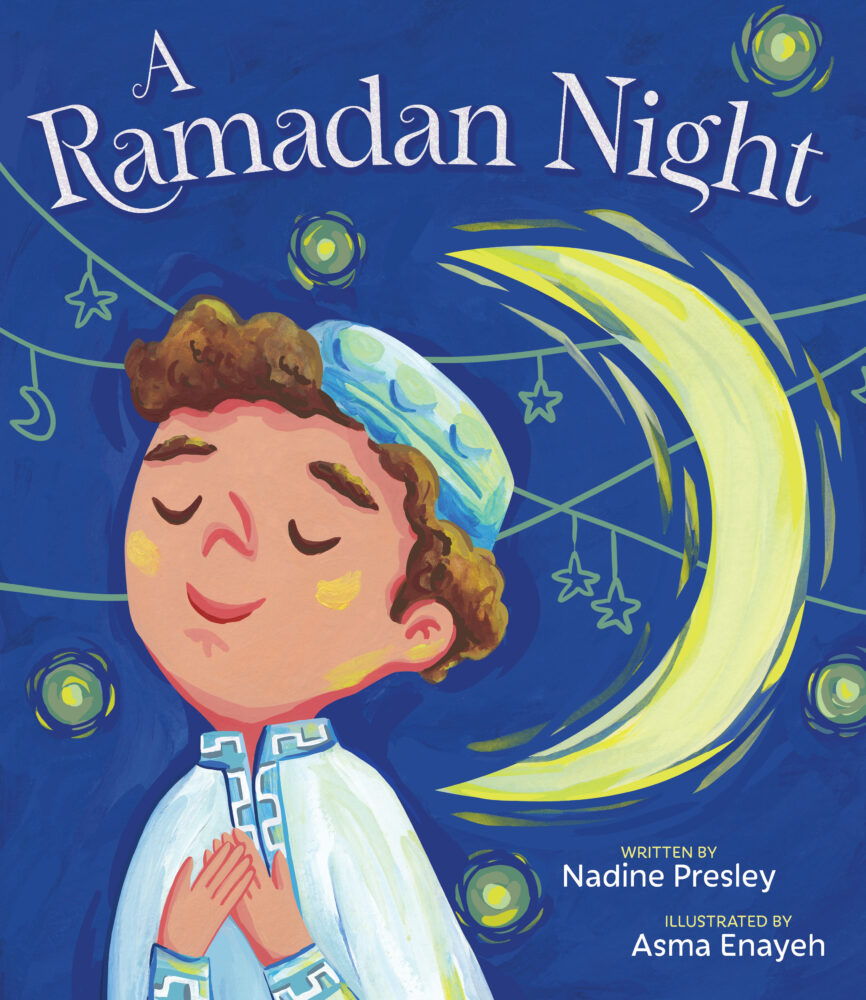
A Ramadan Night
Author: Nadine Presley
Illustrator: Asma Enayeh
Published

Summary: Celebrate the beginning of Ramadan with a young boy and his father in this nighttime sensory picture book that celebrates the wonder, excitement, and peace of the holiday!

The call for prayer hugs tight the sky of Damascus on the first night of Ramadan. As steps flutter to fill spaces in mosques, Sami sets out on a nighttime walk with Baba to answer his what does a Ramadan night feel like?

Through an evening full of sounds and sights and scents, Sami feels the celebration of community. He feels the connection and calm of prayer. He feels the delight of a late-night dessert. He feels the joy of generosity.

He feels…a Ramadan night.

I am so excited to share this Q&A with author Nadine Presley: 

  1. What inspired you to write A Ramadan Night, and what parts of Ramadan were most important for you to include?

I knew I wanted to write a Ramadan book, and I knew I wanted it to capture the wonder, excitement, spirituality, and anticipation that fill the month, especially through a child’s perspective. To begin, I asked children what their favorite part of Ramadan was. Many said the food, which is completely fair, but most of them said the nights. I immediately responded, “Me too.” That was the spark. That was where the story truly began.

I drew deeply from my own childhood memories of growing up in Damascus. I remember walking to the mosque each evening with my prayer rug in hand, noticing the families filling the streets, the way the moon seemed to follow us overhead, the echoes of salaam greeting us at the door. I remember the stillness of prayer, whispering du‘a in sujud, and the quiet sense of accomplishment afterward, especially knowing that something sweet was waiting at home. Those nights felt expansive and intimate all at once, and they have stayed with me.

It was important for me to show that while Ramadan is often understood simply as a month of fasting, it is truly layered and multidimensional. Fasting is central, of course, but Ramadan is also about community, connection, spirituality, prayer, generosity, shared meals, reading Qur’an, and the small childhood joys like staying up past your bedtime. It was important to me to portray Ramadan as an immersive experience, centre atmosphere and emotion rather than explanation, allowing readers not just to learn about Ramadan, but to feel it.

  1. What do you hope students take away from this story?

I hope students come away understanding that traditions, whether their own or someone else’s, are meaningful and worth celebrating.

For Muslim children, I hope the book feels like a warm reflection of their lived experiences. I hope they see their nights, their mosques, their Baba, their desserts, and their joy represented with care and authenticity.

For non-Muslim readers, I hope the story sparks curiosity and empathy. I hope it expands their understanding of Ramadan beyond fasting and invites them into its beauty through connection rather than explanation.

  1. What do you hope young readers feel when they finish the book?

I hope they feel wonder.

I hope they feel the quiet magic of nighttime, the comfort of walking beside someone you love, and the warmth of belonging to something bigger than yourself.

For some children, I hope the book feels familiar, like looking into a mirror. For others, I hope it feels like a window, opening into a new and beautiful experience.

Most of all, I hope they feel warmth.

  1. What was your collaboration process like with your illustrator?

Picture books are such intimate collaborations, and it was incredibly moving to watch the story come to life visually.

One of the most special aspects of this collaboration was something we didn’t even plan. The mosque I had in mind while writing was the Mosque of Badr in Damascus, one of my favorite mosques that I used to go to as a child. Without us ever discussing it, Asma chose to feature that same mosque in the book. When I saw the illustrations, it stopped me in my tracks. It felt like such a tender and beautiful coincidence, almost as if memory itself had guided us both to the same place.

I also love the care given to the details, the architectural elements, the mosaic dome, the warmth of the family’s expressions, the way Syria feels present in the atmosphere of the scenes. And Sami’s little slippers with socks, that detail makes me smile every time. The slippers are such a familiar Syrian masjid look, and it captures the specificity and charm of childhood so perfectly.

The illustrations didn’t simply accompany the text, they expanded it. They added texture, depth, and visual emotion in ways that made the story feel even more lived-in and real.

All in all, it was a truly wonderful experience working with Asma Enayeh, and I am so grateful that our editor, Celia Lee, created what felt like the perfect match.

  1. What does authentic representation mean to you in the context of this book?

Authentic representation, to me, begins with emotional truth and cultural specificity. It lives in the small details, the spirituality woven naturally into the night, the rhythm of footsteps on the way to prayer, the way families exchange salaam, the softness and stillness of sujud, the use of familiar and unapologetic terminology.

It was especially important to me to portray an Arab Muslim Baba in a way that feels warm, loving, and proud. Too often in literature, Arab fathers are reduced to stereotypes or positioned at a distance. I wanted this Baba to reflect the fathers I know, engaged, affectionate, spiritually grounded, playful, and fully present in their child’s world. A father who walks beside his child, guides him gently, and shares in the wonder of the night.

Authenticity also meant resisting the urge to over explain. I didn’t want the story to feel like a lesson about Ramadan. I wanted it to feel like Ramadan. By centring atmosphere, emotion, and lived experience, the book becomes immersive rather than instructional.

Muslim children deserve to see their lives reflected with dignity, beauty, and nuance. And non-Muslim readers deserve the opportunity to step into that world through story, through curiosity, connection, and shared humanity rather than simplification.

  1. If teachers or librarians wanted to use A Ramadan Night in their classrooms or libraries, what conversations or activities would pair well with it?

I would love for A Ramadan Night to be used as a doorway into conversation, creativity, and connection. Because the story is written as a sensory experience, one natural extension is inviting students to reflect on a special night in their own lives. Teachers might encourage them to write using the five senses. What did the air feel like? What sounds filled the space? What smells or tastes stand out in their memory? This helps children see how everyday moments can become meaningful stories.

The book can also open rich discussions about family traditions and community. Students can share celebrations or rituals that are important in their homes, whether religious or cultural, and notice the common threads that often run through them such as togetherness, gratitude, generosity, connection, and joy. These conversations help children see both the uniqueness and universality of traditions.

Because the story unfolds at night, educators might also explore how nighttime shapes mood in storytelling. What makes staying up late feel magical? How does darkness heighten our senses or make familiar places feel different? This can lead to thoughtful conversations about setting and atmosphere in literature.

Ramadan is also a month centred on generosity and care for others. Classrooms or libraries might extend the themes of the book into a small act of service, such as writing thank-you notes, organizing a donation drive, or brainstorming ways to practice kindness in everyday life. This helps students see that the values in the story are not abstract, but lived.

Finally, I hope the book creates space to talk about representation, why it matters to see yourself reflected in stories, and why it is equally important to read about experiences that may be different from your own. Those conversations build empathy, curiosity, and respect.

Ultimately, I hope A Ramadan Night creates room for wonder, connection, and meaningful dialogue in classrooms, libraries, and homes alike.

About the Author: Nadine Presley is a Syrian Canadian author who loves everything about Ramadan. Her earliest memories of Ramadan go back to her days in Damascus, where she joyfully awaited the month to begin. She now resides in Canada with her husband and three boys, working as a literacy educator. Passionate about anti-racism work and promoting pride in Arab Muslim heritage, she is also a speaker for children, youth, and adults. Her favorite things in the world are big hugs, kind words, and delicious Syrian food—especially during Ramadan.

Thank you to Nadine for this fantastic Q&A and to Simon & Schuster for settig it up!

Signature

Educators’ Guide for A Universe of Wishes Edited by Dhonielle Clayton

Share

A Universe of Wishes
Editor: Dhonielle Clayton
Authors: Tara Sim, Natalie C. Parker, Libba Bray, Anna-Marie Mclemore, Kwame Mbalia, V.E. Schwab, Rebecca Roadhouse, Nic Stone, Jenni Balch, Dhonielle Clayton, Mark Oshiro, Samira Ahmed, Tessa Gratton, Zoraida Cordova, Tochi Onyebuchi
Published: December 8th, 2020 by Random House Children’s Books

Summary: From We Need Diverse Books, the organization behind Flying Lessons & Other Stories, comes a young adult fantasy short story collection featuring some of the best children’s authors, including New York Times bestselling authors Libba Bray (The Diviners), V. E. Schwab (A Darker Shade of Magic), Natalie C. Parker (Seafire), and many more. Edited by Dhonielle Clayton (The Belles).

In the fourth collaboration with We Need Diverse Books, fifteen award-winning and celebrated diverse authors deliver stories about a princess without need of a prince, a monster long misunderstood, memories that vanish with a spell, and voices that refuse to stay silent in the face of injustice. This powerful and inclusive collection contains a universe of wishes for a braver and more beautiful world.

Teachers’ Tools for Navigation and Discussion Questions: 

Please view and enjoy the educators’ guide I created for We Need Diverse Books for A Universe of Wishes:

You can also access the educators’ guide here.

You can learn more about A Universe of Wishes on We Need Diverse Book’s page.

Recommended For: 

readaloudbuttonsmall classroomlibrarybuttonsmall litcirclesbuttonsmall closereadinganalysisbuttonsmall

Kellee Signature

Educators’ Guide for Ferris by Kate DiCamillo

Share

Ferris
Author: Kate DiCamillo
Published: April 1st, 2025 by Candlewick Press

Summary: It’s the summer before fifth grade, and for Ferris Wilkey, it is a summer of sheer pandemonium: Her little sister, Pinky, has vowed to become an outlaw. Uncle Ted has left Aunt Shirley and, to Ferris’s mother’s chagrin, is holed up in the Wilkey basement to paint a history of the world. And Charisse, Ferris’s grandmother, has started seeing a ghost at the threshold of her room, which seems like an alarming omen given that she is also feeling unwell. But the ghost is not there to usher Charisse to the Great Beyond. Rather, she has other plans—wild, impractical, illuminating plans. How can Ferris satisfy a specter with Pinky terrorizing the town, Uncle Ted sending Ferris to spy on her aunt, and her father battling an invasion of raccoons? As Charisse likes to say, “Every good story is a love story,” and Kate DiCamillo has written one for the ages: emotionally resonant and healing, showing the two-time Newbery Medalist at her most playful, universal, and profound.

Teachers’ Tools for Navigation and Discussion Questions: 

Please view and enjoy the educators’ guide I created for Ferris:

You can also access the educators’ guide here.

You can learn more about Ferris on its publisher’s page.

Recommended For: 

readaloudbuttonsmall classroomlibrarybuttonsmall litcirclesbuttonsmall closereadinganalysisbuttonsmall

Kellee Signature

Giant Rays of Hope: Protecting Manta Rays to Safeguard the Sea by Patricia Newman

Share

Giant Rays of Hope: Protecting Manta Rays to Safeguard the Sea
Author: Patricia Newman
Published October 1st, 2024 by Lerner Publishing Group

Summary: Off the coast of Perú, gentle giants swim beneath the waves. Thanks to the work of Kerstin Forsberg, giant manta rays have become a symbol of hope for ocean conservation in the region. Mantas are a flagship species, and when they’re protected, the whole ocean ecosystem benefits.

Kerstin, who founded the organization Planeta Océano, has taken a new approach to ocean conservation. Previous conservation projects were often led by scientists from other places who didn’t work with the local people. When Kerstin decided to help manta rays, she sought the opinions of local fishers and educated them about the dangers of overfishing, bycatch, and poaching—things that affect both manta rays and fishers. She also involved local schools and teachers.

With the help of teachers, students, and fishers, Kerstin launched a project to identify and track manta rays and protect them, making the ocean a better place for all creatures. Dive in with author Patricia Newman and explore how taking care of the ocean can benefit everyone!
About the Author: Patricia Newman wants us all to know we are part of nature. As a Robert F. Sibert Honor recipient, she shows us how our actions ripple around the world, empowers us to find our own connections to nature, and encourages us to use our imaginations to act on behalf of our communities. Her nonfiction titles have received multiple starred reviews, Orbis Pictus Recommended Awards (NCTE), Green Earth Book Awards, and several Eureka! Awards. She is based in California.

Review: I love learning new things, and Patricia Newman always delves into topics in such interesting ways that will make any reader want to not only read the entire book but also want to investigate further to learn as much as possible about it.

In this book, I dove (pun intended) into the world of manta rays: their uncertain future, their truly phenomenal elegance and uniqueness, and lots of information about environmental factors. I also learned about how much difference one person can make. This book is a call to future activists, a call for all animal lovers, and a call for all humans to see more than what we normally see.

I am also impressed how Newman wrote an entire book about manta rays but by the end, the reader has thought about so much include flagship species, collaboration, negotiation, activism, the ocean in many different ways, cause and effect, and so much more.

Once again a truly fascinating and informative book has been gifted to us readers by Patricia Newman.

Teachers’ Tools for Navigation and Discussion Questions: 

In the standards-aligned guide provided by Lerner, educators can find lessons about manta ray anatomy, bycatch simulation, the challenge of overfishing, plotting manta sightings, civic role models, and exploring plankton.

The guide’s objectives are:

  • To help students understand our unbreakable connection to the ocean and we affect it.
  • To encourage and empower students to become a voice for the ocean in their homes, schools, and communities.
  • To help students become better science communicators

The guide focuses on Ocean Literacy Standards & Principles as well as United Nations Sustainable Developmental Goals

You can also access the educators’ guide here.

Book Trailer: 

Flagged Spreads: 

Read This If You Love: Nonfiction books about animals, environmental issues, and/or conservation efforts

Recommended For: 

classroomlibrarybuttonsmall 

Signature

**Thank you to the author for providing a copy for review!**

Educators’ Guide for The Hotel Balzaar by Kate DiCamillo, Illustrated by Júlia Sardà

Share

The Hotel Balzaar
Author: Kate DiCamillo
Illustrator: Júlia Sardà
Published: October 1st, 2024 by Candlewick Press

Summary: In a wise and magical follow-up to The Puppets of Spelhorst, Kate DiCamillo revisits the land of Norendy, where tales swirl within tales—and every moment is a story in the making.

At the Hotel Balzaar, Marta’s mother rises before the sun, puts on her uniform, and instructs Marta to roam as she will but quietly, invisibly—like a little mouse. While her mother cleans rooms, Marta slips down the back staircase to the grand lobby to chat with the bellman, study the painting of an angel’s wing over the fireplace, and watch a cat chase a mouse around the face of the grandfather clock, all the while dreaming of the return of her soldier father, who has gone missing. One day, a mysterious countess with a parrot checks in, promising a story—in fact, seven stories in all, each to be told in its proper order. As the stories unfold, Marta begins to wonder: could the secret to her father’s disappearance lie in the countess’s tales? Book two in a trio of novellas bound by place and mood—with elegant line art by Júlia Sardà—The Hotel Balzaar masterfully juggles yearning and belief, shining light into every dark corner.

Teachers’ Tools for Navigation and Discussion Questions: 

Please view and enjoy the educators’ guide I created for Candlewick:

You can also access the educators’ guide here.

Recommended For: 

readaloudbuttonsmall classroomlibrarybuttonsmall litcirclesbuttonsmall closereadinganalysisbuttonsmall

Kellee Signature

Drawn Onward by Daniel Nayeri, Illustrated by Matt Rockefeller

Share

Drawn Onward
Author: Daniel Nayeri
Illustrator: Matt Rockefeller
Published October 8th, 2024 by HarperCollins Children’s Books

Summary: In this enthralling and emotional palindrome picture book by Daniel Nayeri and Matt Rockefeller, a young boy grieving the loss of his mother embarks on a lushly fantastical adventure that illuminates what remains when our loved ones are gone.

All alone

He was not so brave…

His heart needed to know

The answer.

This lyrical, heartfelt story a young boy who’s lost all hope braves the dark forest to ask, “Mom, were you glad you were mom?” Gorgeously illustrated, Drawn Onward gently guides readers through the depths of grief and provides comfort and hope to those who seek answers when it feels like all is lost.

Praise: 

⭐“Magnificently illuminated, video game–like spreads by Rockefeller feature stone ruins, menacing dragons, and ornaments that give the pages a book-of-hours feel. Printz Medalist Nayeri, meanwhile, distills an experience of grief, imparting the importance of seeking time alone to relive moments of shared love.” — Publishers Weekly (starred review)

⭐“A touching triumph of artful collaboration between wordsmithing and world building. Nayeri’s text is sparse but heartrending, sparking large questions that drive readers forward and allowing Rockefeller ample space to construct an evocative fantasy world.” — Booklist (starred review)

⭐“A grieving young boy goes on an impossible adventure and returns, healed. The illustrations are so filled with detail that they demand repeat visits, which will prompt little ones and their grown-ups to delve into the ellipses and explore both text and subtext further.” — Kirkus Reviews (starred review)

About the Creators: 

Daniel Nayeri likes to read things backward even when it doesn’t make sense to do so. He is the author of Everything Sad Is Untrue (A True Story), winner of the Printz Award, the Christopher Medal, and the Middle Eastern Book Award. He loves letter-unit palindromes, like “toot” and “God’s dog,” and word-unit palindromes, like “Never say never” and “Fall leaves after leaves fall,” and if he didn’t say how much he likes and loves his wife and son, he wouldn’t be Daniel Nayeri.

Matt Rockefeller is a visual storyteller inspired by adventuring in the mountains, interpretive dancing with friends, and pondering the many wonders of the universe. In addition to drawing and writing comics, he creates artwork for TV and film animation. He lives in Portland, Oregon, with his family including a little dog that may or may not be a fox.

Review and Educators’ Tools for Navigation: This sparsely-worded text has so much to say. It has so many beautiful layers that readers can dive into. Nayeri’s storytelling is clear, even with little text, and Rockefeller’s illustrations are reminiscent of video games and epics. Drawn Onward is perfect for lessons on visual literacy as the text gives some guidance to the reader but the story is most clear through images. Students could could even write their own narrative to add to the images! And I also would love to hear a conversation of readers discussing the symbolism and theme of the book.

Discussion Questions: 

  • What is the theme of the story?
  • Why do you think the author chose to title the book a palindrome?
  • How was the story symbolic of a palindrome?
  • What do you think the forest symbolized? The sword? The dragon? The dark? Did you notice any other symbols?
  • What strategies did the illustrator use to portray the narrative and emotions through the images?
  • How does this book reflect a hero’s journey?
  • How does the tone and mood of the book change from beginning to middle to end?

Flagged Spreads:


Read This If You Love: Journey by Aaron Becker, Zelda

Recommended For: 

classroomlibrarybuttonsmall 

Signature

**Thank you to HarperCollins for providing a copy for review!**

Cross-Curricular Educators’ Guide for Above the Trenches by Nathan Hale

Share

Above the Trenches (Nathan Hale’s Hazardous Tales #12): A WWI Flying Ace Tale
Author & Illustrator: Nathan Hale
Published: November 14th, 2023 by Abrams Fanfare

Summary: In Above the Trenches, author-illustrator Nathan Hale takes to the skies with the flying aces of World War I to reveal another Hazardous Tale in American history in the #1 New York Times bestselling graphic novel series.

“Yippee! We’re going back to World War One!” said nobody ever—except maybe the Hangman.

When the Great War began in 1914, America had plans to stay out of it. But some young men were so eager to fight, they joined the French Foreign Legion. From deep in the mud and blood of the Western Front, these young volunteers looked to the sky and saw the future—the airplane.

The first American pilots to fight in World War One flew for the French military. France created a squadron of volunteer Americans called the Lafayette Escadrille (named after the great Marquis de Lafayette).

This book is about that volunteer How they got into the French military. How they learned to fly. How they fought—and died. And how these American pilots would go down in history with other legendary flying aces like the Red Baron and his Flying Circus.

Nathan Hale’s Hazardous Tales are graphic novels that tell the thrilling, shocking, gruesome, and TRUE stories of American history. Read them all—if you dare!

Teachers’ Tools for Navigation and Discussion Questions: 

Please view and enjoy the cross-curricular educators’ guide I created for Abrams for Above the Trenches:

You can also access the educators’ guide here.

You can learn more about Above the Trenches on Abrams’s page.

Recommended For: 

classroomlibrarybuttonsmall litcirclesbuttonsmall closereadinganalysisbuttonsmall

Kellee Signature