Student Voices: Reflections on the Current State of the World from Livie S. and Edie M.

Share

Reflections on the Current State of the World

What prohibits schools from having an active school library? by Livie, 7th grade

Most schools around the United States have a library, but it’s even better if they have an active one. Libraries are essential for student growth in their education. There are many reasons that affect a school library’s ability to do this though. Currently in the United States, there have been many budget cuts and natural events that have had an impact on the library society. In this blog post, I will be discussing many aspects that have an effect on school libraries, and what an active school library consists of

Why Libraries are Important

We are all told that libraries are important at some point or another by various people but the question still remains: WHY? They boost student learning and help to build a closer school community. Libraries are fundamental in the growth of a student and their school career. Studies have proven this, from 2007-2008 having more school libraries that host events like literacy week and are an active part in the well-being of the school, test scores increased drastically, the typical student that would usually be seen getting a 70-80 on standardized literary tests was now seen getting a 90-100. 

Defining the Term

What does it mean by active school library? Active school libraries are libraries that are taking part in school functions such as literacy night. It could also be things as little as taking into consideration what books students would want to read. By taking into consideration I mean having books in libraries that are not only new but also interesting. These are just many ways to define what an active school library really is. 

Budget Cuts

A lot of libraries across America are suffering from budget cuts. This is not just limited to school libraries but does have an effect on them. On Monday, February 10th, 2025, President Trump signed an executive order at the White House that would mandate the reduction of seven governmental agencies, one of which included the IMLS (Institute of Museum and Library Systems) and the Department of Education. The IMLS is a government agency that regulates and funds the country’s libraries and museums while the Department of Education ensures that schools across the country are giving their students what they need. Reducing these agencies means making them smaller, which in turn would mean cutting libraries all across the U.S. This is very important to schools because some of their libraries fall under the category of being cut in the reduction. Seminole County Schools in Florida are primarily without librarians because of this. Yes, while the students still have access to libraries, many do not have an actual librarian or dedicated full-time staff in the library. This affects having an active school library because how can there be events if there is no dedicated librarian to set up events. On another note, because of the ILMS and DOE funding being cut, several school libraries are without a clerk, deeply affecting the library setting because now all jobs are placed on the librarian’s shoulders. 

Expectations of Student Learning

While all of this is happening students are still expected to get high test scores. If students do not have the adequate resources at their usage how is it fair to expect this. It is scientifically proven that students with access to resources in a school library perform higher on tests. Many books in the library would have words a student may not have seen before and that is to their benefit; it leads them to ask questions or even look it up. This helps students grow their vocabulary and comprehension skills. Nonfiction books exist to inform people about the real world. While fiction is a great escape from reality… reality is still there and students, and especially adults, need to be informed. History books are especially crucial to make sure that history does not repeat itself (although that may be happening). 

Expectations on Librarians Themselves

Sometimes, or rather most times, librarians are expected to be more than just a librarian. They are expected to host many events throughout the year, such as setting up picture day, distributing laptops, state testing, and even writing the school newsletter. These jobs by themselves wouldn’t be too much to ask of a staff member because most of them happen at different times throughout the year but to also expect librarians to maintain the inviting atmosphere of the library and be an educator within the school while doing these tasks every week/month is unreasonable. While picture day and distributing laptops is not a weekly thing, yearbooks and weekly newsletters are. The librarians may also be asked to sub for other classes if that class is without a sub thus leaving the library unable to be attended or open on that day. Essentially, librarians are being treated not as teacher with a daily job but as disposable. You shouldn’t ask a teacher to stop teaching that day’s lesson just because they needed some copies made or someone to handle behavior, but sadly that is what is happening to most librarians across the U.S. Most libraries are called a media center because the title makes it so that the librarians can be called media specialists, expanding the jobs they can be asked to do. 

Statistics: Decrease in Librarians

Covid has had a big effect on the school librarian population. A study was done in 2020-2021 to reflect this and here are some of the facts from this study. 

  • 29.5% of schools across America reported not having librarians or not having a designated staff member for the library. 
  • Seven out of ten charter schools are without a full time librarian
  • 37.8% of western schools were without librarians, while southern schools had 22.2% of schools without librarians. 
  • Smaller schools (less than 200 students) were more likely to have their library cut
  • Bigger schools (2,000+ students) had an increase in the number of schools without librarians 10.8% to 16.3% 
  • 34.9% of city schools reported no librarian
  • 29.5% of town schools had no librarian
  • 57% of combined schools (k-8, k-12) had no librarian or library program at all
  • 33.8% of hispanic schools had no librarians
  • 32.5% of poverty serving schools (schools that their main population are students living in poverty) are without a librarian
  • The states with the highest percentage of schools without librarians are: Alaska(55.2%), Minnesota(50.6%), Hawaii(50.2%), West Viginia(50%), Michigan(49.9%). 

These facts are quite sad because literacy is an important part of student learning. Librarians are the fundamental base for a good library and without them libraries are unable to thrive as much as a library with a librarian.

Comparatives

Examples of an active school library and what it looks like:

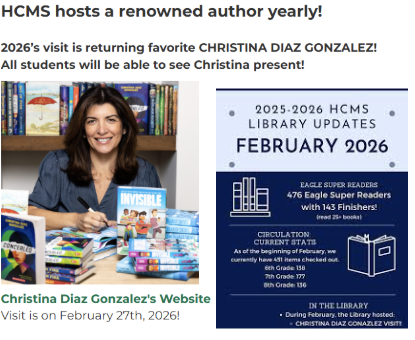
Hunter’s Creek Middle School (the school I go to) has one of the most active school libraries I can think of and one of the most active school librarians. Yes, I am a little biased but there is evidence to support this. Every year we have an author visit the school, this year we had three, but we still have at least one every year. This is to “advertise” reading to the students. As students visit the author in their ELA classes they get an in person talk with the author. I, for one, have certainly been encouraged to read these authors’ books after I have seen them. Another example is that we host literacy night every year for the coming author to encourage their books. We have rooms set up around the campus that are related to the author’s books. This year, we invited the 5th graders from their elementary school so that they could walk around the school and get familiar with our campus. We also have a Google form where students can fill out what books they would like to see in our library. Although, it does take some time to get these books in the library, the books almost always end up in our library. On another note, there is a reading challenge called Eagle Super Reader that is a paper that you fill out with twenty-five books you’ve read throughout the year and get prizes plus an end of year party. This really encourages kids to read because who wouldn’t want to skip school for a day and hang out in the library? This is just a little bit of the whole lot Ms. Moye does for our library and our school. All of these things and events she sets up all help make reading a little more fun for the students. They help to encourage students to read more, expanding their vocabulary and making them more educated. This is one example of an active school library and its effect on the students of which it serves.

Conclusion

In a nutshell, active school libraries are an excellent resource to have but there are certain obstacles that lessen one’s ability to do so. Such as budget cuts and the absence of a full-time librarian. There are schools that have been able to pull this off though, and that has greatly impacted student learning and reading capabilities. All in all, having an active school library is an amazing thing that I hope more students will get the opportunity to have in their educational careers.

Is The Hunger Games our future? by Edie, 8th grade

After reading Layla N.s’ post from last year (https://www.unleashingreaders.com/29146) I was inspired to expand, in light of more recent events (mid 2025-now) like issues regarding much more pressing matters. Such as a major increase in wrongful/ unjust (no fair trial) or violent deportations and racism by ICE (Immigrations and Customs Enforcement), there has also been an increase homelessness and inadequate housing all over the world that was not discussed in the previous post. There has also been another development since the first post; the announced Patriot Games happening summer 2026, which provide many parallels to The Hunger Games universe. The Hunger Games is a dystopian book series converted into movies. Here is a short summary of the plot: There are 12 districts in the country of Panem (originally 13 districts, just like the original 13 colonies!). The Capitol controls all of the districts, in an elected dictatorship type of way, and Panem (the country with all the districts/where The Hunger Games take place) is run with an extremely tyrannical government. Each district provides something for the Capitol, however they cannot trade with other districts, and are forbidden to leave the one they were born in.. Except if they are reaped. The reaping was installed after the districts rebelled against the Capitol and failed, as a punishment for them. The reaping is a part of The Hunger Games, in which the reaping is how they get there. To remind them that the Capitol is always stronger, but also to remind them how “generous” they are. I will explain more of The Hunger Games in their comparison section to the upcoming Patriot Games, but for now that is where I will end the summary. The 3 topics during this post are: Law Enforcement, The Hunger Games vs. The Patriot Games, and Quality of Life. 

Law Enforcement
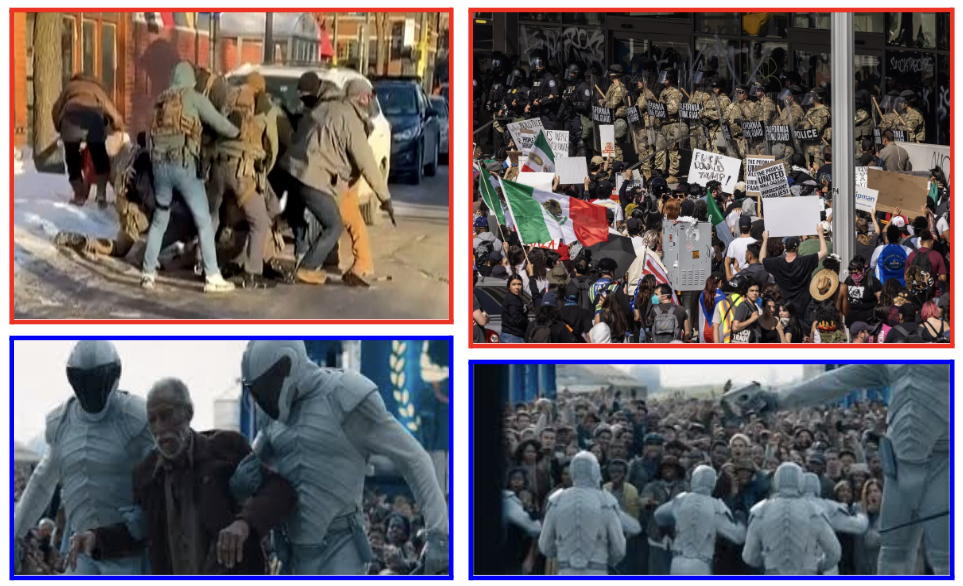
In this section of the post I will be showing and comparing the law enforcement in The Hunger Games vs. The law enforcement in the U.S.. Starting off, the image on the upper right shows people protesting against ICE (Immigration & Customs Enforcement). President Trump thought this was un-American and deployed the National Guard (to go against their own country!), just because of people simply exercising their 1st amendment rights. The image below shows a similar circumstance, but in The Hunger Games. Peacekeepers (who are the law enforcement in the books), are holding back people protesting against The Hunger Games (also fighting against their own country). 

Continuing to the images on the left, both show law enforcement officers holding down protesters, who were later shot dead by those same officers. The one on top shows Alex Pretti, who was filming a detaining by ICE, and mere minutes later, was killed by them. He approached a vehicle with his phone, recording a conflict (he was not prior involved in) with ICE agents. After the person ICE was having a conflict with ran into Alex for safety during the protest, the ICE agent took him as a threat. The agent immediately pepper sprayed him to the ground, and more ICE agents held him and started hitting him. Once the agents removed his (Alex Prettis’) legal carrying firearm, they decided he was still a threat; beaten and bloodied. They then brought out one of their own guns and shot him 10 times.The image below that shows an unnamed man in The Hunger Games series being lifted up on stage, and later shot, because he used a sign of rebellion: lifting the 3 middle fingers and whistling a tune from their district (the same district where a 12 year old girl got murdered in The Hunger Games: District 11). The constitution most likely does not matter/ no longer exist in The Hunger Games universe and it was probably legal for Peacekeepers to do this. It is not legal today. Though the 2 situations are awfully similar: murdered because of protesting. Why are our Constitutional rights slowly disappearing?

The Hunger Games v.s The Patriot Games

“The Patriot Games” “The Hunger Games”. One. Word. Off. The Patriot Games is an event President Trump announced for 2026, to celebrate America’s 250th year of freedom from Great Britain. They require 1 male and 1 female tribute from each state. These tributes for being the top high school student athlete in the state (you read that right; high school; children). Then, they will go to the capital (D.C.) and fight for their (the Capitals) entertainment, and it is unstated whether this will continue annually. The Hunger Games was created by the capitol after the districts lost a rebellion/war to them. It was to show them that they were superior, and was like an annual punishment. The rules were that 1 male and 1 female (ages 12-18) will be reaped (chosen) from each territory. Reaping day was on July 4th/Americas’ Independence Day. The parallels are obvious. 1 male and 1 female child selected from each territory to go fight in the Capitol, for the Capitols enjoyment. Now what happens to the tributes in the Patriot games who do not win is unstated, whether they get anything, or just go home. Luckily it is not a fight to death scenario , but the winners are bathed in riches just as the victor in The Hunger Games. These rules play into what the Capitol stated in The Hunger Games, ruling that the games are used to show that they will always be more powerful, and then the winner being shown mercy and money is a reminder of their “generosity”.

Quality of Life
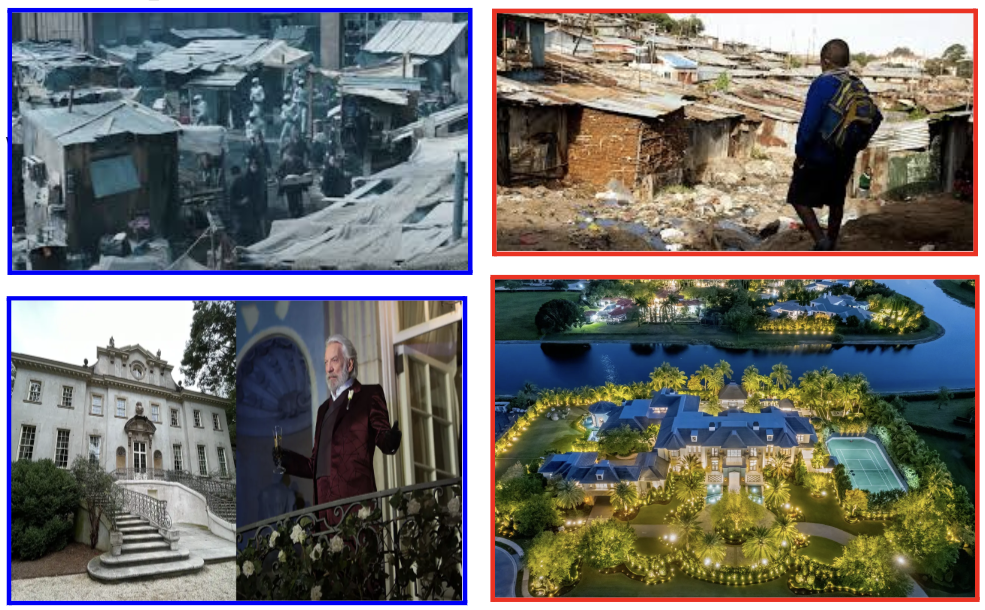
Next, quality of life in the world now versus quality of life in the districts. Starting off, world hunger is a very prominent issue and affects almost 1/10th of the population. Homelessness affects roughly 3% of the world population. These problems lead to awful living in many countries (as shown in the image on the upper right). In the districts from The Hunger Games, specifically district 12, we see lots of horrible living conditions along with many people starving. We even see this in the main character herself (Katniss Everdeen), nearly starving to death, simply because her district didn’t get enough rations for the winter. We also see people living on the streets, or in extremely small and damaged homes (upper left photo), much like present day poverty which affects 9% of the population. Through these we see many similarities with the way people live in these 2 worlds; on the worse side of it.

Now with people on the better side; I am going to compare citizens in the Capitol of Panem, and the billionaires of our world. The amount of rich people in Panem compared to the amount of people in the districts (living in lesser quality of life) is miniscule, yet they rule the country. They usually have ridiculously pricey houses, and outfits (lower left photo). The billionaires in our world are also extremely few (3000 out of more than 8 billion people!). Our billionaires normally have expensive extravagant clothing and homes (lower right), much like the capitol people. Though in small quantities, they have huge influences on our world, through them affecting political standpoints with money. The people who donate are in the 100s; yet every single one of them could obviously spare some of their money that could make a huge difference, but somehow, they are taxed less.

Conclusion

When reading or watching The Hunger Games( or if you haven’t read or watched the series, I hope this post convinced you to do so) you sided with the resistance to The Games/ Capitol right? Why are people still supporting the current state of our country and world when they can clearly see where we could be headed? The similarities between the two universes ( our Earth and The Hunger Games world) are apparent. As of right now, the amount of states in the U.S. who support this is decreasing, but there are still some who will do nothing but praise our way of life. Like in Mockingjay (3rd book in The Hunger Games) in District 2, where loyalty to the Capitol runs deep, they were the last one to surrender and join the rebellion, before the resistance stormed the Capitol. It will take time, but I believe eventually everyone will join the resistance just like in Mockingjay and overthrow our upcoming tyrannical government. Suzanne Collins ( author of The Hunger Games) has said, she only writes when she has something to say. Now this raises a lot of “when will” questions, when will everyone join the resistance? When will we start listening to Suzannes’ writings? When will The Hunger Games become our reality?

Thank you so much to my student voices today and their look at the state of our world!

Author Guest Post: “Parent – Educator Partnership” by Punam V. Saxena, Author of Parent Power: Navigating School and Beyond

Share

“Parent – Educator Partnership”

Parent Power: Navigate School and Beyond strives to normalize parenting. Every day is different presenting its own unique rewards and challenges. We often feel like we are on a merry-go-round and cannot seem to change the mundaneness of our routines.

I felt the same way while raising my four children, I often wondered whether I was doing a good job. Often, it felt like I was “winging it” and was hoping for the best. As a former educator and then stay-in-the-car-mom (I was never at home!) for more than 20 years, it was intuitive for me to build relationships with those who interacted with my children: teachers, administrators, and coaches. I assumed that’s what we, as parents, were supposed to do. We each learned from each other, and I soon became a trusted partner at the school and district levels where we made systemic changes for our children county-wide.

Educators are at a tipping point. They have the monumental task of ensuring our students receive the education they deserve while juggling the ever-changing pandemic world of schools opening, virtual learning, or even going hybrid. It has become almost comical at what is expected and what is reasonable.

Wouldn’t it be nice for educators to have a resource that has insight and expertise in the student’s physical and mental well-being? Someone who we can partner with to help the student where they currently are academically and then help them reach their full potential?

Parents! They are our ticket to helping our students achieve the success they deserve. We need their input, their perspective of how the child learns, or if any happenings at home are affecting the student’s school performance. Their knowledge is critical to helping educators navigate learning in the manner that is most beneficial and impactful for the student.

In this uncertain time, teachers need, more than ever, parent input and guidance.  We are counting on them to help us. But we also must realize the burden parents carry right now. It is imperative to create a symbiotic relationship between schools and parents for students to feel supported and achieve success.

In my debut book, Parent Power: Navigate School and Beyond, I share my insights on how an educator turned Parent Impact Coach built a relationship, became an advocate for schools and students, and helped create systemic changes at the school and district level that affected students and staff county-wide. My education background along with compassion and empathy catapulted me to the forefront of issues that impacted students long-term.

Published May 4, 2021

About the Book: Parent Power: Navigate School and Beyond strives to normalize parenting. Every day is different presenting its own unique rewards and challenges. We often feel like we are on a merry-go-round and cannot seem to change the mundaneness of our routines.

Parent Power offers insight, ideas, and methods to navigate this exhilarating, exhausting task – raising productive, compassionate, future generations. Tackling relevant topics that parents face, with a head-on approach to:

  • Social media
  • Sports
  • Discrimination
  • And many more

Each chapter ends with Punam’s Perspective, a personal anecdote that prompted the need to write the chapter. Those experiences shaped Punam as a parent and an advocate, and, eventually, on this journey to build a formidable team of parent, teacher, and school.

Mom’s Choice Awards, Gold Seal

Amazon #1 Release

Review
Reader’s Favorite, 5-Stars:

Parent and author Punam V. Saxena shares her experiences on becoming a partner in the educational process in Parent Power: Navigate School and Beyond. This invaluable work tells the tale of a stay-at-home mom who became passionate about enhancing students’ educational experience by getting involved in the academic community and forging a trusting relationship with faculty members. She addresses parenting issues related to self-care, community participation, social media control, bullying, discrimination, and quarantined parenting. The book aims to guide parents in raising emotionally intelligent kids by engaging them in dialogues that help them understand the value of diversity and justice as a concept of fairness. As parenting is a lifetime vocation, this work becomes a supportive teammate.

If you’re like most parents, you feel you’re doing a fine job in raising and dealing with your kids based on your child-rearing philosophy. You exhaust all the means to be a good provider. But at some point, it will drain you. One particular aspect that I enjoyed in Parent Power is Saxena’s take on self-care. Children can prove to be a handful, and as a parent, you too deserve tender loving care. Saxena writes with no promises but assures that it is feasible, at the very least, to decrease the frequency of your most challenging parenting days. I strongly recommend Parent Power to all parents for its inspirational and realistic approach to developing strategies to help parents become more centered and productive.

-Vincent Dublado

About the Author: Punam V. Saxena is a mother of four, holds a Bachelor’s degree in Psychology, and a Master’s in Education. Throughout her 30 years of experience between teaching and volunteering in her children’s schools, she implemented several procedures that benefited students and administrators within the school district.

She is a Parent Impact Coach, TEDx speaker, author of Parent Power: Navigate School and Beyond, and podcaster. Her work focuses on bridging the gap and fostering and stronger relationship between parents and schools by empowering parents to become partners in their child’s education.

Punam has been recognized as Volunteer of the Year at Harrison School for the Arts and has received a Key to the City in Lakeland, Florida. She has been featured in the magazines Podcast MovementShoutout Atlanta, Global Fluency, and Women Who Podcast. She has also spoken at several mainstage events including She Podcasts Live, Passionistas Project’s “I’m Speaking and Podcast Movement’s Virtual Summit. Additionally, Punam has been featured on NBC’s Atlanta & Company, CBS, ABC, and FOX.

In her spare time, she enjoys running, cooking, reading, and spending time with her family.

Link to website: www.edu-Me.net
Link to TEDx Ocala Talk: https://www.youtube.com/watch?v=DrY3dM-AvOg

Follow on social media here:
www.facebook.com/theedume
www.twitter.com/edume19
www.instagram.com/theedume
https://www.linkedin.com/in/punam-saxena-m-ed-7981b9124/
https://www.youtube.com/watch?v=DrY3dM-AvOg

Thank you, Punam, for this post! We agree that parents need to support educators and the amazing work they are doing, more importantly now than ever. It is the partnership that is important; parents should not be telling educators what to do or micromanaging instruction or instructional materials, but instead working as a parent with their own children and with their schools to ensure success of students. 

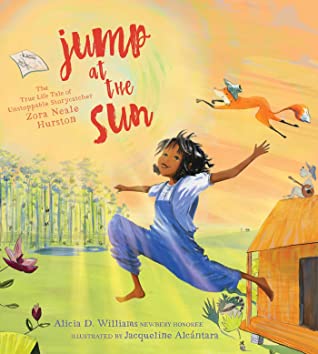
Jump at the Sun: The True Life Tale of Unstoppable Storycatcher Zora Neale Hurston by Alicia D. Williams, Illustrated by Jacqueline Alcántara

Share

Jump at the Sun: The True Life Tale of Unstoppable Storycatcher Zora Neale Hurston
Author: Alicia D. Williams
Illustrator: Jacqueline Alcántara
Published January 12th, 2021 by Atheneum/Caitlyn Dlouhy Books

Summary: A picture book that shines the light on Zora Neale Hurston, the writer and storycatcher extraordinaire who changed the face of American literature.

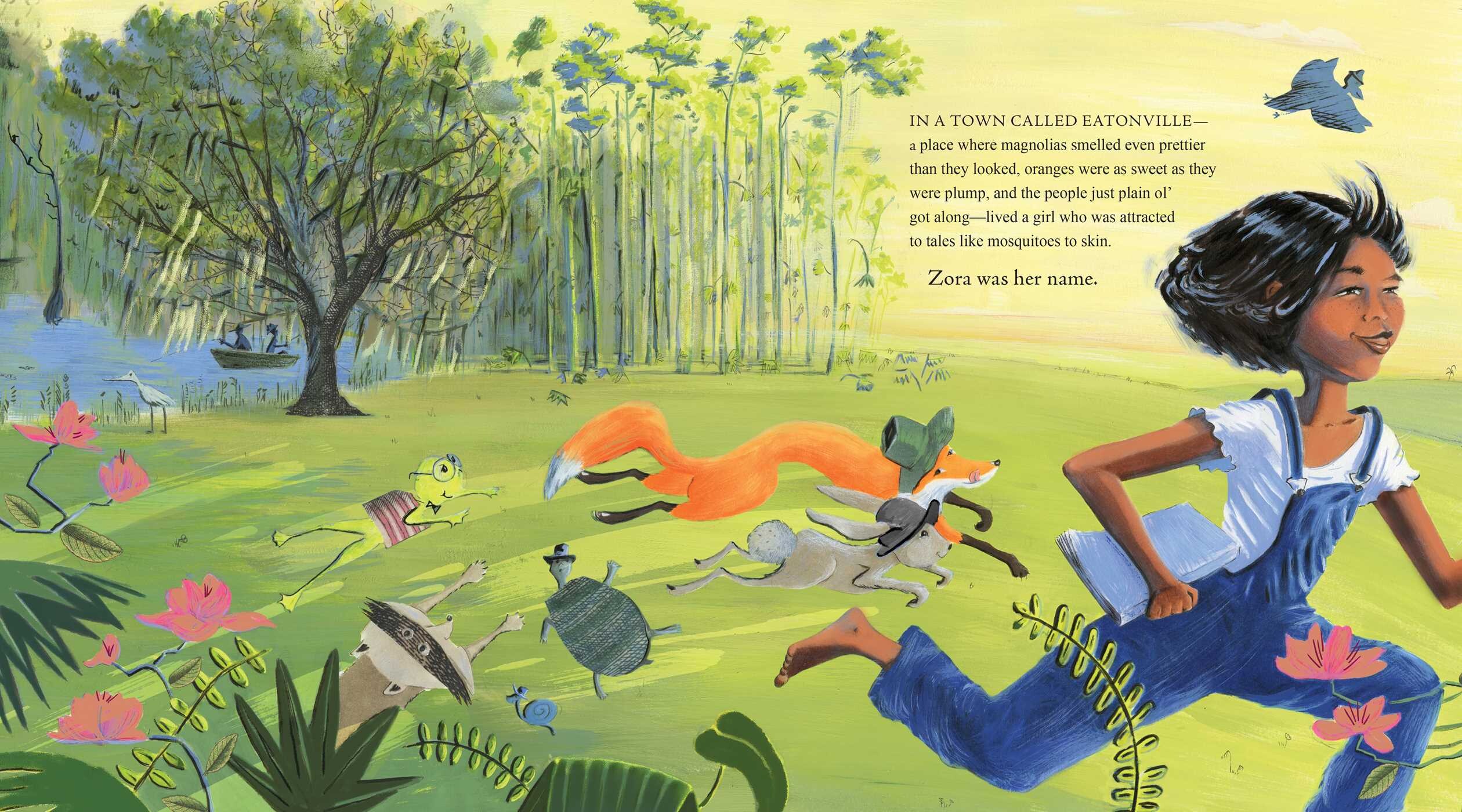
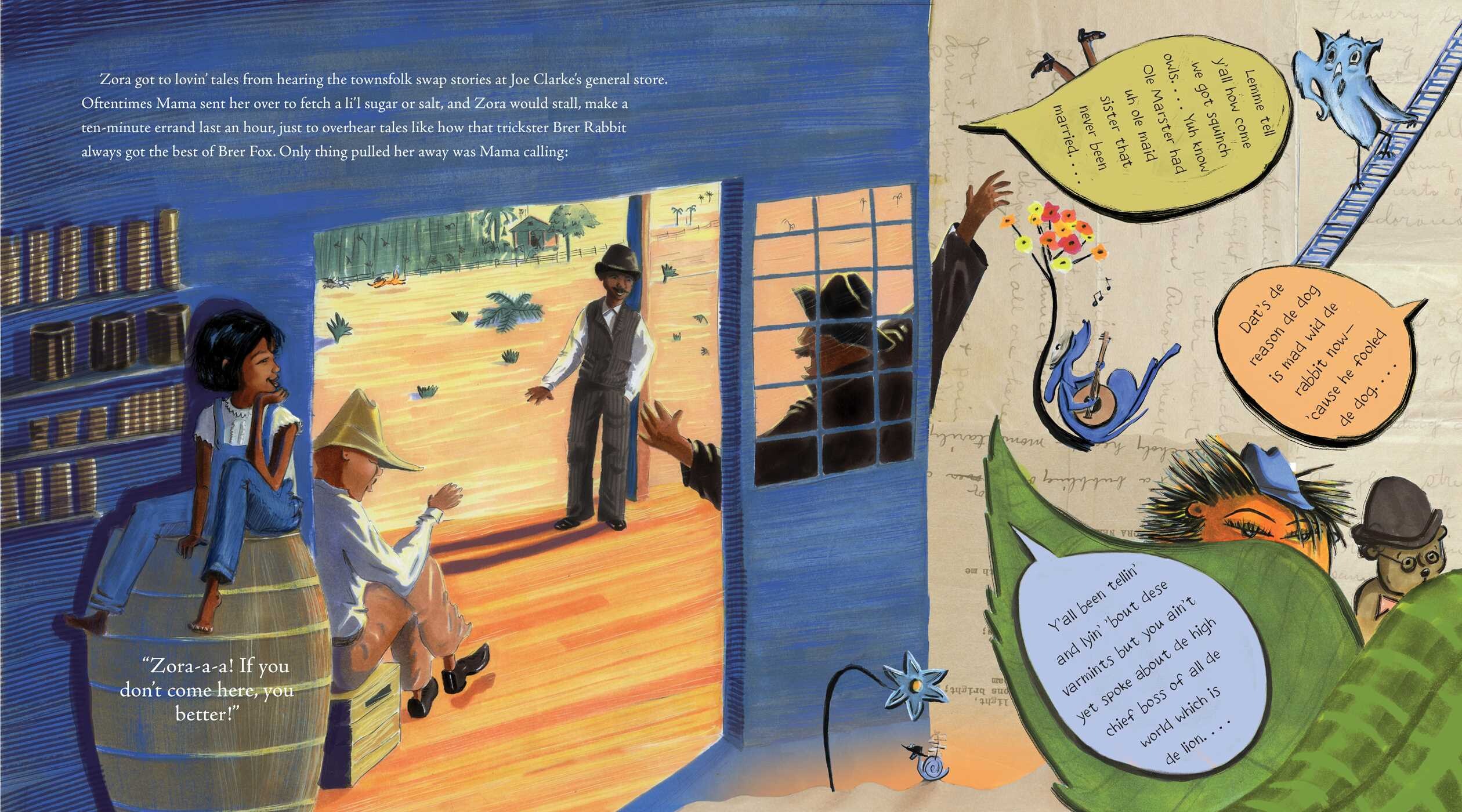
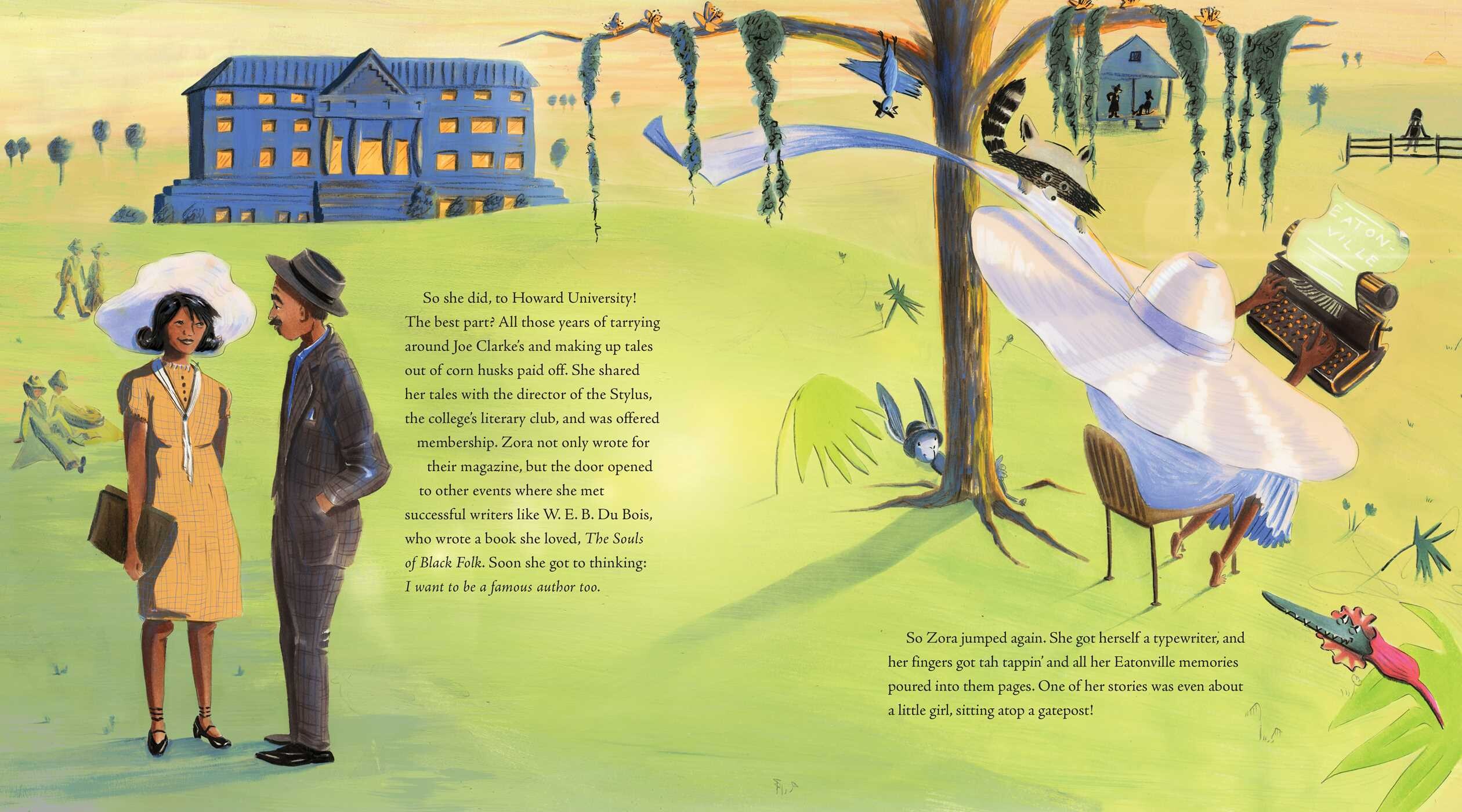
Zora was a girl who hankered for tales like bees for honey. Now, her mama always told her that if she wanted something, “to jump at de sun”, because even though you might not land quite that high, at least you’d get off the ground. So Zora jumped from place to place, from the porch of the general store where she listened to folktales, to Howard University, to Harlem. And everywhere she jumped, she shined sunlight on the tales most people hadn’t been bothered to listen to until Zora. The tales no one had written down until Zora. Tales on a whole culture of literature overlooked…until Zora. Until Zora jumped.

About the Creators:

Alicia D. Williams is the author of Genesis Begins Again, which received a Newbery and Kirkus Prize honors, was a William C. Morris Award finalist, and for which she won the Coretta Scott King – John Steptoe Award for New Talent. A graduate of the MFA program at Hamline University, and an oral storyteller in the African American tradition, she is also a teacher in Charlotte, North Carolina.

Jacqueline Alcántara is the illustrator of the critically acclaimed The Field and Freedom Soup. Her favorite days are spent drawing, painting, writing, and walking her dog. In 2016, she was awarded the inaugural We Need Diverse Books Illustrator mentorship. Find out more at JacquelineAlcantara.com.

Praise: 

*”A lively, joyfully rendered portrait of a literary legend.” – Publisher Weekly, starred review

* “Williams’ narration is a readaloud dream….it will be a joyful guide for folklore enthusiasts” – BCCB, starred review

* “This introduction to an American icon feels just right.” – Kirkus Reviews, starred review

* “A welcome addition to any picture book biography collection.” – School Library Journal, starred review

Review: Zora Neale Hurston has a special place in my heart as Eatonville is right around the corner, and I love the opportunity to be so close to Zora’s home, be inspired by her story, and learn from her. If you are ever here, stop by the Zora Neale Hurston National Museum of Fine Arts!

Alicia D. Williams does a beautiful job capturing the spirit of Zora and showing how truly special she was as a person and story teller. And I loved learning new things about her that I hadn’t known before (like that she graduated from high school at 28 and that she may have been lost to white-washed history if not for Alice Walker). And Alicia’s words mixed with the colorful and active illustrations of Alcántara, Zora is brought to life through the pages of this book.

Teachers’ Tools for Navigation: The publisher provided Curriculum Guide is the best resource for using this book in your classroom:

Discussion Questions: 

  • How are the end pages representative of Zora?
  • How were Zora’s stories important to American literature?
  • Why did the author call Zora a “storycatcher?”
  • How did the author integrate fictional characters and stories within her nonfiction biography of Zora Neale Hurston?
  • Why was some of Zora’s storytelling looked down upon?
  • What does the figurative phrase “reach/jump to the sun” mean?

Flagged Passages: 

Read This If You Love: Zora Neale Hurston, Picture book biographies

Recommended For: 

classroomlibrarybuttonsmall 

Signature

**Thank you to Simon & Schuster for a copy of the book to review!**

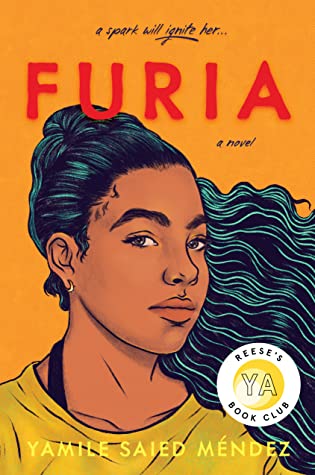
Furia by Yamile Saied Méndez

Share

Furia
Author: Yamile Saied Méndez
Published: September 15, 2020 by Algonquin

Summary: An #ownvoices contemporary YA set in Argentina, about a rising soccer star who must put everything on the line—even her blooming love story—to follow her dreams.

In Rosario, Argentina, Camila Hassan lives a double life.

At home, she is a careful daughter, living within her mother’s narrow expectations, in her rising-soccer-star brother’s shadow, and under the abusive rule of her short-tempered father.

On the field, she is La Furia, a powerhouse of skill and talent. When her team qualifies for the South American tournament, Camila gets the chance to see just how far those talents can take her. In her wildest dreams, she’d get an athletic scholarship to a North American university.

But the path ahead isn’t easy. Her parents don’t know about her passion. They wouldn’t allow a girl to play fútbol—and she needs their permission to go any farther. And the boy she once loved is back in town. Since he left, Diego has become an international star, playing in Italy for the renowned team Juventus. Camila doesn’t have time to be distracted by her feelings for him. Things aren’t the same as when he left: she has her own passions and ambitions now, and La Furia cannot be denied. As her life becomes more complicated, Camila is forced to face her secrets and make her way in a world with no place for the dreams and ambition of a girl like her.

But is it possible that she’s becoming too American—as her father accuses—and what does it mean when her feelings for Harrison and Neo start to change? Ana will spend her year learning that the rules of English may be confounding, but there are no rules when it comes to love.

With playful and poetic breakouts exploring the idiosyncrasies of the English language, Love in English tells a story that is simultaneously charming and romantic, while articulating a deeper story about what it means to become “American.”

Ricki’s Review: I lost a lot of sleep reading this book. I could not stop reading! Camila’s voice was so strong that I was really drawn to her story. I am not a particularly athletic person, yet I loved reading about the soccer within this book. It is set in Argentina, which offered a perspective of the country. It made me want to visit Argentina. There are many rich themes in this text that make it very teachable—in particular, it offers depictions of domestic abuse, sexism, and strength. I can’t recommend this book highly enough.

Teachers’ Tools for Navigation: I would love to use this book with a translanguaging lens of analysis. It would also be interesting to look at feminist theory as a theoretical framing of the text. But it isn’t about me–instead, I’d ask students what they find interesting in the text and what they want to learn more about. This allows for a freedom of curiosity to explore topics of interest from the text (and there are many!).

Discussion Questions:

  • How do gender roles differ related to soccer in Argentina, according to Camila’s perspective?
  • What is the role of family in the text?
  • What does Camila’s mother teach readers? Her brother? Her best friend?
  • Do you think Camila makes the right choices regarding her future? Why or why not?

Flagged Passage: “Our family was stuck in a cosmic hamster wheel of toxic love, making the same mistakes, saying the same words, being hurt in the same ways generation after generation. I didn’t want to keep playing a role in this tragedy of errors.”

Read This Book If You Loved: Love in English by Maria E. Andreu;  Ask Me No Questions by Marina Budhos, Girl in Translation by Jean Kwok; YA Books with Sports

Recommended For: 

classroomlibrarybuttonsmall litcirclesbuttonsmall

  RickiSig

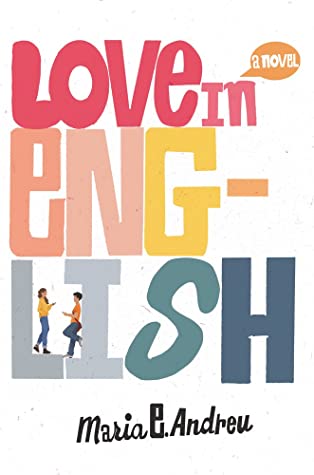
Love in English by Maria E. Andreu

Share

Love in English
Author: Maria E. Andreu
Published: February 2, 2021 by Balzer + Bray

Summary: Sixteen-year-old Ana has just moved to New Jersey from Argentina for her Junior year of high school. She’s a poet and a lover of language—except that now, she can barely understand what’s going on around her, let alone find the words to express how she feels in the language she’s expected to speak.

All Ana wants to do is go home—until she meets Harrison, the very cute, very American boy in her math class. And then there’s her new friend Neo, the Greek boy she’s partnered up with in ESL class, who she bonds with over the 80s teen movies they are assigned to watch for class (but later keep watching together for fun), and Altagracia, her artistic and Instagram-fabulous friend, who thankfully is fluent in Spanish and able to help her settle into American high school.

But is it possible that she’s becoming too American—as her father accuses—and what does it mean when her feelings for Harrison and Neo start to change? Ana will spend her year learning that the rules of English may be confounding, but there are no rules when it comes to love.

With playful and poetic breakouts exploring the idiosyncrasies of the English language, Love in English tells a story that is simultaneously charming and romantic, while articulating a deeper story about what it means to become “American.”

Ricki’s Review: I read this book and immediately thought of the many people who would love reading it. It does a beautiful job offering a lived experience of a young girl who is finely attuned to language acquisition. I have been meeting regularly with two students who have shared similar experiences to those of Ana, and I plan to share this book with them. For many, this book will act as a mirror, window, and sliding glass door. I understand fully the criticism this book has received–Maria E. Andreu writes in the opening that she was born in Spain, and her grandparents moved from Spain to Argentina as toddlers. She grew up in the US, traveled to Argentina at age 6 and then was not allowed to return to the US. She was undocumented at age 8 in the US. She talks about her experiences with this and with White privilege in powerful ways in The Secret Side to Empty. My thoughts about this controversy are not as valuable as those of a person with Latinx descent. In the end, I do wish that the character more closely matched Maria E. Andreu’s story rather than that of a native Argentinian. I loved the book and appreciated all that it taught me about Maria E. Andreu’s experiences with language, and there simply aren’t enough books available that explicitly discuss the linguistic diversity within our schools. this book is one that I will remember for quite some time.

Kellee’s Review: One of the things I love most about my school is the amount of diversity and the acceptance and inclusion of all in the school; we do not care where you are from or what language you speak–you are welcome with open arms!  While reading Love in English, I found myself being so upset with the students and some of the teachers in Ana’s school. Why was her ethnicity and language acquisition something that anyone would find funny or bully-worthy?! But then I remember that other places are not like my school… 

I also found myself connecting with Mr. T the ELL teacher! When I first started working at my school, I was intimidated with teaching ELL students because I didn’t think I would be of any help with someone learning English when it was the only language I knew. But throughout my first few years there, I began to learn that teaching ELL students is one of my favorite honors of being a teacher. My 7th year teaching, I taught a class much like Mr. T’s class, and it is one of my favorite classes I’ve ever taught. Mr. T shows how an ELL class, done correctly, can truly become home at school. 

Also, as a reading teacher & librarian at a school with a large Latinx population, primarily from South America, I found that it is so hard to find books that truly reflect my students’ experiences, but Love in English is a mirror for so many of them! It made me so happy while reading because I know that Ana’s experience is one that they will connect with. 

Overall, this story looks at language acquisition in a way that I have not seen in another book and it does so during a wonderful story with some amazing poetry woven throughout. I also love that the language acquisition aspect is based on the author’s experiences.

Teachers’ Tools for Navigation: We would love to use this book to teach about language and translanguaging. We’d group texts that help us think about the power of discussions related to the nuances of language.

Ana, throughout the novel, focuses on aspects of English in her journal. Use Ana’s journals to guide activities on some of the more challenging and, some would say, nonsensical parts of English, like idioms, similar looking words that are pronounced differently, and more.

Ana’s journals are written in beautiful poetry! Use Ana’s poetry for a mentor text to have students write poetry about similar topics to Ana.

Many of Mr. T’s activities that he implemented in his classroom are amazing activities to work with students acquiring a new language. If you are in a language-focused classroom, they would be assets to your classroom.

Discussion Questions:

  • How does language influence the ways in which Ana moves in the world?
  • How do Ana’s relationships with family and friends impact her life?
  • What is the significance of the title of the book?
  • How might the author’s perspective have influenced her work?
  • Why does Mr. T recommend Ana and Neo watch movies as part of their language acquisition?
  • What is the impact of the author’s use of ### since Ana is the narrator?
  • What is a part of the English language that you find confusing?
  • How did the year that Ana and her dad were apart affect their current relationship?
  • Why was Ana so drawn to a relationship with Harrison at first?
  • How was Altagracia’s friendship lifechanging for Ana?

Flagged Passage: 

“‘We don’t have to speak English,’ I tell her. I think–

We don’t have to do it this way.

We don’t have to make it so hard.

We don’t have to erase everything about us. At least not all at once.

—but I do not say it” (Advanced Reader Copy p. 35).

Recipe for Disaster

How do you get an apple in your eye?
Just how easy is pie? 

Who would eat crow or eat their heart out? 
Or how could anyone eat enough hay to eat like a horse? 
How can a potato sit on the couch?
In a world where so many thins are confusing, even food, 
I dream of a day when it is a piece of cake.” (Digital Review Copy Loc 1125)

Read This Book If You Loved: The Secret Side to Empty by Maria E. Andreu, Return to Sender by Julia Alvarez, Ask Me No Questions by Marina Budhos, Girl in Translation by Jean Kwok, Illegal by Bettina Restrepo

Recommended For: 

classroomlibrarybuttonsmall litcirclesbuttonsmall

  RickiSig and

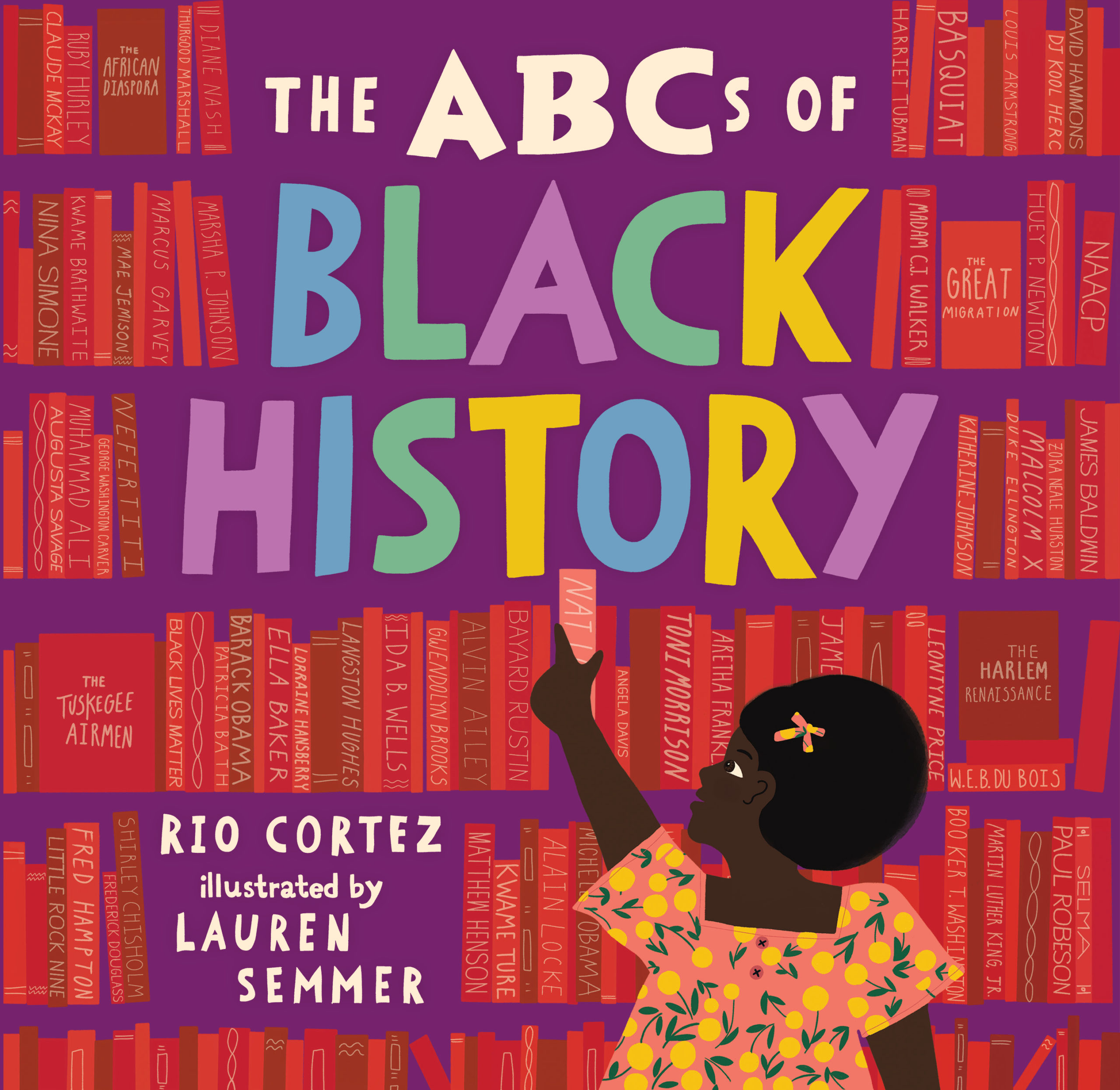
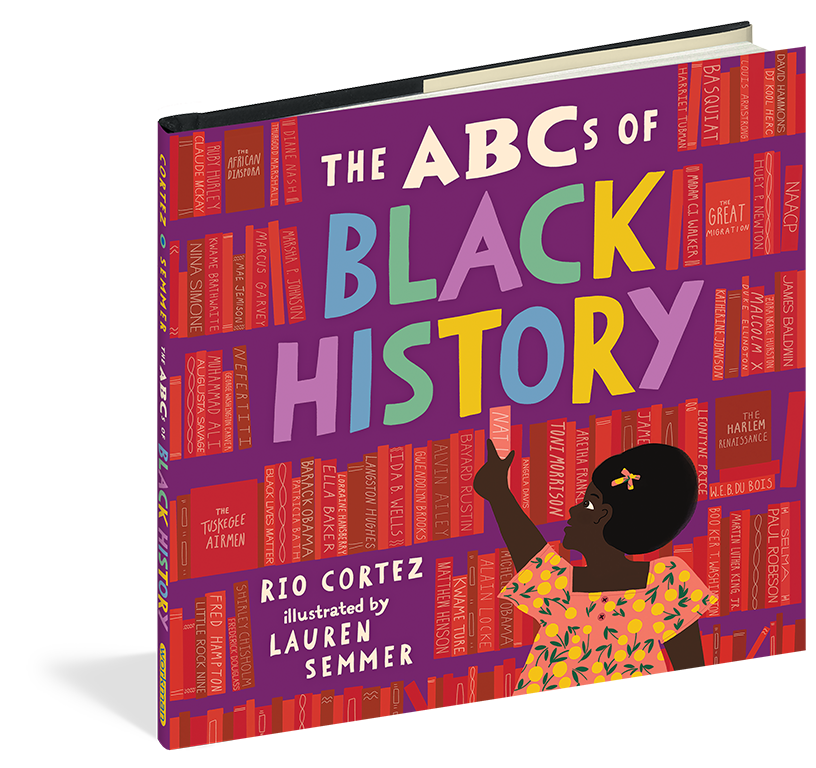
The ABCs of Black History by Rio Cortez, Illustrated by Lauren Semmer

Share

The ABCs of Black History
Author: Rio Cortez
Illustrator: Lauren Semmer
Published: December 8, 2020 by Workman Publishing Company

Summary: While many alphabet books have tackled a range of social justice topics from consent to feminism, there remains an urgent need to explore through a thoughtful lens how Black history has shaped American culture. The ABCs of Black History is a beautiful representation of the ideas and personalities that embody a wide range of Black people, experiences, and ideas in lively verse matched with vivid imagery.

Written by Pushcart-nominated-poet, Rio Cortez and illustrated by newcomer Lauren Semmer, The ABCs of Black History uses the alphabet as a frame to introduce Black history. Beginning with Anthem—an introduction to James Weldon Johnson’s Lift Ev’ry Voice and Sing—and ending with Zenith, a tribute to the mountaintop Dr. King spoke about before his death, readers will travel across continents and centuries, navigate triumph and heartbreak, and celebrate creativity and joy.

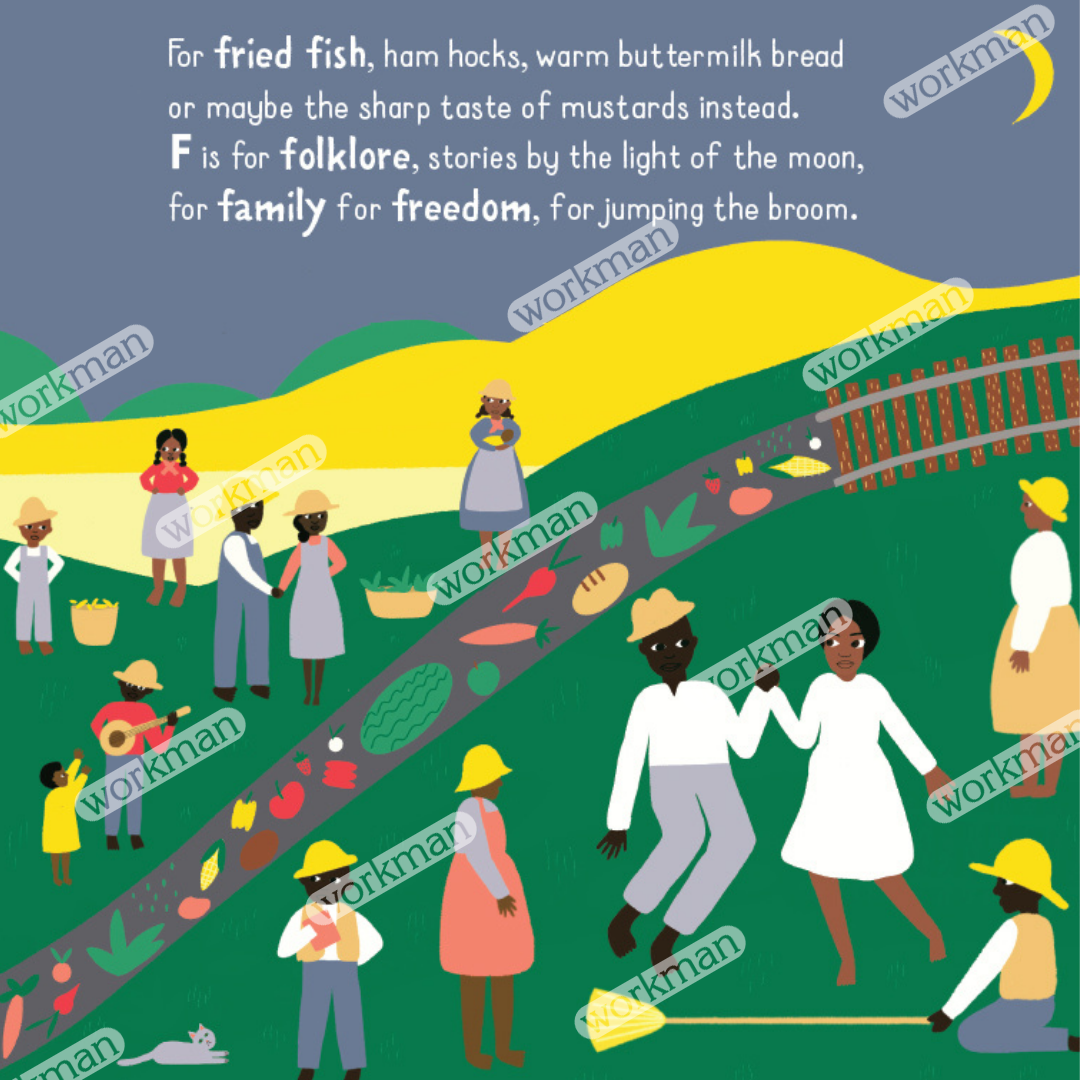
The poetic text introduces big ideas to engage curious minds. Every letter has a rhyming verse, and every spread is a visual feast. F explores the concepts of farming and food. G is for Go! and the Great Migration from the rural South to the urban North. Then the reader lands in Harlem, New York, where they meet Zora Neale Hurston and Langston Hughes. Contemporary moments are included too. M is for march and message, which explores the culmination of movements that have changed the course of history, from the Selma to Montgomery March in 1965 to the Black Lives Matter movement today. And Q is for queens, acquainting readers with powerful women like Leontyne Price, Queen Nandi, Toni Morrison, Michelle Obama, and many more.

The book also includes robust back matter that offers more information on the events, places, and people mentioned in the poem, from Fannie Lou Hamer to DJ Kool Herc, the Little Rock Nine to Sam Cooke.

A necessary addition to every child’s bookshelf, The ABCs of Black History is an exuberant celebration of history, culture, race, and justice.

Ricki’s Review: Oh my. This is a powerful book. Every single page is beautifully constructed. I simply cannot imagine how long it took to create this book. It is 64 pages of masterful writing and eye-catching illustrations. To call this an alphabet book would be to undermine everything that it is. Each spread features a different letter with numerous words connected to Black history and written in poetic form. Nine pages of back matter offer further information of all of the people, places, and terms used throughout the book. Thus, a child will hear the lilt of a poetic description in a read aloud, and the back matter offers more learning. I describe a child here, but as an adult, I was absolutely captivated by this text. This book is one to read and love and it is one to gift. Also, in case you missed it, look at the cover! I loved this book and give it my highest recommendation.

Teachers’ Tools for Navigation: Teachers might ask each child to select a letter in the book. They can learn more about the people, places, and terms used and share with peers more information about Black history. Then, they might create their own alphabet books about a topic they are interested in researching.

Discussion Questions: 

  • Which letter spread did you like the most? What did you learn?
  • How does the author incorporate information in a poetic and engaging way?
  • How do the illustrations elevate your understanding of the text?

Flagged Passage: 

E is for explore—to study a place: like Matthew Henson, the Artctic; Mae Jemison, space.

E is for education, for expanding the mind, like Ruby Bridges, Linda Brown, the Little Rock Nine—The first Black children in all-white schools, they opened the doors and challenged the rules.

Flagged Spread:

Excerpted from THE ABCs of BLACK HISTORY by Rio Cortez (Workman Publishing). Copyright © 2020. Illustrations by Lauren Semmer

Read This If You Love: Nonfiction picture books, Black history books, alphabet books, Hidden Figures by Margot Lee Shetterly, Frederick Douglass: The Lion Who Wrote History by Walter Dean Myers, Duke Ellington: The Piano Prince and His Orchestra by Andrea Davis Pinkney, We March by Shane W. Evans, Harlem’s Little Blackbird: The Story of Florence Mills by Renee Watson, Freedom in Congo Square by Carole Boston Weatherford

Recommended For: 

  classroomlibrarybuttonsmall

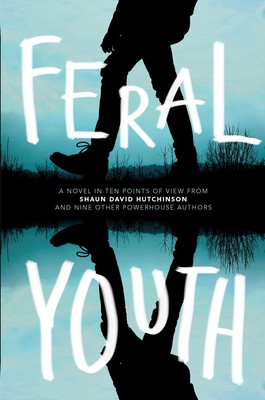
Feral Youth by Shaun David Hutchinson, Brandy Colbert, Suzanne Young, Tim Floreen, Justina Ireland, Alaya Dawn Johnson, Stephanie Kuehn, E.C. Myers, Marieke Nijkamp, Robin Talley

Share

Feral Youth
Authors: Shaun David Hutchinson, Brandy Colbert, Suzanne Young, Tim Floreen, Justina Ireland, Alaya Dawn Johnson, Stephanie Kuehn, E.C. Myers, Marieke Nijkamp, Robin Talley
Published: September 5, 2017 by Simon Pulse

Guest Review by Natalia Sperry

Summary: At Zeppelin Bend, an outdoor education program designed to teach troubled youth the value of hard work, cooperation, and compassion, ten teens are left alone in the wild. The teens are a diverse group who come from all walks of life, and they were all sent to Zeppelin Bend as a last chance to get them to turn their lives around. They’ve just spent nearly two weeks learning to survive in the wilderness, and now their instructors have dropped them off eighteen miles from camp with no food, no water, and only their packs, and they’ll have to struggle to overcome their vast differences if they hope to survive.

Inspired by The Canterbury Tales, Feral Youth features characters, each complex and damaged in their own ways, who are enticed to tell a story (or two) with the promise of a cash prize. The stories range from noir-inspired revenge tales to mythological stories of fierce heroines and angry gods. And while few of the stories are claimed to be based in truth, they ultimately reveal more about the teller than the truth ever could.

Review: This is a complex anthology of traditionally ignored teenaged voices that demand to be heard; I couldn’t put it down! Feral Youth is compelling from the front flap to the final page. The distinct voices of all 10 characters shone through in every part, from their individual stories to the transitional narration, creating an established sense of the full cast that is difficult to attain when juggling so many stories.

In this day and age, it feels more important than ever read book that remind us that all people, even those “troubled kids” traditionally written off by society, have a unique story to tell. Though I initially felt a bit overwhelmed by the number of characters (especially those with similar sounding names!) having such a diverse cast of characters share their stories was really rewarding. Those stories, both those intended to be “factual” and those grounded in fantasy, refuse to go quietly from my mind. In a story centered around teens whose voices have been all but silenced by society, I think that’s a victory.

Teacher’s Tool For Navigation: As the book was inspired by Chaucer’s Canterbury Tales, teachers could have students read the two (or passages from both) and compare and contrast. In particular, looking for thematic parallels could lend itself to discussions about the nature of storytelling and whose voices get told. In that regard, the book could also fit into a unit about “objective truth” in storytelling, perhaps in discussing other narratives or nonfiction.

Even in including the text as a free-reading option, I think it is essential to build empathy through reading diverse stories. Including this text could be not only a way to build empathy, but could provide a starting point for further future reading of a diversity voices as well.

Discussion Questions: What parallels do you find to the Canterbury Tales? Which stories surprised you? Were there any characters you related to that you wouldn’t have anticipated connecting with?  

Flagged: “’They think we’re probably nothing but a bunch of animals, but we showed them who we really are. We showed them that they can’t ignore us’” (287).

Read This If You Loved: The Canterbury Tales by Chaucer, Les Miserables by Victor Hugo, other YA anthologies

Recommended For: 

classroomlibrarybuttonsmall 

RickiSig