Rosie Revere, Engineer by Andrea Beaty

Share

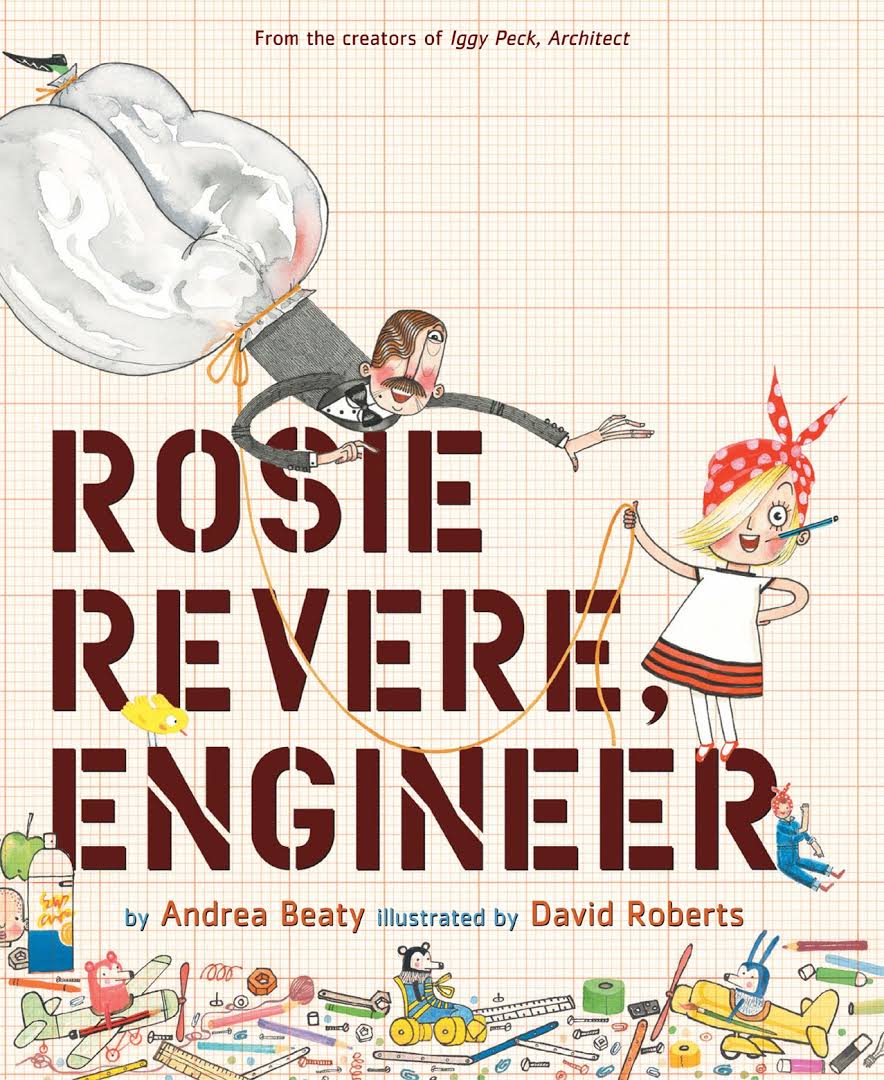
Rosie Revere, Engineer
Author: Andrea Beaty; Illustrated by: David Roberts
Published: September 3, 2013 by Abrams

A Guest Review by Jennifer Zafetti

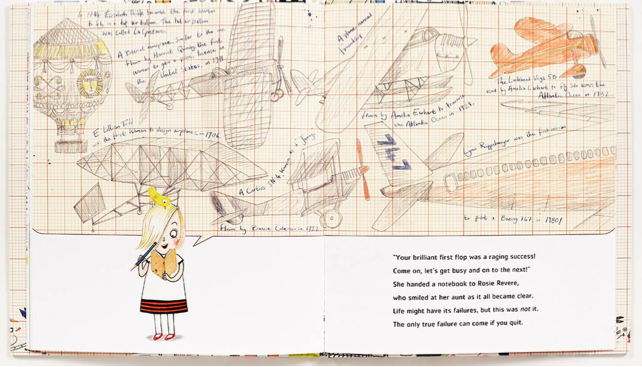
Summary: Rosie is an ambitious young girl who aspires to be an engineer. She creates an invention for her uncle, but becomes embarrassed when he laughs at her. She does not feel supported , until she meets her Great-Great-Aunt Rose who is both an adventurer and an explorer. Her great-great-aunt yearns to fly so Rosie builds her a contraption made out of cheese. When her great-great-aunt laughs at her failure, Rosie becomes disheartened and swears to never invent again. Rose provides her with comfort and explains that, “Your brilliant first flop was a raging success.” This provides Rosie with the encouragement she needs to try again!

Review: I really enjoyed reading this book! I think that it is so important for kids to embrace failures! If Rosie had admitted defeat after her first failure, she would have never been able to be successful. Rosie’s perserverance allowed her to create a flying contraption for her aunt. Furthermore, the rhyming sentences created an engaging tone that kept me wondering what would happen next. This is a great story to read-aloud to a classroom! Additionally, the illustrations on each page really add to the story and provide detailed visuals to accompany Rosie’s different inventions. Overall, I think that this book can be inspirational for all ages—the simple message: never give up!

Teachers’ Tools for Navigation: Rosie Revere, Engineer is an uplifting story in which failure turns into success. Teachers should use this children’s book to teach students about the importance of perseverance. When faced with challenges, students should use them as an opportunity to grow. If you believe in yourself, you can achieve anything!

Also, the teacher can pause the reading to ask for predictions.

Discussion Questions: How did Rosie’s mood change throughout the story?; When is a time that you persevered when facing a challenge?; When is a time that you have learned from a failure? How do Rosie’s family members impact her actions?

Flagged Passage: 

Read This If You Loved: Ada Twist, Scientist by Andrea Beaty, and The Most Magnificent Thing by Ashley Spires

Recommended For:
 classroomlibrarybuttonsmall

Thank you, Jennifer!

RickiSig

Teaching Guide for Ada’s Ideas: The Story of Ada Lovelace, the World’s First Computer Programmer by Fiona Robinson

Share

nfpb2017

Nonfiction Wednesday

Nonfiction Picture Book Wednesday is hosted by Kid Lit Frenzy and was started to help promote the reading of nonfiction texts. Most Wednesdays, we will be participating and will review a nonfiction text (though it may not always be a picture book).
Be sure to visit Kid Lit Frenzy and see what other nonfiction books are shared this week!
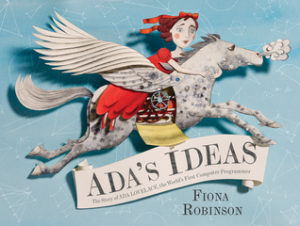
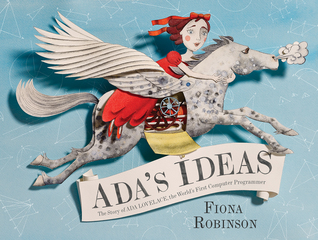
Ada’s Ideas: The Story of Ada Lovelace, the World’s First Computer Programmer
Author and Illustrator: Fiona Robinson
Published August 2nd, 2016 by Abrams Books

Summary: Ada Lovelace (1815–1852) was the daughter of Lord Byron, a poet, and Anna Isabella Milbanke, a mathematician. Her parents separated when she was young, and her mother insisted on a logic-focused education, rejecting Byron’s “mad” love of poetry. But Ada remained fascinated with her father and considered mathematics “poetical science.” Via her friendship with inventor Charles Babbage, she became involved in “programming” his Analytical Engine, a precursor to the computer, thus becoming the world’s first computer programmer. This picture book biography of Ada Lovelace is a portrait of a woman who saw the potential for numbers to make art.

Teaching Guide with Discussion Questions and Activities: 

Ada’s Ideas: The Story of ADA LOVELACE, the World’s First Computer Programmer

Ada Lovelace (1815–1852) was the daughter of Lord Byron, a poet, and Anna Isabella Milbanke, a mathematician. Her parents separated when she was young, and her mother insisted on a logic-focused education, rejecting Byron’s “mad” love of poetry. But Ada remained fascinated with her father and considered mathematics “poetical science.” Via her friendship with inventor Charles Babbage, she became involved in “programming” his Analytical Engine, a precursor to the computer, thus becoming the world’s first computer programmer. This picture book biography of Ada Lovelace is a portrait of a woman who saw the potential for numbers to make art.

Note about this guide and Ada’s Ideas

Ada Lovelace was a mathematician far ahead of her time. Because of this, much of the math included in Ada’s Ideas are quite complex. Because of this, Ada’s Ideas could be used for a wide range of students from early-elementary, focusing on Ada’s impact on math, to college, focusing on her use of complex math to write the first computer programs. Within this guide, you will find activities and discussion questions that primarily focus on its use in elementary and middle classrooms, but this does not limit it to these grade levels.

Vocabulary

These vocabulary words can be found throughout the book (in the order they are listed). Use these words as a starting point for a vocabulary study with Ada’s Ideas. Research shows that reading and discussing vocabulary within the context of reading is one of the most effective ways to learn vocabulary.

Despaired     |     Era     |    Defy     |    Reckless     |    Parallelogram     |    Influence     |    Steady     |    Whirred     |    Clanked     |    Newly Harnessed     |    Mechanical     |    Affectionate     |    Carrier Pigeon     |    Confined     |    Poetical expression     |    Aside     |    Eligible     |    Thrust     |     Regimented     |    Re-ignited     |    Potential     |    Orient     |    Corresponding     |    Loom     |    Thereby     |    Algorithm     |    Compute     |    Potential     |    Foresaw     |    Impact     |    Stunned     |    Envision

Activities: Use these activities to extend student learning with Ada’s Ideas.

Ana’s Parents

  • Ana’s parents are both well-renowned and intelligent; however, they are both very different.
  • Get to know George Byron
    • Have your students read the first stanza of “She Walks in Beauty” by Lord Byron. Analyze the stanza with them and discuss: How is Lord Byron describing the subject of his poem? Does it fit your idea of “Romantic” as Lord Byron was considered a leading figure in the Romantic Movement of poetry.
      • She walks in beauty, like the night
        Of cloudless climes and starry skies;
        And all that’s best of dark and bright
        Meet in her aspect and her eyes;
        Thus mellowed to that tender light
        Which heaven to gaudy day denies.
  • Get to know Anne Isabella Byron
    • Lady Byron was wealthy and educated. She was tutored by a Cambridge University professor as a child and found she excelled at mathematics. Discuss with your students: How did Lady Byron’s fascination of mathematics influence Ana’s life? Do you think her life would have been the same if her mother had not been a mathematician herself?

Nature vs. Nurture

  • Discuss with your students the idea of nature vs. nurture.
  • Lord and Lady Byron worked hard to separate Lord Byron from Ada to try and limit her poetical and imaginative behavior; however, Ada still ended up with quite the imagination. What does this show us about nature vs. nurture? Was Ada’s mother able to change how she was going to grow up by separating her from her father, or did it not matter since she is biologically his daughter?
  • Have your students break into two sides and research the ideas of nature vs. nurture then debate whether a person’s DNA decides their development or if experiences and environment can change the development.
    • Extension: Move the debate to Ada’s situation instead of a generic debate about the idea.

Industrial Revolution

  • The Industrial Revolution was possible because of the engineers, scientists, and mathematicians who put theory into practice. These new exciting feats of engineering and science included the first reliable steam engine, the cotton gin, telegraph, dynamite, vaccines, telephone, light bulb, airplane, and automobile.
  • Individually, in partners, or in groups, assign a different Industrial Revolution invention and look at how it was created, how it changed the world, and how it changed science/math/engineering then present their findings to the class.
  • After learning more about the Industrial Revolution, tie it back to Ada Lovelace’s life by discussing if the class believes that Ada’s accomplishments could have happened during a different time in history.

Influence

  • Ada Lovelace’s findings are largely said to be the first computer program. Her programs, in conjunction with Babbage’s hardware, were a theory over a century before the first computers were invented in the United States and England. Even though she was not part of the actual invention and start of computer science, she influenced much of modern computer science. Use the information below as the starting point for a research paper/project or discussion.
  • Some of the ways Ada has influenced computer science are:
    • Mill made by Babbage’s son
      • Charles Babbage’s son made the part of the analytical engine called the mill which carried out numerical operations.
    • Alan Turing
      • Babbage and Lovelace’s analytical engine was the original “drum” computer though Turing is often portrayed as the inventor of the idea.
    • John Graham-Cumming
      • Graham-Cumming is a British programmer who is working to bring the analytical engine, known as Plan 28, to realization.
    • Some ways Ada has been commemorated:
      • ADA: a standardized computer language used by the US Department of Defense
        • A computer language that appeared for the first time in 1980 and is still used today.
      • Ada Lovelace Day
        • Ada Lovelace Day was founded in 2011 and aims to share female pioneers in STEM fields. Ada Lovelace Day is the second Tuesday of October.

Discussion Questions: Use these questions as whole class discussions, reading check-ins, or as writing prompts with Ada’s Ideas. The discussion questions are written as if they are being asked to a student.

  • Ada’s schedule as an 8-year-old was very intense. Compare and contrast your current schooling schedule to what Ada was expected to do daily.
    • How many hours did she spend on each subject? How long do you spend?
    • Do you feel like what was expected of her was too high of expectations or fair?
  • How did Ada’s contraction of measles change her life?
  • Why did the author choose to cover Ada’s comforter in geometric shapes on the page when she is suffering with measles?
  • Ada surrounded herself with some very intelligent and influential people including Mary Fairfax Somerville, nominated to be jointly the first female member of the Royal Astronomical Society; Charles Dickens, one of the greatest novelist of the Victorian era; Florence Nightingale, the founder of modern nursing; and Charles Babbage. How do you think having these historical figures as her friends helped influence her focus and trajectory in life?
  • The mentorship of Charles Babbage changed Ada’s life as well as the trajectory of computer science. How did Ada influence Charles’s work and vice versa? Do you think either could have accomplished what they did without each other?
    • Compare their work to modern technologies: Ada’s work ended up influencing the creations of ____, and Mr. Babbage’s work ended up influencing the creations of ____.
  • How did Joseph-Marie Jacquard’s loom influence Ada’s idea of the program for the Analytical Engine?
  • The author’s note about Bernoulli Numbers states that Ada chose them as “beautiful examples” of the complexity of the Analytical Engine. Elaborate on this statement: Why would Ada choose something so complicated as the first program she wrote for the Analytical Engine?
  • The illustrations of Ada’s Ideas are Japanese watercolor pieces cut out and rearranged at different depths to achieve 3-D artwork then photographed. How does this artwork fit Ada’s story? Would another type of illustrations have been able to capture Ada’s ideas and personality as well?

Common Core Standards: English Language Arts

Examples of English Language Arts Common Core Anchor Standards that can be met by extending Ada’s Ideas with the above discussion questions/activities.

  • ELA-LITERACY.CCRA.R.1
    Read closely to determine what the text says explicitly and to make logical inferences from it; cite specific textual evidence when writing or speaking to support conclusions drawn from the text.
  • ELA-LITERACY.CCRA.R.2
    Determine central ideas or themes of a text and analyze their development; summarize the key supporting details and ideas.
  • ELA-LITERACY.CCRA.R.3
    Analyze how and why individuals, events, or ideas develop and interact over the course of a text.
  • ELA-LITERACY.CCRA.R.4
    Interpret words and phrases as they are used in a text, including determining technical, connotative, and figurative meanings, and analyze how specific word choices shape meaning or tone.
  • ELA-LITERACY.CCRA.R.5
    Analyze the structure of texts, including how specific sentences, paragraphs, and larger portions of the text (e.g., a section, chapter, scene, or stanza) relate to each other and the whole.
  • ELA-LITERACY.CCRA.W.7
    Conduct short as well as more sustained research projects based on focused questions, demonstrating understanding of the subject under investigation.
  • ELA-LITERACY.CCRA.W.9
    Draw evidence from literary or informational texts to support analysis, reflection, and research.

Computer Science Teachers Association Standards

  • Computational Thinking: Grades K-3, #4: The student will be able to recognize that software is created to control computer operations.
  • Computational Thinking: Grades K-6, #6: The student will be able to understand the connections between computer science and other fields.
  • Computational Thinking: Grades 6-9, #3: The student will be able to define an algorithm as a sequence of instructions that can be processed by a computer.
  • Computing Practice and Programming: Grades K-3, #5: The student will be able to identify jobs that use computing and technology.
  • Computing Practice and Programming: Grades 6-9, #7: The student will be able to identify interdisciplinary careers that are enhanced by computer science.
  • Computers and Communication Devices: Grades 6-9, #3: The student will be able to demonstrate an understanding of the relationship between hardware and software.
  • Computers and Communication Devices: Grade 6-9, #4: The student will be able to use developmentally appropriate, accurate terminology when communicating about technology.
  • Community, Global, and Ethical Impacts: Grade 6-9, #2: The student will be able to demonstrate the knowledge of changes in information technologies over time and the effects those changes have had on education, the workplace, and society.

Author/Illustrator

Fiona Robinson is originally from the north of England she now lives in Brooklyn, New York. She is an author and illustrator of books for children including Whale Shines, What Animals Really Look Like, and Ada’s Ideas. What Animals Really Like received the 2012 Irma Black Award, and Bank Street named it one of the 2012 Best Children’s Books. She has been praised by Publishers Weekly for her “humor tinged with heart,” and her work has been honored by the Royal Academy of Arts in London. Her favorite things include drawing, reading, drinking tea and telling her stories to children. She doesn’t like loud noises or clapping and often reads newspapers and magazines back to front. When she was in elementary school her teachers called her Little Leonardo, and she’s forever thankful for their support and that of her fabulous family in England too.

Resources

https://en.wikipedia.org/wiki/Ada_Lovelace

http://www.telegraph.co.uk/technology/11285007/Ada-Lovelace-paved-the-way-for-Alan-Turings-more-celebrated-codebreaking-a-century-before-he-was-born.html

http://findingada.com/

https://plus.maths.org/content/ada-lovelace-visions-today

The teaching guide can also be viewed at: https://www.scribd.com/document/341092371/Ada-s-Ideas-Teaching-Guide# or http://www.abramsbooks.com/academic-resources/teaching-guides/

Recommended For: 

classroomlibrarybuttonsmall closereadinganalysisbuttonsmall 

Signature

Stand Up and Sing!: Pete Seeger, Folk Music, and the Path to Justice by Susanna Reich

Share

nfpb2017

Nonfiction Wednesday

Nonfiction Picture Book Wednesday is hosted by Kid Lit Frenzy and was started to help promote the reading of nonfiction texts. Most Wednesdays, we will be participating and will review a nonfiction text (though it may not always be a picture book).
Be sure to visit Kid Lit Frenzy and see what other nonfiction books are shared this week!

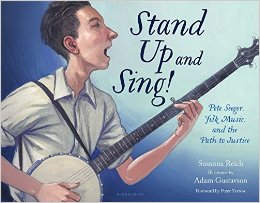
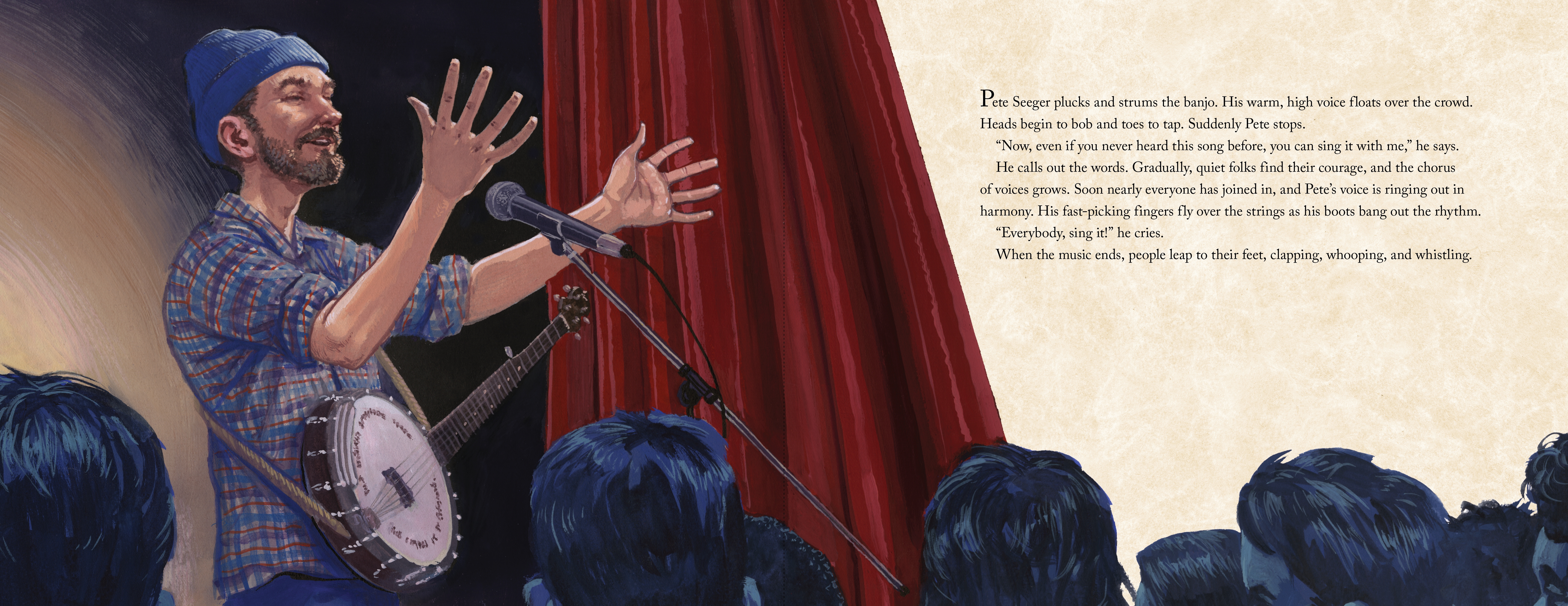
Stand Up and Sing!: Pete Seeger, Folk Music, and the Path to Justice
Author: Susanna Reich
Illustrator: Adam Gustavson
Foreword by Peter Yarrow
Published March 21st, 2017 by Bloomsbury USA Childrens

Summary: Inspired by the rhythms of American folk music, this moving account of Pete Seeger’s life celebrates his legacy, showing kids of every generation that no cause is too small and no obstacle too large if, together, you stand up and sing!

Pete Seeger was born with music in his bones. Coming of age during the Great Depression, Pete saw poverty and adversity that would forever shape his worldview, but it wasn’t until he received his first banjo that he found his way to change the world. It was plucking banjo strings and singing folk songs that showed Pete how music had the incredible power to bring people together.

Using this gift throughout his life, Pete encouraged others to rally behind causes that mattered–fighting for Civil Rights, ending the Vietnam War, or cleaning up the Hudson River. For Pete, no challenge was too great, and what started out as a love for music turned into a lifetime of activism and change. His greatest talent–and greatest passion–would become an unforgettable part of American history.

Praise: 

“Gustavson’s mixed-media illustrations highlight Seeger’s modest upbringing and down-to-earth persona, pairing lushly illustrated scenes of him traveling and performing with rough, loose sketches . . . An intimate look at a pivotal American figure.” –  Publisher’s Weekly

“The ‘We Shall Overcome’ songwriter’s legacy spans decades, and this will surely help a new generation understand his fervor and still-relevant message.” –  Booklist

“Gustavson’s realistic art supports the admiring tone. . . . A solid introduction.” –  School Library Journal

Review: I grew up with parents who loved Bob Dylan, Janis Joplin, Jimi Hendrix, The Beatles, Van Morrison, and Neil Young, so I have definitely heard of Pete Seeger. I knew that he was influenced by Woody Guthrie just as Bob Dylan was (I once wrote a paper about Walt Whitman being the origin of American folk music because of his influence on Woody Guthrie). But I did not have any idea of Seeger’s influence on the social issues that I learned about in this picture book. Though Reich is clear in her Author’s Note that the picture book bio is just a snippit of his life, what she does cover shows me what an impact Seeger had in so many different social issues throughout his life. This story gave me hope. It showed me that music and people who care can definitely make a difference. That someone like Pete Seeger, someone of privilege, can join forces with the oppressed and fight against injustice. That music and poetry and words can make a difference.

Teachers’ Tools for Navigation: Pete Seeger’s story intertwines with many parts of history that are taught. It would be interesting to read Pete’s story when studying the 60s and see how he was influential throughout the different social issues in the 60s. I think it would also be fascinating to listen to Pete’s music while reading the book and discussing how the poetry that he turned into music reflected the feelings of those fighting oppression during this time.

Discussion Questions: How did Pete use music to unite people fighting for a cause?; How is Pete’s use of folk music like Martin Luther King Jr.’s use of speeches and words to fight?; Why did Pete not enjoy fame?

Flagged Passages: “In 1955 Pete was called into court by some congressmen who didn’t think he was a loyal American. Pete refused to answer their questions in the way they wanted. The threat of prison would hang over his head for the next seven years.

Meanwhile the civil rights movement was picking up steam. On a trip to Tennessee in 1957, Pete introduced Dr. Martin Luther King Jr. to the song ‘We Shall Overcome.’

‘That song really sticks with you, doesn’t it?’ Dr. King said.

‘We Shall Overcome’ spread throughout the country. In churches and community halls, at civil rights gatherings and protest marches, people stood arm in arm, their voices forming a bond of home and determination.”

“We Shall Overcome” by Pete Seeger

Read This If You Love: Martin’s Big Words by Doreen Rappaport, When Bob Met Woody by Gary Golio, Blood Brothers by Rich Wallace and Sandra Neil WallaceThe March Against Fear by Ann BausumBoycott Blues by Andrea Davis Pinkey

Recommended For: 

classroomlibrarybuttonsmall closereadinganalysisbuttonsmall

Signature

Review and Giveaway: Mapping My Day by Julie Dillemuth

Share

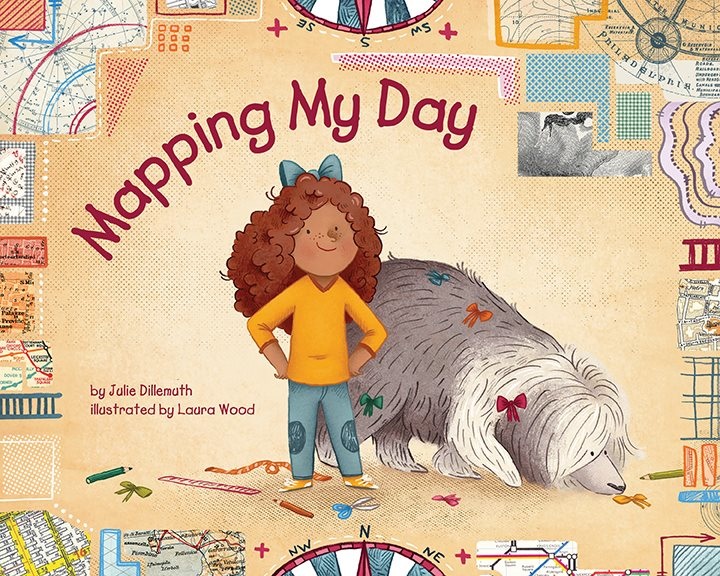
Mapping My Day
Author: Julie Dillemuth
Illustrator: Laura Wood
Published: March 13, 2017 by Magination Press

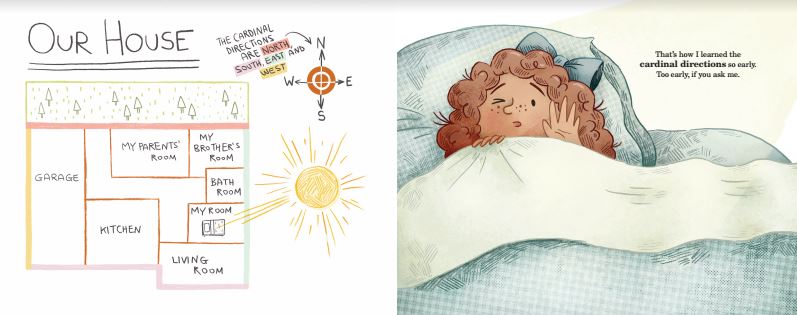
GoodReads Summary: Flora loves drawing maps and uses them to tell us about her life! Mapping My Day introduces spatial relationships and representation: where things and places are in relation to other things. This book intends to show readers how maps can convey information, inspire children to draw their own maps, and introduce basic map concepts and vocabulary. Spatial thinking is how we use concepts of space for problem solving and is shown to be a key skill in science, technology, engineering, and math. Includes a “Note to Parents and Caregivers” with extra mapping activities.

Ricki’s Review: As I read this book, I couldn’t help but think about how my husband will enjoy it. I am going to place it in my son’s room to surprise them. Interdisciplinary books are tricky to write, and Julie Dillemuth does a fantastic job making mapping and mathematics fun! While learning about arrows and symbols on a map, the reader also learns that Flora can make her brother snort milk out of his nose. As a bonus, this is a book that features a multiracial family without being a book about a multiracial family. This made me very happy. This is a book that will be appreciated by teachers and readers alike!

Kellee’s Review: Mapping My Day’s Flora loves maps. She thinks in cardinal directions, she maps out where everything is, and she even plays games using maps. It is because of Flora’s enthusiasm that the readers of her story are going to want to play with maps also which will *surprise, surprise* lead to them learning about mapping skills and even some mathematics. I know this book is going to find its place in elementary classrooms and so many kids out there are going to map their days out just like Flora. 

Teachers’ Tools for Navigation: The back of this book features map-making pages that are free for readers to download at www.apa.org/pubs/magination/441B206.aspx. The maps are connected to the story and allow readers to practice their mapmaking skills—very cool!

Discussion Questions: How does the author incorporate maps in a way that is fun and exciting?; What parts of Flora’s day does she map? What other parts of her day could she have mapped?; How might Flora’s brother’s maps look a bit different?

Flagged Passage:

Read This If You Loved: My Map Book by Sara Fanelli; Math Curse by Jon Scieszka; My Life in Pictures by Deborah Zemke

Recommended For:

  classroomlibrarybuttonsmall

Giveaway!:

a Rafflecopter giveaway

About the Author: Julie Dillemuth was mystified by maps until she figured out how to read them and make them, and it was a particularly difficult map that inspired her to become a spatial cognition geographer. She lives with her family and writes children’s books in Santa Barbara, California, where the west coast faces south. Visit her at her website: http://juliedillemuth.com.

RickiSig andKellee Signature

**Thank you to Barbara at Blue Slip for providing copies for review!**

Many Reflections of Miss Jane Deming by J. Anderson Coats

Share

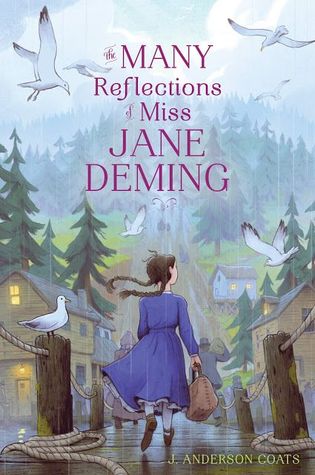
The Many Reflections of Miss Jane Deming
Author: J. Anderson Coats
Published February 28th, 2017 by Atheneum Books for Young Readers

Summary: High-spirited young Jane is excited to be part of Mr. Mercer’s plan to bring Civil War widows and orphans to Washington Territory—but life out west isn’t at all what she expected.

Washington Territory is just the place for men of broad mind and sturdy constitution—and girls too, Jane figures, or Mr. Mercer wouldn’t have allowed her to come on his expedition to bring unmarried girls and Civil War widows out west.

Jane’s constitution is sturdy enough. She’s been taking care of her baby brother ever since Papa was killed in the war and her young stepmother had to start working long days at the mill. The problem, she fears, is her mind. It might not be suitably broad because she had to leave school to take care of little Jer. Still, a new life awaits in Washington Territory, and Jane plans to make the best of it.

Except Seattle doesn’t turn out to be quite as advertised. In this rough-and-tumble frontier town, Jane is going to need every bit of that broad mind and sturdy constitution—not to mention a good sense of humor and a stubborn streak a mile wide.

Review: I didn’t know much about the Washington Territory. I knew that it had to have been settled quite like Oregon (I’m the Oregon Trail generation!) or California, but I didn’t know about the boat expeditions, or any expeditions for that matter, to the territory. It was fascinating to read about Jane’s trip to Washington as well as the complicated family that she traveled with. Jane’s story is not only a look at the history of America and Washington State, it is also a story of the perception about the role of woman in towns and families. Ms. D, in Jane’s story, is such an interesting character. She, as a very young uneducated woman, married Jane’s father who died in the Civil War. Now she is still young and pretty but has a preteen stepdaughter and a toddler son, both things that make you less of an attractive new wife. Jane also has us look at the idea of woman on the frontier because she learns to step outside of the roles her stepmother wants her to have and expand into a well-rounded frontier girl. 

Teachers’ Tools for Navigation: One thing I found disappointing was the lack of back matter in the book though I think this may be where the best classroom opportunity comes from. I assume that most young readers won’t know this time period and the west before it was America, so the reader themselves could use Jane’s story to jump start an inquiry look into the Washington Territory, the expeditions there (were they all in boats?!), and how life was different there than in the east.

Discussion Questions: How does Jane break the female mold in this story?; Why isn’t Ms. D as eligible as a wife as the other girls?; Why do Jane’s friends and Jane part ways a bit once they get to Washington?; Why is Jane’s paper book so important to her?; How did Mr. Mercer use propaganda to get young girls on his boat and also to get men in Washington to help pay for the expedition?; Did Miss Gower need Jane’s help or did she have another motive?

Flagged Passages: “It will need to be grand if it’s to fit the seven hundred unmarried girls and war widows Mr. Mercer plans to bring out west to teach in the schools of Washington Territory or to turn their hands to other useful employment.

Or, if you are Mrs. D, marry one of the many prosperous gentlemen bachelors pining for quality female society.

She’s pinned all her hopes on it. Mrs. D hated working in the Lowell mills. She hated leaving her kitchen and hearth and standing for fourteen hours a day before a loom, sneezing from all the dust and lint and not being able to sleep at night because of the ringing in her ears. She wants to be a wife again, to have someone else go out to work while she keeps house. If she has to go all the way to Washington Territory to do it, by golly, that’s what she’ll do.

After Mrs. D paid our passage, Mr. Mercer gave her a copy of a pamphlet he wrote about the advantages and charms of Washington Territory. She glanced at it once, rolled her eyes, then left it on her chair in teh dining room. I snatched it up and hid it in my secret carpetbag, and when she’s not around, I read it.

I’ve read every word hundreds of times. Even the big words I must puzzle over. Even the boring chapters on Lumber and Trade.” (p. 5-6)

Read This If You Loved: The Oregon Trail, The True Confessions of Charlotte Doyle by Avi, The Very Nearly Honorable Society series by Caroline Carlson, The Chronicles of the Black Tulip series by Barry Wolverton, Rory’s Promise by Michaela MacColl, Hattie series by Kirby Larson, May Amelia series by Jennifer L. Holm

Recommended For:

  readaloudbuttonsmall classroomlibrarybuttonsmall

Kellee Signature

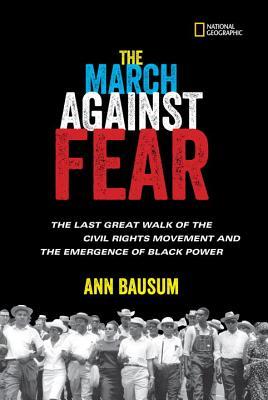
The March Against Fear: The Last Great Walk of the Civil Rights Movement and the Emergence of Black Power by Ann Bausum

Share

nfpb2017

Nonfiction Wednesday

Nonfiction Picture Book Wednesday is hosted by Kid Lit Frenzy and was started to help promote the reading of nonfiction texts. Most Wednesdays, we will be participating and will review a nonfiction text (though it may not always be a picture book).
Be sure to visit Kid Lit Frenzy and see what other nonfiction books are shared this week!

The March Against Fear: The Last Great Walk of the Civil Rights Movement and the Emergence of Black Power
Author: Ann Bausum
Published January 3rd, 2017 by National Geographic Society

Summary: James Meredith’s 1966 march in Mississippi began as one man’s peaceful protest for voter registration and became one of the South’s most important demonstrations of the civil rights movement. It brought together leaders like Martin Luther King Jr. and Stokely Carmichael, who formed an unlikely alliance that resulted in the Black Power movement, which ushered in a new era in the fight for equality.

The retelling of Meredith’s story opens on the day of his assassination attempt and goes back in time to recount the moments leading up to that event and its aftermath. Readers learn about the powerful figures and emerging leaders who joined the over 200-mile walk that became known as the “March Against Fear.”

Thoughtfully presented by award-winning author Ann Bausum, this book helps readers understand the complex issues of fear, injustice, and the challenges of change. It is a history lesson that’s as important and relevant today as it was 50 years ago.

About the Author: Ann Bausum writes about U.S. history for young people, and she has published eight titles with National Geographic Children’s Books including, most recently, Marching to the Mountaintop (2012) and Unraveling Freedom (2010). Ann’s books consistently earn prominent national recognition. Denied, Detained, Deported (2009) was named the 2010 Carter G. Woodson Book Award winner at the secondary school level from the National Council for the Social Studies. Muckrakers (2007) earned the Golden Kite Award as best nonfiction book of the year from the Society of Children’s Book Writers and Illustrators. Freedom Riders (2006) gained Sibert Honor designation from the American Library Association and With Courage and Cloth (2004) received the Jane Addams Children’s Book Award as the year’s best book on social justice issues for older readers. In addition, Ann has written about the nation’s chief executives and their spouses—Our Country’s Presidents (2013, 4th edition) and Our Country’s First Ladies (2007)—as well as the intrepid explorer Roy Chapman Andrews (Dragon Bones and Dinosaur Eggs, 2000).

Review: Ann Bausum’s text is a suspenseful story of the last Civil Rights march from Memphis, TN to Jackson, MS told in chronological order with captioned photographs that help the reader feel like they are present at the time of this march and the social, racial tension that filled America. I am having a very hard time reviewing this book, not because I don’t have nice things to say, but because this timely story is tough because although it is history, it seems like we haven’t come far from where the story takes place (which is terrifying).

Teachers’ Tools for Navigation: I believe that now is the most important time to teach resilience to our children as rights of many people are being threatened. Much of this education can come from conversation and amazing fictional stories, but I think it is vital to teach the history of diverse people within our nation that fought for rights. Children need to learn about women’s history, Black American history, Native American/American Indian history, Asian American history, LBGTQIA history, Irish American history, Jewish history, and so many more–all diverse populations that were prejudiced against and fought. Ann Bausum’s text (and her bibliography!) is a must-read in this education of our future.

Discussion Questions: Why was this march the last of the Civil Rights Movement?; This book is being called “timely” by many reviewers. Why do you think that timely is being used to describe the book?; Why would Bausum choose this march as the topic of her book?; How do the photographs and quotes throughout the book change the experience of reading the text?

Flagged Passages: “A cornerstone of this social justice movement became the willingness of people to put their lives on the line in the fight for change, much as Meredith had done during the integration of Ole Miss. Volunteers in the movement countered the violence of segregationists with tremendous acts of courage. They stood their ground peacefully in the midst of racist attacks, confident that love was a more powerful emotion than hate. Year after year, they persevered, whether it meant walking to work instead of riding segregated buses during the Montgomery bus boycott of 1955 and 1956, or braving violent mobs during the freedom rides of 1961, or enduring police attacks with high-pressure fire hoses during the Birmingham campaign of 196.

Such efforts drew on what movement leaders called the power of nonviolence. Some viewed nonviolence as a strategy, a series of tactics that forced reluctant foes to submit to change; others saw it was a way of life. For nonviolence to work, people had to be willing to remain peaceful, but determined, in the face of any level of violence. They had to outmaneuver their violent oppressors and step in and complete a protest whether their comrades had been arrested, injured, or even killed.” (p. 12-13)

Read This If You Love: To learn about the history of Civil Rights Movement

Recommended For: 

classroomlibrarybuttonsmall closereadinganalysisbuttonsmall

Signature

**Thank you to Karen at Media Masters Publicity for providing a copy for review!**

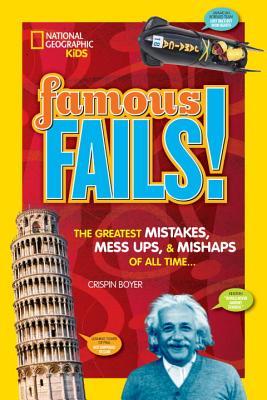
Famous Fails!: Mighty Mistakes, Mega Mishaps, & How a Mess Can Lead to Success! by Crispin Boyer

Share

nfpb2017

Nonfiction Wednesday

Nonfiction Picture Book Wednesday is hosted by Kid Lit Frenzy and was started to help promote the reading of nonfiction texts. Most Wednesdays, we will be participating and will review a nonfiction text (though it may not always be a picture book).
Be sure to visit Kid Lit Frenzy and see what other nonfiction books are shared this week!

Famous Fails!: Mighty Mistakes, Mega Mishaps, & How a Mess Can Lead to Success!
Author: Crispin Boyer
Published October 25th, 2016 by National Geographic Children’s Books

Summary: This fun book of quirky failures and famous flops will keep kids laughing while they learn the importance of messing up in order to get it right. Science, architecture, technology, entertainment — there are epic fails and hilarious goof-ups from every important field. Silly side features help to analyze the failures: “Lesson Learned,” “It Could be Worse!,” “Losing Combinations,” and a “Fail Scale” to help readers navigate the different kinds and scope of the mistakes made. The stories will include what went wrong, what went right, and what kids can learn from each failed attempt.

Review: I think one of the greatest lessons for children to learn is that failure doesn’t always equal failure. So many inventions and success began as what many would consider a failure when in actuality it was the beginning of a great thing. Giving up after a failure means you didn’t learn anything from it when failure is one of the best learning experiences. This text goes through hundreds of examples of famous people who failed or failures that became successes–wonderful stories for young people to read.

Teachers’ Tools for Navigation: As I read more and more of National Geographic’s new books like this one, Awesome 8, Book of Heroes/HeroinesReal or Fake?, and others, I’m coming to realize that these texts are made for project-based learning. These books make me question and inquire so many things within them. As I read, I find myself Googling and thinking and wanting to learn more–and I know they’ll do the same for kids.

Discussion Questions: Which famous inventions did you learn that was from a “failure?”; What famous person did you learn about that surprised you with their “failure?”; When is a time that you “failed” and stopped but now you wish you could go back and keep trying?

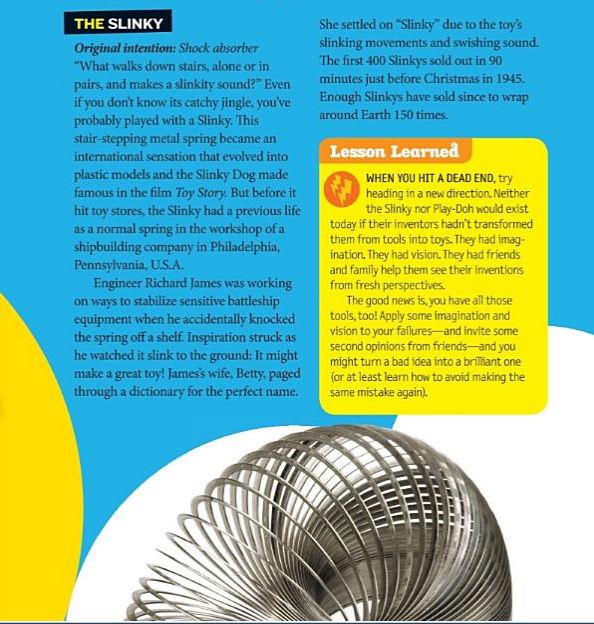
Flagged Passages: 

Read This If You Loved: The Marvelous Thing That Came from a Spring: The Accidental Invention of the Toy That Swept the Nation by Gilbert Ford, Earmuffs for Everyone!: How Chester Greenwood Became Known as the Inventor of Earmuffs by Meghan McCarthy, and other books about inventions; The Book of Heroes by Crispin Boyer & The Book of Heroines by Stephanie Warren Drimmer; and other nonfiction texts about inventors, heroes, failures then successes, and history

Recommended For: 

classroomlibrarybuttonsmall

Signature

**Thank you to Karen at Media Masters Publicity for providing a copy for review!**