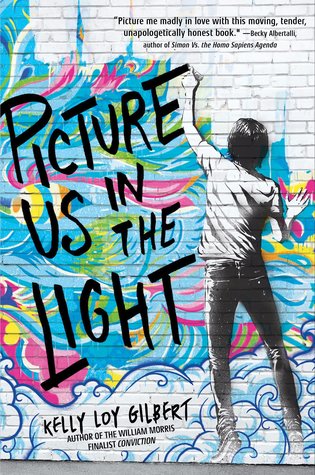
Picture Us in the Light by Kelly Loy Gilbert

Share

Picture Us in the Light
Author: Kelly Loy Gilbert
Published: April 10, 2018 by Disney-Hyperion

Guest Review by Rachel Krieger

Summary: Danny has been an artist for as long as he can remember, and it seems his path is set, with a scholarship to RISD and his family’s blessing to pursue the career he’s always dreamed of. Still, contemplating a future without his best friend, Harry Wong, by his side makes Danny feel a panic he can barely put into words. Harry and Danny’s lives are deeply intertwined and as they approach the one-year anniversary of a tragedy that shook their friend group to its core, Danny can’t stop asking himself if Harry is truly in love with his girlfriend, Regina Chan.

When Danny digs deeper into his parents’ past, he uncovers a secret that disturbs the foundations of his family history and the carefully constructed facade his parents have maintained begins to crumble. With everything he loves in danger of being stripped away, Danny must face the ghosts of the past in order to build a future that belongs to him.

Review: This book is filled to the brim with interesting plot points. While most novels would focus on one to two major things that are going on in a character’s life, this one has several. I found this to be both engaging and chaotic. Some of the time I felt that if Danny was a real person, he would simply explode during the course of events in the book. Danny was dealing with things well beyond what most people his age experience and manages to mostly keep it together despite. There are entire novels that deal with immigration, adoption, death of a loved one, suicide, sexual orientation, poverty, college preparedness, or love, but this one contains all of these ideas, among others. Though it felt like too much at times, this became one of the great aspects of the novel as well.

Throughout the story, Danny struggles with his morality at the same time as struggling with everything that life is dragging him through. Even though he is dealing with more than any human should have to, he still has time to feel the things that remind the reader that he is a person. So many of Danny’s feelings are perfectly reflective of what I and many others feel at points in life. The best part is that no matter who you are or what you have been through, you can connect with one of the topics addressed in this book. Gilbert’s inclusion of so many salient issues substantially increases the relatability.

Teacher’s Tool For Navigation: There are so many great things to talk about in the classroom in relation to this book. Although most reviews look at this novel as an exploration of sexuality, there are several other lenses with which to look through to spur great discussion. The issue that comes to mind first and foremost is immigration and the effect that it can have on a family and especially children in a family. Although Danny himself never went through the process of immigration, his parents did, and this has a huge effect on their family. Through the normal ups and downs of the life of a high schooler, Danny also discovers many things throughout the story that are connected to his family’s immigration and it only adds to his strife.

Many young students know little to nothing about the process of immigration—having never immigrated themselves—and Picture Us in the Light can do a lot to change that. It would be such a beneficial discussion to address the immigration experience that this family has and to even talk about the danger of a single story: that no family or persons story of immigration is exactly alike. It could also be interesting to teach this book alongside a classic tale of immigration such as Upton Sinclair’s The Jungle. There is a lot of material that can be taken from this book and I can see it being a very helpful tool in the classroom for discussing pertinent issues.

Discussion Questions: 

  • Is this novel hypercritical of students dealing with the suicide of a peer?
  • Does this novel reaffirm too many stereotypes?
  • How does this novel do well in talking about the exploration of sexuality?
  • How does it do poorly?
  • Do you believe Danny was as immoral a person as he thought he was?
  • What do the second person, in-between chapter bits do for the story?

We Flagged: “But in that instant, the one where you saw that flash of recognition strike him like lightning, you felt what you came here to see if you’d feel: the same strike at the same time, an atomic pull you can’t explain.”

Read This If You Loved: Aristotle and Dante Discover the Secrets of the Universe by Benjamin Alire Sáenz, I’ll Give You the Sun by Jandy Nelson, Simon Vs. The Homo Sapiens Agenda by Becky Albertalli, American Street by Ibi Zoboi, It’s Kind of a Funny Story by Ned Vizzini, Thirteen Reasons Why by Jay Asher

Recommended For: 

classroomlibrarybuttonsmall 

RickiSig

Author Guest Post!: “The Student Body: Fostering Positive Body Images Among Students” by Leanne Baugh, Author of The Story of My Face

Share

“The Student Body: Fostering Positive Body Images Among Students”

I recently read a survey on StageofLife.com about how teens view their bodies. The article included the following statistics that are alarming but, sadly, not surprising.

  • 20% of teens are either rarely or never happy with their bodies
  • 31% of teens have at least one body part on which they would like to get surgery
  • 56% of teens feel that media’s advertisements are the main cause of low self-esteem

As a teenager (many, many years ago), I struggled with negative body image and pretty much fit into all the statistical categories above. Needless to say, it was a traumatic time in my life. As a Young Adult author, I wanted to find a story thread to explore this theme without writing an “issue book”. I asked myself the question: In a society that is obsessed with beauty, how would my protagonist, Abby Hughes, a seventeen-year-old with a severe facial disfigurement, overcome obstacles and navigate her way to self-acceptance? In the past months since The Story of My Face was published, I have been gratified to hear from readers—both teens and adults—who have been inspired by Abby’s journey.

Organizations such as Be You, Dove Campaign for Self-Esteem, Common Sense Media, and The Body Positive Site have tried to change the conversation about society’s beauty ideal. But, like Abby’s story in the novel, youth are still bombarded with unhealthy images and societal and media pressures about how they “should” look. And it’s taking its toll. Negative body image may contribute to academic problems, disordered eating, poor self-esteem, abandoning physical and social activities, and depression.

What can teachers do to promote positive body images among their students? Here are a few tips from nedic.ca:

  • Be a positive role model who is accepting of your own body.
  • Examine your own values and beliefs about body size and health.
  • Compliment students on their abilities, character, behaviour and other areas that they excel in, rather than their appearance.
  • Show students a variety of images that reflect diverse physical abilities, body sizes and outward appearances.
  • Reinforce the message that bodies come in all shapes, sizes, colours and weights.
  • Engage students in discussions that challenge messages regarding what society deems are desirable physical appearances.
  • Choose respectful language when discussing bodies and health.
  • Encourage students to accept and care for their bodies.
  • Promote physical activity because of its mental and physical health benefits—not to alter shape or size.
  • Teach students how to challenge body-based bullying.

It’s not an exaggeration to say that teachers have the ability to change students’ lives. Encouraging students to accept themselves, just as they are, could make all the difference in the world.

About the Author: Leanne Baugh has been a waitress, receptionist, teacher, stay-at-home mom, and a screenwriter. Leanne is passionate about books, films, beach walks, and hummingbirds. When she isn’t at home in Victoria, B.C., she’s off traveling the world.

About The Story of My FaceAfter being attacked by a grizzly bear in the Rocky Mountains, seventeen-year-old Abby Hughes’ facial scars are all she can think about, and all that she thinks anyone else can see when they look at her.

It’s now September, and Abby’s months of hiding out at home are over. Returning to high school feels as daunting as enduring seven plastic surgeries. She knew it would be hard to show her new face to the world, but she didn’t expect to be rejected by her so-called friends. If she wants others to move past the surface, Abby has to learn to do that herself. Her love of acting and her return to the drama club may be the key to going on with her new life, or it may be the disaster that sends her back into her protective shell.  Reminiscent to the book and film Wonder, Baugh’s story is full of the relatable struggles that teenagers face in high-school.  A character portrait on the importance of self-acceptance, The Story of My Face is a timely novel in the midst of the ever-growing image driven social media landscape.

Thank you, Leanne, for this inspirational post! All we can say is: YES!!!! Body positivity for young girls is so important and is life changing!

Vincent and Theo by Deborah Heiligman

Share

Vincent and Theo: The Van Gogh Brothers
Author: Deborah Heiligman
Published April 18th, 2017 by Henry Holt and Co.

Summary: The deep and enduring friendship between Vincent and Theo Van Gogh shaped both brothers’ lives. Confidant, champion, sympathizer, friend, Theo supported Vincent as he struggled to find his path in life. They shared everything, swapping stories of lovers and friends, successes and disappointments, dreams and ambitions. Meticulously researched, drawing on the 658 letters Vincent wrote to Theo during his lifetime, Deborah Heiligman weaves a tale of two lives intertwined and the love of the Van Gogh brothers.

About the Author: Deborah Heiligman has written many books for children, including National Book Award Finalist Charles and Emma: The Darwins’ Leap of Faith and The Boy Who Loved Math. She lives with her family in New York City.

AccoladesMichael L. Printz Award – Honor, School Library Best Books of the Year, CPL: Chicago Public Library Best of the Best, NYPL Books for the Teen Age, Booklist Editors’ Choice, YALSA Award for Excellence in Nonfiction Finalist, YALSA Award for Excellence in Nonfiction Winner, BCCB Blue Ribbon Award, Boston Globe – Horn Book Award, Kirkus Best Teen Books of the Year, Publishers Weekly Best Books of the Year, Texas TAYSHAS High School Reading List, Horn Book Magazine Fanfare List

Praise: 

“A remarkably insightful, profoundly moving story of fraternal interdependence and unconditional love.” —Kirkus, starred review

“A breathtaking achievement that will leave teens eager to learn more.” —School Library Journal, starred review

“In fittingly painterly language, Heiligman offers vivid descriptions of Vincent’s artwork and life, which grow more detailed and colorful as Vincent’s own artistic style becomes richer and more refined . . . This illuminating glimpse into the van Goghs’ turbulent life and historical period will add compelling depth to readers’ understanding of the iconic painter. ” —Booklist, starred review

“A unique and riveting exploration of art, artists, and brotherly love.” —The Horn Book, starred review

“An intensive exploration of their turbulent lives” —Publishers Weekly, starred review

“This title is a treasure for readers who want to immerse in a roiling domestic drama and who don’t back away from a good cry” —The Bulletin, starred review

Review: I could not stop talking about this book while I was listening to it. That, and that I couldn’t stop listening to the book–I would listen whenever I could, show me what a fabulous book it was. Hieligman does an amazing job making Vincent and Theo’s story come to life through such emotional narrative that the reader cannot help but feel as if we are living alongside the Van Gogh brothers. As someone who loves learning about history and art as well as an interest in brain health, this was a story that was more fascinating than I can even describe.

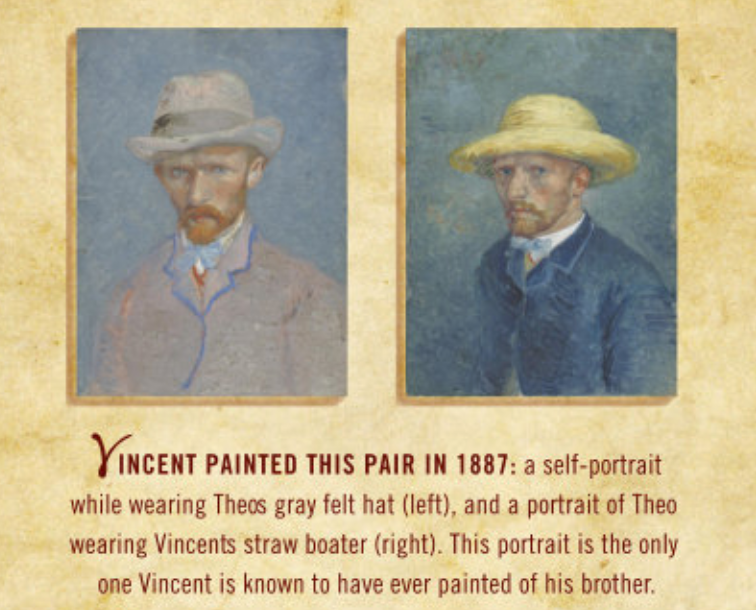
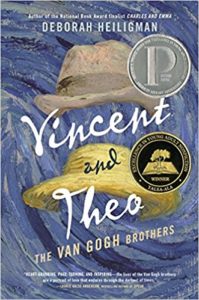
Also, I feel personally connected to this book in a fun way. In November, 2016 Deborah Heiligman and I had a dinner at NCTE, and we got talking about art since she had just finished Vincent and Theo. If you didn’t know, my dad has a BA in Art History and a MFA in Museumology and runs art museums (currently the LSU Museum of Art), so I have grown up around art museums my whole life and with art as a big part of it. One of the things we spoke about is the new information that a painting thought to be a self-portrait (right below) was actually the only known painting of Theo Van Gogh that Vincent painted. One thing that made it hard to determine this was that Theo is wearing the straw hat that Vincent is known to wear while Vincent is wearing Theo’s business felt hat. And this is where Deborah’s question came in: “The hats on the cover matched the hats the men are wearing in the photo although those are not actually their hats. Does it matter?” Now although I love art, I am not the expert, so I offered to ask my dad, and he responded with, “I like the cover as it is. I think it causes a questioning that evidences the new research in an interesting way. It defies previous thoughts and expectations.” Thus the cover stayed as is with an explanation on the jacket (below).
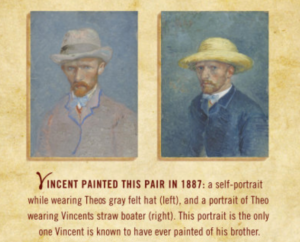
But I think what can show you about the book more than just me raving is all of the awards it received, ⇑ see above, and all of the amazing information about how Deborah researched for the book, ⇓ see below, and of course an excerpt from the book, ⇓ also below.

Teachers’ Tools for Navigation: View Deborah Hieligman’s research for Vincent and Theo and view all the articles & interviews about the book to use with students when reading this nonfiction text. There is so much that can be done with this story and the author’s writing process; use this amazing text in your classrooms, have it in your libraries, read it yourself–however you see fit, but read and share it!

Discussion Questions: 

  • How were Vincent and Theo’s life parallel with each other?
  • In what way were Vincent and Theo’s view of love part of their downfall emotionally?
  • Looking at the two portraits above and after reading the article about the portrait being of Theo, what do you believe? What similarities and differences do you see between the two?
  • How did Deborah Hieligman take all of the letters and research she did and turn them into a narrative?
  • I described this book to my sister as “A love story about two brothers.” Why would I call it a love story?
  • How did Theo’s short but mighty marriage set up for the current popularity of Vincent Van Gogh?
  • Why did it take so long for Vincent to find art?
  • In what way did finding friends in the impressionist art community help Vincent as an artist?

Flagged Passages: 1. TWO BROTHERS, ONE APARTMENT, PARIS, 1887

There was a time when I loved Vincent very much, and he was my best friend, but that’s over now. —Theo van Gogh to his sister Willemien, March 14, 1887

THEO’S BROTHER VINCENT has been living with him for just over a year, and Theo cannot take it anymore.

It is “almost intolerable for me at home,” he writes to their sister Wil in March 1887. Even though Theo has moved them to a larger apartment, this one still feels too small to hold Vincent’s outsized personality and Theo’s desperate need for quiet. He’s dying to tell Vincent to move out, but he knows if he does, Vincent will just be more determined to stay.

Dogged. Contrary. Stubborn. Vincent.

Theo van Gogh is the manager of Goupil & Cie, a successful art gallery on the fashionable Boulevard Montmartre in Paris. Theo is good at his job, but it’s terrifically frustrating for him right now. The owners of the gallery want him to sell paintings in the traditional style because they’re popular and bring in money. Though Theo certainly needs to make money—he has to support himself and Vincent and help their mother—he wants to sell art that is truly exciting to him, paintings by the Impressionists and their crowd, friends of his and Vincent’s: Émile Bernard, Paul Gauguin, Claude Monet, and Henri de Toulouse-Lautrec. Soon, maybe even paintings by Vincent himself.

But these modern painters don’t bring in enough money, so it’s a constant battle with his bosses. Theo haspersuaded them to let him set up a little display of Impressionists on the entresol. The entresol is not the ground floor, and it’s not the first floor. It’s the floor in between. It’s as if the paintings are there, but not quite yet, a glimpse into the future. It’s a start. But he spends his days working hard and comes back to the apartment at 54 Rue Lepic exasperated and exhausted. What he needs at home is rest and peace, but instead he gets VINCENT.

Theo loves his brother’s brilliant mind, his gregariousness, even his fiery temperament. Vincent can be a good antidote to Theo’s own inwardness and tendency to melancholy.

But after so many months of the cold Parisian winter spent indoors with Vincent, Theo is a wreck both mentally and physically. A few months back, in December, he was actually paralyzed—he couldn’t move at all for a few days. Although Theo knows he can’t blame his bad health on his brother, to get better he needs a break from Vincent’s gusts, his squalls, his constant talking and lecturing.

And, to make matters worse, lately Vincent has been furious at him. “He loses no opportunity to let me see that he despises me and I inspire aversion in him,” Theo tells Wil.

A portrait done of the brothers at this time would be sizzling with streaks of red-orange paint.

* * *

WHEN VINCENT AND THEO were young, growing up in the village of Zundert in the Netherlands, their father, a pastor, had written a special prayer. All the Van Gogh children had to memorize it and recite it when they left home:

“O Lord, join us intimately to one another and let our love for Thee make that bond ever stronger.”

Theo has valiantly been living up to that prayer. He’s been Vincent’s best friend for most of the last fifteen years, ever since they made a pledge to each other on a walk. And through many ups and downs and storms, for the past seven years, Theo has been giving Vincent money for paint, pencils and pens, ink, canvases, paper, clothing, food, and, until he moved in, rent.

On March 30 Vincent turns thirty-four; on May 1 Theo will be thirty. They’ve made it this far in their journey together—how can Theo kick him out now?

* * *

VINCENT AND THEO VAN GOGH look a lot alike: They both have red hair, though Vincent’s is redder, Theo’s more reddish blond. Vincent has freckles; Theo does not. They are both medium height—around five feet seven—but Vincent is broader, bigger; Theo slighter, thinner. They have pale blue eyes that sometimes darken to greenish blue. They are definitely brothers.

But they couldn’t give more different impressions.

Vincent in his workman’s clothes spends his days painting, outside if it’s not too cold, or inside the apartment. He is covered with Parisian soot and grime, overlaid with splatters and spatters of paint: ochre, brick red, orange, lemon chrome, cobalt blue, green, black, zinc white.

He doesn’t bathe often, which is typical for a nineteenth-century man, but it’s even less often than he should. He stinks—of body odor, dirt, food, paint, turpentine, wine, and tobacco. He usually has a pipe in his mouth, though he has very few teeth left, and those that are left are rotten.

And yet Vincent looks healthy: he’s robust, sturdy, and vehemently alive. Passion pours from him, as if the world he’s trying to capture is inside him, bursting to come out.

Theo is tidy, well dressed in a suit, looking very much the proper Parisian businessman. His features are finer, more refined. He would be handsome if he weren’t so sick: he’s thin and pale; he looks as though the life is being sucked out of him. He feels that way, too.

* * *

IN MANY WAYS, Vincent’s move to Paris has been good for both brothers. Thanks to Theo’s influence, to the artists he’s met, and to his own tenacious work, Vincent’s paintings are better than ever: they are imbued with color and light and Vincent’s own particular style.

And Vincent has given Theo more of a life. He’d been lonely in Paris, so lonely, and now, even though he doesn’t have a wife and family, Theo at least has a circle of friends through Vincent. For that he is grateful. So even though he’s desperate, Theo doesn’t kick out his brother. Yet.

In April, Theo acknowledges to another sister, Lies, that he’s been ill, “particularly in my spirit, and have had a great struggle with myself.” If he were well, he could deal with Vincent.

In fact both brothers do better with sun and warm air and hours spent outside. The Parisian days are getting longer—by minutes, anyway. If only spring would arrive! But there’s still too much gloom outside and in.

Gloom and fire.

It’s as if there are two Vincents, Theo has told Wil. He knows both sides of his brother very well. Sometimes Vincent is ebulliently happy and kind, sometimes furiously angry and difficult. He has a huge heart, but he’s stubborn and argumentative.

Vincent argues not only with Theo, and with himself, but also with friends and people he admires. One cold and fiery night in the near future, Vincent will fight with another roommate. And that argument will end in blood.

Read This If You Love: History, Art, Brain health, Van Gogh, Heiligman’s writing

Recommended For: 

classroomlibrarybuttonsmall 

Signature

Complexity in The Impossible Knife of Memory by Laurie Halse Anderson

Share

The Impossible Knife of Memory
Author: Laurie Halse Anderson
Published January 7th, 2014

ALAN Walden Award Finalist 2015
National Book Award Longlist 2014
School Library Journal Best Young Adult Book of 2014

Summary: For the past five years, Hayley Kincain and her father, Andy, have been on the road, never staying long in one place as he struggles to escape the demons that have tortured him since his return from Iraq. Now they are back in the town where he grew up so Hayley can attend school. Perhaps, for the first time, Hayley can have a normal life, put aside her own painful memories, even have a relationship with Finn, the hot guy who obviously likes her but is hiding secrets of his own.

Will being back home help Andy’s PTSD, or will his terrible memories drag him to the edge of hell, and drugs push him over? The Impossible Knife of Memory is Laurie Halse Anderson at her finest: compelling, surprising, and impossible to put down.


Complexity in Young Adult Literature

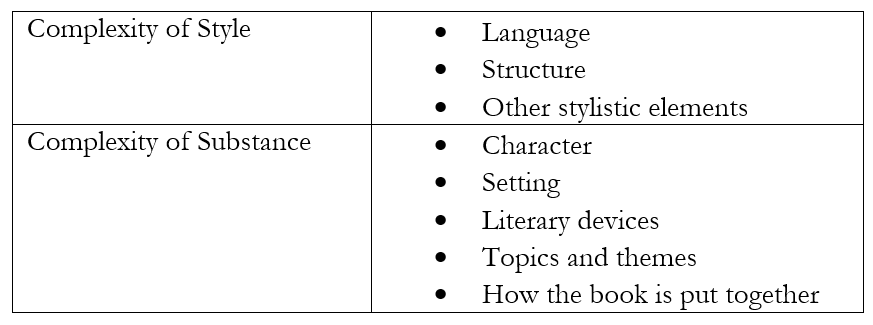
In Teaching Reading with YA Literature: Complex Text, Complex Lives by Jennifer Buehler, Chapter 2 looks at Young Adult Literature and Text Complexity and gives 8 different elements to think about to help analyze the complexity of a text:

Examples of complexity in The Impossible Knife of Memory by Laurie Halse Anderson

Other questions that could be asked while reading to find complexity in YAL
(Examples from Teacher Reading with YA Literature, Buehler 36-37)

  • Language: Are the sentences artfully constructed? Are the words carefully chosen? Does the author incorporate figurative language or poetic expression? Can we hear voice in the writing?
  • Structure: How is it built in terms of form and structure? How do other elements such as titles and subtitles, vignettes and interludes, shifts between past and present, or multiple points of view work together to service the whole?
  • Other Stylistic Elements: Are there other distinct elements in the text?
  • Character: What is there to explore in terms of the character’s thoughts and feelings; conflicts and contradictions; struggles, growth, and change?
  • Setting: How does the author bring us into the world of the story? What details help us to see, hear, and imagine this place?
  • Literary Devices: How does the author use literary or cultural allusions, intertextual references, dialogue, internal monologue, metaphor and symbolism, magical realism, or repetition to build meaning?
  • Topics and themes: What questions does the book ask? What ideas does it explore? What is at stake for teen readers in this book?
  • How the book is put together: How effective is the interplay between plot layers and thematic layers?

Discussion Questions/Writing Prompts for The Impossible Knife of Memory

Complexity can also be increased by the characteristics of the reader (such as motivation, knowledge, and experiences) and task variables (such as purpose and the complexity generated by the task assigned and the questions posed). Here are some examples of discussion questions or writing prompts that could be used in classrooms or with independent readers who are reading The Impossible Knife of Memory.

  • Hayley classifies all people into two categories: freaks & zombies. What does Hayley’s idea of the world show us about her outlook on life?
  • How does Laurie Halse Anderson use the idea of THEN and NOW throughout the novel to build on the theme that memories are a very complex part of life?
  • Drowning is a motif throughout the novel.
  • How does Laurie Halse Anderson show the reader that Hayley’s father is suffering and found addiction without using those words?
  • How did the inclusion of Hayley’s romantic relationship with Finn help move along the story and Hayley’s transformation? Do you feel that Hayley’s story arc would have been the same without Finn in the story?
  • How was the setting an integral part of the story? How did Hayley returning to her deceased grandmother’s home propel the story?
  • .Trish is one of the most complex characters in the book because there are many different Trishes shared with us throughout the story: Trish then, Trish now in reality, and Trish now in Hayley’s mind. How did Laurie Halse Anderson develop each of these different characters to show the reader a full picture of Trish?

This complexity information and activities can be found as a PDF on Laurie Halse Anderson’s website or my SlideShare.

To learn more about complexity in young adult literature, please read Teaching Reading with YA Literature: Complex Text, Complex Lives by Jennifer Buehler!

Alone Together by Sarah Donovan

Share

Alone Together
Author: Sarah J. Donovan
Published: May 1, 2018 by Seela Books

Summary: Sadie Carter’s life is a mess, as wavy and tangled as her unruly hair. At 15, she is barely surviving the chaos of her large Catholic family. When one sister becomes pregnant and another is thrown out, her unemployed dad hides his depression, and her mom hides a secret. Sadie, the peacekeeper and rule-follower, has had enough. The empty refrigerator, years of hand-me-downs, and all the secrets have to stop. She longs for something more and plans her escape.

However, getting arrested was not her plan. Falling in love was not her plan. With the help of three mysterious strangers—a cop, a teacher, and a cute boy—maybe Sadie will find the strength to defy the rules and do the unexpected.

Told in verse, Sarah J. Donovan’s debut Alone Together has secrets, romance, struggle, sin, and redemption, all before Sadie blows out her 16 candles. It’s a courageously honest look at growing up in a big family.

Review: Sarah’s writing shows that she has a firm grasp on adolescence. The book is a beautiful book in verse. I found myself thinking about the characters long after I had closed the text. Sadie lives in a Catholic household, and she is struggling emotionally. She is the only one of the eleven people in her family to sit at the breakfast table, and one of the few siblings who hasn’t left the family altogether. She is the peacemaker and is sick of the empty fridge and bad choices that others seem to make for her. I think that Sadie has a life that many young people will relate to. She is left wondering about the ways in which people exist alone together. This is a great read, and I will be using it (in part and in whole) in my classes.

Teacher’s Tools for Navigation: The title of this book is quite inspiring. Students might be asked to reflect on all of the ways that we are “alone together” in this world. Teachers can offer space and place for students to critically analyze whether we are alone together or whether we are something else. I’d love to hear students’ thoughts about this.

Discussion Questions: 

  • In this text, what is the role of family? In our world, what role does family play? How are we tied and not tied to our families?
  • How does Sadie’s family impact her life?
  • How does Sadie grow within the timeframe of the book? What does she learn?
  • Which verse resonated with you? How does it connect (or not connect) with your life?

Flagged Passage: 

“The only one of eleven

who sets the table every morning

with cereal bowls and spoons,

who matches mounds of socks

without complaint or disdain,

who obeys every stand, kneel, sing in mass

without sneaking out after communion” (6).

Read This If You Love: Because I Am Furniture by Thalia Chaltas; Stop Pretending by Sonia Sones; The House on Mango Street by Sandra Cisneros

Recommended For:

closereadinganalysisbuttonsmall classroomlibrarybuttonsmall

RickiSig

My Magic Breath: Finding Calm Through Mindful Breathing by Nick Ortner and Alison Taylor

Share

My Magic Breath: Finding Calm Through Mindful Breathing
Author: Nick Ortner and Alison Taylor
Illustrator: Michelle Polizzi
Published May 15th, 2018 by HarperCollins

Summary: Do YOU have the magic breath?

Let’s see…Take a deeeeeep breath in…and BLOW it out…

…and like magic, you can feel better just by breathing! Sometimes it’s hard to feel happy. But with this interactive picture book, children breathe along as they learn how to make angry or sad thoughts disappear.

In a world that is sometimes too busy, with too many things going on, My Magic Breath will help steer children into a serene space of mindfulness, self-awareness, and balance.

About the Authors and Illustrator: 

Nick Ortner is CEO of the Tapping Solution, LLC, a company with a mission to promote the natural healing method known as Emotional Freedom Techniques or “tapping” (a combination of Chinese healing practices). This is his second children’s book; his first was The Big Book of Hugs. He is also the New York Times bestselling author of The Tapping Solution, The Tapping Solution for Pain Relief, and the upcoming book The Tapping Solution for Manifesting Your Best Self. Nick lives in Newtown, CT, with his wife and daughter, June. You can find Nick at facebook.com/nortner.

Alison Taylor is an elementary school teacher and coauthor of The Big Book of Hugs. She writes to inspire young people, especially her beloved June and Harris, to find what makes them happy. She lives in Connecticut with her husband.

Michelle Polizzi is an illustrator and designer living and working in California. This is her second book working alongside Nick Ortner and Alison Taylor. She lives in the East Bay with her sons, Rowan and River, her husband, Nick, and their beloved Frenchie, Oscar, where they spend their days creating and inspiring one another. You can see more of her work at designbylovelyday.com.

ReviewDeep breathing is a tool that I have taught my son to use to deal with frustration, anger, or sadness. This lesson was even more supported when Daniel Tiger taught him to, “When you feel so mad you want to roar, take a deep breath and count to four.” We use this mantra often to help him refocus when his brain is getting fogged by an emotion. Additionally, some of Trent’s favorite books are interactive picture books like Press Here! or Don’t Touch This BookMy Magic Breath combines these connections in Trent’s life into one! It not only promotes meaningful breathing in a fun way, it turns it interactive through the illustrations and second person narrative. This is going to be a book that is easily going to jump into our picture book regulars, and I cannot wait to be able to be able to tell Trent to “Think about what happened. Now keep it in your mind! Close your eyes and take a deep breath in. Now blow out your breath…”

Teachers’ Tools for Navigation: Anxiety is something that many teachers now find themselves talking to their students about because so much pressure and stress are on kids these days either socially, academically, or at home. My Magic Breath will be a perfect book to introduce at the beginning of the year then use throughout the year to help students understand and deal with their emotions.

Discussion Questions: 

  • When do you feel the most anxious? Angry? Scared? Sad? Try using mindful breathing during these times.
  • How do you picture your magic breath would look when you blow out during these times? What about a happy time?

Flagged Passages: 

Read This If You Love: Good Morning Yoga by Mariam GatesThe Moment Is Your Life by Mariam GatesMoon by Alison OliverMy Friend is Sad by Mo Willems, The Color Monster by Anna LlenasGrumpy Bird by Jeremy Tankard

Recommended For: 

classroomlibrarybuttonsmall 

Signature

Blog Tour with Review!: The Moment is Your Life (And So Is This One) by Mariam Gates

Share

The Moment is Your Life (And So Is This One)
Author: Mariam Gates; Illustrator: Libby VanderPloeg
Published May 22, 2018 by Dial

Book Summary: Don’t just do something, be here.

The key to happiness is being able to find comfort in this moment, here and now. When you are completely present and not distracted by regrets, worries, and plans, even for a little while, you begin to feel more confident and can deal more easily with everything you experience. This is mindfulness: paying attention to this very moment, on purpose and without judgment–simply being present with curiosity.

This engaging guide, packed with simple exercises and endearing full-color artwork, provides a handy starting point for bringing mindfulness into your daily life. Chapters on meditation, yoga, and mindful breathing explain the benefits of these practices, and you are free to pick and choose what to try. There are quick exercises throughout, and a more extensive tool kit at the end of each chapter. The final chapter offers satisfying five-day challenges that map out ways to pull all of the book’s mindfulness techniques together in your day-to-day life.

With the appeal of a workbook or guided journal, and full of examples relevant to tweens and teens today, this book will be your trusted companion as you begin the valuable, stress-relieving work of being still with skill.

About the Author: Mariam Gates has a master’s degree in education from Harvard University and has been teaching children for more than twenty years. The founder of Kid Power Yoga, she now devotes herself to training children and adults in yoga and mindfulness. She is the author of the picture books Meditate with MeGood Night Yoga, and Good Morning Yoga. She lives with her husband, Rolf Gates, and their two children in Santa Cruz, California.

Mariam Gates

About the Author: Libby VanderPloeg is an illustrator and designer living in Greenpoint, Brooklyn. She grew up in Grand Haven, Michigan, on the edge of the Great Lakes, and since then, she has lived in Grand Rapids, Chicago, New York, and Stockholm. She’s created book covers and editorial illustrations for the New York Times, the Wall Street Journal, and Design*Sponge, among others, and as well as a line of cards and prints that she sells via her Etsy shop and in stores.

Review: I wish I’d had this book as a pre-teen/early adolescent. It would have truly helped me as I struggled with a lot of emotions that made me frustrated, unsure, and overwhelmed. This is a book that has a very expansive age range. I’d give it to a reader between the ages of 8 and 14, but it can be read and appreciated by people of all ages. After I was done reading it, I gifted it to a preservice teacher student who is very passionate about infusing mindfulness in the classroom. We spent a lot of time talking about how she might infuse this book into her student teaching with targeted read alouds. I loved Gates’ picture books (see Good Morning Yoga), and this book was no different. It’s thoughtfully crafted and incredibly relevant to young people. I particularly appreciated the action steps within the text. This provided me with concrete steps for infusing mindfulness into my life.

Teachers’ Tools for Navigation: As a classroom teacher, I would use this book as an initiation each day. It’s always very difficult to get students into the learning mindset. They come in with baggage and also with a lot of energy (positive and negative). This book serves as a reset and allows students to be mindful of their bodies and minds. It also allows students to destress to prepare for the classroom learning.

Discussion Questions: How do the author and illustrator work together to effectively present the material?; What is the author’s purpose? How does she effectively convey this purpose?; Which sections felt most relevant to your life?; What are the key takeaways that emerged from this book? How will you employ the strategies in this book directly into your life?

Flagged Pages:


Read This If You Loved: 

Good Night Yoga (2)

Recommended For: 

readaloudbuttonsmall classroomlibrarybuttonsmall


Follow All the Stops on the Tour: 

WEEK ONE

May 15 – Little Flower Yoga – Review

May 16 – Crossroad Reviews – Review

May 17 – Alissa Yoga – Review

May 18 – Whitney Davis Yoga – Review

WEEK TWO

May 21 – Prose and Khan – Review + Favorite Yoga Poses with Pictures

May 22 –  Librariel Book Reviews – Favorite Yoga Poses + Review

May 23 – Foodie Bibliophile in Wanderlust – Review

May 24 – Unleashing Readers – Review

RickiSig

**Thank you to Friya at Penguin for sending this book for review!**