Here Comes Teacher Cat by Deborah Underwood

Share

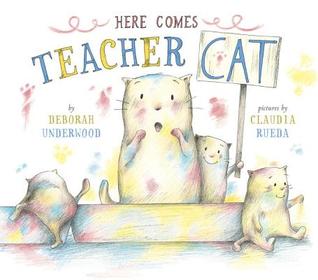
Here Comes Teacher Cat
Author: Deborah Underwood
Illustrator: Claudia Rueda
Published: August 8, 2017 by Dial

Goodreads Summary: It’s back to school for the New York Times bestselling Cat when he steps in as a substitute teacher.

Cat is not pleased to be tapped as substitute teacher. Not only is it cutting into his naptime, but a roomful of kittens is a little, well, scary. At school, he’s faced with six adorable kittens and follows the lesson plan of music, building, and painting–only in pure, mischief-making Cat style. By the end, Cat has learned a thing or two about inspiring others by being himself. But even more heart-melting and humorous is what the kittens have learned from Cat.

Ricki’s Review and Teachers’ Tools for Navigation: This book is very funny. Every time my son and I read it together, he giggles wildly across the pages. Cat is very unhappy when he is asked to play the role of teacher for the day. He doesn’t want to have to deal with the kitties, and he just wants to nap. He gets pretty creative, though, and it makes for a wonderfully fun story. I really like this book because it is very easy to ask my son questions while reading it. For example, I will ask him “What is Teacher Cat doing now? How do you think he feels? What are the kitties doing?” It is also very easy to practice making predictions with this text.

Discussion Questions: How does Teacher Cat change from the beginning to the end of the story?; How is he creative?; What does this story teach us?; Why did the author/illustrator choose to have Teacher Cat and the kitties hold up signs rather than speak?; Who is the narrator?

Reading by Brightly: 

Read This if You Loved: Any of the Here Comes _____ Cat books by Deborah Underwood, Won Ton and Chopstick by Lee Wardlaw; One Leaf Rides the Wind by Celeste Davidson Mannis; If Not for the Cat by Jack Prelutsky; I Haiku You by Betsy E. Snyder; Dogku by Andrew Clements

 Recommended For: 

readaloudbuttonsmall  classroomlibrarybuttonsmall


RickiSig

**Thank you to Penguin for providing a copy of this book for review!**

Blog Tour with Giveaway and Review!: Flashlight Night by Matt Forrest Esenwine, Illustrated by Fred Koehler

Share

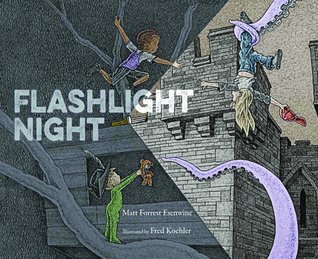
Flashlight Night
Author: Matt Forrest Esenwine
Illustrator: Fred Koehler
Published September 19th, 2017 by Boyds Mills Press

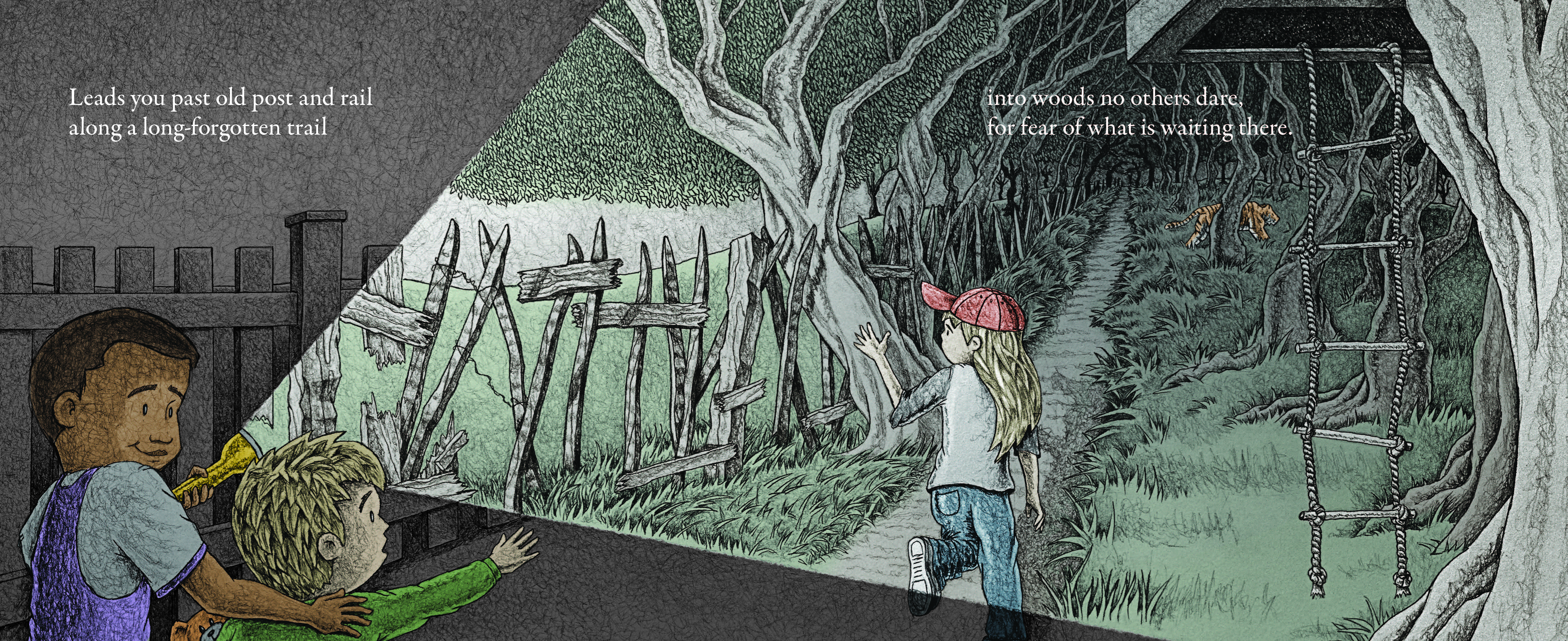
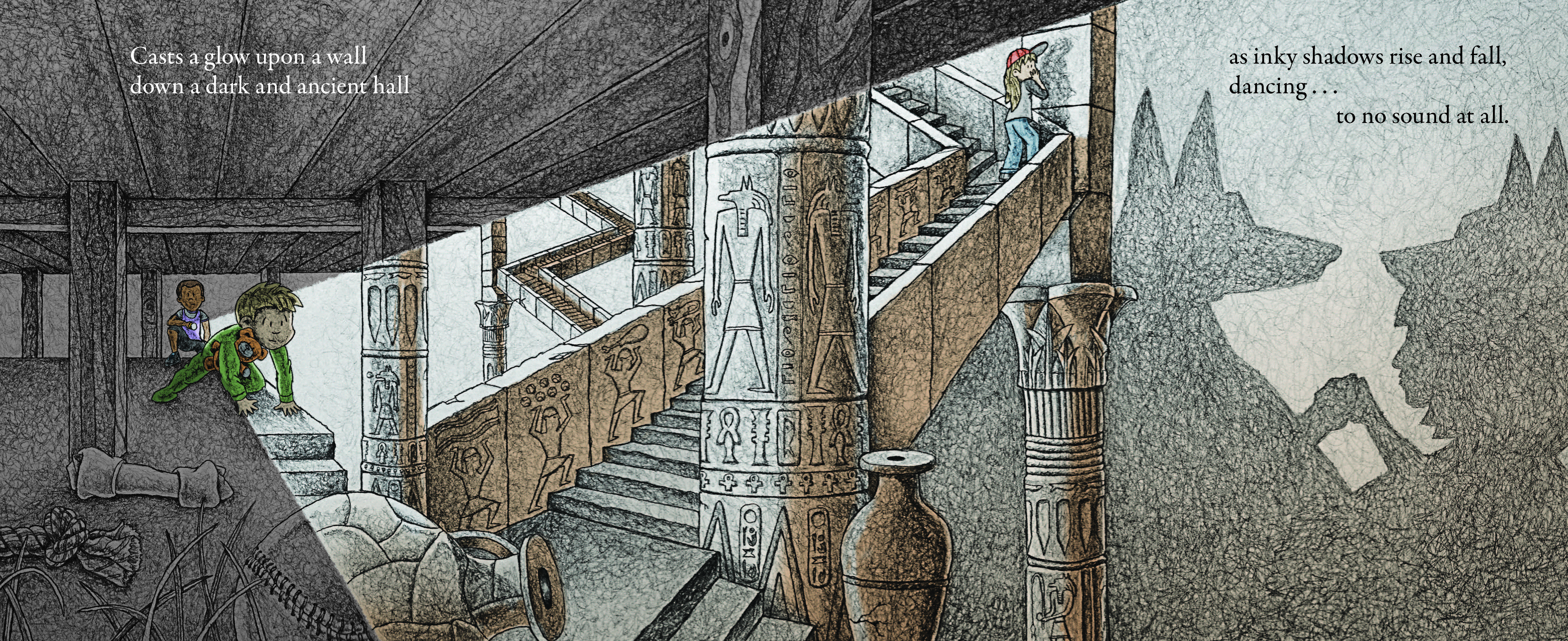
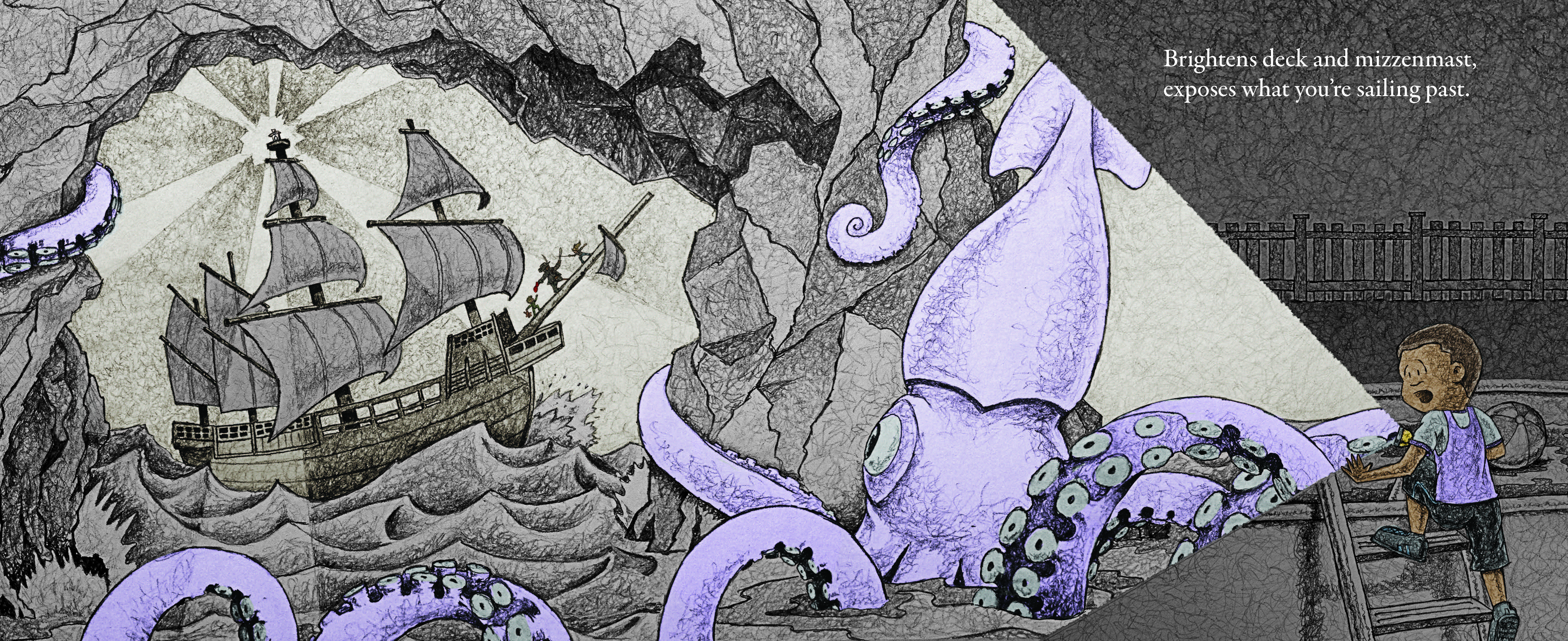
Summary: Flashlight Night is an ode to the power of imagination and the wonder of books. Three children use a flashlight to light a path around their backyard at night; in the flashlight’s beam another world looms. Our heroes encounter spooky woods, a fearsome tiger, a time-forgotten tomb, an Egyptian god, a sword-fighting pirate, and a giant squid. With ingenuity, they vanquish all, then return to their tree house–braver, closer, and wiser than before–to read the books that inspired their adventure.

“Delicious language . . . ingenious metamorphoses . . . a rousing read.” – Kirkus Reviews, Starred review

About the Author: Matt Forrest Esenwine’s poetry has been published in Highlights as well as in anthologies selected by Lee Bennett Hopkins, Carol-Ann Hoyte, and J. Patrick Lewis. He lives with his family in Warner, New Hampshire. Visit mattforrest.com.

About the Illustrator: Fred Koehler is and author-illustrator. His debut picture book, How to Cheer Up Dad, received starred reviews from Booklist, Kirkus Reviews, and BCCB. Fred has a background in advertising and lives with his two spirited kids in Lakeland, Florida, where he loves boating, camping, and the great outdoors.

Review: Flashlight Night by Matt Forrest Esenwine and Fred Koehler takes the reader on an adventure that truly illuminates the power of imagination. Esenwine’s poetic language is lyrical and filled with imagery and when accompanied with Koehler’s beautifully detailed pencil illustrations, the story comes to life.

I was so lucky to be able to spend some time with Fred at ALA and learn all about his adventures to find just the right inspiration for these illustrations. He went on some amazing adventures to Great Britain where he hiked and visited sites all to ensure that his illustrations were perfect for Matt’s story. He also showed us a time-lapse video of his pencil drawing one spread for the book. Yes, hand drawn with pencil. Beautiful and so impressive!

And this story is going to be loved by kids of all ages because of the fun adventures and parents will love the promotion of imagination. For example, this story made Trent want to go exploring, and Trent loves flashlights, so he loved the idea that a flashlight at night can bring about a how imaginative world!

Teachers’ Tools for Navigation: I would love to see what kids could come up with if given the opportunity to write about what their flashlight “showed them” when they go on an adventure around their house or outside. It would be a really fun activity for students to take and print photos of different places around their house and outside their house then write narratives about their adventures around these places and what is “actually there” if they explored with their flashlight.

Some other elements that could be discussed with Flashlight Night are: compare/contrast between what is there and what’s in their imagination and imagery/descriptive language including figurative language.

Discussion Questions: What are some different cultural influences you see in the adventures the kids went on?; What are the differences between reality and their imagination?; What descriptive language did the author use to help add imagery to the story?

Time Lapse Video of the Creation of One of Flashlight Night‘s Illustrations: It took Fred 30-35 hours per spread to create the amazing world the children explore throughout the book.

Flagged Passages: 

Read This If You Love: Journey Trilogy by Aaron BeckerThe Man with the Violin by Kathy Stinson, Noisy Night by Mac Barnett, Curious Case of the Missing Mammoth by Ellie HattieDad and the Dinosaur by Gennifer Choldenko, The Night Gardener by Terry Fan, My Pen by Christopher Myers, The Night World by Mordicai Gerstein, Lenny and Lucy by Philip C. Stead

Recommended For: 

classroomlibrarybuttonsmall closereadinganalysisbuttonsmall 

GIVEAWAY!

a Rafflecopter giveaway

Don’t miss the other stops on the blog tour!

Friday, 9/15  Jama’s Alphabet Soup

Monday 9/18 KitLit Exchange/The Loud Library Lady

Tuesday 9/19 Penny Klostermann Book Blog

Wednesday 9/20 Unleashing Readers

Thursday 9/21 KidLit Frenzy

Friday 9/22 Mrs. Knott’s Book Nook

Monday 9/25 Librarian in Cute Shoes

Tuesday 9/26 Nerdy Book Club

Signature

**Thank you to Boyds Mills Press for having us be part of the blog tour!**

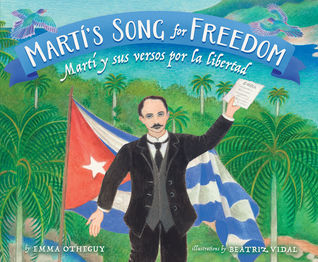
Marti’s Song for Freedom | Martí y sus versos por la libertad by Emma Otheguy

Share

ínfpb2017

Nonfiction Wednesday

Nonfiction Picture Book Wednesday is hosted by Kid Lit Frenzy and was started to help promote the reading of nonfiction texts. Most Wednesdays, we will be participating and will review a nonfiction text (though it may not always be a picture book).
Be sure to visit Kid Lit Frenzy and see what other nonfiction books are shared this week!
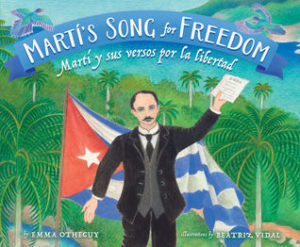
Marti’s Song for Freedom | Martí y sus versos por la libertad
Author: Emma Otheguy
Illustrator: Beatriz Vidal
Published July 17, 2017 by Lee & Low Books

Summary:

Yo soy un hombre sincero
De donde crece la palma,
Y antes de morirme quiero
Echar mis versos del alma
.

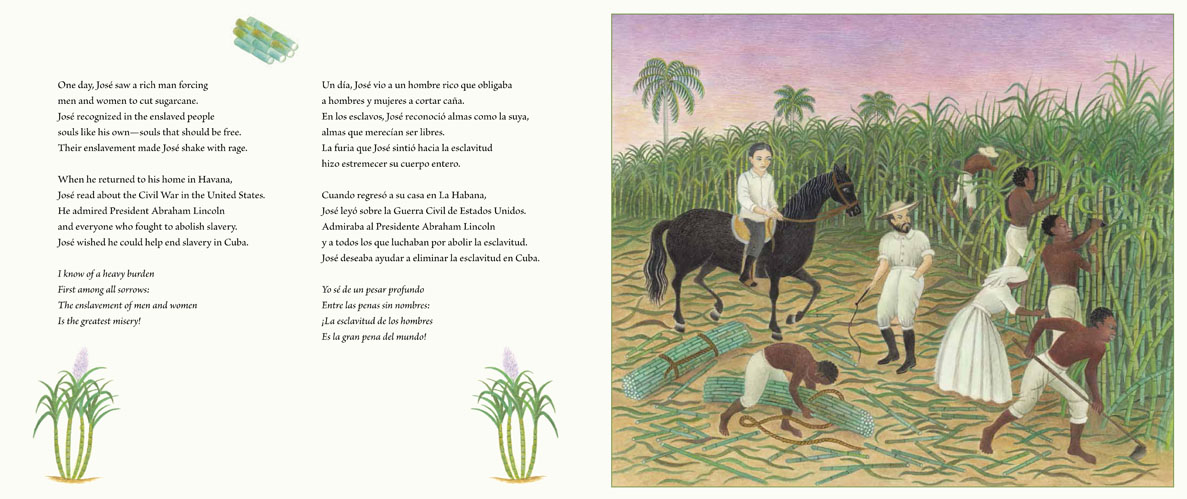
As a boy, José Martí was inspired by the natural world. He found freedom in the river that rushed to the sea and peace in the palmas reales that swayed in the wind. Freedom, he believed, was the inherent right of all men and women. But his home island of Cuba was colonized by Spain, and some of the people were enslaved by rich landowners. Enraged, Martí took up his pen and fought against this oppression through his writings. By age seventeen, he was declared an enemy of Spain and forced to leave his beloved island.

Martí traveled the world, speaking out for Cuba’s independence. But throughout his exile, he suffered from illness and homesickness. He found solace in New York’s Catskill Mountains, where nature inspired him once again to fight for independence.

Written in verse, with excerpts from Martí’s seminal Versos sencillos, this book is a beautiful tribute to a brilliant political writer and courageous fighter of freedom for all men and women.

Praise: 

“A sensitive and poignant tribute to one of Latin America’s most important historical figures.” – School Library Journal, starred review

“A moving account of [Marti’s] crusade for justice.” -Publishers Weekly, starred review

“A timely story that will inspire many to fight for equality and sing songs for freedom.” -Booklist, starred review

“Spotlights a steadfast hero and brilliant writer still worth admiring today.” -Kirkus reviews, starred review

“A direct and approachable introduction to the life and works of Cuban poet and freedom fighter José Martí.” -Shelf Awareness, starred review

About the Creators: 

Emma Otheguy is a children’s book author and a historian of Spain and colonial Latin America. She is a member of the Bank Street Writers Lab, and her short story “Fairies in Town” was awarded a Magazine Merit Honor by the Society of Children’s Book Writers and Illustrators (SCBWI). Otheguy lives with her husband in New York City. This is her picture book debut. You can find her online at emmaotheguy.com.

Beatriz Vidal is an award-winning painter, illustrator, and teacher. Her work has appeared in well-known publications such as The New York Times Magazine, Woman’s Day, and the New Yorker. Her artwork has also been featured on PBS programs and in numerous exhibitions around the world, including the International Exhibition of Illustrations for Children in Italy and the Society of Illustrators in New York. Vidal divides her time between New York City and Buenos Aires, Argentina. You can visit her online at beatrizvidal.com.

ReviewThis beautiful bilingual biography deserves all the praise it is receiving. The beautiful pieces of art that accompany the poetic verses turns this picture book biography into a piece of art! I also loved that not only is Martí’s biography in Spanish and English, but so is the author’s back matter.

I also am so glad that I learned about José Martí! I didn’t know anything about the Cuban war for independence and emancipation from slavery. Cuba has such an extensive history that is not taught here, so this story definitely fills a gap in history education. While the story teaches primarily of Martí’s life, the back matter goes deeper into Cuban independence and reading both is definitely going to pique interests to learn more. I think this book would pair nicely with books about our Civil War to compare the United States to other countries’ fights for freedom.

Teachers’ Tools for Navigation: Emma Otheguy was kind enough to share an activity guide for the text. All of the activities come in Spanish and English and can be downloaded at http://emmaotheguy.com/my-new-book/.

Activity 1: “José Martí wrote many letters throughout his life. He wrote about things he found beautiful or interesting, and also about injustices, and how he though they might get better. Write a letter to a friend, a relative, or an elected official about something you’re passionate about. It can be anything you care about, whether it’s helping your neighbors, caring for animals, or respecting the planet–just share how you feel. Then cut out your letter an mail it.” Followed by a outlined letter for kids to feel out.

Activity 2: “Did you know that José Martí was a poet, and that is poetry book Versos Sencillos was written and published right here in the United States? If you ever hear the song Guantanamera you’ll notice words from Marti’s poetry in the song! Read the first stanza of Martí’s poem, then fill in the blanks to create your own poem.”

Activity 3: “Read the book and solve this crossword puzzle”

Activity 4: “As teenagers, José Martí and his friends wrote and published their own newspaper, La Patria Libre (the free homeland), supporting Cuban independence. Can you create a newspaper? Fill out the boxes with the latest news.” Includes a place for Read All About It, Letter to the Editor, and an illustration.

Discussion Questions: How did José Martí play a part in Cuba’s fight for independence?; Did his age when sent to America surprise you?; Why is Cuba such a mix of culture?; How did the author use José Martí’s own words within her biography of him?; If you were to write to your government about an injustice you see in your country, what would you write about?

Flagged Passages: 
Read This If You Love: Margarita Engle’s books, Henry’s Freedom Box  by Henry Levine and other biographies about the fight for emancipation in the United States, Nonfiction picture book biographies

Recommended For: 

classroomlibrarybuttonsmallclosereadinganalysisbuttonsmall

Signature

**Thank you to Emma Otheguy for providing a copy for review!**

Star Stuff: Carl Sagan and the Mysteries of the Cosmos by Stephanie Roth Sisson

Share

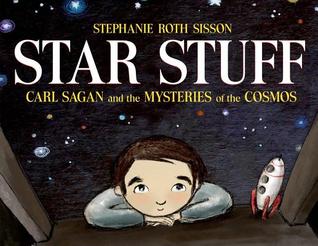
Star Stuff: Carl Sagan and the Mysteries of the Cosmos
Author: Stephanie Roth Sisson
Published: October 14, 2014 by Roaring Brook Press

A Guest Review by Brittany Brown

Summary: A curious boy living in a small city apartment finds the world astonishing. He wants to know about light bulbs, inch worms, and rocket ships. Carl sets out on a journey to find answers, but finds bigger, even more powerful questions. Through his research and studies, Carl eventually earns the title of Dr. Carl Sagan and spends his life seeking knowledge and understanding about the universe. This young

boy’s contributions to science and education have inspired many children everywhere to question the world around them. His story will resonate every child who has ever wondered “how” or “why” or spent an evening looking up at the night sky.

Review: I am constantly looking for books which will inspire my students and get them excited about learning. This book, which is brought to life with beautiful illustrations and the great mysteries of the universe, did that for myself as an adult, too. After reading it, everyday life is once again imbued with the magic and novelty it had in childhood. In Sagan’s eyes, there is no phenomenon too mundane to investigate. The curiosity which most adults leave behind drove Sagan to be the lifelong learner that all teachers hope to foster in their students. Reading this book shows that science is all around us, that we all belong here in the universe, and that in everyone there is a scientist. I absolutely loved reading this book, and as a new teacher building my classroom library, this is the first one which I will be purchasing multiple copies of to share with my students.

Teachers’ Tools for Navigation: This story would pair well with any science or biography unit. It would also serve as a great example of narrative nonfiction.

The most obvious use for this story is in a science unit. I would love to use this book to open up a discussion at the beginning of a unit on the solar system. Not only would it generate excitement, it would also begin to build some vocabulary and background knowledge. It would make the information in the unit more personal and relevant to kids, and would be a great launching point to encourage students to come up with their own questions about how the world works.

This book is also a wonderful book to use for mini lessons in writing. Using this book as an example, a teacher could lead a discussion on how to choose which life events to include in a biography, how to sequence and organize it, and how to incorporate quotes from a historical figure into a writing piece. It also shows how to include facts and achievements in an engaging way, and how to demonstrate a person’s impact on history.

Finally, this book would also be a superb example of narrative nonfiction. Despite containing lots of scientific facts, it reads like a storybook and the illustrations do much of the talking. Students will be captivated with the descriptive narration, and discussions could explore their experiences as readers or how they may be able to attempt this style in their writing.

Discussion Questions: What are your big mystery questions? Where would you go to try to find answers to them? What character traits helped Carl on his journey? What impact did he have on the world? Who does he remind you of?

Book Trailer: 

Read This If You Loved: What Do You Do with an Idea? By Kobi Yamada, I Wonder by Annaka Harris, You Are Stardust by Elin Kelsey, On a Beam of Light: A Story of Albert Einstein by Jennifer Berne, The Boy Who Loved Math: The Improbable Life of Paul Edros by Deborah Heiligman, Look Up!: Henrietta Leavitt, a Pioneering Woman Astronomer by Robert Burleigh

Recommended For:
 classroomlibrarybuttonsmall

Thank you, Brittany!

RickiSig

Review and Giveaway!: Splatypus by Sudipta Bardhan-Quallen

Share

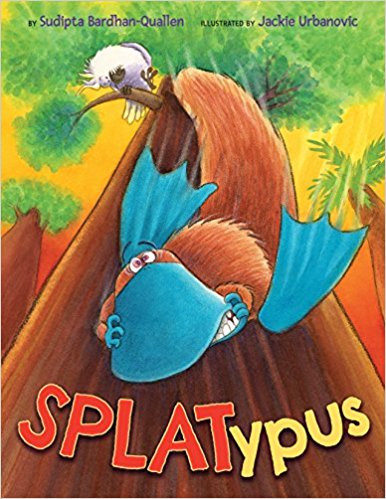
SPLATypus
Author: Sudipta bardhan-Quallen
Illustrator: Jacki Urbanovic
Published April 4th, 2017 by Two Lions

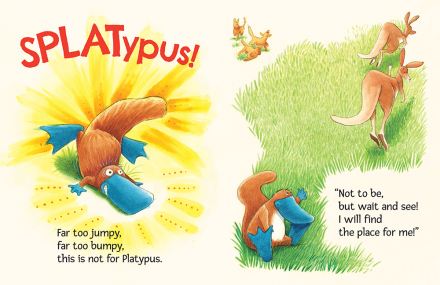
Summary: Lonely Platypus wants to play, but where should he go? Should he jump with the kangaroos? Leap with the possums? Fly with the bats? Every time he tries to find out—skipping, hopping, dipping, dropping—he winds up going splat instead. Can a SPLATypus find a place where he belongs? This rhyming, rollicking story is perfect for reading aloud.

Review: Everyone is searching for their place in the world. Starting at a very young age, we want to be accepted and know that we belong. Kids will love the platypus story because it is about him figuring it out; however, even though the message is quite serious and will lead to important talks, it leads to this topic in a very fun and humorous way. The platypus’s adventure is just so silly that readers will be mesmerized by it and the colorful illustrations! This story is a win-win for teachers, parents, and kids!

Teachers’ Tools for Navigation: The most important way this book will fit into most classrooms is through read aloud and the classroom library. Like I shared above, it really does lead to conversations about identity and fitting in but does so in a non-preachy way. Additionally, the text could be used as a mentor text for writing a narrative animal story in a similar style. Maybe OOPSephant or KangaNO or GOrilla filled with onomatopoeias and rhyming.

Discussion Questions: When is a time you haven’t felt like you fit in? What did you do to make your situation better?: What words in the story rhymed?; What onomatopoeias did the author use in the text? Why do you think they were included?

Flagged Passages: 

Read This If You Loved: Leaping Lemmings by John BriggsHoot and Honk Just Can’t Sleep by Leslie HelakoskiThe Knowing Book by Rebecca Kai DotlichA Big Surprise for Little Card by Charise Mericle HarperThunder Boy Jr. by Sherman AlexieAfter the Fall by Dan Santat, Little Excavator by Anna Dewdney, Not Quite Narwhal by Jessie Sima

Recommended For:

  classroomlibrarybuttonsmall 

Giveaway!

a Rafflecopter giveaway

**Thank you to Al at Two Lions for providing a copy for review and giveaway!**

Snow White: A Graphic Novel by Matt Phelan

Share

Snow White: A Graphic Novel
Author: Matt Phelan
Published: September 21, 2016 by Candlewick

A Guest Review by Emily Baseler

GoodReads Summary: Award-winning graphic novelist Matt Phelan delivers a darkly stylized noir Snow White set against the backdrop of Depression-era Manhattan.

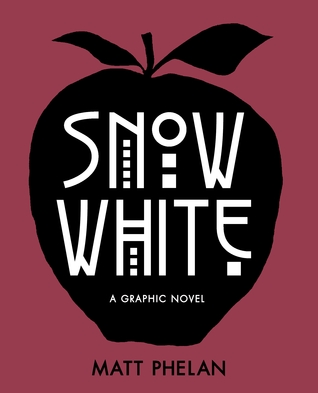
The scene: New York City, 1928. The dazzling lights cast shadows that grow ever darker as the glitzy prosperity of the Roaring Twenties screeches to a halt. Enter a cast of familiar characters: a young girl, Samantha White, returning after being sent away by her cruel stepmother, the Queen of the Follies, years earlier; her father, the King of Wall Street, who survives the stock market crash only to suffer a strange and sudden death; seven street urchins, brave protectors for a girl as pure as snow; and a mysterious stock ticker that holds the stepmother in its thrall, churning out ticker tape imprinted with the wicked words “Another . . . More Beautiful . . . KILL.” In a moody, cinematic new telling of a beloved fairy tale, extraordinary graphic novelist Matt Phelan captures the essence of classic film noir on the page—and draws a striking distinction between good and evil.

Review: Matt Phelan reinvented the “happily ever after” with this retelling. I identify as a Disney Classic enthusiast but I was pleasantly surprised with the ending. The illustrations are gorgeous with distinct intentionality. More mature themes such as death, assassination, murder were evaluated within a historical context to create an incredible murder mystery story at the level of a middle grade reader.

Teachers’ Tools for Navigation: This would be an excellent text to hand a more reluctant reader. There is limited text the reader is asked to interpret the illustrations and structure. In literature groups, students could potentially discuss the use of metaphor, oenomania, author/illustrator’s choice, and compare/ contrast the original fairytale with the retelling. This is also a text I would recommend to a student who has shown an interest in the graphic novel genre to read independently.

Discussion Questions: Why do you think the author choose to use red in selected illustrations? How did this choice influence you as a reader?; Why do you think the author choose to break apart the chapters this way?; Even though there were few words, how did you interpret the mood, tone, and voice of characters?; Did you find yourself needing to interpret the illustrations to understand the plot? What was that experience like for you as a reader?; How is this retelling of the classic fairy tale of “Snow White” different than the original? What did you notice is similar?

Flagged Passage: “My name is Snow White, but my mother didn’t call be that to be funny. She would say that the snow covers everything and makes the entire world beautiful” (Ch. 10)

Book Trailer: 

Read This If You Loved: Red: The True Story of Red Riding Hood by Liesl Shurtliff, Jack: The True Story of Jack and the Beanstalk by Liesl Shurtliff, Rump: The True Story of Rumpelstiltskin by Liesl Shurtliff

Recommended For:
 classroomlibrarybuttonsmall

Thank you, Emily!

RickiSig

The Dark by Lemony Snicket

Share

The Dark
Author: Lemony Snicket
Illustrator: Jon Klassen
Published April 2, 2013 by Little, Brown

Guest Post by: Nichole Pitruzzello

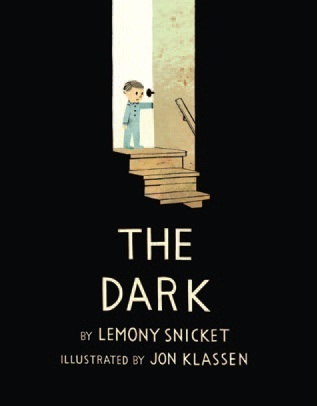
Summary: Laszlo is afraid of the dark. But is the dark afraid of Laszlo? They live in the same house, with the same creaky roof, smooth, cold windows, and several sets of stairs. But the dark mostly stays in the basement…until one night, when it doesn’t. Laszlo walks through his house, as the dark converses with him, on a journey to overcome his fear.

Review: In his unique writing style, Lemony Snicket takes an eerie childhood fear and personifies the dark in a soothing way. John Klassen’s illustrations are a wonderful compliment to the story of Laszlo, using black space and warm colors to enhance the mood. I’m very impressed by the way they take a concept that many children fear, and transform it into a friendly, calming presence. I cannot wait to add this book to my library!

Teachers’ Tools for Navigation: Teachers can use this book as a mentor text for a variety of mini lessons. Lemony Snicket personifies the dark, uses vivid language to talk about Laszlo’s house, and creates suspense through a blend of dialogue and narration. In addition, it’s an excellent book to teach a lesson about overcoming one’s fears. There’s so much that this book can add to a classroom!

Discussion Questions: What are some places that you are scared of, and why are they scary? Was the dark really scary? How did the dark help Laszlo? Why shouldn’t we be afraid of the dark? What should we do when we are afraid of something?

Book Trailer: 

Read This If You Loved: Go Away, Big Green Monster by Ed Emberly, Singing Away the Dark by Caroline Woodward, 13 Words by Lemony Snicket

Recommended For:

   classroomlibrarybuttonsmall