Never Fall Down by Patricia McCormick

Share

NFPB2015

Nonfiction Picture Book Wednesday

Nonfiction Picture Book Wednesday is hosted by Kid Lit Frenzy and was started to help promote the reading of nonfiction texts. Most Wednesdays, we will be participating and will review a nonfiction text (though it may not always be a picture book).
Be sure to visit Kid Lit Frenzy and see what other nonfiction books are shared this week!
**This book is technically historical fiction, but I felt it was pretty darn close to nonfiction**

never fall down

Never Fall Down
Author: Patricia McCormick
Published May 8th, 2012 by Balzer + Bray

Goodreads Summary: This National Book Award nominee from two-time finalist Patricia McCormick is the unforgettable story of Arn Chorn-Pond, who defied the odds to survive the Cambodian genocide of 1975-1979 and the labor camps of the Khmer Rouge.

Based on the true story of Cambodian advocate Arn Chorn-Pond, and authentically told from his point of view as a young boy, this is an achingly raw and powerful historical novel about a child of war who becomes a man of peace. It includes an author’s note and acknowledgments from Arn Chorn-Pond himself.

When soldiers arrive in his hometown, Arn is just a normal little boy. But after the soldiers march the entire population into the countryside, his life is changed forever.

Arn is separated from his family and assigned to a labor camp: working in the rice paddies under a blazing sun, he sees the other children dying before his eyes. One day, the soldiers ask if any of the kids can play an instrument. Arn’s never played a note in his life, but he volunteers.

This decision will save his life, but it will pull him into the very center of what we know today as the Killing Fields. And just as the country is about to be liberated, Arn is handed a gun and forced to become a soldier.

My Review: When I started Never Fall Down, I had no idea what I was getting myself into. I began it because Ricki recommended it to me, but I didn’t read the back or have any prior knowledge about the book. So, when I began, I had no idea how tough this book was going to be.

I also have to preface with my ignorance of the Cambodian Genocide. I blame my lack of world history education because this is a time of history that should be taught. It, along with the Holocaust and Armenian Genocide, was based in racism and the attempt to purify a country. Reading Arn’s story throws you right in the middle of the genocide, and Patricia McCormick doesn’t hold anything back. Every time you think nothing can get worse for Arn and the Cambodians, something does, but you also have such hope for Arn’s survival as you seen him overcome every obstacle he faces. Even though death actually stares him in the face throughout the book, this young boy somehow continues. He continues through starvation, excessive work, lack of sleep, and murder surrounding him.  Arn stated in interviews with McCormick that music saved his life, but I think it was more about his willingness to do whatever was needed to survive and especially anything to help those he cared for to survive.

Patricia McCormick tells our story in a broken English dialect that was influenced by “Arn’s own beautiful, improvised English” that McCormick heard in her head after interviewing him and traveling with him to Cambodia over a couple of years.  The extent that Ms. McCormick went to ensure that Arn’s story was a true representation of his trials and heroism is honorable.

Teachers’ Tools For Navigation: This would be a perfect cross-curricular text! It could be read in a world history class in full or in parts. Although it is McCormick’s writing, it is definitely Arn’s story, and Arn’s story is one that needs to be shared. This book could also be used in lit circles where each group has a different book about a piece of history or an individual who/that is not usually learned about (maybe with Between Shades of Gray by Ruta Sepetys, Sold, Caminar by Skila Brown, The Glass Collector by Anna Perera, Son of a Gun by Anne de Graaf, Inside Out & Back Again by Thanhha Lai, Guantanamo Boy by Anna Perera, A Long Walk to Water by Linda Sue Park, The Queen of Water by Laura Resau, or Now is the Time for Running by Michael Williams).

One of my amazing 8th grade students read this book recently, and she was as enthralled with it as I was. Immediately after finishing, she got online and started learning more about Arn and Cambodia. She came across an amazing video with both Patricia McCormick and Arn in it. It is 27 minutes long, but it is so worth watching:

Discussion Questions: What do you think ultimately helped Arn survive?; How did Sombo save Arn’s life at the orphan camp? When the war with the Vietnamese started? At the killing fields?; Do you think music is what saved Arn?; How were the Khmer Rouge able to make their prisoners do whatever they wanted them to?; Why did the Khmer Rouge kill all the educated Cambodians?; Why was Sombo so unsure about the Coca Cola?

We Flagged: “All the time now we hear girl screaming, girl running, girl crying. At night but also sometime in the daytime. All the tie, the Khmer Rouge they chase the girl, cut the hair. Sometime with scissor, sometime with knife. Chop short, to the chin, like boy. The girl, they cry and sometime they run. They run, it’s no good. The Khmer Rouge may shoot them, maybe take them to the bushes, do whatever they want. A lot of the girl afterward, they pull on their hair, pull like maybe they can stretch it, make it long, make it beautiful again.

My number two big sister, Maly, her hair like silk. Most proud thing about her, her hair. Shiny black, like blue, like a crow has. Every night she brush her hair, every morning. Sometime even she brush her hair not thinking, just dreaming maybe about the boy she love. One morning I wake up before everyone and see her making rice. Her neck, it’s bare now, her skin there is pale, never saw the sun, her long hair gone. Last night while I was asleep, the soldier, they cut her beauty. So now when she give me a bowl of rice soup, her eyes stay on the ground.” (p. 29-30)

Read This If You Loved: Titles listed above in Teachers’ Tools for Navigation

Recommended For: 

classroomlibrarybuttonsmall litcirclesbuttonsmall closereadinganalysisbuttonsmall

Signature

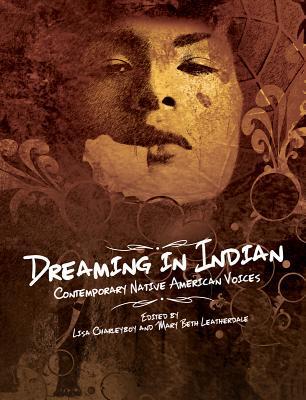
Dreaming in Indian Edited by Lisa Charleyboy and Mary Leatherdale

Share

dreaming in indian

Dreaming in Indian: Contemporary Native American Voices
Editors: Lisa Charleyboy and Mary Leatherdale
Published: July 24, 2014 by Annick Press

Summary: A powerful and visually stunning anthology from some of the most groundbreaking Native artists working in North America today.

Truly universal in its themes, “Dreaming In Indian” will shatter commonly held stereotypes and challenge readers to rethink their own place in the world. Divided into four sections, ‘Roots, ‘ ‘Battles, ‘ ‘Medicines, ‘ and ‘Dreamcatchers, ‘ this book offers readers a unique insight into a community often misunderstood and misrepresented by the mainstream media.

Emerging and established Native artists, including acclaimed author Joseph Boyden, renowned visual artist Bunky Echo Hawk, and stand-up comedian Ryan McMahon, contribute thoughtful and heartfelt pieces on their experiences growing up Indigenous, expressing them through such mediums as art, food, the written word, sport, dance, and fashion. Renowned chef Aaron Bear Robe, for example, explains how he introduces restaurant customers to his culture by reinventing traditional dishes. And in a dramatic photo spread, model Ashley Callingbull and photographer Thosh Collins reappropriate the trend of wearing ‘Native’ clothing.

Whether addressing the effects of residential schools, calling out bullies through personal manifestos, or simply citing hopes for the future, “Dreaming In Indian” refuses to shy away from difficult topics. Insightful, thought-provoking, and beautifully honest, this book will to appeal to young adult readers. An innovative and captivating design enhances each contribution and makes for a truly unique reading experience.

Review: I fell in love with the stunning illustrations and beautiful language of this book. I read two to three pages per night because I wanted to leave time to absorb the authors’ words and artists’ work. The eclectic mix of forms makes for a very powerful anthology that will prove enduring for readers. It features a variety of tribes, and the differing formats and content give readers a sense of both a unity across tribes and a distinctness of individuals from the different tribes. I found it to be truly inspiring and wish I could donate this book to every middle and high school classroom.

Teacher’s Tools for Navigation: This text is obviously a great resource for teachers. It need not be used in its entirety because this text would be excellent for close readings. Whatever the format, it would be preferable to avoid using this book solely during the month of November—“Native American Heritage Month.” I align with scholars who believe that diverse cultures should be highlighted year-round and integrated within curricula, rather than solely within designated months.

Discussion Questions: In what ways are the themes of this book universal? In what way are they distinct?; What themes can you find across the works?; How does this book shed light on Indian culture?; How is the text structured? Do you find the style to be effective?

Book Trailer: 

From the Authors:

Recommended For:

closereadinganalysisbuttonsmall classroomlibrarybuttonsmall

RickiSig

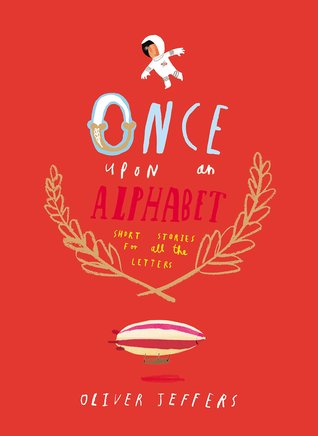
Once Upon an Alphabet by Oliver Jeffers

Share

Once Upon an Alphabet

Once Upon an Alphabet: Short Stories for all the Letters
Author: Oliver Jeffers
Published October 14th, 2014 by Philomel

Goodreads Summary: If words make up the stories and letters make up the words, then stories are made up of letters. In this menagerie we have stories made of words, made FOR all the letters.

The most inventive and irresistible book of the year spans a mere 26 letters (don’t they all!) and 112 pages. From an Astronaut who’s afraid of heights, to a Bridge that ends up burned between friends, to a Cup stuck in a cupboard and longing for freedom, Once Upon an Alphabet is a creative tour de force from A through Z. Slyly funny in a way kids can’t resist, and gorgeously illustrated in a way readers of all ages will pour over, this series of interconnected stories and characters explores the alphabet in a way that will forever raise the bar.

In Once Upon an Alphabet, #1 New York Times bestseller Oliver Jeffers has created a stunning collection of words and artwork that is a story book, alphabet book, and gorgeously designed art book all in one.

Kellee’s Review and Teachers’ Tools for Navigation: Oliver Jeffers is just brilliant. Everything he does is unique, and he actually keeps surprising me with each new book. And he makes me laugh out loud, which is always such a treat. This book has 26 quirky short stories, each corresponding with a letter. Each story has characters, plot, theme, and conflict, and each is quite clever and funny. It is just so well done!

I’d love to see this book used as a read aloud for 26 days. Each day as a different letter. With every letter, teachers could focus on different things: the letter, illustrations, voice, characterization, plot arc, conflict, theme, mood, figurative language, etc. It would be a great opener to the day and would also be a lot of fun to ask students to write their own stories for the letters. This pushes an alphabet book to a whole different level!

Ricki’s Review and Teachers’ Tools for Navigation: I agree with Kellee. Decades from now, children will still be enjoying Jeffers’ books. For me, he is comparable to the greats in children’s literature. My favorite part about this book was the way he connected the letters. It made me excited when he returned to some of the previous short stories.

This book begs for students to write. The short stories teach literary skills in an engaging way. Kellee’s idea was similar to my own. I would love to see a classroom book of these letters. Each student could be assigned a letter or two. With some funding, perhaps the students could bring a bound version home. It would be much more fun for students to practice letters when they can read their classmate’s stories! The way Jeffers flexes his creative muscles would also be inspiring to high school students.

Discussion Questions: Which letter’s story was your favorite? Why?; In what ways was Oliver Jeffers creative in his storytelling?; Can you think of other stories for each letter?

We Flagged: 

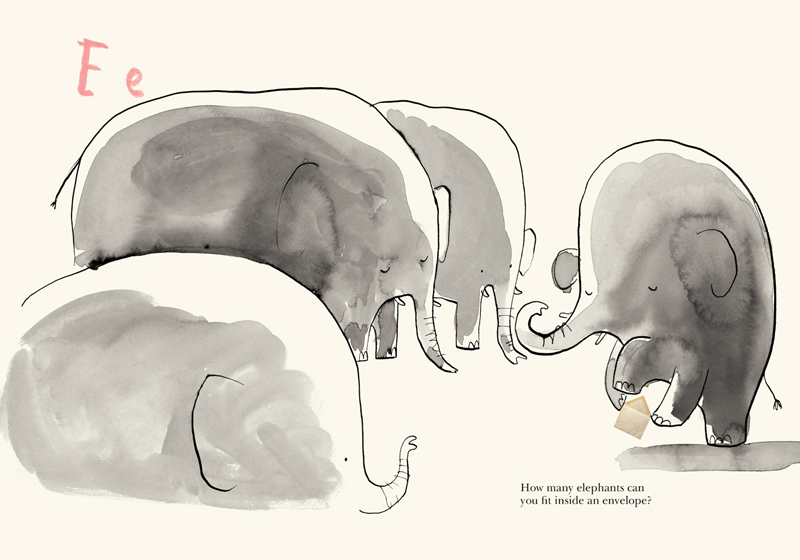
jeffers-e
http://www.oliverjeffers.com/media/5-e-2-web.jpg

Read This If You Loved: Any books by Oliver Jeffers, Eric Carle, or Dr. Seuss

Recommended For: 

classroomlibrarybuttonsmall readaloudbuttonsmall closereadinganalysisbuttonsmall

Signature andRickiSig

**Thank you to Penguin Young Readers Group for providing copies for review!**

Blog Tour and Review!: Catch that Cookie! by Hallie Durand

Share

cookie

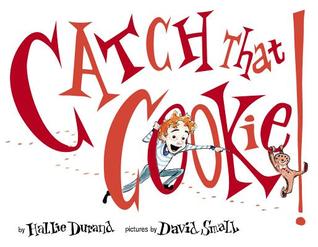
Catch That Cookie!
Author: Hallie Durand
Illustrator: David Small
Published August 14th, 2014 by Dial

Publisher Summary: Gingerbread men can play a mean game of sneaky tag!  Don’t believe it? Marshall didn’t either no matter how much his teacher, Ms. Gray, told him. But when the cookies go missing from the oven and the students find clues all around the classroom, Marshall can deny it no longer: Gingerbread men are real and they’re on the run!

From the author of the Dessert First Trilogy and Mitchell books, Hallie Durand, and Caldecott winner and two time honoree illustrator David Small, comes a tantalizing new tale that will have readers racing through the pages, eager to see where the gingerbread men have gone.

My Review and Teachers’ Tools for Navigation: This book has the potential to not only be a fun, interactive read for kids, but one that could definitely be used in a classroom. Since the reader, along with Mitchell, are given clues throughout the book, the reader can work with Mitchell to try to figure out where the gingerbread men went. It would be so much fun to read this with kids. The clues are rhyming with words left out, so they must use the context clues and rhyming skills to figure out the missing word. Also, to complete track the men down in the end, Mitchell has to make some inferences which would be a great discussion on how he figured it out. So, either in the classroom or at home, this book is definitely going to get some laughs and start good conversations.

Discussion Questions: If your gingerbread man could run, where do you think he would go?; Marshall gave his cookie six raisin eyes! Tell us how you would design your own gingerbread man.

I would make my gingerbread man look like a ninja so that he would be the hardest gingerbread man to find and he would always be where ever you weren’t looking!

Comment below OR share through Twitter using #catchthatcookie!

We Flagged: 

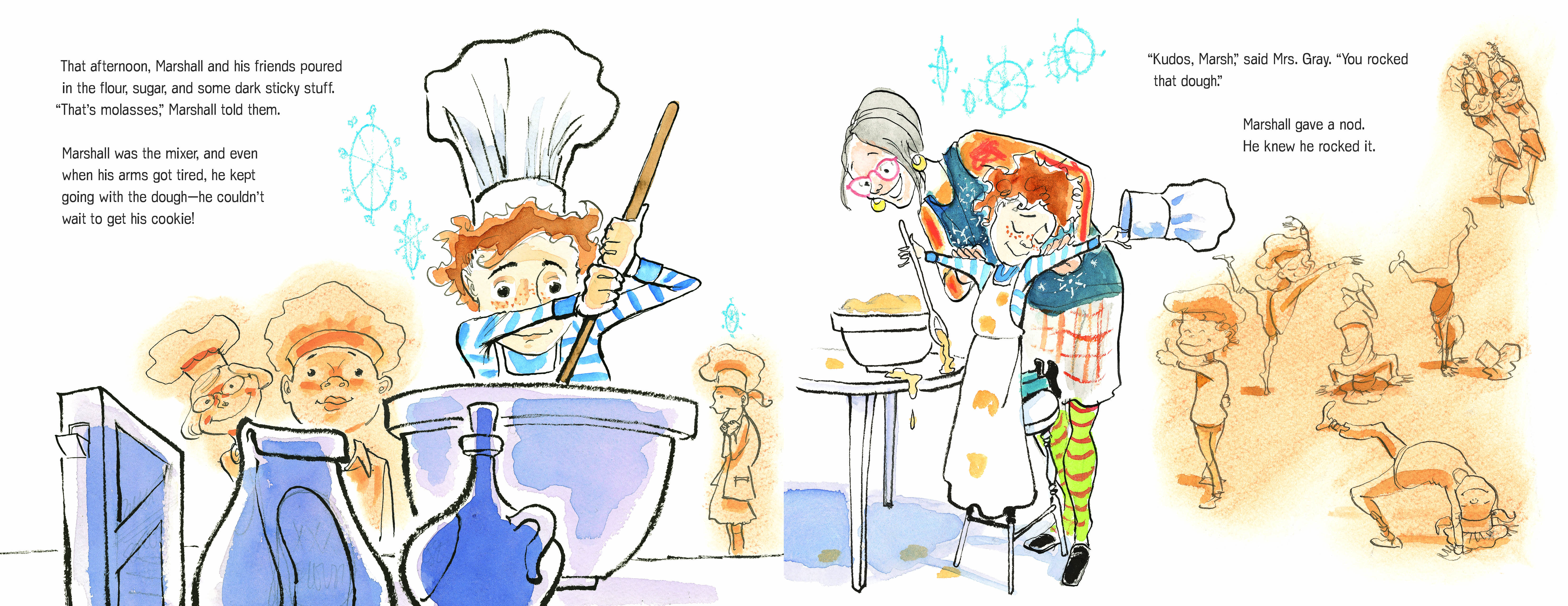
Cookie_10-11

Read This If You Loved: Mitchell books by Hallie Durand, Help! We Need a Title by Herve Tullet 

Recommended For: 

classroomlibrarybuttonsmall readaloudbuttonsmall

Signature

**Thank you to Rachel at Penguin for having us as a stop on the blog tour!**

You Are (Not) Small by Anna Kang

Share

small

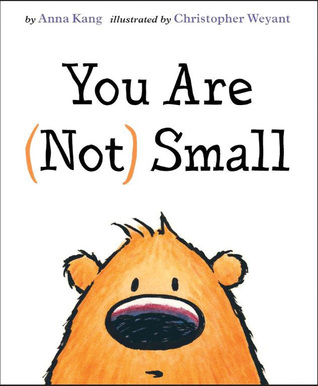
You Are (Not) Small
Author: Anna Kang
Illustrator: Christopher Weyant
Published August 5th, 2014 by Two Lions

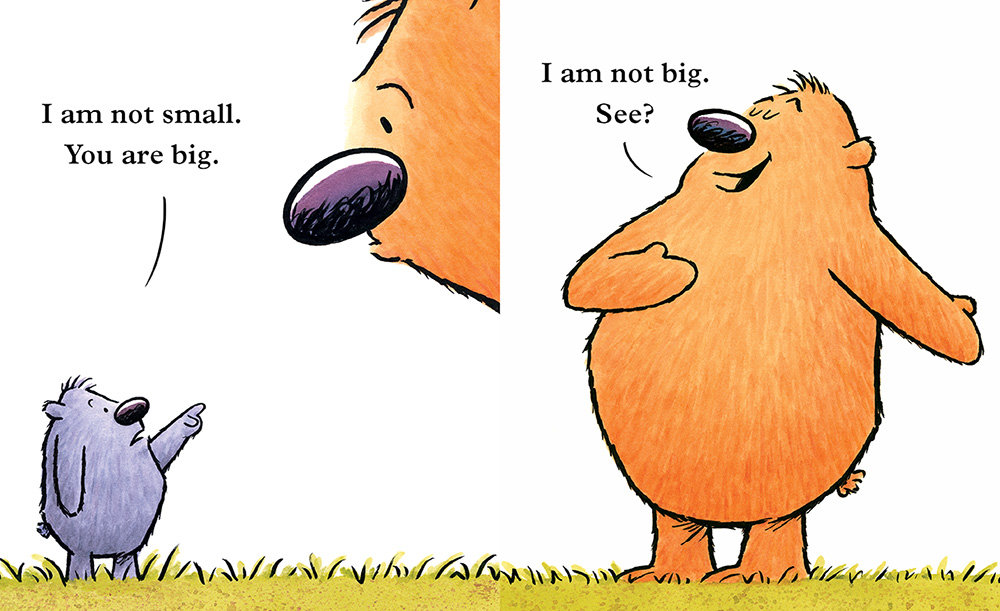
Goodreads Summary: Two fuzzy creatures can’t agree on who is small and who is big, until a couple of surprise guests show up, settling it once and for all. The simple text of Anna Kang and bold illustrations of New Yorkercartoonist Christopher Weyant tell an original and very funny story about size–it all depends on who’s standing next to you.

About the Author and Illustrator: You Are (Not) Small  is the first collaboration of this talented husband-and-wife team. Anna’s childhood experience growing up in a town where she and her family were one of the few Asians was an instrumental part of the inspiration for the book. Of this experience, Anna says, “I eventually learned that how you saw others—and yourself—largely depended on your personal experience and your community, which shapes your perspective.” Christopher adds, “When I was growing up, I was always the second smallest in my class so this story is near and dear to me. I learned the valuable lesson that there are good things about being small, there’s always someone taller, and humor is a wonderful way to handle/celebrate our differences.”

Christopher Weyant’s work has been published worldwide in books, newspapers, magazines, and online. His cartoons are in permanent collection at The Whitney Museum of American Art and The Morgan Library & Museum in New York City. Anna Kang received her MFA from USC’s School of Cinematic Arts. You Are (Not) Small is their first children’s book; they are currently at work on a sequel. They live with their children in New Jersey.

Kellee’s Review: I love these little monsters! They are so persistent and determined! And what makes this book even better is the the colorful, thick-lined illustrations. They are very eye catching.  As much as I love these little (tiny? big? giant?) creatures, kids will love them even more and will be surprised by the twist towards the end of the book.

Ricki’s Review: With my husband’s and my genetics, my son is destined to be short. I was always the shortest student in my classes, and this story would have made me feel a lot better as a child! I value books that teach children to celebrate their differences and to feel comfortable with themselves. This would also be a great book to prevent bullying. The confidence of these characters is admirable, and they make great role models. This would be a fantastic read-aloud.

Teachers’ Tools for Navigation: This fun, seemingly simple book is more than it seems! It gives amazing opportunities to talk about perspectives, adjectives, and interjections. The creatures could also easily be compared and contrasted. It is a great introduction to all of these concepts.

A downloadable classroom guide is also available through Amazon.

Discussion Questions: Which of the monsters do you think is big? Which do you think is small?; What other adjectives could you use to describe the ___ monster?

We Flagged: 

Read This If You Loved: Big Bug by Henry Cole, Horns to Toes by Sandra Boynton, Giraffes Can’t Dance by Giles Andreae, Unicorn Thinks He’s Pretty Great by Bob Shea, The Magic of Maxwell and His Tail by Maureen Stolar Kanefield

Recommended For: 

readaloudbuttonsmall classroomlibrarybuttonsmall

Signature andRickiSig

**Thank you to Deborah Bass for providing these books for review.**

Review and Teaching Guide!: El Deafo by Cece Bell

Share

NF PB 2014

Nonfiction Picture Book Wednesday

Nonfiction Picture Book Wednesday is hosted by Kid Lit Frenzy and was started to help promote the reading of nonfiction texts. Most Wednesdays, we will be participating and will review a nonfiction text (though it may not always be a picture book).
Be sure to visit Kid Lit Frenzy and see what other nonfiction books are shared this week!

deafo

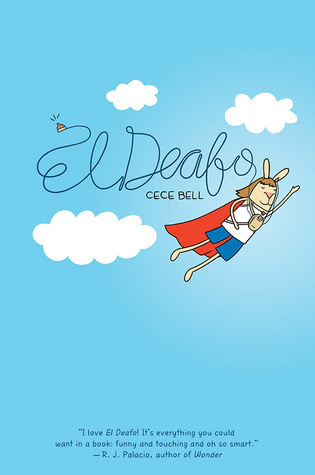
El Deafo
Author: Cece Bell
Published September 2nd, 2014 by Abrams

Publisher Summary: Going to school and making new friends can be tough. But going to school and making
new friends while wearing a bulky hearing aid strapped to your chest? That requires superpowers! In this funny, poignant graphic-novel memoir, author/illustrator Cece Bell chronicles her hearing loss at a young age and her subsequent experiences with the Phonic Ear, a very powerful—and very awkward—hearing aid. The Phonic Ear gives Cece the ability to hear—sometimes
things she shouldn’t—but also isolates her from her classmates. She really just wants to fit in and find a true friend, someone who appreciates her as she is. After some trouble, she is finally able to harness the power of the Phonic Ear and become “El Deafo, Listener for All.” And more importantly, declare a place for herself in the world and fi nd the friend she’s longed for.

Author: Cece Bell has written and illustrated several books for children, including the Geisel Honor book Rabbit & Robot: The Sleepover. She lives in Virginia with her husband, author Tom Angleberger.

My Review: There are times that you read a book and when you are done, you just know that it is a special book. El Deafo is one of those books. As you all know, I am a huge fan of Hurt Go Happy by Ginny Rorby, and one of the reasons I am is because it looks at disabilities in a positive light and shows that a disability is not an end, but just a change. El Deafo is another novel that does this. Although Cece, like Joey in Hurt Go Happy, finds herself deaf at a young age, we see her overcome this blow and turn it into a superpower. But this book is about more than deafness; it is about being a kid, about growing up, about friendship, about ackwardness, about school, about crushes, about family, about life. This book is truth.

Teachers’ Tools For Navigation: There is so much you can do with this graphic novel. Many activities can be found in the teaching guide that I wrote for Abrams. This book is perfect for independent reading, for lit circles  with other graphic novel memoirs, for jigsawing, for read alouds, and for looking deeply into the text.

(Also, and I didn’t want to harp on this because they are both such unique books, but this book will be loved by the readers of Smile. They both look at such an important part of life.)

Discussion Questions: Language Arts:  Cece uses many different kinds of clues to help her lip-read. (pages 30–31) What are the 4 types of clues? How do they help with lip-reading? In what other ways can these clues be helpful?; On page 60, Cece shares an analogy of her friendship with Laura. She feels like a baited fish that is caught on Laura’s hook. What analogies could we make to
describe Cece’s friendship with Ginny? Martha? Emma?; Science: What is meningitis? How can it cause deafness?;  What is an audiologist? What would you have to study to become one?; History/Social Studies: Many deaf and hard of hearing individuals have made history, including Helen Keller, William Ellsworth Hoy, and Juliette Gordon Low. Research these or other deaf or hard of
hearing individuals throughout history and today. How did being deaf affect their lives? What were their accomplishments?

We Flagged: 

01ORIGINSPanelsREVISED
**From Cece Bell’s blog**

Read This If You Loved: Smile and Sister by Raina Telgemeier, The Dumbest Idea Ever! by Jimmy Grownley, I Remember Beirut by Zeina Abirached, Odd Duck by Cecil Castellucci

Recommended For: 

classroomlibrarybuttonsmall readaloudbuttonsmall closereadinganalysisbuttonsmall litcirclesbuttonsmall

Signature

Boys of Blur by N. D. Wilson

Share

boys of blur

Boys of Blur
Author: N. D. Wilson
Published: April 8, 2014 by Random House

Ricki’s Summary and Review: 12-year-old Charlie Reynolds’ family travels to town of Taper to attend the funeral of a beloved football coach. When Charlie’s stepfather is given the opportunity to coach the town’s football team, Charlie is not thrilled to learn that they will be living in this creepy town filled with ancient stories of runaway slaves, native tribes, and monsters that rise organically from the murky swamps. He tries to fit into this mysterious place, where boys chase rabbits through burning sugarcane and everything seems to revolve around football. As he comes to learn about this town of secrets, Charlie wonders if he has the courage to uncover the mysteries that surround him.

Set deep in the heart of the Florida Everglades, this text is sure to grip readers with its muck, swords, blood, and gore. Wilson integrates complex allusions to Beowulf, which will compel readers to uncover all of the parallels with the classic legend. The beautifully complex language of this fast-paced story inspires close readings while also teaching readers lessons about evilness, heroism, and family.

Kellee’s Review: What I found most intriguing about this book is that Wilson was able to allude to Beowulf in a middle grade book without completely scaring away the reader.  Although I have read in multiple reviews that this book will grab reluctant readers’ attention, I think that some of the allusions are hard to grasp without prior knowledge, so reluctant readers may need some assistance understanding thus making the book a great read aloud as it will grab attention and start deep discussion (see Tools for Navigation).  In addition to the allusions, there are opportunities to discuss hero’s quest, abuse, and loyalty.

You will also find some beautiful writing in this novel. Wilson has a way with words that made this novel lyrical yet easy to read. From the very first line: “When the sugarcane’s burning and the rabbits are running, look for the boys who are quicker than flame.” I was impressed with how literary the novel was.  

Teacher’s Tools for Navigation: There are obvious parallels between this novel and  the legend of Beowulf, and pairing these two texts for discussion would prove very rewarding. Perhaps, teachers could use this Boys of Blur in conjunction with Gareth Hinds’ graphic novel of Beowulf. Then, the class could compare and contrast both the story lines and the differing formats authors might employ to convey a story and message.

Discussion Questions: How is Charlie characterized? Do you find him to be a strong character?; What role does Cotton play in the story?; What role does Charlie’s father play in the story? Can he be forgiven?; How does the author use language effectively?

We Flagged: “‘Yes,’ Mrs. Wisdom said, ‘you are. You’re made of tiny spinning bits as fast as light. But those bits aren’t all of you. They fly off. They get lost, and new ones come on and join the swirling Charlie-shaped dance that is your body. And dwelling in that dance, woven through every racing bit, heating it all with life and guiding it, there is a fire, a soul—you. It takes a dream to see something like that, something closer to the way things really are” (110).

Read This If You Loved:  Beowulf by Unknown, 100 Cupboards by N. D. Wilson, Maniac Magee by Jerry Spinelli, Holes by Louis Sachar, Ophelia and the Marvelous Boy by Karen FoxleeRaining Sardines by Enrique Flores-Galbis

Recommended For:

 readaloudbuttonsmall litcirclesbuttonsmall closereadinganalysisbuttonsmall classroomlibrarybuttonsmall 

RickiSigand Signature