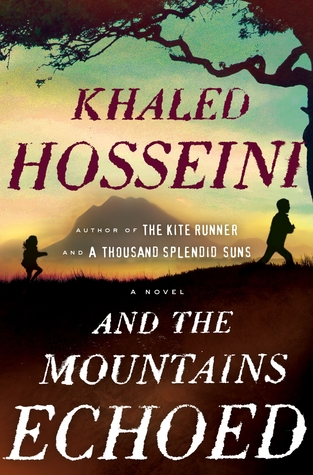
And the Mountains Echoed
Author: Khaled Hosseini
Published May 21st, 2013 by Riverhead Books
Summary: Told from various points of view, this novel is a collection of powerful stories, woven with the rich history of Afghanistan. All of the characters are linked in some way, showing the profound impact that seemingly small decisions can have on others in the world. After finishing this story, the character’s voices still speak in my head: Three-year-old Pari and ten-year-old Abdullah, villagers in rural Afghanistan…Nabi, an elderly Afghan who is devoted to the care of the wealthy Mr. Wahdati…Nila, a tortured soul, who is lost in her poetry and past…Idris, a man visiting his homeland of Afghanistan, who recognizes and is embarrassed by his privileged life in America…Markos, a plastic surgeon living in Afghanistan, who works to fix the deformities caused by the war…Adel, a young Afghan boy living in a mansion with bodyguards…these characters and a few others are richly realized and will tug the heartstrings of readers.
Review: Spanning five decades and multiple generations, the stories cross paths in unbelievable ways. Readers might, at the beginning of each section, feel a bit uncomfortable with the shifts in narration, locations, and time periods, but Hosseini makes the connections clear, and the story’s structure is essential to the central messages of loyalty, family, and the devastating effects of war. I experienced many similar emotions as when I read Hosseini’s other books, The Kite Runner and A Thousand Splendid Sons, such as grief and anger, and when this book ended, I couldn’t help but feel a sense of catharsis. Emotions aside, this book is quite different. The writing felt more lyrical and complex (if that is even possible) than Hosseini’s other works. I couldn’t help but put the book down at several times because I was in awe of the craftsmanship of the text’s structure and connectedness.
Teacher’s Tools for Navigation: Kite Runner has always been a literature circle choice in my classroom. This novel is much more complex and would need a lot of teacher support, but it would be a fantastic literature circle choice for advanced, high school readers. If used as a whole-class text, teachers might have students diagram the relationships between characters, write journal entries from the perspectives of different characters, or write letters from one character to another. Many of the characters don’t interact at any point, but it would be enlightening to consider what messages they might have for each other. It would be helpful if teachers gave background knowledge of the political situation in Afghanistan to support the reading of this text. This is a great text to teach structure and narration, but additionally, it is a great model of voice. Ranging in age, race, and personality, these characters all have varying insights of the world, and these are reflected in their words and actions. Students would have to think critically to analyze their voices.
Discussion Questions: How might our decisions affect others indirectly connected to us?; What responsibility does a child have to his/her parent?; Am I privileged? How are my life experiences different from those around me?; What will we remember most as we age?
We Flagged: “They say, Find a purpose in your life and live it. But sometimes, it is only after you have lived that you recognize your life had a purpose, and likely one you never had in mind” (p. 127).
“‘J’aurais dû être plus gentille–I should have been more kind. That is something a person will never regret. You will never say to yourself when you are old, Ah, I wish I was not good to that person. You will never think that'” (p. 382-283).
Read This If You Loved: Kite Runner by Khaled Hosseini, A Thousand Splendid Sons by Khaled Hosseini, The Book Thief by Markus Zusak, Water for Elephants by Sara Gruen
Recommended For:



What do you think about using contemporary adult bestsellers in the classroom? I try to mix classics, YAL, and other bestsellers, while still allowing students the choice to select the texts they read. Do you agree with this philosophy?
Oh, and have you read this one? I would love to hear your thoughts because the characters are still interrupting my daily thoughts. 🙂