Nonfiction Wednesday
Nonfiction Picture Book Wednesday is hosted by Kid Lit Frenzy and was started to help promote the reading of nonfiction texts. Most Wednesdays, we will be participating and will review a nonfiction text (though it may not always be a picture book).
Be sure to visit Kid Lit Frenzy and see what other nonfiction books are shared this week!
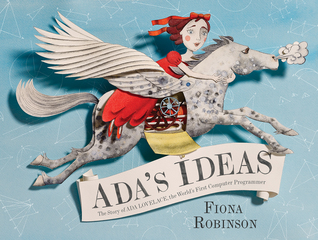
Ada’s Ideas: The Story of Ada Lovelace, the World’s First Computer Programmer
Author and Illustrator: Fiona Robinson
Published August 2nd, 2016 by Abrams Books
Summary: Ada Lovelace (1815–1852) was the daughter of Lord Byron, a poet, and Anna Isabella Milbanke, a mathematician. Her parents separated when she was young, and her mother insisted on a logic-focused education, rejecting Byron’s “mad” love of poetry. But Ada remained fascinated with her father and considered mathematics “poetical science.” Via her friendship with inventor Charles Babbage, she became involved in “programming” his Analytical Engine, a precursor to the computer, thus becoming the world’s first computer programmer. This picture book biography of Ada Lovelace is a portrait of a woman who saw the potential for numbers to make art.
Teaching Guide with Discussion Questions and Activities:
Ada’s Ideas: The Story of ADA LOVELACE, the World’s First Computer Programmer
Ada Lovelace (1815–1852) was the daughter of Lord Byron, a poet, and Anna Isabella Milbanke, a mathematician. Her parents separated when she was young, and her mother insisted on a logic-focused education, rejecting Byron’s “mad” love of poetry. But Ada remained fascinated with her father and considered mathematics “poetical science.” Via her friendship with inventor Charles Babbage, she became involved in “programming” his Analytical Engine, a precursor to the computer, thus becoming the world’s first computer programmer. This picture book biography of Ada Lovelace is a portrait of a woman who saw the potential for numbers to make art.
Note about this guide and Ada’s Ideas
Ada Lovelace was a mathematician far ahead of her time. Because of this, much of the math included in Ada’s Ideas are quite complex. Because of this, Ada’s Ideas could be used for a wide range of students from early-elementary, focusing on Ada’s impact on math, to college, focusing on her use of complex math to write the first computer programs. Within this guide, you will find activities and discussion questions that primarily focus on its use in elementary and middle classrooms, but this does not limit it to these grade levels.
Vocabulary
These vocabulary words can be found throughout the book (in the order they are listed). Use these words as a starting point for a vocabulary study with Ada’s Ideas. Research shows that reading and discussing vocabulary within the context of reading is one of the most effective ways to learn vocabulary.
Despaired | Era | Defy | Reckless | Parallelogram | Influence | Steady | Whirred | Clanked | Newly Harnessed | Mechanical | Affectionate | Carrier Pigeon | Confined | Poetical expression | Aside | Eligible | Thrust | Regimented | Re-ignited | Potential | Orient | Corresponding | Loom | Thereby | Algorithm | Compute | Potential | Foresaw | Impact | Stunned | Envision
Activities: Use these activities to extend student learning with Ada’s Ideas.
Ana’s Parents
- Ana’s parents are both well-renowned and intelligent; however, they are both very different.
- Get to know George Byron
- Have your students read the first stanza of “She Walks in Beauty” by Lord Byron. Analyze the stanza with them and discuss: How is Lord Byron describing the subject of his poem? Does it fit your idea of “Romantic” as Lord Byron was considered a leading figure in the Romantic Movement of poetry.
- She walks in beauty, like the night
Of cloudless climes and starry skies;
And all that’s best of dark and bright
Meet in her aspect and her eyes;
Thus mellowed to that tender light
Which heaven to gaudy day denies.
- She walks in beauty, like the night
- Have your students read the first stanza of “She Walks in Beauty” by Lord Byron. Analyze the stanza with them and discuss: How is Lord Byron describing the subject of his poem? Does it fit your idea of “Romantic” as Lord Byron was considered a leading figure in the Romantic Movement of poetry.
- Get to know Anne Isabella Byron
- Lady Byron was wealthy and educated. She was tutored by a Cambridge University professor as a child and found she excelled at mathematics. Discuss with your students: How did Lady Byron’s fascination of mathematics influence Ana’s life? Do you think her life would have been the same if her mother had not been a mathematician herself?
Nature vs. Nurture
- Discuss with your students the idea of nature vs. nurture.
- Lord and Lady Byron worked hard to separate Lord Byron from Ada to try and limit her poetical and imaginative behavior; however, Ada still ended up with quite the imagination. What does this show us about nature vs. nurture? Was Ada’s mother able to change how she was going to grow up by separating her from her father, or did it not matter since she is biologically his daughter?
- Have your students break into two sides and research the ideas of nature vs. nurture then debate whether a person’s DNA decides their development or if experiences and environment can change the development.
- Extension: Move the debate to Ada’s situation instead of a generic debate about the idea.
Industrial Revolution
- The Industrial Revolution was possible because of the engineers, scientists, and mathematicians who put theory into practice. These new exciting feats of engineering and science included the first reliable steam engine, the cotton gin, telegraph, dynamite, vaccines, telephone, light bulb, airplane, and automobile.
- Individually, in partners, or in groups, assign a different Industrial Revolution invention and look at how it was created, how it changed the world, and how it changed science/math/engineering then present their findings to the class.
- After learning more about the Industrial Revolution, tie it back to Ada Lovelace’s life by discussing if the class believes that Ada’s accomplishments could have happened during a different time in history.
Influence
- Ada Lovelace’s findings are largely said to be the first computer program. Her programs, in conjunction with Babbage’s hardware, were a theory over a century before the first computers were invented in the United States and England. Even though she was not part of the actual invention and start of computer science, she influenced much of modern computer science. Use the information below as the starting point for a research paper/project or discussion.
- Some of the ways Ada has influenced computer science are:
- Mill made by Babbage’s son
- Charles Babbage’s son made the part of the analytical engine called the mill which carried out numerical operations.
- Alan Turing
- Babbage and Lovelace’s analytical engine was the original “drum” computer though Turing is often portrayed as the inventor of the idea.
- John Graham-Cumming
- Graham-Cumming is a British programmer who is working to bring the analytical engine, known as Plan 28, to realization.
- Some ways Ada has been commemorated:
- ADA: a standardized computer language used by the US Department of Defense
- A computer language that appeared for the first time in 1980 and is still used today.
- Ada Lovelace Day
- Ada Lovelace Day was founded in 2011 and aims to share female pioneers in STEM fields. Ada Lovelace Day is the second Tuesday of October.
- ADA: a standardized computer language used by the US Department of Defense
- Mill made by Babbage’s son
Discussion Questions: Use these questions as whole class discussions, reading check-ins, or as writing prompts with Ada’s Ideas. The discussion questions are written as if they are being asked to a student.
- Ada’s schedule as an 8-year-old was very intense. Compare and contrast your current schooling schedule to what Ada was expected to do daily.
- How many hours did she spend on each subject? How long do you spend?
- Do you feel like what was expected of her was too high of expectations or fair?
- How did Ada’s contraction of measles change her life?
- Why did the author choose to cover Ada’s comforter in geometric shapes on the page when she is suffering with measles?
- Ada surrounded herself with some very intelligent and influential people including Mary Fairfax Somerville, nominated to be jointly the first female member of the Royal Astronomical Society; Charles Dickens, one of the greatest novelist of the Victorian era; Florence Nightingale, the founder of modern nursing; and Charles Babbage. How do you think having these historical figures as her friends helped influence her focus and trajectory in life?
- The mentorship of Charles Babbage changed Ada’s life as well as the trajectory of computer science. How did Ada influence Charles’s work and vice versa? Do you think either could have accomplished what they did without each other?
- Compare their work to modern technologies: Ada’s work ended up influencing the creations of ____, and Mr. Babbage’s work ended up influencing the creations of ____.
- How did Joseph-Marie Jacquard’s loom influence Ada’s idea of the program for the Analytical Engine?
- The author’s note about Bernoulli Numbers states that Ada chose them as “beautiful examples” of the complexity of the Analytical Engine. Elaborate on this statement: Why would Ada choose something so complicated as the first program she wrote for the Analytical Engine?
- The illustrations of Ada’s Ideas are Japanese watercolor pieces cut out and rearranged at different depths to achieve 3-D artwork then photographed. How does this artwork fit Ada’s story? Would another type of illustrations have been able to capture Ada’s ideas and personality as well?
Common Core Standards: English Language Arts
Examples of English Language Arts Common Core Anchor Standards that can be met by extending Ada’s Ideas with the above discussion questions/activities.
- ELA-LITERACY.CCRA.R.1
Read closely to determine what the text says explicitly and to make logical inferences from it; cite specific textual evidence when writing or speaking to support conclusions drawn from the text. - ELA-LITERACY.CCRA.R.2
Determine central ideas or themes of a text and analyze their development; summarize the key supporting details and ideas. - ELA-LITERACY.CCRA.R.3
Analyze how and why individuals, events, or ideas develop and interact over the course of a text. - ELA-LITERACY.CCRA.R.4
Interpret words and phrases as they are used in a text, including determining technical, connotative, and figurative meanings, and analyze how specific word choices shape meaning or tone. - ELA-LITERACY.CCRA.R.5
Analyze the structure of texts, including how specific sentences, paragraphs, and larger portions of the text (e.g., a section, chapter, scene, or stanza) relate to each other and the whole. - ELA-LITERACY.CCRA.W.7
Conduct short as well as more sustained research projects based on focused questions, demonstrating understanding of the subject under investigation. - ELA-LITERACY.CCRA.W.9
Draw evidence from literary or informational texts to support analysis, reflection, and research.
Computer Science Teachers Association Standards
- Computational Thinking: Grades K-3, #4: The student will be able to recognize that software is created to control computer operations.
- Computational Thinking: Grades K-6, #6: The student will be able to understand the connections between computer science and other fields.
- Computational Thinking: Grades 6-9, #3: The student will be able to define an algorithm as a sequence of instructions that can be processed by a computer.
- Computing Practice and Programming: Grades K-3, #5: The student will be able to identify jobs that use computing and technology.
- Computing Practice and Programming: Grades 6-9, #7: The student will be able to identify interdisciplinary careers that are enhanced by computer science.
- Computers and Communication Devices: Grades 6-9, #3: The student will be able to demonstrate an understanding of the relationship between hardware and software.
- Computers and Communication Devices: Grade 6-9, #4: The student will be able to use developmentally appropriate, accurate terminology when communicating about technology.
- Community, Global, and Ethical Impacts: Grade 6-9, #2: The student will be able to demonstrate the knowledge of changes in information technologies over time and the effects those changes have had on education, the workplace, and society.
Author/Illustrator
Fiona Robinson is originally from the north of England she now lives in Brooklyn, New York. She is an author and illustrator of books for children including Whale Shines, What Animals Really Look Like, and Ada’s Ideas. What Animals Really Like received the 2012 Irma Black Award, and Bank Street named it one of the 2012 Best Children’s Books. She has been praised by Publishers Weekly for her “humor tinged with heart,” and her work has been honored by the Royal Academy of Arts in London. Her favorite things include drawing, reading, drinking tea and telling her stories to children. She doesn’t like loud noises or clapping and often reads newspapers and magazines back to front. When she was in elementary school her teachers called her Little Leonardo, and she’s forever thankful for their support and that of her fabulous family in England too.
Resources
https://en.wikipedia.org/wiki/Ada_Lovelace
https://plus.maths.org/content/ada-lovelace-visions-today
The teaching guide can also be viewed at: https://www.scribd.com/document/341092371/Ada-s-Ideas-Teaching-Guide# or http://www.abramsbooks.com/academic-resources/teaching-guides/
Recommended For: