The Star-Spangled Banner illustrated by Peter Spier

Share

spangled

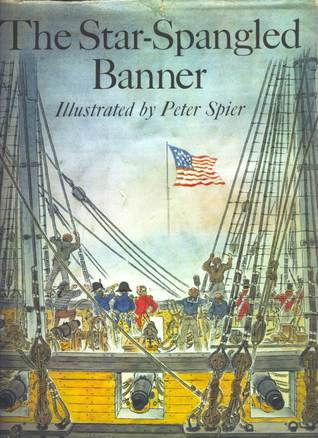
The Star-Spangled Banner
Author: Francis Scott Key
Illustrator: Peter Spier
Published September 19, 1973 by Doubleday Books for Young Readers

Goodreads Summary: Due to careful research, Spier’s artwork depicts “the dawn’s early light” and “the rocket’s red glare” with remarkable authenticity and detail in this celebratory book. Among the highlights: a brief history of the anthem, a reproduction of Francis Scott Key’s original manuscript, music for guitar and piano chords and many photographs.

My Review and Teachers’ Tools for Navigation: Peter Spier’s illustrations bring our national anthem to life. Spier carefully researched all lines of them poem as well as other facts about the War of 1812 when the anthem was written and used all of this knowledge to help show the meaning behind Key’s words. In the afterword, Spier shares much of the research to help tie it all together. 

In the past, as a school, we actually had students do something very similar. They each received a line from the first verse, and they had to research what it meant and then draw an illustration to share with their classmates the meaning. These were then put together as a book, so that the entire national anthem could be read with illustrations showing the meaning. Students loved the activity, and I really think it helped make history mean more to them than just dates.

Discussion Questions: What is Key trying to say in The Star-Spangled Banner?; What caused Key to write this poem?; Had you ever heard the second or third verse before? What did you think of it?; For some of the lines, Spier chose to draw a modern setting–why do you think he chose these specific places? 

We Flagged: 

Recommended For: 

readaloudbuttonsmall classroomlibrarybuttonsmall closereadinganalysisbuttonsmall

Happy Fourth of July!

Signature

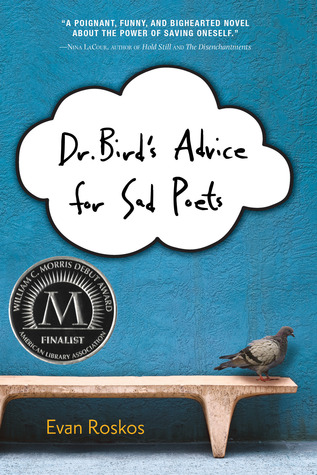
Dr. Bird’s Advice for Sad Poets by Evan Roskos

Share

dr bird's advice for sad poets

Dr. Bird’s Advice for Sad Poets
Author: Evan Roskos
Published: March 5, 2013 by Houghton Mifflin Harcourt

Summary: “I hate myself but I love Walt Whitman, the kook. Always positive. I need to be more positive, so I wake myself up every morning with a song of myself.” 

Sixteen-year-old James Whitman has been yawping (à la Whitman) at his abusive father ever since he kicked his beloved older sister, Jorie, out of the house. James’s painful struggle with anxiety and depression—along with his ongoing quest to understand what led to his self-destructive sister’s exile—make for a heart-rending read, but his wild, exuberant Whitmanization of the world and keen sense of humor keep this emotionally charged debut novel buoyant.

Ricki’s Review: Dr. Bird’s Advice for Sad Poets is such an important book. It captures depression and anxiety in a way that is both authentic and heart-wrenching at the same time. I wanted to reach into the pages of the book to give James a big hug. Similarly to It’s Kind of a Funny Story by Ned Vizzini, this book employs humor without detracting from the very realness of James’ struggles with loneliness and isolation. Teens (and adults) will find themselves in James because he is depicted in a sympathetic way that is very human. This novel is brilliant and should be in every classroom library.

Kellee’s Review: I concur with everything that Ricki said. Dr. Bird’s is a very special book. On a Top Ten Tuesday list, I wrote that I wished there were more books about kids with chemical imbalances, and Dr. Bird’s is the closest I’ve read yetEvan Roskos captures the feeling of a manic depressive state. The energy of the writing actually changes as James’s state of mind changes: anxious, manic, depressed. However, what makes it truly special is that even in the end, there is optimism. Although James is fighting his own chemical imbalance, he keeps doing just that—fighting.

Another thing I adored about this book is the idea of art and writing as therapy. James finds solace in photography and poetry, which is a positive lesson for teens because it shows the power of art, writing, and poetry.

Teacher’s Tools for Navigation: It would be interesting for teachers to do literature circles with texts that concern mental health. Students might read this book along with titles like: Forgive Me, Leonard Peacock by Matthew Quick, It’s Kind of a Funny Story by Ned Vizzini, The Perks of Being a Wallflower by Stephen Chbosky, Twisted by Laurie Halse Anderson, Everybody Sees the Ants by A.S. King, and 13 Reasons Why by Jay Asher. I imagine that reading these titles would foster incredibly rich discussions about depression, anxiety, and suicide. In my opinion, we must have these conversations with our students.

Also, Walt Whitman is a huge part of James’s life, and Whitman is mentioned throughout the book. The Whitman references (and James’s poetry emulating Whitman) would great to be examined in a classroom.

Discussion Questions: If James didn’t have abusive parents, do you think his life would be the same? Do you think depression is genetic in his family?; How does James show bravery?; What role does Walt Whitman play in James’ life?

We Flagged: “People in the world suffer from greater calamities than I do. I eat, I have clothes, I have a house. I read about people around the world who survive on less than a dollar a day. I read about how there are hundreds of millions of widows living in poverty. I see ads for kids who are born with ragged lips and jagged teeth. I don’t have anything like that. I just wake up with a deep hatred of myself. How selfish is that?” (p. 115)

“Later, as my father drives me to the pizzeria, his gassy, grumpy body reeking of judgment and anger and disappointment, I can’t help but wonder how little he knows about the depth of my sadness. The depth of my very being. Will he be upset to find me dead, or relieved?” (p. 214)

Read This If You Loved: (Many of these are listed above.) Forgive Me, Leonard Peacock by Matthew Quick, It’s Kind of a Funny Story by Ned Vizzini, The Perks of Being a Wallflower by Stephen Chbosky, Twisted by Laurie Halse Anderson, Everybody Sees the Ants by A.S. King, Reality Boy by A.S. King, Dear Life, You Suck by Scott Blagden, 13 Reasons Why by Jay Asher, Leaves of Grass by Walt Whitman

Recommended For:

 closereadinganalysisbuttonsmall litcirclesbuttonsmall classroomlibrarybuttonsmall

RickiSig andSignature

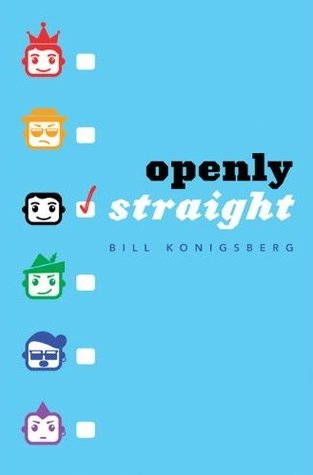
Openly Straight by Bill Konigsberg

Share

openly

Openly Straight
Author: Bill Konigsberg
Published May 28th, 2013 by Arthur A. Levine Books

Goodreads Summary: A funny, honest novel about being out, being proud . . . and being ready for something else.

Rafe is a normal teenager from Boulder, Colorado. He plays soccer. He’s won skiing prizes. He likes to write.

And, oh yeah, he’s gay. He’s been out since 8th grade, and he isn’t teased, and he goes to other high schools and talks about tolerance and stuff. And while that’s important, all Rafe really wants is to just be a regular guy. Not that GAY guy. To have it be a part of who he is, but not the headline, every single time.

So when he transfers to an all-boys’ boarding school in New England, he decides to keep his sexuality a secret — not so much going back in the closet as starting over with a clean slate. But then he sees a classmate breaking down. He meets a teacher who challenges him to write his story. And most of all, he falls in love with Ben . . . who doesn’t even know that love is possible.

This witty, smart, coming-out-again story will appeal to gay and straight kids alike as they watch Rafe navigate being different, fitting in, and what it means to be himself

Review and Teachers’ Guide to Navigation: This is such a great book! It is written well, very funny, smart, and has an important theme. What blew me away the most is how it was so humorous when dealing with a tough subject, but never lost its maturity and importance. Sometimes if you add humor to a novel, it becomes slap stick or more of a novelty, but Bill Konigsberg does it perfectly in Openly Straight.

As a teacher, what I immediately find myself connecting to was the journal entries from Rafe followed by Mr. Scarborough responses. Mr. Scarbourgh becomes quite an important person in Rafe’s life, and I feel that only through these journals, reflections, and responses that Rafe was able to make it at the new school. I think much of what Mr. Scarborough does with Rafe could be transferred directly into most classrooms.

Discussion Questions: Why did Rafe feel like he needed to hide who he was?; Have you ever felt like you couldn’t be who you really are?; How does Mr. Scarborough play a role in Rafe’s life?; How would you react if you were Ben?

We Flagged: “‘It’s hard to be different,’ Scarborough said. ‘And perhaps the best answer is not to tolerate differences, not even to accept them. But to celebrate them. Maybe then those who are different would feel more loved, and less, well, tolerated.'”

Read This If You Loved: Paper Towns by John Green, The Beginning of Everything by Robyn Schneider, Two Boys Kissing by David Leviathan, Will Grayson, Will Grayson by John Green and David Leviathan, Life in Outer Space by Melissa Kiel

Recommended For: 

readaloudbuttonsmall closereadinganalysisbuttonsmall classroomlibrarybuttonsmall

Signature

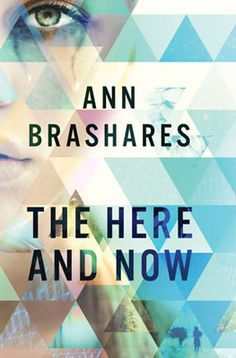
The Here and Now by Ann Brashares

Share

the here and now

The Here and Now
Author: Ann Brashares
Published: April 8, 2014 by Delacorte Press

Summary: An unforgettable epic romantic thriller about a girl from the future who might be able to save the world… if she lets go of the one thing she’s found to hold on to.

Follow the rules. Remember what happened. Never fall in love.

This is the story of seventeen-year-old Prenna James, who immigrated to New York when she was twelve. Except Prenna didn’t come from a different country. She came from a different time—a future where a mosquito-borne illness has mutated into a pandemic, killing millions and leaving the world in ruins. 

Prenna and the others who escaped to the present day must follow a strict set of rules: never reveal where they’re from, never interfere with history, and never, ever be intimate with anyone outside their community. Prenna does as she’s told, believing she can help prevent the plague that will one day ravage the earth. But everything changes when Prenna falls for Ethan Jarves.

Review: I particularly loved the first half of this book. While time travel is at the heart of this text, I think it would be a great book to give to readers who love dystopian fiction. Prenna’s memory of her futuristic world was fascinating to me. At times, I found Brashares to be a bit didactic, but overall, the book is very well-written and will entice readers from the first page. I always enjoy reading books about time travel because my mind spins as I try to grapple with the paradox time travel provides. If we change the past, will we exist in the future? And how can this work, if we are living in this previous time? Ah! My brain hurts. I enjoyed this book because it made me think.

Teacher’s Tools for Navigation: Similar to my review of All Our YesterdaysI think students would have a lot of fun selecting a time period to travel to, and perhaps, picking one event in history they would change and how it might impact the future. This could develop into a research project, and I can imagine there would be fantastic interdisciplinary connections with the subject of history. Alternatively (or additionally), teachers could link this text with the subject of science–where students research ways we are destroying our planet.

Discussion Questions: How are we destroying our planet? Do you think Ann Brashares’ prediction of the future is accurate? What is Brashares’ tone in this text?; If you could travel in time, what is one event in history that you would change and why? How might it change events in the future?

We Flagged: “People here act like the great things have already been lost, but they are wrong. They have so much still to lose” (Chapter Three).

“I guess memory is a deep well, and you don’t know what’s down there until you lower the bucket and start hauling it up” (Chapter Fifteen).

Please note: The above quotes are from the advanced reader copy. The quotes may have changed with publication.

Read This If You Loved: All Our Yesterdays by Cristin Terrill, When You Reach Me by Rebecca Stead, The Time Machine by H.G. Wells, The Giver by Lois Lowry, Legend by Marie Lu, Divergent by Veronica Roth

Recommended For:

 closereadinganalysisbuttonsmall litcirclesbuttonsmall classroomlibrarybuttonsmall

RickiSig

A Long Walk to Water by Linda Sue Park

Share

longwalk

A Long Walk to Water
Author: Linda Sue Park
Published November, 2010 by Houghton Mifflin Harcourt

Goodreads Summary: A Long Walk to Water begins as two stories, told in alternating sections, about a girl in Sudan in 2008 and a boy in Sudan in 1985. The girl, Nya, is fetching water from a pond that is two hours’ walk from her home: she makes two trips to the pond every day. The boy, Salva, becomes one of the “lost boys” of Sudan, refugees who cover the African continent on foot as they search for their families and for a safe place to stay. Enduring every hardship from loneliness to attack by armed rebels to contact with killer lions and crocodiles, Salva is a survivor, and his story goes on to intersect with Nya’s in an astonishing and moving way.

My Review and Teachers’ Tools for Navigation: The wars in Sudan and Darfur are the most violent and long lasting wars in the world; however, most Americans are unaware that they are even occurring. Linda Sue Park took a true story of a lost boy’s survival (watch a video about the true story here) after being chased from his village because of war and transformed it into a novel that will leave the reader with a feeling of awe. Awe of the bravery and pure fearlessness of Salva and the other Lost boys of Sudan and awe of the world of riches and blindness we live in while a horrendous war wages on the other side of the world. I love this book because it is very accessible to children, it won’t bog them down with too much history; however, it will definitely make them aware of the situation in Sudan.

Discussion Questions: What is a way that you could share what you learned about the Lost Boys of Sudan? How can you help? 

We Flagged: “Salva took a few steps towards the men.
‘Hey!’
A soldier approached Salva and raised his gun.
Salva froze. All he could see was the gun’s huge barrel, black and gleaming, as it moved toward his face.
The end of the barrel touched his chin.
Salva felt his knees turn to water. He closed his eyes.
If I die now, I will never see my family again.
Somehow, this thought strengthened him enough to keep him from collapsing in terror.
He took a deep breath and opened his eyes.” (p. 11)

“Going was easy.
Going, the big plastic container held only air… There was little weight, going. There was only heat, the sun already baking the air, even though it was long before noon. It would take her half the morning if she didn’t stop on the way.
Heat. Time. And thorns…
Nya filled the container all the way to the top. Then she tied the gourd in back in place and took the padded cloth doughnut from her pocked. The doughnut went on her head first, followed by the heavy container of water, which she would hold in place with one hand.
With the water balanced on her head, and her foot still sore from the thorn, Nya knew that going home would take longer than coming had. But she might reach home by noon, if all went well.” (p. 1, 14-15)

Read This If You Loved: The Queen of Water by Laura Resau, Now is the Time for Running by Michael Williams, Sold by Patricia McCormick, Diamonds in the Shadows by Caroline B. Cooney, Shabanu by Suzanne Fisher Staples, So Long a Letter by Mariama Ba

Recommended For: 
readaloudbuttonsmall closereadinganalysisbuttonsmall
classroomlibrarybuttonsmall litcirclesbuttonsmall
Signature

Hairy, Scary, Ordinary; To Root, to Toot, to Parachute; & A Mink, a Fink, a Skating Rink by Brian P. Cleary

Share

NF PB 2014

Nonfiction Picture Book Wednesday

Nonfiction Picture Book Wednesday is hosted by Kid Lit Frenzy and was started to help promote the reading of nonfiction texts. Most Wednesdays, we will be participating and will review a nonfiction text (though it may not always be a picture book).
Be sure to visit Kid Lit Frenzy and see what other nonfiction books are shared this week!

adjective verb noun

Hairy, Scary, Ordinary: What Is an Adjective? 
Published September 1st, 2001 by Carolrhoda Books

To Root, to Toot, to Parachute: What Is a Verb? 
Published April 1st, 2001 by Carolrhoda Books

A Mink, a Rink, a Skating Rink: What Is a Noun?
Published September 1st, 1999 by Lerner Publishing Group

Author: Brian P. Cleary
Illustrator: Jenya Prosmitsky

Hairy, Scary, Ordinary Goodreads Summary: Simple, rhyming text and colorful cartoon cats help children expand their vocabularies and gain an appreciation for the rhythm of language in this lighthearted book of rhyming verse. Adjectives like frilly, silly, polka-dotted, fizzy, and spunky are printed in color, and all the words will tickle you pink!

To Root, to Toot, to Parachute Goodreads Summary: What is a verb? It’s easier to show than explain! In this fun and animated introduction to grammer, rhyming verse is used to creatively clarify the concept of verbs. Chock-full of colorful, lively examples, the playful rhymes and illustrations of comical cartoon cats combine to hightlight key words in the sentences. Verbs like toss and tumble, jump and jam, jog and juggle, jig and leap are printed in color for easy identification.

A Mink, a Fink, a Skating Rink Goodreads Summary: “Words are Categorical” is a series which explores some of the basic principles of English grammar in a fun way. The books each deal with a different part of language, using playful and ingenious rhymes to make them easy to remember. In “What is a Noun?” children are introduced to one of the essential building blocks of the English language. It includes sections on both common and proper nouns. The nouns are highlighted in color to make them easy to identify.

My Review and Teachers’ Tools for Navigation: Teaching parts of speech is one of the hardest things to teach students, and it is even harder to teach them in a fun and interesting way. These books make it so that both of these things are possible. I like that each of the books focuses on only one part of speech instead of trying to teach multiple grammatical concepts thus making the chance of mastery much more likely. I also found the rhyming and silliness of the books just so endearing, and it would definitely help with the knowledge sticking.

Discussion Questions: What is a noun/adjective/verb? What are some examples? What are some nouns/adjectives/verbs that rhyme with each other?

We Flagged: 
Hairy, Scary, Ordinary: “Adjectives are words like hair, scary, cool, and ordinary. They describe like tan and tall, funny, frisky, smooth and small.”

To Root, to Toot, to Parachute: “Whether you scale a wall or a fish, make a design on a cup or a dish, take out the garbage, or sharpen your knife—verbs are a part of your everyday life.”

A Mink, a Fink, a Skating Rink: “Hill is a noun. Mill is a noun. Even Uncle Phil is a noun.”

Read This If You Loved: Eat, Shoots, and Leaves, Twenty-Odd Ducks, & The Girl’s Like Spaghetti by Lynne Truss, Other Words are CATegorical books by Brian Leary, Basher Basics: Grammar by Simon Basher, and other grammar books

Recommended For: 

readaloudbuttonsmall closereadinganalysisbuttonsmall

Signature

All Our Yesterdays by Cristin Terrill [Kellee’s Review]

Share

yesterdays

All Our Yesterdays
Author: Cristin Terrill
Published September 3rd, 2013 by Disney Hyperion

Goodreads Summary: What would you change?

Imprisoned in the heart of a secret military base, Em has nothing except the voice of the boy in the cell next door and the list of instructions she finds taped inside the drain.

Only Em can complete the final instruction. She’s tried everything to prevent the creation of a time machine that will tear the world apart. She holds the proof: a list she has never seen before, written in her own hand. Each failed attempt in the past has led her to the same terrible present—imprisoned and tortured by a sadistic man called the doctor while war rages outside.

Marina has loved her best friend, James, since they were children. A gorgeous, introverted science prodigy from one of America’s most famous families, James finally seems to be seeing Marina in a new way, too. But on one disastrous night, James’s life crumbles, and with it, Marina’s hopes for their future. Marina will protect James, no matter what. Even if it means opening her eyes to a truth so terrible that she may not survive it… at least, not as the girl she once was. Em and Marina are in a race against time that only one of them can win.

All Our Yesterdays is a wrenching, brilliantly plotted story of fierce love, unthinkable sacrifice, and the infinite implications of our every choice.

My Review and Teachers’ Tools for Navigation: This is a book that keeps you reading. I couldn’t put it down. I found myself reading whenever I could (including times when I was holding my sleeping son or when I should have been sleeping).  When you find out how Marina and Em are connected, it just blew my mind! I then had to find out how everything was going to turn out. I was just so impressed with everything:

First, the plot. It is so complex and intricate. You have to pay attention to keep up with the timeline, but it isn’t so bad that you’ll get lost. It is so admirable that the author was able to craft such intense timelines and intertwine them seamlessly.

Second, the language. I loved how Cristin Terrill wrote. The imagery throughout transported you into the story.

Third, the suspense. I just HAD to know what was going to happen!

Fourth, the characters. In a way that I’ve never experience before, Cristin Terrill truly gets you into the minds and hearts of the characters. You understand their motives, who they used to be, who they’ll become, all because of the way that Terrill tells the story and crafts her characters. You feel their heartbreak with them (and one particular realization that you find out in the very end just broke my heart and blew my mind), and you are so invested in everything they do.

Finally, the themes. The discussions that would come from this novel would be so interesting. Just the idea of power and corruption that is dealt with would lead to quite a debate.

Ricki also pointed out in her review how fun it would be to have students imagine what they would change if time travel existed.

This text would be a wonderful mentor text to discuss plot and character development, theme, and style. And most importantly, it will be a text that students will be intrigued with, not want to put down, and share with everyone.

Discussion Questions: What would you change if you had the ability to change time?; How far would you go to protect your best friend?; How did Cristin Terrill build suspense throughout the novel?; Why does power lead to corruption? Where have we seen this happen in history?

We Flagged: “Far down the hallway, I hear the clink of a door. Someone is approaching. I bolt upright and lunge for the drain. No telling what the doctor will do if he finds me breaking into it, and if he sees the sheet of paper… The though sends ice through my veins. He’ll kill me for sure. Hands clumsy with rushing, I break the spoon into several pieces and drop them down the drain. I can now make out a pair of heavy boots against the cement. I jam the grating back onto the drain and replace the screws as best I can with fingertips and nails. I swipe up the plastic bag and piece of paper and throw myself at my mattress. I show them both underneath just as Kessler’s face appears at the small window in my cell door.” (p. 9-10)

Read This If You Loved: Chronal Engine by Greg Leitich Smith, Ruby Red by Kerstin Gier, Awaken by Katie Kacvinsky, Lost Time by Susan Maupin Schmid, When You Reach Me by Rebecca Stead, Found by Margaret Peterson Haddix, London Calling by Edward Bloor

Recommended For: 

closereadinganalysisbuttonsmall classroomlibrarybuttonsmall litcirclesbuttonsmall

Signature