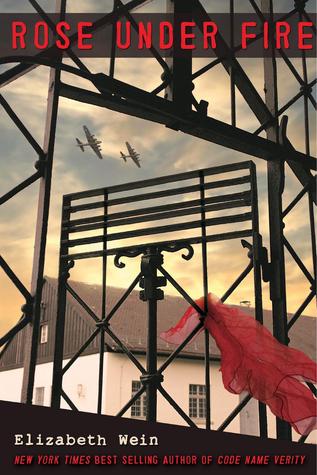
Rose Under Fire by Elizabeth Wein

Share

17262236
Title: Rose under Fire
Author: Elizabeth Wein
Expected Publication: September 10th, 2013 by Miramax (Disney)

Summary: While flying an Allied fighter plane from Paris to England, American ATA pilot and amateur poet, Rose Justice, is captured by the Nazis and sent to Ravensbrück, the notorious women’s concentration camp. Trapped in horrific circumstances, Rose finds hope in the impossible through the loyalty, bravery and friendship of her fellow prisoners. But will that be enough to endure the fate that’s in store for her?

Elizabeth Wein, author of the critically-acclaimed and best-selling Code Name Verity, delivers another stunning WWII thriller. The unforgettable story of Rose Justice is forged from heart-wrenching courage, resolve, and the slim, bright chance of survival.

Review: Out of the thousands of books I’ve read, this one is going to sit among my all-time favorites. There is a phenomenal balance of history and narrative that will engage readers while offering harrowing lessons in history. I am not an air and space girl. My husband loves planes, and he was giddy when we went to the Smithsonian Air and Space Museum in Washington D.C. As much as I want to love planes, I don’t find them to be interesting. This book changed my outlook.

Rose under Fire has many similarities with Wein’s Code Name Verity. They are both written in an epistolary format, involve pilots/airplanes, and are set during World War II. Both offer wonderfully complex themes about friendship, loyalty, and the strength of women. However, Rose under Fire focuses more on concentration camps, while Code Name Verity dealt more with the interrogation techniques used during World War II. Neither of these two elements drove the novels, but they are two plot features that make the texts quite different from one other. I found CNV to be a bit slow in the beginning (which isn’t the case with all readers), but I was hooked to Rose under Fire from the very first page. Wein writes characters so vividly that I still feel their presence in my life, long after I finish the books. I recommend this book to everyone. It will appeal to readers of all ages, backgrounds, genders, and interest levels.

Teacher’s Tools for Navigation: Teachers, this is a MUST-HAVE book. It is phenomenally written and shows the truly complexity of young adult literature. It can be used to teach elements like setting, character, dialogue, the epistolary format, imagery, voice, and theme. Students might write letters back to Rose, or they could analyze one of the many well-developed characters in this story. It would also make for a great research unit of topics like the Nuremberg Trials, female WWII pilots, flying bombs, or the experimentation on Holocaust prisoners. History teachers will also find this text to be invaluable.

Discussion Questions: What loyalties did the Holocaust prisoners have for each other? What are some examples of incidents that showed this loyalty?; Why were the Rabbits so important to the concentration camp? What did they add to the story as a whole?; How does Maddie’s friendship with Rose differ from her friendship with Julie?; Why was Nick’s character important throughout the story? How does his level of importance change, and why?; Rose has very different friendships with many of the characters. Describe how three of these friendships differ from one another.; Does the novel end in a hopeful way? Why or why not?

We Flagged: I marked so many passages that it is hard to choose just a few, so I selected two longer quotes that show the quality of Wein’s writing.

Incredible Imagery:

“…and the reason everyone in there was trying to get out in the rain was because they were dying of thirst.

Really dying of it, I think.

Hands and arms and heads stuck out anywhere there was a gap—cupped hands collecting rainwater, some holding bowls or even just a piece of cloth to collect moisture—I saw one woman lying on her back with her hair in the black cinder mud at the tent’s edge, her mouth open, letting a rivulet of water stream down the canvas and into her mouth.”

And Beautiful Figurative Language:

“Hope—you think of hope as a bright thing, a strong thing, sustaining. But it’s not. It’s the opposite. It’s simply this: lumps of stale bread stuck down your shirt. Stale gray bread eked out with ground fish bones, which you won’t eat because you’re going to give it away, and maybe you’ll get a message through to your friend. That’s all you need.

God, I was hungry.”

Please note: The above quotes are from the Advanced Reader Copy. The e-book (a galley) did not provide page or chapter numbers. The quotes may change when the book is published.

Read This If You Loved: Code Name Verity by Elizabeth Wein, Between Shades of Gray by Ruta Sepetys, Nazi Hunters by Neal Bascomb, Night by Elie Wiesel

Recommended For:

 litcirclesbuttonsmall closereadinganalysisbuttonsmall classroomlibrarybuttonsmall

026F3FBCC8C3913BD3A4D3F6920340D5

Thank you to NetGalley and Disney for sending me the Advanced Reader Copy!

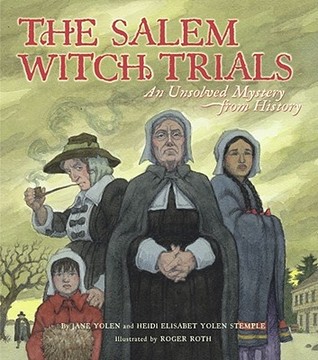
The Salem Witch Trials: An Unsolved Mystery from History by Jane Yolen & Heidi Elisabet Yolen Stemple

Share

NF PB 2013

Nonfiction Picture Book Wednesday

Nonfiction Picture Book Wednesday is hosted by Kid Lit Frenzy and was started to help promote the reading of nonfiction texts. Most Wednesdays, we will be participating and will review a nonfiction text (though it may not always be a picture book).
Be sure to visit Kid Lit Frenzy and see what other nonfiction books are shared this week!

salem

The Salem Witch Trials: An Unsolved Mystery from History
Authors: Jane Yolen & Heidi Elisabet Yolen Stemple
Illustrated by: Roger Roth
Published September 7th, 2004 by Simon & Schuster Books for Young Readers

Goodreads Summary: In 1692 Salem, Massachusetts, witnessed one of the saddest and most inexplicable chapters in American history. When a group of girls came down with a horrible, mysterious bout of illness, the town doctor looked in his medical books but failed to find a reasonable diagnosis. Pretty soon everyone in town was saying the same thing: The girls were ill because they were under a spell, the spell of witchcraft! And still, the question remains: Why did the hysteria occur? The townspeople had many things to worry about back then: smallpox, strife with the local Indians, a preacher demanding higher wages, and the division of land in the community. But did all of those problems justify a witch hunt?

Become a detective as you read this true story, study the clues, and try to understand the hysteria! The Unsolved Mystery from History series is written by acclaimed author Jane Yolen and former private investigator Heidi Elisabet Yolen Stemple. This is an innovative history lesson that’s sure to keep kids thinking throughout.

Review: The mystery of the Salem Witch Trials is one that has haunted the United States for over 3oo years now and is one that students love to read about (and I do, too!). Most of my thoughts about this book are about how awesome this book is for the classroom. The Yolens seemed to have written it specifically for teachers to use.

Teacher’s Tools For Navigation: This book promotes studying history, inquiry, and vocabulary. The book begins with an introduction to a young girl who enjoys unsolved mysteries from history and then the book is set up like her case notebook. Each page of the case notebook includes a narrative nonfiction section about what was going on in Salem, an informational nonfiction section where facts about the story are explained even more in detail, and then there are vocabulary words from the two sections defined for the reader. Finally, in the back of the book the different theories about what could be the answer to the unsolved mystery are shared and briefly discussed. The set up of this book leads to infinite possibilities of being used in the classroom. Students could debate, write research papers, could do their very own case notebook about a different mystery, etc. Another option is to get all of the Unsolved Mystery from History books and have students get into lit circle groups and have each group read a different mystery then research and share.

Discussion Questions: What do you think happened in Salem? [Could be a wonderful debate or cooperative research presentation/paper in class. Have each students, after reading the different theories, decide which they believe is true. Then within their groups come up with evidence that supports the theory that they believe in.]

We Flagged: “Narrative Nonfiction Section: One bitterly cold day in February, Betty and Abigail both fell ill, collapsing onto their small rope beds. They convulsed. They contorted. Their arms and legs jerked about. They shouted bizarre, unintelligible words. They crouched under chairs and cowered as if frightened. In other houses in Salem Village several of their friends began to act the same way.

Informational Nonfiction Section: The other sick girls in Salem village included Ann Punam Jr. (age 12), Mercy Lewis (age 19), Mary Walcott (age 16), Elizabeth Hubbard (age 17), and Mary Warren (age 20). Like Abigail, Elizabeth and Mercy were orphans; Mercy may have witnessed her parents being killed in an Indian attack three years earlier in Main. Mary Walcott had lost her mother when she was eight. Ann and Betty were daughters of landowners, but Marry Warren, Elizabeth, and Mercy were maidservants.

Vocabulary: Convulsed: shook violently, Contorted: Twisted into unusual shapes, Unintelligible: Impossible to understand” (p. 12-13)

Read This If You Loved: I Walk in Dread by Lisa Rowe Fraustino, The Sacrifice by Kathleen Benner Duble, Witch Child by Celia Rees, The Witch of Blackbird Pond by Elizabeth George Speare, Witches: The Absolutely True Tale of Disaster in Salem by Rosalyn Schanzer and other nonfiction books about Salem

Recommended For: 

closereadinganalysisbuttonsmall readaloudbuttonsmall

classroomlibrarybuttonsmall litcirclesbuttonsmall

Signature

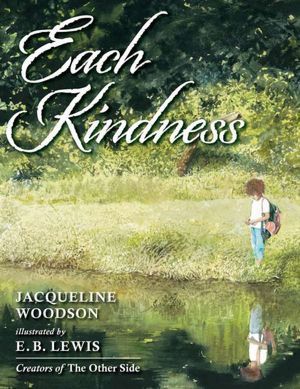
Each Kindness by Jacqueline Woodson (Kellee’s Review)

Share

kindness

Each Kindness
Author: Jacqueline Woodson
Illustrator: E.B. Lewis
Published October 2nd, 2012 by Nancy Paulsen Books

Summary: Each kindness makes the world a little better

Chloe and her friends won’t play with the new girl, Maya. Maya is different–she wears hand-me-downs and plays with old-fashioned toys. Every time Maya tries to join Chloe and her gang, they reject her. Eventually, Maya plays alone, and then stops coming to school altogether. When Chloe’s teacher gives a lesson about how even small acts of kindness can change the world, Chloe is stung by the lost opportunity for friendship, and thinks about how much better it could have been if she’d shown a little kindness toward Maya.

This unforgettable book is written and illustrated by the award-winning team that created The Other Side and the Caldecott Honor winner Coming On Home Soon. With its powerful message and striking art, it will resonate with readers long after they’ve put it down.

Review: When I read Each Kindness by Jacqueline Woodson for the first time, it made me not only want to share it with everyone I knew, but also make me want to do something nice for others. This pushed me to think more carefully about how everything affects those around me. What I really love about this book is how it can be used in the classroom.

Teacher’s Tool For Navigation: Today, I wanted to share with you what I did with my classes when it came to sharing Each Kindness with them. First, I will say that it affected them as much as it affected me. After reading, we had a great conversation about how the book connected to their lives and what it meant to them. This conversation moved to how Chloe’s actions affected Maya including inferences of Maya’s feelings that were not shared in the book. The insight that my students had were very deep and I believe it made them look at some of the choices they make in their daily lives. We also discussed how Chloe could have changed things. How could she have made Maya feel welcome?  We made multi-flow maps showing the causes/effects of decisions.

Following this discussion, I had the students make an oath to do a kind act that day- something they normally wouldn’t do and recorded them on as a poster to share. Then the next day we shared the kindness we did. Only through discussions and books like this, that students will think more about their choices and how it affects those around them. Since this book read aloud and discussion, my students have brought up Each Kindness often and have made connections to their lives as well as other books. Each Kindness is a book that can make the world a better place, but only if it is shared.

Discussion Questions: What could Chloe have done differently to make Maya seem welcome?; How did Chloe’s (and her friend’s) behavior affect Maya?; What could you do differently to make someone feel kindness?

We Flagged: “This is what kindness does, Ms.Albert said. Each little thing we do goes out, like a ripple, into the world.”

Read This If You Loved: Because Amelia Smiled by David Ezra Stein, Unicorn Thinks He’s Pretty Great by Bob Shea

Recommended For: 

classroomlibrarybuttonsmall readaloudbuttonsmall closereadinganalysisbuttonsmall

This is a great book to read during the first couple of weeks of school. 

Signature

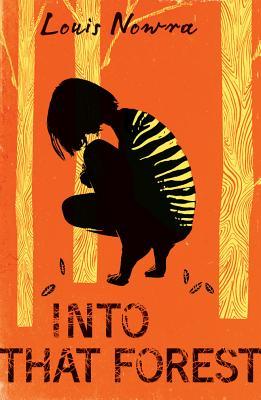
Into That Forest by Louis Nowra

Share

17870105
Title: Into That Forest
Author: Louis Nowra
Expected Publication: September 3th, 2013 by Amazon Children’s Publishing

Summary: Hannah and Becky are traveling down a river in Tasmania, Australia with Hannah’s parents when a storm erupts. Their boat overturns, and Hannah and Becky are left to survive in the wild. Two Tasmanian tigers are nearby, and because they’ve recently lost their pups, the tigers adopt Hannah and Becky as their own children. The two girls slowly adapt to the tigers’ ways, adopting their habits and forgetting words. It isn’t long before they become feral children, acting only as animals would.

Review: I have never read a book quite like this one. When I tried to compare it to other books I’ve read, I immediately thought of Endangered (Eliot Schrefer), which describes bonobos rather than tigers. With both books, I developed a fondness for the animals and their habits. Also, they both roped me into their beautiful settings and imagery. The only other books I could compare this to were those about abuse and neglect, as the children slowly developed animalistic ways, as abandoned children do.

The language is a bit peculiar at first, as Hannah is writing the story as an elderly woman, and she admits her language isn’t very good. I found myself slipping into the beautiful wording by the third or fourth page, and I didn’t find that it distracted my reading, and instead, it added to the experience. If I could change anything, I might alter the ending a bit, but perhaps, I am being too particular. I loved learning about the tigers’ lifestyle, and I was hooked to this survival story from the very first page. The sisterly bond that develops between Hannah and Becky is remarkable, and the story teaches themes of loyalty and companionship. Readers will be left pondering humanity and the differences between animals and humans.

Teacher’s Tools for Navigation: Students may find the language to be a bit difficult to understand at first, so the teacher may need to provide some close readings at first. I suspect most students quickly adjust to the language and will no longer be distracted by the wording after the first few pages, and they will likely find that it adds a lot of color to the text. Teachers could have students select their favorite descriptions of the setting and imagery, as these elements are very well-developed and would serve as a great model for students. Upon completion of the text, students might research topics like Tasmania, feral children, and tigers. I was left wanting to learn more about the Tasmanian wilderness and lifestyle, and I imagine that students will also find this book to pique their curiosity.

Discussion Questions: What does it mean to be human? How do the girls lose their humanity?; What are some of the patterns of the tigers’ behavior that the girls adopt? Why is this necessary?; How do you imagine Hannah’s life today? How has this experience changed her?

We Flagged: “As the water boiled and foamed, we bounced along with me father, unable to steer the boat toward the shore. The river were so wild that all we could do were to cling on tight to the sides of the boat or each other as we were flung back and forward like puppets with no strings. The rain chucked down and we were soaked, so soggy it were like the rain were drilling through our skin into our marrow.”

“The more I looked at its black eyes, the more I seen kindness […] I knew it were saying to us, Come, I’ll take you home.”

Please note: The above quotes are from the Advanced Reader Copy. The e-book (a galley) did not provide page or chapter numbers. The quotes may change when the book is published.

Read This If You Loved: Endangered by Eliot Schrefer, Never Fall Down by Patricia McCormick, Dog Boy by Eva Hornung, Second Nature by Alice Hoffman, Into the Wild by Jon Krakauer

Recommended For:

readaloudbuttonsmall litcirclesbuttonsmall closereadinganalysisbuttonsmall classroomlibrarybuttonsmall

026F3FBCC8C3913BD3A4D3F6920340D5

Thank you to NetGalley and Amazon Children’s Publishing for sending me the Advanced Reader Copy!

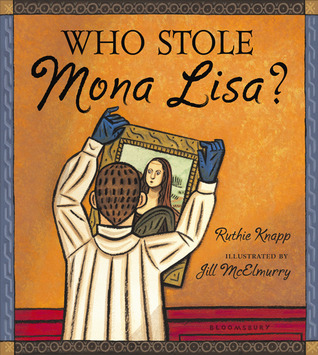
Who Stole Mona Lisa? by Ruthie Knapp

Share

NF PB 2013

Nonfiction Picture Book Wednesday

Nonfiction Picture Book Wednesday is hosted by Kid Lit Frenzy and was started to help promote the reading of nonfiction texts. Most Wednesdays, we will be participating and will review a nonfiction text (though it may not always be a picture book).
Be sure to visit Kid Lit Frenzy and see what other nonfiction books are shared this week!

mona

Who Stole Mona Lisa?
Author: Ruthie Knapp
Illustrated by: Jill McElmurry
Published by September 1st, 2010 by Bloombury USA Childrens

Goodreads Summary: She has a legendary smile, and millions come to see her every day. Some say she is the most famous painting in the world. Who is she? Why, the Mona Lisa, of course! But did you know that she was once stolen from her wall at the Louvre? Who took her? Why? Where was she hidden? How was she found? Someone call the police!

Narrated by the lady of the enigmatic smile herself—and brought to life with gorgeous paintings that take the reader from da Vinci’s renaissance right up to the present day—this is a stylishly whimsical account of the glorious, wonderful, sometimes dangerous life of the best recognized painting of all time. Discover the secrets behind her mysterious smile, and hear for yourself the amazing true story of her kidnapping.

Review: How fascinating! First, let me tell you a little bit about my background. My father has a BA in Art History and an MFA in Museumology. These studies led him to become an executive director of art museums (he is currently directing the Hunter Museum of American Art in Chattanooga, TN) thus impacting my life greatly. My entire childhood has been surrounded by the arts (my mother is a photographer as well). This has made art history something that I am very interested in which then made this book so fascinating for me and I believe it will be incredibly fascinating for all readers.

Mona Lisa is probably the most famous painting of all time, but many, including me, do not know her history. She is more of a mystery that we all are enthralled with than a piece of artwork that is talked about in history class; however, Ruthie Knapp’s book shows us that Mona Lisa’s history is a lot more interesting than we probably thought. And what I think makes this book one that will draw in all sorts of readers is the way she tells the story. The story is told from Mona Lisa’s point of view which makes it more of a caper, mystery type story instead of just informational nonfiction.

Teacher’s Tools For Navigation: As soon as I read this book, I saw how I could use it in the classroom. Seeing things from different points of view and perspectives is something that, as a teacher, I am always trying to help my students achieve. This book, since it is told from Mona Lisa’s point of view, is a perfect example of seeing a situation from a different point of view. After reading Who Stole Mona Lisa? I would start a discussion on how others in the story might have viewed the situation. How would the director of the Louvre have told the story differently? How about Vincenzo Perugia? Parisians? All of these people would have viewed the loss of Mona Lisa differently. These thoughts then could be transferred to anything. Maybe have students choose a historical event and think about it from a different person’s point of view: Babe Ruth’s huge “called” home run from the pitchers point of view, atomic bombings of Japan from a Japanese citizen’s point of view, an event in a book from a different character’s point of view, etc. The options are infinite.

Discussion Questions: How would the director of the Louvre have told the story differently? How about Vincenzo Perugia? Parisians?; Look up other stolen pieces of art. What happened to them?

We Flagged: “Leonardo da Vinci is the artist who painted me. It took him four years! Leonardo loved me. He looked at me while he ate past. He would not travel without me. He said I was his masterpiece. I was famous because Leonardo was famous. Fans jammed his studio to watch him paint.” (p. 10-11)

“The man with the mustache loved me too. He said I reminded him of someone special. He looked at me at every meal: over apples, eggs, and trout; cake and prunes and piglet snout. He looked at me on rainy days, on snowy days, and during summer squalls. He looked at me when he bathed. He looked at me when he shaved. He looked at me for TWO years. I was tired of the man with the mustache. I missed my wall. I missed people staring. I missed children looking sideways and upside down. (p. 24-25)

Read This If You Loved: Nonfiction books about Leonardo da Vinci or Mona Lisa, any books told from inanimate objects’ points of view, Seen Art?  by Jon Sciezska, Capture the Flag by Kate Messner, Linnea in Monet’s Garden by Christina Bjork

Recommended For: 

classroomlibrarybuttonsmall closereadinganalysisbuttonsmall readaloudbuttonsmall

Signature

Blog Tour and Author Guest Post!: The Year of Shadows by Claire Legrand

Share

YoS_blogtour_banner

Today, I am so happy to be part of The Year of Shadows blog tour! First, let me tell you a bit about the book: 
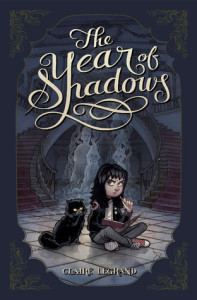
shadows

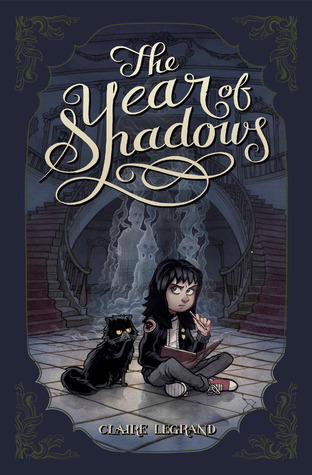
The Year of Shadows
Author: Claire Legrand
Published August 27th, 2013 by Simon & Schuster Books for Young Readers

Goodreads Summary: Olivia Stellatella is having a rough year.

Her mother left, her neglectful father — the maestro of a failing orchestra — has moved her and her grandmother into his dark, broken-down concert hall to save money, and her only friend is Igor, an ornery stray cat.

Just when she thinks life couldn’t get any weirder, she meets four ghosts who haunt the hall. They need Olivia’s help — if the hall is torn down, they’ll be stuck as ghosts forever, never able to move on.

Olivia has to do the impossible for her shadowy new friends: Save the concert hall. But helping the dead has powerful consequences for the living . . . and soon it’s not just the concert hall that needs saving.

I am so excited to read this! One of the things that intrigues me the most is the setting of a concert hall; reminds me of Phantom of the Opera. 

clairelegrand_authorphoto2

Today we are so lucky to have author Claire Legrand as a guest blogger. Claire Legrand used to be a musician until she realized she couldn’t stop thinking about the stories in her head. Now a writer, Ms. Legrand can often be found typing with purpose at her keyboard, losing herself in the stacks at her local library, or embarking upon spontaneous adventures to lands unknown. Her first novel is The Cavendish Home for Boys and Girls, a New York Public Library Best Book for Children in 2012. Her second novel, The Year of Shadows, releases August 27, 2013, with her third novel, Winterspell, to follow in fall 2014. She is one of the four authors behind The Cabinet of Curiosities, an anthology of dark middle grade fiction due out in July 2014 from Greenwillow Books/HarperCollins. Claire lives in New Jersey with a dragon and two cats. Visit her at claire-legrand.com and at enterthecabinet.com.

Here at Unleashing Readers, one of our goals is helping educators find books that will help them teach their students about different literary elements. We are so excited for Claire Legrand to discuss the literary elements of setting, characterization, and language, and how she utilized those elements to bring the world of The Year of Shadows to life! I think you all will find this post interesting and so useful.

SETTING

The sense of place in The Year of Shadows was one of the first story elements I established. Olivia’s world is an isolated one—she lives at Emerson Hall, she goes to school, she works after school at the tea shop across the street called The Happy Place. We don’t see a lot of Olivia’s city beyond those three locations, and the time spent at Olivia’s school and The Happy Place are relatively minimal. The Year of Shadows is really all about Emerson Hall. It’s not only where Olivia spends the majority of her time; it’s also her new home. I therefore knew I would have to make the Hall as vibrant a character as Olivia herself, full of moods and memories. The Hall needed to feel like a whole new world, one that Olivia explores in the new lens of “home” just as the readers are exploring it for the first time. The state of the Hall, and how Olivia perceives it, represents Olivia’s state of mind.

At the beginning of the story, Emerson Hall is decrepit, shabby, old. Its paint has faded, its carpet is torn, and the once-grand stone angels on the building’s façade have been vandalized. Like Olivia and her broken family, Emerson Hall has seen better days. Olivia directs her hatred of what her life has become at the Hall itself; to her, Emerson Hall and its orchestra lie at the root of her troubles. She doesn’t realize until much later that her refusal to reach out to friends for help and her destructive tendency to isolate herself are more problematic than living in Emerson Hall. Like Olivia and her family, Emerson Hall literally starts to fall apart as the story progresses. Both Olivia and her home undergo crises that could make or break them. It is Olivia’s realization that she and the Hall need each other if they are going to survive that marks a turning point in the story, and allows her to find a peace that, at the beginning of The Year of Shadows, she can’t imagine finding ever again.

CHARACTERIZATION

Imagine for a moment that you are twelve years old. You have enjoyed a comfortable, happy life with your father, mother, and grandmother. Art is in your blood; you are never without your trusty sketchpad, and you studied symphonies with your conductor father from the time you could crawl.

Then, things start to go wrong. Your mother and father start to fight; you lie awake at night listening to them. Your father spends more and more time working and less and less time with you and your mother. The orchestra isn’t doing well; lots of businesses aren’t doing well, and who wants to spend money they don’t have on coming to hear an increasingly crummy orchestra perform? Your stomach is in constant knots.

One day, a day that should have been like any other day, you wake up to find that your mother is gone. She left in the middle of the night without a clue as to her destination. It’s just you and your father now—your father who seems to care more than ever about work, much more than he cares about you. He lets bills and letters from your school pile up. (You’re not doing well in school these days.) He sells your house and moves you into the backstage storage rooms of a music hall that should probably be condemned.

You hate him. You hate everything. Sometimes, you even hate yourself.

This is Olivia. This is the girl whose story I sat down to tell when I wrote The Year of Shadows. She was a difficult character to bring to life; as you can see, her story isn’t a happy one. I needed to both communicate her (righteous, justified) anger and grief while still keeping her sympathetic. To achieve this, I balanced her darker moments—berating her father, insulting people who try to help her—with lighter ones. I felt it was even more important with Olivia than it was for some of my other, more immediately sympathetic characters, to give the reader peeks of the true her, beneath all the hurt that consumes her.

Olivia is an artist. There are beautiful worlds inside her, worlds she brings to life in her sketchpad even when—especially when—nothing else makes sense.

Olivia is kindhearted, devoted to her frail grandmother. She is determined to transform the backstage rooms of Emerson Hall into something like a home—decorating the bare gray walls with pictures from her sketchbook, spending the limited money she earns from working after school to buy her grandmother scarves and a nice warm rug for the cold floor.

Olivia is brave. She will face down ghosts—even the distinctly unfriendly ones—if it means defending her father, as much as she thinks she hates him. (But finding the courage to trust again? That she doesn’t find so easily.)

Creating Olivia was all about finding the right balance between her good moments and her bad ones, and ensuring that even her worst moments came from a place readers could understand.

The other characters in The Year of Shadows help Olivia in different ways. They are like rungs on the ladder Olivia must climb to pull herself out of her depression. Henry is trusting and loyal, traits Olivia can no longer see in herself or in her family. Joan is not afraid of being herself, or of letting others see her, while Olivia is constantly trying to hide. Mr. and Mrs. Barsky are the loving couple Olivia used to see in her parents. Trumpet player Richard Ashley is the love of music Olivia once had, and has now lost.

Even the ghosts play their part. I like to think of the four main ghosts in The Year of Shadows as fulfilling a function similar to that of the Ghosts of Christmas Past, Present, and Future in Dickens’s A Christmas Carol, each of which teach Ebenezer Scrooge something about himself. Olivia’s ghosts do the same, each “lesson” increasing in importance. Violinist Frederick helps Olivia rediscover her love of music. Best friends Tillie and Jax remind Olivia of the power and value of friendship. And poor Mr. Worthington, with his horrible secret, shows Olivia that even her family, as dysfunctional as it is, is worth saving.

 LANGUAGE

Establishing just the right blend of language to tell Olivia’s story was a tricky process for me. I wanted the language of The Year of Shadows to feel contemporary yet classic, homey yet eerie. The reader needed to feel at home in Emerson Hall, but still feel as unsettled as Olivia does. There are horror elements in this book, but it is not a horror novel; it is ultimately a story about family and friendship. The language needed to both accurately describe intense issues—financial trouble, death and the afterlife, parental abandonment and neglect, bullying, depression—while still being accessible to young readers. Through the narration, I needed Olivia to identify and explore complex emotions; at the same time, I needed her to describe them in such a way that felt authentic for an emotionally confused twelve-year-old.

I think it’s impossible to discuss a story’s language without addressing voice, and establishing Olivia’s voice was essential in developing the right language for The Year of Shadows. I was fortunate to quickly “hear” Olivia’s voice—informal but poetic, intelligent but not book-smart, sarcastic yet brimming with emotion too overwhelming to share. Her voice is conversational, peppered with fragments.

Ultimately, I wanted the language of The Year of Shadows to evoke just that—shadows. Dark, shifting shapes on the wall created by fleeting sweeps of light. Shadows, while they might seem frightening at first, are ultimately hopeful things, because you can’t have a shadow without light. For Olivia, it takes a while to find her light—but she does in the end, even if it wasn’t quite what she was expecting.

Below are a few brief (spoiler-free!) selections from The Year of Shadows that are representative of the book’s overall language:

“The picture I had of them in my head was pretty fuzzy, so I kept drawing them over and over, trying to capture the memory of them on the page. It wasn’t working very well; it’s harder than you might think to draw just the right amount of transparency, of driftiness.”

“The Maestro didn’t cry. The Maestro was made of stone and numbers and anger, and mostly he was made of music—cold, unfeeling, metal-tubed music.”

“Mr. Worthington stared. His eyes and mouth were the largest, hanging open like gateways to some secret, dark place. His head didn’t hang quite right, like someone had screwed it on wrong, and he was skinny as a bundle of twigs.”

“The shades overhead scampered away, but one lingered above me, its face cocked to the side like a bird. It opened its mouth and groaned, this low, rumbling sound that made my ears hurt.”

“In a week and a half, we’d know the Hall’s fate. No, not its fate. Its destiny. I liked that word better. It sounded softer, like something Mom would say. It sounded like stars.”

“Henry didn’t say anything more after that. I think he was afraid to talk to me, afraid that I would crack. He might have been right. All I knew was the tip of my charcoal on my sketchpad, like I was sewing myself back together.”

I can see this post being used in reading or writing workshop; what a great resource for teachers! Also, doesn’t it make you want to read the book even more?!

I want to thank Claire Legrand for stopping by, and I hope you found the post as useful as I did!

Signature

Feynman by Jim Ottaviani

Share

9844623

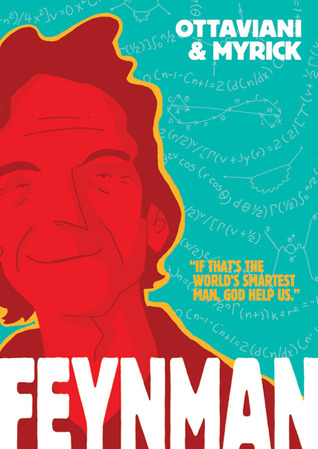
Feynman
Author: Jim Ottaviani
Art by: Leland Myrick
Coloring by: Hilary Sycamore
Published August 30th, 2011 by First Second

Goodreads Summary: Richard Feynman: physicist . . . Nobel winner . . . bestselling author . . . safe-cracker. In this substantial graphic novel biography, First Second presents the larger-than-life exploits of Nobel-winning quantum physicist, adventurer, musician, world-class raconteur, and one of the greatest minds of the twentieth century: Richard Feynman. Written by nonfiction comics mainstay Jim Ottaviani and brilliantly illustrated by First Second author Leland Myrick, Feynman tells the story of the great man’s life from his childhood in Long Island to his work on the Manhattan Project and the Challenger disaster. Ottaviani tackles the bad with the good, leaving the reader delighted by Feynman’s exuberant life and staggered at the loss humanity suffered with his death. Anyone who ever wanted to know more about Richard P. Feynman, quantum electrodynamics, the fine art of the bongo drums, the outrageously obscure nation of Tuva, or the development and popularization of the field of physics in the United States need look no further than this rich and joyful work.

Review: This book definitely showed me that I have HUGE gaps in knowledge in history, science, and math. Reading this book was so challenging for me – probably one of the hardest books I’ve read in a very, very long time. It took me 10 days because most days I didn’t read much because I’d find myself rereading or going online to research or just overwhelmed by the little bit I read. Makes me feel for our struggling readers who are given text that are too hard for them and not given scaffolding. If anyone ever tells you that graphic novels are not complex or challenging texts, hand them this book.

Now, all of this is saying things about myself, not about the book. The book itself was fascinating. I learned so much! I’ll be honest. Physics is still so over my head and most of the physics stuff talked about in the book (and that I researched) just didn’t make sense to me; however, this book also includes a great story of Feynman’s life and history about the atomic bomb, NASA, and the Nobel Prize. All of which I did truly enjoy and learn something from. It was also quite funny at times- Feynman was a character!

Teacher’s Tools for Navigation: I cannot wait to show this text to the physical science teachers at my school. It is a great text to show content area teachers that there are wonderful texts out there that can be used in the classroom. This book then can expand to even more instruction on Feynman and all of his physics. You can even view Feynman’s lectures online!!

Discussion Questions: When Feynman was working on the atomic bomb, some of his colleagues felt that it was a devastating invention while others continued working on it without thinking of the destruction it would cause. How do you feel about the construction of the atomic bomb? Were the use/construction of them justified?; After watching one of Feynman’s lectures, why was he better at explaining physics than other lecturers?

We Flagged: “But then a miracle occurred. And it’s occurred again and again in my life, and it’s very lucky for me. The moment I start to think about physics and concentrate on what I’m explaining, I’m completely immune to being nervous. No worries about the audience and the personalities. I was calm, everything was good. My talk wasn’t good because I wasn’t used to giving lectures, but there was no nervousness until I sat down. Einstein appreciated that things might be different from his famous theory of relativity – very nice, and very interesting. Pauli had more objections, but Wheeler kept his promise and answered all of them.” (p. 48-49)

Read This If You Loved: Surely Your Joking, Mr. Feynman! and other books by Richard P. Feynman On a Beam of Light by Jennifer Berne, Who Was Albert Einstein? by Jess M. Brallier, Nonfiction physics books

Recommended For: 

classroomlibrarybuttonsmall closereadinganalysisbuttonsmall

Signature