A Long Walk to Water by Linda Sue Park

Share

longwalk

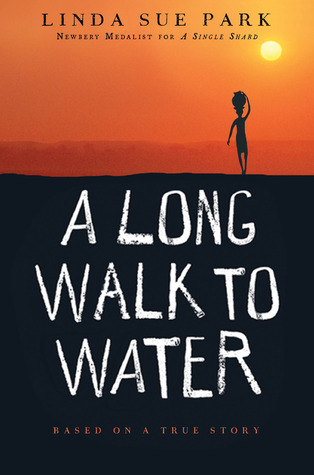
A Long Walk to Water
Author: Linda Sue Park
Published November, 2010 by Houghton Mifflin Harcourt

Goodreads Summary: A Long Walk to Water begins as two stories, told in alternating sections, about a girl in Sudan in 2008 and a boy in Sudan in 1985. The girl, Nya, is fetching water from a pond that is two hours’ walk from her home: she makes two trips to the pond every day. The boy, Salva, becomes one of the “lost boys” of Sudan, refugees who cover the African continent on foot as they search for their families and for a safe place to stay. Enduring every hardship from loneliness to attack by armed rebels to contact with killer lions and crocodiles, Salva is a survivor, and his story goes on to intersect with Nya’s in an astonishing and moving way.

My Review and Teachers’ Tools for Navigation: The wars in Sudan and Darfur are the most violent and long lasting wars in the world; however, most Americans are unaware that they are even occurring. Linda Sue Park took a true story of a lost boy’s survival (watch a video about the true story here) after being chased from his village because of war and transformed it into a novel that will leave the reader with a feeling of awe. Awe of the bravery and pure fearlessness of Salva and the other Lost boys of Sudan and awe of the world of riches and blindness we live in while a horrendous war wages on the other side of the world. I love this book because it is very accessible to children, it won’t bog them down with too much history; however, it will definitely make them aware of the situation in Sudan.

Discussion Questions: What is a way that you could share what you learned about the Lost Boys of Sudan? How can you help? 

We Flagged: “Salva took a few steps towards the men.
‘Hey!’
A soldier approached Salva and raised his gun.
Salva froze. All he could see was the gun’s huge barrel, black and gleaming, as it moved toward his face.
The end of the barrel touched his chin.
Salva felt his knees turn to water. He closed his eyes.
If I die now, I will never see my family again.
Somehow, this thought strengthened him enough to keep him from collapsing in terror.
He took a deep breath and opened his eyes.” (p. 11)

“Going was easy.
Going, the big plastic container held only air… There was little weight, going. There was only heat, the sun already baking the air, even though it was long before noon. It would take her half the morning if she didn’t stop on the way.
Heat. Time. And thorns…
Nya filled the container all the way to the top. Then she tied the gourd in back in place and took the padded cloth doughnut from her pocked. The doughnut went on her head first, followed by the heavy container of water, which she would hold in place with one hand.
With the water balanced on her head, and her foot still sore from the thorn, Nya knew that going home would take longer than coming had. But she might reach home by noon, if all went well.” (p. 1, 14-15)

Read This If You Loved: The Queen of Water by Laura Resau, Now is the Time for Running by Michael Williams, Sold by Patricia McCormick, Diamonds in the Shadows by Caroline B. Cooney, Shabanu by Suzanne Fisher Staples, So Long a Letter by Mariama Ba

Recommended For: 
readaloudbuttonsmall closereadinganalysisbuttonsmall
classroomlibrarybuttonsmall litcirclesbuttonsmall
Signature

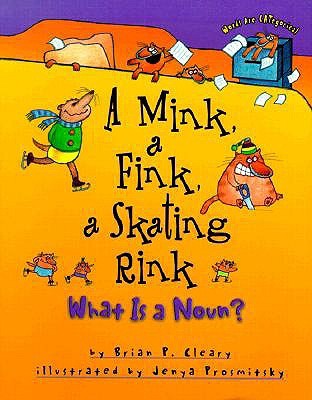
Hairy, Scary, Ordinary; To Root, to Toot, to Parachute; & A Mink, a Fink, a Skating Rink by Brian P. Cleary

Share

NF PB 2014

Nonfiction Picture Book Wednesday

Nonfiction Picture Book Wednesday is hosted by Kid Lit Frenzy and was started to help promote the reading of nonfiction texts. Most Wednesdays, we will be participating and will review a nonfiction text (though it may not always be a picture book).
Be sure to visit Kid Lit Frenzy and see what other nonfiction books are shared this week!

adjective verb noun

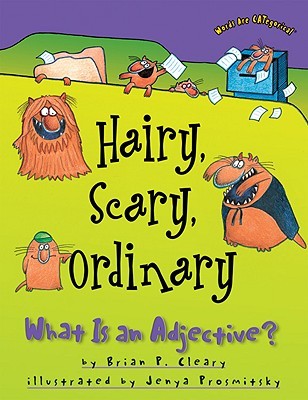
Hairy, Scary, Ordinary: What Is an Adjective? 
Published September 1st, 2001 by Carolrhoda Books

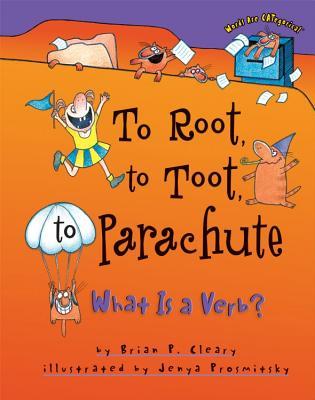
To Root, to Toot, to Parachute: What Is a Verb? 
Published April 1st, 2001 by Carolrhoda Books

A Mink, a Rink, a Skating Rink: What Is a Noun?
Published September 1st, 1999 by Lerner Publishing Group

Author: Brian P. Cleary
Illustrator: Jenya Prosmitsky

Hairy, Scary, Ordinary Goodreads Summary: Simple, rhyming text and colorful cartoon cats help children expand their vocabularies and gain an appreciation for the rhythm of language in this lighthearted book of rhyming verse. Adjectives like frilly, silly, polka-dotted, fizzy, and spunky are printed in color, and all the words will tickle you pink!

To Root, to Toot, to Parachute Goodreads Summary: What is a verb? It’s easier to show than explain! In this fun and animated introduction to grammer, rhyming verse is used to creatively clarify the concept of verbs. Chock-full of colorful, lively examples, the playful rhymes and illustrations of comical cartoon cats combine to hightlight key words in the sentences. Verbs like toss and tumble, jump and jam, jog and juggle, jig and leap are printed in color for easy identification.

A Mink, a Fink, a Skating Rink Goodreads Summary: “Words are Categorical” is a series which explores some of the basic principles of English grammar in a fun way. The books each deal with a different part of language, using playful and ingenious rhymes to make them easy to remember. In “What is a Noun?” children are introduced to one of the essential building blocks of the English language. It includes sections on both common and proper nouns. The nouns are highlighted in color to make them easy to identify.

My Review and Teachers’ Tools for Navigation: Teaching parts of speech is one of the hardest things to teach students, and it is even harder to teach them in a fun and interesting way. These books make it so that both of these things are possible. I like that each of the books focuses on only one part of speech instead of trying to teach multiple grammatical concepts thus making the chance of mastery much more likely. I also found the rhyming and silliness of the books just so endearing, and it would definitely help with the knowledge sticking.

Discussion Questions: What is a noun/adjective/verb? What are some examples? What are some nouns/adjectives/verbs that rhyme with each other?

We Flagged: 
Hairy, Scary, Ordinary: “Adjectives are words like hair, scary, cool, and ordinary. They describe like tan and tall, funny, frisky, smooth and small.”

To Root, to Toot, to Parachute: “Whether you scale a wall or a fish, make a design on a cup or a dish, take out the garbage, or sharpen your knife—verbs are a part of your everyday life.”

A Mink, a Fink, a Skating Rink: “Hill is a noun. Mill is a noun. Even Uncle Phil is a noun.”

Read This If You Loved: Eat, Shoots, and Leaves, Twenty-Odd Ducks, & The Girl’s Like Spaghetti by Lynne Truss, Other Words are CATegorical books by Brian Leary, Basher Basics: Grammar by Simon Basher, and other grammar books

Recommended For: 

readaloudbuttonsmall closereadinganalysisbuttonsmall

Signature

All Our Yesterdays by Cristin Terrill [Kellee’s Review]

Share

yesterdays

All Our Yesterdays
Author: Cristin Terrill
Published September 3rd, 2013 by Disney Hyperion

Goodreads Summary: What would you change?

Imprisoned in the heart of a secret military base, Em has nothing except the voice of the boy in the cell next door and the list of instructions she finds taped inside the drain.

Only Em can complete the final instruction. She’s tried everything to prevent the creation of a time machine that will tear the world apart. She holds the proof: a list she has never seen before, written in her own hand. Each failed attempt in the past has led her to the same terrible present—imprisoned and tortured by a sadistic man called the doctor while war rages outside.

Marina has loved her best friend, James, since they were children. A gorgeous, introverted science prodigy from one of America’s most famous families, James finally seems to be seeing Marina in a new way, too. But on one disastrous night, James’s life crumbles, and with it, Marina’s hopes for their future. Marina will protect James, no matter what. Even if it means opening her eyes to a truth so terrible that she may not survive it… at least, not as the girl she once was. Em and Marina are in a race against time that only one of them can win.

All Our Yesterdays is a wrenching, brilliantly plotted story of fierce love, unthinkable sacrifice, and the infinite implications of our every choice.

My Review and Teachers’ Tools for Navigation: This is a book that keeps you reading. I couldn’t put it down. I found myself reading whenever I could (including times when I was holding my sleeping son or when I should have been sleeping).  When you find out how Marina and Em are connected, it just blew my mind! I then had to find out how everything was going to turn out. I was just so impressed with everything:

First, the plot. It is so complex and intricate. You have to pay attention to keep up with the timeline, but it isn’t so bad that you’ll get lost. It is so admirable that the author was able to craft such intense timelines and intertwine them seamlessly.

Second, the language. I loved how Cristin Terrill wrote. The imagery throughout transported you into the story.

Third, the suspense. I just HAD to know what was going to happen!

Fourth, the characters. In a way that I’ve never experience before, Cristin Terrill truly gets you into the minds and hearts of the characters. You understand their motives, who they used to be, who they’ll become, all because of the way that Terrill tells the story and crafts her characters. You feel their heartbreak with them (and one particular realization that you find out in the very end just broke my heart and blew my mind), and you are so invested in everything they do.

Finally, the themes. The discussions that would come from this novel would be so interesting. Just the idea of power and corruption that is dealt with would lead to quite a debate.

Ricki also pointed out in her review how fun it would be to have students imagine what they would change if time travel existed.

This text would be a wonderful mentor text to discuss plot and character development, theme, and style. And most importantly, it will be a text that students will be intrigued with, not want to put down, and share with everyone.

Discussion Questions: What would you change if you had the ability to change time?; How far would you go to protect your best friend?; How did Cristin Terrill build suspense throughout the novel?; Why does power lead to corruption? Where have we seen this happen in history?

We Flagged: “Far down the hallway, I hear the clink of a door. Someone is approaching. I bolt upright and lunge for the drain. No telling what the doctor will do if he finds me breaking into it, and if he sees the sheet of paper… The though sends ice through my veins. He’ll kill me for sure. Hands clumsy with rushing, I break the spoon into several pieces and drop them down the drain. I can now make out a pair of heavy boots against the cement. I jam the grating back onto the drain and replace the screws as best I can with fingertips and nails. I swipe up the plastic bag and piece of paper and throw myself at my mattress. I show them both underneath just as Kessler’s face appears at the small window in my cell door.” (p. 9-10)

Read This If You Loved: Chronal Engine by Greg Leitich Smith, Ruby Red by Kerstin Gier, Awaken by Katie Kacvinsky, Lost Time by Susan Maupin Schmid, When You Reach Me by Rebecca Stead, Found by Margaret Peterson Haddix, London Calling by Edward Bloor

Recommended For: 

closereadinganalysisbuttonsmall classroomlibrarybuttonsmall litcirclesbuttonsmall

Signature

Baseball Is… by Louise Borden

Share

NF PB 2014

Nonfiction Picture Book Wednesday

Nonfiction Picture Book Wednesday is hosted by Kid Lit Frenzy and was started to help promote the reading of nonfiction texts. Most Wednesdays, we will be participating and will review a nonfiction text (though it may not always be a picture book).
Be sure to visit Kid Lit Frenzy and see what other nonfiction books are shared this week!

baseball

Baseball Is…
Author: Louise Borden
Illustrator: Raul Colon
Published February 18th, 2014 by Margaret K. McElderry Books

Goodreads Summary: The ultimate celebration of an all-American sport, this picture book captures the joy and the history of baseball;and knocks it out of the park!

Don’t wait for Opening Day to start your baseball season! Crack open Baseball Is…; and revel in the fun of this all-American game! Perfect for the stats-counting superfan and the brand-new little leaguer,Baseball Is…; captures the spirit of this cherished pastime, honoring its legendary past, and eagerly anticipating the future of the sport that is stitched into our history.

My Review: I am a huge baseball fan, have been for over 24 years now, so I am a sucker for baseball books. This one is special though. It captures the beauty of the baseball stadiums around the country, the intricacies of the sport, and the amazing history that baseball holds. I also love the choice of telling baseball’s story in verse. It made it rhythmic like the sport.

Teachers’ Tools for Navigation: This book is a wonderful mentor text for free verse. The poetry is very rhythmic, but has  no rhyme. The book also has some amazing vocabulary: craftsman, poise, spectators, finesse, etc. It captures the sport through imagery: “the crack of the bat,” “slow stride of the manager,” “groans or boos,” etc.

On top of the poetic aspects of the book, you can learn so much about baseball and history from the book. It discusses greats like Babe Ruth and Jackie Robinson. Also talks about the Negro and Women’s Leagues. All parts of history in general, not just baseball.

Discussion Questions: How did Jackie Robinson change the game?; Why was their a Women’s League?; What sounds would you hear at a baseball game?

We Flagged: 
“Baseball is our game…
the sport of America.
Its stories are stitched
through our nation’s history.
Its teams and its heroes
we carry in our heart.” (p. 1-2)

Read This If You LovedBarbed Wire Baseball by Marissa Moss, Chin Music by Lee Edelstein, Something to Prove: The Great Satchel Paige vs. Rookie Joe DiMaggio by Robert Skead, Brothers at Bat: The True Story of an Amazing All-Brother Baseball Team by Audrey Vernick, Silent Star: The Story of Deaf Major Leaguer William Hoy by Bill Wise, The Legend of the Curse of the Bambino by Dan Shaughnessy

Recommended For: 

closereadinganalysisbuttonsmall classroomlibrarybuttonsmall readaloudbuttonsmall

Signature

The Beginning of Everything by Robyn Schneider

Share

beginning

The Beginning of Everything
Author: Robyn Schneider
Published August 27, 2013 by Katerine Tegen

Goodreads Summary: Golden boy Ezra Faulkner believes everyone has a tragedy waiting for them—a single encounter after which everything that really matters will happen. His particular tragedy waited until he was primed to lose it all: in one spectacular night, a reckless driver shatters Ezra’s knee, his athletic career, and his social life.

No longer a front-runner for Homecoming King, Ezra finds himself at the table of misfits, where he encounters new girl Cassidy Thorpe. Cassidy is unlike anyone Ezra’s ever met, achingly effortless, fiercely intelligent, and determined to bring Ezra along on her endless adventures.

But as Ezra dives into his new studies, new friendships, and new love, he learns that some people, like books, are easy to misread. And now he must consider: if one’s singular tragedy has already hit and everything after it has mattered quite a bit, what happens when more misfortune strikes?

Robyn Schneider’s The Beginning of Everything is a lyrical, witty, and heart-wrenching novel about how difficult it is to play the part that people expect, and how new beginnings can stem from abrupt and tragic endings.

My Review: Another novel filled with smart high schoolers—that makes me so happy!! I hope this is a trend because I love seeing brainy characters in my book and not stereotypical ones. The Beginning of Everything is described as witty, and it is very much so. The sarcasm and wit just bleeds out of this book. I found myself laughing out loud at parts, and usually just because a character had the audacity to say something they shouldn’t have.

In The Beginning of Everything, I actually connected more with the secondary characters than the protagonist. They were so well established and had such unique voices while Ezra sounded like any good-0le boy; however, I will say that by making his voice less distinct allowed for him to grow even in his prose. As he found his new, true identity, his voice became to ring out more true. I am not sure if the author did this on purpose or not, but either way it worked!

Oh, and the final pages. Guys, they were so good! Although it felt a bit rushed to me, the lyrical writing got me in the end. Perfect.

Teachers’ Tools for Navigation: Although this book’s main home is in teens’ hands from a classroom, school, or public library, there are definitely parts that can be pulled out to be used in a classroom.

Since the characters are intelligent, many of the conversations have allusions to literature (Mary Oliver, Shakespeare, Fitzgerald, Frost) or their topics are quite deep (connecting organic chemistry to life, panopticon, Banksy, German insults). Also, there are debate topics that would be so interesting to look into such as imperialism, capitalism, and the economy.

One fun activity that I would definitely pull out of this book is fake debates. When Ezra, Toby, Cassidy, etc. were at their debate tournament, they had fake debates where they had to choose a side of quite silly topics like “Should vampires be allowed to vote?” This would be a great activity to do in classes to work on persuasion and arguments. (However, be careful about actually reading aloud the scene this is in as they also make it a drinking game.)

Discussion Questions: Do you feel like we live in a society similar to the panopticon? [If you don’t know what this is, it is quite fascinating: http://en.wikipedia.org/wiki/Panopticon]; Do you think Cassidy made the right choice in the end?; Ezra truly connects with The Great Gatsby because of all the changes his life is going through. What book to you connect with and why?

Flagged: “Her face was inches from mine. I could see the freckles that dusted her nose and the gold flecks in the disquieting blue of her eyes.” (p. 111)

“My admirable opponent argues that vampires do not deserve suffrage, as many great yet misinformed politicians have done before her while calling for the continued marginalization of women, or other minorities.” Cassidy began. “Yet vampires were, at some point human. At what point can a man’s voting rights be revoked, if he is proven to be of rational mind?” (p. 157)

Read This If You Loved: Life in Outer Space by Melissa Kiel, Stargirl by Jerry Spinelli, Paper Towns by John Green

Recommended For: 

classroomlibrarybuttonsmall closereadinganalysisbuttonsmall

Signature

What Do You Do When Something Wants To Eat You? by Steve Jenkins

Share

NF PB 2014

Nonfiction Picture Book Wednesday

Nonfiction Picture Book Wednesday is hosted by Kid Lit Frenzy and was started to help promote the reading of nonfiction texts. Most Wednesdays, we will be participating and will review a nonfiction text (though it may not always be a picture book).
Be sure to visit Kid Lit Frenzy and see what other nonfiction books are shared this week!

eatyou

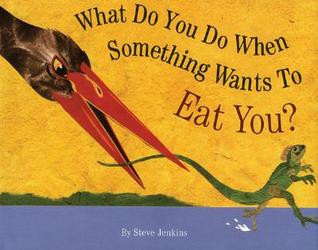
What Do You Do When Something Wants To Eat You?
Author and Illustrator: Steve Jenkins
Published October 27th, 1997 by HMH Books for Young Readers

Goodreads Summary: What would you do if something wanted to eat you? Walk on water? Stick out your tongue? Play dead? Animals in the wild use all kinds of methods to protect themselves from their enemies. Using dynamic and intricate cut-paper collages, Steve Jenkins explores the many fascinating and unique defense mechanisms creatures use to escape from danger.

My Review: Steve Jenkins just has a way of making nonfiction more interesting than other authors, and this book is no different than his others. This book takes different animals and shows the different ways they protect themselves: from squirting ink to camouflage.  The illustrations are done in Steve Jenkins’s paper-cut style and are done as well as his other books. The text, though simple, is full of information and definitely makes the reader want to learn more.

Teachers’ Tools for Navigation: This book can definitely be used in reading and science class. It is a good introduction to animal defenses and animal adaptations. It can lead to inquiry and research of each of these animals. It would be a great first research project for students to choose one of the animals and learn more about them. It is also a good introduction to cause and effect. What causes _____ to need to defend themselves? What is the effect of ____ being attacked?

Discussion Questions: What type of defenses do animals use to keep themselves from being harmed?; How does camouflage work?; What causes animals to need to defend themselves? What are the effects of them being attacked?

We Flagged: “A flying fish escapes danger by leaping from the water, spreading its winglike fins, and gliding as far as a thousand feet.”

Read This If You Loved: Any Steve Jenkins book, Any Seymour Simon animal book, Lifetime by Lola M. Schaefer, Frog Song by Brenda Z. Guiberson

Recommended For: 

readaloudbuttonsmall closereadinganalysisbuttonsmall
classroomlibrarybuttonsmall litcirclesbuttonsmall

Signature

Amulet Books Graphic Novel Teaching Guide

Share

abrams

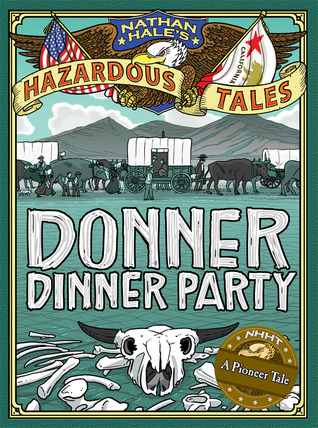
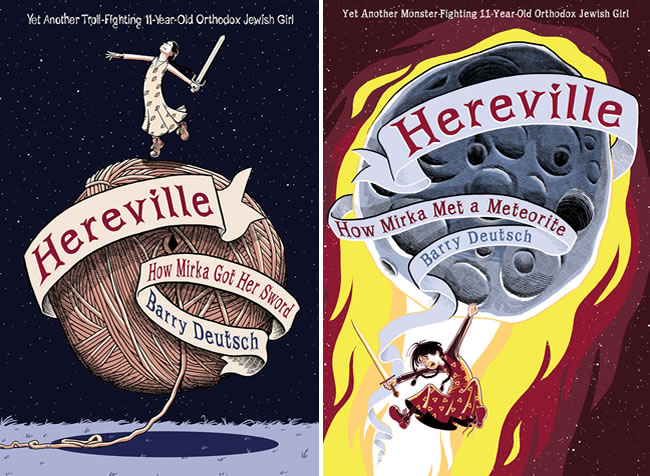
In January, I was contacted by a publicity and marketing associate from Abrams Books/Amulet Books out of the blue. In this email, I was asked to work on a teaching guide about their graphic novels: The Misadventures of Salem Hyde, Nathan Hale’s Hazardous Tales, Hereville, and the Explorer series.

1729025518405488 

13591161135911621729026018405492

1283377017290285

I was beyond honored! And, of course, I said that I would definitely love to do it as I had read all of the graphic novels, and I am a huge fan of them.

First, they asked me to write an introduction about graphic novels and their importance in the classroom. I am a huge advocate for using graphic novels in schools, so I immediately began researching and writing. Here is the introduction:

What are graphic novels? The easiest way to describe graphic novels is to say that they are book-length comic books. However, a more complex definition that educators and librarians use is “book-length narratives told using a combination of words and sequential art, often presented in comic book style” (Fletcher-Spear, 37). Graphic novels are not written in just one genre; they can be in any genre, since graphic novels are a format/medium. Graphic novels are much like novels, but they’re told through words and visuals. They have all narrative elements, including characters, a complete plot, a conflict, etc.

Middle grade and young adult graphic novels cover a wide spectrum of themes and topics. Some common themes found in graphic novels for this age include the hero’s journey; overcoming hardship; and finding one’s identity. For example, in Hereville, we meet Mirka, an everyday girl who learns to use her brains and brawn to overcome her foes. In The Misadventures of Salem Hyde, Salem is working on finding out just who she is (both as a witch and as a person) with the help of her friend Whammy. Graphic novels can cross curricular lines. One example is the Nathan Hale’s Hazardous Tales series—comical nonfiction that takes historical events and presents them in interesting ways, using graphics and humor that will make students want to learn even more about the historical time periods. In the Explorer series, stories include topics such as animal adaptation, volcanic eruptions, and the fate of humanity. Like novels, graphic novels offer opportunities in all subject areas to extend students’ thinking.

Over the past few years, graphic novels have become a hot topic, growing in popularity with both children and educators. While many teachers are beginning to include them in the classroom, there are still teachers, administrators, and librarians who struggle with including this format in their schools. So, why should you use them in your classroom and have them available for students?

  • Graphic novels can make a difficult subject interesting and relatable. (Cohen)
  • Students are visual learners, and today’s students have a much wider visual vocabulary than students in the past. (Karp)
  • Graphic novels can help foster complex reading skills by building a bridge from what students know to what they still have to learn. (NCTE)
  • Graphic novels can help with scaffolding when trying to teach higher-order thinking skills or other complex ideas.
  • For students who struggle to visualize while they read, graphic novels provide visuals that shows what good readers do. (NCTE)
  • Many graphic novels rely on symbol, allusion, satire, parody, irony, and characters/plot and can be used to teach these, and other, literary devices. (Miller; NCTE)
  • Often, in between panels (called the gutter), the reader must make inferences to understand how the events in one panel lead to the events in the next. (McCloud)
  • Graphic novels can make differentiating easier. (Miller)
  • Graphic novels can help ELL (English Language Learners) and reluctant and struggling readers since they divide the text into manageable chunks, use images (which help students understand unknown vocabulary), and are far less daunting than prose. (Haines)
  • Graphic novels do not reduce the vocabulary demand; instead, they provide picture support, quick and appealing story lines, and less text, which allow the reader to understand the vocabulary more easily. (Haines)
  • Research shows that comic books are linguistically appropriate reading material, bearing no negative impact on school achievement or language acquisition. (Krashen)
  • Students love them.

Although you can find graphic novel readers at all reading levels, graphic novels can truly be a gateway to the joys of reading for reluctant and struggling readers. Reluctant readers often find reading to be less fun than video games, movies, and other media, but many will gravitate toward graphic novels because of the visuals and the fast pace. Struggling readers will pick up graphic novels for these reasons as well but also because the graphic novel includes accommodations directly in the book: images, less text, etc.

All in all, graphic novels can interest your most reluctant and struggling readers and also extend all of your readers, including your most gifted.  

Resources

  • Cohen, Lisa S. “But This Book Has Pictures! The Case for Graphic Novels in an AP Classroom.” AP Central. CollegeBoard.
  • Fletcher-Spear, Kristin, Merideth Jenson-Benjamin, and Teresa Copeland. “The Truth About Graphic Novels: A Format, Not a Genre.” The ALAN Review Winter (2005): 37­–44.
  • Haines, Jennifer. “Why Use Comics in The Classroom?” Comic Book Daily. N.p., 20 Mar. 2012.
  • Karp, Jesse. “The Case for Graphic Novels in Education.” American Libraries. N.p., 1 Aug. 2011.
  • Krashen, Stephen. The Power of Reading. Englewood, CO: Libraries Unlimited, Inc. 1993.
  • McCloud, Scott. Understanding Comics. Northampton, Mass.: Kitchen Sink, 1993. 
  • Miller, Andrew. “Using Graphic Novels and Comics in the Classroom.” Edutopia. N.p., 11 Jan. 2012.
  • NCTE, comp. “Using Comics and Graphic Novels in the Classroom.” The Council Chronicle September (2005) http://www.ncte.org/magazine/archives/122031.

 I then began reading and rereading the graphic novels and planning activities and discussion questions that could go along with each book. I was asked to come up with activities for all subjects, so this pushed me out of my comfort zone a bit; however, I loved trying to figure out how these amazing books could be used throughout all classes.  Some examples:

  • Salem Hyde [Science]: At the end of Spelling Trouble, Salem and Whammy have to rescue a whale, but it is done in a very unconventional way. How would real scientists rescue a whale in distress?
  • Hazardous Tales [Language Arts/History]: The Provost (a British soldier) and Nathan Hale disagree about the cause of the Revolutionary War. Based on One Dead Spy, what events caused the Americans to revolt? Do you agree with the Provost or with Nathan Hale about the causes of the war? (This could also be used as a debate question in class.)
  • Hereville [Math]: On pages 31–32 [of Hereville 1], Mirka is given a math problem: Three people are splitting a cake, so they cut it into thirds. But then a fourth person shows up. How can they cut the cake so that each person gets an equalamount of cake? (Mirka comes up with a solution, but are there others?) What if two more people had shown up? Three more? Four more? 
  • Explorer [History]: On page 84 [of The Mystery Boxes], in The Soldier’s Daughter, the man says, “War is a dark power.” Where in history have we seen war consume someone? Have there been wars that did not need to be fought? Research past wars and determine if a war was started because of the need for power or if there was a legitimate reason for it. 

These are just some examples.

I am happy to share the entire teaching guide with you. It can be found at http://www.abramsbooks.com/academic-resources/teaching-guides/ along with other teaching guides. The direct link to the PDF is http://www.abramsbooks.com/pdfs/academic/GraphicNovels_TeachingGuide.pdf.

I hope you find it useful as I am very proud of it,

Signature