Honey Girl: The Hawaiian Monk Seal by Jeanne Walker Harvey

Share

nfpb2017

Nonfiction Wednesday

Nonfiction Picture Book Wednesday is hosted by Kid Lit Frenzy and was started to help promote the reading of nonfiction texts. Most Wednesdays, we will be participating and will review a nonfiction text (though it may not always be a picture book).
Be sure to visit Kid Lit Frenzy and see what other nonfiction books are shared this week!

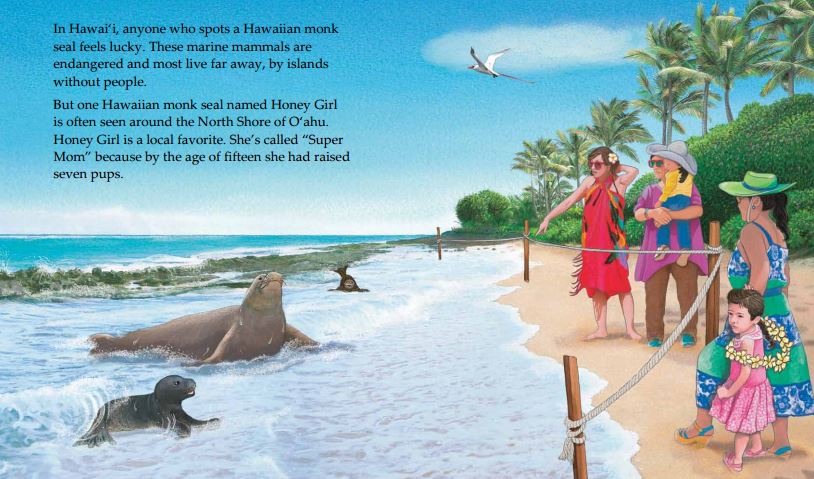
Honey Girl: The Hawaiian Monk Seal
Author: Jeanne Walker Harvey
Illustrator: Shennen Bersani
Published February 1st, 2017 by Arbordale Publishing

Summary: Hawaiian locals and visitors always enjoy spotting endangered Hawaiian monk seals, but Honey Girl is an extra special case. She has raised seven pups, and scientists call her “Super Mom.” After Honey Girl is injured by a fishhook, she gets very sick. Scientists and veterinarians work to save Honey Girl until she can be released back to her beach. This true story will have readers captivated to learn more about this endangered species.

Website: https://arbordalepublishing.com/bookpage.php?id=HoneyGirl

Review: I loved Honey Girl’s story. Honey Girl is a mother, a survivor, a symbol of hope, and a miracle of science. Jeanne Walker Harvey did a fabulous job not only developing Honey Girl’s character and developing her story but intertwining all of that with scientific undertones. She brings to the forefront issues of endangered species, humans effects on animals, and the importance of conservation scientists. All of this mixed with the colorful illustrations and amazing setting gives us such a beautiful picture picture.

Teachers’ Tools for Navigation: Honey Girl’s back matter gives such a wealth of information. Anything that wasn’t taught during Honey Girl’s story is revealed. The “For Creative Minds” section includes information on the Hawaiian Monk Seal life cycle, fun facts, conservation information, and rescue & rehabilitation.

In addition to all of the science and geography components of Honey Girl’s story that can be discussed and learned from, there are definitely reading and vocabulary opportunities within the book also. Check out:
Teaching Activity Guide
Reading Quiz
Related Websites
For Creative Minds Quiz

Discussion Questions: How did humans effect Honey Girl’s life?; What are some ways that we could help endangered species?; How does Honey Girl give us hope about the Hawaiian Monk Seal?

Flagged Passages: 

Read This If You Love: Who Lives in the Sea?: Ocean Animals of Hawaii by Monika Mira, Ocean Animals by Johnna Rizzo

Recommended For: 

classroomlibrarybuttonsmall closereadinganalysisbuttonsmall 

Signature

**Thank you to Barbara at Blue Slip Media for providing a copy for review!**

Star-Crossed by Barbara Dee

Share

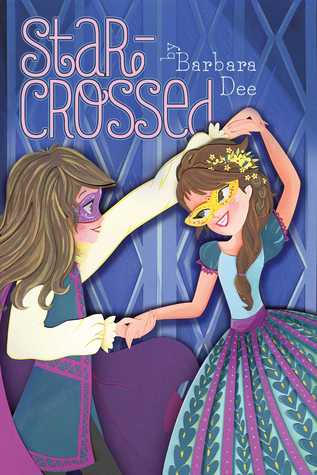
Star-Crossed
Author: Barbara Dee
Published March 14th, 2017 by Aladdin

Summary: Mattie, a star student and passionate reader, is delighted when her English teacher announces the eighth grade will be staging Romeo and Juliet. And she is even more excited when, after a series of events, she finds herself playing Romeo, opposite Gemma Braithwaite’s Juliet. Gemma, the new girl at school, is brilliant, pretty, outgoing—and, if all that wasn’t enough: British.

As the cast prepares for opening night, Mattie finds herself growing increasingly attracted to Gemma and confused, since, just days before, she had found herself crushing on a boy named Elijah. Is it possible to have a crush on both boys AND girls? If that wasn’t enough to deal with, things backstage at the production are starting to rival any Shakespearean drama! In this sweet and funny look at the complicated nature of middle school romance, Mattie learns how to be the lead player in her own life.

Review: I really, really, really enjoyed this book. First, it made me like Shakespeare more than I did before. Second, I think that it dealt with sexual identity in a gentle and realistic manner. 

I must admit that Shakespeare is a fear of mine because I just never have felt like I got him the way I should as an English Lit major and English teacher; however, it is what it is. When I see Shakespeare plays, I am always transported into the story and understand what all the hoopla is about, but reading it cold, I just never get it. I worried that a story about a middle school putting on Romeo and Juliet would let the Shakespeare bog it down, but it did the opposite–it helped this story be what it is. The reader learns to love Shakespeare as Mattie learns to love him. And since we are in class and at rehearsals with Mattie, we also get to be part of some of the lessons about the play thus helping the reader understand the text as well as Mattie is supposed to. It was brilliantly intertwined.

Mattie’s feelings toward Gemma are obvious to the reader before Mattie even realizes what they are, but that felt truly realistic to me because if you are someone who has already crushed on boys, feeling the same way towards a girl could be confusing, but Dee never makes it seem like what Mattie seems is anything but natural which is beautiful to see in a middle grade novel.

Teachers’ Tools for Navigation: In addition to being in classroom, school, and public libraries, sections of the story could definitely be used in conjunction to a reading of Romeo and Juliet. Some of the discussions of the play, both during Mattie’s English class and during play rehearsals, would be great jumping off points for similar discussions in the classroom.

Discussion Questions: What clues did Dee include that Mattie’s feelings for Gemma were deeper than she first realized?; If your class was putting on Romeo and Juliet, who do you think would be best to play each character? Explain.; What allusions to Romeo and Juliet did Dee include within the text?; Have you ever read a text that affected you the way Romeo and Juliet effected Mattie?

Flagged Passages: “But that afternoon, when I got home from Verona’s and locked myself in my bedroom to read Romeo and Juliet, something happened to me. It was kind of like a thunderbolt, I guess you could call it. Because as I was reading, I stared speaking the words out loud, feeling the characters’ emotions as if they were mind. I didn’t understand every word, and a few times I skimmed when certain characters (specifically, Mercutio and Friar Lawrench) got speechy. But the idea that Romeo and Juliet had a secret love they had to hid from their families, even from their best friends–it was a story so real I could almost see it happening in front of me.

And wen I got to the end, when Juliet discovers that Romeo is dead, and kisses his lips, and they’re still warm, I did the whole scene in front of the mirror, including the kiss. My eyes had actual tears, and I thought: It’s like this play is happening TO me. Inside me. 

I wanted to own it. I wanted to eat it, as if it were chocolate layer cake.” (p. 68-69)

Read This If You Love: Shakespeare, Middle grade novels about school life and identity 

Recommended For:

   classroomlibrarybuttonsmall

**Thank you to Simon & Schuster for providing a copy of the book and to Barbara Dee for reaching out to me!**

Because of Mr. Terupt by Rob Buyea

Share

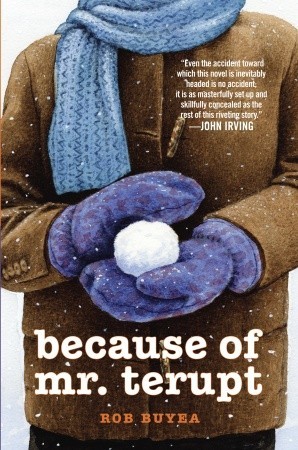
Because of Mr. Terupt
Author: Rob Buyea
Published October 12, 2010 by Delacorte

A Guest Review by Julia Kipphut

Summary: Mr. Terupt’s fifth grade class at Snow Hill School is comprised of various types of students, some including: a new student, a popular girl, a bully, and a troublemaker. Their teacher, Mr. Terupt who is passionate and energetic, strives to engage his students and instill a sense of community amongst his class. Unfortunately, one day, a snowball fight goes awry and leaves Mr. Terupt in a coma. His class is rattled and must learn to work together, be kind, and hope for Mr. Terupt’s recovery.

Review: This book includes a variety of characters, each owning their own identity and personality. Each chapter is written from a different character’s perspective, making for a fluid and interesting read. They are relatable for children and allow them to recognize themselves in each character. Each character evolves in the story and shows tremendous growth, proving the rich development of the people in this book. The message of community and forgiveness is nicely intertwined in the story and proves that it is always better to choose kindness. The theme of this book is positive and motivational. 

Teachers’ Tools for Navigation: Because of Mr. Terupt serves as a great reader aloud for upper elementary school students. 4th and 5th graders who are struggling with their identity and place in a classroom community can learn the importance of compassion. Students can learn to embrace individual differences for a common goal or outcome, mirroring the characters in this book. Additionally, this book allows students to study character development throughout the story; each character evolves- allowing for effective classroom discussion.

Because of each character of this book is written from a different character’s perspective, students are able to study point of view and consider the influence each chapter has on the story as a whole. Students are able to learn about each character in depth and can even use literature circles to each study a character for analysis.

Discussion Questions: How might the story be different if the snowball accident did not happen?; What do you think the author’s purpose or message was for this story?; Why do you think the author chose to write this story from different characters points of views? Do you think this was effective?

Book Trailer: 

Read This If You Loved: Out of My Mind by Sharon Draper; Wonder by R. J. Palacio

Recommended For:

  litcirclesbuttonsmall  classroomlibrarybuttonsmall

Thank you, Julia!

RickiSig

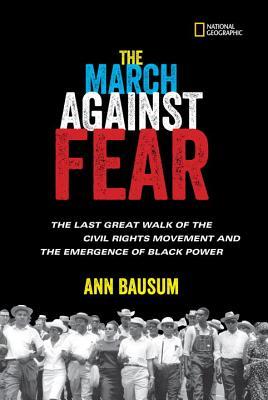
The March Against Fear: The Last Great Walk of the Civil Rights Movement and the Emergence of Black Power by Ann Bausum

Share

nfpb2017

Nonfiction Wednesday

Nonfiction Picture Book Wednesday is hosted by Kid Lit Frenzy and was started to help promote the reading of nonfiction texts. Most Wednesdays, we will be participating and will review a nonfiction text (though it may not always be a picture book).
Be sure to visit Kid Lit Frenzy and see what other nonfiction books are shared this week!

The March Against Fear: The Last Great Walk of the Civil Rights Movement and the Emergence of Black Power
Author: Ann Bausum
Published January 3rd, 2017 by National Geographic Society

Summary: James Meredith’s 1966 march in Mississippi began as one man’s peaceful protest for voter registration and became one of the South’s most important demonstrations of the civil rights movement. It brought together leaders like Martin Luther King Jr. and Stokely Carmichael, who formed an unlikely alliance that resulted in the Black Power movement, which ushered in a new era in the fight for equality.

The retelling of Meredith’s story opens on the day of his assassination attempt and goes back in time to recount the moments leading up to that event and its aftermath. Readers learn about the powerful figures and emerging leaders who joined the over 200-mile walk that became known as the “March Against Fear.”

Thoughtfully presented by award-winning author Ann Bausum, this book helps readers understand the complex issues of fear, injustice, and the challenges of change. It is a history lesson that’s as important and relevant today as it was 50 years ago.

About the Author: Ann Bausum writes about U.S. history for young people, and she has published eight titles with National Geographic Children’s Books including, most recently, Marching to the Mountaintop (2012) and Unraveling Freedom (2010). Ann’s books consistently earn prominent national recognition. Denied, Detained, Deported (2009) was named the 2010 Carter G. Woodson Book Award winner at the secondary school level from the National Council for the Social Studies. Muckrakers (2007) earned the Golden Kite Award as best nonfiction book of the year from the Society of Children’s Book Writers and Illustrators. Freedom Riders (2006) gained Sibert Honor designation from the American Library Association and With Courage and Cloth (2004) received the Jane Addams Children’s Book Award as the year’s best book on social justice issues for older readers. In addition, Ann has written about the nation’s chief executives and their spouses—Our Country’s Presidents (2013, 4th edition) and Our Country’s First Ladies (2007)—as well as the intrepid explorer Roy Chapman Andrews (Dragon Bones and Dinosaur Eggs, 2000).

Review: Ann Bausum’s text is a suspenseful story of the last Civil Rights march from Memphis, TN to Jackson, MS told in chronological order with captioned photographs that help the reader feel like they are present at the time of this march and the social, racial tension that filled America. I am having a very hard time reviewing this book, not because I don’t have nice things to say, but because this timely story is tough because although it is history, it seems like we haven’t come far from where the story takes place (which is terrifying).

Teachers’ Tools for Navigation: I believe that now is the most important time to teach resilience to our children as rights of many people are being threatened. Much of this education can come from conversation and amazing fictional stories, but I think it is vital to teach the history of diverse people within our nation that fought for rights. Children need to learn about women’s history, Black American history, Native American/American Indian history, Asian American history, LBGTQIA history, Irish American history, Jewish history, and so many more–all diverse populations that were prejudiced against and fought. Ann Bausum’s text (and her bibliography!) is a must-read in this education of our future.

Discussion Questions: Why was this march the last of the Civil Rights Movement?; This book is being called “timely” by many reviewers. Why do you think that timely is being used to describe the book?; Why would Bausum choose this march as the topic of her book?; How do the photographs and quotes throughout the book change the experience of reading the text?

Flagged Passages: “A cornerstone of this social justice movement became the willingness of people to put their lives on the line in the fight for change, much as Meredith had done during the integration of Ole Miss. Volunteers in the movement countered the violence of segregationists with tremendous acts of courage. They stood their ground peacefully in the midst of racist attacks, confident that love was a more powerful emotion than hate. Year after year, they persevered, whether it meant walking to work instead of riding segregated buses during the Montgomery bus boycott of 1955 and 1956, or braving violent mobs during the freedom rides of 1961, or enduring police attacks with high-pressure fire hoses during the Birmingham campaign of 196.

Such efforts drew on what movement leaders called the power of nonviolence. Some viewed nonviolence as a strategy, a series of tactics that forced reluctant foes to submit to change; others saw it was a way of life. For nonviolence to work, people had to be willing to remain peaceful, but determined, in the face of any level of violence. They had to outmaneuver their violent oppressors and step in and complete a protest whether their comrades had been arrested, injured, or even killed.” (p. 12-13)

Read This If You Love: To learn about the history of Civil Rights Movement

Recommended For: 

classroomlibrarybuttonsmall closereadinganalysisbuttonsmall

Signature

**Thank you to Karen at Media Masters Publicity for providing a copy for review!**

Famous Fails!: Mighty Mistakes, Mega Mishaps, & How a Mess Can Lead to Success! by Crispin Boyer

Share

nfpb2017

Nonfiction Wednesday

Nonfiction Picture Book Wednesday is hosted by Kid Lit Frenzy and was started to help promote the reading of nonfiction texts. Most Wednesdays, we will be participating and will review a nonfiction text (though it may not always be a picture book).
Be sure to visit Kid Lit Frenzy and see what other nonfiction books are shared this week!

Famous Fails!: Mighty Mistakes, Mega Mishaps, & How a Mess Can Lead to Success!
Author: Crispin Boyer
Published October 25th, 2016 by National Geographic Children’s Books

Summary: This fun book of quirky failures and famous flops will keep kids laughing while they learn the importance of messing up in order to get it right. Science, architecture, technology, entertainment — there are epic fails and hilarious goof-ups from every important field. Silly side features help to analyze the failures: “Lesson Learned,” “It Could be Worse!,” “Losing Combinations,” and a “Fail Scale” to help readers navigate the different kinds and scope of the mistakes made. The stories will include what went wrong, what went right, and what kids can learn from each failed attempt.

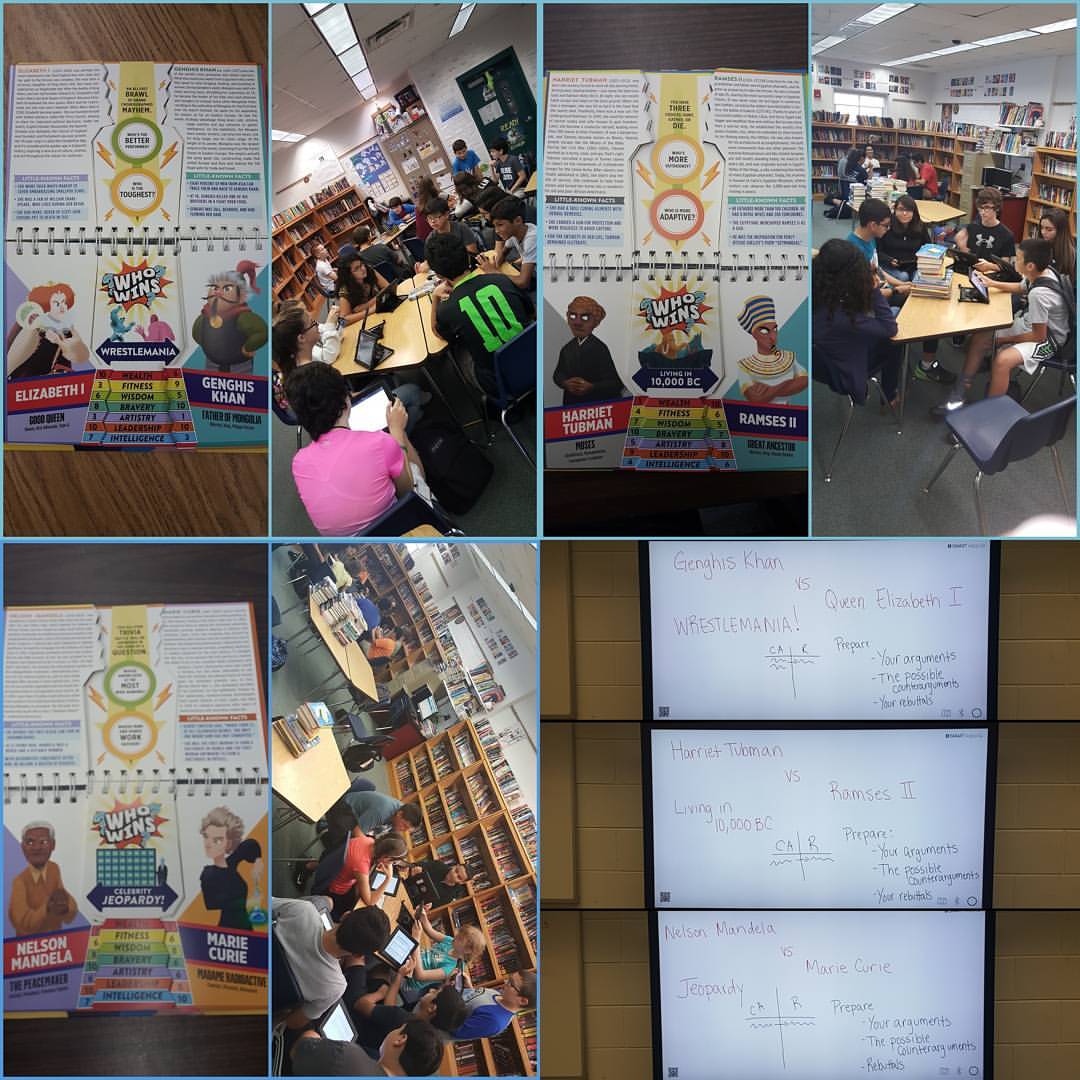
Review: I think one of the greatest lessons for children to learn is that failure doesn’t always equal failure. So many inventions and success began as what many would consider a failure when in actuality it was the beginning of a great thing. Giving up after a failure means you didn’t learn anything from it when failure is one of the best learning experiences. This text goes through hundreds of examples of famous people who failed or failures that became successes–wonderful stories for young people to read.

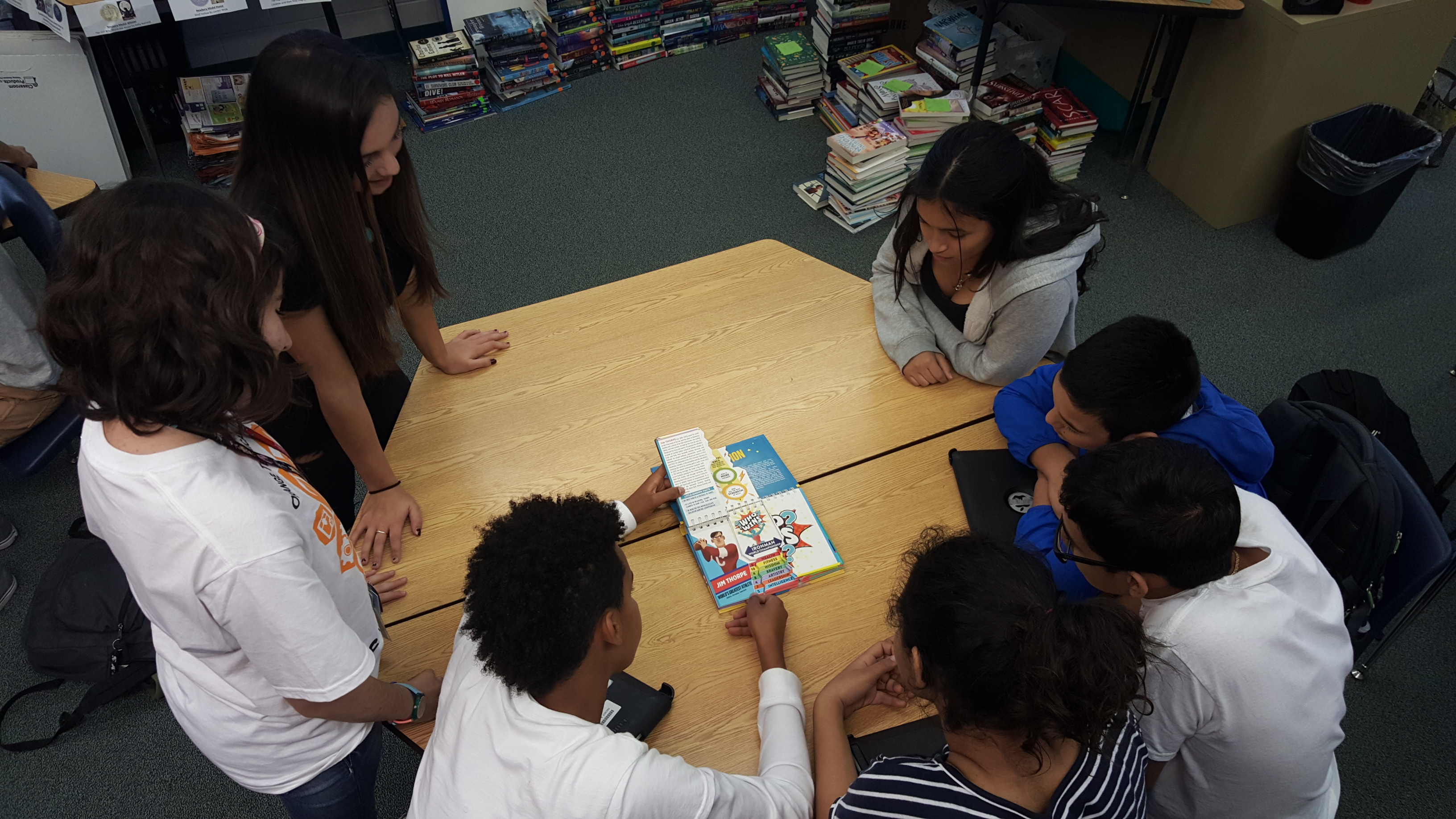
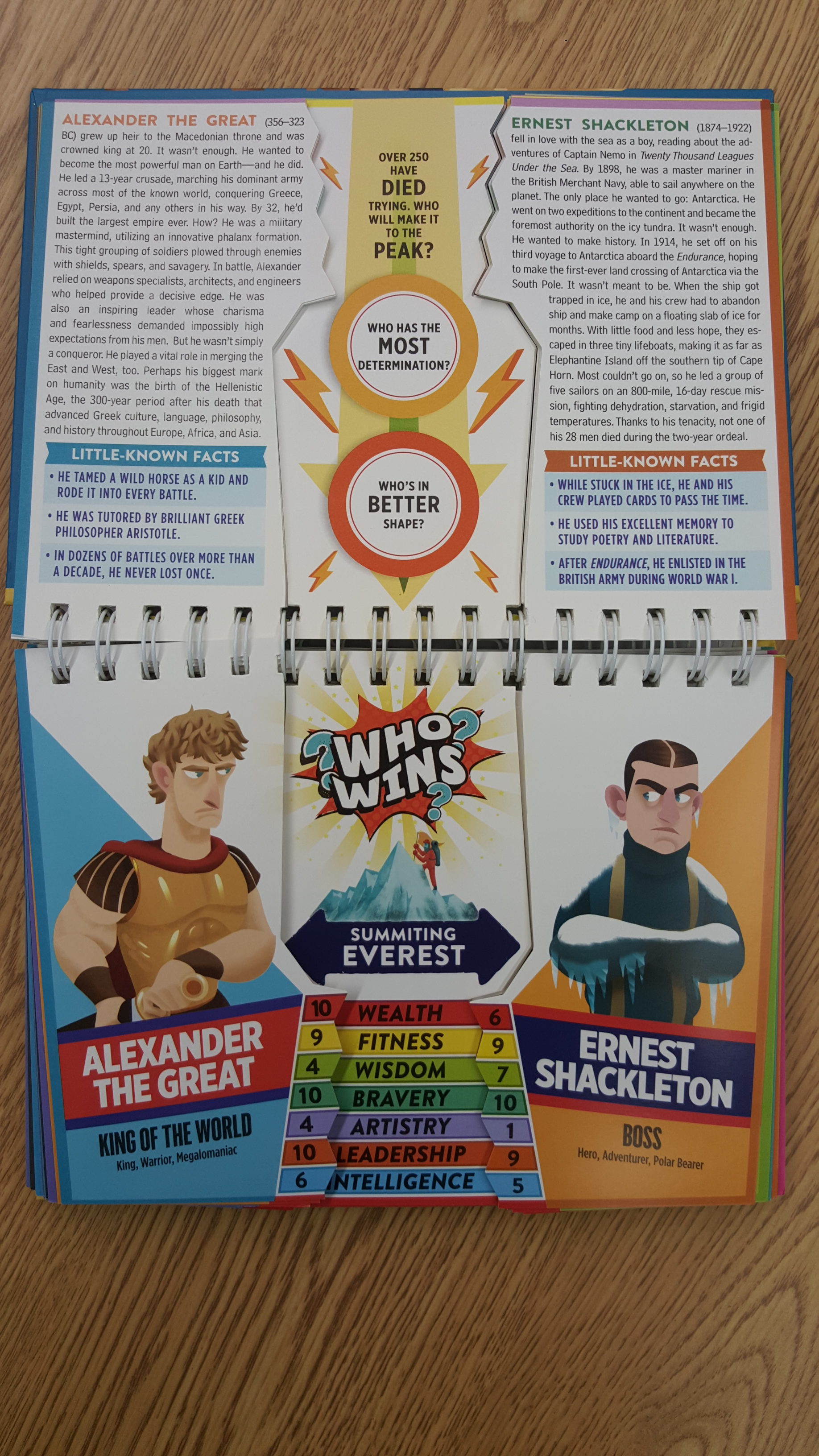
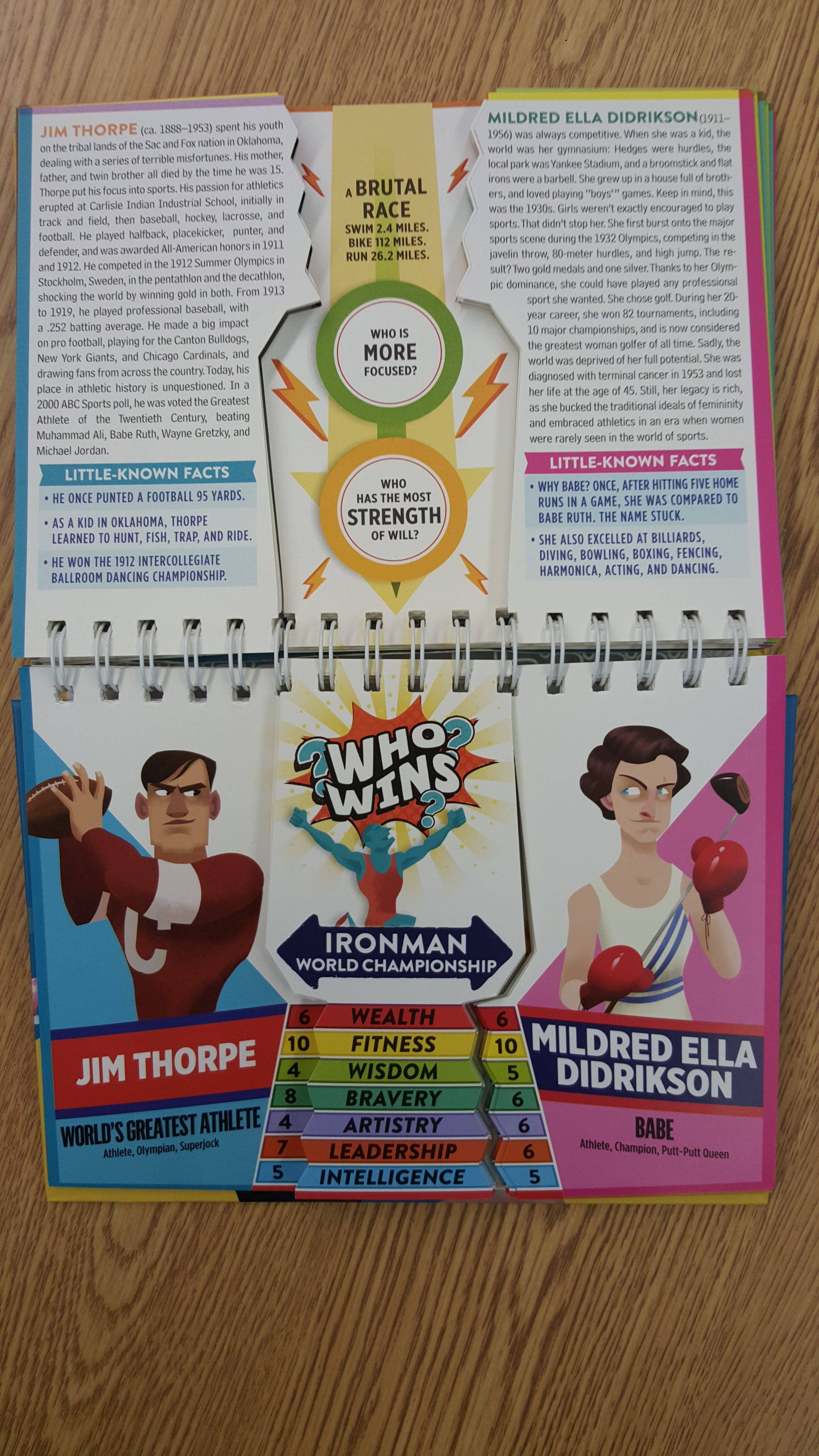
Teachers’ Tools for Navigation: As I read more and more of National Geographic’s new books like this one, Awesome 8, Book of Heroes/HeroinesReal or Fake?, and others, I’m coming to realize that these texts are made for project-based learning. These books make me question and inquire so many things within them. As I read, I find myself Googling and thinking and wanting to learn more–and I know they’ll do the same for kids.

Discussion Questions: Which famous inventions did you learn that was from a “failure?”; What famous person did you learn about that surprised you with their “failure?”; When is a time that you “failed” and stopped but now you wish you could go back and keep trying?

Flagged Passages: 

Read This If You Loved: The Marvelous Thing That Came from a Spring: The Accidental Invention of the Toy That Swept the Nation by Gilbert Ford, Earmuffs for Everyone!: How Chester Greenwood Became Known as the Inventor of Earmuffs by Meghan McCarthy, and other books about inventions; The Book of Heroes by Crispin Boyer & The Book of Heroines by Stephanie Warren Drimmer; and other nonfiction texts about inventors, heroes, failures then successes, and history

Recommended For: 

classroomlibrarybuttonsmall

Signature

**Thank you to Karen at Media Masters Publicity for providing a copy for review!**

Ghost by Jason Reynolds

Share

ghost

Ghost
Author: Jason Reynolds
Published: August 30, 2016 byAtheneum/Caitlyn Dlouhy Books

GoodReads Summary: Running. That’s all that Ghost (real name Castle Cranshaw) has ever known. But never for a track team. Nope, his game has always been ball. But when Ghost impulsively challenges an elite sprinter to a race — and wins — the Olympic medalist track coach sees he has something: crazy natural talent. Thing is, Ghost has something else: a lot of anger, and a past that he is trying to outrun. Can Ghost harness his raw talent for speed and meld with the team, or will his past finally catch up to him?

Ricki’s Review: I will read anything by Jason Reynolds. He captures the adolescent voice perfectly. Ghost reminds me of so many kids that I taught, and if I was still teaching, I would be thrilled to bring this book to school to recommend it to dozens of my students. Luckily, I can now share it with preservice teachers! I am very excited that this book will be one installment of a series of companion texts. It doesn’t end with a hook, which I am grateful for, and I believe the next book will feature a different character. There are so many great lessons that emerge from this story. Teachers would have much to discuss in their classrooms. I highly, highly recommend this text. It belongs in schools and in the hands of kids.

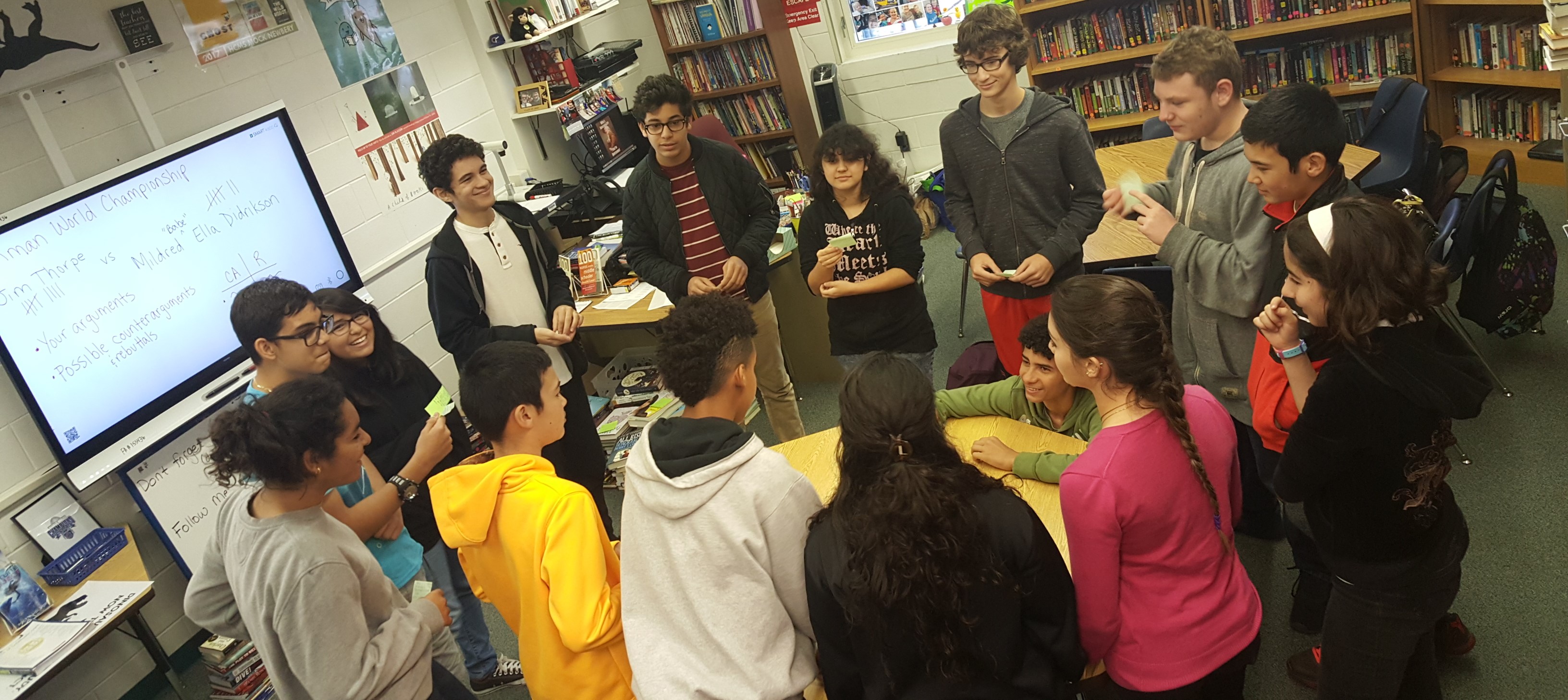
Kellee’s Review: This book is one of those books that I don’t like to tell people what it is about because any summary just doesn’t capture the brilliance of the characterization and story. However, through the word-of-mouth compliments of middle schoolers, it has become a favorite book for many of our school’s students and even won our HCMS Mock Newbery Award! I think it is Jason Reynolds’s way of connecting with adolescent readers through a true voice and circumstances that so many of them will connect to.

Teachers’ Tools for Navigation: We recommend using this book to teach characterization. Ghost reflects the qualities of a human—he has good and bad qualities and makes some mistakes. Students might list all of the lessons that Ghost learns through the story. They could even try to map the lessons he learns in a visual diagram of their choice.

Discussion Questions: How does Ghost’s past haunt him? Does it shape who he is?; What poor choices does Ghost make? Why does he make the choices, and are they justified?; How does the track team act as an unconventional family for Ghost?

Flagged Passage: “You can’t run away from who you are, but what you can do is run toward who you want to be.”

Read This If You Loved:  The Boy in the Black Suit by Jason Reynolds; The Running Dream by Wendelin Van Draanen; Boy21 by Matthew Quick; Ball Don’t Lie by Matt de la Peña

Recommended For:

readaloudbuttonsmall litcirclesbuttonsmall closereadinganalysisbuttonsmall classroomlibrarybuttonsmall

RickiSig andKellee Signature

Sea Otter Heroes: The Predators That Saved an Ecosystem by Patricia Newman

Share

nfpb2017

Nonfiction Wednesday

Nonfiction Picture Book Wednesday is hosted by Kid Lit Frenzy and was started to help promote the reading of nonfiction texts. Most Wednesdays, we will be participating and will review a nonfiction text (though it may not always be a picture book).
Be sure to visit Kid Lit Frenzy and see what other nonfiction books are shared this week!

Sea Otter Heroes: The Predators That Saved an Ecosystem
Author: Patricia Newman
Published by January 1st, 2017 by Millbrook Press

Summary: Marine biologist Brent Hughes didn’t think sea otters and sea grass had much in common. But his research at Elkhorn Slough, an estuary on Monterey Bay in northern California, revealed a new and surprising connection between the two. The scientist expected this estuary to be overrun with algae due to the fertilizer runoff from surrounding fields. But it wasn’t. Why?

Review: As someone who struggled with biology when in school, I love narrative nonfiction about nature because it helps me fill in education gaps. Sea Otter Heroes looks at trophic cascade (cause and effect relationships within a food chain) and how it affects an ecosystem–so interesting! This information along with the beautiful photographs make this book a scientific journey.

Teachers’ Tools for Navigation: Patricia Newman’s books (Plastics, Ahoy! and Ebola included) are made for classrooms. This text includes not only the cause-effect relationship between otters and sea grass, but also has experiments, information about careers, a glossary, and an afterword about rethinking our relationship with nature giving the reader real ways they can make a difference. This book would be perfect to use in a life science unit or class.

Discussion Questions: What is the “critical link between” sea otters and flowering sea grass?; Finding the link was an accident, what was Brent Hughes studying when he found the connection? What was the proof that the connection existed?; How does the Elkhorn Slough exist?; What are Hughes’s 7 steps to think like a scientist? Observe nature and go through the 7 steps yourself.; What part did sea hares play in Brett Hughes’s experiment?; What is a trophic cascade?; How are what was discovered about the otters similar to the situations with wolves and sperm whales Newman shared?

Flagged Passages: 

Read This If You Love: Scientists in the Field books, National Geographic and Animal Planet books about animals 

Recommended For:

  readaloudbuttonsmall classroomlibrarybuttonsmall 

Kellee Signature

**Thank you to Lerner and Patricia for providing a copy for review!**