A Tribute to Walter Dean Myers

Share

myers

Kellee

When I heard of Walter Dean Myers’s passing, tears immediately began flowing. As a reader, many of us feel close to authors when we read their books, but with Myers, it was more for me. He meant something to me, my students (past, present, and future), my fellow teachers, their students, and everyone else who ever touched one of his books.

I read my first Walter Dean Myers, Shooter, in May of 2007 during my Master’s year. I was blown away by the truth within his books and the way in which he could weave a story. Then I read Monster and was once again awed by the unique ways that he told his stories (interview, police report, etc.). I followed these two YA books with read 5 more of his YA (Handbook for Boys, Dope Sick, It Ain’t All For Nothing, Kick, and Fallen Angels), 1 middle grade (Autobiography of my Dead Brother), and 2 picture books (Harlem and Muhammad Ali). All brilliant. But what made these books even more special for me? They were books that my students wanted to read. They were easy sells. They grabbed their attention. They sucked them in. They were a reflection of people in their lives and themselves. And they were written so well. Even when I moved to teaching the most struggling readers in my school, I found that they gravitated towards Myers’s books even when the “reading level” was higher than theirs. Because of this, I began using an excerpt from Slam as a mentor text during a lesson. This brought even more of my students to his books. I also used Love that Dog by Sharon Creech during my poetry unit which has Walter Dean Myers as a character and uses one of his poems.  Because of Jack’s love of Myers, even more kids were interested in his work.  The demand for his books never stopped, so I kept buying his books. And lending his books. He was a constant presence in my room, and a presence that is irreplaceable.
20131123_075715 20131123_075705

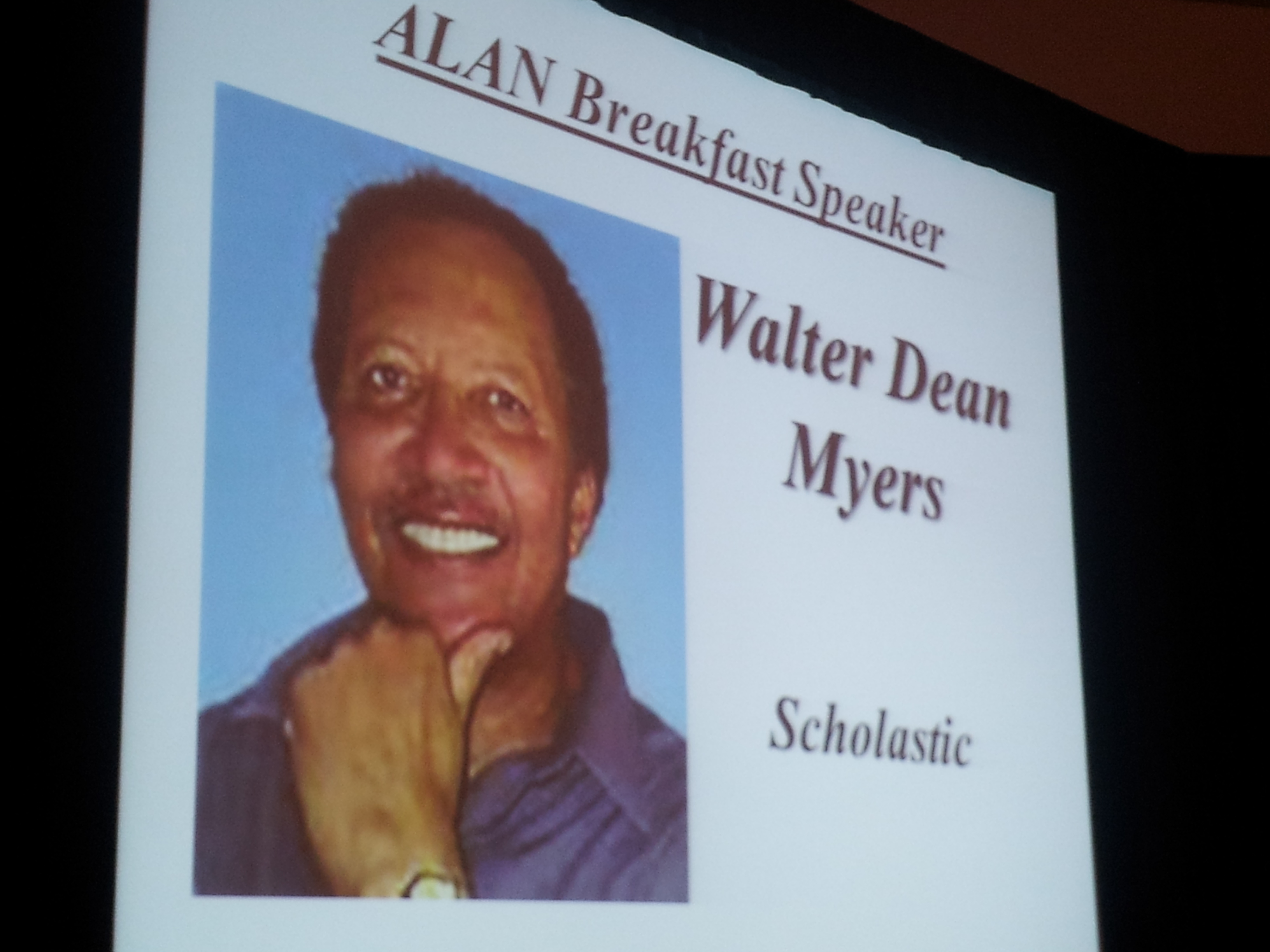
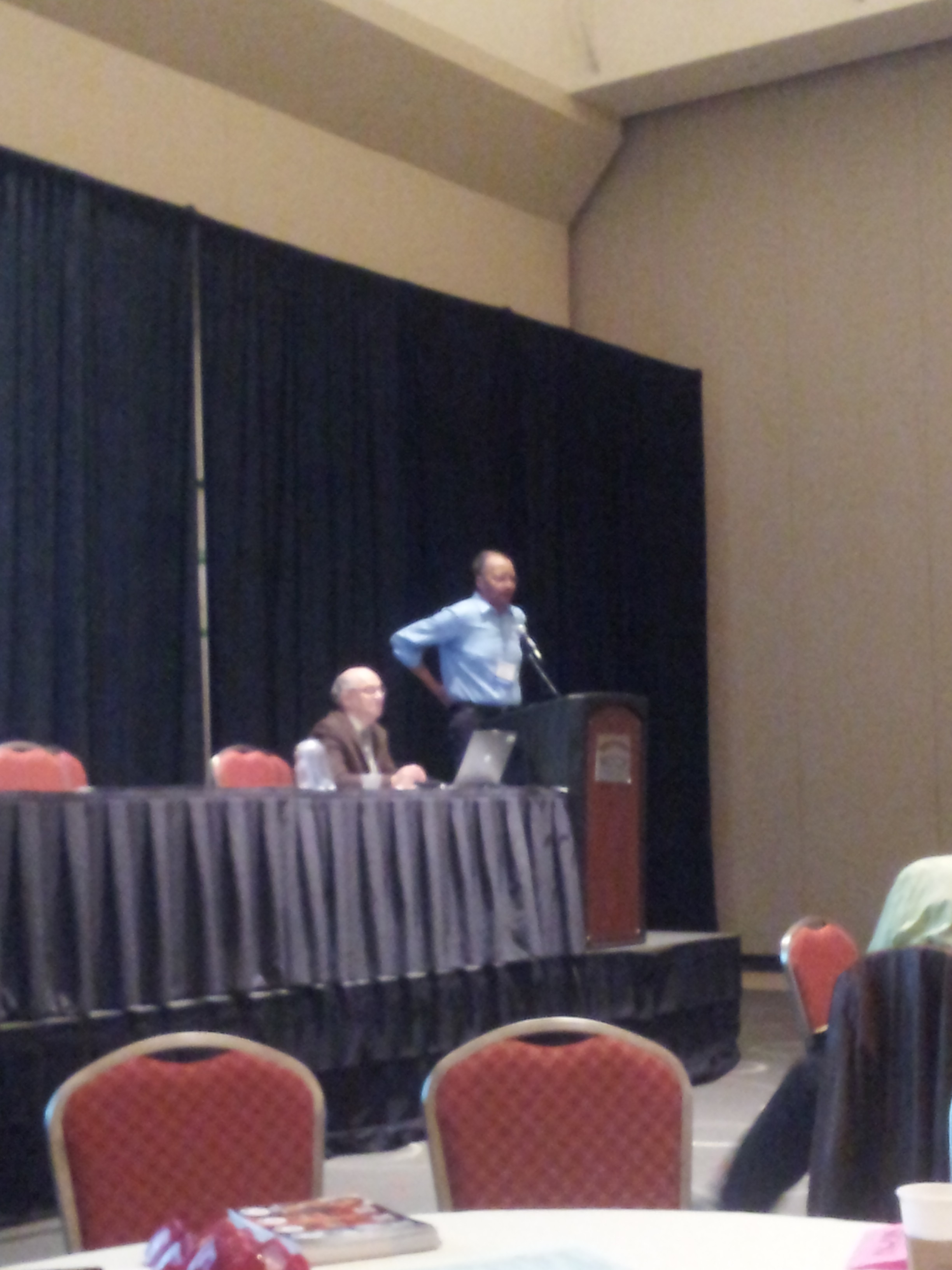
I’ve also been lucky enough to see him speak twice and meet him once. He was a true gentleman, advocate for literacy, and just had a way with words. In 2011, Myers spoke at ALAN and shared how writing was his passion, and he was lucky enough to have publishers that would let him do whatever he could pull off. MAN could he pull off some amazing things. In 2013, Myers was the ALAN breakfast speaker. His speech was about diversity (economic and race) and reading. He shared how he’d been going to prisons for over 20 years to speak to the youth there to promote literacy.  He reminded us that there are all types of children, and that “we need to acknowledge that these [diverse] kids exist,” and “you will save some lives by the choices of the books that you get into kids’ hands.” It was a speech that would make any person want to go out and change the world because we were listening to a person who had.

Ricki

Walter Dean Myers was a gentle, kind man with a fiery spirit. He was committed to change and a strong advocate for young people. When I first met him, I was surprised by how soft-spoken he was. It became immediately clear that his words had power, and I listened very closely when he spoke. Even when the lines for his book signings were out of the door, he treated all of the people in the line as if they were the only ones who mattered.
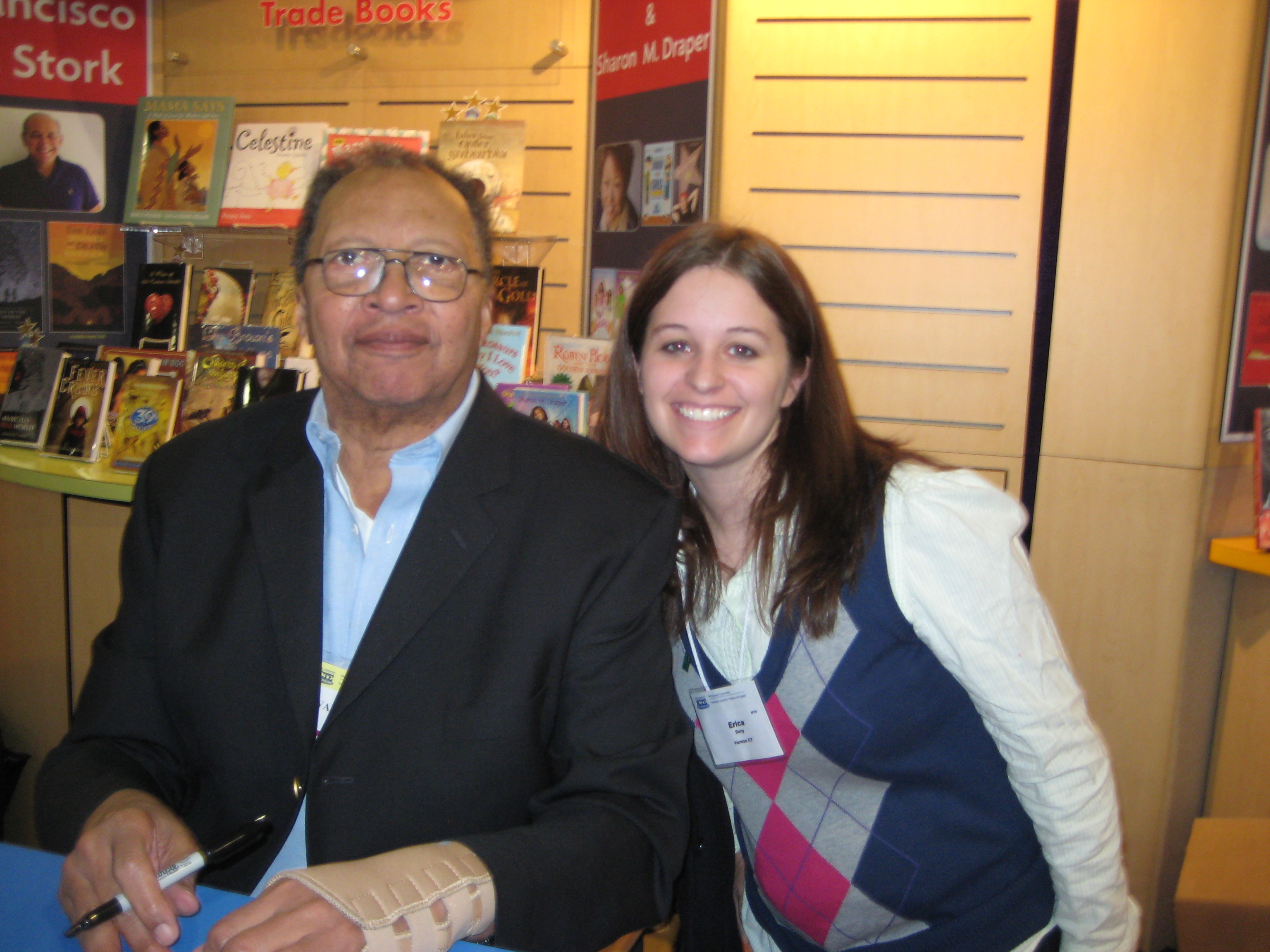
Walter Dean Myers

A few weeks ago, I was fortunate enough to receive his newest book, On a Clear Day in the mail. When a brown envelope comes, it is often a mystery about which book will be inside. When I pulled out the book and saw his name, I felt a rush of excitement.  I will read anything by this man. In this particular text, Myers strays from his norm and dapples in the dystopian genre. This does not surprise me because he has never been afraid to be innovative and break barriers.  

I’ve been fortunate enough to teach Walter Dean Myers’ books, and any teacher who has used them in the classroom knows how powerful they can be for kids. My students have used Monster to debate the inequities of society, and they have learned about the devastation of war from Sunrise Over Fallujah. When I wrote a tribute to Myers on my Facebook page, a student posted about how much he treasures Fallen Angels because Myers’ military experience was very clear. His books are gripping, honest and gritty. These are the kind of books that help kids realize that they are readers.

Walter Dean Myers leaves behind a legacy of powerful books that will reach children for decades. He is truly a giant among men, and I’ve been honored to learn from him.

Walter Dean Myers’s will always be alive in his books,

Signature andRickiSig

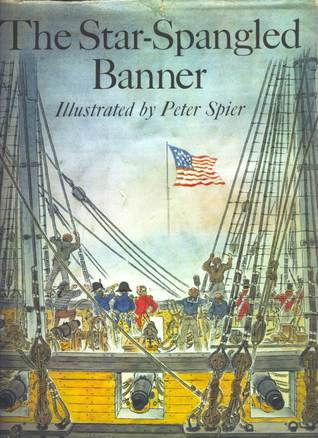
The Star-Spangled Banner illustrated by Peter Spier

Share

spangled

The Star-Spangled Banner
Author: Francis Scott Key
Illustrator: Peter Spier
Published September 19, 1973 by Doubleday Books for Young Readers

Goodreads Summary: Due to careful research, Spier’s artwork depicts “the dawn’s early light” and “the rocket’s red glare” with remarkable authenticity and detail in this celebratory book. Among the highlights: a brief history of the anthem, a reproduction of Francis Scott Key’s original manuscript, music for guitar and piano chords and many photographs.

My Review and Teachers’ Tools for Navigation: Peter Spier’s illustrations bring our national anthem to life. Spier carefully researched all lines of them poem as well as other facts about the War of 1812 when the anthem was written and used all of this knowledge to help show the meaning behind Key’s words. In the afterword, Spier shares much of the research to help tie it all together. 

In the past, as a school, we actually had students do something very similar. They each received a line from the first verse, and they had to research what it meant and then draw an illustration to share with their classmates the meaning. These were then put together as a book, so that the entire national anthem could be read with illustrations showing the meaning. Students loved the activity, and I really think it helped make history mean more to them than just dates.

Discussion Questions: What is Key trying to say in The Star-Spangled Banner?; What caused Key to write this poem?; Had you ever heard the second or third verse before? What did you think of it?; For some of the lines, Spier chose to draw a modern setting–why do you think he chose these specific places? 

We Flagged: 

Recommended For: 

readaloudbuttonsmall classroomlibrarybuttonsmall closereadinganalysisbuttonsmall

Happy Fourth of July!

Signature

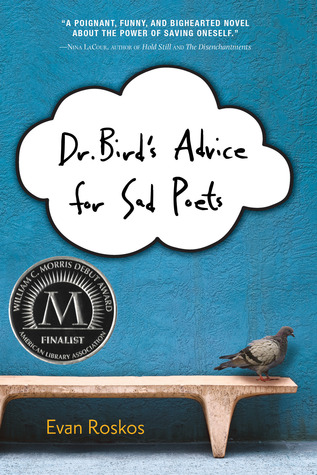
Dr. Bird’s Advice for Sad Poets by Evan Roskos

Share

dr bird's advice for sad poets

Dr. Bird’s Advice for Sad Poets
Author: Evan Roskos
Published: March 5, 2013 by Houghton Mifflin Harcourt

Summary: “I hate myself but I love Walt Whitman, the kook. Always positive. I need to be more positive, so I wake myself up every morning with a song of myself.” 

Sixteen-year-old James Whitman has been yawping (à la Whitman) at his abusive father ever since he kicked his beloved older sister, Jorie, out of the house. James’s painful struggle with anxiety and depression—along with his ongoing quest to understand what led to his self-destructive sister’s exile—make for a heart-rending read, but his wild, exuberant Whitmanization of the world and keen sense of humor keep this emotionally charged debut novel buoyant.

Ricki’s Review: Dr. Bird’s Advice for Sad Poets is such an important book. It captures depression and anxiety in a way that is both authentic and heart-wrenching at the same time. I wanted to reach into the pages of the book to give James a big hug. Similarly to It’s Kind of a Funny Story by Ned Vizzini, this book employs humor without detracting from the very realness of James’ struggles with loneliness and isolation. Teens (and adults) will find themselves in James because he is depicted in a sympathetic way that is very human. This novel is brilliant and should be in every classroom library.

Kellee’s Review: I concur with everything that Ricki said. Dr. Bird’s is a very special book. On a Top Ten Tuesday list, I wrote that I wished there were more books about kids with chemical imbalances, and Dr. Bird’s is the closest I’ve read yetEvan Roskos captures the feeling of a manic depressive state. The energy of the writing actually changes as James’s state of mind changes: anxious, manic, depressed. However, what makes it truly special is that even in the end, there is optimism. Although James is fighting his own chemical imbalance, he keeps doing just that—fighting.

Another thing I adored about this book is the idea of art and writing as therapy. James finds solace in photography and poetry, which is a positive lesson for teens because it shows the power of art, writing, and poetry.

Teacher’s Tools for Navigation: It would be interesting for teachers to do literature circles with texts that concern mental health. Students might read this book along with titles like: Forgive Me, Leonard Peacock by Matthew Quick, It’s Kind of a Funny Story by Ned Vizzini, The Perks of Being a Wallflower by Stephen Chbosky, Twisted by Laurie Halse Anderson, Everybody Sees the Ants by A.S. King, and 13 Reasons Why by Jay Asher. I imagine that reading these titles would foster incredibly rich discussions about depression, anxiety, and suicide. In my opinion, we must have these conversations with our students.

Also, Walt Whitman is a huge part of James’s life, and Whitman is mentioned throughout the book. The Whitman references (and James’s poetry emulating Whitman) would great to be examined in a classroom.

Discussion Questions: If James didn’t have abusive parents, do you think his life would be the same? Do you think depression is genetic in his family?; How does James show bravery?; What role does Walt Whitman play in James’ life?

We Flagged: “People in the world suffer from greater calamities than I do. I eat, I have clothes, I have a house. I read about people around the world who survive on less than a dollar a day. I read about how there are hundreds of millions of widows living in poverty. I see ads for kids who are born with ragged lips and jagged teeth. I don’t have anything like that. I just wake up with a deep hatred of myself. How selfish is that?” (p. 115)

“Later, as my father drives me to the pizzeria, his gassy, grumpy body reeking of judgment and anger and disappointment, I can’t help but wonder how little he knows about the depth of my sadness. The depth of my very being. Will he be upset to find me dead, or relieved?” (p. 214)

Read This If You Loved: (Many of these are listed above.) Forgive Me, Leonard Peacock by Matthew Quick, It’s Kind of a Funny Story by Ned Vizzini, The Perks of Being a Wallflower by Stephen Chbosky, Twisted by Laurie Halse Anderson, Everybody Sees the Ants by A.S. King, Reality Boy by A.S. King, Dear Life, You Suck by Scott Blagden, 13 Reasons Why by Jay Asher, Leaves of Grass by Walt Whitman

Recommended For:

 closereadinganalysisbuttonsmall litcirclesbuttonsmall classroomlibrarybuttonsmall

RickiSig andSignature

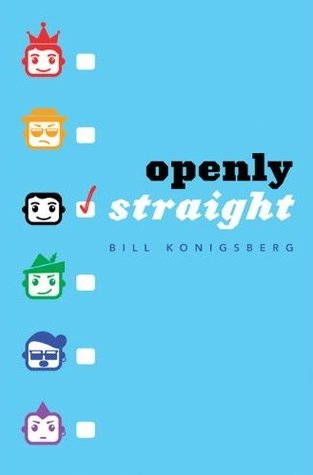
Openly Straight by Bill Konigsberg

Share

openly

Openly Straight
Author: Bill Konigsberg
Published May 28th, 2013 by Arthur A. Levine Books

Goodreads Summary: A funny, honest novel about being out, being proud . . . and being ready for something else.

Rafe is a normal teenager from Boulder, Colorado. He plays soccer. He’s won skiing prizes. He likes to write.

And, oh yeah, he’s gay. He’s been out since 8th grade, and he isn’t teased, and he goes to other high schools and talks about tolerance and stuff. And while that’s important, all Rafe really wants is to just be a regular guy. Not that GAY guy. To have it be a part of who he is, but not the headline, every single time.

So when he transfers to an all-boys’ boarding school in New England, he decides to keep his sexuality a secret — not so much going back in the closet as starting over with a clean slate. But then he sees a classmate breaking down. He meets a teacher who challenges him to write his story. And most of all, he falls in love with Ben . . . who doesn’t even know that love is possible.

This witty, smart, coming-out-again story will appeal to gay and straight kids alike as they watch Rafe navigate being different, fitting in, and what it means to be himself

Review and Teachers’ Guide to Navigation: This is such a great book! It is written well, very funny, smart, and has an important theme. What blew me away the most is how it was so humorous when dealing with a tough subject, but never lost its maturity and importance. Sometimes if you add humor to a novel, it becomes slap stick or more of a novelty, but Bill Konigsberg does it perfectly in Openly Straight.

As a teacher, what I immediately find myself connecting to was the journal entries from Rafe followed by Mr. Scarborough responses. Mr. Scarbourgh becomes quite an important person in Rafe’s life, and I feel that only through these journals, reflections, and responses that Rafe was able to make it at the new school. I think much of what Mr. Scarborough does with Rafe could be transferred directly into most classrooms.

Discussion Questions: Why did Rafe feel like he needed to hide who he was?; Have you ever felt like you couldn’t be who you really are?; How does Mr. Scarborough play a role in Rafe’s life?; How would you react if you were Ben?

We Flagged: “‘It’s hard to be different,’ Scarborough said. ‘And perhaps the best answer is not to tolerate differences, not even to accept them. But to celebrate them. Maybe then those who are different would feel more loved, and less, well, tolerated.'”

Read This If You Loved: Paper Towns by John Green, The Beginning of Everything by Robyn Schneider, Two Boys Kissing by David Leviathan, Will Grayson, Will Grayson by John Green and David Leviathan, Life in Outer Space by Melissa Kiel

Recommended For: 

readaloudbuttonsmall closereadinganalysisbuttonsmall classroomlibrarybuttonsmall

Signature

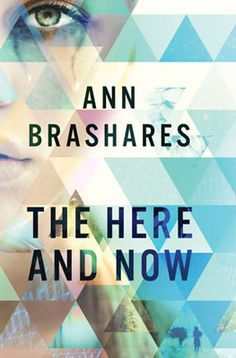
The Here and Now by Ann Brashares

Share

the here and now

The Here and Now
Author: Ann Brashares
Published: April 8, 2014 by Delacorte Press

Summary: An unforgettable epic romantic thriller about a girl from the future who might be able to save the world… if she lets go of the one thing she’s found to hold on to.

Follow the rules. Remember what happened. Never fall in love.

This is the story of seventeen-year-old Prenna James, who immigrated to New York when she was twelve. Except Prenna didn’t come from a different country. She came from a different time—a future where a mosquito-borne illness has mutated into a pandemic, killing millions and leaving the world in ruins. 

Prenna and the others who escaped to the present day must follow a strict set of rules: never reveal where they’re from, never interfere with history, and never, ever be intimate with anyone outside their community. Prenna does as she’s told, believing she can help prevent the plague that will one day ravage the earth. But everything changes when Prenna falls for Ethan Jarves.

Review: I particularly loved the first half of this book. While time travel is at the heart of this text, I think it would be a great book to give to readers who love dystopian fiction. Prenna’s memory of her futuristic world was fascinating to me. At times, I found Brashares to be a bit didactic, but overall, the book is very well-written and will entice readers from the first page. I always enjoy reading books about time travel because my mind spins as I try to grapple with the paradox time travel provides. If we change the past, will we exist in the future? And how can this work, if we are living in this previous time? Ah! My brain hurts. I enjoyed this book because it made me think.

Teacher’s Tools for Navigation: Similar to my review of All Our YesterdaysI think students would have a lot of fun selecting a time period to travel to, and perhaps, picking one event in history they would change and how it might impact the future. This could develop into a research project, and I can imagine there would be fantastic interdisciplinary connections with the subject of history. Alternatively (or additionally), teachers could link this text with the subject of science–where students research ways we are destroying our planet.

Discussion Questions: How are we destroying our planet? Do you think Ann Brashares’ prediction of the future is accurate? What is Brashares’ tone in this text?; If you could travel in time, what is one event in history that you would change and why? How might it change events in the future?

We Flagged: “People here act like the great things have already been lost, but they are wrong. They have so much still to lose” (Chapter Three).

“I guess memory is a deep well, and you don’t know what’s down there until you lower the bucket and start hauling it up” (Chapter Fifteen).

Please note: The above quotes are from the advanced reader copy. The quotes may have changed with publication.

Read This If You Loved: All Our Yesterdays by Cristin Terrill, When You Reach Me by Rebecca Stead, The Time Machine by H.G. Wells, The Giver by Lois Lowry, Legend by Marie Lu, Divergent by Veronica Roth

Recommended For:

 closereadinganalysisbuttonsmall litcirclesbuttonsmall classroomlibrarybuttonsmall

RickiSig

The Invisible Boy by Trudy Ludwig

Share

invisible

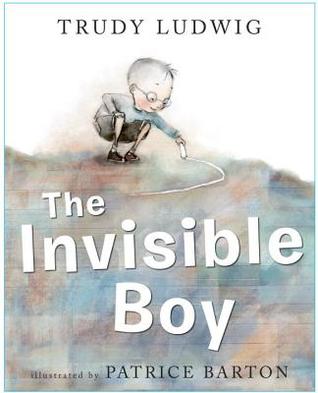
The Invisible Boy
Author: Trudy Ludwig
Illustrator: Patrice Barton
Published October 8th, 2013 by Alfred A. Knopf

Goodreads Summary: Meet Brian, the invisible boy. Nobody ever seems to notice him or think to include him in their group, game, or birthday party . . . until, that is, a new kid comes to class.

When Justin, the new boy, arrives, Brian is the first to make him feel welcome. And when Brian and Justin team up to work on a class project together, Brian finds a way to shine.

From esteemed author and speaker Trudy Ludwig and acclaimed illustrator Patrice Barton, this gentle story shows how small acts of kindness can help children feel included and allow them to flourish. Any parent, teacher, or counselor looking for material that sensitively addresses the needs of quieter children will find The Invisible Boy a valuable and important resource. 

Includes backmatter with discussion questions and resources for further reading. 

Review: Wow. This book affected me, so I know it would affect students. Although this is a book aimed at helping students think about how they affect others, there was one scene, early on, that shows Brian being ignored by everyone including his teacher which made me even sadder. It is so important for everyone, adults included, to think about how they treat or ignore others.

The other thing that I thought was brilliant was the way the illustrations were done. Brian comes to life actually right in front of our eyes. Such a smart way to visually show the moral of the story.

If you have not read this book yet, get it from your library or just go ahead and purchase it. You will not regret it.

Teachers’ Tools for Navigation: This book needs to be added to any kindness or empathy units out there right now. When I go back into the classroom, I will include it when I read Each Kindness, Because Amelia Smiled, and Stand Tall, Molly Lou Melon (check out my post on how I use Each Kindness in my middle school classroomInvisible Boy will fit perfectly.)

The author also includes recommended reading for adults and kids as well as wonderful Questions for Discussion in the back of the book.

Discussion Questions: (Found in the backmatter of the book) How many kids did it take in this story to help Brian begin to feel less invisible?; What specifically did Justin do to make Brian feel less invisible?; Are there kids in your class, grade, or school who you see being treated as if they are invisible? If yes, what could you do to make them feel more valued and appreciated?

We Flagged: 

Read This If You Loved: Each Kindness by Jacqueline Woodson, Stand Tall, Molly Lou Melon by Patty Lovell, Because Amelia Smiled by David Ezra Stein, Unicorn Thinks He’s Pretty Great by Bob Shea

Recommended For: 

readaloudbuttonsmall litcirclesbuttonsmall classroomlibrarybuttonsmall

Signature

Review, Giveaway, and Author Interview!: How To Cheer Up Dad by Fred Koehler

Share

dad

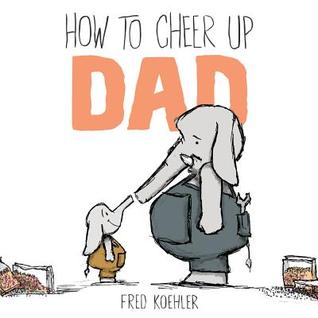
How To Cheer Up Dad
Author and Illustrator: Fred Koehler
Published March 20th, 2014 by Dial

Goodreads Summary: A hilarious book about parent and child relationships for fans of Ian Falconer and Jon Agee–a perfect gift idea for Father’s Day and beyond!

Little Jumbo just can’t understand why his dad is having such a bad day. It couldn’t be the raisins Little Jumbo spit out at the ceiling or the bath he refused to take–after all, Little Jumbo’s dad knew he hated raisins and had already taken a bath that week! Luckily, Little Jumbo is such a thoughtful elephant that he decides to turn his dad’s bad day around with some of his–ahem, his dad’s –favorite things.

How to Cheer up Dad is a standout debut featuring a charmingly oblivious little elephant with serious pluck and staying power. It turns the parent-child roles upside down is a great book for dads and the kids who make them laugh.

Review: This book was a gift for my husband and son to read together, and it is a perfect father-son book. It shows the connection that a child and parent has, and also how a child’s choices can affect a parent and vice versa. It is a wonderful conversation starter and is a wonderful way to teach this lesson. And it is funny!

Additionally, I LOVE the illustrations. Fred Koehler’s style adds an extra layer of joy to the book (with Fred’s “signature messy line work”).  The illustrations also add extra information to the story. It takes both the illustrations and the text to tell the whole story.

Author Interview: I’m so happy to be able to share with you all an exclusive author Q&A with Fred Koehler, the author and illustrator of How to Cheer Up Dad. 

Kellee @ Unleashing Readers: How did you transition from being a graphic artist to being an author/illustrator?

Fred Koehler: Awesome question! I’ve always been a writer and a doodler–in sketchbooks, my church bulletin, or the margins of my homework assignments. I studied graphic design in college and sadly, there was very little doodling to be done on a computer screen. Several years into my career as a designer I discovered drawing tablets, which allow the artist to use a digital pen that translates directly into the design software. So then I could doodle directly onto the screen and it suddenly clicked. I could use everything I’d learned as a designer and translate that into digital drawings.

The writing had always been a creative outlet for me, and I’d written at least one finished novel (which will never get published because it was awful). But… when I started to combine the writing with the drawing and the design all together, it took my artistry to a completely new level.

UR: What is the inspiration behind How to Cheer Up Dad?

FK: How to Cheer Up Dad is really a reminder to myself and parents everywhere that our kids are capable of being incredibly awesome and terribly frustrating with barely a breath in between. Kids live life without any filters, and it’s up to us as parents to decide how we’re going to react to that reality. The main character, Little Jumbo, is loosely based on both my son, Jack, and myself when I was a kid. Little Jumbo is charmingly oblivious to the massive amounts of trouble he causes, but genuinely dedicated to making things right in the end.

UR: Why elephants?

FK: The elephants came from a random doodle at Mitchell’s Coffee House in Lakeland, FL. I was there with my son, trying to work on some sketches, and my son was trying to get me to do anything but work on my sketches. I just remember being frustrated by the whole ordeal, coming home, and later seeing this doodle of two elephants in my sketchbook. Lucy Cummins, an art director at Simon & Schuster, eventually saw that sketch, and suggested how I might start to turn it into a picture book. I followed her advice and had several publishers fall in love with the characters. Eventually Kate Harrison at Dial Books for Young Readers acquired the manuscript. Plus, elephants are funny. And awesome.

UR: What illustrators and authors inspire you?

FK: One of the coolest things about this industry is the people you get to meet. Growing up I watched all the Chuck Jones cartoons, loved Jim Hensen’s work, and had every Disney animated movie memorized. When I started pursuing the path of becoming an author/illustrator, I got to meet lots and lots of other up-and-coming artists and storytellers who have inspired me. LeUyen Pham (Bedtime for Mommy, Freckleface Strawberry) recently accepted my FB friend request, so she’s at the top of my mind. I love her line work and the expressions that she gets from her characters. I got to watch Molly Idle (Tea Rex, Flora and the Flamingo) go from working for small indie publishers to winning a Caldecott honor last year. Dan Santat (Beekle, Sidekicks) has awesome writing/illustrating chops, and he gave me great advice early on. And the prolific Paul Zelinsky (Z is For Moose, The Wheels on the Bus, many others) has been kind enough to let me ask him lots of rookie questions along the way. 

UR: Are you working on anything else?

FK: Yes! Right now I’ve got two more books under contract. Little Jumbo is getting a sequel, and I’m still working with my incredible editor Kate Harrison and my awesome art director Lily Malcom on how exactly we’re going to one-up the work we did with How to Cheer Up Dad. It’s got such universal relevance and Little Jumbo is such a likable character, we’ve got to make sure and give him a sequel worthy of his potential.

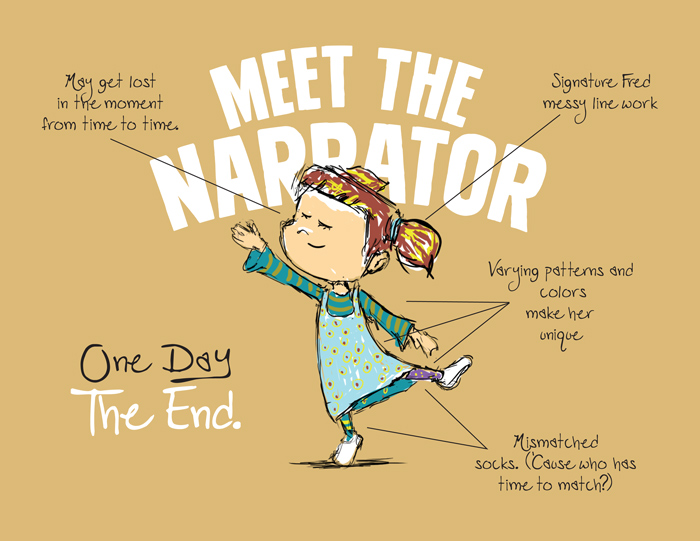
Also great news is that I’m working with Rebecca Davis at Boyds Mills Press to illustrate One Day, The End, which was written by Rebecca Kai Dotlich. And, since I think your readers might like to get the first sneak peek ever, I’m going to let slip a screen shot of the unnamed little girl who will star in this extremely creative book. This image is from my art direction concept that was just recently approved by the publisher. 🙂

FK Narrator

UR: Thank you so much Fred for the amazing interview and exclusive sneak peek! I, personally, am so excited for all of your upcoming projects! And because of how much I loved How to Cheer Up Dad and because of your kindness, I am happy to be able to offer a giveaway of a signed copy of  How to Cheer Up Dad with a custom illustration on the inside cover! Thank you Fred for that as well!

Teachers’ Tools for Navigation: This book is great to teach cause and effect. Readers can learn about why the dad is in a foul mood and what Jumbo does to fix it. It would be a perfect way to discuss the difficult concept of cause and effect using a situation that is very accessible.

Discussion Questions: What has caused Little Jumbo’s dad to be in a bad mood? What are the effects of his bad mood? What does Little Jumbo do to help cheer his dad up?

We Flagged: 

Dad’s mood was clearly getting worse, so Little Jumbo suggested that Dad needed a time out.

Read This If You Loved: Hug Time by Patrick McDonell, Elephant and Piggie series by Mo Willems, My Dad Thinks He’s Funny by Katrina Germein

Recommended For: 

readaloudbuttonsmall classroomlibrarybuttonsmall

GIVEAWAY

a Rafflecopter giveaway

And to all of our dad readers: Happy Father’s Day!

Signature