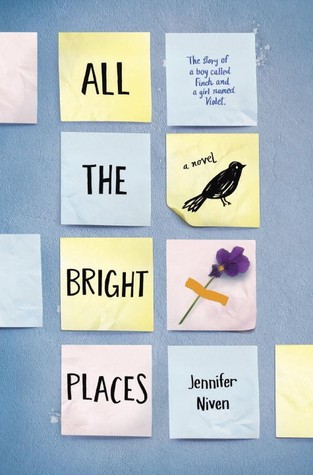
All the Bright Places by Jennifer Niven

Share

all the bright places

All the Bright Places
Author: Jennifer Niven
Published: January 6, 2015 by Knopf

Goodreads Summary: The Fault in Our Stars meets Eleanor and Park in this compelling, exhilarating, and beautiful story about a girl who learns to live from a boy who intends to die.

Theodore Finch is fascinated by death, and he constantly thinks of ways he might kill himself. But each time, something good, no matter how small, stops him.

Violet Markey lives for the future, counting the days until graduation, when she can escape her Indiana town and her aching grief in the wake of her sister’s recent death.

When Finch and Violet meet on the ledge of the bell tower at school, it’s unclear who saves whom. And when they pair up on a project to discover the “natural wonders” of their state, both Finch and Violet make more important discoveries: It’s only with Violet that Finch can be himself—a weird, funny, live-out-loud guy who’s not such a freak after all. And it’s only with Finch that Violet can forget to count away the days and start living them. But as Violet’s world grows, Finch’s begins to shrink.

This is an intense, gripping novel perfect for fans of Jay Asher, Rainbow Rowell, John Green, Gayle Forman, and Jenny Downham from a talented new voice in YA, Jennifer Niven.

Ricki’s Review: A publishing representative who I deem to be a friend pressed this book into my hand. “Read it,” she insisted. She told me I would want to curl up into a ball in my bed and fall into this book. I fell hard. The writing is incredible. I hate to compare books with others because it creates a sense of expectation that often goes unfulfilled for future readers, but I couldn’t help but consider comparisons with my all-time favorite YA texts. The quirky nature of the characters reminded me of Pudge, Alaska, Charlie, Eleanor, and Park. The direction of the plot reminded me of other titles (which will remain unnamed to prevent spoilers). But I cannot compare this book to others because while it allowed to me reminisce about my favorite titles, it was quite different. The deep, honest, hard-hitting depiction of mental illness was enough to take my breath away. I felt rage that made me want to punch my mattress; I felt sadness that made me feel a hopeless sense of emptiness; but above all, I felt the power of love, loyalty, and friendship that made my heart both ache and swell. This is an unforgettable book. I suspect it will be the book that everyone will be talking about this year and for years to come.

Teacher’s Tools for Navigation: Mental illness and bullying are pervasive in our schools. We can’t teach enough books about these themes because they are incredibly relevant for young people. As a former teacher, I was jealous of the teacher who created the assignment for Violet and Finch, and I wanted to do it with my former students. It would be so neat to duplicate this project while students read the book. Additionally, I think students would benefit from creating their own version of the post-it collages that Violet and Finch make. As an alternative, I would consider having students research the warning signs of suicide and finding these instances in the text. There are so many themes for the students to consider, the teaching categories at the top and tags at the bottom of this post show a variety of different directions a teacher might take with the instruction of this text.

Access the book’s website to share your bright place or read Germ MagazineThe educator guide also has CCSS tie-ins.

Discussion Questions: What is the end message of this book? What is the author’s purpose?; What foreshadowing does Niven provide?; How do Violet’s family members show their grief in different ways?; Do you agree with the ending? Would you change it? Why do you think Niven ended the book in the way she did?

We Flagged: “It’s my experience that people are a lot more sympathetic if they can see you hurting, and for the millionth time in my life I wish for measles or smallpox or some other easily understood disease just to make it easier on me and also on them.”

**Please note: The above quotation is from an advanced reader copy. The quotation may change in the final published form of the text.**

Read This If You Loved: Looking for Alaska by John Green, Eleanor and Park by Rainbow Rowell, Dr. Bird’s Advice for Sad Poets by Evan Roskos, The Fault in Our Stars by John Green, Forgive Me, Leonard Peacock by Matthew Quick, It’s Kind of a Funny Story by Ned Vizzini, The Perks of Being a Wallflower by Stephen Chbosky, Twisted by Laurie Halse Anderson, Everybody Sees the Ants by A.S. King, Burn by Suzanne Phillips

Recommended For:

 closereadinganalysisbuttonsmall litcirclesbuttonsmall classroomlibrarybuttonsmall

RickiSig

My Yellow Balloon by Tiffany Papageorge

Share

yellowballoon

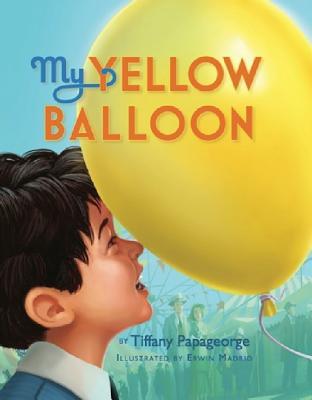
My Yellow Balloon
Author: Tiffany Papageorge
Illustrator: Erwin Madrid
Published October 1st, 2014 by Minoan Moon Publishing

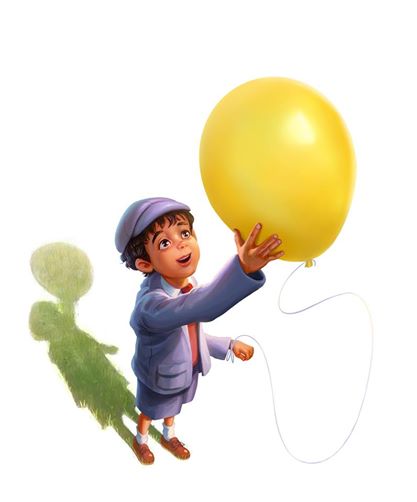
Publisher’s Summary:  It all started at the carnival…That’s where Joey makes a new friend: a bright yellow balloon. Joey and his beloved balloon do everything together, until the balloon accidentally slips off Joey’s wrist and flies far, far away. What will Joey do without his special friend?

Tiffany Papageorge has crafted a poignant tale of love, loss, and letting go that will serve as a comforting guide to children who are navigating the complicated emotions of grief. Learn more about Tiffany at her Facebook page or Linkedin.

Kellee’s Review: This book’s illustrations blew my mind. They are beautiful! Before I can talk about anything else, I definitely have to address how impressed I was by them.  Luckily, the story is just as good as the illustrations. My Yellow Balloon is about Joey and his yellow balloon and the loss of the balloon he became attached to. This is the second book I’ve read recently about loss and grief. I think it is so important that there are picture books out there for kids dealing with tough situations. I like the way that this book symbolizes the loss by showing that Joey’s world lost color and using a fold out to show perspective as the balloon is lost. It was very well done.

Ricki’s Review: I agree with Kellee that the text features of this book are remarkable. When the color of the illustrations shift, my stomach felt like they were tied in knots, and I felt Joey’s sorrow. The language used to depict the ways Joey comes to terms with his grief are realistic and will be very helpful for children. This book should be a staple in classrooms. Even if students are not experiencing grief at the time of the story, it will help them cope with, unfortunately, the inevitability of this topic.

Teachers’ Tools for Navigation: This book could be used to talk about the concept of theme. The theme is quite evident and would inspire great discussions. Loss and grief are something that all children can connect to, and My Yellow Balloon would be a great jumping off point for this discussion.

Discussion Questions: Have you lost anything special to you? How did you feel?; Why did the author take away the colors after Joey lost his balloon?; How is the sun symbolic for Joey? Can the balloon be considered a symbol?

We Flagged: 

yellowballoon1

“The balloon man wrapped the string around Joey’s wrist and said, ‘Here, let me tie you two together.’ From that moment on, they were never apart.”

Read This If You Loved: Knock, Knock by Daniel Beaty, I’ll Always Love You by Hans Wilhem, Each Kindness by Jacqueline Woodson

Recommended For: 

classroomlibrarybuttonsmall readaloudbuttonsmall

Signature andRickiSig

**Thank you to Christine at New Shelves Distribution for providing copies for review!**

Just Call My Name by Holly Goldberg Sloan

Share

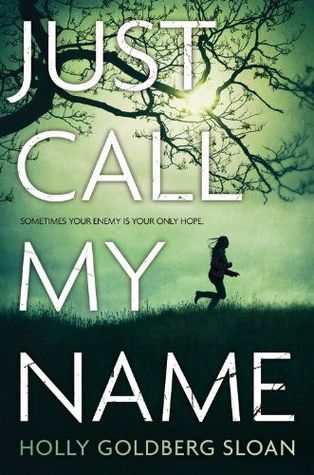
Just Call My Name

Just Call My Name
Author: Holly Goldberg Sloan
Published: August 5, 2014 by Little, Brown Books for Young Readers

Summary: The happily-ever-after of Holly Goldberg Sloan’s acclaimed debut, I’ll Be There, is turned on its head in this riveting, emotional sequel about friends, enemies, and how those roles can shift in a matter of moments.

Emily Bell has it all. She’s in love with a boy named Sam Border, and his little brother has become part of her family. This summer is destined to be the best time of their lives–until a charismatic new girl in town sets her sights on Sam. Now Emily finds herself questioning the loyalty of the person she thought she could trust most.

But the biggest threat to her happiness is someone she never saw coming. Sam’s criminally insane father, whom everyone thought they’d finally left behind, is planning a jailbreak. And he knows exactly where to find Emily and his sons when he escapes…and takes his revenge.

Review: Holly Goldberg Sloan is an incredible writer. I enjoyed the first book in the series, but I liked this one even more. I appreciate the great depth of her characters. Often, coincidences are categorized as poor writing, but Sloan uses them intentionally and in a clever way—defying literary assumptions about quality writing. The book is quite suspenseful, and readers will have the urge to race through it to learn how the plot unravels. The way Sloan builds the plot details is very thoughtful and meticulous, and I found myself constantly reflecting about how intelligent she is. This sequel is well worth the read. It is a difficult one to put down! It reads like a very literary mystery and would be a great text for teachers to have in their classrooms. One aspect that I love about this series is it turns our concept of family on its head; it will teach readers about the power of a strong family unit—traditional or not.

Teacher’s Tools for Navigation: This would be a fantastic resource for teachers teaching plot, suspense, and foreshadowing. The way Sloan builds the events and details is admirable, and students would learn a lot from her design. While it is a sequel, I think this book could certainly stand alone. The ominous mood made my heart race! Check out more curricular connections here: Curricular Connections.

Discussion Questions: How does Sloan thoughtfully use coincidence to build her story?; What is Destiny’s role in the novel? How does Sam perceive her? Is he right? What does this tell us about Sam? Why does the author name her, “Destiny”?; How do the shifts in point-of-view add to your reading of the text?

We Flagged: “That happens to really happy people. They don’t notice the little things” (p.81).

Read This If You Loved: I’ll Be There by Holly Goldberg Sloan, We Were Liars by e. lockhart, YA Suspense/Mystery

Recommended For:

  litcirclesbuttonsmall classroomlibrarybuttonsmall

RickiSig

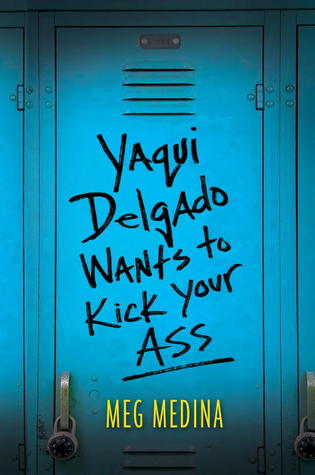
Yaqui Delgado Wants to Kick Your Ass by Meg Medina

Share

Yaqui Delgado

Yaqui Delgado Wants to Kick Your Ass
Author: Meg Medina
Published: March 26, 2013 by Candlewick Press

Summary: In Meg Medina’s compelling new novel, a Latina teen is targeted by a bully at her new school — and must discover resources she never knew she had.

One morning before school, some girl tells Piddy Sanchez that Yaqui Delgado hates her and wants to kick her ass. Piddy doesn’t even know who Yaqui is, never mind what she’s done to piss her off. Word is that Yaqui thinks Piddy is stuck-up, shakes her stuff when she walks, and isn’t Latin enough with her white skin, good grades, and no accent. And Yaqui isn’t kidding around, so Piddy better watch her back. At first Piddy is more concerned with trying to find out more about the father she’s never met and how to balance honors courses with her weekend job at the neighborhood hair salon. But as the harassment escalates, avoiding Yaqui and her gang starts to take over Piddy’s life. Is there any way for Piddy to survive without closing herself off or running away? In an all-too-realistic novel, Meg Medina portrays a sympathetic heroine who is forced to decide who she really is.

Ricki’s Review: There are many books about bullying, but it is rare to read a text that makes you truly feel frighted for the character being bullied. This text felt very real to me, and it will surely resonate with teenagers. There are many lessons about bullying, but there are also some phenomenal examples of family and friendship. Piddy’s mother isn’t perfect and like all parents, she makes mistakes, but she is a single mother who tries her best. The ups and downs of this mother-daughter relationship offer much to ponder and discuss. As adolescents go through high school, they form new bonds and often, they also grow apart from childhood friends. Piddy’s circumstances of a new school with new friendships will absolutely connect with teens.

Kellee’s Review: Like Ricki stated above, this book makes you feel. As Yaqui fills Piddy’s world with fear, Piddy begins to lose herself and get caught up in the terror. As a reader, you find yourself afraid with Piddy whenever she leaves her house, goes to school, or even thinks about doing either. A book that can do this is brilliant. Meg Medina has a way of sucking you into the world, and I think it is her use of imagery throughout. You can see the characters, hear the music Piddy listens to, feel the fear, etc. And Piddy’s voice is so crystal clear, that is something she never loses. When you finish reading, you can still hear Piddy’s voice in your head.  I also feel that this is a wonderful diverse book in a time when the YA community is calling for diverse books. This one should be in high school classrooms, and should be discussed as it has such important themes and beautiful writing (no matter what anyone thinks about it!).

Teacher’s Tools for Navigation: This would be a great read aloud at the beginning of the school year. Bullying is a problem that is all too real in our school systems, and it must be addressed immediately, in my opinion. This book would provide rich discussions for classrooms, and it is a must-read for teens. It would be great to do several book groups (or lit circles) that are centered on bullying texts in order to compare the characters’ experiences.

Discussion Questions: Does Piddy make the right decisions? Would you make different choices than her? Why or why not?; Why does the author incorporate Spanish into the text? What does it add, stylistically?; How does Piddy’s absent father affect her?; Which individuals have a positive impact on Piddy? How do these relationships build her character?; Is Joey a good influence on Piddy? What does she learn from him?; Do you agree with the choice that Piddy makes in the end? Would you have made the same choice? Does it show weakness or strength?

We Flagged: “’Son unas cualquieras,’ [my mother] mutters. Nobodies. No culture, no family life, illiterates, she means. The kind of people who make her cross to the other side of the street if she meets them in the dark on payday. They’re her worst nightmare of what a Latin girl can become in the United States. Their big hoop earrings and plucked eyebrows, their dark lips painted like those stars in the old black-and-white movies, their tight T-shirts that show too much curve and invite boys’ touches” (p. 55). 

Read This If You Loved:  Speak by Laurie Halse Anderson, Mexican WhiteBoy by Matt de la Peña, The Secret Life of Sonia Rodriguez by Alan Sitomer, Burn by Suzanne Phillips, Thirteen Reasons Why by Jay Asher, Forgive Me, Leonard Peacock by Matthew Quick, Out of Nowhere by Maria Padian, Shine by Lauren Myracle, The Mockingbirds by Daisy Whitney

Recommended For:

  litcirclesbuttonsmall classroomlibrarybuttonsmall

SignatureandRickiSig

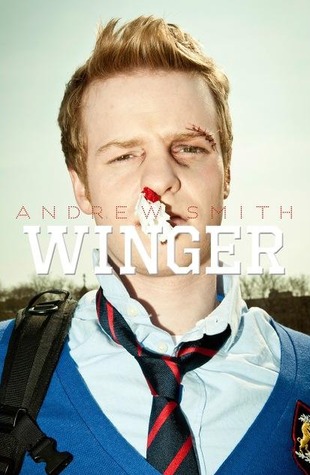
Winger by Andrew Smith (Kellee’s Review)

Share

winger

Winger
Author: Andrew Smith
Published May 14th, 2013 by Simon & Schuster

Goodreads Summary: Ryan Dean West is a fourteen-year-old junior at a boarding school for rich kids. He’s living in Opportunity Hall, the dorm for troublemakers, and rooming with the biggest bully on the rugby team. And he’s madly in love with his best friend Annie, who thinks of him as a little boy.

With the help of his sense of humor, rugby buddies, and his penchant for doodling comics, Ryan Dean manages to survive life’s complications and even find some happiness along the way. But when the unthinkable happens, he has to figure out how to hold on to what’s important, even when it feels like everything has fallen apart.

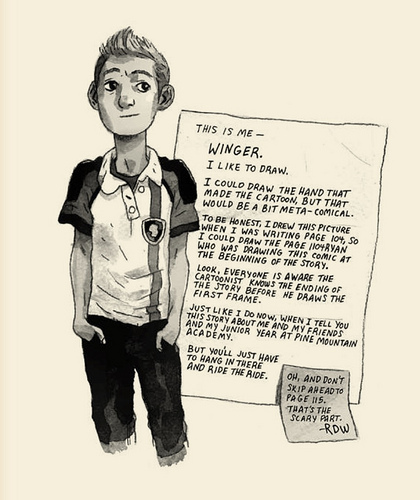
Filled with hand-drawn info-graphics and illustrations and told in a pitch-perfect voice, this realistic depiction of a teen’s experience strikes an exceptional balance of hilarious and heartbreaking.

My Review: Andrew Smith sure knows how to write a teenage boy’s voice. He gets inside of adolescent male’s mind, and puts it all on paper for us. (It probably has something to do with teaching high school.) Ryan Dean’s voice and his story are so authentic. This book will make you cringe, laugh out loud, shake your head, and cry.  I am also so impressed with all of the themes that are dealt with in this book without ever feeling over done. These themes include bullying, absent parents, peer pressure, identity, sexuality, prejudice, and friendship.  In addition, Smith builds his characters, setting, and plot seamlessly. You fall in love with all of the characters, main and secondary. Even the antagonist. The setting itself is a character. And finally the plot arc was perfectly done, and was so unpredictable all the way to the end.

Teachers’ Tools for Navigation: First and foremost, this book needs to read by teens. However that happens, it is the right thing. The easiest way would be to get it into libraries and classrooms. There are also parts of the book that could definitely be pulled out to be used in the classroom in may different ways. On that junps to mind right away is using Ryan Dean’s comics as mentor texts for writing comics to write narratives of everyday events. Ricki also has some great ideas for Winger in the classroom in her review.

Discussion Questions: What kind of social challenges does Ryan Dean have to overcome since he is 14 but a junior?; Were you able to predict the end of the book?; What are some traits about Ryan Dean that made him easy to connect to?; How does Opportunity Hall and the rest of the school become a character in Winger?

We Flagged: 

winger2(p. 21)

Read This If You Loved: Looking for Alaska by John Green, Openly Straight by Bill Konigsberg

Recommended For: 

classroomlibrarybuttonsmall closereadinganalysisbuttonsmall

Signature

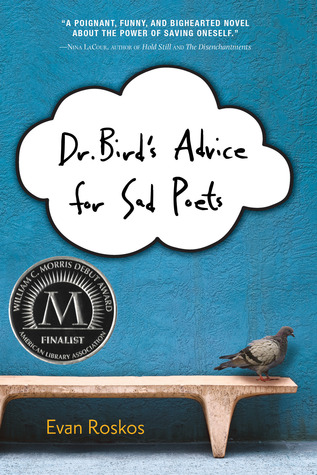
Dr. Bird’s Advice for Sad Poets by Evan Roskos

Share

dr bird's advice for sad poets

Dr. Bird’s Advice for Sad Poets
Author: Evan Roskos
Published: March 5, 2013 by Houghton Mifflin Harcourt

Summary: “I hate myself but I love Walt Whitman, the kook. Always positive. I need to be more positive, so I wake myself up every morning with a song of myself.” 

Sixteen-year-old James Whitman has been yawping (à la Whitman) at his abusive father ever since he kicked his beloved older sister, Jorie, out of the house. James’s painful struggle with anxiety and depression—along with his ongoing quest to understand what led to his self-destructive sister’s exile—make for a heart-rending read, but his wild, exuberant Whitmanization of the world and keen sense of humor keep this emotionally charged debut novel buoyant.

Ricki’s Review: Dr. Bird’s Advice for Sad Poets is such an important book. It captures depression and anxiety in a way that is both authentic and heart-wrenching at the same time. I wanted to reach into the pages of the book to give James a big hug. Similarly to It’s Kind of a Funny Story by Ned Vizzini, this book employs humor without detracting from the very realness of James’ struggles with loneliness and isolation. Teens (and adults) will find themselves in James because he is depicted in a sympathetic way that is very human. This novel is brilliant and should be in every classroom library.

Kellee’s Review: I concur with everything that Ricki said. Dr. Bird’s is a very special book. On a Top Ten Tuesday list, I wrote that I wished there were more books about kids with chemical imbalances, and Dr. Bird’s is the closest I’ve read yetEvan Roskos captures the feeling of a manic depressive state. The energy of the writing actually changes as James’s state of mind changes: anxious, manic, depressed. However, what makes it truly special is that even in the end, there is optimism. Although James is fighting his own chemical imbalance, he keeps doing just that—fighting.

Another thing I adored about this book is the idea of art and writing as therapy. James finds solace in photography and poetry, which is a positive lesson for teens because it shows the power of art, writing, and poetry.

Teacher’s Tools for Navigation: It would be interesting for teachers to do literature circles with texts that concern mental health. Students might read this book along with titles like: Forgive Me, Leonard Peacock by Matthew Quick, It’s Kind of a Funny Story by Ned Vizzini, The Perks of Being a Wallflower by Stephen Chbosky, Twisted by Laurie Halse Anderson, Everybody Sees the Ants by A.S. King, and 13 Reasons Why by Jay Asher. I imagine that reading these titles would foster incredibly rich discussions about depression, anxiety, and suicide. In my opinion, we must have these conversations with our students.

Also, Walt Whitman is a huge part of James’s life, and Whitman is mentioned throughout the book. The Whitman references (and James’s poetry emulating Whitman) would great to be examined in a classroom.

Discussion Questions: If James didn’t have abusive parents, do you think his life would be the same? Do you think depression is genetic in his family?; How does James show bravery?; What role does Walt Whitman play in James’ life?

We Flagged: “People in the world suffer from greater calamities than I do. I eat, I have clothes, I have a house. I read about people around the world who survive on less than a dollar a day. I read about how there are hundreds of millions of widows living in poverty. I see ads for kids who are born with ragged lips and jagged teeth. I don’t have anything like that. I just wake up with a deep hatred of myself. How selfish is that?” (p. 115)

“Later, as my father drives me to the pizzeria, his gassy, grumpy body reeking of judgment and anger and disappointment, I can’t help but wonder how little he knows about the depth of my sadness. The depth of my very being. Will he be upset to find me dead, or relieved?” (p. 214)

Read This If You Loved: (Many of these are listed above.) Forgive Me, Leonard Peacock by Matthew Quick, It’s Kind of a Funny Story by Ned Vizzini, The Perks of Being a Wallflower by Stephen Chbosky, Twisted by Laurie Halse Anderson, Everybody Sees the Ants by A.S. King, Reality Boy by A.S. King, Dear Life, You Suck by Scott Blagden, 13 Reasons Why by Jay Asher, Leaves of Grass by Walt Whitman

Recommended For:

 closereadinganalysisbuttonsmall litcirclesbuttonsmall classroomlibrarybuttonsmall

RickiSig andSignature

We Were Liars by e. lockhart

Share

we were liars

We Were Liars
Author: e. lockhart
Expected Publication: May 13th, 2014 by Delacorte

Summary: A beautiful and distinguished family.
A private island.
A brilliant, damaged girl; a passionate, political boy.
A group of four friends—the Liars—whose friendship turns destructive.
A revolution. An accident. A secret.
Lies upon lies.
True love.
The truth.

We Were Liars is a modern, sophisticated suspense novel from National Book Award finalist and Printz Award honoree e. lockhart.

Read it.
And if anyone asks you how it ends, just LIE.

Review: I can’t tell you anything about this book without giving anything way, and I would never do that to you, so let me just say this—this is a book that I will remember forever. It is haunting and sent chills up my spine. I was sucked into the story of this beautifully screwed up family with too much money for its own good.

Teacher’s Tools for Navigation: This would bridge beautifully with The Great Gatsby. There are so many parallels, and I can’t write them here, or I will give away too much of the plot. The figurative language in this title is also stunning. English teachers will go gaga over the pages upon pages of text that can be used for close reading. It made me want to go back to teaching English!

Discussion Questions: What does this story teach us about humanity?; What drives each of the family members?; What does Gat’s character add to the story?; How does lockhart unravel the plot? What makes her an effective writer?; What is the message of this complex text?

We Flagged: “If you want to live where people are not afraid of mice, you must give up living in palaces” (Chapter 40).

Please note: The above quote is from the Advanced Reader Copy. The chapter numbers is included instead of page numbers because the e-reader did not provide page numbers. The quotes may change when the book is published.

Read This If You Loved: The Great Gatsby by F. Scott Fitzgerald, I Will Save You by Matt de la Peña, If I Stay by Gayle Forman

Recommended For:

closereadinganalysisbuttonsmall litcirclesbuttonsmall classroomlibrarybuttonsmall

RickiSig