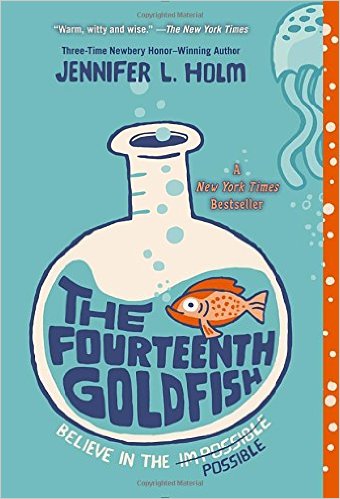
The Fourteenth Goldfish by Jennifer L. Holm

Share

The Fourteenth Goldfish
Author: Jennifer L. Holm
Published: April 5, 2016 by Yearling

A Guest Review by Kelsey Iwanicki

Summary: The Fourteenth Goldfish follows the story of Ellie, an 11-year-old girl, who is currently struggling to find her passion, especially following the gradual drop off with her one and only friend, Brianna. However, everything changes when her mother brings home a quirky and crabby 13-year-old boy, Melvin. Ellie notices striking similarities between Melvin and her seventy-something year-old grandfather until he comes clean and tells her that they are in fact the same person. Melvin has worked on developing a drug to reverse the signs of aging, which has successfully worked on himself.

As Ellie and Melvin get closer, they also form an unlikely friendship with a goth student, Raj. Together they give Melvin advice about being a teenager, such as giving him acne medicine and hair elastics. They also help Melvin eventually, after a few failed attempts, steal the same compound that reversed his age. Melvin’s original plan was to steal the gene so he could share it with the world and receive the Nobel Peace Prize. However, Ellie persuaded him not to on the grounds of moral ethics and how scientific impacts can be both positive and negative. Due to this, Melvin flushes the compound down the drain and starts to tour the country. Thanks to her time with her grandfather, Ellie is able to discover his passion in science and also gain a few friends along the way, Raj and Momo.

Review: What I liked most about this book was its quirkiness, mostly exemplified through Melvin. Although the relationship between Ellie and Melvin is untraditional, you can also get glimpses of a typical relationship between a grandfather and granddaughter is like, one that isn’t usually written about. The majority of characters are nontraditional, such as Raj, who is explicitly written as goth; Ellie, a girl scientist (although this is becoming more popular, usually boys are the ones in the STEM fields); and Melvin, as a grumpy 13-year-old.

What I didn’t like about the book was the build-up. Although they failed multiple times at stealing the compound, there was no suspense for when Melvin actually succeeded. Rather, he just came home one day with it. The climax actually was when Ellie had a self-realization that science has both positives and negatives, which honestly was kind of a let down because the plot had focused around getting the compound from the lab. Ultimately, it was a good theme because Ellie realizes there are good and bad things with any passion.

All in all, I did like the book, I think it could appeal to students who are interested in science and realistic fiction books.

Teachers’ Tools for Navigation: This book should definitely be included in a classroom library for independent reading because I think it would appeal for students because it is a little quirky and has some interesting characters. It could also prompt some interesting discussions for literature circles because students could discuss the ethics behind using a compound to reverse aging.

A teacher could also use it as a read aloud for a few reasons. It would be interesting to consider the other perspectives of characters such as Melvin or Melissa, Ellie’s mother. Additionally, they could talk about the character traits and what makes Melvin and Ellie such strong characters. Or, they could talk about science and ethics behind what scientists release.

Discussion Questions: If you had a compound that could reverse aging, would you take it? Why or why not?; If you discovered a compound that could reverse aging, would you deliver it to the public? Why or why not?; What do you think will happen to Ellie and Brianna’s friendship? Ellie and Momo’s?; What do you think the side affects are from taking the compound? / What do you think happened to Melvin?; Put yourself in Ellie’s shoes, how would you feel if your grandfather attended the same school as you?; What is the importance of the fourteenth goldfish?

Flagged Passage: “Average people just give up at the obstacles we face every day. Scientists fail again and again and again. Sometimes for our whole lives. But we don’t give up, because we want to solve the puzzle” (p. 47).

Read This If You Loved: El Deafo by Cece Bell; Fish in a Tree by Lynda Mullaly Hunt; Out of My Mind by Sharon Draper; Rain Reign by Ann M. Martin; Unusual Chickens for the Exceptional Poultry Farmer by Kelly Jones

Recommended For:
 classroomlibrarybuttonsmall

Thank you, Kelsey!

RickiSig

Review and Giveaway: Cowboy Car by Jeanie Franz Ransom

Share

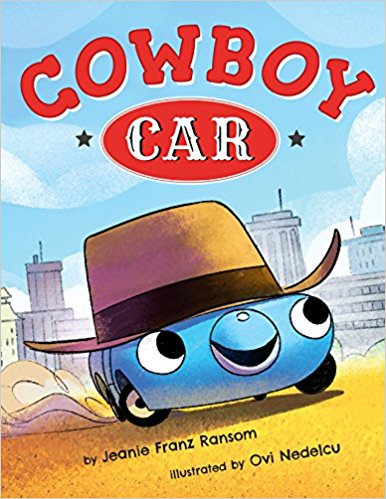
Cowboy Car
Author: Jeanie Franz Ransom
Illustrator: Ovi Nedelcu
Anticipated Published: April 11, 2017 by Two Lions

Goodreads Summary: A little car with a big dream…

Ever since Little Car was knee-high to his daddy’s hubcaps, he’s wanted to be a cowboy. Cowboys get to drive the range, wear big hats, and sleep under the stars. Everyone tells Little Car that cars can’t be cowboys, but he can’t stop dreaming of rounding up lil’ dogies by day and talking around the campfire at night. So Little Car packs his trunk and heads Out West. Vroom! Can he prove he has what it takes to be a true cowboy? Join Little Car as he zooms into the hearts of kids everywhere.

Ricki’s Review: A car that dreams of being a cowboy! This was a fun story to read with my boys. The illustrations are quite charming, and Little Car made me smile. He refuses to give up, despite the obstacles he faces. My three-year-old asked a lot of great questions while we were reading the book, and we were able to talk about the car’s perseverance. I particularly liked all of the puns in the book. While the puns were completely over my sons’ heads, it made the reading even more enjoyable for me. This book has a theme that we constantly try to relay to our students—not to give up despite what the world throws at you. It would be a great addition to any classroom.

Kellee’s Review: What a cute story about following your dreams even when everyone doubts you! This is a message that is so important to share with kids because throughout their life there are going to be those who doubt them; however, I want Trent to know that as long as he works hard, wants something enough, has a good plan, is realistic about speed bumps ahead, and goes for it, he can live his dream. This is a theme that is found in picture books, chapter books, middle grade novels, and young adult novels because kids need to be reminded of this. Life shouldn’t be about what others expect of you but what YOU expect for you. Little Car embodies this message by doing something that everyone doubted he could do and he did it his own way. I know this story will be one that teachers and parents will want to share with their kids (and their kids will love it because who doesn’t love cars and cowboys!).

Teachers’ Tools for Navigation: Teachers might ask students to connect the theme of this story to real-life individuals today or in history. They might consider other people who have faced struggles and who have persevered. It would be neat to have each student learn about a different person of their choosing. This would add variety and remind students that they should not give up in the face of adversity.

Discussion Questions: What challenges does Little Car face? How does he overcome them?; What do Little Car’s parents think? How does he respond?; What other people (current or historical) have faced struggles? How did they overcome these struggles?

Flagged Passage: “‘Cars can’t be cowboys,’ everyone told Little Car.”

Read This If You Love: Race Car Dreams by Sharon Chriscoe; Race Car Count by Rebecca Kai Dotlich; Busy Trucks on the Go by Eric Ode and Kent Culotta; Goodnight, Goodnight, Construction Site by by Sherri Duskey Rinker; The Racecar Alphabet by Brian Floca; Alphabeep: A Zipping, Zooming ABC by Debora Pearson; The Three Little Rigs by David Gordon; Ten Little School Cars by School Specialty Publishing

Recommended For: 

classroomlibrarybuttonsmall readaloudbuttonsmall

Giveaway!

a Rafflecopter giveaway

RickiSigandSignature

**Thank you to Al at Amazon for providing copies for review!**

Rosie Revere, Engineer by Andrea Beaty

Share

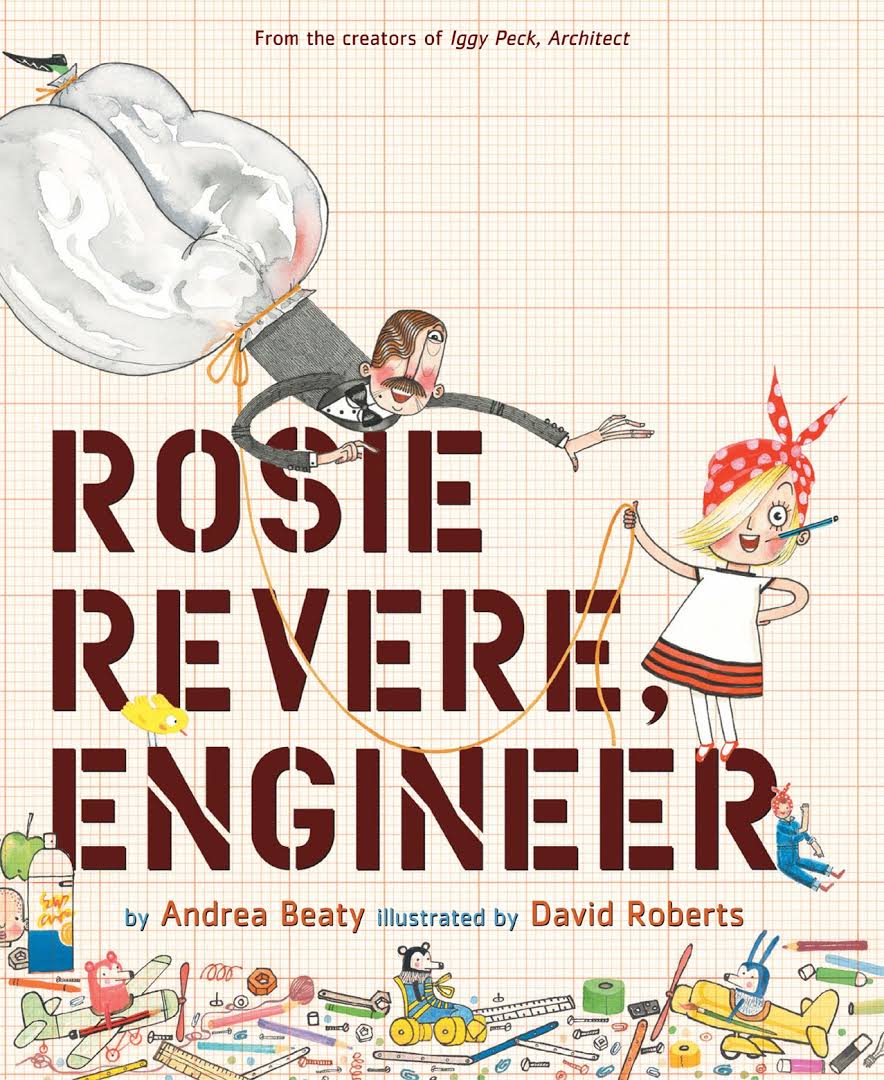
Rosie Revere, Engineer
Author: Andrea Beaty; Illustrated by: David Roberts
Published: September 3, 2013 by Abrams

A Guest Review by Jennifer Zafetti

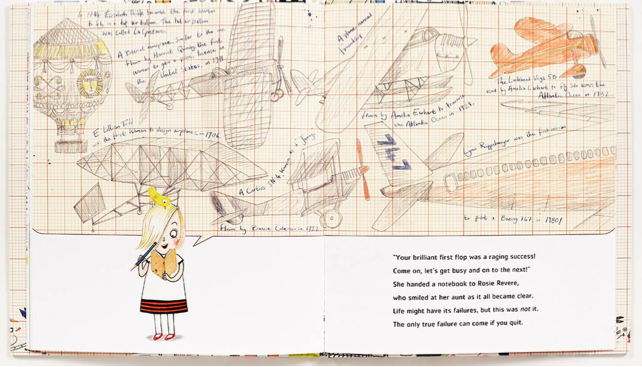
Summary: Rosie is an ambitious young girl who aspires to be an engineer. She creates an invention for her uncle, but becomes embarrassed when he laughs at her. She does not feel supported , until she meets her Great-Great-Aunt Rose who is both an adventurer and an explorer. Her great-great-aunt yearns to fly so Rosie builds her a contraption made out of cheese. When her great-great-aunt laughs at her failure, Rosie becomes disheartened and swears to never invent again. Rose provides her with comfort and explains that, “Your brilliant first flop was a raging success.” This provides Rosie with the encouragement she needs to try again!

Review: I really enjoyed reading this book! I think that it is so important for kids to embrace failures! If Rosie had admitted defeat after her first failure, she would have never been able to be successful. Rosie’s perserverance allowed her to create a flying contraption for her aunt. Furthermore, the rhyming sentences created an engaging tone that kept me wondering what would happen next. This is a great story to read-aloud to a classroom! Additionally, the illustrations on each page really add to the story and provide detailed visuals to accompany Rosie’s different inventions. Overall, I think that this book can be inspirational for all ages—the simple message: never give up!

Teachers’ Tools for Navigation: Rosie Revere, Engineer is an uplifting story in which failure turns into success. Teachers should use this children’s book to teach students about the importance of perseverance. When faced with challenges, students should use them as an opportunity to grow. If you believe in yourself, you can achieve anything!

Also, the teacher can pause the reading to ask for predictions.

Discussion Questions: How did Rosie’s mood change throughout the story?; When is a time that you persevered when facing a challenge?; When is a time that you have learned from a failure? How do Rosie’s family members impact her actions?

Flagged Passage: 

Read This If You Loved: Ada Twist, Scientist by Andrea Beaty, and The Most Magnificent Thing by Ashley Spires

Recommended For:
 classroomlibrarybuttonsmall

Thank you, Jennifer!

RickiSig

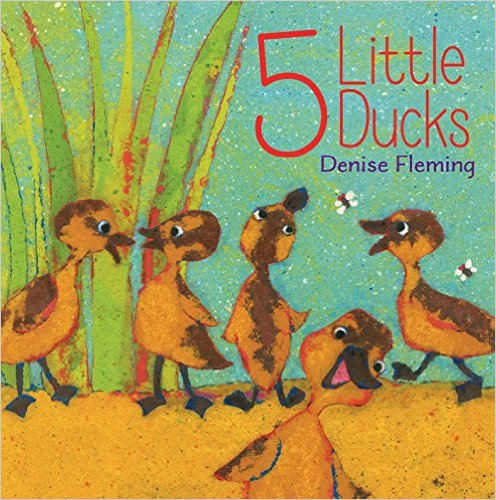
5 Little Ducks by Denise Fleming

Share

5 Little Ducks
Author: Denise Fleming
Published November 8, 2016 by Beach Lane Books

A Guest Review by Kathryn O’Connor

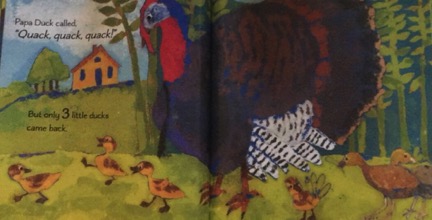
Summary: Papa Duck and his ducklings go on adventures through the woods and over the hills everyday. Each time Papa Duck yells out “Quack quack quack” to gather his ducklings, but not all of them come back. In fact, with each adventure, one fewer duck returns. Finally on Saturday, Papa Duck went out alone and yelled “Quack, quack, quack”. It was then that all of his ducks came back! When the family woke up together on Sunday, Mama Duck decided it would be best for the family to stay in and rest.

Review: Denise Fleming takes a modern spin on a classic nursery rhyme. It is fun to find out what new adventure the ducklings are taking on throughout the week. Because the ducks meet new people and explore new places each day, the reader is kept engaged. The repetition of the story makes it easy for young readers to follow along with and make predictions. In combination with this, the large text format and bolded numbers allow for easy comprehension.

The lively illustrations bring life to the text, and I love how perspective is used in all of them. Some of the pictures you’ll find to be zoomed out, while some are zoomed in. My favorite part of this picture book is at the end where Fleming has two non-fiction pages based on the animals of the story. This encourages the readers thinking and allows them to explore further.

Although this book is a helpful, entertaining tool for teaching days of the week and numbers 1-5, my only concern is that readers might become worried or anxious thinking about the well-being of the ducks. At some points while reading, I was concentrated on where the ducks were, if they were still alive, and when they were going to return to their family, rather than enjoying the text.

Teachers’ Tools for Navigation: This story can be used at first as a whole class read aloud, and perhaps even in a singing voice. Students will quickly pick up on the pattern of the story due to the repetition. By keeping the book in a classroom library, readers will then be willing to pick up the text and read independently or to a friend for they have already familiarized themselves with it. For beginning readers, this will spark motivation and love of reading. This story is also a helpful aid in teaching and counting numbers 1-5, days of the week, and sequencing text.

Discussion Questions: How many ducks do you think will come back?; What day comes next?; Why does Papa Duck yell “quack, quack, quack” everyday?; Where do you think the ducks are going?; Why do you think the ducks want to explore?; Why is Papa Duck feeling sad?; How do you think Papa Duck felt when his ducks returned?; Why does Mama Duck want all of the ducks to rest on Sunday?

Flagged Page:


Read This If You Loved: 10 Little Rubber Ducks by Eric Carle, Make Way for Ducklings by Robert McCloskey, or The Very Hungry Caterpillar by Eric Carle

Recommended For:
 classroomlibrarybuttonsmall

Thank you, Kathryn!

RickiSig

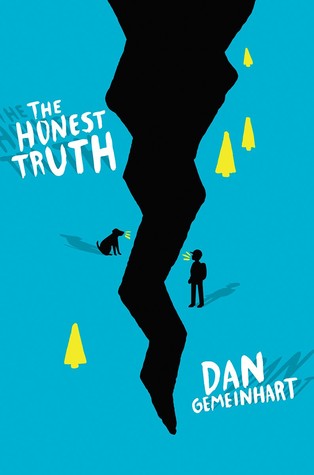
The Honest Truth by Dan Gemeinhart

Share

honest truth

The Honest Truth
Author: Dan Gemeinhart
Published: January 27, 2015 by Scholastic Press

Summary: In all the ways that matter, Mark is a normal kid. He’s got a dog named Beau and a best friend, Jessie. He likes to take photos and write haiku poems in his notebook. He dreams of climbing a mountain one day.

But in one important way, Mark is not like other kids at all. Mark is sick. The kind of sick that means hospitals. And treatments. The kind of sick some people never get better from.

So Mark runs away. He leaves home with his camera, his notebook, his dog, and a plan to reach the top of Mount Rainier–even if it’s the last thing he ever does.

The Honest Truth is a rare and extraordinary novel about big questions, small moments, and the incredible journey of the human spirit.

Ricki’s Review: In the introduction of the ARC, Dan Gemeinhart writes that this story was inspired by his friend Mark, who passed away from cancer. While the book is not about Mark, there are “smooth rocks of truth” within it. He wrote the story in hopes that Mark would enjoy reading it. With this in mind, I began the book already emotionally invested. Mark is a 12-year-old boy who has recently relapsed with cancer. He is tired of being sick, and he has set out with his dog and plans to go to Mt. Rainier to die. Much of the book is Mark’s journey to Rainier, and we slowly learn about his experiences with cancer throughout the story. Every other chapter is written by his best friend Jesse, and I found their friendship to be inspiring, particularly given the author’s introduction. This is a beautiful story that will leave a mark on readers’ hearts. I will be recommending it often.

Kellee’s Review: The Honest Truth was my first choice for my school’s faculty book club because I had only hear amazing things about it. I jumped into reading it without knowing anything about it, but by the end of the first page, I knew that all my friends who recommended it to me were right. Mark has a voice that is so full of hurt and sorrow that it jumps off the page and into your heart. The obstacles he faces and overcomes while also making his way to die alone show the strength of his character. I also was a big fan of the two points of view because it allows the reader to see what was going on at home and maybe get some more truth than what Mark was telling us (though he swears it all is the honest truth).

For our book club meeting, I tabbed up my book with passages I loved (I’ll list all the pages below), haikus that Mark wrote, and descriptions of all of the photographs he took along the way.

Teachers’ Tools for Navigation: This would make a fantastic read-aloud. It has so much to discuss! The richly realized themes would make for fantastic conversations in the classroom. I would love to hear students’ thoughts about the story, particularly in relation to the discussion questions below. There are many debatable points in the story—which makes it all the more interesting to use as a read aloud!

Additionally, The Honest Truth would be a good introduction to haiku and visual story telling since Mark writes haiku and takes photographs to help tell his story. The haiku (in chronological order) are found on pages 120, 8, 22, 78, 79, 130. The photos Mark took are explained on pages 226-227. Using these as mentor texts, students can create their own story using poetry and photography.

More discussion ideas can be found at http://www.scholastic.com/teachers/lesson-plan/honest-truth-discussion-guide.

Discussion Questions: Was Mark selfish to leave home? Do you think he should have told his parents? Do you think what he did was fair? Were his actions fair to his dog?; If you were Jesse, would you have told authorities? Was she wrong to keep a secret? Do you think Mark had the ability to make such a big decision?; How did Gemeinhart use personification to help make the setting a character (see pages 34, 124, and 196)?; How much pressure do sick children have to act like adults?; How was Mark’s journey selfish? How was is selfless?; Who called? Wesley or Jess?; Why didn’t the mom ever look at her credit card report to see the train ticket?; Were you angry at Mark? Scared? How do you think students will feel?; Is a 12-year-old old enough to decide you want to die? Is it reasonable for adults to expect a kid to keep on going through treatment after treatment?

Flagged Passage: “Dogs die. But dogs live, too. Right up until they die, they live. They live brave, beautiful lives. They protect their families. And love us. And make our lives a little brighter. And they don’t waste time being afraid of tomorrow.”

Kellee’s favorite passages can be found on page 5 (“Here’s…”), 19 (“I bit…”), 21 (“I closed…”), 46 (“I was…”), 70 (“She knew…), 82 (“I like…), 97 (“Here’s…”), 179 (“They would…”), 212 (“And then…”), 228 (“There’s more…)

Read This Book If You Loved: “To Build a Fire” by Jack London; Hatchet by Gary Paulsen; The Call of the Wild by Jack London; Wonder by R.J. Palacio, The Fault in Our Stars by John Green

Recommended For: 

classroomlibrarybuttonsmall readaloudbuttonsmall litcirclesbuttonsmall

  RickiSigand Kellee Signature

Teaching Guide for Sophie Quire and the Last Storyguard by Jonathan Auxier

Share

sophie quire

Sophie Quire and the Last Storyguard
A Peter Nimble Adventure
Author: Jonathan Auxier
Published April 5th, 2016 by Abrams Books

Summary: It’s been two years since Peter Nimble and Sir Tode rescued the kingdom of HazelPort. In that time, they have traveled far and wide in search of adventure. Now Peter and Sir Tode have been summoned by Professor Cake for a new mission: find a 12-year-old girl named Sophie Quire.

Sophie knows little beyond the four walls of her father’s bookshop, where she works as a bookmender and dreams of leaving the confines of her city walls. But when a strange boy and his talking cat/horse companion show up searching for a rare and mysterious book, she finds herself pulled into an adventure beyond anything she has ever read.

Teaching Guide: 

Sophie Quire is a special young lady, and you and your students are going to adore her adventure! Here is a teaching guide to help guide you or your students through your reading. This guide can be used as a tool for classrooms or book clubs.

You can also access the guide here.

You can learn more about Sophie at ABRAMS’ website.

Recommended For: 

classroomlibrarybuttonsmall readaloudbuttonsmall closereadinganalysisbuttonsmall litcirclesbuttonsmall

Kellee Signature

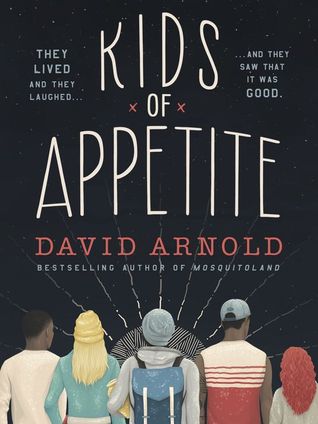
Kids of Appetite by David Arnold

Share

kids of appetite

Kids of Appetite
Author: David Arnold
Published: September 20, 2016 by Viking

GoodReads Summary: The bestselling author of Mosquitoland brings us another batch of unforgettable characters in this tragicomedy about first love and devastating loss.

Victor Benucci and Madeline Falco have a story to tell.
It begins with the death of Vic’s father.
It ends with the murder of Mad’s uncle.
The Hackensack Police Department would very much like to hear it.
But in order to tell their story, Vic and Mad must focus on all the chapters in between.

This is a story about:

1. A coded mission to scatter ashes across New Jersey.
2. The momentous nature of the Palisades in winter.
3. One dormant submarine.
4. Two songs about flowers.
5. Being cool in the traditional sense.
6. Sunsets & ice cream & orchards & graveyards.
7. Simultaneous extreme opposites.
8. A narrow escape from a war-torn country.
9. A story collector.
10. How to listen to someone who does not talk.
11. Falling in love with a painting.
12. Falling in love with a song.
13. Falling in love.

Review: I fell into this book. From the moment I started reading, I had difficulty putting it down. David Arnold has true talent at engaging readers in a thought-provoking story in which the characters have great depth. The allusions to The Outsiders will not be lost on readers. This group of kids captured my heart just like the kids within the classic. Comparing the two stories is interesting, but this book explores very different issues, and I appreciated that the author didn’t seem to intentionally align the texts too much.

The point-of-view alternates between two characters, Vic and Mad. Vic has Moebius Syndrome, which causes partial facial paralysis. He is grieving the loss of his father and struggling to come to terms with his mother’s new relationship (and the mean-spirited step-brothers that come along with this). Mad is a tortured soul—dedicated to her grandmother but struggling with the losses of her parents and a very difficult situation (no spoilers here). The other members of the crew, who don’t have their own narrative sections but whose voices are very powerful, have individual struggles that weigh on them. This group of kids finds solace in each other, and the dynamic between them is unforgettable.

Teachers’ Tools for Navigation: I’d love to include this book in a group of literature circle books that all reflect disability. I think it would be particularly interesting to explore the intersections between friendship and disability. Students might examine and conceptualize their definitions of normal. The ALAN Review‘s Fall 2016 issue is about (Re)Defining Normal, and many of the articles would be very useful for this very topic.

Discussion Questions: What struggles do each of the characters face? How does each cope with these struggles in different ways?; How does Vic’s disability impact his interactions with others? How do others (strangers and other characters) respond to him?; What power does friendship have? How do each of these characters from different backgrounds come together, and why?; What is the role of Baz’s book? Why is it important to the story?

We Flagged: “‘We are all part of the same story, each of us different chapters. We may not have the power to choose setting or plot, but we can choose what kind of character we want to be'” (p. 104).

*This excerpt was taken from an advanced reader copy. The quote may change after the book is published.*

Read This If You Loved: The Outsiders by S. E. Hinton, The Unlikely Hero of Room 13B by Teresa Toten, The Absolutely True Diary of a Part-Time Indian by Sherman Alexie, Martyn Pig by Kevin Brooks, All the Bright Places by Jennifer Niven, Not If I See You First by Eric Lindstrom

Recommended For:

litcirclesbuttonsmall closereadinganalysisbuttonsmall classroomlibrarybuttonsmall

RickiSig