Clap When You Land by Elizabeth Acevedo

Share

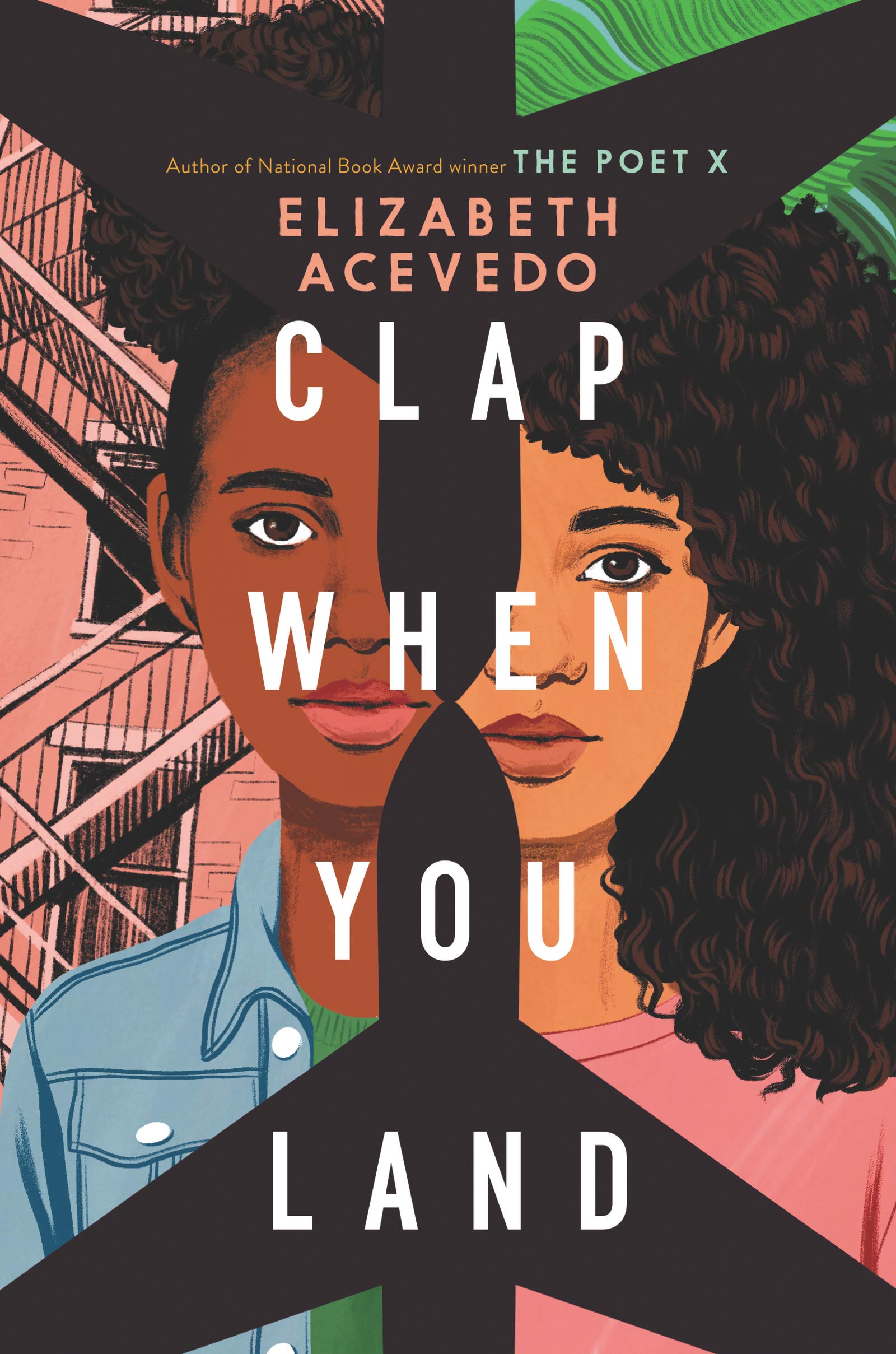
Clap When You Land
Author: Elizabeth Acevedo
Published March 5, 2020 by HarperTeen

Summary: In a novel-in-verse that brims with grief and love, National Book Award-winning and New York Times bestselling author Elizabeth Acevedo writes about the devastation of loss, the difficulty of forgiveness, and the bittersweet bonds that shape our lives.

Camino Rios lives for the summers when her father visits her in the Dominican Republic. But this time, on the day when his plane is supposed to land, Camino arrives at the airport to see crowds of crying people…

In New York City, Yahaira Rios is called to the principal’s office, where her mother is waiting to tell her that her father, her hero, has died in a plane crash.

Separated by distance—and Papi’s secrets—the two girls are forced to face a new reality in which their father is dead and their lives are forever altered.

And then, when it seems like they’ve lost everything of their father, they learn of each other.

Ricki’s Review: I was so happy to see that this book won the Amelia Elizabeth Walden Award. It is one of the most beautifully written books that I have ever read. It made me laugh, it made me weep, and it filled me with so many emotions and so many wonderings. The book is beautifully lyrical, and the voices are so strong. There’s a scene in the book that simply took my breath away. If you haven’t read this book yet, I recommend you head out and purchase it now. It’s absolutely magnificent.

Discussion Questions: 

  • How do the two perspectives of the story work together? How did it enhance your reading of the story?
  • How does place function in the story?
  • Where is home for the characters?
  • How do the characters in the story grieve? What understandings did it offer about grief and loss?
  • How do the characters in this book show strength in many different ways?

Flagged Passage: 

“Can you be from a place
you have never been?

You can find the island stamped all over me,
but what would the island find if I was there?

Can you claim a home that does not know you,
much less claim you as its own?”

Read This If You Love: Books. Seriously, it would be very difficult not to see the beauty of this book. Elizabeth Acevedo is one of the greatest writers of our time.

Recommended For: 

classroomlibrarybuttonsmall   

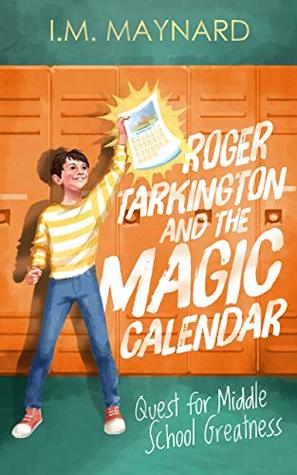
Author Guest Post: “Two Words That Can Help with Writer’s Block in Students!” by By I.M. Maynard, Author of the Roger Tarkington and the Magic Calendar

Share

“Two Words That Can Help with Writer’s Block in Students!”

Imagine, you’ve just announced an end-of-school year creative writing assignment for your students. You are expecting a positive response given your school just hosted a local author who talked about the writing process or your class just finished an inspiring novel. Besides, all students want to express themselves, right? And in creative writing, there are no wrong answers and so this should be a slam dunk assignment.

Then the arms shoot up into the air.

“What can we write about?” Anything, you respond.

“Can it be about space aliens?” Yes.

“How about super heroes?” Absolutely.

Can I write about myself?” Sure. This is your assignment. Be creative and have fun.

This is going really well. The students are as excited as you are about this assignment. But when you walk down the row of desks to check on their progress you notice that several notebooks or laptops remain blank. These students defend their lack of progress by saying that they have nothing to write about. They don’t know how to start. Even the students who started strong complained of writer’s block. “I don’t know what to write next. I’m stuck.”

If this scene plays out in your classroom, it is time to let them in on the creative writing secret that has launched stories and even writing careers. It was certainly key to my middle grade time travel series, Roger Tarkington and the Magic Calendar. The creative writing secret I refer to is what I call the what if technique. In my view, what if are the two most important words in creative writing.

The origin of my middle grade time travel series started as a what if. My toddler son was obsessed with calendars. About the same time, he was given a children’s magic kit with a cartoon magician featured on outside of the kit box. It got me thinking: what if the magic wand was used to turn the calendar magic? Thus started my journey with Roger Tarkington and his adventures at Jefferson Middle School.

While I can’t be certain, I would imagine that many stories started using what if.

          What if a boy were trapped inside a video game (Trapped in a Video Game)? What if a student with a face deformity went to school for the first time (Wonder)What if a boy was stranded alone in the woods (Hatchet)? Asking what if can help turn an ordinary situation, such as playing a video game, hiking in the woods, or going to school, into an intriguing premise for your next story.

Answering the what if question often leads to more questions. For example, how did a boy end up in the woods by himself? Perhaps the author used what if to come up with options, such as: What if he got lost by taking the wrong trail? What if he was on a school or Boy Scout outing and got separated from the group? What if the small plane he traveled in crashed in the middle of the woods?

I went through several what if scenarios before I settled on the premise of Roger Tarkington and the Magic Calendar. Originally, I was focused on the magic wand from the magic kit. I looked around my son’s playroom and asked a series of what if questions. What if the magic wand brought my son’s stuffed animals to life? I liked that idea, but it was too similar to the movie, Toy Story. What if the magic wand was used to turn my toddler son into a grown man? No, I wanted to tell a children’s focused story and so I opted against that idea. It wasn’t until I saw my son sitting near the magic kit while looking through a wall calendar that I came up with the premise of a magic calendar that allows someone to repeat days of the week by touching inside the calendar day. The idea matched my interest in writing about everyday school life, but with a fun time travel-like twist.

Inevitably, writer’s hit snags in their story. The what if technique is a great place to start in overcoming what seems like impossible roadblocks. During this brainstorming, I write down every what if answer, especially the silliest ones. If nothing stands out, I come back to the sheet of paper later and reread the answers. If nothing else, you’ll get a good laugh. However, this review often triggers new what if answers, sometimes ones that combine elements of two different answers.

The what if technique forces writers to face the creative problems they face with action. The technique also shifts the focus from negative thinking (i.e., I don’t have any ideas, I have writer’s block) to possibility simply by framing the roadblock as a question.

So does the what if technique solve every writing problem? Of course not. What if won’t motivate you to write, it won’t help with sentence structure or spelling, and it won’t address writer doubt or fatigue. However, the what if technique and similar writing strategies can help writers at any level or writing stages to address challenges and find solutions so that writers can get to the two next important words in creative writing: the end.

About the Book: Meet Roger Tarkington.

The almost 11-year-old has a plan for middle school greatness. A perfect plan that—lasts for all of about five minutes. 286 seconds, to be exact.

It’s all ruined when Kyle-the-Vile Brossman appears unexpectedly on the first day of school. Making matters worse, Kyle pledges to make Roger’s year miserable, just like he did at Bellingware Elementary School.

Roger’s unlucky start to sixth grade turns magical when his calendar turns into a time travel portal that allows him to repeat days.

Influenced by his Middle School Greatness Tip #31 (Don’t wait for it to happen, make it happen), Roger devises a new plan to use his magic calendar to beat Kyle, clearing his path to middle school greatness.

Foolproof plan for middle school success, right? Maybe in real life, but remember, this is middle school!

Will Roger succeed in using his magic calendar to standout at Jefferson Middle School and achieve middle school greatness?

Or will he fall under the constant attacks from Kyle and the unexpected, everyday obstacles of middle school?

About the Author: I.M. Maynard is the author of the Roger Tarkington and the Magic Calendar middle grade time travel series. The first book in the series, Roger Tarkington and the Magic Calendar: Quest for Middle School Greatness, was released in 2020. The second book in the series, Roger Tarkington and the Magic Calendar: Surviving Middle School, was released in 2021. I.M. Maynard is currently working on the third and final book in the series. When he isn’t writing, I.M. Maynard enjoys reading. HIs favorite contemporary authors include Louis Sachar (Holes), Stuart Gibbs (Spy School), Gordon Korman (Jackpot), and Chris Rylander (The Fourth Stall). Born and educated in the Midwest, I.M. Maynard now lives on the East Coast with his wife and son, who was the inspiration for the middle grade series. Learn more about I.M. Maynard at https://www.maynardauthor.com/.

Thank you, I.M., for this post showing how to help students get those creative juices flowing!

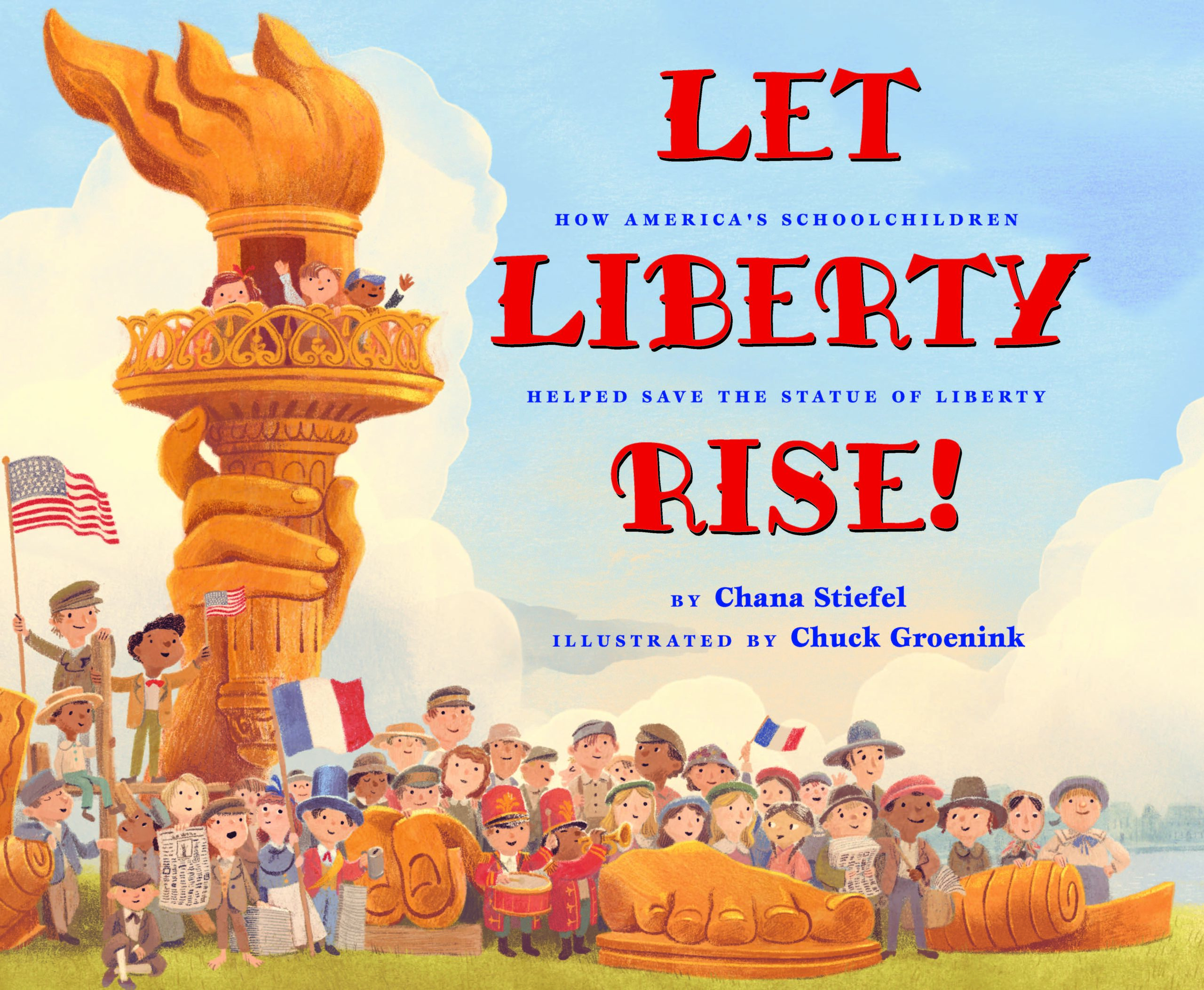
Review and Giveaway!: Let Liberty Rise!: How America’s Schoolchildren Helped Save the Statue of Liberty by Chana Stiefel, Illustrated by Chuck Groenink

Share

Let Liberty Rise!: How America’s Schoolchildren Helped Save the Statue of Liberty
Author: Chana Stiefel
Illustrator: Chuck Groenink
Anticipated Publication: March 2, 2021 by Scholastic

Goodreads Summary: How did 121,000 Americans save their most beloved icon? Here is an inspiring story about the power we have when we all work together!

“This charming history title is a true inspiration for the present. An informative must-have for all libraries.” — School Library Journal, starred review

“All rise to this evocative, empowering offering.” — Kirkus Reviews

“[A] true tale of cooperation among all ages.” — Publishers Weekly

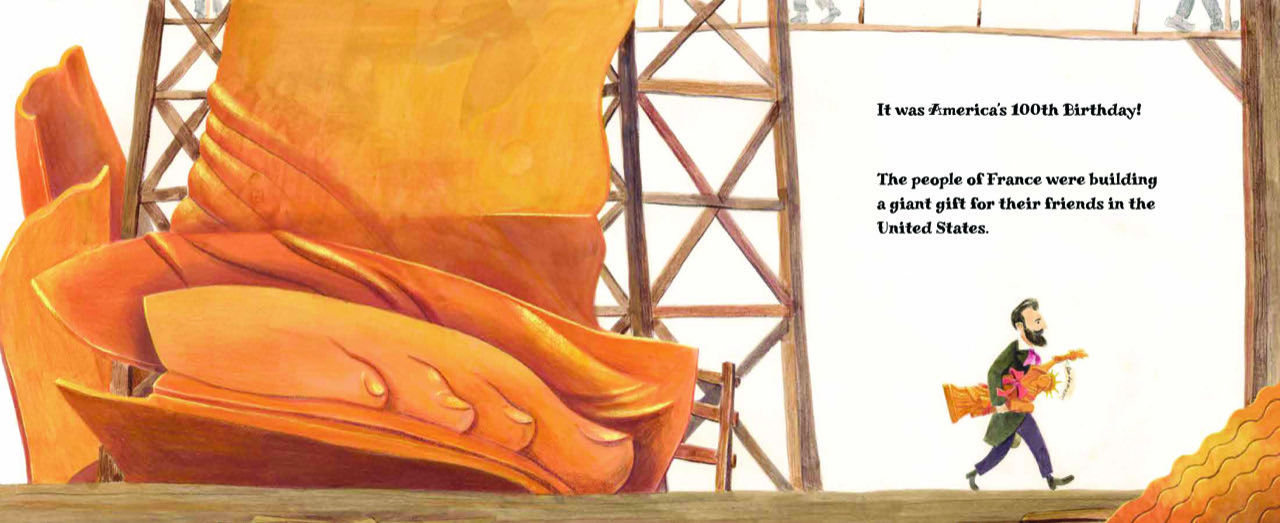
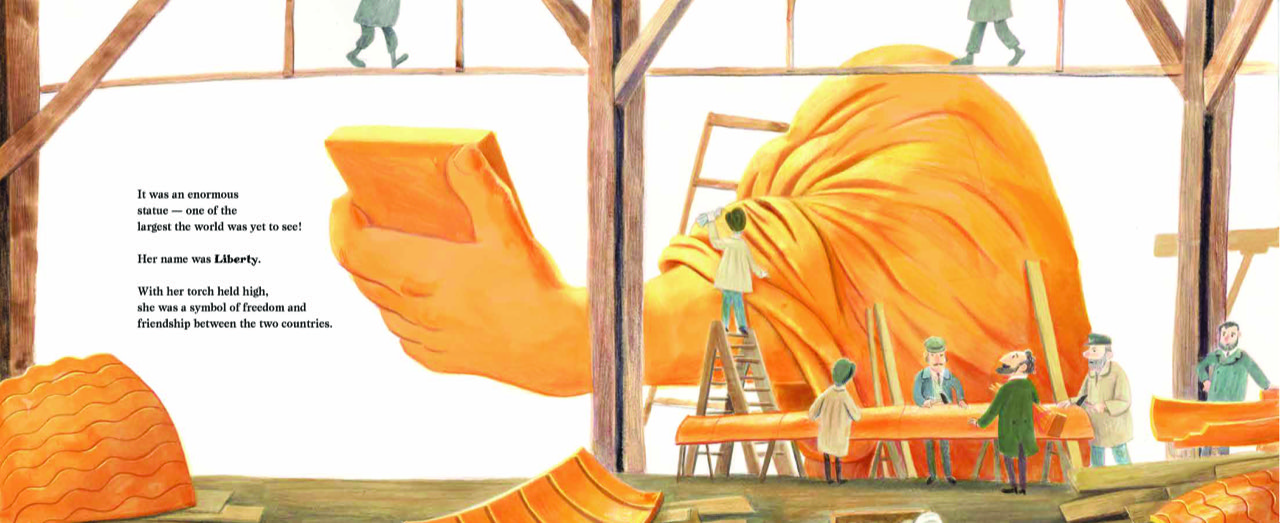
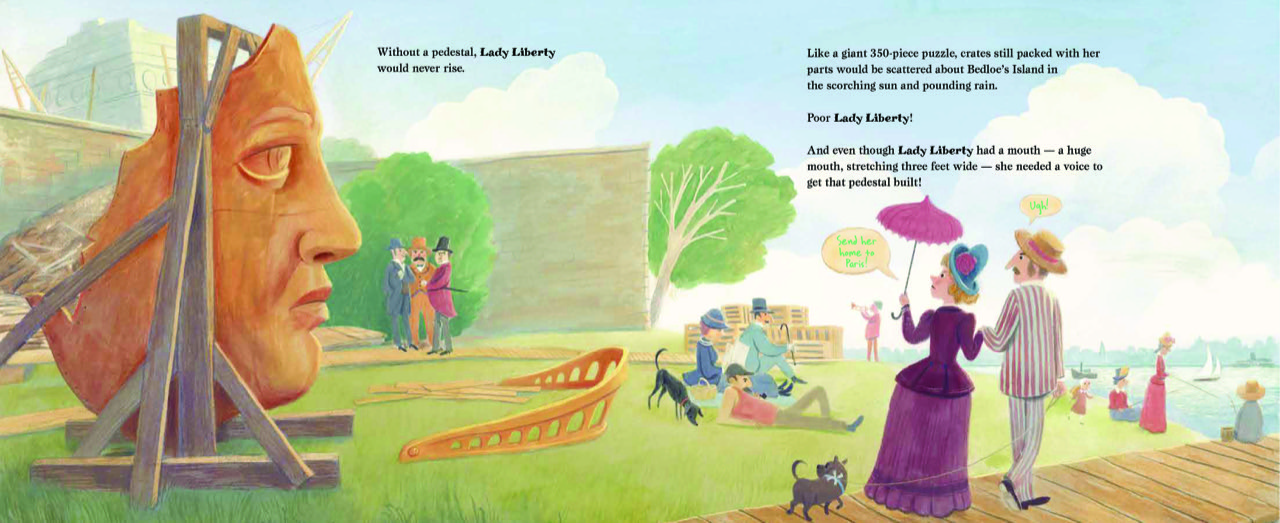
On America’s 100th birthday, the people of France built a giant gift! It was one of the largest statues the world had ever seen — and she weighed as much as 40 elephants! And when she arrived on our shores in 250 pieces, she needed a pedestal to hold her up. Few of America’s millionaires were willing to foot the bill.

Then, Joseph Pulitzer (a poor Hungarian immigrant-cum-newspaper mogul) appealed to his fellow citizens. He invited them to contribute whatever they could, no matter how small an amount, to raise funds to mount this statue. The next day, pennies, nickels, dimes, and quarters poured in. Soon, Pulitzer’s campaign raised enough money to construct the pedestal. And with the help of everyday Americans (including many thousands of schoolchildren!) the Statue of Liberty rose skyward, torch ablaze, to welcome new immigrants for a life of freedom and opportunity!

Chana Stiefel’s charming and immediate writing style is perfectly paired with Chuck Groenink’s beautiful, slyly humorous illustrations. Back matter with photographs included.

About the Creators:

Chana Stiefel is the author of more than 25 books for kids. She hails from sunny South Florida and now lives in New Jersey, just a ferry ride away from the Statue of Liberty. Chana loves visiting schools and libraries as well as sharing her passion for reading and writing with children. She earned a master’s degree in Science, Health, and Environmental Reporting from New York University. To learn more, visit Chana at chanastiefel.com. Facebook: Chana Stiefel; Twitter: @chanastiefel; Instagram: @chanastiefel

Chuck hails from an overgrown village among the peat bogs in the north of the Netherlands, where he spent his formative years climbing trees, drawing, reading, and cycling. He attended the Artez Institute of Visual Arts in Kampen, graduating from the Department of Illustration in 2004. He now resides in Valatie, New York, with his wife, dog, and two cats. Visit Chuck at chuckgroenink.com; Instagram: @c.groenink

Ricki’s Review: Wow! I did not know about this story, and it is really quite inspirational. As a person who values community and coming together for shared causes, I fell in love with this book. As one of the children in the text who donated 60 cents said, “Drops make an ocean.” After looking at the cover, my kids wanted to know why the statue of liberty wasn’t green, which started our first conversation. Then, we had many other wonderful conversations together. We even did some math to determine how much 40 elephants weigh! The illustrations feel majestic–they offer up-close looks at the different parts of the Statue of Liberty. I can’t get enough of this book. Also, be sure to check out the timeline and photographs. 

Teachers’ Tools for Navigation: Reading this story will make kids want to work toward a cause themselves. Culturally sustaining practices ask educators and schools to be accountable to their communities. I’d love to use this book to kick off a class discussion of how the students could work toward a cause in their own communities. 

Download a free curriculum guide and check out the book trailer on the book page for Let Liberty Rise!

Discussion Questions: 

  • What did you learn from the book?
  • Who is the hero of this book? Are there many heroes?
  • How can you give back in your own community?

Flagged Spreads: 

Giveaway:

Read This if You Love: Nonfiction picture books, history books, stories of heroism and community

Recommended For: 

readaloudbuttonsmall classroomlibrarybuttonsmall closereadinganalysisbuttonsmall

RickiSig

**Thank you go Barbara at Blue Slip Media for providing a copy for review!**

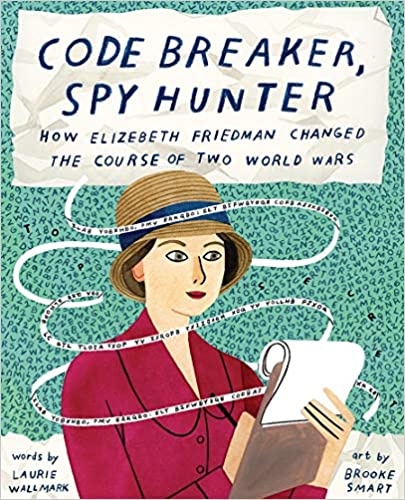
Review and Giveaway!: Code Breaker, Spy Hunter: How Elizebeth Friedman Changed the Course of Two World Wars by Laurie Wallmark, Illustrated by Brooke Smart

Share

Code Breaker, Spy Hunter: How Elizebeth Friedman Changed the Course of Two World Wars
Author: Laurie Wallmark
Illustrator: Brooke Smart
Anticipated Publication: March 2, 2021 by Harry N. Abrams

Goodreads Summary: Decode the story of Elizebeth Friedman, the cryptologist who took down gangsters and Nazi spies.

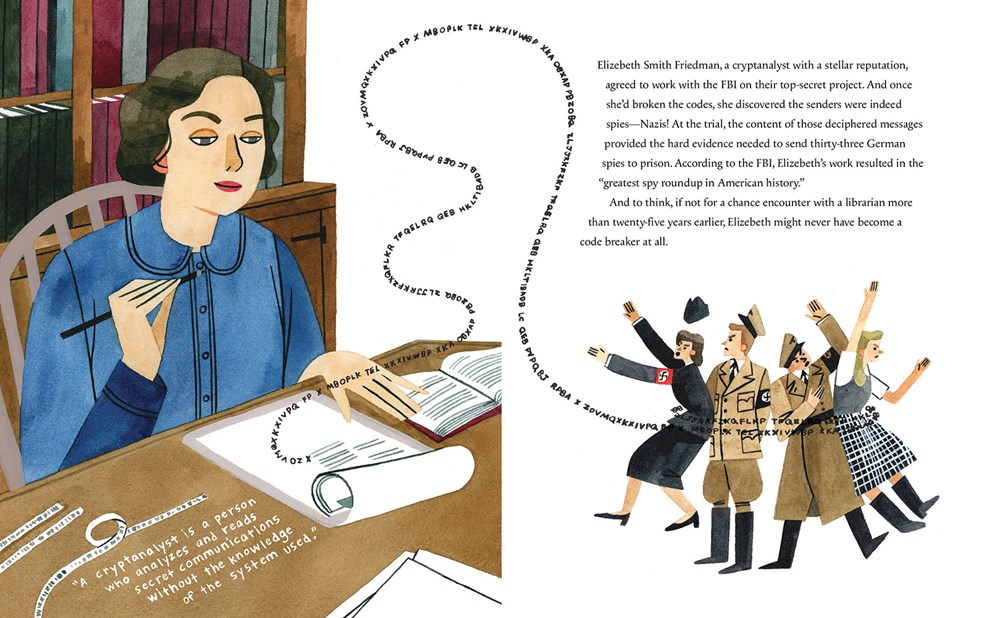
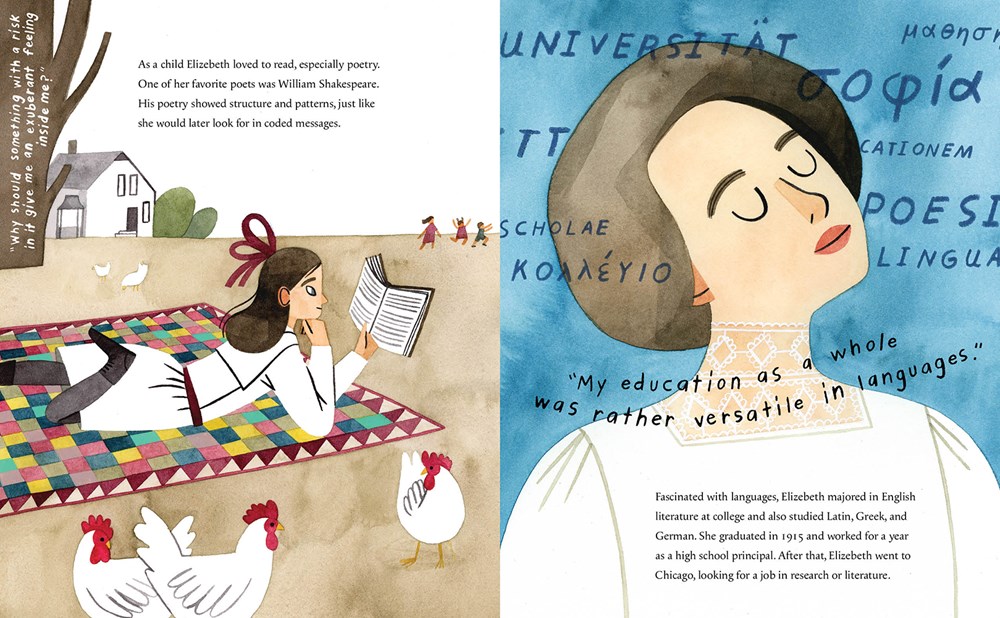
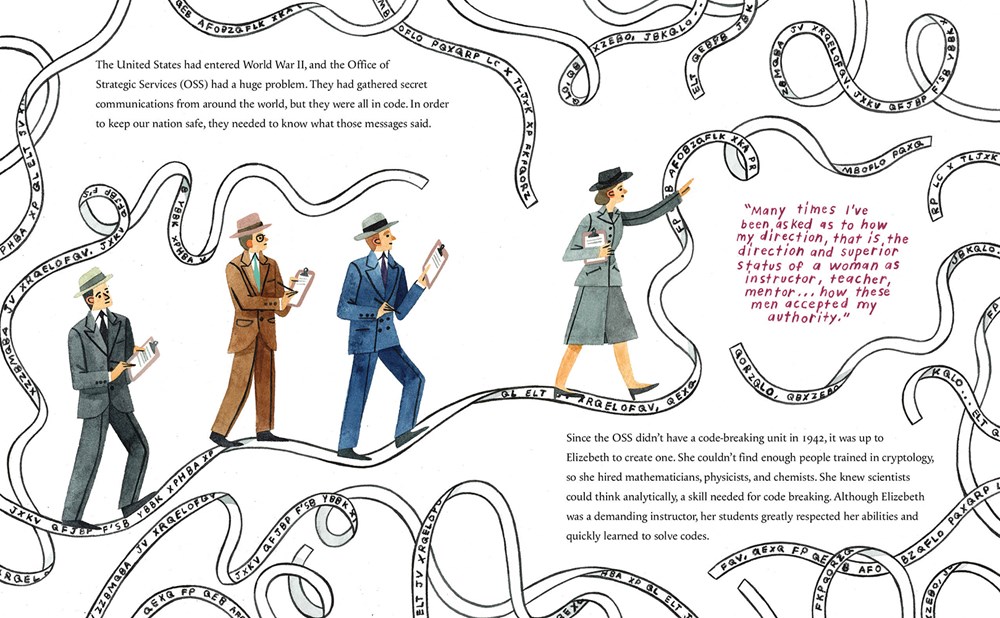
In this picture book biography, young readers will learn all about Elizebeth Friedman (1892-1980), a brilliant American code breaker who smashed Nazi spy rings, took down gangsters, and created the CIA’s first cryptology unit. Her story came to light when her secret papers were finally declassified in 2015. From thwarting notorious rumrunners with only paper and pencil to counter-spying into the minds and activities of&; Nazis, Elizebeth held a pivotal role in the early days of US cryptology. No code was too challenging for her to crack, and Elizebeth’s work undoubtedly saved thousands of lives. Extensive back matter includes explanations of codes and ciphers, further information on cryptology, a bibliography, a timeline of Elizebeth&;s life, plus secret messages for young readers to decode.

About the Creators: 

Award-winning author Laurie Wallmark has written picture-book biographies of women in STEM fields ranging from computer science to mathematics, astronomy to code breaking. Her books have earned multiple starred reviews, been chosen as Junior Library Guild Selections, and received awards such as Outstanding Science Trade Book, Cook Prize Honor, and Parents’; Choice Gold Medal. She is a former software engineer and computer science professor. She lives in Ringoes, New Jersey. You can find her at lauriewallmark.com. On Twitter: @lauriewallmark, Facebook: @lauriewallmarkauthor, Instagram: @lauriewallmark

Brooke Smart loves telling stories through her illustrations, especially stories about brave women from history. She has always loved to read, and growing up she could be found nightly falling asleep with a book on her chest. Illustrating books as a professional artist is a lifelong dream come true. She is living the busy, tired, happy, wonderful dream in Salt Lake City, Utah, with her husband, their three kids, and their naughty cat named Sunshine. Learn more about her at brooke-smart.com. Instagram: @bookesmartillustration

Ricki’s Review: This book is packed with information! I wasn’t familiar with this Women in STEM series, and now I feel like I need to get all of the books! The book has a great complexity—from the way in which the story is told in an engaging way that draw readers in to the way the illustrations and text are laid on the page. Typically, I give books away after I read and review them, but I am going to have a hard time parting with this one. Elizebeth Friedman’s bravery is simply awe-inspiring. She is a true heroine who needs to be named more frequently in history. Get this book. You truly won’t be disappointed.

Teachers’ Tools for Navigation: This book begs to be read in literature circles with other books about heroes/heroines, women in STEM, or powerful people in history. It would ignite powerful conversations about the characteristics of historical and contemporary heroes and heroines.

Check out the Code Breaker, Spy Hunter book page, where you’ll find a trailer, cool activity sheets, and more!

Discussion Questions: 

  • What is one intentional choice the author made in telling this story?
  • What are the qualities of a hero? Who are some historical and contemporary heroes who inspire you?
  • What are some of the pivotal moments in Friedman’s life story? How did she change the world for the better?

Flagged Spreads: 

Giveaway:


Other Books by Laurie Wallmark: Grace Hopper: Queen of Computer Code; Ada Byron Lovelace and the Thinking Machine; Hedy Lamarr’s Double Life: Hollywood Legend and Brilliant Inventor; Numbers in Motion: Sophie Kowalevski, Queen of Mathematics

Recommended For: 

readaloudbuttonsmall classroomlibrarybuttonsmall closereadinganalysisbuttonsmall

RickiSig

**Thank you go Barbara at Blue Slip Media for providing a copy for review!**

Love in English by Maria E. Andreu

Share

Love in English
Author: Maria E. Andreu
Published: February 2, 2021 by Balzer + Bray

Summary: Sixteen-year-old Ana has just moved to New Jersey from Argentina for her Junior year of high school. She’s a poet and a lover of language—except that now, she can barely understand what’s going on around her, let alone find the words to express how she feels in the language she’s expected to speak.

All Ana wants to do is go home—until she meets Harrison, the very cute, very American boy in her math class. And then there’s her new friend Neo, the Greek boy she’s partnered up with in ESL class, who she bonds with over the 80s teen movies they are assigned to watch for class (but later keep watching together for fun), and Altagracia, her artistic and Instagram-fabulous friend, who thankfully is fluent in Spanish and able to help her settle into American high school.

But is it possible that she’s becoming too American—as her father accuses—and what does it mean when her feelings for Harrison and Neo start to change? Ana will spend her year learning that the rules of English may be confounding, but there are no rules when it comes to love.

With playful and poetic breakouts exploring the idiosyncrasies of the English language, Love in English tells a story that is simultaneously charming and romantic, while articulating a deeper story about what it means to become “American.”

Ricki’s Review: I read this book and immediately thought of the many people who would love reading it. It does a beautiful job offering a lived experience of a young girl who is finely attuned to language acquisition. I have been meeting regularly with two students who have shared similar experiences to those of Ana, and I plan to share this book with them. For many, this book will act as a mirror, window, and sliding glass door. I understand fully the criticism this book has received–Maria E. Andreu writes in the opening that she was born in Spain, and her grandparents moved from Spain to Argentina as toddlers. She grew up in the US, traveled to Argentina at age 6 and then was not allowed to return to the US. She was undocumented at age 8 in the US. She talks about her experiences with this and with White privilege in powerful ways in The Secret Side to Empty. My thoughts about this controversy are not as valuable as those of a person with Latinx descent. In the end, I do wish that the character more closely matched Maria E. Andreu’s story rather than that of a native Argentinian. I loved the book and appreciated all that it taught me about Maria E. Andreu’s experiences with language, and there simply aren’t enough books available that explicitly discuss the linguistic diversity within our schools. this book is one that I will remember for quite some time.

Kellee’s Review: One of the things I love most about my school is the amount of diversity and the acceptance and inclusion of all in the school; we do not care where you are from or what language you speak–you are welcome with open arms!  While reading Love in English, I found myself being so upset with the students and some of the teachers in Ana’s school. Why was her ethnicity and language acquisition something that anyone would find funny or bully-worthy?! But then I remember that other places are not like my school… 

I also found myself connecting with Mr. T the ELL teacher! When I first started working at my school, I was intimidated with teaching ELL students because I didn’t think I would be of any help with someone learning English when it was the only language I knew. But throughout my first few years there, I began to learn that teaching ELL students is one of my favorite honors of being a teacher. My 7th year teaching, I taught a class much like Mr. T’s class, and it is one of my favorite classes I’ve ever taught. Mr. T shows how an ELL class, done correctly, can truly become home at school. 

Also, as a reading teacher & librarian at a school with a large Latinx population, primarily from South America, I found that it is so hard to find books that truly reflect my students’ experiences, but Love in English is a mirror for so many of them! It made me so happy while reading because I know that Ana’s experience is one that they will connect with. 

Overall, this story looks at language acquisition in a way that I have not seen in another book and it does so during a wonderful story with some amazing poetry woven throughout. I also love that the language acquisition aspect is based on the author’s experiences.

Teachers’ Tools for Navigation: We would love to use this book to teach about language and translanguaging. We’d group texts that help us think about the power of discussions related to the nuances of language.

Ana, throughout the novel, focuses on aspects of English in her journal. Use Ana’s journals to guide activities on some of the more challenging and, some would say, nonsensical parts of English, like idioms, similar looking words that are pronounced differently, and more.

Ana’s journals are written in beautiful poetry! Use Ana’s poetry for a mentor text to have students write poetry about similar topics to Ana.

Many of Mr. T’s activities that he implemented in his classroom are amazing activities to work with students acquiring a new language. If you are in a language-focused classroom, they would be assets to your classroom.

Discussion Questions:

  • How does language influence the ways in which Ana moves in the world?
  • How do Ana’s relationships with family and friends impact her life?
  • What is the significance of the title of the book?
  • How might the author’s perspective have influenced her work?
  • Why does Mr. T recommend Ana and Neo watch movies as part of their language acquisition?
  • What is the impact of the author’s use of ### since Ana is the narrator?
  • What is a part of the English language that you find confusing?
  • How did the year that Ana and her dad were apart affect their current relationship?
  • Why was Ana so drawn to a relationship with Harrison at first?
  • How was Altagracia’s friendship lifechanging for Ana?

Flagged Passage: 

“‘We don’t have to speak English,’ I tell her. I think–

We don’t have to do it this way.

We don’t have to make it so hard.

We don’t have to erase everything about us. At least not all at once.

—but I do not say it” (Advanced Reader Copy p. 35).

Recipe for Disaster

How do you get an apple in your eye?
Just how easy is pie? 

Who would eat crow or eat their heart out? 
Or how could anyone eat enough hay to eat like a horse? 
How can a potato sit on the couch?
In a world where so many thins are confusing, even food, 
I dream of a day when it is a piece of cake.” (Digital Review Copy Loc 1125)

Read This Book If You Loved: The Secret Side to Empty by Maria E. Andreu, Return to Sender by Julia Alvarez, Ask Me No Questions by Marina Budhos, Girl in Translation by Jean Kwok, Illegal by Bettina Restrepo

Recommended For: 

classroomlibrarybuttonsmall litcirclesbuttonsmall

  RickiSig and

Nonfiction Writers Dig Deep: 50 Award Winning Children’s Book Authors Share the Secret of Engaging Writing Edited by Melissa Stewart

Share


Nonfiction Writers Dig Deep: 50 Award Winning Children’s Book Authors Share the Secret of Engaging Writing
Editor: Melissa Stewart
Published November 2020 by National Council of Teachers of English

Summary: In Nonfiction Writers Dig Deep: 50 Award-Winning Children’s Book Authors Share the Secret of Engaging Writing, some of today’s most celebrated writers for children share essays that describe a critical part of the informational writing process that is often left out of classroom instruction.

To craft engaging nonfiction, professional writers choose topics that fascinate them and explore concepts and themes that reflect their passions, personalities, beliefs, and experiences in the world. By scrutinizing the information they collect to make their own personal meaning, they create distinctive books that delight as well as inform.

In addition to essays from mentor authors, Nonfiction Writers Dig Deep includes a wide range of tips, tools, teaching strategies, and activity ideas from editor Melissa Stewart to help students (1) choose a topic, (2) focus that topic by identifying a core idea, theme, or concept, and (3) analyze their research to find a personal connection. By adding a piece of themselves to their drafts, students will learn to craft rich, unique prose.

100 percent of the proceeds will be divided among the National Council of Teachers for English (NCTE), We Need Diverse Books (WNDB), and the Society of Children’s Book Writers and Illustrators (SCBWI)

About the Author: Melissa Stewart has written more than 180 science books for children, including the ALA Notable Feathers: Not Just for Flying, illustrated by Sarah S. Brannen; the SCBWI Golden Kite Honor title Pipsqueaks, Slowpokes, and Stinkers: Celebrating Animal Underdogs, illustrated by Stephanie Laberis; and Can an Aardvark Bark?, illustrated by Caldecott Honoree Steve Jenkins. She coauthored 5 Kinds of Nonfiction: Enriching Reading and Writing Instruction with Children’s Books (forthcoming) and grades K-2 and 3-5 editions of Perfect Pairs: Using Fiction & Nonfiction Picture Books to Teach Life Science. Stewart maintains the award-winning blog Celebrate Science and serves on the Society of Children’s Book Writers and Illustrators board of advisors. Her highly regarded website features a rich array of nonfiction writing resources.

Contributors: Sarah AlbeeChris BartonDonna Janell BowmanMary Kay CarsonNancy CastaldoJason ChinLesa Cline-RansomeSeth FishmanCandace FlemingKelly Milner HallsDeborah HeiligmanSusan HoodGail JarrowLita JudgeJess KeatingBarbara KerleyHeather LangCynthia LevinsonMichelle MarkelCarla Killough McClaffertyHeather L. MontgomeryPatricia NewmanElizabeth PartridgeBaptiste PaulMiranda PaulTeresa RobesonMara RockliffBarb RosenstockLaura Purdie SalasAnita SanchezApril Pulley SayreSteve SheinkinRay Anthony ShepardAnita SilveyTraci SorellTanya Lee StoneJennifer SwansonStephen R. SwinburneDon TateLaurie Ann ThompsonPamela S. TurnerPatricia ValdezSandra Neil WallaceLaurie WallmarkJennifer WardCarole Boston WeatherfordLee WindPaula YooKaren Romano Young

From Melissa Stewart: “Behind the Book”

The idea for this book traces back to the 2017 National Council of Teachers of English (NCTE) Annual Convention in St. Louis, Missouri, when I was fortunate to participate in a panel titled ‘The Secret of Crafting Engaging Nonfiction’ with two of the most talented children’s nonfiction authors of our time—Candace Fleming and Deborah Heiligman.

During our discussion, moderated by educator and children’s nonfiction enthusiast Alyson Beecher, we dove deeply into what fuels our work and why we routinely dedicate years of our lives to a single manuscript. As we compared our thoughts and experiences, we came to realize something critically important—each of our books has a piece of us at its heart. And that personal connection is what drives us to keep working despite the inevitable obstacles and setbacks.

Several other nonfiction authors attended our presentation, and afterward they praised our insights. That conversation helped us all understand our creative process in a new and exciting way. And it eventually led to the essays in this anthology, which are our way of sharing an important—and often unrecognized and underappreciated—aspect of nonfiction writing with educators and students.

Review and Teachers’ Tools for Navigation: I was star struck seeing all of the authors who had contributed! I was lucky enough to be at the presentation that this book’s seed of an idea started, so when I heard about this book, I knew it would be a book I would need!

This book is all about moving nonfiction writing to an authentic experience. The book is broken into 3 sections to help guide writing instruction:

  • Choosing a Topic
  • Finding a Focus
  • Making is Personal

Within each section there are essays by mentor authors focusing on different aspects of the topic. I loved reading the essays that ranged from a look at how to take an idea and make it grow, about complexities within nonfiction, about the bumps along the way, about the writing process, and everything else you can think of.

Then the last part of the chapter is In the Classroom which helps tie the essays all together with how to take it to our students.

This book is written specifically with teachers in mind–it is such an amazing resource!

Video about the Book: https://melissa-stewart.com/books/teachers/bk_nonfiction_writers_dig_deep.html

Read This If You Love: Teaching authentic nonfiction writing

Recommended For: 

Signature

Educators’ Guide for A Stone Sat Still by Brendan Wenzel

Share

A Stone Sat Still
Author & Illustrator: Brendan Wenzel
Published: August 27th, 2019 by Chronicle Books

Summary: The brilliant follow-up to the Caldecott Honor-winning and New York Times bestselling picture book They All Saw a Cat by Brendan Wenzel!

A Stone Sat Still tells the story of a seemingly ordinary rock—but to the animals that use it, it is a resting place, a kitchen, a safe haven…even an entire world.

This is a gorgeous exploration of perspective, perception, and the passage of time, with an underlying environmental message that is timely and poignant.

• Filled with stunning illustrations in cut paper, pencil, collage, and paint
• Soothing rhythms invite reading aloud and bedtime snuggles
• Introduces concepts like color, size, function, and time in a way that is easily understandable and teachable for children

With a rhythmic, calming narrative about the stone and its place in the world—and the changing environment—A Stone Sat Still proves Brendan Wenzel’s mastery of the picture book form.

Teachers’ Tools for Navigation and Discussion Questions: 

Please view and enjoy the official educators’ guide for A Stone Sat Still (created by me!):

You can also access the teaching guide here.

You can learn more about A Stone Sat Still here.

Recommended For: 

readaloudbuttonsmall classroomlibrarybuttonsmall litcirclesbuttonsmall closereadinganalysisbuttonsmall

Kellee Signature