Locomotive by Brian Floca (Kellee’s Review)

Share

NF PB 2014

Nonfiction Picture Book Wednesday

Nonfiction Picture Book Wednesday is hosted by Kid Lit Frenzy and was started to help promote the reading of nonfiction texts. Most Wednesdays, we will be participating and will review a nonfiction text (though it may not always be a picture book).
Be sure to visit Kid Lit Frenzy and see what other nonfiction books are shared this week!

locomotive

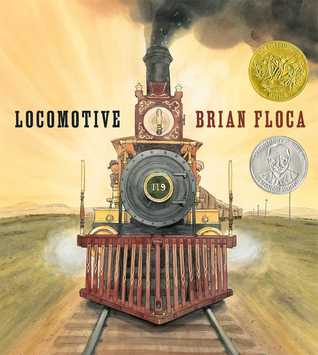
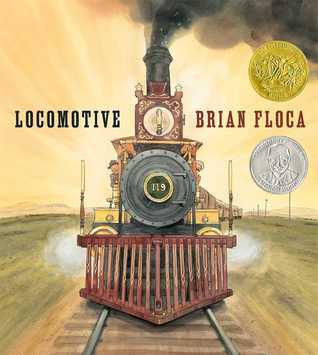
Locomotive
Author and Illustrator: Brian Floca
Published September 3rd, 2013 by Atheneum Books for Young Readers

Goodreads Summary: The Caldecott Medal Winner, Sibert Honor Book, and New York Timesbestseller Locomotive is a rich and detailed sensory exploration of America’s early railroads, from the creator of the “stunning” (Booklist)Moonshot.

It is the summer of 1869, and trains, crews, and family are traveling together, riding America’s brand-new transcontinental railroad. These pages come alive with the details of the trip and the sounds, speed, and strength of the mighty locomotives; the work that keeps them moving; and the thrill of travel from plains to mountain to ocean.

Come hear the hiss of the steam, feel the heat of the engine, watch the landscape race by. Come ride the rails, come cross the young country!

My Review: Rhythm. Onomatopoeias. (Well-researched) History. Gorgeous (and historically accurate) illustrations. Lyrical narrative. Unique point of view. This book has everything.

YOU (second person POV!) are a passenger on a train cross America with your family in 1869. Throughout the book, you will encounter many different landmarks, experience things on a train very few had at this time in history, and learn about the intricacies of the train. So fascinating! And all told in rich, beautiful language. It is hard to even share much more about the book because it is such an experience.

Check out Ricki’s review of Locomotive as well HERE.

Teachers’ Tools for Navigation: I would LOVE to read this to kids. There are so many places to stop and discuss and research and learn, but never without an enthralling story accompanying.  It would be a great book to use across subjects. There are definitely opportunities for all subjects: social studies (trans-continental travel, history, trains); science (the science of steam engines); math (travel); reading/writing (onomatopoeia, point of view, rhythm).

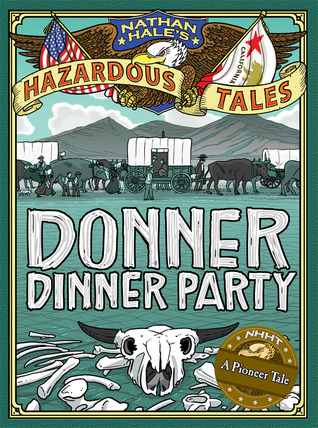
Also, and this is fresh on my mind because I just read it, but I would love to read this and The Donner Dinner Party and then look at the two journeys. How long did each take? Dangers? It would be an interesting look at how trains truly changed transportation.

Discussion Questions: How does having the book in 2nd point of view make it more enthralling?; What onomatopoeias were used in the book? How did these words help suck you into the story?; How did the author’s rhythm make you feel like you are actually on the train?; What are the landmarks that were passed on the trans-continental railroad? Why are these landmarks significant?; How does a steam engine work? What are the jobs of all of the different people on board?

We Flagged:
“Here is how this road was built,
with a grunt and a heave and a swing,
with the ring of shovels on stone,
the ring of hammers on spikes:

CLANK CLANK CLANK!

Men came from far away
to build from the East,
to build from the West,
to meet in the middle.

They cleared the rocks
and dug the tunnels.
They raised the hammers
and brought them down—

“Three strokes to the spike,
ten spikes to the rail!”

CLANK CLANK CLANK!”

Read This If You Loved: The Donner Dinner Party by Nathan Hale, Train by Elisha Cooper

Recommended For: 

readaloudbuttonsmall closereadinganalysisbuttonsmall classroomlibrarybuttonsmall

Signature

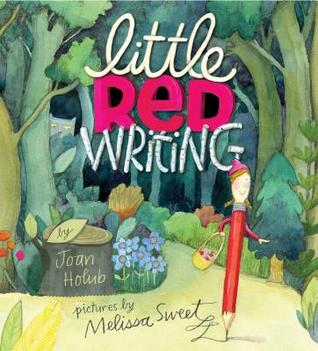
Little Red Writing by Joan Holub

Share

little

Little Red Writing
Author: Joan Holub
Illustrator: Melissa Sweet
Published September 24th, 2013 by Chronicle Books

Goodreads Summary: Acclaimed writer Joan Holub and Caldecott Honoree Melissa Sweet team up in this hilarious and exuberant retelling of Little Red Riding Hood, in which a brave, little red pencil finds her way through the many perils of writing a story, faces a ravenous pencil sharpener (the Wolf 3000)… and saves the day.

My Review and Teachers’ Tools for Navigation: I really think these wonderful woman created this book for just for teachers. It is a perfect, perfect, perfect book for a read aloud AND for a mentor text!

First, the book is a direct allusion to Red Riding Hood and is a great book to throw into the mix when looking at different versions of Red Riding Hood. I can just picture this book, with a version of the original story, Hoodwinked the movie, and Lon Po Po. Wow! What great discussions and activities you could do with this.

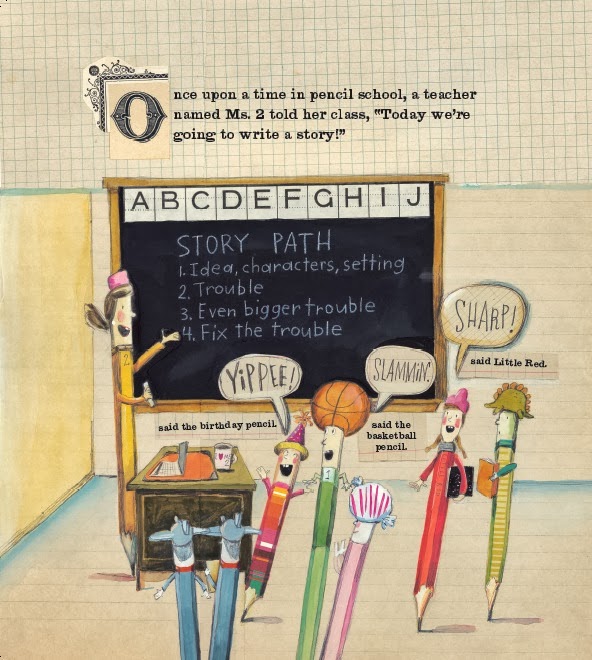
Second, this book is not just an awesome narrative and it includes a great lesson about writing a narrative. Red, our main character, is given the job to write a story and the book takes us through her journey of writing the story where she needs to include characters, setting, trouble, and fixing the trouble. A perfect opportunity to discuss narrative elements.  Taking this even further, it would be so much fun to look at the ideas that each of the other pencils had for their stories and write the entire story. You would have to look at each pencil’s personality and think about how s/he would write the story.

Finally, the book also deals with some parts of speech and how to use them. First are verbs where Red looks for more interesting verbs. She then looks for adjectives to add description. Then learns the importance of conjunctions (but watch out! They can lead to run-on sentences). Finally came adverbs with a bit of punctuation and capitalization discussion. Each part of speech is discussed in a nonboring way and the introduction could be a jumping off point to a deeper discussion.

Discussion Questions: How did Red use adjectives throughout the story to help you visualize the action?; What ended up being Red’s trouble, how did it get worse, and how did she fix it?; Pick one of the other pencils’ stories. How do you think it would end?

We Flagged: 

Read This If You Loved: Red Riding Hood by Brothers Grimm, Lon Po Po by Ed Young, The Day the Crayons Quit by Drew Daywalt

Recommended For: 

readaloudbuttonsmall closereadinganalysisbuttonsmall classroomlibrarybuttonsmall

Signature

Locomotive by Brian Floca (Ricki’s Review)

Share

locomotive

Locomotive
Author and Illustrator: Brian Floca
Published September 3rd, 2013 by Atheneum Books for Young Readers

Goodreads Summary: The Caldecott Medal Winner, Sibert Honor Book, and New York Timesbestseller Locomotive is a rich and detailed sensory exploration of America’s early railroads, from the creator of the “stunning” (BooklistMoonshot.

It is the summer of 1869, and trains, crews, and family are traveling together, riding America’s brand-new transcontinental railroad. These pages come alive with the details of the trip and the sounds, speed, and strength of the mighty locomotives; the work that keeps them moving; and the thrill of travel from plains to mountain to ocean.

Come hear the hiss of the steam, feel the heat of the engine, watch the landscape race by. Come ride the rails, come cross the young country!

My Review: Filled with a beautiful array images (watercolor, ink, acrylic, etc.), this incredibly well-researched book takes readers on a journey through the summer of 1869. It took my husband and me three nights to read this title to our son because we needed to pause and take in its magic. After I closed the last page of the book, a library copy, my husband looked at me and mouthed (because our son was asleep), “Let’s buy this one.” There is a wonderful balance of factual information about the train and lyrical language that brims with gorgeous figurative language. This book is a standout and well-deserving of the accolades it has received.

**A special thanks to Kellee, who texted me that I had to read this one. You can read her review here.**

Teachers’ Tools for Navigation: I would use this text in any grade level. I envision the eager eyes of elementary school students as their curiosity is piqued… middle schoolers, suddenly interested in trains and this time in our history…or high schoolers, researching the different parts of the train and learning how effective figurative language can be in writing. This book would be a great mentor text to teach creativity. The layout of the pages is so very purposeful, which pave the way for great classroom discussions.

Discussion Questions: How does Brian Floca grab the readers’ attention? How is his writing purposeful?; In what ways does Floca manipulate language?; How does the second person point-of-view add to the story?; What does this book teach us? Go beyond the obvious.; How do the pages differ in their visual appeal? Why do you think this is?

We Flagged:

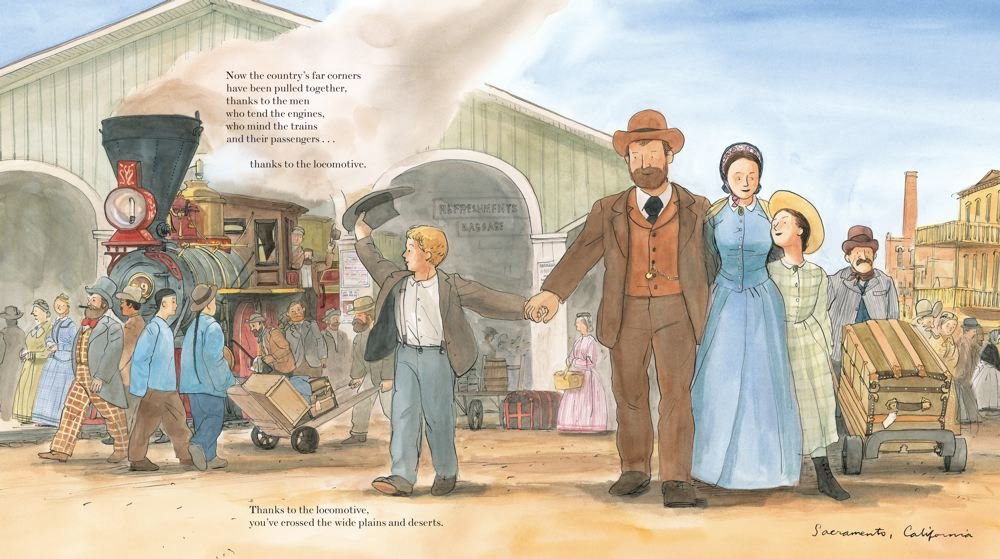
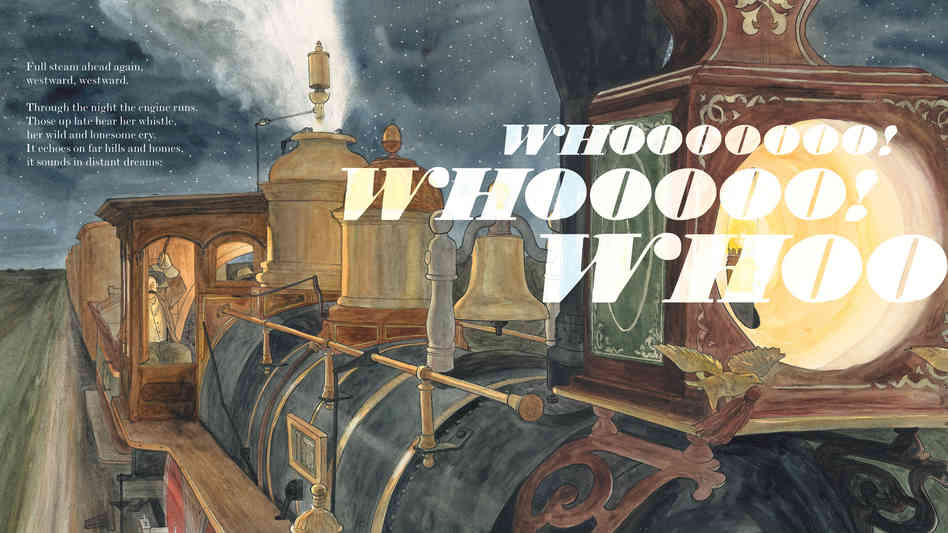
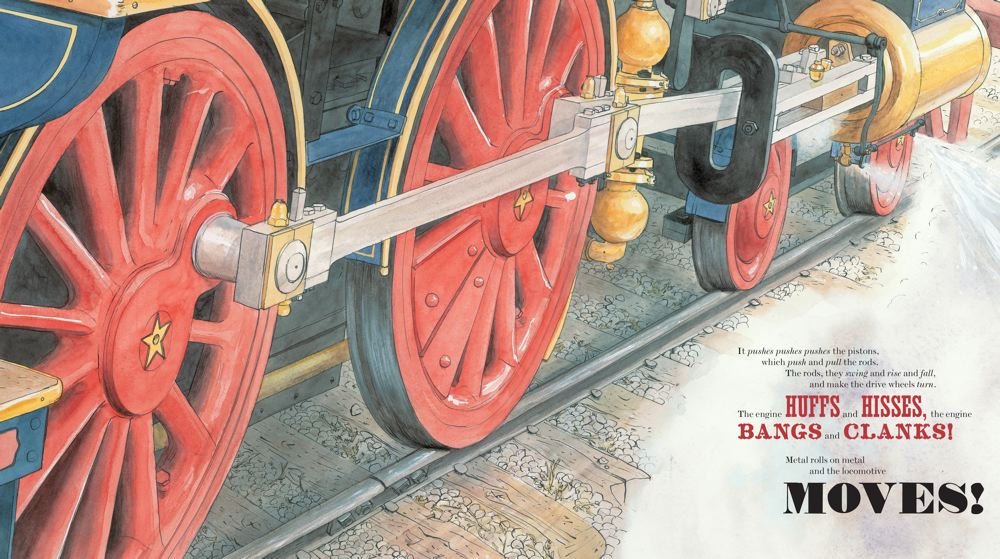
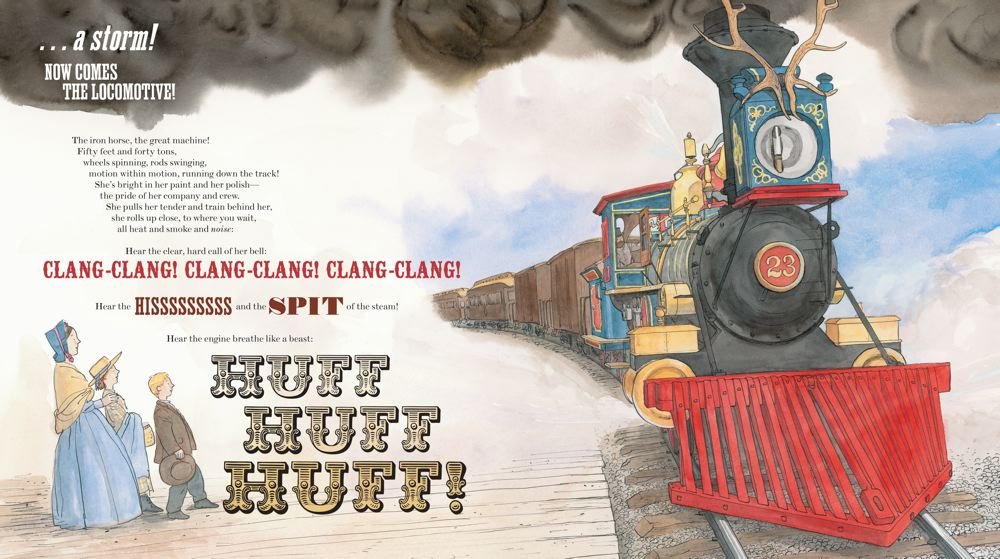
Rather than including a quote here, I wanted to show you a few of the gorgeous spreads with this book. These pages are pulled from images posted on Amazon.

locomotive1 locomotive2 locomotive4 locomotive3

Read This If You Loved: The Polar Express by Chris Van Allsburg

Recommended For: 

readaloudbuttonsmall closereadinganalysisbuttonsmall classroomlibrarybuttonsmall

RickiSig

Threatened by Eliot Schrefer

Share

threatened

Threatened
Author: Eliot Schrefer
Published: February 25th, 2014 by Scholastic Press

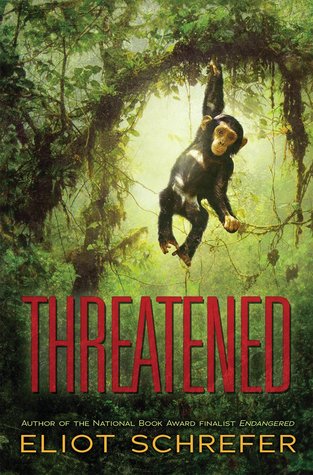
GoodReads Summary: Into the jungle. Into the wild. Into harm’s way. When he was a boy, Luc’s mother would warn him about the “mock men” living in the trees by their home — chimpanzees whose cries would fill the night. Luc is older now, his mother gone. He lives in a house of mistreated orphans, barely getting by. Then a man calling himself Prof comes to town with a mysterious mission. When Luc tries to rob him, the man isn’t mad. Instead, he offers Luc a job. Together, Luc and Prof head into the rough, dangerous jungle in order to study the elusive chimpanzees. There, Luc finally finds a new family — and must act when that family comes under attack.

As he did in his acclaimed novel Endangered, a finalist for the National Book Award, Eliot Schrefer takes us somewhere fiction rarely goes, introducing us to characters we rarely get to meet. The unforgettable result is the story of a boy fleeing his present, a man fleeing his past, and a trio of chimpanzees who are struggling not to flee at all.

Review: If you follow this blog, you know that Kellee and I are advocates for Eliot Schrefer’s writing. He is an incredibly talented writer; his settings feel authentic in that he makes far away places seem very close to home. I develop a strong kinship with his characters—animal or human. Kellee has been raving about Threatened since the ALAN conference, and I knew I wanted to read it as soon as I got a hang of being a new mom. It didn’t disappoint. The writing is stunning.

I expected Threatened to be very similar to Endangered, but I was wrong. Endangered is about an American girl visiting her mother in a Congolese bonobo sanctuary when a civil war breaks out. Threatened, on the other hand, is about an orphan boy from Gabon who goes into the wild with a professor in order to learn more about chimpanzees. But these books are more than their settings and the animals. They teach us about what it means to be human. Threatened, in particular, made me think about humanity’s evolution and the difficulties that come from living in the wild. I couldn’t help but think about how far humanity has strayed from nature. Even when Luc feels that he wants for nothing, he is ashamed that he still holds material desires. This book makes readers think critically, and it would be a great book to use in the classroom.

Teacher’s Tools for Navigation: After reading this book, I wanted to learn more about chimpanzees and how they are different from humans. Schrefer’s book has a call to action. He gives suggestions of how we might help these endangered animals. In particular, he discusses the sad state of animal testing and provides readers with ways to take action. This book will help students become critical thinkers, and hopefully, teachers will help students enact social justice for these animals which are so genetically close to us.

Discussion Questions: Are humans too far removed from nature?; How does Luc become more animalistic after he lives for extensive time in the wild? Are his changes mental? Physical?; What do the chimpanzees teach us about humanity? How are they similar and different from us?; What can we do to help these endangered species?

We Flagged: “We can try so hard, but in some basic way we’re bound by how we’re raised. There’s no escaping it. We can love someone and want to be open to the feeling but fail because our hearts got wired one way long before we knew it was happening. We can break our own hearts because of what our souls believe” (Chapter 10).

**Please note: This quote is taken from the NetGalley. It may be different in the published version of the book.**

Read This If You Loved: Endangered by Eliot Schrefer, Into That Forest by Louis Nowra, Dog Boy by Eva Hornung, Second Nature by Alice Hoffman, Into the Wild by Jon Krakauer

Recommended For:

 readaloudbuttonsmalllitcirclesbuttonsmallclassroomlibrarybuttonsmall

RickiSig

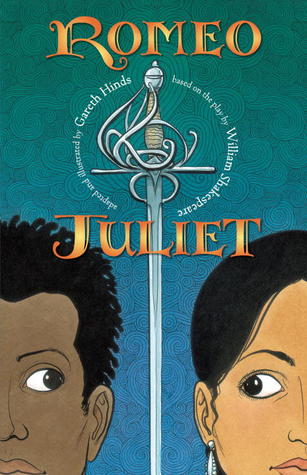
Romeo and Juliet by Garth Hinds

Share

romeo

Romeo and Juliet
Adaption and Illustrator: Gareth Hinds
Author: William Shakespeare
Published September 10th, 2013 by Candlewick Press

Goodreads Summary: Gareth Hinds’s stylish graphic adaptation of the Bard’s romantic tragedy offers modern touches — including a diverse cast that underscores the story’s universality.

She’s a Capulet. He’s a Montague. But when Romeo and Juliet first meet, they don’t know they’re from rival families — and when they find out, they don’t care. Their love is honest and raw and all-consuming. But it’s also dangerous. How much will they have to sacrifice before they can be together? In a masterful adaptation faithful to Shakespeare’s original text, Gareth Hinds transports readers to the sun-washed streets and market squares of Shakespeare’s Verona, vividly bringing the classic play to life on the printed page.

Review and Teacher’s Tools For Navigation: This graphic novel does for Shakespeare’s text what Leonardo DiCaprio’s Romeo and Juliet film did for the play. It makes it so accessible and helps the reader SEE what is going on in the play so that the Shakespeare’s words are easier to interpret. This graphic novel should be in every classroom and school library and should be used whenever the play is.  I also found Garth Hinds’s afterword very fascinating and gives a deeper look into Verona.

Discussion Questions: Gareth Hinds decided to make his characters multicultural to show the universality of the story. How does making his characters multicultural make the story more accessible and show the universality?; Garth Hinds had to abridge the play a bit to fit it into the graphic novel. After reading the play and the graphic novel, what did he remove? Does it change the story?

We Flagged: 

Read This If You Loved: Romeo and Juliet by William Shakespeare, The Odyssey by Garth Hinds

Recommended For: 

classroomlibrarybuttonsmall readaloudbuttonsmall closereadinganalysisbuttonsmall

Signature

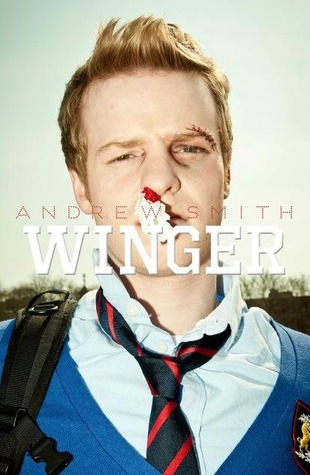
Winger by Andrew Smith (Ricki’s Review)

Share

winger

Winger
Author: Andrew Smith
Published: May 14th, 2013 by Simon and Schuster

GoodReads Summary: Ryan Dean West is a fourteen-year-old junior at a boarding school for rich kids. He’s living in Opportunity Hall, the dorm for troublemakers, and rooming with the biggest bully on the rugby team. And he’s madly in love with his best friend Annie, who thinks of him as a little boy.

With the help of his sense of humor, rugby buddies, and his penchant for doodling comics, Ryan Dean manages to survive life’s complications and even find some happiness along the way. But when the unthinkable happens, he has to figure out how to hold on to what’s important, even when it feels like everything has fallen apart.

Filled with hand-drawn info-graphics and illustrations and told in a pitch-perfect voice, this realistic depiction of a teen’s experience strikes an exceptional balance of hilarious and heartbreaking.

Review: With every page I turned, I fell more in love with this book. I found elements of this text to be reminiscent of Looking for Alaska by John Green, another wonderfully compelling work. Andrew Smith does a beautiful job unraveling the plot of this story. I found it to be incredibly unpredictable—all of my predictions, in fact, were incorrect. The book surprised me in wonderful ways. The characterization and setting shine brightly. I felt as if I was in the boarding school right with the characters, and they were my friends just as much as they were Ryan Dean’s friends. I couldn’t stop reading by the end of the book, and I think readers will equally be hooked to this coming-of-age tale.

Teacher’s Tools for Navigation: This text would fit in well with many units—particularly those of bullying, heroism, or homophobia. I could also see it matching well with Looking for Alaska, and readers might draw parallels between the two texts.

Discussion Questions: How does Andrew Smith build character? How does this characterization bolster elements of the plot?; What does the book teach us about friendship? About judging people?; Who is the hero of this story?; How does the sport of rugby play a role in the plot, characterization, and theme of this text?

We Flagged: “And then it’s always that one word that makes you so different and puts you outside the overlap of everyone else; and that word is so fucking big and loud, it’s the only thing anyone ever hears when your name is spoken.

And whenever that happens to us, all the other words that make us the same disappear in its shadow.”

Read This If You Loved: Looking for Alaska by John Green, Deadline by Chris Crutcher, The Perks of Being a Wallflower by Stephen Chbosky, Twisted by Laurie Halse Anderson

Recommended For:

 litcirclesbuttonsmall classroomlibrarybuttonsmall

RickiSig

The Great American Dust Bowl by Don Brown

Share

NF PB 2014

Nonfiction Picture Book Wednesday

Nonfiction Picture Book Wednesday is hosted by Kid Lit Frenzy and was started to help promote the reading of nonfiction texts. Most Wednesdays, we will be participating and will review a nonfiction text (though it may not always be a picture book).
Be sure to visit Kid Lit Frenzy and see what other nonfiction books are shared this week!

dust

The Great American Dust Bowl
Author and Illustrator: Don Brown
Published October 8th, 2013 by HMH Books for Young Readers

Goodreads Summary: A speck of dust is a tiny thing. In fact, five of them could fit into the period at the end of this sentence.

On a clear, warm Sunday, April 14, 1935, a wild wind whipped up millions upon millions of these specks of dust to form a duster—a savage storm—on America’s high southern plains.

The sky turned black, sand-filled winds scoured the paint off houses and cars, trains derailed, and electricity coursed through the air. Sand and dirt fell like snow—people got lost in the gloom and suffocated . . . and that was just the beginning.

Don Brown brings the Dirty Thirties to life with kinetic, highly saturated, and lively artwork in this graphic novel of one of America’s most catastrophic natural events: the Dust Bowl.

Review: Ever since I read Out of the Dust by Karen Hesse, I’ve loved learning about this scary time in American history (also, the danger hasn’t ceased just because it happens less often). This book does a beautiful job of taking this time in history and laying it out for the reader so that it is very easy to understand. It includes background about the geographical area, information about the Depression, and then takes you through the Dust Bowl all the way to modern days. So interesting!

Teacher’s Tools For Navigation: First, this book will make a great companion to Out of the Dust. I think many readers struggle with Hesse’s book because they don’t have the background knowledge needed to understand the book and Don Brown’s book gives all the background needed.  The Great America Dust Bowl can also be used as a resource when teaching the Dust Bowl, the depression, or agriculture.

Discussion Questions: How did the Depression impact farmers thus help cause the Dust Bowl to happen?; How is the problems of the Dust Bowl still impacting us today?

We Flagged: 

Read This If You Loved: Out of the Dust by Karen Hesse, Grapes of Wrath by John Steinbeck, The Storm in the Barn by Matt Phelan, Survival in the Storm: The Dust Bowl Diary of Grace Edwards, Dalhart, TX 1935 by Katelan Janke

Recommended For: 

classroomlibrarybuttonsmall closereadinganalysisbuttonsmall

Signature