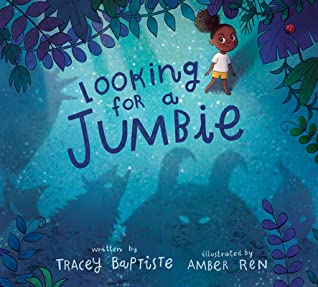
Looking for a Jumbie Author: Tracey Baptiste
Illustrator: Amber Ren
Published September 21st, 2021 by Balzer + Bray
Summary: New York Times bestselling author Tracey Baptiste and acclaimed illustrator Amber Ren take readers on a fun, creepy, storytime-ready romp through a forest filled with creatures from Caribbean folklore.
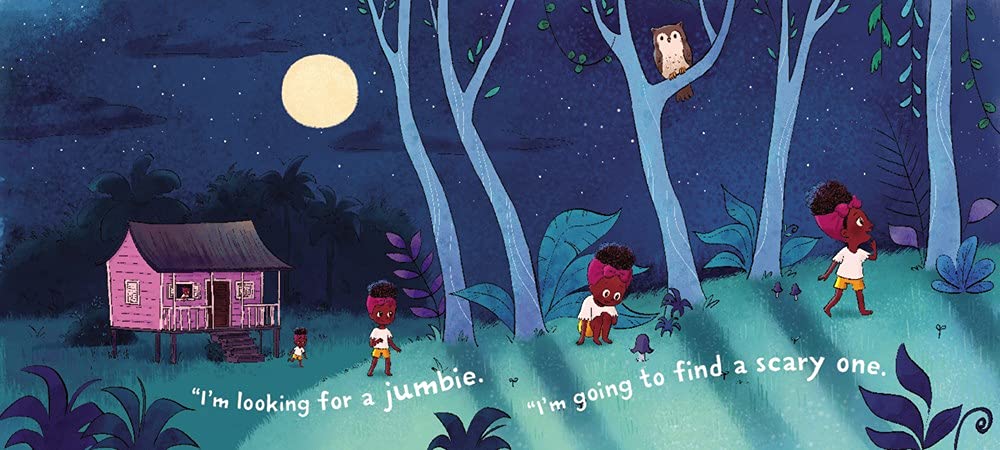
I’m looking for a jumbie, I’m going to find a scary one.
But Mama says jumbies exist only in stories. So Naya sets out on a nighttime adventure to find out for herself.
No such thing, say the friends she makes along the way.
But Naya is sure that jumbies are real. Some have big mouths. Or thick fur. Or glowing skin. Or sharp teeth. Kind of like her new friends….
Looking for a Jumbie is a gentle, bouncy, and creepily fun read-aloud inspired by traditional Caribbean tales.
Praise:
“A vibrant and entertaining tale filled with mythical creatures from Caribbean stories that is perfect for Halloween and year-round.” -School Library Journal
“The illustrations are colorful and dreamlike, and Ren pays special attention to accentuating the features of characters. A nice addition to offerings on being afraid of the dark, monsters, or nighttime adventures.” –Booklist
About the Author: Tracey Baptiste is the New York Times bestselling author of the middle grade novels Minecraft: The Crash, The Jumbies, Rise of the Jumbies, and The Jumbie God’s Revenge. A former elementary school teacher, Tracey is now on the faculty at Lesley University’s creative writing MFA program. Raised in Trinidad until she was fifteen, she now lives with her family in New Jersey. You can visit her online at www.traceybaptiste.com.
About the Illustrator: Amber Ren is the illustrator of Because by Mo Willems, a New York Times bestseller. She is also a visual development artist, and her work has been featured in the Eric Carle Museum of Picture Book Art’s first online exhibition, “ART in PLACE: Social Distancing in the Studio.” You can find her online at www.amber-ren.com.
Kellee’s Review: This book is equally compelling, spooky, and fun! Trent and I had a great time chanting the “I’m looking for a jumbie…” part of the story (great repetition & rhythm!) and meeting all of the jumbies that Naya meets along the way. The illustrations were also perfect for the story! I loved the way that Ren was able to bring such beautiful coloring in even in a story happening at night. After we were done, we went on a Google hunt to learn more about jumbies, and I introduced Trent to Baptiste’s middle grade Jumbies books too–he says he can’t wait to read them when he is older!
Ricki’s Review: This book feels like an instant classic to me—it is one that I will read and enjoy with my kids again and again. There are so many different ways to approach this text for kids, and it offers so much potential for classrooms. I love the ways in which the jumbies are made approachable for kids. It offered wonderful conversations in my family about fears and bedtime scary things. This is a book that belongs in every home. I think it will find a place in all readers’ hearts.
Teachers’ Tools for Navigation: What a great addition to lessons about mythology/folklore for young readers! Looking for a Jumbie is a perfect introduction to Caribbean folklore and can start a delve into more stories.
Discussion Questions:
Which Jumbie would you like to meet?
Why was Naya never scared of the Jumbies?
Was Mama right or wrong about the Jumbies?
How did the illustrator leave clues about the upcoming Jumbie?
What is the mood of the book? How did the illustrations add to the mood of the book?
Flagged Passages:
Activity Guide:
Read This If You Love: Folklore & Mythology; Magical Stories
Recommended For:
&
**Thank you to SparkPoint Studio for providing copies for review!!**
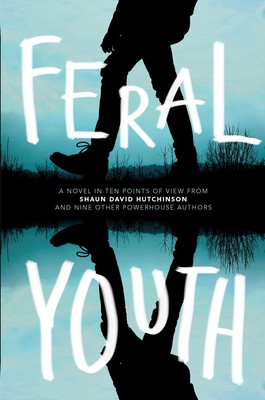
Feral Youth
Authors: Shaun David Hutchinson, Brandy Colbert, Suzanne Young, Tim Floreen, Justina Ireland, Alaya Dawn Johnson, Stephanie Kuehn, E.C. Myers, Marieke Nijkamp, Robin Talley
Published: September 5, 2017 by Simon Pulse
Guest Review by Natalia Sperry
Summary: At Zeppelin Bend, an outdoor education program designed to teach troubled youth the value of hard work, cooperation, and compassion, ten teens are left alone in the wild. The teens are a diverse group who come from all walks of life, and they were all sent to Zeppelin Bend as a last chance to get them to turn their lives around. They’ve just spent nearly two weeks learning to survive in the wilderness, and now their instructors have dropped them off eighteen miles from camp with no food, no water, and only their packs, and they’ll have to struggle to overcome their vast differences if they hope to survive. Inspired by The Canterbury Tales, Feral Youth features characters, each complex and damaged in their own ways, who are enticed to tell a story (or two) with the promise of a cash prize. The stories range from noir-inspired revenge tales to mythological stories of fierce heroines and angry gods. And while few of the stories are claimed to be based in truth, they ultimately reveal more about the teller than the truth ever could.
Review: This is a complex anthology of traditionally ignored teenaged voices that demand to be heard; I couldn’t put it down! Feral Youth is compelling from the front flap to the final page. The distinct voices of all 10 characters shone through in every part, from their individual stories to the transitional narration, creating an established sense of the full cast that is difficult to attain when juggling so many stories.
In this day and age, it feels more important than ever read book that remind us that all people, even those “troubled kids” traditionally written off by society, have a unique story to tell. Though I initially felt a bit overwhelmed by the number of characters (especially those with similar sounding names!) having such a diverse cast of characters share their stories was really rewarding. Those stories, both those intended to be “factual” and those grounded in fantasy, refuse to go quietly from my mind. In a story centered around teens whose voices have been all but silenced by society, I think that’s a victory.
Teacher’s Tool For Navigation: As the book was inspired by Chaucer’s Canterbury Tales, teachers could have students read the two (or passages from both) and compare and contrast. In particular, looking for thematic parallels could lend itself to discussions about the nature of storytelling and whose voices get told. In that regard, the book could also fit into a unit about “objective truth” in storytelling, perhaps in discussing other narratives or nonfiction.
Even in including the text as a free-reading option, I think it is essential to build empathy through reading diverse stories. Including this text could be not only a way to build empathy, but could provide a starting point for further future reading of a diversity voices as well.
Discussion Questions: What parallels do you find to the Canterbury Tales? Which stories surprised you? Were there any characters you related to that you wouldn’t have anticipated connecting with?
Flagged: “’They think we’re probably nothing but a bunch of animals, but we showed them who we really are. We showed them that they can’t ignore us’” (287).
Read This If You Loved: The Canterbury Tales by Chaucer, Les Miserables by Victor Hugo, other YA anthologies
“Combining History with Fantasy – Why and Three Hows”
To be an historian, you must be detail oriented. But writing fantasy is about creativity and imagination. So when I decided to use my Ph.D. in ancient Egyptian history to write a fantasy story for middle grade readers—a story that sends two South Side Chicago kids 3,000 years into the past—figuring out how to merge the historian with the storyteller was a painful task. It seemed so simple the day my son—then nine, now sixteen—first suggested I write a book about a kid who looked like him lost in time. It took many years, and a lot of false starts, but eventually I figure out a few ways to merge the historical details stuffed in my head with the imagination that fired up my heart.
The topsy-turvy journey was worth the effort. I wanted to share my passion for ancient Egypt with middle school aged kids, in part, because I think it’s important that today’s youth recognize that the practices, systems, and objects we enjoy today were inherited from across the globe, including from this impressive African culture. And my hunch was that some kids who wouldn’t read straight history would be open to fantasy drenched in mummies and giant scorpions and magician princesses.
Here are three things I did to make the history in Jagger Jones and the Mummy’s Ankh more fantastical…
1. Integrating the theme
The first breakthrough came when I integrated the history into my worldbuilding by selecting a theme that relates to both. Since it’s a three book series, I chose an ancient blessing that captures three themes worthy of exploration: ankh, wedja, seneb, which means (may you have) life, prosperity and health. Book one is about life (ankh), which brings us to our mummy—the princess Meketaten, who really did die around the time my book is set. But since it’s ancient Egypt, Jagger’s task is not to save her life—that wouldn’t honor the history—but her afterlife. The ancient Egyptian belief in the afterlife is both fantastical and historical!
2. Mixing it up … literally
My biggest aha moment came when I figured out a way to mix the modern with the ancient. Artifacts, aka things, were the key. See, everyone has things, modern sixth graders and ancient princesses alike. I thought kids would be interested in the things ancient Egyptians valued, like magical amulets and small figurines designed to spring to life in the afterworld to care for the dead. And imagine the shock an iPhone 3,000 years in the past would trigger. But the real fun came when I started switching modern things with ancient artifact. For example, when the kids’ magician sidekick loses the wax she needs to cast a magic spell, it gets replace by gum from Aria’s purse. (It’s the best way to magic up a killer Apep serpent! Who knew?)
3. Digging the details
Yes, details are key for all writers. But when you’re creating new worlds (writing fantasy) or taking people into unfamiliar historical periods (writing history), giving readers information on what things look like, sound like, and feel like is even more important. When your historical period is ancient Egypt, addressing the sense of smell is a must. That’s because ancient Egypt was a smelly place. No, I haven’t traveled back in time to confirm that suspicion, but scents are so commonly referenced in stories and texts and even images that I feel secure with the assumption. One way I highlighted the sense of smell in my series was to give magicians unique scents—the princess Tatia’s magic spells smell like fresh herbs, while the lovely Mut’s spells release the scent of lotus blossoms. It was just one small way to weave real history into the fantasy.
With book one, Jagger Jones and the Mummy’s Ankh, available in late May, I hope kids enjoy the adventure and don’t mind the history they pick up on the journey. You can learn more about Egyptian history, my books, and classroom activities like my Jagger Jones themed escape the room activity, on my website here: http://malaynaevans.com
Jagger Jones & the Mummy’s Ankh Author: Malayna Evans
Published May 28th, 2019 by Month9Books
About the Book: Jagger Jones is a whiz kid from Chicago’s South Side. Ask him anything about Ancient Egypt, and Jagger can fill hours describing all that he knows. But when he and his precocious little sister Aria fall more than three thousand years back in time to the court of Amarna, Egypt, Jagger discovers a truth that rocks his world: books don’t teach you everything there is to know.
Mummies, pyramids, and cool hieroglyphics make awesome movie props, but the ancient court of Amarna is full of over-sized scorpions, magical amulets, and evil deities determined to scare unwanted visitors away. If Jagger and Aria are to return safely home, they must find nine soul-infested gemstones, defeat an evil general, save the royal family, and figure out how to rescue themselves!
Armed only with Jagger’s knowledge of history and a few modern objects mined from his pockets and Aria’s sparkly purse, the siblings have exactly one week to solve supernatural riddles and rescue the royal family. If they can pull it off, Jagger Jones just might return to Chicago a hero.
About the Author: Malayna Evans was raised in the mountains of Utah and spent her childhood climbing, skiing, reading Sci-Fi, and finding trouble. Many years later, she earned her Ph.D. in ancient Egyptian history from the University of Chicago. She’s used her education to craft a time-travel series set in ancient Egypt. Book one, Jagger Jones and the Mummy’s Ankh, is out in May of 2019. Malayna spends her time visiting classrooms to share her passion for ancient Egypt, traveling with her two kids, and walking her rescue dog, Caesar. She lives in Oak Park, Il.
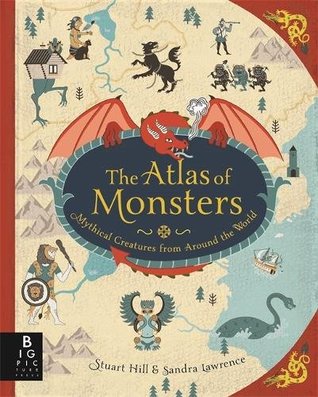
The Atlas of Monsters: Mythical Creatures from Around the World
Creators: Sandra Lawrence and Stuart Hill
Published April 23rd, 2019 by Running Press
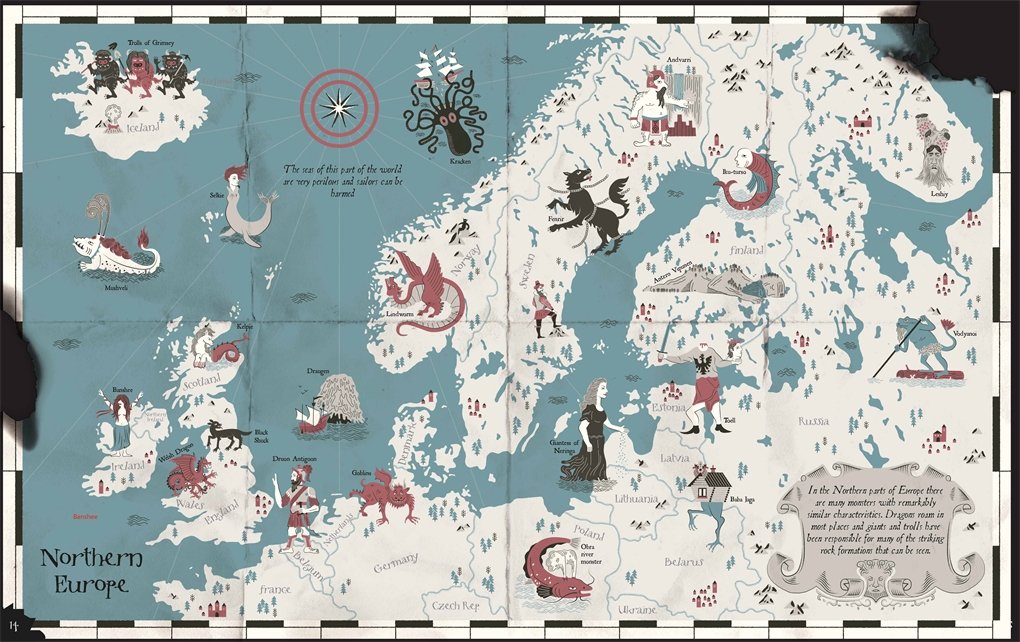
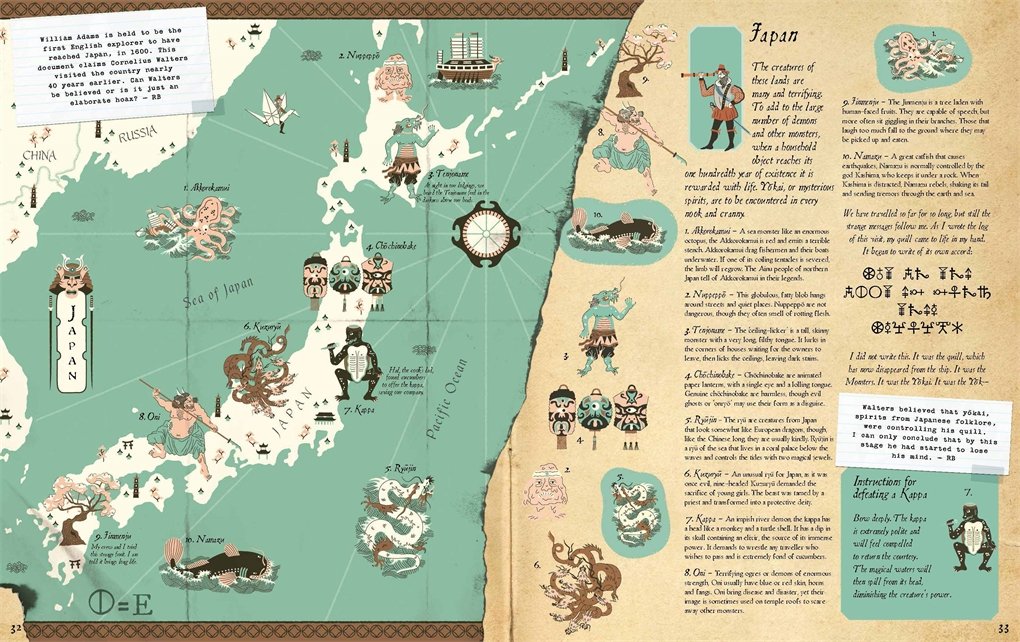
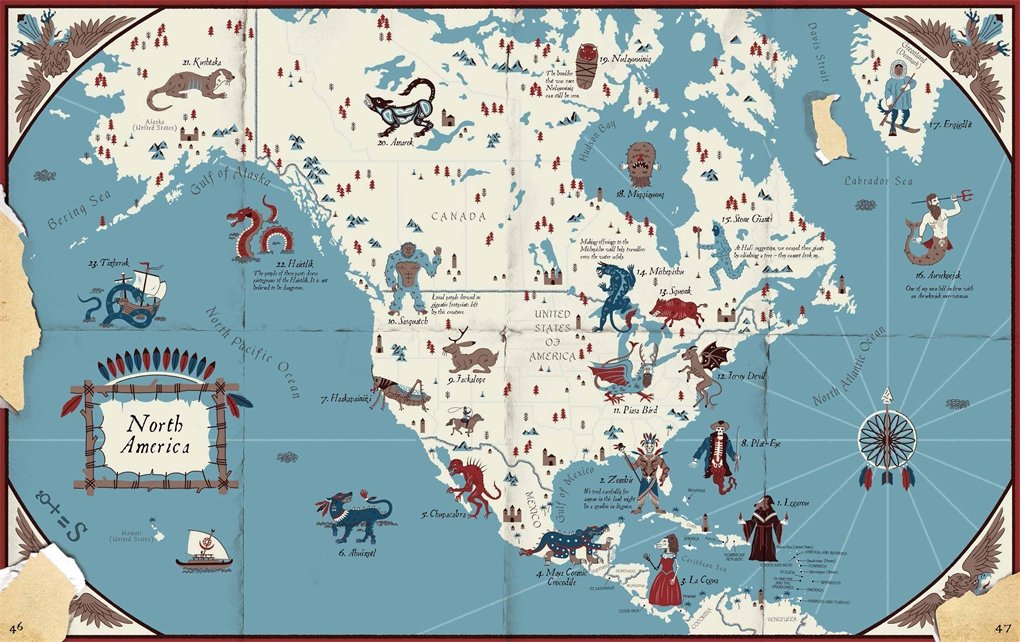
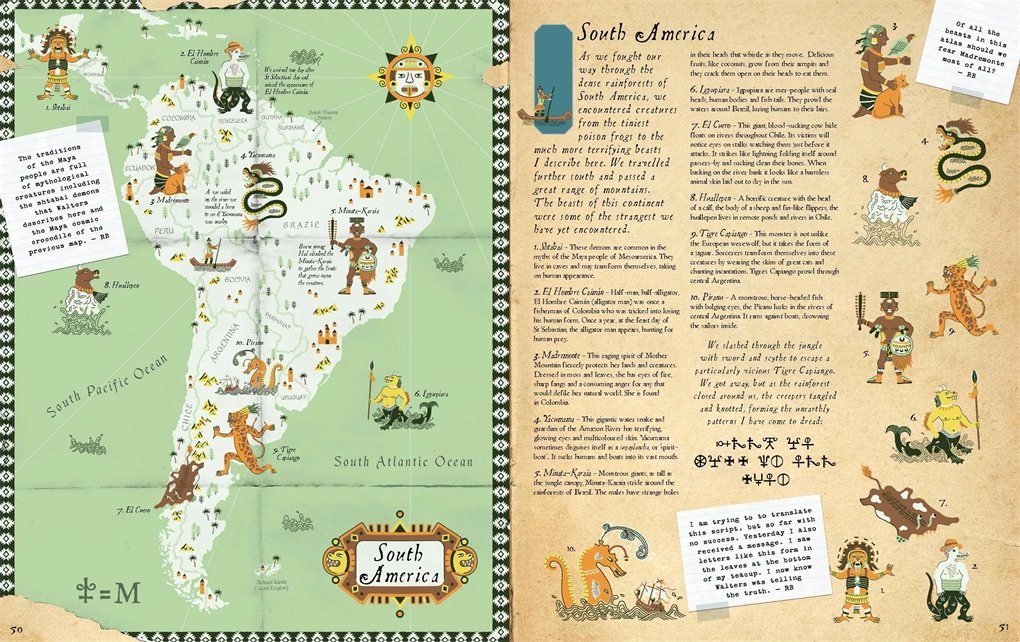
Summary: A whimsical and imaginative catalog of fantastical beasts and creatures of myth and legend from around the world-complete with a code that needs cracking to uncover the mystery of the monster atlas!
One day a collection of very old maps is found in a dusty library. They show where in the world monsters and creatures from mythology and folklore can be found. According to the notes left with the maps, they were made by Cornelius Walters, an intrepid explorer from the 15th century. But did Walters really make these elaborate maps, or is it all a hoax? The librarian who discovered them is not certain . . . and what are the strange messages in a cryptic code that Walters records in his ship’s log? The codes throughout, once cracked, may indeed lead to something sinister that will happen should the atlas ever be published!
This is a gorgeously illustrated and comprehensive catalog of monsters, beasts, and mythical creatures from around the globe, with an easy-to-read format and incredible detail on each spread. It is many things, all at once:
A reference guide: Grouped by continent, this illustrated atlas lists and defines magical creatures from folklore around the world. Readers will find creatures from stories they’ve heard–like leprachauns, manticores, zombies–and learn about lesser-known creatures like the squonk, the tatzelwurm, and the fengu.
A journal: Presented as a record created by a fifteenth-century voyager named Cornelius Walters, the book includes Cornelius’s personal anecdotes about encountering monsters during his journey.
A mystery: The book also includes notes from a librarian who supposedly found the atlas and is trying to figure out whether Cornelius was making up stories for the monsters…or whether monsters are real.
A code: A mysterious code appears on each page and is referred to by both Cornelius and the librarian, encouraging readers to crack it…before it’s too late.
For kids (and adults) who love mythology, the supernatural, mysteries, or code-breaking, this whimsical blend of folklore and fiction provides both a joy and a surprise on every page.
About the Creators:
Sandra Lawrence is an author and journalist. She is the author of two middle grade history books: Grisly History: Death and Destruction and Grisly History: Trials and Treachery. She lives in London, England.
Stuart Hill is an illustrator and designer. He is especially interested in printed textures, hand-lettering, and map illustration. He lives in England.
Review:This book is really everything that the summary states. It is fascinating! And beautiful! There is some humor because of the voyager’s anecdotes and the librarian’s notes, too, which is always nice. And the addition of the code adds an interactive element to the text. Highly recommended for any teacher teaching mythology or any traditional stories with monsters/creatures.
Teachers’ Tools for Navigation: This text would be perfect for teaching and discussing the Literacy.RL.9 standard which discusses how modern texts uses traditional text. Using The Atlas of Monsters, students can get an introduction to allusion around a discussion of where they have heard of the monsters before. And this is just the beginning! It would be so much fun to make your own Atlas of Monsters!
Discussion Questions:
Find the clues throughout each page, and crack the codes in the book.
How many different points of view are shared in the book? How does this affect the reading experience?
Pick one of the creatures and do further research and create a longer profile about them.
Before reading about one of the continents, do your own research and try to predict which mythical creatures will be mentioned.
What are some similarities/differences between what you knew about ____ and what is in the text?
Flagged Passages:
Read This If You Love: Mythology, Cryptozoology, Folklore, the supernatural, code breaking
Recommended For:
**Thank you Running Press Kids for providing a copy of the book to review!**
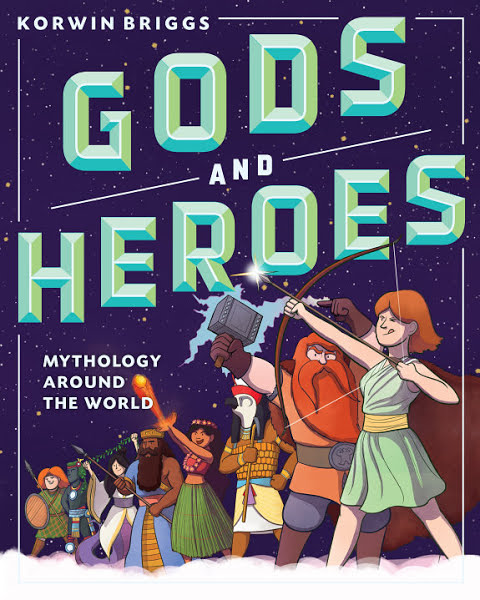
Gods and Heroes Author: Korwin Briggs
Published August 21, 2018 by Workman
GoodReads Summary: Meet the Original Superheroes.
Before there was Batman, Wonder Woman, or Black Panther…there was Indra, Hindu king of gods, who battled a fearsome snake to save the world from drought. Athena, the powerful Greek goddess of wisdom who could decide the fate of battles before they even began. Okuninushi, the Japanese hero who defeated eighty brothers to become king and then traded it all for a chance at immortality.
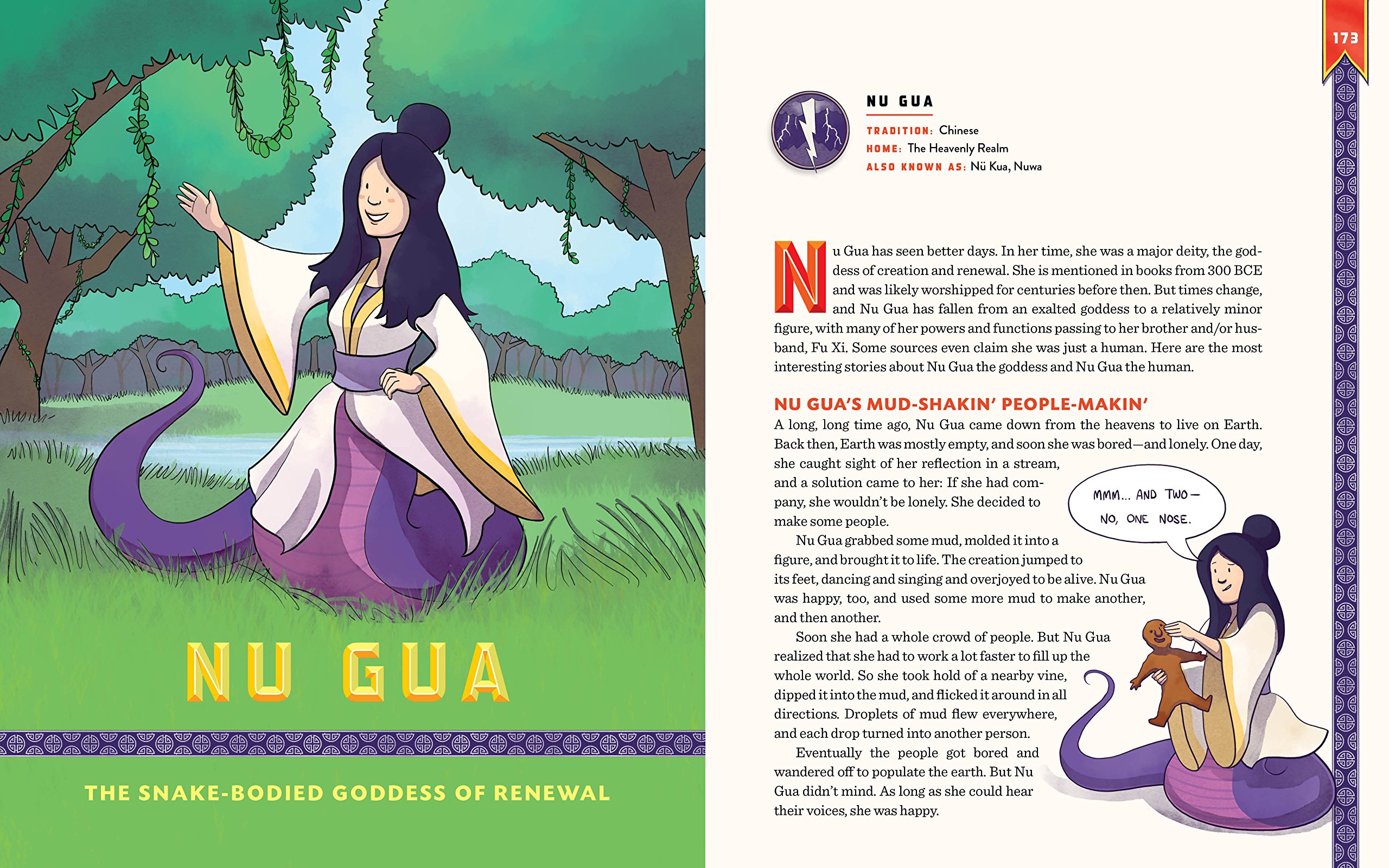
Featuring more than 70 characters from 23 cultures around the world, this A-to-Z encyclopedia of mythology is a who’s who of powerful gods and goddesses, warriors and kings, enchanted creatures and earthshaking giants whose stories have been passed down since the beginning of time—and are now given fresh life for a new generation of young readers.
Plus, You’ll Learn All About:
Dragons: The Hydra, St. George’s Dragon, and the Australian Rainbow Snake
Giants: Grendel, Balor of the Evuil Eye, Polyphemus, and the Purusha with the thousand heads
Monsters: Manticore, Sphinx, Minotaur, Thunderbird, and Echidne, mother of the Nemean lion that nearly killed Heracles
Underworlds: Travel to Hades, Valhalla, and the Elysian Fields
Review: I always enjoy Workman books. The offer nonfiction information in a way that is fun and engaging. My four-year-old loved this book (even though most of it was a bit over his head). I’d recommend this book for the targeted audience (grades 3-7), but I think younger and older kids would really enjoy it (I know I did!). There are a diverse set of gods and heroes within this story, and they don’t originate from one culture, which I liked a lot. My son seemed to love the Greek/Roman gods the most, so those are the ones that we’ve read so far. We read about a different god/hero each night, and we’ve been going strong for about two weeks. We look forward to reading these stories each night. It makes for a fantastic bedtime routine.
Teachers’ Tools for Navigation: Teachers might ask each student to pick a different god or hero and present it to the class. I’d encourage students to choose a god/hero that interests them, and I think this onus would help students get excited about their presentations!
Discussion Questions: Which heroine/hero did you enjoy the most? Why?; Did you notice any similarities across cultural heroes? Differences? Which hero would you want to learn more about?
Flagged Passages:
Read This If You Love: Mythology, Gods, Heroes, History
Recommended For:
**Thank you to Diana at Workman for providing a copy for review!**
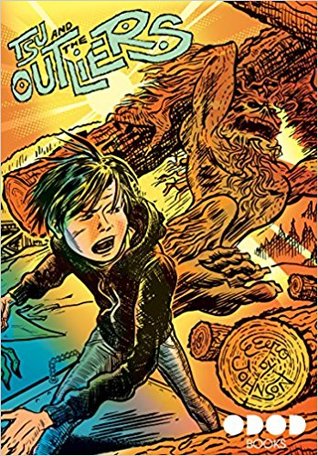
Tsu and the Outliers
Author: E. Eero Johnson
Published May 8th, 2018 by odod books
Summary: Tsu and the Outliers is a graphic novel about a non- verbal boy whose rural existence appears unbearable until rumors of a monstrous giant upend his mundane life. Tsu finds himself at the center of the mystery, as his strange metaphysical connection with the creature is revealed.
As the dragnet closes in, Tsu is forced to choose between a dangerous path leading beyond the periphery of human perception or a life without his only friend.
About the Author: E. Eero Johnson (Erik T. Johnson) is a Minneapolis-based illustrator, graphic designer, and comic book artist. His illustrations have appeared in GQ, The New Yorker, Newsweek, Wired, and The New York Times, and on several book covers. His comic book projects, The Outliers and Kozmo-Knot, have gained a growing interest from the indie comic world. He lives with his wife, Tammy, sons, Emmett and Eilif, and a crazy Boston terrier.
Review: Tsu and the Outliers is an interesting look at a new type of superhero: a young non-verbal boy who is able to communicate with a creature that his world is afraid of. There are some interesting discussion points when it comes to bullying since Tsu is judged by his classmates because of his disability. This is a big theme during the beginning of the book as we get to know Tsu. The creature also ends up being a Sasquatch and they are being chased by a chupacabra-like creature which introduces North American folklore. Overall, the story is pretty crazy (in a good way), and the end of the book sets up for a definite sequel which I NEED because Tsu makes a crazy decision at the end of the book with no explanation.
Teachers’ Tools for Navigation: Use the scene where Tsu is bullied by Jespers to start a dialogue about bullying. Discuss why the scene makes them angry and uncomfortable and what could have been done by others to help Tsu. Have students create anti-bullying advertisements to share in your school.
When mythology and folklore are discussed, the focus is primarily on Greek, Roman, and Egyptian. Use Tsu and the Outliers to discuss North American folklore including the Sasquatch and chupacabra. Have them research the tales about these creatures and create their own myth with them in it. Also, as a class, discuss the difference between the characters is Tsu and traditional folklore.
Discussion Questions:
What foreshadowing was there to show that Tsu was more than what everyone assumed?
Tsu’s lack of verbal communication in the end of the book ended up not being a disability. What do you think caused it?
Why do you think Tsu made the choice he did at the end of the book?
Why do you think Tsu’s mother made the claim she did at the end of the book covering up for Tsu?
Why does the Chimpanzee-professor want Tsu?
Flagged Passages:
Read This If You Love: Superpowers, Folklore, Superhero comics
Recommended For:
**Thank you to odod books for providing a copy for review!**
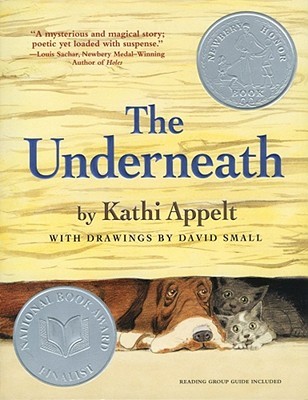
The Underneath Author: Kathi Appelt
Illustrator: David Small
Published May 6th, 2008 by Atheneum Books for Young Readers
Newbery Honor (2009), National Book Award Finalist (2009)
Summary: There is nothing lonelier than a cat who has been loved, at least for a while, and then abandoned on the side of the road.
A calico cat, about to have kittens, hears the lonely howl of a chained-up hound deep in the backwaters of the bayou. She dares to find him in the forest, and the hound dares to befriend this cat, this feline, this creature he is supposed to hate. They are an unlikely pair, about to become an unlikely family. Ranger urges the cat to hide underneath the porch, to raise her kittens there because Gar-Face, the man living inside the house, will surely use them as alligator bait should he find them. But they are safe in the Underneath…as long as they stay in the Underneath.
Kittens, however, are notoriously curious creatures. And one kitten’s one moment of curiosity sets off a chain of events that is astonishing, remarkable, and enormous in its meaning. For everyone who loves Sounder, Shiloh, and The Yearling, for everyone who loves the haunting beauty of writers such as Marjorie Kinnan Rawlings, Flannery O’Connor, and Carson McCullers, Kathi Appelt spins a harrowing yet keenly sweet tale about the power of love, and its opposite, hate; the fragility of happiness; and the importance of making good on your promises.
Author: Kathi Appelt is the New York Times best-selling author of more than forty books for children and young adults. Her first novel, The Underneath, was a National Book Award Finalist and a Newbery Honor Book. It also received the PEN USA Award. Her other novels include The True Blue Scouts of Sugar Man Swamp, a National Book Award finalist, and Maybe a Fox, one of the Bank Street Books Best Children’s Books of the Year. In addition to writing, Ms. Appelt is on the faculty in the Masters of Creative Writing for Children and Young Adults at Vermont College of Fine Arts. She lives in College Station, Texas. To learn more, and to find curriculum materials and activity pages, visit her website at kathiappelt.com.
Review: Anyone who has read a Kathi Appelt book knows that she is amazing at two things: weaving a story together in a way that only she can & pulling at heart strings causing definite mood swings while reading. The Underneath is the epitome of her excellence, and I am sad it took me so long to get to this book. Once done, I was very excited to ask Kathi about this masterpiece, and my questions and her answers show more about what makes this book the award winner that it is.
Interview:
Kellee: How do you work to weave different elements into your story such as mythology, the natural world, and contemporary stories?
Kathi: It’s always interesting to me to learn what sets a story off. Some authors swear that they start with characters. And I would say that characters are definitely a good place to start. But when I reflect over my many years of writing, I feel like I mostly start with place. I ask, what is it about this place that lends itself to story? What is the history of it? The social and cultural importance of it? Who has lived here? Who was here a thousand years ago? What were they doing? How did they survive? What impact did natural forces play on this place? What is the flora and fauna? Are there ghosts? Are there particular features of it? So, it seems to me that place creates the basis for most of my stories.
In The Underneath, one of my story lines occurs a thousand years ago, which means that my mythological characters (who were interlopers), would have encountered members of the Caddo/Hasinai nation. Theirs was a sophisticated, highly organized society. But a couple of things happened. One was a massive earthquake that caused a devastating flood which wiped out an entire city, thousands of people. Another was the encroachment of European settlers who brought in disease and ultimately drove the Caddo/Hasinai out of their ancestral lands.
The Caddo were—and still are—known for their pottery, so it made sense to feature a significant jar in my story. That way, I could more clearly link the characters to each other across time periods. One thing leads to another. But in the end, it goes back to place.
Kellee: The Underneath has multiple stories that are interwoven and meet at the end. How do you plan writing a novel like this?
Kathi: Extended narrative has always been difficult for me. I started my professional writing life as a poet and picture book author. As a result, it seemed like everything I wrote tended to finish at the bottom of page three. It was why writing a novel eluded me for such a long time. I always thought that a novel meant writing long chapters, strung together chronologically, and moving from point A to a final point Z. But it wasn’t in my nature to write like that. Long chapters weren’t the way I rolled. Finally, after many failed attempts, I figured out that if I was ever going to write a novel, I would have to go with my grain as opposed to going against my grain. So, I adapted to “writing by snapshot.” In other words, I write in small, significant scenes—I call them SSS’s. I can get a lot done that way without worrying about word counts or chapter lengths, or even transitions. Plus, they’re easy to manipulate. A small scene can be moved hither and yon until it finds the right place in the story.
I think that one of the reasons that writers fail is because they haven’t found their own natural way of working. Long narrative passages aren’t my strength. I’m not saying that I can’t write them, only that they’re not where my strengths lie.
So, finding the form that fits both our natural strengths and that suits the story, is one of the keys to unlocking a book . . . and a writer. Not all of us are meant to be poets. Not all of us are meant to be soaring prose practitioners. It could be that I’m a little ADD, and the short scenes suit me.
At any rate, making this discovery was how I finally finished a novel.
I also want to say in regard to planning, I do make very loose outlines when I embark upon a new project. Those outlines tend to flex as I move through the draft. But I always try to at least have a vague idea of how the story will end. Otherwise, I’ll just write myself right off the cliff. If I can see the destination, I can get there eventually.
Kellee: Personification allows the setting to become its own character in the story. How do you plan this and implement it well when you are writing?
Kathi: I spend tons of time researching the plants and animals that populate the setting. And to me, a living organism, such as a tree, is just that—living. If you spend enough time around trees, it seems like they each have their own personalities, their own needs, and their own ideas. I’m just saying. So, unless something is inanimate—like a rock, say—I can usually find the heart of that living organism. That is always my goal.
Kellee: What about The Underneath do you think resonated with readers 10 years ago and still remains today?
My true hope with The Underneath is that my young readers can see the value of making a good choice. In my story, both the hero Ranger and the antagonist Gar Face have similar experiences, similar fates if you will. They’ve both been badly treated, both been isolated, and yet only one of them turns towards love. Grandmother too, finally, at long last—after the longest time out in history—chooses love. I think that young readers are tuned in to this. I think they’re built for love. What I hope my story does is to give them the courage to make that choice.
Kellee: What feedback have you gotten from readers over the years about The Underneath? What stands out about what the book means to them?
Gosh, it’s hard to say just one thing, but it seems to me that mostly what I hear over and over from them is how much they love the relationship between Ranger and the kittens. That small sweetness seems to be the key that opens the story up. To me, it’s proof that we don’t all have to be the same or look the same or smell the same or whatever to become best friends. And no matter how small we are, we can make a difference for those we love.
Book Trailer:
GIVEAWAY!
Fifteen lucky winners will receive an autographed paperback copy of The Underneath. In addition, one Grand Prize winner will win a classroom set of 20 copies of the book PLUS a 30-40 minute Skype visit for her/his school, classroom, or library with award-winning author Kathi Appelt. Enter here!
Recommended For:
Thank you, Kathi, for your thorough and beautiful answers to my interview questions, and thank you to Blue Slip Media for the giveaway and trailer!


 &
&