
Nonfiction Picture Book Wednesday
Nonfiction Picture Book Wednesday is hosted by Kid Lit Frenzy and was started to help promote the reading of nonfiction texts. Most Wednesdays, we will be participating and will review a nonfiction text (though it may not always be a picture book).
Be sure to visit Kid Lit Frenzy and see what other nonfiction books are shared this week!
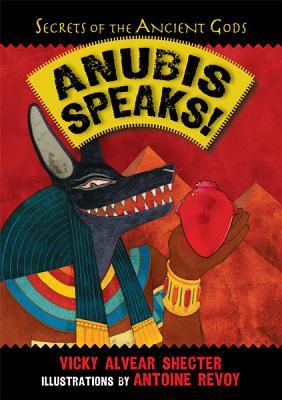
Anubis Speaks! A Guide to the Afterlife by the Egyptian God of the Dead
Author: Vicky Alvear Shecter
Illustrator: Antoine Revoy
Published October 1st, 2013 by Boyd Mills Press
Goodreads Summary: Anubis, the ancient Egyptian god of death and mummification, takes the reader on a personal tour of the “Dark Lands”–the Egyptian afterworld. While touring, Anubis explains ancient Egyptian death practices and escorts the reader onto Ra’s “Night Boat,” where they must battle the evil demon of destruction, Apophis, so that Ra can be reborn in the morning as the sun disk.
Based on Egyptology research–particularly the Book of the Dead, The Book of Apophis, the Book of Caverns and others–Anubis Speaks gives middle-grade readers a fun yet factual look at ancient Egyptian beliefs, rituals and practices.
My Review: I was introduced to Vicky Alvear Shecter when I read Cleopatra’s Moon and was struck by her way to intertwine fact, mythology, and fiction into a fascinating story. I’ve recently (once I started teaching it) become a very hug fan of mythology though mostly Greek and Roman; however, with my reading of Cleopatra’s Moon (then the Kane Chronicles by Rick Riordan), I jumped into Egyptian mythology head first and began learning more and more thus realizing how fascinating all mythology is.
Now to Anubis Speaks! What I enjoyed most about this book was how it was put together. It isn’t just another nonfiction book that lists facts and myths and hope that students find it interesting. Instead Shecter made sure to make the book entertaining and different and intertwined myths with a fun narrative from the Egyptian god of the dead. (YES! The whole book is told from the point of view of Anubis making it quite hilarious at points and making it more interesting than just an informational nonfiction book.)
Teacher’s Tools for Navigation: This book fits perfectly into a mythology unit. It can be used as a whole or parts taken out. It is a great resource for any teacher teaching Egypt or Egyptian mythology. Also, because it is written so entertainingly, it can definitely be used as a read aloud.
Discussion Questions: Which other Egyptian god/dess’s point of view would you like to read a book by?; Which myth that Anubis shared was your favorite?; What part of Egyptian history that Anubis shared did you find to be the most interesting?
We Flagged: “Allow me to introduce myself. I am Anubis—the Egyptian god of the “Mysteries of Embalming,” the “Guardian of the Veil of Death,” “Opener of the Ways of the Dead,” and if you are “bad” . . . Your. Worst. Nightmare.
But do not fear. I will not snatch your beating heart from your chest and toss it to my good friend, crocodile-headed Amut the Destroyer for a squishy snack . . . not today anyway. Instead, I will guide you through my world of deep magic, strange gods, and gruesome monsters. I will show you how my people, the ancient Egyptians, prepared the dead for eternal and evil—every night—to keep you safe.” (p. 8)
Read This If You Loved: The Kane Chronicles (series) by Rick Riordan, Percy Jackson and the Olympians (series) by Rick Riordan, Cleopatra’s Moon by Vicky Alvear Shecter, Aphrodite the Diva by Joan Holub, Who Was King Tut? by Roberta Edwards and other nonfiction King Tut books, Athena’s Son by Jeryl Schoenbeck, The Gruesome Truth about the Egyptians by Jillian Powell and other nonfiction Egyptian books
Recommended For:




**Thank you to Vicky Alvear Shecter and Teresa Rolfe Kravtin for sending me a copy!**