All the Bright Places by Jennifer Niven

Share

all the bright places

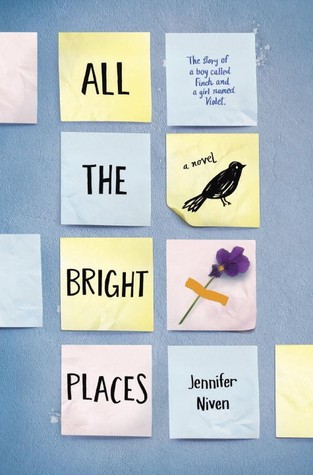
All the Bright Places
Author: Jennifer Niven
Published: January 6, 2015 by Knopf

Goodreads Summary: The Fault in Our Stars meets Eleanor and Park in this compelling, exhilarating, and beautiful story about a girl who learns to live from a boy who intends to die.

Theodore Finch is fascinated by death, and he constantly thinks of ways he might kill himself. But each time, something good, no matter how small, stops him.

Violet Markey lives for the future, counting the days until graduation, when she can escape her Indiana town and her aching grief in the wake of her sister’s recent death.

When Finch and Violet meet on the ledge of the bell tower at school, it’s unclear who saves whom. And when they pair up on a project to discover the “natural wonders” of their state, both Finch and Violet make more important discoveries: It’s only with Violet that Finch can be himself—a weird, funny, live-out-loud guy who’s not such a freak after all. And it’s only with Finch that Violet can forget to count away the days and start living them. But as Violet’s world grows, Finch’s begins to shrink.

This is an intense, gripping novel perfect for fans of Jay Asher, Rainbow Rowell, John Green, Gayle Forman, and Jenny Downham from a talented new voice in YA, Jennifer Niven.

Ricki’s Review: A publishing representative who I deem to be a friend pressed this book into my hand. “Read it,” she insisted. She told me I would want to curl up into a ball in my bed and fall into this book. I fell hard. The writing is incredible. I hate to compare books with others because it creates a sense of expectation that often goes unfulfilled for future readers, but I couldn’t help but consider comparisons with my all-time favorite YA texts. The quirky nature of the characters reminded me of Pudge, Alaska, Charlie, Eleanor, and Park. The direction of the plot reminded me of other titles (which will remain unnamed to prevent spoilers). But I cannot compare this book to others because while it allowed to me reminisce about my favorite titles, it was quite different. The deep, honest, hard-hitting depiction of mental illness was enough to take my breath away. I felt rage that made me want to punch my mattress; I felt sadness that made me feel a hopeless sense of emptiness; but above all, I felt the power of love, loyalty, and friendship that made my heart both ache and swell. This is an unforgettable book. I suspect it will be the book that everyone will be talking about this year and for years to come.

Teacher’s Tools for Navigation: Mental illness and bullying are pervasive in our schools. We can’t teach enough books about these themes because they are incredibly relevant for young people. As a former teacher, I was jealous of the teacher who created the assignment for Violet and Finch, and I wanted to do it with my former students. It would be so neat to duplicate this project while students read the book. Additionally, I think students would benefit from creating their own version of the post-it collages that Violet and Finch make. As an alternative, I would consider having students research the warning signs of suicide and finding these instances in the text. There are so many themes for the students to consider, the teaching categories at the top and tags at the bottom of this post show a variety of different directions a teacher might take with the instruction of this text.

Access the book’s website to share your bright place or read Germ MagazineThe educator guide also has CCSS tie-ins.

Discussion Questions: What is the end message of this book? What is the author’s purpose?; What foreshadowing does Niven provide?; How do Violet’s family members show their grief in different ways?; Do you agree with the ending? Would you change it? Why do you think Niven ended the book in the way she did?

We Flagged: “It’s my experience that people are a lot more sympathetic if they can see you hurting, and for the millionth time in my life I wish for measles or smallpox or some other easily understood disease just to make it easier on me and also on them.”

**Please note: The above quotation is from an advanced reader copy. The quotation may change in the final published form of the text.**

Read This If You Loved: Looking for Alaska by John Green, Eleanor and Park by Rainbow Rowell, Dr. Bird’s Advice for Sad Poets by Evan Roskos, The Fault in Our Stars by John Green, Forgive Me, Leonard Peacock by Matthew Quick, It’s Kind of a Funny Story by Ned Vizzini, The Perks of Being a Wallflower by Stephen Chbosky, Twisted by Laurie Halse Anderson, Everybody Sees the Ants by A.S. King, Burn by Suzanne Phillips

Recommended For:

 closereadinganalysisbuttonsmall litcirclesbuttonsmall classroomlibrarybuttonsmall

RickiSig

Dr. Bird’s Advice for Sad Poets by Evan Roskos

Share

dr bird's advice for sad poets

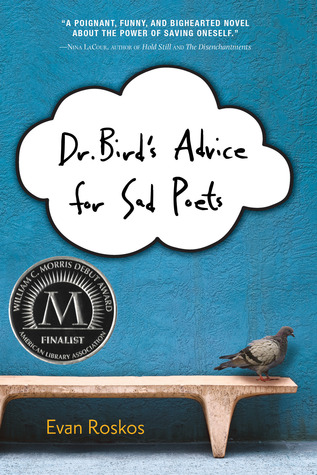
Dr. Bird’s Advice for Sad Poets
Author: Evan Roskos
Published: March 5, 2013 by Houghton Mifflin Harcourt

Summary: “I hate myself but I love Walt Whitman, the kook. Always positive. I need to be more positive, so I wake myself up every morning with a song of myself.” 

Sixteen-year-old James Whitman has been yawping (à la Whitman) at his abusive father ever since he kicked his beloved older sister, Jorie, out of the house. James’s painful struggle with anxiety and depression—along with his ongoing quest to understand what led to his self-destructive sister’s exile—make for a heart-rending read, but his wild, exuberant Whitmanization of the world and keen sense of humor keep this emotionally charged debut novel buoyant.

Ricki’s Review: Dr. Bird’s Advice for Sad Poets is such an important book. It captures depression and anxiety in a way that is both authentic and heart-wrenching at the same time. I wanted to reach into the pages of the book to give James a big hug. Similarly to It’s Kind of a Funny Story by Ned Vizzini, this book employs humor without detracting from the very realness of James’ struggles with loneliness and isolation. Teens (and adults) will find themselves in James because he is depicted in a sympathetic way that is very human. This novel is brilliant and should be in every classroom library.

Kellee’s Review: I concur with everything that Ricki said. Dr. Bird’s is a very special book. On a Top Ten Tuesday list, I wrote that I wished there were more books about kids with chemical imbalances, and Dr. Bird’s is the closest I’ve read yetEvan Roskos captures the feeling of a manic depressive state. The energy of the writing actually changes as James’s state of mind changes: anxious, manic, depressed. However, what makes it truly special is that even in the end, there is optimism. Although James is fighting his own chemical imbalance, he keeps doing just that—fighting.

Another thing I adored about this book is the idea of art and writing as therapy. James finds solace in photography and poetry, which is a positive lesson for teens because it shows the power of art, writing, and poetry.

Teacher’s Tools for Navigation: It would be interesting for teachers to do literature circles with texts that concern mental health. Students might read this book along with titles like: Forgive Me, Leonard Peacock by Matthew Quick, It’s Kind of a Funny Story by Ned Vizzini, The Perks of Being a Wallflower by Stephen Chbosky, Twisted by Laurie Halse Anderson, Everybody Sees the Ants by A.S. King, and 13 Reasons Why by Jay Asher. I imagine that reading these titles would foster incredibly rich discussions about depression, anxiety, and suicide. In my opinion, we must have these conversations with our students.

Also, Walt Whitman is a huge part of James’s life, and Whitman is mentioned throughout the book. The Whitman references (and James’s poetry emulating Whitman) would great to be examined in a classroom.

Discussion Questions: If James didn’t have abusive parents, do you think his life would be the same? Do you think depression is genetic in his family?; How does James show bravery?; What role does Walt Whitman play in James’ life?

We Flagged: “People in the world suffer from greater calamities than I do. I eat, I have clothes, I have a house. I read about people around the world who survive on less than a dollar a day. I read about how there are hundreds of millions of widows living in poverty. I see ads for kids who are born with ragged lips and jagged teeth. I don’t have anything like that. I just wake up with a deep hatred of myself. How selfish is that?” (p. 115)

“Later, as my father drives me to the pizzeria, his gassy, grumpy body reeking of judgment and anger and disappointment, I can’t help but wonder how little he knows about the depth of my sadness. The depth of my very being. Will he be upset to find me dead, or relieved?” (p. 214)

Read This If You Loved: (Many of these are listed above.) Forgive Me, Leonard Peacock by Matthew Quick, It’s Kind of a Funny Story by Ned Vizzini, The Perks of Being a Wallflower by Stephen Chbosky, Twisted by Laurie Halse Anderson, Everybody Sees the Ants by A.S. King, Reality Boy by A.S. King, Dear Life, You Suck by Scott Blagden, 13 Reasons Why by Jay Asher, Leaves of Grass by Walt Whitman

Recommended For:

 closereadinganalysisbuttonsmall litcirclesbuttonsmall classroomlibrarybuttonsmall

RickiSig andSignature

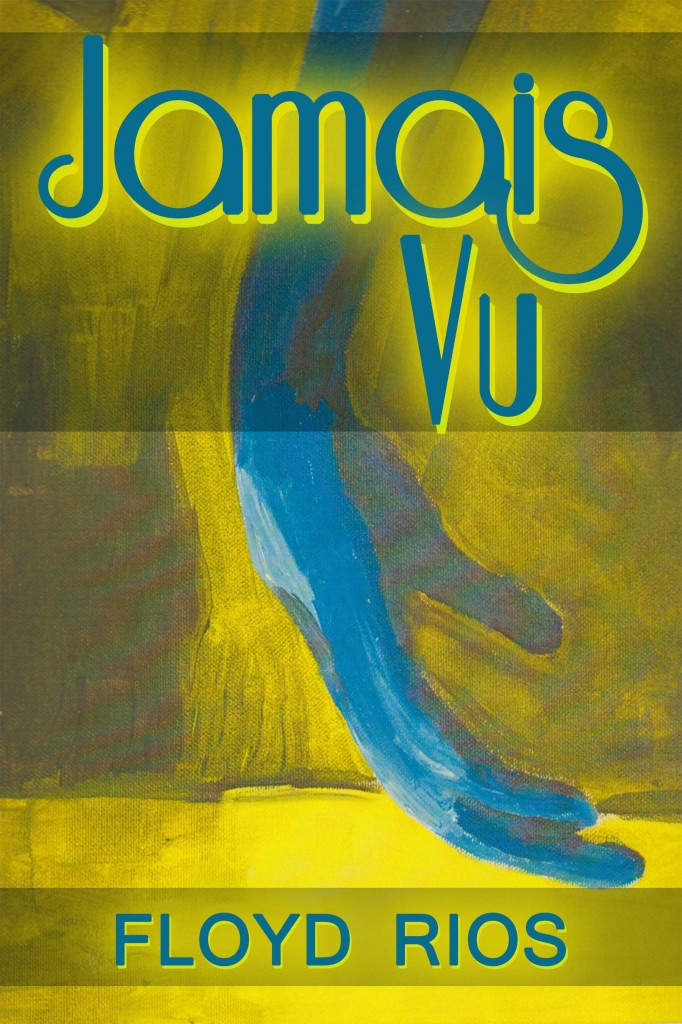
Author Guest Post!: Mental Illness, Brain Disease, and Societal Pressures: My Top 5 Books on Brain Matters by Lisa Martens, author of Jamais Vu

Share

Mental Illness, Brain Disease, and Societal Pressures: My Top 5 Books on Brain Matters by Lisa Martens

As a former epileptic, my favorite books center around mental health and brain disorders. One condition often affects the other: Schizophrenics simply have different brains than so-called “normal” people. But where does the physical problem end and the mental problem begin? Is there even a difference, or are they constantly informing one another? Here are my Top 5 books on brain matters:

  1. Wintergirls by Louise Halse Anderson – (Fiction) Anorexia has broken the hearts and bodies of many teenagers in our society. Wintergirls shows one teen girl’s struggle with the disease after her best friend dies. This issue has an abnormally high fatality rate, probably because the logic is so airtight, so cyclical. It is true, without a doubt, that our society makes huge demands on girls to be thin. It’s easy for a young woman to feel that, given the standard for beauty, that she is supposed to starve herself to be loved. This book is relatable even if you do not have an eating disorder. But! Trigger warning if you are in recovery. This book could potentially cause you to relapse. You’re beautiful the way you are!
  2. Brain on Fire: My Month of Madness by Susannah Cahalan – (Nonfiction) What happens when something is wrong with your brain? Like, physically wrong with your brain? Sometimes people don’t believe you. Sometimes people search for a psychological cause to a physical problem. That’s what happens here in Brain on Fire. This is nonfiction and chronicles the journey of Susanna through a rare brain condition. The book is also a call to action: Susannah was cured because she was lucky enough to have great insurance, a supportive family who never gave up, and more resources than most of us have. What happens to those who have this rare condition, but are wrongfully diagnosed and institutionalized, possibly forever? Like Plath’s character in The Bell Jar.
  3. Gospel of Winter by Brendan Kiely –  (Fiction) This book, though fictional, centers around the very real abuse scandal in the Catholic Church in the early 2000s. Although the main characters are far more wealthy than I ever was as a child, all the pressures are there: to be perfect, to be an adult, to reconcile having been abused with your sexual identity. Aiden, the main character, struggles to understand that he was abused, and that he is not homosexual. His good friend Mark was also abused, but is genuinely homosexual. Both boys struggle with the guilt of feeling like they ‘deserved’ or ‘asked for’ this abuse to happen to them. This book reminds us that sometimes even the most affluent, supposedly privileged people in our society can fall victim: Abuse and betrayal know no price tag.
  4. You Jump, I Jump by Annarose Russo – (Nonfiction) This book has an online community centered around it, and can serve as a resource for teens struggling with their own depression. The book itself is published by indie author Annarose Russo, who has used her own struggles with depression to inspire others going through the same issues.
  5. The Bell Jar by Sylvia Plath – (Fiction-ish) The more I read this Sylvia Plath classic, the more I appreciate it. As a teenager, I enjoyed the strong female character, and the acknowledgment (finally!) of the extra pressures growing women go through. As I’ve learned more about the context and the time period, specifically the Red Scare, this book is all the more powerful. Sylvia lived during a time where ‘strangeness’ could easily be associated with ‘communism’, and the United States was on a witch hunt. Coupled with her own issues, the pressure to be the perfect woman, daughter, and writer must have been great. To be anything else would have been unpatriotic.
What is your favorite book on mental health or brain health? Why are these conditions important for Young Adult readers to learn about?
————————————————————————————————————————————————————-
Lisa Martens believes in brain matters! She’s the author of Jamais Vu written under pen name Floyd Rios. 
In Jamais Vu, Arsenal Mist is an epileptic girl living in Plano, Texas. To her parents, everything seems fine, but Arsenal actually suffers from the rarest side effects of her seizure medication: night terrors, hallucinations, and suicidal thoughts . . . Will she be cured, or will the “cure” destroy her?
Follow Lisa:
Twitter: @WitnessLima
Instagram: @WitnessLima
Thank you Lisa for your post!
Signature and RickiSig


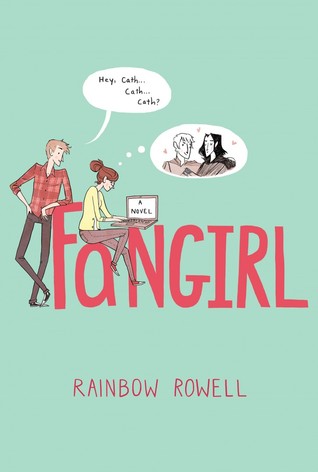
Fangirl by Rainbow Rowell (Kellee’s Review)

Share

fangirl

Fangirl
Author: Rainbow Rowell
Published September 10th, 2013 by St. Martin’s Press

Goodreads Summary: A coming-of-age tale of fan fiction, family and first love.

Cath is a Simon Snow fan. Okay, the whole world is a Simon Snow fan . . . But for Cath, being a fan is her life — and she’s really good at it. She and her twin sister, Wren, ensconced themselves in the Simon Snow series when they were just kids; it’s what got them through their mother leaving.

Reading. Rereading. Hanging out in Simon Snow forums, writing Simon Snow fan fiction, dressing up like the characters for every movie premiere.

Cath’s sister has mostly grown away from fandom, but Cath can’t let go. She doesn’t want to. Now that they’re going to college, Wren has told Cath she doesn’t want to be roommates. Cath is on her own, completely outside of her comfort zone. She’s got a surly roommate with a charming, always-around boyfriend, a fiction-writing professor who thinks fan fiction is the end of the civilized world, a handsome classmate who only wants to talk about words . . . And she can’t stop worrying about her dad, who’s loving and fragile and has never really been alone.

For Cath, the question is: Can she do this? Can she make it without Wren holding her hand? Is she ready to start living her own life? Writing her own stories?  And does she even want to move on if it means leaving Simon Snow behind?

Ricki’s Review: Ricki was lucky enough to read this book before me and wrote a wonderful review in December, so check that one out too!

Kellee’s Review: You know a book is good when in the first 5 pages you already know and feel for you main character. Cath is like many college freshman–afraid. She has known one world for so long and everything around her is changing. This book is about her figuring out her way. Anyone that went to college will connect with Cath and her struggles of finding a balance between who you were in high school and who you are becoming. I really appreciate Rainbow Rowell’s main characters and how they are not perfect–this makes them so much more relatable. (I just give a shout out to the Emergency Dance Party scene–this made me love Cath so much!)

Oh, and the dialogue! I love the way her characters converse. The banter is hilarious and just perfect. Also, I cannot review this book without giving props to the secondary characters. They are so solid and thought out. Although Cath is the main character, no one feels like Rainbow Rowell didn’t put love and time into them. I especially love their father who is probably the most flawed character but is so full of love. (Oh, and Levi. Who cannot love Levi?!?!?!)

[As a teacher, I also liked the look into Levi’s struggle with reading yet his amazing intelligence. I think it is a great conversation starter and a great example of many of the students I encounter. Pg. 168 is Levi’s explanation of his struggles–powerful.]

And all of the book love! Anyone who has ever loved a book or series will adore the fangirl moments. Although an obvious allusion to Harry Potter, Cath and Wren’s love of Simon Snow will make any reader think about their favorite novel which they lose themselves in.

Also this book is about writing: the beauty of good writing and the struggle of good writing. Cath can write in the world of Simon Snow, but struggles in finding her own world. This actually runs parallel quite beautifully with her finding of her self. She is literally and figuratively trying to find her own voice. (And I love that a teacher plays a role in this.)

Overall, a just-right book. I read it in one sitting and didn’t want to put it down. (It did remind me a lot of Anna and the French Kiss–did anyone else feel this way?), but it really was a solid story filled with just enough love, nerdy, and soul searching.

Teacher’s Tools For Navigation: I can see how many aspects of this novel could be used in a creative writing course. So much of Cath’s story revolves around writing and different scenes or pieces of fanfiction could be pulled out to use in class. I especially like the discussion about “Why write fiction?” on pg. 21-23.

I also would love to analyze more the excerpts that are put before each chapter and how they connect with the chapter. Many have theme connections or direct character connections. They were placed very intentionally and discussing why would be so interesting.

Check out Ricki’s recommendations here.

Discussion Questions: Cath loves to write, but often finds it hard; what is something you do that you love, but often find challenging? How do you overcome this?; How does Simon Snow compare to Harry Potter?

We Flagged: “Cath wasn’t sure how she was going to keep everything straight in her head. The final project, the weekly writing assignments–on top of all her other classwork, for every other class.  All the reading, all the writing. The essays, the justifications, the reports. Plus Tuesdays and sometimes Thursdays writing with Nick. Plus Carry on. Plus e-mail and notes and comments… Cath felt like she was swimming in words. Drowning in them, sometimes.” (p. 100)

Read This If You Loved: Anna and the French Kiss by Stephanie Perkins, Eleanor and Park by Rainbow Rowell, Olivia Twisted by Vivi Barnes, You Against Me by Jenny Downham, My Life Undecided by Jessica Brody

Recommended For: 

classroomlibrarybuttonsmall closereadinganalysisbuttonsmall

Signature

The Killing Woods by Lucy Christopher

Share

killing woods

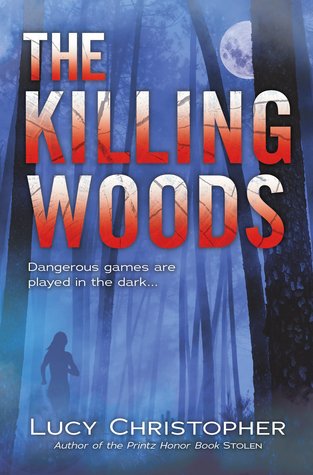
The Killing Woods
Author: Lucy Christopher
Published: January 7th, 2014 by Chicken House (Scholastic)

GoodReads Summary: Fatal attraction, primal fear, survival in the forest: From the author of the Printz Honor Book Stolen, the highly anticipated thriller about deadly games played in the dark.

Ashlee Parker is dead, and Emily Shepherd’s dad is accused of the crime. A former soldier suffering from PTSD, he emerges from the woods carrying the girl’s broken body. “Gone,” he says, then retreats into silence.

What really happened that wild night? Emily knows in her bones that her father is innocent — isn’t he? Before he’s convicted, she’s got to find out the truth. Does Damon Hilary, Ashlee’s charismatic boyfriend, have the answers? Or is he only playing games with her — the kinds of games that can kill?

Review: I absolutely loved Stolen, so I was thrilled to read another book by Lucy Christopher. This book reads more like a thriller. I was sucked into the mystery and very curious about how the plot would unravel. I think this book is most notable for the intricate descriptive details about the setting. I felt the dark coldness of the killing woods. The setting was spooky, which set the tone for the dark story. There are richly realized themes of friendship, family, and loyalty.

Teacher’s Tools for Navigation: Emily’s father suffers from PTSD. I think Lucy Christopher is delivering a message about PTSD, and it would be important for readers to think more about this. Students might find value in learning more about PTSD before, during, and after reading this book.

Discussion Questions: Why is everyone quick to blame Emily’s father? Do you think he is guilty?; What is The Game? What are the different roles that everyone plays in The Game? What does it teach us about this group of kids? Is it realistic and does it reflect people in general?

We Flagged: “I guess whoever built and buried that IED out there in the desert will never know how far that blast traveled. But all things ripple out, cause shrapnel.”

Read This If You Loved: Stolen by Lucy Christopher, The Body of Christopher Creed by Carol Plum-Ucci, Fight Club by Chuck Palahniuk, What Happened to Cass McBride by Gail Giles, The Things a Brother Knows by Dana Reinhardt, The Lovely Bones by Alice Sebold

Recommended For:

classroomlibrarybuttonsmall

RickiSig

**Thank you to NetGalley and Scholastic Chicken House for providing the Advanced Reader Copy for review!**

Fangirl by Rainbow Rowell (Ricki’s Review)

Share

16068905

Fangirl
Author: Rainbow Rowell
Published: September 10th, 2013 by St. Martin’s Griffin

GoodReads Summary: A coming-of-age tale of fan fiction, family and first love.

Cath is a Simon Snow fan.

Okay, the whole world is a Simon Snow fan . . .

But for Cath, being a fan is her life — and she’s really good at it. She and her twin sister, Wren, ensconced themselves in the Simon Snow series when they were just kids; it’s what got them through their mother leaving.

Reading. Rereading. Hanging out in Simon Snow forums, writing Simon Snow fan fiction, dressing up like the characters for every movie premiere.

Cath’s sister has mostly grown away from fandom, but Cath can’t let go. She doesn’t want to.

Now that they’re going to college, Wren has told Cath she doesn’t want to be roommates. Cath is on her own, completely outside of her comfort zone. She’s got a surly roommate with a charming, always-around boyfriend, a fiction-writing professor who thinks fan fiction is the end of the civilized world, a handsome classmate who only wants to talk about words . . . And she can’t stop worrying about her dad, who’s loving and fragile and has never really been alone.

For Cath, the question is: Can she do this?

Can she make it without Wren holding her hand? Is she ready to start living her own life? Writing her own stories?

And does she even want to move on if it means leaving Simon Snow behind?

Review: I can’t remember reading a book that felt so authentic to and aligned with my own experiences. I have this urge to buy hundreds of copies of this book and pass them out to college freshmen. Freshman year of college is an incredibly difficult time, and this book helped me remember it vividly. From Rowell’s descriptions of the domesticated squirrels to the awkwardness of roommate interactions to the feeling of entering the dining hall for the first time and not knowing where to go or where to sit (and feeling sure everyone is watching you), this book perfectly captures the minute details of college life–and all of the insecurities that come with it. I loved the parallels cast between Simon Snow’s story and Cather’s, and it inspired me to want to be a writer. This is a beautifully compelling story that will resonate with readers.

View Kellee’s review of Fangirl HERE.

Teacher’s Tools for Navigation: This would be a great book to teach along with a creative writing unit. It would inspire students to want to become stronger writers. Students could write their own fanfictions or alternate storytelling (like Nick and Cather did). Cather’s struggles as a writer are inspirational, and I am betting that most people, like me, close this book and want to get out their computers and start writing.

Very few authors are able to hone in on the minute details of humanity. I noticed Rowell’s incredible ability to do this in Eleanor & Park, and she certainly did not stop there. I would love to copy passages of this book for close readings. This would really help students understand good, powerful writing.

Discussion Questions: Cather finds it difficult to write about any world other than that of Simon Snow. Why do you think that might be?; How are Cather and Wren different? Do you think there are any underlying reasons for their differences?; What is Nick’s purpose in the novel? What does he show about Cather?

We Flagged:

“I feel sorry for you, and I’m going to be your friend.”
“I don’t want to be your friend,” Cath said as sternly as she could. “I like that we’re not friends.”
“Me, too. I’m sorry you ruined it by being so pathetic.”

“In new situations, all the trickiest rules are the ones nobody bothers to explain to you. (And the ones you can’t Google.)”

Read This If You Loved: Eleanor & Park by Rainbow Rowell, Looking for Alaska by John Green, The Perks of Being a Wallflower by Stephen Chbosky, Same Difference by Siobhan Vivian

Recommended For:

closereadinganalysisbuttonsmall litcirclesbuttonsmall classroomlibrarybuttonsmall

RickiSig

If You Find Me by Emily Murdoch

Share

 15793231

If You Find Me
Author: Emily Murdoch
Published: March 26th, 2013 by St. Martin’s Griffin

GoodReads Summary: There are some things you can’t leave behind…

A broken-down camper hidden deep in a national forest is the only home fifteen year-old Carey can remember. The trees keep guard over her threadbare existence, with the one bright spot being Carey’s younger sister, Jenessa, who depends on Carey for her very survival. All they have is each other, as their mentally ill mother comes and goes with greater frequency. Until that one fateful day their mother disappears for good, and two strangers arrive. Suddenly, the girls are taken from the woods and thrust into a bright and perplexing new world of high school, clothes and boys.

Now, Carey must face the truth of why her mother abducted her ten years ago, while haunted by a past that won’t let her go… a dark past that hides many a secret, including the reason Jenessa hasn’t spoken a word in over a year. Carey knows she must keep her sister close, and her secrets even closer, or risk watching her new life come crashing down.

Review: It has been a while since I couldn’t put a book down. This gut-wrenching tale captivated me from the very beginning. When authors try to portray emotions, they can feel superficial for readers. But Murdoch’s writing feels effortless. I connected with Carey in a way that reminded me of how I understood Melinda in Speak by Laurie Halse Anderson. My hands shook with anger in response to her pain, and as she felt overwhelmed and scared, I cried along with her. The backwoodsy dialect made the story feel real and authentic. It constantly reminded me of where Carey was coming from. Murdoch expertly unfolds the plot for readers, which adds a level of complexity but also makes readers feel as if they are coming to terms with Carey’s life right along with her. This is a beautiful, compelling story that I won’t forget.

Teacher’s Tools for Navigation: One of the strengths of this book is the special bond between the siblings. Carey’s love for her 6-year-old sister, Jenessa, fills the reader with comfort and sureness. It would be interesting for students to consider this bond and what holds these two sisters together. I could also see students researching more about child abuse and neglect. Carey and Jenessa have to make a dramatic adjustment to life on the outside, and I imagine that students will want to learn more about this struggle and its potential difficulties.

Discussion Questions: Why does Carey keep secrets? Do you agree with her decisions?; Why does Carey have difficulty forming a relationship with her father? Do you think she has been brainwashed?; What are the long-term effects of abuse? What kinds of abuse are there? Will Carey ever heal?

We Flagged:

“I answer her with my silence, understanding the full power of it for the first time. Words are weapons. Weapons are powerful. So are unsaid words. So are unused weapons” (p. 24).

“We make attachments to what’s familiar. We find the beauty, even in the lack. That’s human. We make the best of what we’re given” (p. 169).

Read This If You Loved: Speak by Laurie Halse Anderson, Room by Emma Donoghue, A Child Called “It” by Dave Pelzer, The 5th Wave by Rick Yancey (for the sibling bond and the woodsy setting), Bastard Out of Carolina by Dorothy Allison, White Oleander by Janet Fitch, Stolen: A Letter to My Captor by Lucy Christopher

Recommended For:

litcirclesbuttonsmall classroomlibrarybuttonsmall

RickiSig