Blog Tour, Giveaway, Author Guest Post, and Reviews!: Antsy Ansel: Ansel Adams, A Life in Nature by Cindy Jenson-Elliott

Share

NFPB2016

Nonfiction Wednesday

Nonfiction Picture Book Wednesday is hosted by Kid Lit Frenzy and was started to help promote the reading of nonfiction texts. Most Wednesdays, we will be participating and will review a nonfiction text (though it may not always be a picture book).
Be sure to visit Kid Lit Frenzy and see what other nonfiction books are shared this week!

antsy-adams

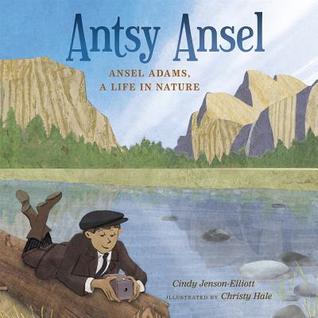
Antsy Adams: Ansel Adams, A Life in Nature
Author: Cindy Jenson-Elliott
Illustrator: Christy Hale
Published September 6th, 2016 by Henry Holt and Co.

Goodreads Summary: You may be familiar with Adams’s iconic black-and-white nature photographs. But do you know about the artist who created these images?

As a child, Ansel Adams just couldn’t sit still. He felt trapped indoors and never walked anywhere–he ran. Even when he sat, his feet danced. But in nature, Ansel felt right at home. He fell in love with the gusting gales of the Golden Gate, the quiet whisper of Lobos Creek, the icy white of Yosemite Valley, and countless other remarkable natural sights.

From his early days in San Francisco to the height of his glory nationwide, this book chronicles a restless boy’s path to becoming an iconic nature photographer.

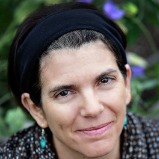
Cindy Jenson-Elliott photo

About the Author: Cindy Jenson-Elliott is the author of 17 books, a teacher and environmental educator. She teaches writing workshops through her small business Words to Go (www.wordstogosd.com) You can see her work on her website at www.cindyjensonelliott.com.

Kellee’s Review: As a child of a museum director and a photographer, Ansel Adams has been a name that I’ve known since I was quite young. He was one of the first artists whose work I could identify on my own. I was fascinated by his photographs–almost spooky in their lights and shadows but beautiful to where you cannot take your eyes off of them.

I loved learning about Ansel as a child. His story rang true as a teacher especially because there are so many kids like Ansel who are not made for the traditional setting of school yet are brilliant and should be educated a bit differently than the norm. Cindy Jenson-Elliott and Christy Hale do a very good job at showing and telling how Ansel viewed the world. With detailed illustrations, onomatopoeias, and a rhythmic texts, Ansel’s story is told in such an authentic way that really takes the reader into his brilliant mind.

Ricki’s Review: I’ve heard the name Ansel Adams, but I never connected it to the beautiful photography. I am so glad to have read this book because it made me aware of an important man that I didn’t know much about! As a mom of a son that is always itching to go outdoors, this was a great book to read to him. He felt very connected to Ansel! It also taught him all of the lessons he learns while he is outside! It is great to learn about who this man was as a child and what his life was like when he was growing up. 

Teachers’ Tools for Navigation: Ansel’s story fits into art, history, and language arts. Ansel Adams is a very significant artist of the 20th century and his story could be told within the context of art history or American history. The historical aspect in addition to the imagery, figurative language, and rhythm makes this text perfect for the classroom.

Discussion Questions: How did Ansel’s life change after his dad pulled him out of school? How did this choice affect the rest of his life?; How did Ansel’s personality differ from what the school expected of him?; Who do you think had the biggest influence on Ansel’s life?; Ansel was able to do what he loved for a living. What do you love to do? How could you make a living doing it?

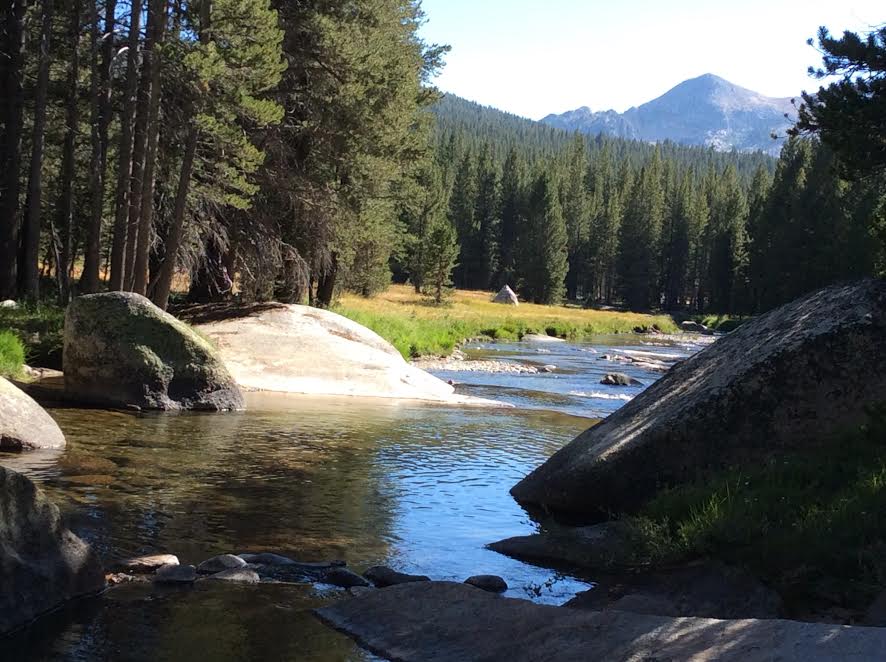
Author Guest Post: I really enjoyed working on this book, partly because I loved the character, but also because I spend a lot of time in the places Ansel Adams haunted. I went to Yosemite for the first time at the same age as Ansel Adams went. And each year, my family treks up to the High Sierra to camp and explore.

I also loved deeply immersing myself in his life and discovering so many things I had not realized: that he explored nearby nature — not far away and exotic locales — as a child, and that forged his connection with the natural world;  that he did commercial work to make a living for his family (so affirming for artists and writers who have to do the same thing!); that he was a concert pianist.

Sometimes when you deeply research a life in order to write a biography, you fall a little bit in love with your subject. Though this was my first biography, from what I understand from other biographers, that’s a common experience. I also understand that many biographers, after spending a few years with someone, fall out of love as they discover all the dimensions of a personality. That didn’t happen for me with Ansel Adams. Reading about the person, seeing where he lived and what he valued throughout his life, and particularly through reading autobiography, I felt such admiration and respect. In a well-written autobiography, you get into a state where you feel like you are experiencing a person’s essence. Reading Ansel Adams’s autobiography was like that for me — his poetic word choices, the way he described the world he lived in and his experience in that world, I had the feeling of standing beside him and seeing his world through his eyes. I wanted to carry that essence into my picture book about Ansel Adams. I wanted young readers to feel what Ansel Adams must have felt making a connection with nature in quiet Lobos Creek behind his house, or meeting his beloved Yosemite for the first time. I wanted the experience of reading Antsy Ansel: Ansel Adams, a Life in Nature, to be visceral. I hope that through my words and Christy Hale’s collage art, that people experience the world through a beautiful set of eyes.

Flagged Passages: 

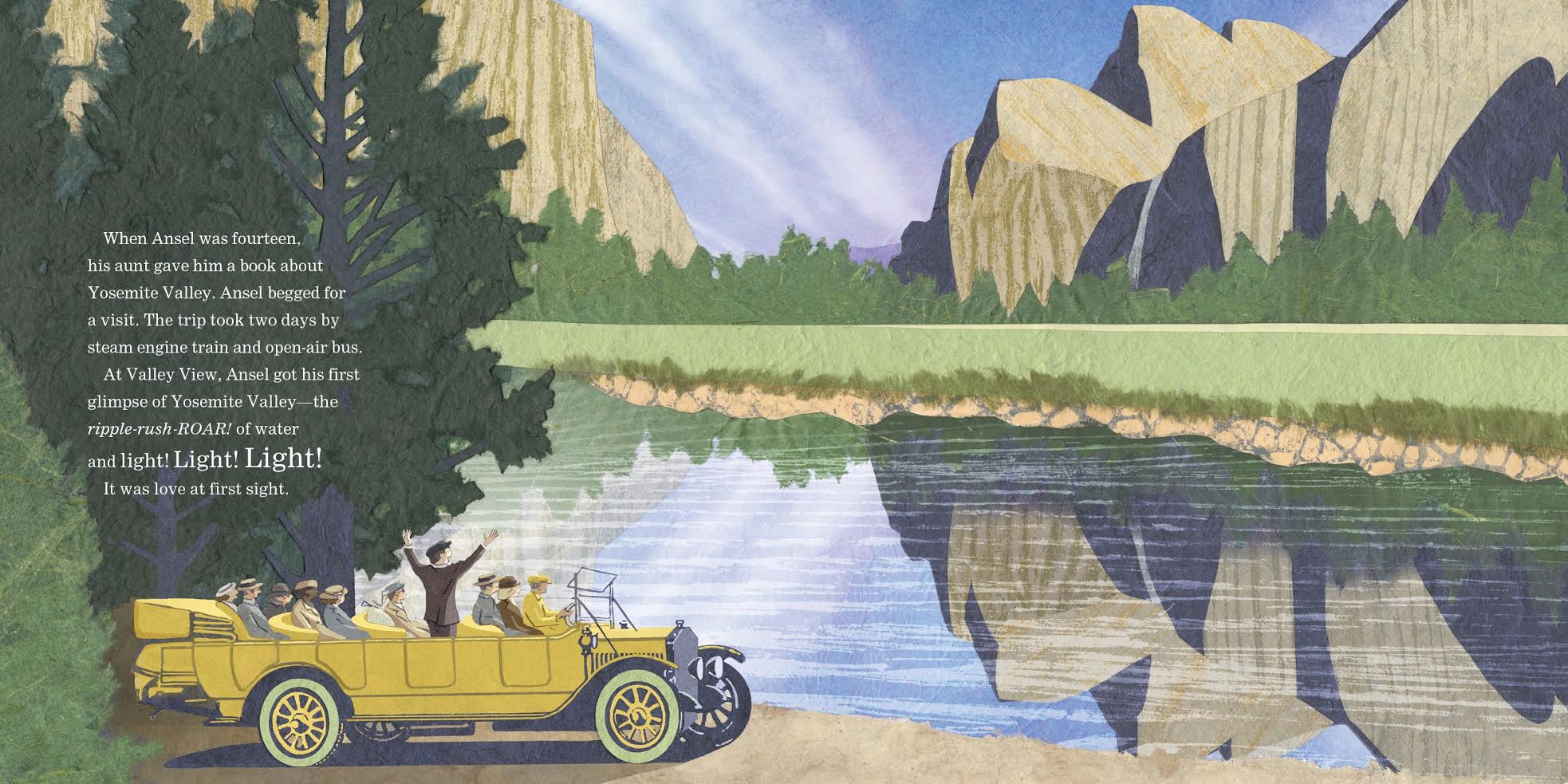
ansel-yosemite ansel-adams-spread-2

(Yosemite photographs to see the beauty and precision of Christy Hale’s artwork)

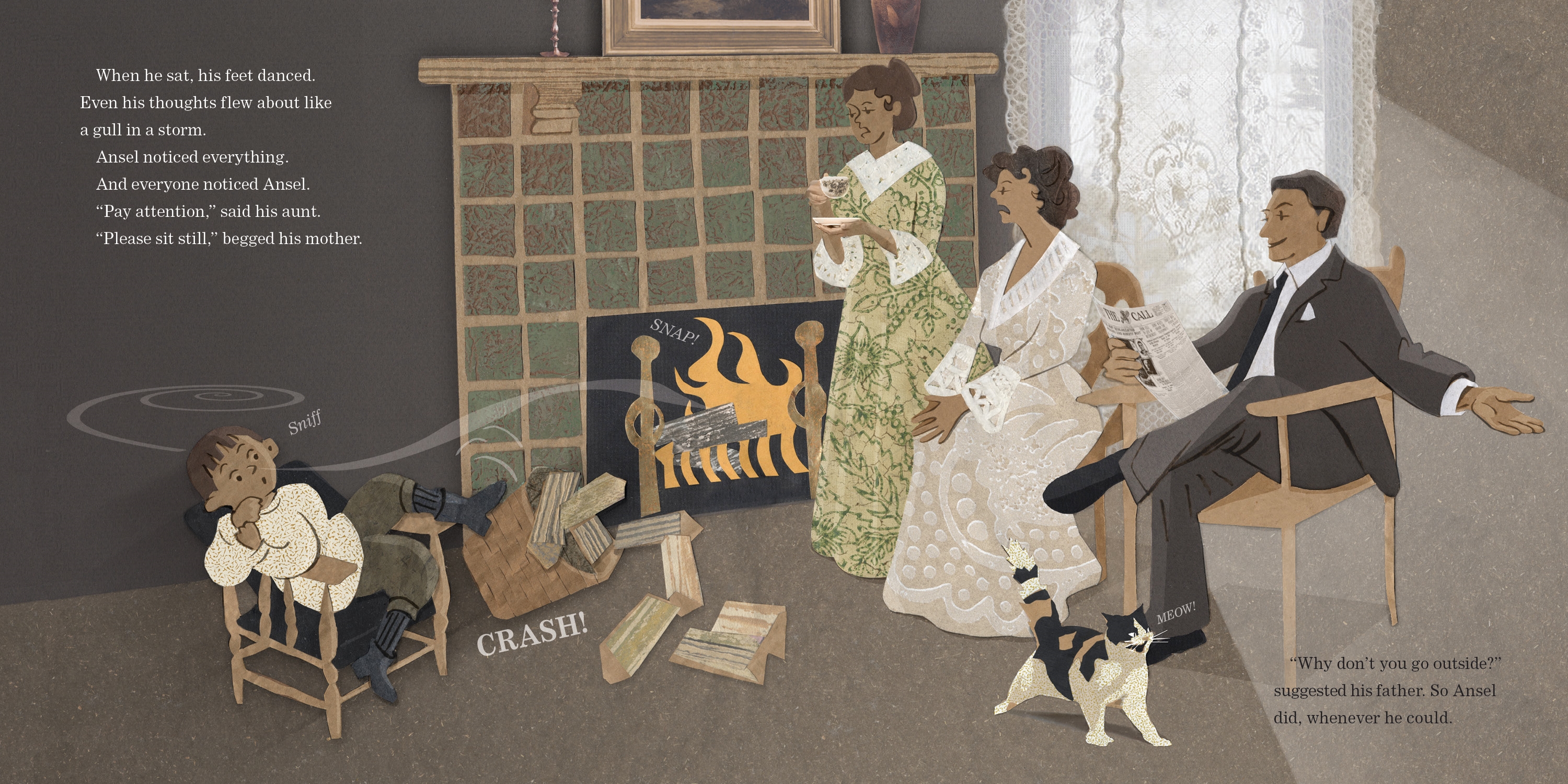
ansel-adams-spread

Read This If You Love: Art/photography, The Noisy Paintbox by Barb Rosenstock, The Museum by Susan Verde, Dorothea’s Eyes by Barb Rosenstock, Photos Framed by Ruth ThomsonThe Sky Painter by Margarita Engle, On a Beam of Light by Jennifer Berne

Recommended For: 

classroomlibrarybuttonsmall readaloudbuttonsmall closereadinganalysisbuttonsmall litcirclesbuttonsmall

Giveaway!

a Rafflecopter giveaway

Signatureand RickiSig

**Thank you to Cindy and Morgan at Macmillan for providing copies for review!**

Blog Tour with Review!: Blood Brother: Jonathan Daniels and His Sacrifice for Civil Rights by Rich Wallace and Sandra Neil Wallace

Share

NFPB2016

Nonfiction Wednesday

Nonfiction Picture Book Wednesday is hosted by Kid Lit Frenzy and was started to help promote the reading of nonfiction texts. Most Wednesdays, we will be participating and will review a nonfiction text (though it may not always be a picture book).
Be sure to visit Kid Lit Frenzy and see what other nonfiction books are shared this week!

blood-brother

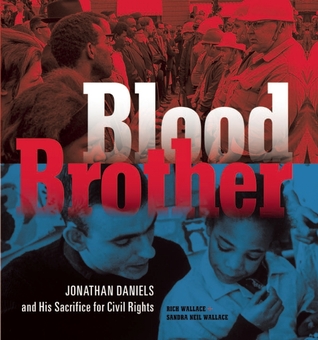
Blood Brothers: Jonathan Daniels and His Sacrifice for Civil Rights
Author: Rich Wallace and Sandra Neil Wallace
Published September 13th, 2016 by Calkins Creek

Goodreads Summary: Jonathan Daniels, a white seminary student from New Hampshire, traveled to Selma, Alabama, in 1965 to help with voter registration of black residents. After the voting rights marches, he remained in Alabama, in the area known as “Bloody Lowndes,” an extremely dangerous area for white freedom fighters, to assist civil rights workers. Five months later, Jonathan Daniels was shot and killed while saving the life of Ruby Sales, a black teenager. Through Daniels’s poignant letters, papers, photographs, and taped interviews, authors Rich Wallace and Sandra Neil Wallace explore what led Daniels to the moment of his death, the trial of his murderer, and how these events helped reshape both the legal and political climate of Lowndes County and the nation.

Blood Brother has received two starred reviews so far from Kirkus and Booklist, and a very strong review from School Library Journal:

*”This powerful biography of a little-known figure underscores the fact that civil rights workers in the 1960s South knowingly put their lives on the line for the cause…. The authors deftly convey Daniels’ complex personality, drawing from letters and interviews, including 18 they conducted. Numerous photographs, relatively large print, and an open design invite readers in… An unusually inspiring story skillfully told.”—Kirkus Reviews, starred review

*”Outside of his hometown (Keene, New Hampshire), the name Jonathan Daniels isn’t well known, but it should be… a thoroughly researched, meticulously documented biography, which is interesting from the start, but increasingly absorbing… The many well-chosen photos show up beautifully on the large, glossy pages. The riveting story of one individual among the many working for Civil Rights during the 1960s.”—Booklist, starred review

“In a masterly demonstration of scholarly research and nonfiction writing, the Wallaces have crafted a powerful biographical narrative of civil rights activist Jonathan Daniels…. careful annotations and thorough indexing help readers keep track of the many players and scenes in this true-life drama. The authors have created a biography that brings to light the life and legacy of a lesser-known civil rights activist… this visually stunning and morally significant history is highly recommended…” —School Library Journal

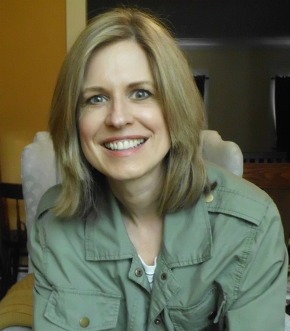
About the Authors: Sandra Neil Wallace had a lengthy career as a news anchor and ESPN sportscaster before writing realistic fiction and nonfiction for young readers. A pioneer in the journalism field, she was the first woman to cover the National Hockey League on network TV. Selected as a promising new voice in children’s literature by The Horn Book, Wallace’s titles have been named to state and national awards lists including Bank Street College’s Best Children’s Book of the Year, ALA-YALSA Quick Picks, and Booklist’s Top 10 Sports Books for Youth. Visit sandraneilwallace.com.

author_sandra_neil_wallace_2013

Rich has been writing since he was a little boy, when he wrote and illustrated his own comic books. He has since published more than 25 novels for kids and teenagers. Many of those books have been award winners. Rich has an extensive background as a writer and editor, having served for many years as a senior editor at Highlights for Children magazine. He still writes the monthly “Timbertoes” feature for that venerable publication. Writing about sports and athletes comes naturally to him, as he has competed in athletics his entire life. He was a champion runner in high school and college, and still competes in Masters track and field. He’s also played a lot of basketball and soccer. For several years he was a newspaper sportswriter.

These days, Rich continues to pen a wide range of novels in addition to writing about human nutrition and other health issues for the adult market. Rich and his wife Sandra recently moved to New England with their dog Lucy. He is the father of two sons.

author_rich_wallace

Review: This book is not just an important book for young adults to read, it is an important book PERIOD. The story of Jonathan Daniels and his impact within the Civil Rights Movement shows how rights for equality is a fight for all people, not just those who are being discriminated against. Daniels had the guts to stand up for what he believed in. The connection between Jonathan Daniels’s story and the current racial tension is scary yet hopeful because it shows how differences can be made by those who believe in equity, equality, kindness, and love.

Teachers’ Tools for Navigation: This is a text that needs to be in social studies and language arts classrooms in middle and high school. It needs to be shared. View the publisher’s Educator’s Guide, Blood Brother Educator’s Guide, to view some suggestions on how to use the text in your classroom.

Discussion Questions: How does the Civil Rights Movement compare to the Black Lives Matter movement?; Jonathan Daniels did what he knew was right even though there were dangers. What does this tell you about Daniels?; What did Daniels sacrifice for the Civil Rights Movement?; How did the structure of the text impact the central idea and theme of the text?

Book Trailer: 

Read This If You Love: Learning about the Civil Rights Movement 

Recommended For: 

classroomlibrarybuttonsmall closereadinganalysisbuttonsmall litcirclesbuttonsmall

Signature

**Thank you to Kerry at Boyds Mills Press for having me be part of the blog tour!**

Risking Exposure by Jeanne Moran

Share

risking exposure

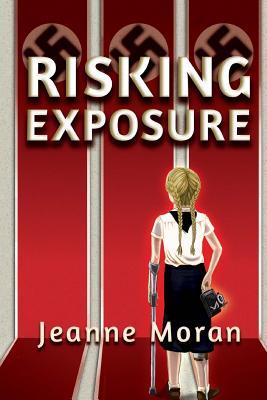
Risking Exposure
Author: Jeanne Moran
Published September 13th, 2013 by CreateSpace Independent Publishing Platform

Summary: Munich, Germany, 1938. The Nazis are in power and war is on the horizon.

Timid Sophie Adler is a member of Hitler Youth and a talented amateur photographer. When she contracts polio, her Youth leader supplies her with film. Photographs she takes of fellow polio patients are turned into propaganda, mocking people with disabilities, people just like her.

Sophie’s new disability has changed her status. She has joined the ranks of the outsiders, targets of Nazi scorn and possible persecution.

Her only weapon is her camera.

Review: Sophie’s story is one that is not often told. World War II stories often focus on the impact of the Holocaust on the Jewish population of Europe; however, what happened to those in Germany who weren’t Jewish yet the Nazis felt were useless? This story looks at one girls’ version of a story, but Sophie still is “useful” to the Nazis because she is a photographer, but she has to make a choice between taking photographs of what she is told or photographs of the truth about what is going on in Germany. 

Much of Sophie’s story is universal: bullying, friendship, family issues, etc., but readers will also learn about the Hitler Youth and the beginning of Hitler’s rise in Germany.

Teachers’ Tools for Navigation: In addition to being a book that should definitely be in classroom libraries, I could also see Risking Exposure being a perfect addition to World War II lit circles/text sets. Since Sophie’s story is so unique, it will make any set of books include more diverse stories about WWII.

Discussion Questions: If you were Sophie, would you go with what she knew was right or would you do what was ordered of you?; How did contracting polio change Sophie’s life?; How did being a photographer potentially save Sophie’s life?; How did Sophie’s kindness cause her to contract polio?; How is Sophie’s story different than other WWII stories you’ve read?; How do you think Sophie’s decision is going to affect her life?

Flagged Passages: “When Werner ordered me to grab my camera and follow him into the woods, I obeyed. He was the Scharfuhrer, the Master Sergeant. What else could I do?

My best friend Ronnie bolted to her feet alongside me. ‘You don’t need to go everywhere Sophie does, Renate,’ Wener said to her in his usual high-pitched whine. But she ignored him and winked at me as we crashed through the underbrush. Rennie got away with a certain level of disobedience. Younger sisters can.

But I wasn’t Werner’s sister. I couldn’t risk it.” (p. 3)

Read This If You Loved: The War that Saved my Life by Kimberly Brubaker Bradley, Hitler Youth by Susan Campbell Bartoletti

Recommended For:

classroomlibrarybuttonsmall litcirclesbuttonsmall

Kellee Signature

The Memory of Things by Gae Polisner

Share

the memory of things

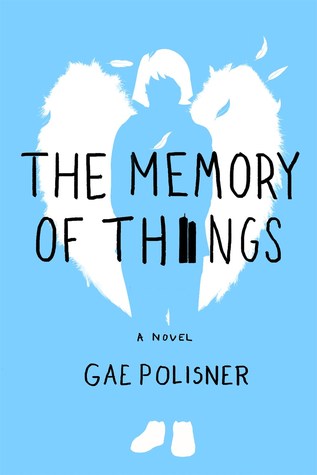
The Memory of Things
Author: Gae Polisner
Published: September 6, 2016 by St. Martin’s Griffin

GoodReads Summary: The powerful story of two teenagers finding friendship, comfort, and first love in the days following 9/11 as their fractured city tries to put itself back together.

On the morning of September 11, 2001, sixteen-year-old Kyle Donohue watches the first twin tower come down from the window of Stuyvesant High School. Moments later, terrified and fleeing home to safety across the Brooklyn Bridge, he stumbles across a girl perched in the shadows. She is covered in ash and wearing a pair of costume wings. With his mother and sister in California and unable to reach his father, a New York City detective likely on his way to the disaster, Kyle makes the split-second decision to bring the girl home. What follows is their story, told in alternating points of view, as Kyle tries to unravel the mystery of the girl so he can return her to her family. But what if the girl has forgotten everything, even her own name? And what if the more Kyle gets to know her, the less he wants her to go home? The Memory of Things tells a stunning story of friendship and first love and of carrying on with our day-to-day living in the midst of world-changing tragedy and unforgettable pain—it tells a story of hope.

Review: I read this book several weeks ago, and I still can’t thinking about it. As a few other bloggers have said, this is a book about 9/11—but it isn’t a book about 9/11. It is more a book about friendship, about growing up, and about being human. There are so many topics in this book that are worthy of discussion, and I think teachers will really appreciate its beauty. The writing is quiet yet powerful, and the book has a sort of shattering impact on readers. I loved the connections that Kyle makes in this book, and I particularly enjoyed the ways each of the individuals he interacts with tells the reader more about him. He grows from everyone in this book, and I’d love to discuss this growth with students.

Teacher’s Tools for Navigation: Teachers might ask students to research the many themes of this book to provide background information. They might look at disability/caregivers, PTSD, suicide, and 9/11—just to name a few. They could also look at the different stages of trauma to learn more about how each of the characters reacts differently to the tragic events that occurred on 9/11.

Discussion Questions: Is Kyle helping the girl, or is she helping him?; What do we learn from Kyle’s uncle? What does he teach us about disability and humanity?; In what ways does Kyle show strength, and in what ways does he show weakness? How does he grow from each experience of the text?

We Flagged: “So now I get it. Now I fully understand. Tuesday, and those planes, they’ve broken something. Permanently. And in the process, they’ve changed everything. And everyone.”

This is a quote from an advanced reader’s copy. Some quotes may change before publication.

Read This If You Loved: Extremely Loud and Incredibly Close by Jonathan Safran Foer; The Impossible Knife of Memory by Laurie Halse Anderson; Personal Effects by E.M. Kokie, The Things a Brother Knows by Dana Reinhardt, If I Lie by Corrine Jackson, Purple Heart by Patricia McCormick

Recommended For:

 litcirclesbuttonsmall classroomlibrarybuttonsmall

RickiSig

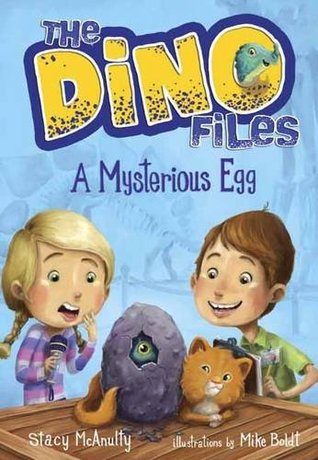
The Dino Files: A Mysterious Egg by Stacy McAnulty

Share

Dino Files 1

The Dino Files #1: A Mysterious Egg
Author: Stacy McAnulty
Illustrator: Mike Boldt
Published: January 19, 2016 by Random House Kids

Summary: What if a fossil in your backyard . . . came to life?!

Frank’s grandma is a famous paleontologist (that’s a dinosaur scientist). But she’s also an adult who makes up rules. Rules like: no digging for dinosaur bones when you have a sunburn. That means Frank is stuck playing inside with his annoying cousin, Samantha. But then Grandma finds a fossil of an egg! And when Frank and Sam sneak into the dino lab late at night, they find something even more amazing. . . .

The hilarious Dino Files chapter book series follows a nine-year-old dinosaur expert, his paleontologist grandparents, a cat named Saurus, and fossils that might not be so extinct!

About the Author: Stacy McAnulty is the author of several children’s books including Excellent Ed, illustrated by Julia Sarcone-Roach; The Dino Files series, illustrated by Mike Boldt;  and 101 Reasons Why I’m Not Taking a Bath, illustrated by Joy Ang. Stacy grew up outside of Albany, New York and received my B.S. in Mechanical Engineering from the University at Buffalo. A career opportunity brought her to central North Carolina in 1998. She currently lives in Kernersville, NC with her husband, their three children and two dogs.

Also, Stacy offers FREE Skype interviews and signed bookmarks to any class reading The Dino Files!

Ricki’s Review: This is a hilariously fun series that is sure to be a hit in classrooms. I see it working best in grades 1-4. As a child, I was disappointed when my chapter books no longer had pictures, and this book is a great transitional book because it has the best of both worlds—a great story and pictures to go along with it! Frank reminds me of many kids. He is frustrated by all of the rules set out for him, and he just wants to have fun. He manages to sneak around a bit and something awesome happens with that dinosaur egg (I’ll let you guess)! I also want to put in a plug for the fact that Frank is a cat lover. My son loves cats, and I hate how books/shows always feature males as dog lovers and females as cat lovers. I loved Saurus the cat!

Kellee’s Review: I plowed through this and the sequel because I loved the premise and the characters so much! I love that Frank and Sam represent such different types of kids within each of them and between each of them; I think so many readers will relate to their personalities. I also really liked how dinosaurs are introduced throughout the book without making the book didactical in any way. Instead it is educational and funny! This series is a wonderful introduction to early chapter books also because it is very engaging and will appeal to all kinds of readers. 

Teacher’s Tools for Navigation: This book is a great jump start to researching about dinosaurs! I know a lot of early elementary schools have a big dinosaur unit, and I think this book would appeal to readers of all ages. The book might also work well for a fossil unit, too! It would be interesting to investigate whether it would be possible to hatch a fossilized dino egg. Then, the class could have a discussion about whether this book might be considered realistic fiction or fantasy. Further activities and information is available at: www.thedinofiles.com.

Discussion Questions: What good choices does Frank make? What bad choices does he make? What are the outcomes of his choices?; What words would you use to describe Frank? How is he different or similar to you?; What rules is Frank forced to follow? Do you think these rules are fair?; How do the illustrations enhance your reading experience?

Flagged Passage: “I need to be at that dig site! Instead, I’m stuck inside the museum with PopPop. The good thing is I got my own name tag. Finally.”

Read This If You Loved: Dinosaur Cove by Rex Stone; Dinosaur Trouble by Dick King Smith; Dinosaur Pox by Jeremy Strong

Recommended For:

litcirclesbuttonsmall classroomlibrarybuttonsmall readaloudbuttonsmall

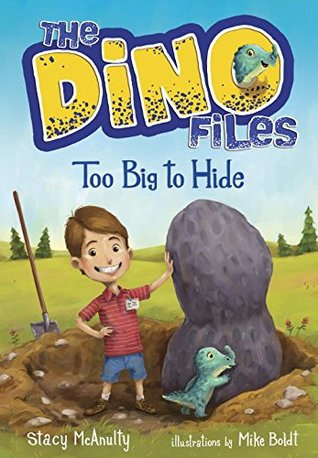
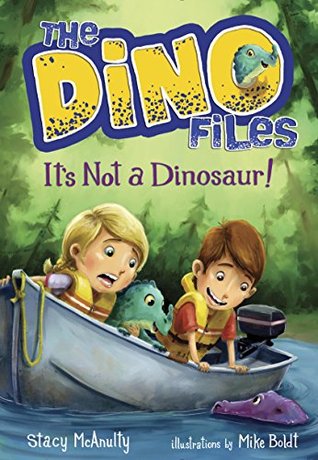
Check Out the Other Books in the Series!:
dino files 2 dino files 3

RickiSigand Kellee Signature

**Thank you to Stacy for providing copies for review!!**

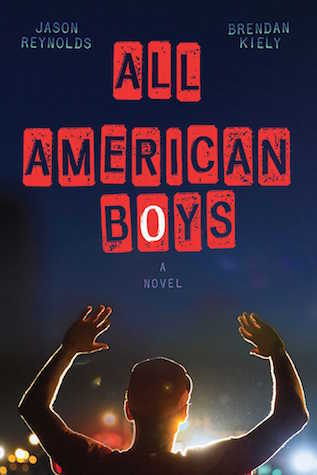
All American Boys by Jason Reynolds and Brendan Kiely

Share

All American Boys

All American Boys
Authors: Jason Reynolds and Brendan Kiely
Published: September 29, 2015 byAtheneum/Caitlyn Dlouhy Books

GoodReads Summary: Rashad is absent again today.

That’s the sidewalk graffiti that started it all…

Well, no, actually, a lady tripping over Rashad at the store, making him drop a bag of chips, was what started it all. Because it didn’t matter what Rashad said next—that it was an accident, that he wasn’t stealing—the cop just kept pounding him. Over and over, pummeling him into the pavement. So then Rashad, an ROTC kid with mad art skills, was absent again…and again…stuck in a hospital room. Why? Because it looked like he was stealing. And he was a black kid in baggy clothes. So he must have been stealing.

And that’s how it started.

And that’s what Quinn, a white kid, saw. He saw his best friend’s older brother beating the daylights out of a classmate. At first Quinn doesn’t tell a soul…He’s not even sure he understands it. And does it matter? The whole thing was caught on camera, anyway. But when the school—and nation—start to divide on what happens, blame spreads like wildfire fed by ugly words like “racism” and “police brutality.” Quinn realizes he’sgot to understand it, because, bystander or not, he’s a part of history. He just has to figure out what side of history that will be.

Rashad and Quinn—one black, one white, both American—face the unspeakable truth that racism and prejudice didn’t die after the civil rights movement. There’s a future at stake, a future where no one else will have to be absent because of police brutality. They just have to risk everything to change the world.

Cuz that’s how it can end.

Ricki’s Review: I read this book a few months ago, and frankly, I can’t stop thinking about how important this story is. We read so many books in our lifetimes, and some just take our breath away. This is one of those books. I can’t recommend this book highly enough. I believe it belongs in every classroom. The strength of the two voices in this book is remarkable, and it makes for an excellent teaching tool—about heroism; about doing what is right and true; and about being a good, decent human being. The acts within this book are all-to-common, and I believe this book promotes genuine change. The book is literary at the same time that it is engaging. It will pull (and has pulled) readers of all ages and backgrounds. I typically don’t review books long after they have been published, but this book feels too important to leave out. If you haven’t read it already, I recommend it move to the top of your TBR list. It’s and incredible story.

Kellee’s Review: I too read this book a few months ago. It was a choice for our Faculty Book Club, and it was a perfect book to discuss with a bunch of educators. All American Boys is a book that is going to be a classic because it highlights modern history in a thoughtful and truthful way. This is a book that I would recommend to everyone to read. It is a perfect jumping off point to discuss race relations, Black Lives Matter, and We Need Diverse Books. The way the book is set up, with two voices, will help readers have permission to talk about what is happening in our country, the Civil Rights movement and its tie into modern times, and the racial tension currently happening in our country.

Jason & Brendan

I’d like to also add that I recently was lucky enough to see Jason Reynolds and Brendan Kiely accept their Coretta Scott King Author Honor Award at the ALA Annual Conference here in Orlando, and they both moved me to tears. Jason actually gave two speeches since he won an honor for All American Boys and Boy in the Black Suit. His second speech was a brilliant advocacy poem titled Machetes which can be viewed here or read here. His first speech and Brendan’s speech are not available yet. Brendan says School Library Journal will be publishing his, and I am not sure about Jason’s; however, I did tweet some quotes as I sat and listened:

  • I hope The Boy in the Black Suit gives young men permission to feel and be human and sometimes need a hug. – Jason Reynolds
  • Memory in of itself is life. -Jason Reynolds
  • If you are doing this work, this award is yours too. -Jason Reynolds
  • Jason Reynolds talking about his mama made me cry. I hope my son’s love can be as true as his is.
  • There are bodies missing, and I cannot bring them back. It is time for action. -Brendan Kiely
  • Revolution begins in the heart. -Brendan Kiely
  • Love is art. Love is education. Love is accountability. And it needs repeating love is love is love is love. -Brendan Kiely
  • I want to reckon w whiteness…speak truth to myself. -Brendan Kiely

Teachers’ Tools for Navigation: This book begs to be taught in classrooms. If I was still teaching it would be the first book that I would request to be added to curriculum. I think it would be particularly fascinating to use this book as a read-aloud while simultaneously doing literature circles with by Ilyassah Shabazz and Kekla Magoon, The Rock and the River by Kekla Magoon, and How it Went Down by Kekla Magoon. These books all deal with civil rights issues, as well, and it would be interesting to look at civil rights across time and history and also within other relevant contexts.

The Simon & Schuster Reading Group Guide gives some discussion questions, journal responses, and research ideas.

Discussion Questions: How do Rashad’s and Quinn’s voices shine differently in the text?; Did Quinn do the right thing? Would you have done the same?; What would you have done if you had been in Rashad’s circumstance? Would you have done anything differently?; How is racism present both in obvious and nuanced ways in the plot events of this text?

Flagged Passage: “If you are neutral in situations of injustice, you have chosen the side of the oppressor.”

Read This If You Loved: by Ilyassah Shabazz and Kekla Magoon; The Rock and the River by Kekla Magoon; How it Went Down by Kekla Magoon; Freedom Summer by Deborah Wiles; Audacity by Melanie Crowder; The Boy in the Black Suit by Jason Reynolds

Recommended For:

readaloudbuttonsmall litcirclesbuttonsmall closereadinganalysisbuttonsmall classroomlibrarybuttonsmall

RickiSig andKellee Signature

Grimm’s Fairy Tales by the Brothers Grimm, Audio Book Collection by Listening Library

Share

Grimm's Fairy Tales

Grimm’s Fairy Tales
Author: The Brothers Grimm;
Narrators: Award Winning Cast (Various)
Published: May 10, 2016 by Listening Library

Goodreads Summary: Read by a cast of award-winning narrators, this collection contains some of the most timeless and enchanting folk and fairy tales collected by the Brothers Grimm.

The Brothers Grimm collected the original fairy tales that Americans are most familiar with today. Lyrically translated and beautifully narrated by an all-star cast, these 21 tales are selected from The Complete Grimm’s Fairy Tales and presented just as Jacob and Wilhelm Grimm originally set them down: bold, primal, just frightening enough, and endlessly engaging.

Stories include:
Rapunzel, read by Katherine Kellgren
Cinderella, read by January LaVoy
Little Red-Cap, read by Simon Vance
Little Briar-Rose, read by Grover Gardner
Little Snow-White, read by Kate Rudd
Rumpelstiltskin, read by Jim Dale
The Shoes That Were Danced to Pieces, read by Alfred Molina
A Riddling Tale, read by Janis Ian
The Twelve Brothers, read by Graeme Malcolm
The White Snake, read by Scott Brick
The Elves, read by Bahni Turpin
The Six Swans, read by Davina Porter
The Twelve Huntsmen, read by Dion Graham
The Goose-Girl, read by Edoardo Ballerini
Sweet Porridge, read by Jayne Entwistle
The Golden Goose, read by Luke Daniels
Eve’s Various Children, read by Roy Dotrice
Snow-White and Rose-Red, read by Julia Whelan
The Frog-King, or Iron Henry, read by Kirby Heyborne
The Sea-Hare, read by Mark Bramhall
Hansel and Gretel, read by Robin Miles

Ricki’s Review: I particularly loved the variety in this collection. The narrators provide their own personal touches to each fairy tale, and I found every story to be captivating. The audio format enhances the ways the stories are told. The collection contains the more popular fairy tales along with the more lesser known, and I loved listening to the stories that I had never read before. Grimm’s Fairy Tales are a staple of my childhood, and I feel lucky to share these stories with my son. I think he will really enjoy the audio form, and I hope to play them in long car rides. It will be great to stop after each fairy tale to discuss the characters and themes. I will wait until he is a bit older because the fairy tales are a bit more gruesome than the popular renditions. I appreciate the fact that Listening Library didn’t go with the typical, clean, popularized versions of the stories. It gives readers a stronger sense of the true, original works.

Kellee’s Review: I really enjoy fairy tales of all kinds and have read Grimms collections of various types over the years, but this collection is the first time that I found myself completely enthralled in the stories even though I already knew them like they were new to me. The narrators that Listening Library chose are the best in the business. I can’t even pick a favorite because they all make each story shine.  

While listening, I found so many opportunities to have discussions. From theme to similarities/differences to changes in popular versions to repetition within and through tales. I think these stories will make wonderful read alouds within my house or in my classroom.

Teachers’ Tools for Navigation: This collection provides excellent opportunities for teachers to ask students to compare and contrast elements across the fairy tales. The could listen to a different story each day (they are brief enough that this would be a great listen-aloud). Alternatively, it might be neat to have students work in groups, select stories of their choice, and share out what they learned. Then the entire class could discuss what they are hearing across stories. It would also be fun to discuss the lesser known fairy tales and why these tales may not have become as popular as the others. Lastly, students might discuss the cleansing of the works of The Brothers Grimm. Robin Kirk’s article “Painted on the Surface: The Marbury Lens and Gore in Young Adult Fiction” in the Fall 2015 issue of The ALAN Review is a great resources for teachers to consider gore in fiction, and it discusses the cleansing of The Brothers Grimm’s Fairy Tales.

Discussion Questions: Which fairy tales did you find most captivating? Why?; Which common themes across any of the fairy tales? Which themes seem to be unique to specific fairy tales?; Some of these fairy tales are more popular than others. Why do you think that is? Do you wish any of the lesser known fairy tales were more popular?

Book Trailer:

Read This If You Loved: Grimm’s Fairy Tales by The Brothers Grimm, Fairy Tale Comics by Chris Duffy, Any Fairy Tales

Recommended For: 

readaloudbuttonsmall classroomlibrarybuttonsmall litcirclesbuttonsmall

RickiSigand Kellee Signature

**Thank you to Katie at Penguin Random House for providing copies for review!**