Review and Giveaway!: Like Bug Juice on a Burger and Like Carrot Juice on a Cupcake by Julie Sternberg

Share

bug juice

Like Bug Juice on a Burger (Eleanor #2)
Author: Julie Sternberg
Illsutrator: Matthew Cordell
Published April 2nd, 2013 by Amulet Books

Goodreads Summary: I hate camp. I just hate it. I wish I didn’t. But I do. Being here is worse than bug juice on a burger. Or homework on Thanksgiving. Or water seeping into my shoes. In this sequel to the critically acclaimed Like Pickle Juice on a Cookie, Eleanor is off to summer camp. At first she’s excited to carry on the family tradition at Camp Wallumwahpuck, but when she gets there she finds icky bugs, terrible food, and worst of all: swim class, where she just can’t seem to keep up with everyone else. But as the days go on, Eleanor realizes that even the most miserable situations can be full of special surprises and that growing up is full of belly flops. 

Review and Teachers’ Tools for Navigation: This book definitely brought back memories! I loved the idea of summer camp and many of the activities, but I hated the bugs and the food and the changing in front of other people. There are many times when I was away that I just wanted to go home; however, there were things that saved me- specifically, like Eleanor, the animals. I loved working in the barn with the horses and it is what saved me and then got me going back year after year. I remember walking into the barn and being able to be part of these horses’ lives and the scene where Eleanor meets Cornelius the goat brought me right back to that moment. 

This book would be a wonderful read aloud for right before summer because even if students are not going to summer camp, there is probably something new and scary that they will try this summer and this book will definitely cause discussion about how something new may be scary, but that doesn’t mean you won’t like it eventually. Julie Sternberg’s writing also lends itself to some amazing discussions about free verse poetry and, in this one, letter writing. Maybe use the letter writing part of the book to segue into writing a letter to next year’s class. 

Finally, I love the idea of the Wall of Feelings! The Wall of Feelings is where the campers put up how they feel about camp; however, Eleanor is given the job of writing about how she used to feel about camp and then how she feels about camp now. What a great way for students to express themselves! This would be a great formative assessment for looking at how students feel about reading or school or some other topic at the beginning of the year vs. the end. 

Discussion Questions: Think about a time in your life when you did something you were scared to do. How did you overcome your fear/nervousness? How did it turn out in the end?  

We Flagged: “The bus was bumping
down a gravel road
with bushes and trees and weeds all around. 
This isn’t beautiful
I thought. 
This is creepy
I missed sidewalks full of people
checking their phones
and walking their cute dogs. 
I missed paved roads, too, 
filled with taxis and bik riders.” (Chapter 5) 
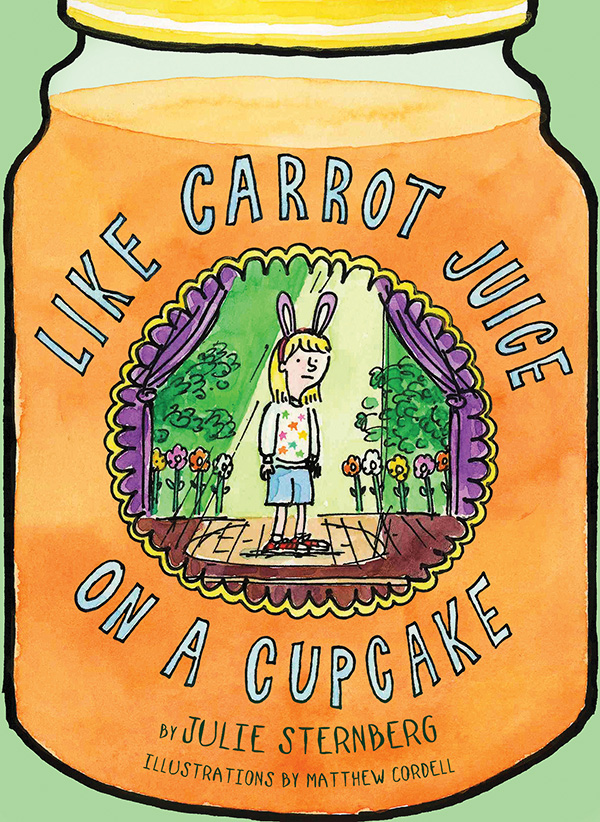
Like Carrot Juice on a Cupcake_cover (1)

Like Carrot Juice on a Cupcake
Author: Julie Sternberg
Illustrator: Matthew Cordell
Published March 18th, 2014 by Amulet Books

Goodreads Summary: I did a mean thing.
A very mean thing.
I HATE that I did it.
But I did.
This is worse than
carrot juice on a cupcake
or a wasp on my pillow
or a dress that’s too tight at the neck.
In the third installment from the team who created Like Pickle Juice on a Cookie and Like Bug Juice on a Burger, Eleanor’s relationship with her best friend, Pearl, experiences its first growing pains. When a glamorous new student transfers to school, at first Eleanor’s excited about the possibility of a new friend. But when Pearl is assigned to be the new girl’s buddy, Eleanor fears she can’t compete. To make matters worse, Eleanor’s been chosen for the lead role in the springtime musical, which means she has to sing a solo in front of the entire school!
From overcoming stage fright to having a secret crush, young readers will relate to Eleanor as she navigates the bittersweet waters of growing up.

Review and Teachers’ Tools for Navigation: This book has multiple levels going on at the same time. There is the story of Eleanor and Pearl’s friendship and their first speed bump. Then there is Eleanor getting the lead in the play, and dealing with the fear of singing a solo. Eleanor dealing with her puppy having trouble getting house trained. And finally, the Eleanor and Nicholas story. But Sternberg balances it all because it is just all part of Eleanor’s life. Julie Sternberg is so great at writing in an elementary student’s voice. It is so authentic and well done!

What I love so much about all of the “Eleanor” books are that they are written in verse, and Eleanor is an amazing poet. I love that it is free verse and includes such beautiful language, but it never comes off as anything but authentic. Teachers could definitely take Eleanor’s writing and use it as a mentor text for students to write about their own experiences.

Discussion Questions: Have you ever hurt a friend’s feelings? What did you do to make it better?; How was Eleanor able to overcome her stage fright?; Why was Eleanor so scare and jealous of Ainsley?; Do you think Eleanor likes Nicholas?


Read These If You Loved: Like Pickle Juice on a Cookie by Julie Sternberg, Marty McGuire and Marty McGuire Digs Worms by Kate Messner, Where I Live by Eileen Spinelli, Go Out and Play! by KaBoom!, Lunch Lady and the Summer Camp Shakedown by Jarrett Kroscozka, Camp Babymouse by Jenni and Matt Holm, Bink and Gollie by Kate DiCamillo, Ramona books by Beverly Cleary

Curriculum Guide for All of the “Eleanor” Books Can be Found Here.

Both Books Recommended For: 

classroomlibrarybuttonsmall closereadinganalysisbuttonsmall readaloudbuttonsmall

GIVEAWAY

a Rafflecopter giveaway

Signature

**Thank you to Barbara at Blue Slip Media for providing copies for review**
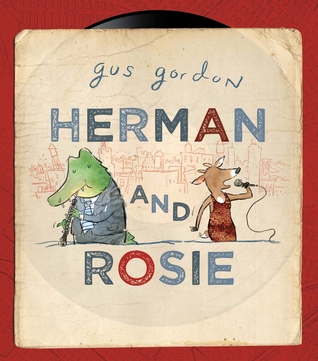
Herman and Rosie by Gus Gordon

Share

herman

Herman and Rosie
Author and Illustrator: Gus Gordon
Published October 15th, 2013 by Roaring Brook Press

Goodreads Summary: Once upon a time in a very busy city, on a very busy street, in two very small apartments, lived…
 Herman and Rosie. Herman liked playing the oboe, the smell of hot dogs in the winter, and watching films about the ocean. Rosie liked pancakes, listening to old jazz records, and watching films about the ocean. They both loved the groovy rhythm of the city, but sometimes the bustling crowds and constant motion left them lonely, until one night …

My Review: This book is a love note to music and for finding a friend to share your love. This wonderful story is told in a way that makes you fall in love with the characters immediately and feel every up and down with them. Also, the illustrations in this picture book are probably some of my favorite ever. I love the cartoony style mixed with some mixed media. Beautiful.

Teachers’ Tools for Navigation: I think this book will find its most love as a read aloud and as a wait to promote music and other passions; however, the book could definitely be used in other ways in the classroom. The tone and mood of the book takes a drastic turn about halfway through and would be a good introduction to these two narrative elements. It is interesting to look at how the illustrations helped drive the change. Also, there are onomatopoeias throughout that add to the imagery of the book.

Discussion Questions: How does music bring Herman and Rosie together?; Would Herman and Rosie every had become friends without the bad event happening to them?; How are Herman and Rosie similar? Different?

We Flagged: 

“Herman lived on the seventh floor. He liked potted plants, playing the oboe, wild boysenberry yogurt, the smell of hot dogs in the winter, and watching films about the ocean.”

Read This If You Loved: Marvin Makes Music by Marvin Hamlisch, Jazz ABZ by Wynton Marsalis, Ella Fitzgerald and Duke Ellington by Andrea Davis Pinkney, The Fantastic Undersea Life of Jacque Cousteau by Dan Yaccarino

Recommended For: 

readaloudbuttonsmall classroomlibrarybuttonsmall

Signature

Baseball Is… by Louise Borden

Share

NF PB 2014

Nonfiction Picture Book Wednesday

Nonfiction Picture Book Wednesday is hosted by Kid Lit Frenzy and was started to help promote the reading of nonfiction texts. Most Wednesdays, we will be participating and will review a nonfiction text (though it may not always be a picture book).
Be sure to visit Kid Lit Frenzy and see what other nonfiction books are shared this week!

baseball

Baseball Is…
Author: Louise Borden
Illustrator: Raul Colon
Published February 18th, 2014 by Margaret K. McElderry Books

Goodreads Summary: The ultimate celebration of an all-American sport, this picture book captures the joy and the history of baseball;and knocks it out of the park!

Don’t wait for Opening Day to start your baseball season! Crack open Baseball Is…; and revel in the fun of this all-American game! Perfect for the stats-counting superfan and the brand-new little leaguer,Baseball Is…; captures the spirit of this cherished pastime, honoring its legendary past, and eagerly anticipating the future of the sport that is stitched into our history.

My Review: I am a huge baseball fan, have been for over 24 years now, so I am a sucker for baseball books. This one is special though. It captures the beauty of the baseball stadiums around the country, the intricacies of the sport, and the amazing history that baseball holds. I also love the choice of telling baseball’s story in verse. It made it rhythmic like the sport.

Teachers’ Tools for Navigation: This book is a wonderful mentor text for free verse. The poetry is very rhythmic, but has  no rhyme. The book also has some amazing vocabulary: craftsman, poise, spectators, finesse, etc. It captures the sport through imagery: “the crack of the bat,” “slow stride of the manager,” “groans or boos,” etc.

On top of the poetic aspects of the book, you can learn so much about baseball and history from the book. It discusses greats like Babe Ruth and Jackie Robinson. Also talks about the Negro and Women’s Leagues. All parts of history in general, not just baseball.

Discussion Questions: How did Jackie Robinson change the game?; Why was their a Women’s League?; What sounds would you hear at a baseball game?

We Flagged: 
“Baseball is our game…
the sport of America.
Its stories are stitched
through our nation’s history.
Its teams and its heroes
we carry in our heart.” (p. 1-2)

Read This If You LovedBarbed Wire Baseball by Marissa Moss, Chin Music by Lee Edelstein, Something to Prove: The Great Satchel Paige vs. Rookie Joe DiMaggio by Robert Skead, Brothers at Bat: The True Story of an Amazing All-Brother Baseball Team by Audrey Vernick, Silent Star: The Story of Deaf Major Leaguer William Hoy by Bill Wise, The Legend of the Curse of the Bambino by Dan Shaughnessy

Recommended For: 

closereadinganalysisbuttonsmall classroomlibrarybuttonsmall readaloudbuttonsmall

Signature

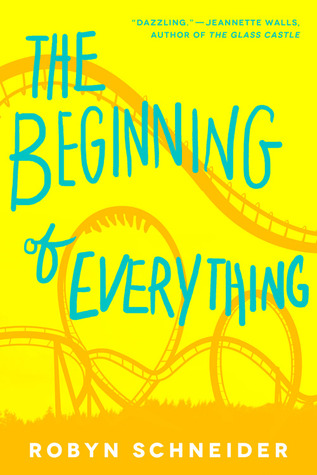
The Beginning of Everything by Robyn Schneider

Share

beginning

The Beginning of Everything
Author: Robyn Schneider
Published August 27, 2013 by Katerine Tegen

Goodreads Summary: Golden boy Ezra Faulkner believes everyone has a tragedy waiting for them—a single encounter after which everything that really matters will happen. His particular tragedy waited until he was primed to lose it all: in one spectacular night, a reckless driver shatters Ezra’s knee, his athletic career, and his social life.

No longer a front-runner for Homecoming King, Ezra finds himself at the table of misfits, where he encounters new girl Cassidy Thorpe. Cassidy is unlike anyone Ezra’s ever met, achingly effortless, fiercely intelligent, and determined to bring Ezra along on her endless adventures.

But as Ezra dives into his new studies, new friendships, and new love, he learns that some people, like books, are easy to misread. And now he must consider: if one’s singular tragedy has already hit and everything after it has mattered quite a bit, what happens when more misfortune strikes?

Robyn Schneider’s The Beginning of Everything is a lyrical, witty, and heart-wrenching novel about how difficult it is to play the part that people expect, and how new beginnings can stem from abrupt and tragic endings.

My Review: Another novel filled with smart high schoolers—that makes me so happy!! I hope this is a trend because I love seeing brainy characters in my book and not stereotypical ones. The Beginning of Everything is described as witty, and it is very much so. The sarcasm and wit just bleeds out of this book. I found myself laughing out loud at parts, and usually just because a character had the audacity to say something they shouldn’t have.

In The Beginning of Everything, I actually connected more with the secondary characters than the protagonist. They were so well established and had such unique voices while Ezra sounded like any good-0le boy; however, I will say that by making his voice less distinct allowed for him to grow even in his prose. As he found his new, true identity, his voice became to ring out more true. I am not sure if the author did this on purpose or not, but either way it worked!

Oh, and the final pages. Guys, they were so good! Although it felt a bit rushed to me, the lyrical writing got me in the end. Perfect.

Teachers’ Tools for Navigation: Although this book’s main home is in teens’ hands from a classroom, school, or public library, there are definitely parts that can be pulled out to be used in a classroom.

Since the characters are intelligent, many of the conversations have allusions to literature (Mary Oliver, Shakespeare, Fitzgerald, Frost) or their topics are quite deep (connecting organic chemistry to life, panopticon, Banksy, German insults). Also, there are debate topics that would be so interesting to look into such as imperialism, capitalism, and the economy.

One fun activity that I would definitely pull out of this book is fake debates. When Ezra, Toby, Cassidy, etc. were at their debate tournament, they had fake debates where they had to choose a side of quite silly topics like “Should vampires be allowed to vote?” This would be a great activity to do in classes to work on persuasion and arguments. (However, be careful about actually reading aloud the scene this is in as they also make it a drinking game.)

Discussion Questions: Do you feel like we live in a society similar to the panopticon? [If you don’t know what this is, it is quite fascinating: http://en.wikipedia.org/wiki/Panopticon]; Do you think Cassidy made the right choice in the end?; Ezra truly connects with The Great Gatsby because of all the changes his life is going through. What book to you connect with and why?

Flagged: “Her face was inches from mine. I could see the freckles that dusted her nose and the gold flecks in the disquieting blue of her eyes.” (p. 111)

“My admirable opponent argues that vampires do not deserve suffrage, as many great yet misinformed politicians have done before her while calling for the continued marginalization of women, or other minorities.” Cassidy began. “Yet vampires were, at some point human. At what point can a man’s voting rights be revoked, if he is proven to be of rational mind?” (p. 157)

Read This If You Loved: Life in Outer Space by Melissa Kiel, Stargirl by Jerry Spinelli, Paper Towns by John Green

Recommended For: 

classroomlibrarybuttonsmall closereadinganalysisbuttonsmall

Signature

Amulet Books Graphic Novel Teaching Guide

Share

abrams

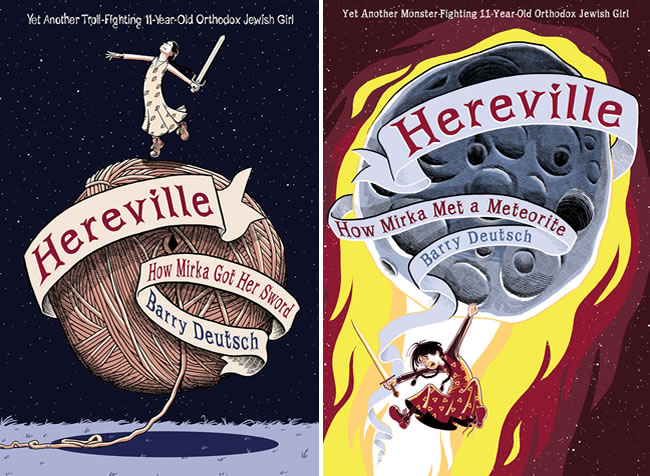
In January, I was contacted by a publicity and marketing associate from Abrams Books/Amulet Books out of the blue. In this email, I was asked to work on a teaching guide about their graphic novels: The Misadventures of Salem Hyde, Nathan Hale’s Hazardous Tales, Hereville, and the Explorer series.

1729025518405488 

13591161135911621729026018405492

1283377017290285

I was beyond honored! And, of course, I said that I would definitely love to do it as I had read all of the graphic novels, and I am a huge fan of them.

First, they asked me to write an introduction about graphic novels and their importance in the classroom. I am a huge advocate for using graphic novels in schools, so I immediately began researching and writing. Here is the introduction:

What are graphic novels? The easiest way to describe graphic novels is to say that they are book-length comic books. However, a more complex definition that educators and librarians use is “book-length narratives told using a combination of words and sequential art, often presented in comic book style” (Fletcher-Spear, 37). Graphic novels are not written in just one genre; they can be in any genre, since graphic novels are a format/medium. Graphic novels are much like novels, but they’re told through words and visuals. They have all narrative elements, including characters, a complete plot, a conflict, etc.

Middle grade and young adult graphic novels cover a wide spectrum of themes and topics. Some common themes found in graphic novels for this age include the hero’s journey; overcoming hardship; and finding one’s identity. For example, in Hereville, we meet Mirka, an everyday girl who learns to use her brains and brawn to overcome her foes. In The Misadventures of Salem Hyde, Salem is working on finding out just who she is (both as a witch and as a person) with the help of her friend Whammy. Graphic novels can cross curricular lines. One example is the Nathan Hale’s Hazardous Tales series—comical nonfiction that takes historical events and presents them in interesting ways, using graphics and humor that will make students want to learn even more about the historical time periods. In the Explorer series, stories include topics such as animal adaptation, volcanic eruptions, and the fate of humanity. Like novels, graphic novels offer opportunities in all subject areas to extend students’ thinking.

Over the past few years, graphic novels have become a hot topic, growing in popularity with both children and educators. While many teachers are beginning to include them in the classroom, there are still teachers, administrators, and librarians who struggle with including this format in their schools. So, why should you use them in your classroom and have them available for students?

  • Graphic novels can make a difficult subject interesting and relatable. (Cohen)
  • Students are visual learners, and today’s students have a much wider visual vocabulary than students in the past. (Karp)
  • Graphic novels can help foster complex reading skills by building a bridge from what students know to what they still have to learn. (NCTE)
  • Graphic novels can help with scaffolding when trying to teach higher-order thinking skills or other complex ideas.
  • For students who struggle to visualize while they read, graphic novels provide visuals that shows what good readers do. (NCTE)
  • Many graphic novels rely on symbol, allusion, satire, parody, irony, and characters/plot and can be used to teach these, and other, literary devices. (Miller; NCTE)
  • Often, in between panels (called the gutter), the reader must make inferences to understand how the events in one panel lead to the events in the next. (McCloud)
  • Graphic novels can make differentiating easier. (Miller)
  • Graphic novels can help ELL (English Language Learners) and reluctant and struggling readers since they divide the text into manageable chunks, use images (which help students understand unknown vocabulary), and are far less daunting than prose. (Haines)
  • Graphic novels do not reduce the vocabulary demand; instead, they provide picture support, quick and appealing story lines, and less text, which allow the reader to understand the vocabulary more easily. (Haines)
  • Research shows that comic books are linguistically appropriate reading material, bearing no negative impact on school achievement or language acquisition. (Krashen)
  • Students love them.

Although you can find graphic novel readers at all reading levels, graphic novels can truly be a gateway to the joys of reading for reluctant and struggling readers. Reluctant readers often find reading to be less fun than video games, movies, and other media, but many will gravitate toward graphic novels because of the visuals and the fast pace. Struggling readers will pick up graphic novels for these reasons as well but also because the graphic novel includes accommodations directly in the book: images, less text, etc.

All in all, graphic novels can interest your most reluctant and struggling readers and also extend all of your readers, including your most gifted.  

Resources

  • Cohen, Lisa S. “But This Book Has Pictures! The Case for Graphic Novels in an AP Classroom.” AP Central. CollegeBoard.
  • Fletcher-Spear, Kristin, Merideth Jenson-Benjamin, and Teresa Copeland. “The Truth About Graphic Novels: A Format, Not a Genre.” The ALAN Review Winter (2005): 37­–44.
  • Haines, Jennifer. “Why Use Comics in The Classroom?” Comic Book Daily. N.p., 20 Mar. 2012.
  • Karp, Jesse. “The Case for Graphic Novels in Education.” American Libraries. N.p., 1 Aug. 2011.
  • Krashen, Stephen. The Power of Reading. Englewood, CO: Libraries Unlimited, Inc. 1993.
  • McCloud, Scott. Understanding Comics. Northampton, Mass.: Kitchen Sink, 1993. 
  • Miller, Andrew. “Using Graphic Novels and Comics in the Classroom.” Edutopia. N.p., 11 Jan. 2012.
  • NCTE, comp. “Using Comics and Graphic Novels in the Classroom.” The Council Chronicle September (2005) http://www.ncte.org/magazine/archives/122031.

 I then began reading and rereading the graphic novels and planning activities and discussion questions that could go along with each book. I was asked to come up with activities for all subjects, so this pushed me out of my comfort zone a bit; however, I loved trying to figure out how these amazing books could be used throughout all classes.  Some examples:

  • Salem Hyde [Science]: At the end of Spelling Trouble, Salem and Whammy have to rescue a whale, but it is done in a very unconventional way. How would real scientists rescue a whale in distress?
  • Hazardous Tales [Language Arts/History]: The Provost (a British soldier) and Nathan Hale disagree about the cause of the Revolutionary War. Based on One Dead Spy, what events caused the Americans to revolt? Do you agree with the Provost or with Nathan Hale about the causes of the war? (This could also be used as a debate question in class.)
  • Hereville [Math]: On pages 31–32 [of Hereville 1], Mirka is given a math problem: Three people are splitting a cake, so they cut it into thirds. But then a fourth person shows up. How can they cut the cake so that each person gets an equalamount of cake? (Mirka comes up with a solution, but are there others?) What if two more people had shown up? Three more? Four more? 
  • Explorer [History]: On page 84 [of The Mystery Boxes], in The Soldier’s Daughter, the man says, “War is a dark power.” Where in history have we seen war consume someone? Have there been wars that did not need to be fought? Research past wars and determine if a war was started because of the need for power or if there was a legitimate reason for it. 

These are just some examples.

I am happy to share the entire teaching guide with you. It can be found at http://www.abramsbooks.com/academic-resources/teaching-guides/ along with other teaching guides. The direct link to the PDF is http://www.abramsbooks.com/pdfs/academic/GraphicNovels_TeachingGuide.pdf.

I hope you find it useful as I am very proud of it,

Signature

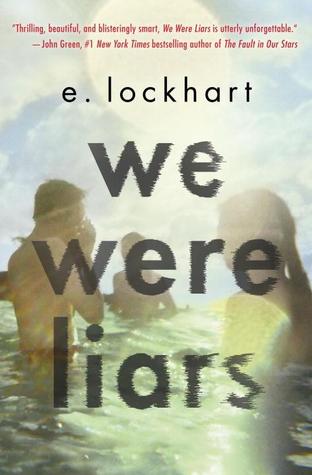
We Were Liars by e. lockhart

Share

we were liars

We Were Liars
Author: e. lockhart
Expected Publication: May 13th, 2014 by Delacorte

Summary: A beautiful and distinguished family.
A private island.
A brilliant, damaged girl; a passionate, political boy.
A group of four friends—the Liars—whose friendship turns destructive.
A revolution. An accident. A secret.
Lies upon lies.
True love.
The truth.

We Were Liars is a modern, sophisticated suspense novel from National Book Award finalist and Printz Award honoree e. lockhart.

Read it.
And if anyone asks you how it ends, just LIE.

Review: I can’t tell you anything about this book without giving anything way, and I would never do that to you, so let me just say this—this is a book that I will remember forever. It is haunting and sent chills up my spine. I was sucked into the story of this beautifully screwed up family with too much money for its own good.

Teacher’s Tools for Navigation: This would bridge beautifully with The Great Gatsby. There are so many parallels, and I can’t write them here, or I will give away too much of the plot. The figurative language in this title is also stunning. English teachers will go gaga over the pages upon pages of text that can be used for close reading. It made me want to go back to teaching English!

Discussion Questions: What does this story teach us about humanity?; What drives each of the family members?; What does Gat’s character add to the story?; How does lockhart unravel the plot? What makes her an effective writer?; What is the message of this complex text?

We Flagged: “If you want to live where people are not afraid of mice, you must give up living in palaces” (Chapter 40).

Please note: The above quote is from the Advanced Reader Copy. The chapter numbers is included instead of page numbers because the e-reader did not provide page numbers. The quotes may change when the book is published.

Read This If You Loved: The Great Gatsby by F. Scott Fitzgerald, I Will Save You by Matt de la Peña, If I Stay by Gayle Forman

Recommended For:

closereadinganalysisbuttonsmall litcirclesbuttonsmall classroomlibrarybuttonsmall

RickiSig

Locomotive by Brian Floca (Kellee’s Review)

Share

NF PB 2014

Nonfiction Picture Book Wednesday

Nonfiction Picture Book Wednesday is hosted by Kid Lit Frenzy and was started to help promote the reading of nonfiction texts. Most Wednesdays, we will be participating and will review a nonfiction text (though it may not always be a picture book).
Be sure to visit Kid Lit Frenzy and see what other nonfiction books are shared this week!

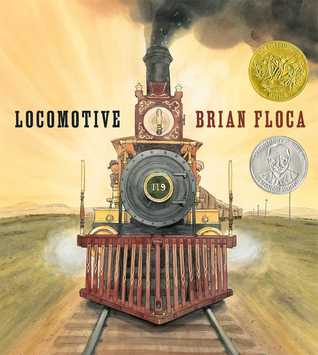
locomotive

Locomotive
Author and Illustrator: Brian Floca
Published September 3rd, 2013 by Atheneum Books for Young Readers

Goodreads Summary: The Caldecott Medal Winner, Sibert Honor Book, and New York Timesbestseller Locomotive is a rich and detailed sensory exploration of America’s early railroads, from the creator of the “stunning” (Booklist)Moonshot.

It is the summer of 1869, and trains, crews, and family are traveling together, riding America’s brand-new transcontinental railroad. These pages come alive with the details of the trip and the sounds, speed, and strength of the mighty locomotives; the work that keeps them moving; and the thrill of travel from plains to mountain to ocean.

Come hear the hiss of the steam, feel the heat of the engine, watch the landscape race by. Come ride the rails, come cross the young country!

My Review: Rhythm. Onomatopoeias. (Well-researched) History. Gorgeous (and historically accurate) illustrations. Lyrical narrative. Unique point of view. This book has everything.

YOU (second person POV!) are a passenger on a train cross America with your family in 1869. Throughout the book, you will encounter many different landmarks, experience things on a train very few had at this time in history, and learn about the intricacies of the train. So fascinating! And all told in rich, beautiful language. It is hard to even share much more about the book because it is such an experience.

Check out Ricki’s review of Locomotive as well HERE.

Teachers’ Tools for Navigation: I would LOVE to read this to kids. There are so many places to stop and discuss and research and learn, but never without an enthralling story accompanying.  It would be a great book to use across subjects. There are definitely opportunities for all subjects: social studies (trans-continental travel, history, trains); science (the science of steam engines); math (travel); reading/writing (onomatopoeia, point of view, rhythm).

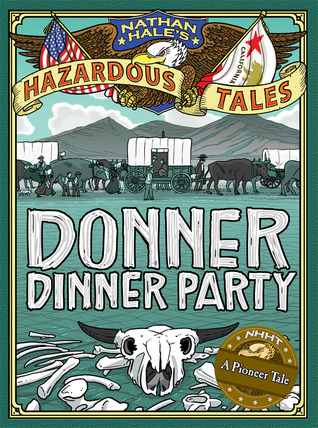
Also, and this is fresh on my mind because I just read it, but I would love to read this and The Donner Dinner Party and then look at the two journeys. How long did each take? Dangers? It would be an interesting look at how trains truly changed transportation.

Discussion Questions: How does having the book in 2nd point of view make it more enthralling?; What onomatopoeias were used in the book? How did these words help suck you into the story?; How did the author’s rhythm make you feel like you are actually on the train?; What are the landmarks that were passed on the trans-continental railroad? Why are these landmarks significant?; How does a steam engine work? What are the jobs of all of the different people on board?

We Flagged:
“Here is how this road was built,
with a grunt and a heave and a swing,
with the ring of shovels on stone,
the ring of hammers on spikes:

CLANK CLANK CLANK!

Men came from far away
to build from the East,
to build from the West,
to meet in the middle.

They cleared the rocks
and dug the tunnels.
They raised the hammers
and brought them down—

“Three strokes to the spike,
ten spikes to the rail!”

CLANK CLANK CLANK!”

Read This If You Loved: The Donner Dinner Party by Nathan Hale, Train by Elisha Cooper

Recommended For: 

readaloudbuttonsmall closereadinganalysisbuttonsmall classroomlibrarybuttonsmall

Signature