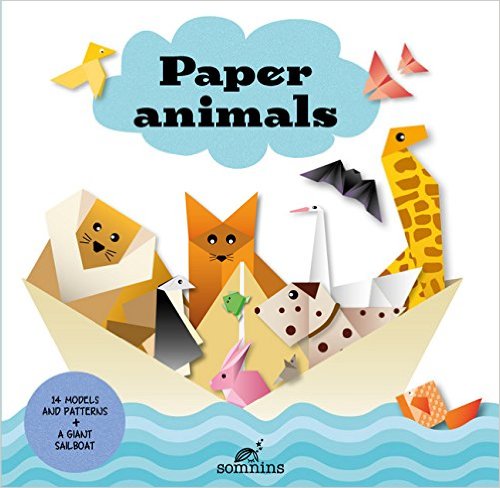
Paper Animals by Kane Miller Books

Share

Paper Animals

Paper Animals
Published: December 5, 2016 by Kane Miller Books

Goodreads Summary: In this book there are 14 different animals, with step-by-step instructions and different levels of difficulty, which will help you become an origami expert. Once you have all the animals ready, fold the giant boat at the end of the book and take all the passengers on board! Included are thirty pages of patterned paper, with printed fold lines. Develops hand eye co-ordination. Learn a form of communication without language. Focuses patience and increases self-esteem. Well-suited to a classroom of 30 or more students. Creates and manipulates basic geometric shapes such as squares, rectangles, and triangles. Reflects the ingenuity and aesthetics of Japanese culture; children gain appreciation of a different culture, opening a doorway to exploration and increased tolerance. Learn the ancient art of origami! In this book there are 14 different animals, with step-by-step instructions and different levels of difficulty.

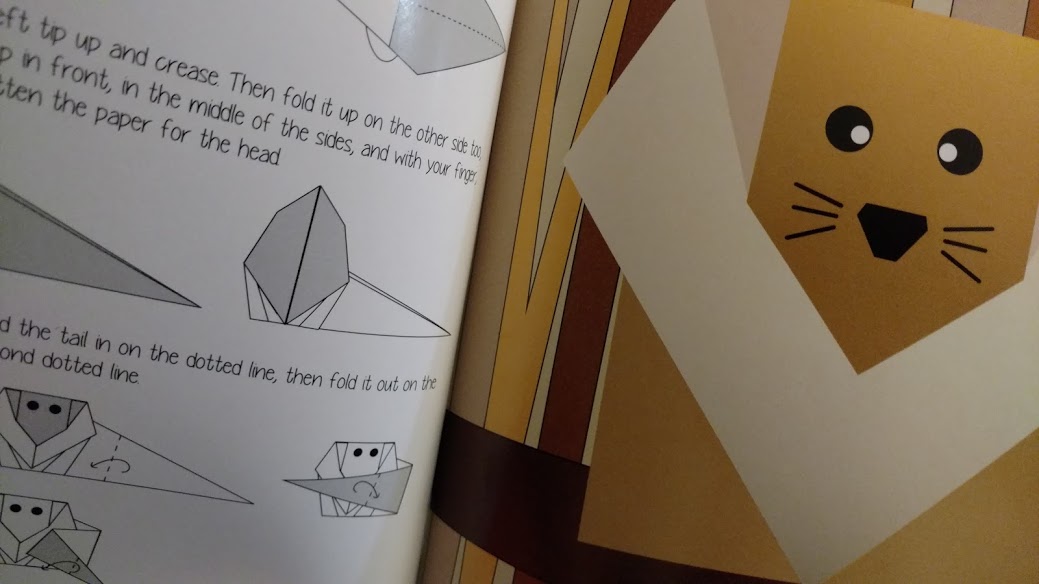
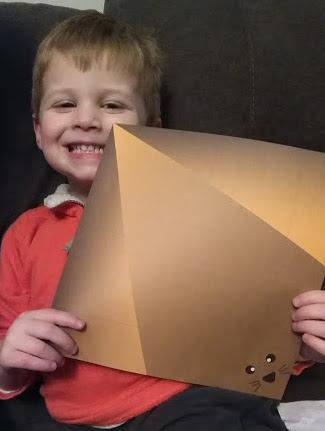
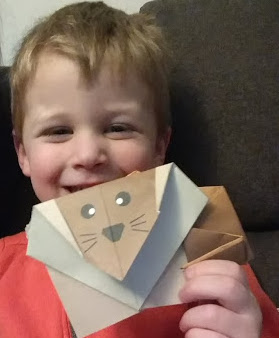
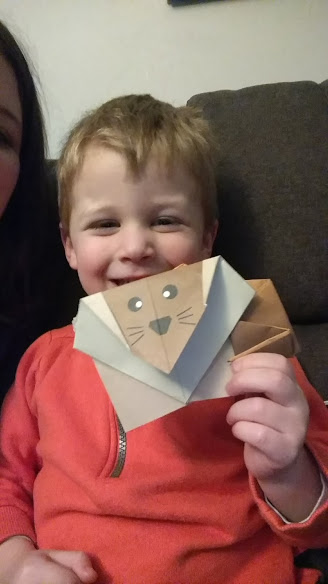
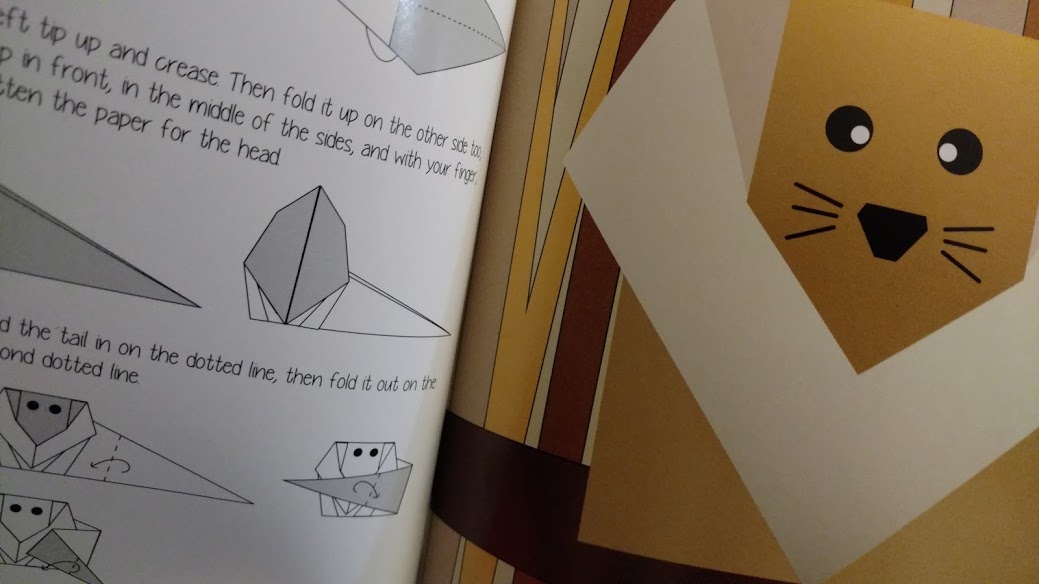
My Review: I have always enjoyed origami, so this book made me feel a bit nostalgic. The first half of the book features pictures of the finished products and directions. The second half of the book includes origami paper that is tailored to each of the animals in the front of the book. So, for example, there is a lion instruction page in the first half of the book, and there is a page of lion origami paper at the end of the book that includes dotted lines for folds and a lion face! My three-year-old is absolutely obsessed with this book. We do one paper animal per day, and we put the animal inside of the giant book (included in the back of the book). He is too young to do the folding himself, but he cheers me on as I fold the paper. I would recommend this book to upper elementary schoolers through adults. Even as an adult, I found some of the paper animals to be very tricky.

Teachers’ Tools for Navigation: In high school, we were required to give a speech that included very specific instructions for participants. I made an origami crane and my peers followed my instructions at their seats. It would be fun to use this as a model for the speech activity. As an alternative, students might create their own origami animal with instructions! This would be hard to do, but it would be great fun!

Discussion Questions: What aspects are important when we give instructions? How did the authors of this book make the instructions easier to follow?; Which animals proved more difficult to make, and why?

Flagged Spread: 

origamil2

origami3 origami4

Read This If You Loved: Activity Books; Origami

Recommended For: 

 classroomlibrarybuttonsmall

RickiSig

Enter Title Here by Rahul Kanakia

Share

entertitlehere-rahulkanakia

Enter Title Here
Author: Rahul Kanakia
Published: August 2, 2016 by Disney-Hyperion

Summary: I’m your protagonist—Reshma Kapoor—and if you have the free time to read this book, then you’re probably nothing like me.

Reshma is a college counselor’s dream. She’s the top-ranked senior at her ultra-competitive Silicon Valley high school, with a spotless academic record and a long roster of extracurriculars. But there are plenty of perfect students in the country, and if Reshma wants to get into Stanford, and into med school after that, she needs the hook to beat them all.
What’s a habitual over-achiever to do? Land herself a literary agent, of course. Which is exactly what Reshma does after agent Linda Montrose spots an article she wrote for Huffington Post. Linda wants to represent Reshma, and, with her new agent’s help scoring a book deal, Reshma knows she’ll finally have the key to Stanford.
But she’s convinced no one would want to read a novel about a study machine like her. To make herself a more relatable protagonist, she must start doing all the regular American girl stuff she normally ignores. For starters, she has to make a friend, then get a boyfriend. And she’s already planned the perfect ending: after struggling for three hundred pages with her own perfectionism, Reshma will learn that meaningful relationships can be more important than success—a character arc librarians and critics alike will enjoy.

Of course, even with a mastermind like Reshma in charge, things can’t always go as planned. And when the valedictorian spot begins to slip from her grasp, she’ll have to decide just how far she’ll go for that satisfying ending. (Note: It’s pretty far.)

My Review: Whew! I really enjoyed this book! Rahul Kanakia really nails the pressure that overachievers experience. I was reminded of myself a bit. Reshma is willing to do anything to maintain her valedictorian status, and she takes things a bit too far. She is such an unlikeable character that I found her to be quite likable. I notice the GoodReads ratings of this book are high (a 3.58 average) but not incredibly high, and I laughed. Books with unlikable characters are always unfairly low in their ratings. When I put this book down, I felt like I’d learned a lot. Reshma feels like a real person because she makes some major mistakes. She is an anti-hero. I had difficulty putting the book down because I wanted to see how far she would go, and it made me cringe a bit. This book evoked a visceral reaction out of me!

Teachers’ Tools for Navigation: I would love to teach this book because it would evoke some excellent classroom discussions. Reshma represents the ugly side of many people, and I think that readers will have strong reactions to her selfishness. I’d particularly like to dive into her relationship with her mother. Readers could discuss family histories and how these may influence our decisions and our concepts of self.

This book is a great way to introduce metafiction. It would be very interesting to tease apart how the plot relates to the narrator’s book.

Discussion Questions: How do Reshma’s parents differ? How do they influence her decisions? What impact do they have on her as a person?; Does Reshma go too far? What are the consequences? Would you have gone as far as she did?; Why might the author have chosen to write the book as if Reshma was writing it? How does this impact your reading of the text?

Flagged Passage: “The thing no one understands about me is that sometimes, once in a while, I get this feeling like I can do anything, and that feeling is so rare and so beautiful that it’s really hard not to simply surrender to it.”

Read This Book If You Loved: The Secret Side of Empty by Maria E. Andreu; I Crawl Through It by A.S. King


Recommended For: 

classroomlibrarybuttonsmall litcirclesbuttonsmall

  RickiSig

The Sun is Also a Star by Nicola Yoon

Share

the sun is also a star

The Sun Is Also a Star
Author: Nicola Yoon
Published: November 1, 2016 by Delacorte

Summary: Natasha: I’m a girl who believes in science and facts. Not fate. Not destiny. Or dreams that will never come true. I’m definitely not the kind of girl who meets a cute boy on a crowded New York City street and falls in love with him. Not when my family is twelve hours away from being deported to Jamaica. Falling in love with him won’t be my story.

Daniel: I’ve always been the good son, the good student, living up to my parents’ high expectations. Never the poet. Or the dreamer. But when I see her, I forget about all that. Something about Natasha makes me think that fate has something much more extraordinary in store—for both of us.

The Universe: Every moment in our lives has brought us to this single moment. A million futures lie before us. Which one will come true?

My Review: This book shines brightly. It is more than a love story. The description of the text doesn’t quite do it justice. While reading Nicola Yoon’s words, I thought of politics, I thought of the universe, I thought of science, and I thought of culture. Natasha and Daniel have a lot of baggage, and their family histories have formed who they are. Both are strong characters who want to be better than some of the mistakes their family members have made. I appreciated the depth of this text.

Teachers’ Tools for Navigation: I love talking about immigration in the classroom because it is a great opportunity for powerful discussions. I would love to talk about Natasha’s situation and students’ opinions about it. This might allow students an opportunity to look at immigration laws and how they impact others.

Throughout the text, Yoon provides snippets of other characters’ lives. These snippets impact the narrators, and it would be interesting to discuss how each snipped changes the way we read the story.

Discussion Questions: Is Natasha’s father entirely wrong in his approach to life? Can you find some redemption in his poor decisions?; Do you believe in fate? How can we tie this story to science?; Does Natasha’s family deserve to go home? Do you think they should be allowed to stay in the United States of America?; What role does Daniel’s father play in the development of the story?

Flagged Passage: “There’s a Japanese phrase that I like: koi no yokan. It doesn’t mean love at first sight. It’s closer to love at second sight. It’s the feeling when you meet someone that you’re going to fall in love with them. Maybe you don’t love them right away, but it’s inevitable that you will.”

Read This Book If You Loved: Everything, Everything by Nicola Yoon; Eleanor and Park by Rainbow Rowell; The Secret Side of Empty by Maria E. Andreu


Recommended For: 

classroomlibrarybuttonsmall litcirclesbuttonsmall

  RickiSig

How the World Was: A California Childhood by Emmanuel Guibert

Share

NFPB2016

Nonfiction Wednesday

Nonfiction Picture Book Wednesday is hosted by Kid Lit Frenzy and was started to help promote the reading of nonfiction texts. Most Wednesdays, we will be participating and will review a nonfiction text (though it may not always be a picture book).
Be sure to visit Kid Lit Frenzy and see what other nonfiction books are shared this week!

How the World Was

How the World Was: A California Childhood 
Author: Emmanuel Guibert; Translation: Kathryn Pulver
Published: July 15, 2014 by First Second

Summary: In 1994, French cartoonist Emmanuel Guibert befriended an American veteran named Alan Cope and began creating his new friend’s graphic biography. Alan’s War was the surprising and moving result: the story of Cope’s experiences as an American GI in France during World War II.

How the World Was is Emmanuel Guibert’s moving return to documenting the life of his friend. Cope died several years ago, as Guibert was just beginning work on this book, but Guibert has kept working to commit his friend’s story to paper. Cope grew up in California during the great depression, and this remarkable graphic novel details the little moments that make a young man’s life…while capturing the scope of America during the great depression.

A lyrical, touching portrait, How the World Was is a gift for a dear friend in the last moments of his life… and also a meditation on the birth of modern America.

Review: Many of you know Emmanuel Guibert’s graphic novel Alan’s War. Guibert is a French cartoonist who tells the true story of Alan Cope, an American GI in France in WWII. How the World Was: A California Childhood depicts Alan’s earlier childhood experiences, growing up during the Great Depression in California. The graphic novel is unlike others that I’ve read, and I really enjoy Guibert’s style. The chapters read like vignettes of Cope’s childhood; some of the scenes are graphic, and many are quite moving. This text would be excellent for close reading, and I don’t think readers even need to read it in its entirety to appreciate and understand each chapter.

Teacher’s Tools for Navigation: I’d love to use this text in the classroom, and I would probably use a single chapter. (This would inspire readers to take the entire book out on their own, which is a style I love to use when I am teaching.) I was particularly moved by the end of the book, where Alan’s mother goes in for surgery. I’d love to do a close reading of this section to discuss author’s purpose and Alan’s identity development.

Discussion Questions: How does this graphic novel differ from others that you’ve read?; How is the author’s writing style similar to short vignettes? Why might he have chosen to write the book in this why? Is it effective for you, the reader?; What scenes stand out to you? Why might this be?

Flagged Passage: I’ve included a section that stands out to me. It is a bit peculiar to include in a graphic novel, but there is a lesson in the pages that follow. I imagine that censors would be horrified to see this page alone, but within the context of the chapter, it is a very important scene.

how the world was

Special thanks to http://goodokbad.com/index.php/reviews/how_the_world_was_review for sharing this scene in his reviews. It’s a good one.

Read This If You Love: The Photographer by Emmanuel Guibert; Alan’s War by Emmanuel Guibert; The Stranger by Albert Camus; The House on Mango Street by Sandra Cisneros

Recommended For:

closereadinganalysisbuttonsmall classroomlibrarybuttonsmall

RickiSig

The Secret Side of Empty by Maria E. Andreu

Share

the secret side of empty

The Secret Side of Empty
Author: Maria E. Andreu
Published: March 11, 2014 by Running Press

Summary: As a straight-A student with a budding romance and loyal best friend, M.T.’s life seems as apple-pie American as her blondish hair and pale skin. But M.T. hides two facts to the contrary: her full name of Monserrat Thalia and her status as an undocumented immigrant.

But it’s harder to hide now that M.T.’s a senior. Her school’s National Honor Society wants her to plan their trip abroad, her best friend won’t stop bugging her to get her driver’s license, and all everyone talks about is where they want to go to college. M.T. is pretty sure she can’t go to college, and with high school ending and her family life unraveling, she’s staring down a future that just seems empty. In the end, M.T. will need to trust herself and others to stake a claim in the life that she wants.

Author Maria E. Andreu draws from her personal experience as a (formerly) undocumented immigrant to explore an issue that affects over one million children in the U.S. But while the subject matter is timely, it is M.T.’s sharp, darkly funny voice and longing for a future that makes this story universally poignant.

My Review: In the last year, I have met many people who have told me that they were or are undocumented immigrants. Immigration reform is a hot topic in politics right now, and I can’t help but wonder if people are thinking about others in terms of their humanity. I’ve become increasingly heavy-hearted as I have listened to speeches about immigration, and I longed to learn more about the topic. After searching news articles, research studies, statistics, and government websites, I felt that I needed more story, and so I picked up this book from the library. It received excellent reviews, and I understand why. The author draws upon her personal experiences as a formerly undocumented immigrant, and the narrator, M. T., feels very real. I learned about some of the struggles undocumented immigrants experience, and I am grateful for all that I learned from this book. M. T. deals with other complex issues beyond her immigrant status—relationship issues, domestic abuse, and contemplations of suicide. There is so much to discuss regarding the text. I loved the book and am so glad I found it. I highly recommend it.

Teachers’ Tools for Navigation: This is a fantastic book to discuss undocumented immigrants with students. It would be wonderful to help students consider aspects of immigration reform and explore other perspectives. The author is featured in this article about Donald Trump.

Discussion Questions: How might the author’s perspective have influenced her work?; What do you learn about immigration? How does this influence, change, or solidify your beliefs?; How does M. T.’s relationship with Nate evolve? Do you agree with everything he did?; Did M. T. make the right decision to leave home? Why or why not?

Flagged Passage: I will always be a stranger everywhere. With my parents, I am too American. With Americans, I am a spectator with my nose pressed against their windowpanes, watching their weird rituals and rites of passage, never quite understanding them completely. A little chunk of me will always be a stranger everywhere, different chunks of stranger in different situations. (p. 98).

Read This Book If You Loved: Return to Sender by Julia Alvarez, Ask Me No Questions by Marina Budhos, Girl in Translation by Jean Kwok, Illegal by Bettina Restrepo


Recommended For: 

classroomlibrarybuttonsmall litcirclesbuttonsmall

  RickiSig

Supercars (Mean Machines Series) by Kane Miller Books

Share

NFPB2016

Nonfiction Wednesday

Nonfiction Picture Book Wednesday is hosted by Kid Lit Frenzy and was started to help promote the reading of nonfiction texts. Most Wednesdays, we will be participating and will review a nonfiction text (though it may not always be a picture book).
Be sure to visit Kid Lit Frenzy and see what other nonfiction books are shared this week!

supercars

Supercars
Published: March 2016 by Kane Miller Books

Kane Miller Summary of the Mean Machine Series: Sure to get your young car enthusiast revved up, the Mean Machines series is pedal-to-themetal, fast and furious fun … from the comfort and safety of your living room! Which customized car has a top speed of 252 mph? Which engine has a nitrous oxide injector? Which car’s nickname is the Black Bat? Which car has a plasma TV inside the truck?! Find out!

Ricki’s Review: My favorite aspect of this book (and the series) is that readers of all levels will enjoy it. My toddler absolutely loves the pictures and can’t get enough of them. This book has not left our house since we received it a few weeks ago. He says, “What’s this, Mama?” to every picture on every page. My husband has also enjoyed this book, and I love to watch the two of them engrossed in the pictures and text. This is a book that reminds me that there is so much that I don’t know about cars. I may not be able to pronounce some of the terms in the book, but I most certainly have fun trying! I suspect this book will remain on our couch for several more weeks (if not months), and I am quite all right with that. 

Teachers’ Tools for Navigation: This would be a great book to spark research projects. Teachers might give students a copy of one of the books in this series and ask them to research cars that would fit into the other texts of the series. They might also investigate why certain cars are included while others aren’t.

Discussion Questions: Which car is the fastest? Which is the largest? Which has the most power?; What differences do you see between the cars? What similarities do you see?; What makes these cars “super”?; Which car would you most want to own and why?

We Flagged a spread from the Performance Cars book, which looks similar to Supercars (but with different cars):

url-1

Read This If You Love: Cars!

Recommended For: 

classroomlibrarybuttonsmall

RickiSig

**Thank you to Lynn for providing a review copy!**

Ricki’s 2016 NCTE and ALAN Experience

Share

2016-ncte

If you haven’t been to the NCTE (National Council of Teachers of English) convention or ALAN (Assembly on Literature for Adolescents of the NCTE) Workshop and you love books, this would be a real treat to yourself. The NCTE convention occurs each November the Thursday through Sunday before Thanksgiving. Then, the ALAN Workshop occurs the Monday and Tuesday following the NCTE convention. Attendees include teachers, librarians, teacher educators, authors, and publishers. I’ve gone every year since 2006, and I absolutely love attending.

I love meeting all of the great, incredible new authors. But this year, I was able to meet two of my childhood icons, Ann M. Martin, author of The Baby-Sitters Club series and S. E. Hinton, author of The Outsiders.

15107368_10103729408876601_8402640874323432055_n

Ann M. Martin

15037313_10103730362984561_1890780387595358292_n

S. E. Hinton

The NCTE convention allows us to fulfill our childhood dreams, but it also helps us fulfill adult dreams. This year, I was honored to chair a panel that featured Laurie Halse Anderson, E. K. Johnston, and Amber Smith at the ALAN Workshop. Laurie led the discussion, which was centered on issues of rape and healing. All three authors have phenomenal books that critically examine this topic.

lha-panel

Me, E. K. Johnston, Laurie Halse Anderson, Amber Smith

My first presentation was “Opportunity for Advocacy: Examining Young Adult Literature’s Treatment of Erased Identities and Histories.” I was really proud with how this presentation went! Wendy, Kellee, and I presented different ways that young adult texts erase or deny identities and how this can be used to promote advocacy. Two of the handouts that emerged from this session will be available this Wednesday and Thursday

30208

Me, Kellee, Wendy

I also presented at a roundtable session, “Advocating for Hope: The Amelia Elizabeth Walden Award and Its Importance in Promoting and Providing a Positive Outlook.” We used the Amelia Elizabeth Walden Award books to show different creative ways to help students search for messages of hope. We also discussed how to create text sets of hope.

30221

Advocating for Hope Roundtable

I also presented at a roundtable in the “Culturally Diverse Young Adult Literature: Voices of Advocacy & Community” session. Meg Medina and Kekla Magoon started out the presentation and discussed the importance of culturally diverse literature to promote advocacy. My roundtable featured Kekla Magoon’s How it Went Down. We talked about how interdisciplinary ideas, like dog-whistle politics, could be used to help students analyze perspective and work toward advocacy.

My last presentation was in a paper panel called “Examining Responses to Young Adult Literature in English Education and English Language Arts Classrooms.” Wendy Glenn and I talked about our research study about the ways students labeled as struggling negotiated their reading identities in nontraditional and traditional English courses. The full paper is available in the Research in the Teaching of English‘s August 2016 journal. The article is published here.

I also attended some great presentations about identity, equity, and advocacy (my interests). I learned so much and am very excited to keep rethinking my instruction and research.

From old friends to new, I am always excited by the incredible connections I make at this conference. I am lifted up by the individuals who share this passion for reading and feel so grateful for my NCTE and ALAN families. Thank you all for another wonderful year that invigorated me and made me feel even more alive and excited to begin this next year—for I genuinely believe that reading saves lives.

Until next year, friends! Will I see you there? 

2017-ncte-web_banner_660x133

RickiSig