Review and Educators’ Guide: Taking Cover: One Girl’s Story of Growing Up During the Iranian Revolution by Nioucha Homayoonfar

Share

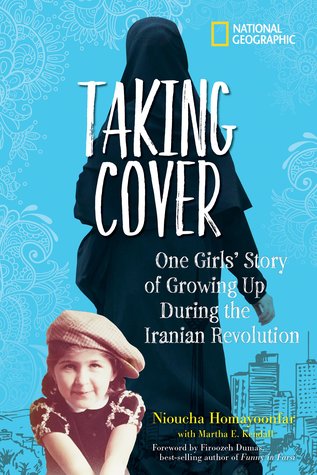
Taking Cover: One Girl’s Story of Growing Up During the Iranian Revolution
Author: Nioucha Homayoonfar
Foreward by Firoozeh Dumas
Published January 1st, 2019 by National Geographic Children’s Books

Summary: In the mid 1970’s Nioucha Homayoonfar’s French mother and Iranian father made a decision that would change her life forever. At the age of five, Nioucha and her parents moved from Pittsburgh to her father’s homeland of Iran, at the time a modern, bustling country where people from different religions co-existed peacefully and women and men alike pursued the highest level of education and professional opportunities. A new school, new language, and new friends took some time to get used to.  But none of that compared to the changes that Nioucha experienced during and after the Iranian revolution of 1979. Once the Ayatollah took control, full robes and head scarves were required, religion classes became mandatory and boys were no longer allowed to interact with girls.  Her life continued to be filled with family, friends, pop music and even her first boyfriend (although both the music and the boyfriend were strictly prohibited), but Tehran had become barely recognizable as bombs were dropped on her neighborhood, loved ones and even Nioucha herself were kidnapped, acquaintances were executed and day by day, their freedom was chipped away.

Publishing in time for the 40th anniversary of the Iranian revolution, Taking Cover reveals the extraordinary story of Nioucha’s struggle to adjust, to understand and to figure out her place in the world while unrest and oppression swirled around her.  Additionally, this title is a unique blend of coming-of-age storytelling and history. Coupled with a thought-provoking forward by New York Times best-selling author Firoozeh Dumas (Funny in FarsiTaking Cover encourages readers to take a deeper look at the importance of protecting religious, political, and social freedoms while Nioucha’s vivid descriptions of Iranian life — the food, the smells, and its customs — exposes readers to a country and culture rarely written about.

Review: Generally, our system of history education and media focus do not set up Americans with great global information which is evident in the many nonfiction and historical fiction books I’ve encountered in my recent lifetime that have taught me so much about the world. This is one of those books.

This memoir does a special thing in being a beautiful narrative that at its heart is about a young girl growing up but is also addresses the true prejudice against women in Iran as well as teach some basics about the Islam faith and the Iranian Revolution. It is hard to balance these objectives but Taking Cover does it really well which makes it perfect for middle school readers because the story will engage them while they are exposed to a time period and place that they may know little about, as I did.

Side note: Is anyone else really impressed by the vivid memories that some have of their childhood? That is another thing I took away from this book–I remember a lot less than others! Excerpts from the memoir would be wonderful as a mentor text about writing about memories using imagery.

Side note: I would love to do a memoir book club with diverse voices including Taking Cover! I was thinking Born a Crime (the new young reader edition), Hey KiddoOpen Mic, and March Book One-Three. What other titles do you know of that would fit this idea?

Educators’ Guide provided by the publisher:

Flagged Passages: “CHAPTER 1: Fury 1986 (Part 1)

Javabe ablahan khomooshist. -Persian Proverb
Silence is the best answer to fools.

I knew I was in trouble when the white jeep made a U-turn. Driven by the Zeinab Sisters (or the Black Crows, as I called them), it raced toward me and screeched to a stop.

My mother was pushing my brother in a stroller. She had already crossed the street, but I’d lagged behind. So when the ‘Moral Police’ pulled in front of me, I was all alone. Their job was to ensure that all women and girls dressed in a manner dictated by Islam. To set an example, these four were covered head to toe in black chadors, and some even wore gloves.

The Black Crow sitting in the back seat jumped out and grabbed my arm without saying a word. I caught my mother’s eye just as I was being pushed inside the jeep. Maman stood helplessly, screaming across the traffic for the Crows to let me go.” (p. 11)

Read This If You Love: Memoirs, Learning about unreported history, Expanding your knowledge of the world

Recommended For: 

classroomlibrarybuttonsmall

Signature

**Thank you to Karen at Media Masters Publicity for providing the book for review!**

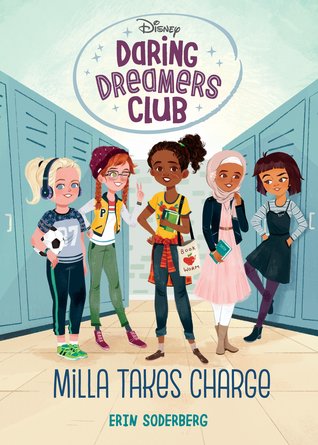
Daring Dreamers Club: Milla Takes Charge by Erin Soderberg

Share

Daring Dreamers Club #1: Milla Takes Charge
Author: Erin Soderberg
Illustrator: Anoosha Syed
Published June 5th, 2018 by Random House

Summary: When you follow your dreams, the possibilities are endless!

Milla loves nothing more than imagining grand adventures in the great wide somewhere, just like Belle. She dreams of traveling the world and writing about her incredible discoveries. Unfortunately, there is nothing pretend about the fifth-grade overnight and Milla’s fear that her moms won’t let her go.

Enter Piper, Mariana, Zahra, and Ruby. Together with Milla, they form the Daring Dreamers Club and become best friends. But can they help Milla believe she’s ready for this real grand adventure?

Diverse, talented, and smart–these five girls found each other because they all had one thing in common: big dreams. Touching on everyday dramas and the ups and downs of friendship, this series will enchant all readers who are princesses at heart.

About the Creators: 

ERIN SODERBERG lives in Minneapolis, MN, with her husband, three adventure-loving kids, and a mischievous Goldendoodle named Wally. Before becoming an author, she was a children’s book editor and a cookie inventor and worked for Nickelodeon. She has written many books for young readers, including the Quirks and Puppy Pirates series. Visit her online at erinsoderberg.com.

ANOOSHA SYED is a Pakistani illustrator & character designer for animation. She received her BFA in illustration at Ceruleum: Ecole d’arts Visuels in Switzerland, and now lives in Canada. Visit her online at anooshasyed.com.

Praise: 

“Though core issues of identity, independence, and teamwork ground the novel, Disney Princess devotees will likely be the most charmed. —Publishers Weekly

“I cannot wait to “hear” the stories of all the other girls! Brava Erin SD for kicking off a new series for the younger MG set! Positive messages for kids! —Goodreads Praise

“Young readers will be able to relate to the story, there is a positive message, and the characters provide a model of friendship, showing how friends work together and support on another. Loved meeting these girls!” —Goodreads Praise

ReviewI know that at first this book may seem like a book that only Disney or Princess lovers would like, but it is so much more than that! So please do not judge this book by that idea! Instead you will find a story about girls who find a deep friendship within each other after being placed in a group at school together. With the guidance of an amazing educator, they look deep within themselves and join as a group while still celebrating their individuality.

Now, as someone who DOES love Disney and Disney princesses, I loved the angle that this book took! After the first assignment by their group teacher, the girls are asked to write about a princess who they connect with. Milla and her friends are using the strengths of the princesses as inspiration to build their own strengths. For example, Milla feels like her life is very sheltered, and she loves to write, so she finds inspiration in Belle. Ruby, who is athletic and prides herself in her strength, first struggles to connect with a princess but then she realizes that Mulan is a person that is very much who she would like to be. And each girl does her own reflection (written in her own words in a journal format).

This first book focuses on Milla, but we get to know all the girls through the inclusion of the journals and from Milla’s point of view. I assume that future books will also be in different points of view to allow readers to get to know more in depth each of the characters. I look forward to future books to see where Piper, Milla, Mariana, Ruby, Zahra and Ms. Bancroft go next!

Teachers’ Tools for Navigation: I love Ms. Bancroft! And I think that how she had the girls introduce themselves and her first assignment that she gave the Daring Dreamers Club would be wonderful activities in a classroom:

  • “I’d love for each of you to introduce yourself and share one of your big dreams.”
  • “I want each of you to think of a princess you connect with or feel inspired by and explain why. Dig deep and really think about your answer.”

Since each of the girls’ answers are shared in the book, they would be a great thing to share as well.

In addition, this book is going to be LOVED by realistic fiction fans! I cannot wait to share it with my students.

Discussion Questions: 

  • Which of the five main characters do you connect with the most?
  • If you had to choose a princess you connect with, who would you choose?
  • Do you think Milla went about getting her moms to trust her correctly?
  • How does Ms. Bancroft inspire the girls? How is she different than the last music teacher?
  • What is one of your big dreams?

Flagged Passages: “Milla loved reading and writing just about anything, but there was nothing she enjoyed more than creating adventures for herself. In Milla’s stories, she was always a brave hero without fears or worries of any kind. One of the things Milla most loved about writing was that she was totally in charge and got to make all the decisions about what would happen on her adventures. The only limitation was her imagination, and her imagination was vast.” (p. 6)

Read This If You Love: Baby-Sitters Club by Ann M. Martin, Harbor Me by Jacqueline Woodson, Be Prepared by Vera Brosgol, Whatever After by Sarah Mlynowski

Recommended For: 

classroomlibrarybuttonsmall 

Disney’s Dream Big, Princess–Be a Champion Campaign: 

Signature

**Thank you to Sydney at Penguin Random House for providing a copy for review!**

Student Voices: Book Wishes by Ten of Kellee’s 2017-18 Middle School Students

Share

Edwin C.’s Book Wish (7th grade)

I’ve never seen a book with a motive or change like this: I want it to be your typical protagonist and they have to stop someone. The author makes the protagonist look all nice and like they are the one doing the right thing then suddenly the protagonist shares their true intentions and they show they are actually the antagonist. And the antagonist is actually the protagonist. I think this would make a very interesting story, and the big plot twist would drag someone into the book.

Alejandro S.’s Book Wishes (8th grade)

  • One of my book wishes is for there to be more teenager reincarnation into a fantasy world where they are strong and smart enough to survive.
  • Another one of my book wishes is for there to be books where a person is transported inside a game and the game turns into real life.
    • Kellee’s note: Heir Apparent by Vivian Vande Velde would fit this wish!
  • I wish there were books about surviving in a fantasy world as the main character has to purge the demon king and has to keep his power a secret to stay safe.
  • I wish there was a book about a main character who starts out weak in a fantasy world then unlocks a secret power which allows them to grow stronger at a faster pace and they have to save the world from chaos.
  • I wish there was a book with a main character who is a dragon who has to deal with monsters and humans.

Lucas D.’s Book Wishes (8th grade)

  • I wish there were more books about a kid who has it rough and only basketball helps him ignore it.
    • Kellee’s note: Slam by Walter Dean Myers would fit this wish!
  • I wish a book existed about a kid who rules the school but a simple mistake ruins his whole career in basketball.
  • A wish for me is for there to be about a book where there’s two kids left on Earth, and there are clues on how to live.
  • Another wish is for a book about a man who is hard working and dedicated to going to the NBA but ends up playing in the G-league, so he’s now nonstop training to make his dream come true.
  • I wish there was a book about a struggling kid who has nothing to live for and no one to help him in life or school, but when he picks up a basketball, everything changes.

Christian U.’s Book Wishes (8th grade)

  • I would like a book like Rescued by Eliot Schrefer but from the ape’s point of view. Many books are from the primate’s owner’s POV, and it would be interesting if one would accurately describe the behavior of an ape in real world situations.
  • I would like a book about a chair that holds secrets from WWII that could potentially stop WWIII from happening.
  • I would like a book about the life of an abused child because it can show how hard one’s life can get and the hardships they face and how they overcome it.
    • Kellee’s note: A Child Called It by Dave Pelzer would fit this wish!
  • I would like a book about the hardships Black Americans face today. This information can help show readers what it is like and potentially stop racism, discrimination, and other hardships.
    • Kellee’s note: The Hate U Give by Angie Thomas, Dear Martin by Nic Stone, Tyler Johnson was Here by Jay Coles, and more would fit this wish!
  • I would like a book about an utopian community that seems perfect but the main character is facing many hardships. Readers would relate to hardships when everything seems perfect.

Lizzie S.’s Book Wishes (6th grade)

  • I wish there were more books about:
    • Middle schoolers discovering their sexuality.
    • Camp life.
    • Sexual assault survivors.
    • Funny things little kids say.
    • The struggle of being a woman.
    • Dying coral reef.
    • Deforestation.
    • Women becoming themselves.
    • Endangered species.
    • Characters who are enemies and the narratives alternate.

Sarah H.’s Book Wishes (8th grade)

I want more books that talk about LBGTQ+ in middle school because middle school is already hard and questioning your sexuality doesn’t make it easier. Reading about people/characters in the same situation help push you in the right path. More books like that will help kids/students feel less alone and find people who are facing the same problems or thinking the same questions they are.

Estela R.’s and Ashley F.’s Book Wishes (8th grade)

  • Here are some ideas for books that Estela and Ashley wish existed:
    • Tabitha is just a normal 17 year old girl, except for the fact that she goes to Gloria Steinem School of the Arts, a Performing and Visual Arts School. During junior year she sees her dad die in a car crash, so she becomes a foster child of one of the most popular stars on Earth, Gavin DiCaprio, the son of Leonardo DiCaprio.
    • Lilia is in her senior year at Jackson High School in Prescott, Arizona. In 8th grade, her best friend, Justin, moved to a boarding school in England. He suddenly comes back for senior year and although Lilia remembers him, he has no clue who she is. She plays it off like they never met before; however, at a party, she goes into his room with him, and she sees all these pictures of her and him when they were little.
    • Every year teens from 13-18 go to a camp. They each get put into 4 different groups: cliste (smart), athletau (athletic), terreux (down to earth), and dirigeants (leaders). Bellamy and his sister, Maxwell, go to a camp where they have to take three official tests with their group to survive and not get illuminated (which means death).
    • Lee was a “normal” 8th grader, but his life changes when he gets stuck in his favorite horror movie “Skin.” He meets the main character, Victoria, and they have to work together to kill Skin for Lee to be able to go home.
    • Casey and Maisy are internet best friends. They have bonded for months over shows, movies, and more! They Facetime and text everyday until Casey gets into a coma, and Maisy has to figure out why she’s not texting anymore. Then she wants to somehow get to her.

Kim J.’s and Serine M.’s Book Wish

  • Here is an idea for a book that Kim and Serine wish existed:
    • The story is based off of a kidnapping. The main character has to be kidnapped to save others. What if she fails? But the world needs to change, and she’s the only one that can do it.
      • Main character: Adelyn Wyer
      • Friends: Julie, Kalia, Angelica
      • Other characters: Calyn, Wybie, Mr. Smelly, Doodle, Pete
      • Parents: Alex Wyer, Melissa Cargener

Thank you to my wonderful students, Edwin, Alejandro, Lucas, Christian, Lizzie, Sarah, Estela, Ashley, Kim, and Serine, for all their wishes and ideas!

Teaching Guide with Activities and Discussion Questions for Fox + Chick: The Party and Other Stories by Sergio Ruzzier

Share

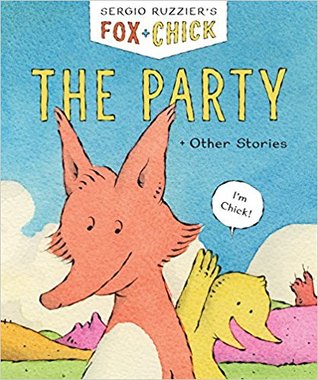
Fox + Chick: The Party and Other Stories
Author and Illustrator: Sergio Ruzzier
Published April 17th, 2018 by Chronicle Books

Summary: Fox and Chick don’t always agree. But Fox and Chick are always friends. With sly humor and companionable warmth, Sergio Ruzzier deftly captures the adventures of these two seemingly opposite friends. The luminous watercolor images showcased in comic-book panel form will entice emerging readers, while the spare text and airiness of the images make this early chapter book accessible to a picture book audience as well.

Teachers’ Tools for Navigation: Activities for The Party and Other Stories include:

How to Read a Graphic Novel

Reading a graphic novel differs from reading prose text because readers must infer everything outside of the dialogue they are given and what is presented in the illustrations.

First, using Fox + Chick discuss the differences with your class between a picture book, a chapter book, and a graphic novel. Make sure to point out the parts of a graphic novel like speech bubbles show what the characters are saying, panels (each square), and the gutter (the space between panels). Then discuss how to read a graphic novel (typically read left to right, top to bottom).

Extension activity: Discuss with students why an author would choose to write their story as a graphic novel versus a chapter book or picture book.

Then, to show how inferences have to be made between panels, use pages 2/3 to page 4. As a reader you can infer that Chick continued walking to the house shown on page 2/3 even though the illustrations don’t show each little step. Also, between the first two panels on page 4, the reader can infer that Chick had to wait a bit even though the panels don’t show it.

After reading the story, have students show how they use inferring to comprehend the story by:

K-1st: Retell the story including inferences made between panels and what the illustrations show.

2nd-3rd: Rewrite the story as a narrative including inferences made between panels and what the illustrations show.

Conflict and Resolution

Conflict is the problem with a story or part of a story while the resolution is how that problem is solved. In each of the chapters in Fox + Chick, there is a conflict and a resolution. Each chapter gives an opportunity to learn these narrative elements.

For chapter 1, “The Party,” as a class, determine the conflict and the resolution.

For chapter 2, “Good Soup,” have students determine the conflict and resolution in pairs.

For chapter 3, “Sit Still,” have students determine the conflict and resolution independently.

Character Traits

Character traits are all the aspects of a character’s behavior from how they act to what they think.

Before reading: As a class, list the character traits the students assume a fox and a chick are going to have. How will they act? What type of personality will they have? How are they going to interact with each other?

After reading: Independently or as a class, have students complete a character trait activity on each character. Have students answer the following questions then place their answers into a graphic organizer:

How did the character act in the story?

What feelings did the character portray in the story?

What words would you use to describe the character’s personality?

See the Teaching Guide Created by me (Kellee) for even more activities and discussion questions! 

You can also access the teaching guide through Chronicle’s website here.

Recommended For: 

readaloudbuttonsmall classroomlibrarybuttonsmall closereadinganalysisbuttonsmall

Kellee Signature

Teaching Guide with Activities and Discussion Questions for Polly Diamond and the Magic Book by Alice Kuipers

Share

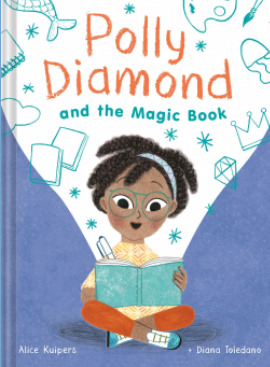
Polly Diamond and the Magic Book
Author: Alice Kuipers
Illustrator: Diana Toledano
Expected Publication May 1st, 2018 by Chronicle

Summary: Polly loves words. And she loves writing stories. So when a magic book appears on her doorstep that can make everything she writes happen in real life, Polly is certain all of her dreams are about to come true. But she soon learns that what you write and what you mean are not always the same thing! Funny and touching, this new chapter book series will entertain readers and inspire budding writers.

Teachers’ Tools for Navigation: Activities for Polly Diamond include:

Color Poem

On page one, Polly says that her teacher said her color poem was fantastic.

Have your students use the Read. Write. Think. template to create their own color poem.

Template

Finish her perfect house story

On page 3, Polly is interrupted while writing her perfect house story.

Finish her story with what your perfect house would include.

Wishes

When Polly realizes her book is magical, she thinks of many things she can wish for such as a cell phone, not frizzy hair, more books, a flat screen TV, and world peace.

Using a brainstorming graphic organizer, have your students think of all the things they wish for.

After brainstorming all of their wishes, have them circle your top three.

Using the five-paragraph format for informative essays, have students write explaining their three wishes.

Measuring

For Polly’s grandmother’s recipe for pancakes called for a cup of flour and a cup of milk. Many times, when baking, you do not have what you need to make the recipe, and not just ingredients—you may not have the right measuring cup.

Bring in one cup measuring cups along with 1/4, 1/3, 1/2, 3/4, tablespoon, and teaspoon measuring cups/spoons. Break students into groups and give each group one of each measuring cup/spoon as well as something to measure (water, rice, flour), and have them answering the following questions:

  • If you only had 1/4 cup, how could you get one cup of flour?
  • If you only had 1/3 cup, how could you get one cup of flour?
  • If you only had 1/2 cup, how could you get one cup of flour?
  • If you only had 3/4 cup, how could you get one cup of flour?
  • If you only had a tablespoon, how could you get one cup of flour?
  • If you only had a teaspoon, how could you get one cup of flour?

Favorite words

Polly has a lot of favorite words: words with double letters like doozy and mutli-meaning words like basil.

Have students make a list of three words that they really like.

For each word, they should define it and also explain why they like the word.

When finished, students should do a word meet and greet. Using clock buddies or some other buddy system, have students meet with other students in the classroom and learn about their favorite words. They should add the favorite words they learn about to their list.

Paint names

On page 29, Polly makes up names for paint that describes the color such as muddy pond, lunch bag, and baboon butt.

First, have students look at the colors Polly described on page 29 and find the corresponding color in either a crayon box or a color exploration site online.

Then, have students create color names using imagery. Either have them use the color exploration site online or the colors from Microsoft Word.

Affixes

Show students how there are different word parts (affixes) that can be put together to make new words. They are like puzzle pieces! Share with them the different types of word parts (prefix, suffix, root, and base) and how they fit together.

On page 56, Polly explains how adding un- to the beginning of a word gives it an opposite meaning. The word she uses as an example is unobservant. Share with your students that un- is a prefix that means NOT which does make a word the opposite. Have student brainstorm a list of words with un- at the beginning and define them using NOT as the definition for un.

Extension: dis-, il-, im-, in-, and ir- also mean NOT. Students can also explore words with these
prefixes.

Extension: On page 57, Polly also talks about adding –fully to the end a word to make it bigger,
but it does more than that. Share with your students that –fully is actually a combination of ful, a root word that means full of, and –ly, a suffix that turns an adjective to an adverb, so her example of sorrowfully means full of sorrow (adv).

After showing students how words break apart and how affixes help with word meanings, give students words with un- and –ful (or any other affix you taught) and have them mark the different word parts and define the word.

Coloring Sheets

Coloring sheets can also be downloaded from Chonricle’s website here.

See the Teaching Guide Created by Me (Kellee) for even more activities! 

You can also access the teaching guide through Chronicle’s website here.

Recommended For: 

readaloudbuttonsmall classroomlibrarybuttonsmall closereadinganalysisbuttonsmall

Kellee Signature

I Love You, Michael Collins by Lauren Baratz-Logsted

Share

I Love You, Michael Collins
Author: Lauren Baratz-Logsted
Published June 20th, 2017 by Farrar, Straus and Giroux (BYR)

Summary: It’s 1969 and the country is gearing up for what looks to be the most exciting moment in U.S. history: men landing on the moon. Ten-year-old Mamie’s class is given an assignment to write letters to the astronauts. All the girls write to Neil Armstrong (“So cute!”) and all the boys write to Buzz Aldrin (“So cool!”). Only Mamie writes to Michael Collins, the astronaut who will come so close but never achieve everyone else’s dream of walking on the moon, because he is the one who must stay with the ship.

After school ends, Mamie keeps writing to Michael Collins, taking comfort in telling someone about what’s going on with her family as, one by one, they leave the house thinking that someone else is taking care of her—until she is all alone except for her cat and her best friend, Buster. And as the date of the launch nears, Mamie can’t help but wonder: Does no one stay with the ship anymore?

I Love You, Michael Collins was a Best Book of June 2017 on Amazon; a semifinalist for the Goodreads Readers’ Choice Awards; and a pick by the Planetary Society for Best Science Children’s Books of 2017.

ReviewThere is so much I really enjoyed about this book!

First, I adored looking into the experience of the moon landing. I cannot even imagine witnessing it happening! What an amazing feat it was and completely unimaginable. (And I hope to at some point see it happen again.) And I thought Baratz-Logsted did a good job showing all the different types of feelings towards the moon landing and space program. But I’m glad that she focused on its amazingness and the excitement.

Second, I think the author did a fantastic job with the character’s voice. With a book of letters it is essential that the writing sounds like the character because it is actually the character writing all the words. I loved seeing all the techniques she used to write like Mamie while still keeping her writing to a literary level.

Third, I loved that the book was not just a reenactment of the moon landing and a family’s celebration of it. The story has so many layers within it: Mamie’s introverted personality and the look into what makes a kid like this happy; her family’s conflicts and issues; and the power of one best friend.

Overall, I Love You, Michael Collins is a fun historical fiction middle grade book that is perfect for so many readers!

Teachers’ Tools for Navigation: The first thing I went to when I thought about this book from a teachers point of view was the idea of letter writing. Mamie writes Michael Collins originally because it is a school project. Mamies letters could be used as a starting point on how to write letters, parts of a letter, etc. And students could even write a letter to someone in the news that is doing something amazing.

Next summer is the 50th anniversary of the moon landing, and at the end of next school year, I am definitely going to do a cross-curricular unit about NASA and the Apollo missions along with a read aloud of excerpts from this novel. It is so engaging as a story and will also be a great way for students in the 21st century to have a window into the 1960s.

But even without this amazing anniversary, Baratz-Logsted’s title is one that middle grade students will find enjoyment in and should definitely be in classrooms and libraries!

Discussion Questions: 

  • How did the author help make her writing seem like a ten-year-old was writing the letters?
  • Michael Collins is not a household name like Buzz Aldrin and Neil Armstrong. Why is that? Do you think we should all know his name in the same context as the other two astronauts?
  • Which character do you think changed the most throughout the book?
  • What do you think is going to happen next with Mamie’s family?
  • How did Buster’s friendship help Mamie keep her positivity and sanity during this tough time in her family?
  • If you were going to have a moon landing party, what would you make?
  • How would the story of Mamie’s parents’ separation have been different in the 21st century?

Flagged Passages: 

“Dear Michael Collins,

I finally figured out why you never write back. Can you figure out how I figured this out? If not, I will tell you. I did the math.

Okay, I didn’t really do the math, since I don’t have all the information. But it struck me that I might not be the only person writing to you. I though, if every school in the country has just one class that is writing letters to the astronauts and if in each class there is just one kid like me writing to you, then that is still a lot of mail.

It’s no wonder you can’t write back to everyone. And of course you do have other things to do right now.

I’m not sure how I feel about the idea of you getting more mail than I originally thought you did. On the one hand, I’m really happy for you. I’m glad you’ve got more than just me. On the other hand, it was kind of nice when I thought I was the only one. It felt special. Like I was the the only one who knew about you. Which of course isn’t true. The whole world knows about you. It’s just that most of them don’t seem to appreciate you very much.

Does it ever bother you that Neil Armstrong and Buzz Aldrin get so much more mail than you do? I hope not. It certainly wouldn’t bother me. There was a time I thought it might be nice to be popular–you know, to have a lot of friends. But then Buster came along, and then Campbell, and I realized that that is quite enough for me…” (p. 30-31)

Read This If You Love: Space! I recommend Space Encyclopedia by David A. Aguilar and Moon Base Crisis by Rebecca Moesta & Kevin J. Anderson. Also check out Planetary.org’s list of recommended books from 2017: http://www.planetary.org/blogs/emily-lakdawalla/2017/1115-space-books-kids.html and 2016: http://www.planetary.org/blogs/emily-lakdawalla/2016/emily-lakdawalla-space-book-recommendations.html

Recommended For: 

classroomlibrarybuttonsmall closereadinganalysisbuttonsmall

Signature

On Gull Beach by Jane Yolen

Share

On Gull Beach
Author: Jane Yolen
Illustrator: Bob Marstall
Published March 27th, 2018 by Cornell Lab Publishing Group

Summary: Together again! On Gull Beach reunites bestselling children’s author Jane Yolen and award-winning illustrator Bob Marstall for the third installment of the acclaimed On Bird Hill and Beyondseries of children’s books written for the renowned Cornell Lab of Ornithology.

In On Bird Hill, Yolen and Marstall took readers on a surreal journey with a boy and his dog as they see the natural world, ultimately witnessing the miracle of a chick emerging from an egg.

On Duck Pond continued their journey, this time at a serene pond filled with birds, frogs, and turtles who are suddenly disrupted by their intrusion, but soon settle back into a quiet equilibrium.

On Gull Beach brings us to an idyllic shoreline in Cape Cod, where gulls hover, dive, and chase with pitched acrobatics in pursuit of a seastar. This enchanting sequel in a brand new habitat will delight readers young and old.

As with all Cornell Lab Publishing Group books, 35% of net proceeds from the sale of this title goes directly to the Cornell Lab to support projects such as children’s educational and community programs.

Our review of On Duck Pond from May 4, 2017.

Kellee’s Review: What I love about this series of books by Yolen and Marstall are the way they have combined the beauty of Yolen’s lyrical words with information about the birds and other animals and their habitats that the books focus on. In this one we follow a young boy as he takes a walk on the beach and tried to say a starfish from the birds on the beach. Yolen’s rhythmic writing takes you on the journey while Marstall’s illustrations make them come to life. 

Ricki’s Review: I am still waiting for the day that I read a Jane Yolen book that I don’t love. Today isn’t that day. As Kellee said, Yolen’s words are lyrical. She rhymes, but it isn’t a cheesy sort of rhyme. Instead, it’s quite beautiful and urges readers to keep turning the pages. Marstall’s illustrations are realistic, and they pull the reader into the story. The back matter provides clarifying information about gulls (see the page spread that we feature below). As a New Englander, I smiled at the variety of gulls that the authors feature. The book features photographs along with informational text to teach readers all about the “So many gulls!” This made me long for the summer, and I am looking forward to identifying these gulls on our next beach trip! 

Teachers’ Tools for Navigation: Each of the books Yolen and Marstall have done focus on a different bird in a different habitat. What a great way to combine reading, writing, and science! In an elementary classroom, have students jigsaw to each of the books and come together in a home group so share what they learned about each habitat and the animals that live there. Then students can research a bird of their choice and its habitat to write their own poem about a visit to see the bird.

Discussion Questions: 

  • The habitat Yolen and Marstall were focusing on is a New England Beach. If you have been to a beach in another area, how is the New England beach in the book different and similar to the beach you have gone to?
  • What other birds other than gulls live on beaches all over the world?
  • What parts of the beach habitat did Yolen and Marstall highlight in their book?
  • How does the structure of poetry change this nonfiction book to make it different than other books about birds and habitats?
  • What are the differences and similarities between the three habitats and three birds that Yolen and Marstall have focused on?

Flagged Passages: 

Read This If You Love: Yolen & Marstall’s other ornithology books, Books about birds like Hello, Hippo! Goodbye, Bird! by Kristyn Crow, The Sky Painter by Margarita Engle, Elwood Bigfood: Wanted Birdie Friends by Jill Esbaum, Birds by Kevin Henkes, Look Up! by Annette LeBlanc Cate, Seabird in the Forest by Joan Dunning

Recommended For: 

classroomlibrarybuttonsmall closereadinganalysisbuttonsmall 

Signature