Frog Song by Brenda Z. Guiberson

Share

NF PB 2014

Nonfiction Picture Book Wednesday

Nonfiction Picture Book Wednesday is hosted by Kid Lit Frenzy and was started to help promote the reading of nonfiction texts. Most Wednesdays, we will be participating and will review a nonfiction text (though it may not always be a picture book).
Be sure to visit Kid Lit Frenzy and see what other nonfiction books are shared this week!

frogsong

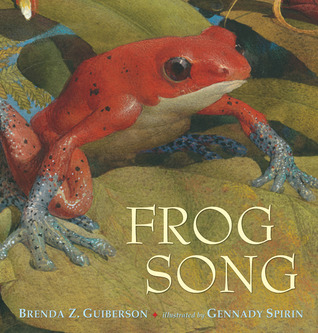
Frog Song
Author: Brenda Z. Guiberson
Illustrator: Gennady Spirin
Published February 5th, 2013 by Henry Holt and Co.

Goodreads Summary: Since the time of the dinosaurs, frogs have added their birrups and bellows to the music of the earth. Frogs are astonishing in their variety and crucial to ecosystems. Onomatopoeic text and stunning illustrations introduce young readers to these fascinating and important creatures, from Chile to Nepal to Australia.

Review and Teacher’s Tools for Navigation: I must admit–I am not a fan of frogs. They actually scare me quite a bit. They are so sporadic and unpredictable–one even jumped on my head at a party once! However, animals of all kind fascinate me and this is a book full of amazing facts about these slimy, jumpy creatures.  The book is set up so that it is easy to navigate with quick interesting facts about 11 different frogs (& toads) with extra information in the back.  I also liked the information given in the back about the trouble that frogs are in because of human activity. I think this book would be a great asset in any science classroom studying biology or ecology (would also be wonderful in a reading class or even a geography lesson because of the different places the frogs came from). Another wonderful way this book could be used in a reading class is because of all of the onomatopoeias within the book. I would love to hear the actual sounds of the frogs and then see the onomatopoeia that the author chose.

Discussion Questions: Which frog fact fascinates you the most? Do extra research about this frog and find other interesting facts about the animal.; Compare and contrast two of the frogs.; Write a fact book about animals like Frog Songs and include the sounds the animals make.

We Flagged: “In Chile, the Darwin’s frog sings in the beech forest. CHIRP-CHWEEET! The male guards 30 eggs in the damp leaves for three weeks. when the tadpoles wiggle, he scoops them into his mouth. SLURP! They slither into his vocal sacs, where he keeps them safe and moist for seven weeks. Then he gives a big yawn, and the little froglets pop out.” (p. 16)

Read This If You Loved: Lifetime by Lola Schaefer, Actual Size by Steve Jenkins, Island by Jason Chin, Seabird in the Forest by Joan Dunning, Slap, Squeak, and Scatter by Steve Jenkins

Recommended For: 

classroomlibrarybuttonsmall readaloudbuttonsmall closereadinganalysisbuttonsmall

Signature

Thrice Told Tales: Three Mice Full of Writing Advice by Catherine Lewis

Share

Thrice Told Tales

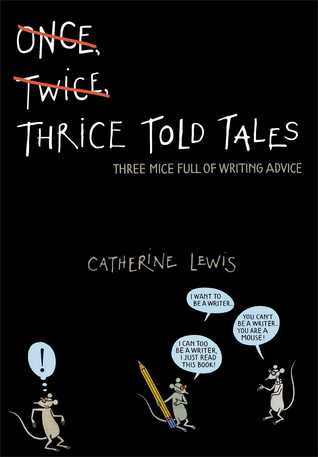
Thrice Told Tales: Three Mice Full of Writing Advice
Author: Catherine Lewis
Published: August 27th, 2013 by Atheneum Books for Young Readers

GoodReads Summary: Three Blind Mice. Three Blind Mice. See how they run? No. See how they can make all sorts of useful literary elements colorful and easy to understand! Can one nursery rhyme explain the secrets of the universe? Well, not exactly—but it can help you understand the difference between bildungsroman, epigram, and epistolary.

From the absurd to the wish-I’d-thought-of-that clever, writing professor Catherine Lewis blends Mother Goose with Edward Gorey and Queneau, and the result is learning a whole lot more about three not so helplessmice, and how to fine tune your own writing, bildungsroman and all.

If your writing is your air, this is your laughing gas.*

*That’s a metaphor, friends.

Review: This is one of those books that is so clever, I am depressed that I didn’t come up with the idea myself. Reading and writing teachers will adore the way this book is constructed and be excited to use it in their classrooms. A different writing term is creatively interpreted on each page within the context of the Three Blind Mice nursery rhyme. At the bottom of each page, Lewis gives an explanation of the writing term and how it can be employed in writing (see the flagged passage below). I loved the ways Lewis humorously portrayed each term. For example, on the page about style, she takes a line from the nursery rhyme and rewrites it in the style of famous authors like Dickens and Hemingway. As a bonus, I learned about a few literary terms that I didn’t know! It was so fun to read. I shared it with my pre-service teachers, and they also adored it and were excited to use it in their own classrooms.

Teacher’s Tools for Navigation: Teachers can hand-pick terms they want to teach to their students. I wish this book was published when I was teaching because it makes the literary terms very accessible. Teachers can take the terms and ask students to reinterpret them within the context of a different nursery rhyme (or even within the context of a song or movie).

Discussion Questions: How can I rewrite a nursery rhyme to show a literary term?; How can I employ these literary/writing terms to make me a better writer?

We Flagged: “Developing one’s style is like developing a sense of fashion. You may start off by trying on a lot of costume jewelry; big showy ten-dollar words. They’ll get attention all right, but maybe you’ll discover there’s something better out there for you. Perhaps you’ll try a charm bracelet full of dangling modifiers. Or a simple silver bracelet and an onyx ring. Keep experimenting for pleasant combinations, and a truer picture of yourself and your work will begin to emerge” (p. 134).

Read This If You Loved: In the Middle by Nancie Atwell, Bird by Bird by Anne Lamott, Writing Workshop by Ralph Fletcher, Celebrating Writers by Ruth Ayres with Christi Overman

Recommended for:

readaloudbuttonsmall closereadinganalysisbuttonsmall classroomlibrarybuttonsmall

026F3FBCC8C3913BD3A4D3F6920340D5

What is your favorite book for teaching writing? Can you think of creative ways to use this in the classroom?


Battle Bunny by Jon Scieszka and Mac Barnett

Share

battle

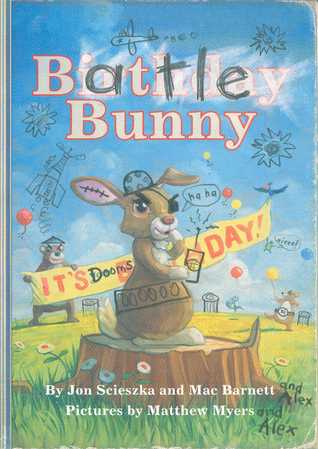
Battle Bunny
Authors: Jon Scieszka and Mac Barnett
Illustrator: Matthew Myers
Published October 22nd, 2013 by Simon & Schuster Books for Young Readers

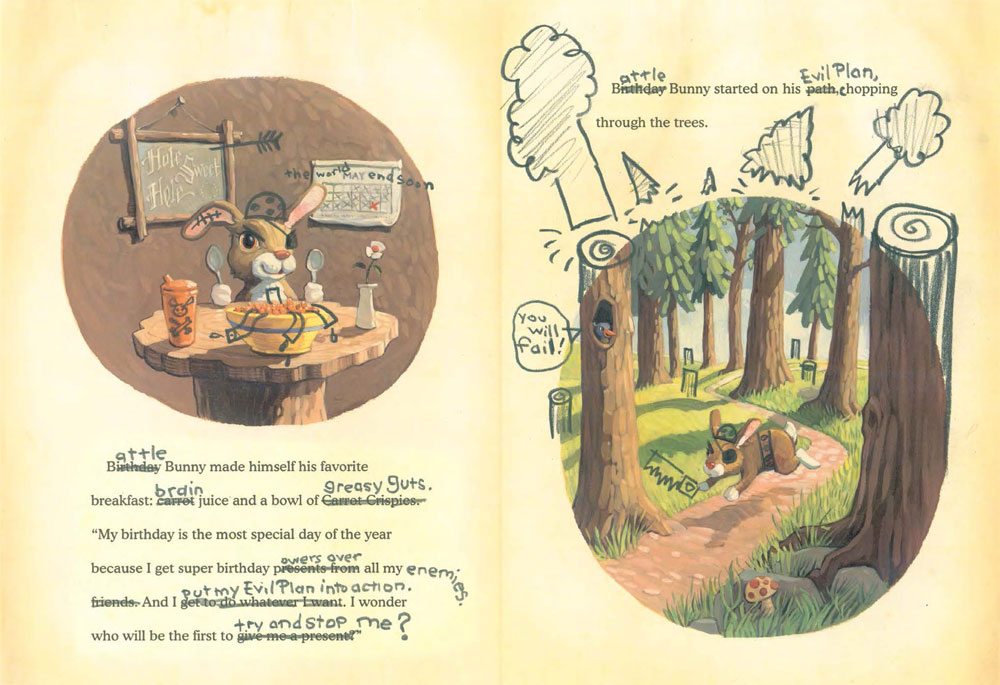
Goodreads Summary: Alex has been given a saccharine, sappy, silly-sweet picture book about Birthday Bunny that his grandma found at a garage sale. Alex isn’t interested; until he decides to make the book something he’d actually like to read. So he takes out his pencil, sharpens his creativity, and totally transforms the story!

Birthday Bunny becomes Battle Bunny, and the rabbit’s innocent journey through the forest morphs into a supersecret mission to unleash an evil plan; a plan that only Alex can stop.

Featuring layered, original artwork that emphasizes Alex’s additions, this dynamic exploration of creative storytelling is sure to engage and inspire.

My Review: This book made me laugh out loud! What a perfect insight into the mind of a young boy (reminds me of so many doodles I’ve seen on papers over the year!).  Also, I was blown away by the creativity of Sceiszka and Barnett.  I wish I was teaching in a classroom because it would have been a book that I would have brought into the classroom to share with kids (yes, even my middle schoolers. Actually, definitely my middle schoolers.) because it is just so awesome!

Teachers Tools for Navigation: This picture book would be so much fun as a read aloud (original story than the modified one). Also, I can also picture bringing in picture books (maybe older ones or bought at a used book store) and letting the students modify their own! And so much creativity, vocabulary, cleverness, imagination, etc. are needed to transform a text the way Alex did–it’d be such a fun yet tough activity.

There is even a Battle Bunny website (http://mybirthdaybunny.com) where you can make your own story. They give you the original Birthday Bunny text and let you make your own. They actually provide PDFs of the entire text!  Also on the website are educators information that includes a curriculum guide.

Discussion Questions: What other stories could you build around Birthday Bunny?; (Writing activity) Using the picture book you were given, create a new story by changing words and adding photos.

We Flagged: 

Read This If You Loved: Scaredy Squirrel books by Melanie Watts, Bananas in my Ears by Michael Rosen, The Stinky Cheese Man by Jon Scieszka, You Will Be My Friend by Peter Brown

Recommended For: 

classroomlibrarybuttonsmall readaloudbuttonsmall closereadinganalysisbuttonsmall

Signature

The Misadventures of Salem Hyde by Frank Cammuso

Share

salem1

Spelling Trouble
Author and Illustrator: Frank Cammuso
Published October 1st, 2013 by Harry N. Abrams

salem2

Big Birthday Bash
Author and Illustrator: Frank Cammuso
Published May 20th, 2014 by Amulet Books

Spelling Troubles Goodreads Summary: Salem Hyde just isn’t like other kids. For one thing, she’s stubborn, independent, and impulsive. For another, she’s a witch. Salem acts first and thinks later—which means most of her thinking involves coming up with excuses!

Good thing she’s been assigned an animal companion, Lord Percival J. Whamsford III. This over-anxious cat doesn’t like Salem calling him “Whammy,” and Salem doesn’t like listening to his long-winded explanations as to why she shouldn’t do something . . . like enter the class spelling bee.

Salem knows she can beat all her classmates at spells, no problem. Too late, she realizes the competition is about spelling words, not magic. And there’s nothing like a misspelled spell to cause all kinds of havoc!

Big Birthday Bash Goodreads Summary: Young witch Salem Hyde is stubborn, impulsive, and loves flying. Her cat companion, Whammy, is nervous, careful, and loves staying on the ground. Somehow, though, they’re best friends. In this second book in the series, Salem is invited to a birthday party, and she wants to make sure everything goes perfectly. But from the invitations to the presents, party games, and spells gone awry, nothing happens exactly the way it should, and she’ll need Whammy’s help to sort it all out. 

My Review: I made sure to pick this up at NCTE from Abrams because Frank Cammuso is a big hit in my classroom. His series, Knights of the Lunch Table (great allusion to King Arthur!) is loved by many a reader (so much so that I think my copy of the first in the series just bit the dust and I’ll need to replace it). Although they did tell me that readers of TKotLT are older than the intended audience for Salem Hyde I wanted to make sure to read it because I was sure I was going to enjoy it—and I did! I’m also so pleased with the embracing of graphic novels that have been happening over the last 5 years and even graphic novels for young readers. The amount of graphic novels for young readers is really starting to accumulate and I have been impressed with most of the ones I’ve read, Salem Hyde included. I feel that many of the juvenile graphic novels are well done, multi-layered, and truly respectable just like the YA graphic novels.

Salem Hyde reminds me of Sabrina the Teenage Witch, but a bit more of a trouble maker. Salem made me laugh and made me shake my head. She is one headstrong, independent little lady who, mixed with trying to figure out all of her match powers as she grows up as a witch, is a great main character.

Teacher’s Tools for Navigation: These books will find most of its success in children’s hands; however, it could definitely be used as a read aloud. Also, in both of these books Whammy, at one point, tells Salem a story to help teacher her a lesson and they are both based off of classics. In Spelling Trouble it is Moby Dick and in Big Birthday Bash it is Gift of the Magi. Salem Hyde would be a perfect introduction to these two stories for young readers.  Another aspect of Salem Hyde that I, as a teacher, may use in the classroom are the character introductions that were included. Each new character got a “Getting to know ____” with their likes, dislikes, and other fun facts (magic powers, etc.). This would be a fun activity to do when writing a narrative and trying to develop characters.

Discussion Questions: How does Whammy use stories to help Salem understand?; How is Salem a better friend to Edgar than Shelly?; Why was Whammy exactly what Salem needed?

We Flagged: 

Or “Look Inside” Spelling Troubles on Amazon

Read This If You Loved: Babymouse and Squish series by Jennifer and Matthew Holm, Gabby and Gator by James Burk, Luz Makes a Splash by Claudia Davila, Sadie and Ratz by Sonya Hartnett, Lulu series by Judith Viorst, Bink and Gollie series by Kate DiCamillo, Franny K. Stein series by Jim Benton, Marty McGuire series by Kate Messner, Giants Beware by Jorge Aguirre

Recommended For: 

classroomlibrarybuttonsmall readaloudbuttonsmall closereadinganalysisbuttonsmall

Signature

Teachers Write Sunday Check-In 7/7/13

Share

Teachers Write

Teachers Write! is an online virtual summer writing camp for teachers and librarians who understand how important it is for people teaching writing to walk the walk.

My plans for Teachers Write: 

This summer, my friend Jennifer Fountain and I are working on writing a proposal for a education professional book about teaching struggling readers which is our passion. Our goal this summer is to finish the cover letter, the expanded outline, and a couple of sample chapters so that by the end of the summer we can present our proposal.

My summer writing recap so far: 

So far so good! However, does anyone else find that the summer is going so quickly! This is also my first summer trying to have a reading and writing goal and it is so hard to keep up with both of them. Also, when your reading is research, it goes much slower than reading for pleasure or even for review or a committee. Also, launching a new blog really eats into both!

Writing a proposal is a lot more work than I even imagined. The biggest challenge for us has been putting onto paper what we already understand in our brains. When writing the proposal, you have to remember that the editor or publisher reading it may not know certain things about education and you have to explain it. You can’t just say book pass or other terms; you have to explain them.

I’ve also found out that I really like the idea of co-authoring. I am truly enjoying working with Jenn. It is so nice to have someone to talk to about decisions, have someone to read your work, and someone to bounce ideas off of.  I also think that she keeps me on track which means I should be writing right now…


How is writing going for all of my Teachers Writes friends? Do you find it hard to keep up with writing and reading? How do you balance the two?

Happy writing!

Signature