Paper Animals by Kane Miller Books

Share

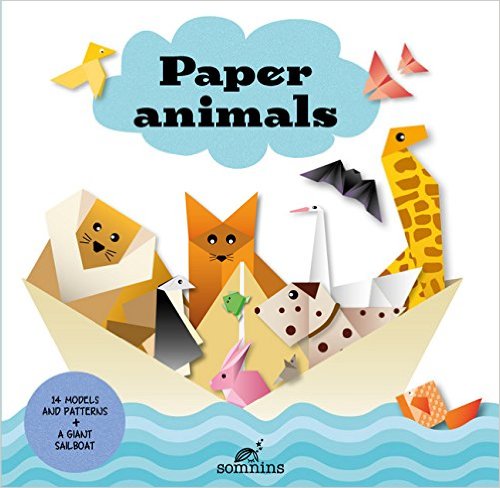
Paper Animals

Paper Animals
Published: December 5, 2016 by Kane Miller Books

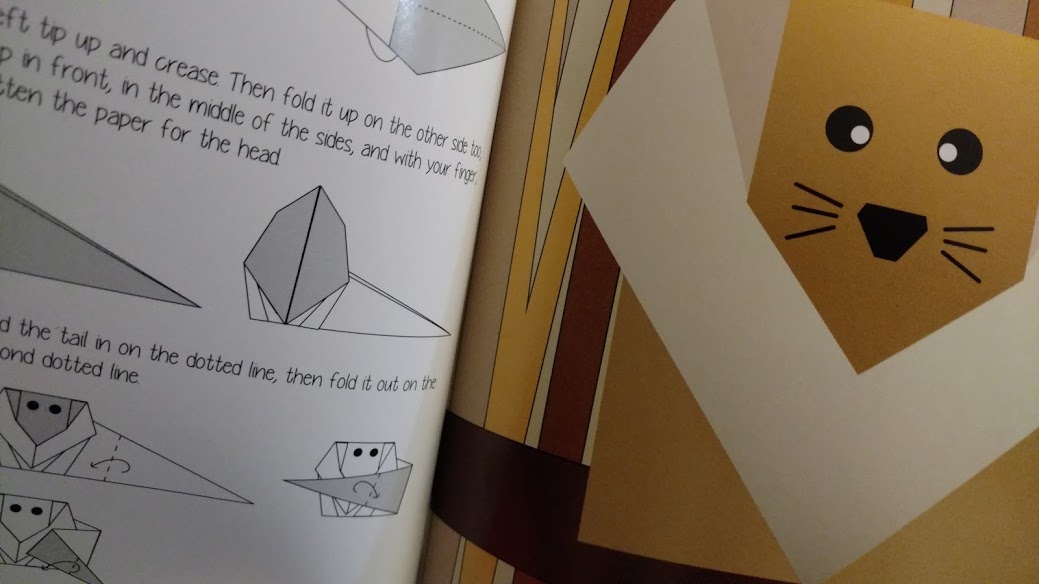
Goodreads Summary: In this book there are 14 different animals, with step-by-step instructions and different levels of difficulty, which will help you become an origami expert. Once you have all the animals ready, fold the giant boat at the end of the book and take all the passengers on board! Included are thirty pages of patterned paper, with printed fold lines. Develops hand eye co-ordination. Learn a form of communication without language. Focuses patience and increases self-esteem. Well-suited to a classroom of 30 or more students. Creates and manipulates basic geometric shapes such as squares, rectangles, and triangles. Reflects the ingenuity and aesthetics of Japanese culture; children gain appreciation of a different culture, opening a doorway to exploration and increased tolerance. Learn the ancient art of origami! In this book there are 14 different animals, with step-by-step instructions and different levels of difficulty.

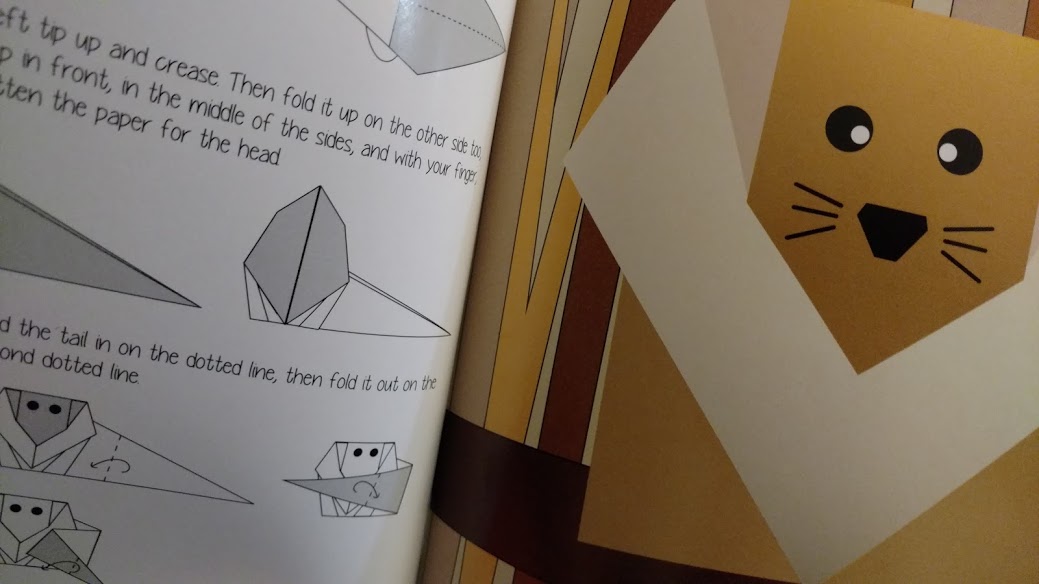
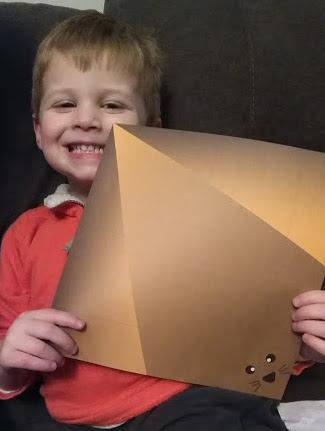
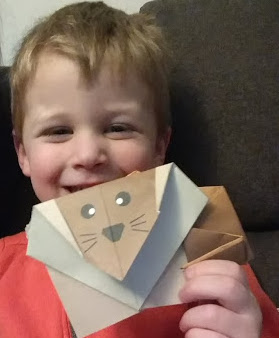
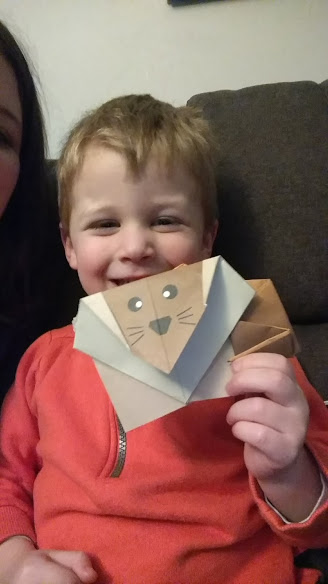
My Review: I have always enjoyed origami, so this book made me feel a bit nostalgic. The first half of the book features pictures of the finished products and directions. The second half of the book includes origami paper that is tailored to each of the animals in the front of the book. So, for example, there is a lion instruction page in the first half of the book, and there is a page of lion origami paper at the end of the book that includes dotted lines for folds and a lion face! My three-year-old is absolutely obsessed with this book. We do one paper animal per day, and we put the animal inside of the giant book (included in the back of the book). He is too young to do the folding himself, but he cheers me on as I fold the paper. I would recommend this book to upper elementary schoolers through adults. Even as an adult, I found some of the paper animals to be very tricky.

Teachers’ Tools for Navigation: In high school, we were required to give a speech that included very specific instructions for participants. I made an origami crane and my peers followed my instructions at their seats. It would be fun to use this as a model for the speech activity. As an alternative, students might create their own origami animal with instructions! This would be hard to do, but it would be great fun!

Discussion Questions: What aspects are important when we give instructions? How did the authors of this book make the instructions easier to follow?; Which animals proved more difficult to make, and why?

Flagged Spread: 

origamil2

origami3 origami4

Read This If You Loved: Activity Books; Origami

Recommended For: 

 classroomlibrarybuttonsmall

RickiSig

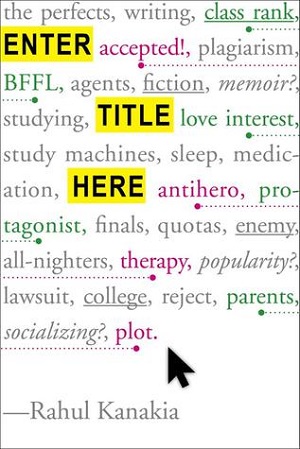
Enter Title Here by Rahul Kanakia

Share

entertitlehere-rahulkanakia

Enter Title Here
Author: Rahul Kanakia
Published: August 2, 2016 by Disney-Hyperion

Summary: I’m your protagonist—Reshma Kapoor—and if you have the free time to read this book, then you’re probably nothing like me.

Reshma is a college counselor’s dream. She’s the top-ranked senior at her ultra-competitive Silicon Valley high school, with a spotless academic record and a long roster of extracurriculars. But there are plenty of perfect students in the country, and if Reshma wants to get into Stanford, and into med school after that, she needs the hook to beat them all.

What’s a habitual over-achiever to do? Land herself a literary agent, of course. Which is exactly what Reshma does after agent Linda Montrose spots an article she wrote for Huffington Post. Linda wants to represent Reshma, and, with her new agent’s help scoring a book deal, Reshma knows she’ll finally have the key to Stanford.

But she’s convinced no one would want to read a novel about a study machine like her. To make herself a more relatable protagonist, she must start doing all the regular American girl stuff she normally ignores. For starters, she has to make a friend, then get a boyfriend. And she’s already planned the perfect ending: after struggling for three hundred pages with her own perfectionism, Reshma will learn that meaningful relationships can be more important than success—a character arc librarians and critics alike will enjoy.

Of course, even with a mastermind like Reshma in charge, things can’t always go as planned. And when the valedictorian spot begins to slip from her grasp, she’ll have to decide just how far she’ll go for that satisfying ending. (Note: It’s pretty far.)

My Review: Whew! I really enjoyed this book! Rahul Kanakia really nails the pressure that overachievers experience. I was reminded of myself a bit. Reshma is willing to do anything to maintain her valedictorian status, and she takes things a bit too far. She is such an unlikeable character that I found her to be quite likable. I notice the GoodReads ratings of this book are high (a 3.58 average) but not incredibly high, and I laughed. Books with unlikable characters are always unfairly low in their ratings. When I put this book down, I felt like I’d learned a lot. Reshma feels like a real person because she makes some major mistakes. She is an anti-hero. I had difficulty putting the book down because I wanted to see how far she would go, and it made me cringe a bit. This book evoked a visceral reaction out of me!

Teachers’ Tools for Navigation: I would love to teach this book because it would evoke some excellent classroom discussions. Reshma represents the ugly side of many people, and I think that readers will have strong reactions to her selfishness. I’d particularly like to dive into her relationship with her mother. Readers could discuss family histories and how these may influence our decisions and our concepts of self.

This book is a great way to introduce metafiction. It would be very interesting to tease apart how the plot relates to the narrator’s book.

Discussion Questions: How do Reshma’s parents differ? How do they influence her decisions? What impact do they have on her as a person?; Does Reshma go too far? What are the consequences? Would you have gone as far as she did?; Why might the author have chosen to write the book as if Reshma was writing it? How does this impact your reading of the text?

Flagged Passage: “The thing no one understands about me is that sometimes, once in a while, I get this feeling like I can do anything, and that feeling is so rare and so beautiful that it’s really hard not to simply surrender to it.”

Read This Book If You Loved: The Secret Side of Empty by Maria E. Andreu; I Crawl Through It by A.S. King


Recommended For: 

classroomlibrarybuttonsmall litcirclesbuttonsmall

  RickiSig

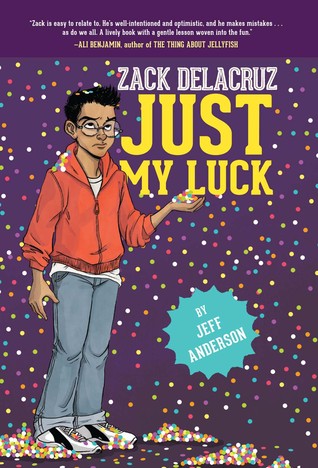
Zack Delacruz: Just My Luck by Jeff Anderson

Share

zack-delacruz-2

Zack Delacruz: Just My Luck
Author: Jeff Anderson
Published October 11th, 2016 by Sterling Children’s Books

Summary: Zack Delacruz is back—and eager to meet Abhi, the new girl at school. But things get off to a rough start when he accidentally knocks her to the ground during a game of dodgeball. And whenever he tries to make amends, she just ignores him. Nothing works—not his friends’ advice or his “lucky” cologne. In fact, he just seems more and more cursed! Then, at the Fall Fiesta-val, Zack finally learns the real reason behind Abhi’s cold shoulder . . . but not before total chaos erupts. With a runaway train, exploding confetti-filled eggs, and Abhi’s terrifying older brother, will Zack ever get a chance to talk to his crush? In the end, Zack learns what it means to believe, to listen, and to be a good friend.

This dynamite sequel captures the middle-school experience—and will keep readers laughing from beginning to end.

Review: I always worry about sophmore books because there is always a chance that the story will just not hold up to the premiere; however, Zack is back and better than ever! The first Zack Delacruz adventure really introduced us to the diverse cast of characters at Zack’s school and just how rough of a time Zack has on a day-to-day basis. Book two begins with one of the funniest days I’ve ever read about in a book! Not only does he knock down the new girl who he wants to get to know during a game of dodgeball, but it definitely gets worse than that (but I am not going to tell you!). Next to the humor, the thing I love most about Anderson’s choice of character is that he makes sure that Zack’s school reflects a real school and the teachers and kids that go there. 

Teachers’ Tools for Navigation: Just like the first book, I think the key to Zack’s potential is making sure he is in libraries and read aloud.

Discussion Questions: What is the most embarrassing thing that’s ever happened to you at school?; What should Zack learn from what happened with Abhi?

Flagged Passages: “And all the frustration and embarrassment from the day made my skin burn. Why did every terrible thing seem to always happen to me? My eyes were getting wet. I wasn’t going to add crying to my fool portfolio. All my rage went into the red ball. I gripped it, not sure what to do. After all, I really didn’t want to hit her. But if I threw the ball too softly, people would say I had a crush on Abhi.  Then they would start heckling me from the sidelines. Just like this stupid game of dodgeball, there was no way to win middle school. So, I chuck the ball low and away, so I would just miss her leg. But at that moment, Abhi jumped.

The ball smashed into her angle, and her legs flew back from the force of the ball. She slammed facedown on the hard wooden floor with a boom like thunder.

The gym went silent.” (p. 34)

Read This If You Loved: Zack Delacruz: Me and My Big Mouth by Jeff AndersonFrank Einstein by Jon SciezskaPickle by Kim BakerBetter Nate Than Ever by Tim Federle, Big Nate by Lincoln Peirce, Diary of a Wimpy Kid by Jeff Kinney

Recommended For:

classroomlibrarybuttonsmall readaloudbuttonsmall

Kellee Signature

**Thank you to Lauren at Sterling for providing a copy for review!!**

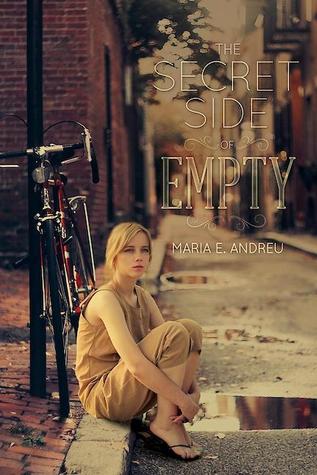
The Secret Side of Empty by Maria E. Andreu

Share

the secret side of empty

The Secret Side of Empty
Author: Maria E. Andreu
Published: March 11, 2014 by Running Press

Summary: As a straight-A student with a budding romance and loyal best friend, M.T.’s life seems as apple-pie American as her blondish hair and pale skin. But M.T. hides two facts to the contrary: her full name of Monserrat Thalia and her status as an undocumented immigrant.

But it’s harder to hide now that M.T.’s a senior. Her school’s National Honor Society wants her to plan their trip abroad, her best friend won’t stop bugging her to get her driver’s license, and all everyone talks about is where they want to go to college. M.T. is pretty sure she can’t go to college, and with high school ending and her family life unraveling, she’s staring down a future that just seems empty. In the end, M.T. will need to trust herself and others to stake a claim in the life that she wants.

Author Maria E. Andreu draws from her personal experience as a (formerly) undocumented immigrant to explore an issue that affects over one million children in the U.S. But while the subject matter is timely, it is M.T.’s sharp, darkly funny voice and longing for a future that makes this story universally poignant.

My Review: In the last year, I have met many people who have told me that they were or are undocumented immigrants. Immigration reform is a hot topic in politics right now, and I can’t help but wonder if people are thinking about others in terms of their humanity. I’ve become increasingly heavy-hearted as I have listened to speeches about immigration, and I longed to learn more about the topic. After searching news articles, research studies, statistics, and government websites, I felt that I needed more story, and so I picked up this book from the library. It received excellent reviews, and I understand why. The author draws upon her personal experiences as a formerly undocumented immigrant, and the narrator, M. T., feels very real. I learned about some of the struggles undocumented immigrants experience, and I am grateful for all that I learned from this book. M. T. deals with other complex issues beyond her immigrant status—relationship issues, domestic abuse, and contemplations of suicide. There is so much to discuss regarding the text. I loved the book and am so glad I found it. I highly recommend it.

Teachers’ Tools for Navigation: This is a fantastic book to discuss undocumented immigrants with students. It would be wonderful to help students consider aspects of immigration reform and explore other perspectives. The author is featured in this article about Donald Trump.

Discussion Questions: How might the author’s perspective have influenced her work?; What do you learn about immigration? How does this influence, change, or solidify your beliefs?; How does M. T.’s relationship with Nate evolve? Do you agree with everything he did?; Did M. T. make the right decision to leave home? Why or why not?

Flagged Passage: I will always be a stranger everywhere. With my parents, I am too American. With Americans, I am a spectator with my nose pressed against their windowpanes, watching their weird rituals and rites of passage, never quite understanding them completely. A little chunk of me will always be a stranger everywhere, different chunks of stranger in different situations. (p. 98).

Read This Book If You Loved: Return to Sender by Julia Alvarez, Ask Me No Questions by Marina Budhos, Girl in Translation by Jean Kwok, Illegal by Bettina Restrepo


Recommended For: 

classroomlibrarybuttonsmall litcirclesbuttonsmall

  RickiSig

Be Light Like a Bird by Monika Schröder

Share

Be Light like a Bird

Be Light Like a Bird
Author: Monika Schröder
Published September 1st, 2016 by Capstone Young Readers

Summary: After the death of her father, twelve-year-old Wren finds her life thrown into upheaval. And when her mother decides to pack up the car and forces Wren to leave the only home she’s ever known, the family grows even more fractured. As she and her mother struggle to build a new life, Wren must confront issues with the environment, peer pressure, bullying, and most of all, the difficulty of forgiving those who don’t deserve it. A quirky, emotional middle grade novel set in Michigan’s Upper Peninsula, Be Light Like a Bird features well-drawn, unconventional characters and explores what it means to be a family and the secrets and lies that can tear one apart.

Review: When I originally started this book over the summer, I had just finished Truth or Dare by Barbara Dee which was about a young girl’s grief after the loss of her mother, so when I picked up Be Light Like a Bird and Wren’s father passed away in the first few pages, it just emotionally wrecked me. I tried continuing, but the grief that Wren and her mother feel just lept off the page and into my heart–I had to put it down for a bit. When I picked it back up, after Augusta Scattergood recommended it, I jumped right in, prepared this time, and loved every second of my journey with Wren and her mother. 

Be Light Like a Bird was so tough for me to read the first time because the emotions that Monika Schröder evokes through her writing are just so real. Wren’s mother is in the anger stage of grief and just cannot seem to leave it while Wren wants to accept and learn to live without her father, but when your only remaining parent is in such denial and anger, it really affects the young person’s life that they are raising.

I also really love Jana’s review of Be Light Like a Bird. Visit her post to see more about the book.

Teachers’ Tools for Navigation: Wren’s journey is going to be perfect for students dealing with grief, moving to a new school, bullying, or someone who wants to start a petition or stand up for something they don’t think it write. Wren and Theo work very hard in the book to save a local pond from being built over. On their political journey, they go to a town council meeting and start a petition. They are an inspiration to what young people can do to make a difference, and teachers could definitely use part of their story to discuss advocacy, environmental, or political issues their students could fight.

Discussion Questions: What are different ways to deal with grief?; What are the six stages of grief? What are some examples from the book that show that Wren and her mom went through some of the stages?; What did Theo teach Wren about herself?; Why do you think Wren chose to try to talk her mom into staying in Pyramid? Who in the town of Pyramid helped Wren feel at home?

Flagged Passages: “…I realized she wasn’t crying because she was sad–it was because she was so mad.

Then she told me to put everything I wanted to keep into a suitcase.

How do you decide what to keep when your Dad has died and your mother has turned into a raging woman you hardly recognize? If it were up to me, I would have kept everything the way it was before. But that is obviously not an option…I sad in my room and looked around, trying to decide what to pack, but the cloud was making me numb. None of the stuff really mattered anymore.” p. 13-14

Read This If You Loved: Snicker of Magic by Natalie Lloyd, Some Kind of Happiness by Claire Legrand, Far from Fair by Elana K. Arnold

Recommended For:

  classroomlibrarybuttonsmall closereadinganalysisbuttonsmall

Kellee Signature

**Thank you to M0nika for providing a copy for review!**

Hundred Percent by Karen Romano Young

Share

hundred-percent

Hundred Percent
Author: Karen Romano Young
Published August 9th, 2016 by Chronicle Books

Summary: The last year of elementary school is big for every kid. Christine Gouda faces change at every turn, starting with her own nickname—Tink—which just doesn’t fit anymore. Christine navigates a year’s cringingly painful trials in normalcy—uncomfortable Halloween costumes, premature sleepover parties, crushed crushes, and changing friendships. Throughout all this, Tink learns, what you call yourself, and how you do it, has a lot to do with who you are.

This book marks beloved author Karen Romano Young’s masterful return to children’s literature: a heartbreakingly honest account of what it means to be between girl and woman, elementary and middle school, inside and out—and just what you name that in-between self.

“A lovely, lovely tale full of warmth, humor, and intelligence.”—Kirkus Reviews, starred review

“Perfectly captures the emotions of middle schoolers and their evolving friendships and familial relationships.”—School Library Journal, starred review

“Romano’s characters jump off the page in a thoughtful and realistic look at what it means to be on the precipice of adolescence.”—Publishers Weekly

“A brilliant and irresistible book about the sharp pains and joys of real life. Karen Romano Young is a writer like no other.—Rebecca Stead, Newbery Award–winning author of When You Reach Me

“Karen Romano Young must be twelve. There’s no other way she can possibly know what she knows about sixth grade in all its weirdness and glory.”—Annie Barrows, New York Times bestselling author of the Ivy & Bean series

“Karen Romano Young has an unerring feel for the shifting alliances and uncomfortable intrigues of sixth graders.” —Ellen Wittlinger, Printz Honor–winning author of Hard Love

Review: The blurbs for Hundred Percent state that the book delves into the true emotions and experiences of a sixth grader, and that it does. It actually is so realistic that it will make adults, myself included, a bit uncomfortable. Thinking back to sixth grade, it was the time where everyone was figuring out their identities: social, emotional, physical, sexual. Hundred Percent captures this. Tink is trying to figure out who her friends are, if it is worth liking boys, how to deal with changes all over the place, and so much more. I do know that there are parts of the book that some adults will be uncomfortable with their students/child reading if they are the same age as Tink. For example, there are derogatory terms used such as slut/slutty and horny skank, a lip syncing scene to “Honky Tonk Women,” and a discussion of what “sleeping together” is. Although this may be a bit uncomfortable, the more I think about the more I have come to realize that these conversations are definitely happening between 6th graders, and we can’t, as the adults in their life, pretend like they are not (though I still don’t know why the teachers let them choose “Honky Tonk Women”). With all this being said, I still think this text is for our most mature sixth graders, but those students need Tink’s story. 

Teachers’ Tools for Navigation: In addition to a classroom library book, the text could be used within the classroom during a creative writing unit. The prose of Hundred Percent is lyrical and beautifully written. Karen Romano Young is able to take the most mundane of thoughts or activities and make them sing on the page. Because of this, some parts of the story could definitely be used as a mentor text for writing.

Flagged Passages: “Tink could have cried, but instead she smiled. She was thinking about the moment when she’d held the dishpan down to the surface of the water and turned it sideways to let the lobster slosh out of it. Its clause had sprung wide open, as if it was looking for something to grab on to. The Sound was so cool and blue and clear. She hung over the water to watch the lobster sinking down into the gloom. Back where it belonged again, back home like Tink. She felt like–like crying, but also laughing, like smiling through a storm, like an ambassador of lobsters. She wondered: Does an ambassador ever forget that the foreign land he’s learned so much about isn’t the place he’s from?” p. 55

Read This If You Loved: Truth or Dare by Barbara DeeStill a Work in Progress by Jo KnowlesThe Secret Hum of Daisy by Tracy Holczer

Recommended For:

  classroomlibrarybuttonsmall

Kellee Signature

**Thank you Chronicle Books for providing a copy for review!**

Juana & Lucas by Juana Medina

Share

juana

Juana & Lucas
Author and Illustrator: Juana Medina
Expected Publication September 27th, 2016 by Candlewick Press

Summary: Juana loves many things — drawing, eating Brussels sprouts, living in Bogotá, Colombia, and especially her dog, Lucas, the best amigo ever. She does not love wearing her itchy school uniform, solving math problems, or going to dance class. And she especially does not love learning the English. Why is it so important to learn a language that makes so little sense? But when Juana’s abuelos tell her about a special trip they are planning—one that Juana will need to speak English to go on—Juana begins to wonder whether learning the English might be a good use of her time after all. Hilarious, energetic, and utterly relatable, Juana will win over los corazones — the hearts — of readers everywhere in her first adventure, presented by namesake Juana Medina.

Review: Early chapter books are one of my book gaps, and I have been trying, over the last few years, to read as many of them as I can, so I was very happy to have the chance to read Medina’s Juana & Lucas. One thing I have noticed as I read these beloved early chapter books are that although the characters may be diverse in some aspects of their culture/identity, most of the characters are not diverse in their ethnicity. However, now here comes Juana (and Bea Garcia!). She is a character that everyone reading will relate to in some way, and now Latina/Latino students or students learning English will have a character to relate to in early chapter books. 

In addition to the new diversity in this group of books, Juana & Lucas is also just a funny and sweet book about a young girl who has to learn that working hard to learn or be able to do something new is worth the work. This theme will definitely resonate with so many students!

I also want to add that I didn’t know much about Columbia when I started, but when Juana starts talking about Bogotá, you can hear her love of the city come through the pages, so I went to Wikipedia right away to learn more about the city, and I am in love! I told Jim I want to retire there. It is beautiful, and their temperature varies from 43 to 66 degrees! That is the perfect weather! Now, I have to go through the same thing as Juana and learn Spanish, so I am ready to go in 25 or so years 🙂

 Teachers’ Tools for Navigation: Juana’s story will be an asset for writing, reading, Spanish, and ELL classes. Medina’s writing can be used as a mentor text for voice and descriptive language, the story is perfect for reading strategies such as context clues and character analysis, the book includes Spanish words throughout the story that aren’t always defined, and Juana is struggling with learning English. All of these things make Juana’s story one that is a perfect addition to all classrooms.

Discussion Questions: How did the character pages help you learn about the different characters in the book vs. if they had not been included? (Class activity: have students complete a character page like Juana’s about members of their family, characters in different books, or a character before they write a narrative.); How does Juana overcome the struggles she has with English at the beginning of the book?; How does each character throughout help Juana grow as a students and person?; Why do you think the author chose to have some words in different size and bold font?; How did the author help you “hear” Juana’s voice while you were reading?; How were you able to determine the meaning of the Spanish words throughout the book?

Flagged Passages: “Mami is the most important person in my life. Most. Important. And here’s why: Besides being the best of moms, Mami is really good at taking care of plants. She loves all plants, even the ones with the complicated names I can’t pronounce…” (p. 31)

Early Sketch for Juana & Lucas (http://juanamedina.tumblr.com/post/139399423961/early-sketch-for-juana-lucas)

Read This If You Loved: Bea Garcia: My Life in Pictures by Deborah Zemke, Amelia’s Notebook series by Marissa Moss, Judy Moody series by Megan McDonald

Recommended For:

  classroomlibrarybuttonsmall readaloudbuttonsmall closereadinganalysisbuttonsmall

Kellee Signature