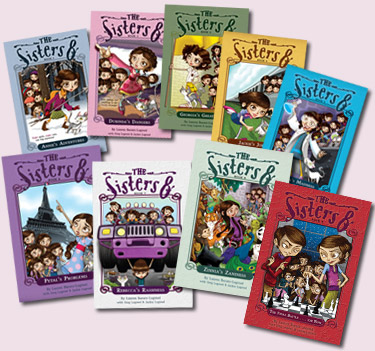
Celebrating 10 Years of the Sisters 8 series by Lauren Baratz-Logsted with Greg Logsted and Jackie Logsted (with a special message from the author!)

Share

The Sisters 8 Series by Lauren Baratz-Logsted with Greg Logsted and Jackie Logsted

The Sisters 8 #1: Annie’s Adventures The Sisters 8 #2: Durinda’s Dangers
Published December 29th, 2008 by HMH Books for Young Readers

through

The Sisters 8 #9: The Final Battle…For Now
Published August 7th, 2012 by HMH Books for Young Readers

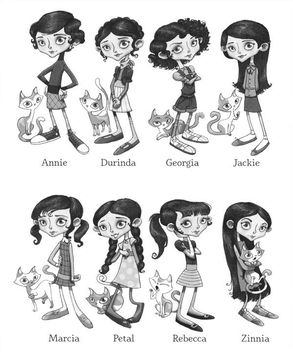
About the Series: The story begins on New Year’s Eve, eight sisters–octuplets–wait for Mommy to come back from the kitchen with eggnog and Daddy to come back from the shed with more wood for the fire.

But they–Mommy and Daddy, that is–don’t. Come back. Ever.

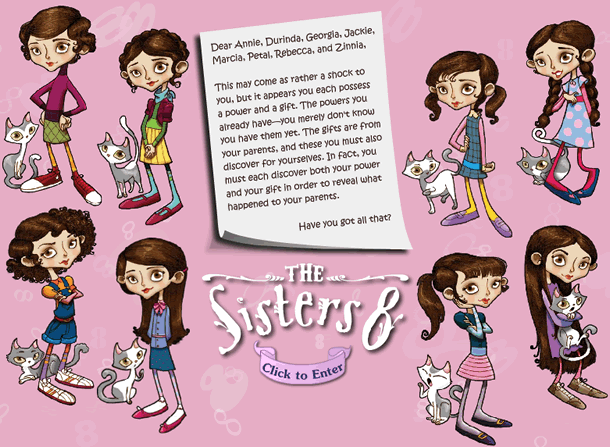
It takes the sisters a few minutes to notice, but when they do it’s just as you would expect. Disbelief! Outrage! Despair! But then a note appears, telling the girls that each one of them has a talent and a gift. They all must find theirs to learn what happened to Mommy and Daddy.

Okay, so that’s how it begins. How does it end? Enter the world of the Sisters Eight to find out…

About Annie’s Adventures (Book #1): A rather large problem has befallen the Huit girls. (Sisters, actually. Octuplets to be exact.) One particular New Year’s Eve, the girls wait for their mommy to bring them hot chocolate and their daddy to return with more wood for the fire. But they don’t. Mommy and Daddy, that is. They’re gone. Poof! Maybe dead—no one knows for sure.

You must see the problem here. Eight little girls on their own, no mommy or daddy to take care of them. This is not a good thing.

So now these little girls, must take care of themselves. Get to school, cook the meals, feed the cats (eight of them, too), and pay the bills. They can’t ask for help, oh no. Any self-respecting adult would surely call in social services, and those well-meaning people would have to split them up. After losing their parents, being split up would be completely unbearable.

At the same time, the question remains:What happened to Mommy and Daddy? The Sisters Eight (as they are called, affectionately and otherwise) are determined to find out. Luckily, they do seem to have someone or something helping them. Notes keep appearing behind a loose brick in the fireplace.

It’s a good old-fashioned mystery with missing (or dead) parents, nosy neighbors, talking refrigerators, foul-smelling fruitcake (is there any other kind?), and even a little magic. Eight little girls, eight cats, and one big mystery—let the fun begin!

Annie’s Adventures, wherein the girls’ parents go missing (or die) and the girls learn each one has a power and gift. Annie, being the oldest, is the first to discover hers.

And expand the Sisters Eight adventures by entering The Sisters Eight Website!

After you enter, you can:

  • Learn about each of the books,
  • Learn about the authors,
  • Read reviews of the books,
  • Meet the Huit sisters,
  • Take a quiz to see which Sisters Eight you are,
  • Printable paper dolls,
  • Make your own beanbags,
  • Decorate a t-shirt,
  • Design flip-flops,
  • Make a friendship bracelet, or
  • Learn about starting a Sisters 8 book club!

About the Author: Lauren Baratz-Logsted is the author of more than a dozen books for adults and young readers, including The Twin’s Daughter, Crazy Beautiful, and the Sisters 8 series, which she cowrites with her husband and daughter.

A personal note from the author on this special anniversary: 

Who could ever have predicted that getting snowbound in Crested Butte, Colorado, back in 2006 would lead 12 years later to a nine-book series that has sold over a quarter of a million copies? But that’s what happened to my family. When a visit with friends that was supposed to last five days turned into 10 following a blizzard that closed Denver Airport, my husband Greg and me and our then-6yo daughter Jackie had to find new ways to entertain ourselves, which in our case meant brainstorming what would become known as The Sisters 8 series, about octuplets whose parents go missing on New Year’s Eve, leaving the girls to solve the mystery of where their parents went while keeping other adults from realizing there are no longer any adults in the house. The first two books were published in December 2008, with seven more books since.

Over the course of my career, I’ve been extraordinarily lucky. While I have neither the money of Rowling nor the critical acclaim of Franzen, I’ve been able to write the books I wanted to write – for adults, teens and children – in a variety of genres, and seen nearly 40 of those books published. If that’s not lucky, I don’t know what is. But nothing in all of it has given me more pleasure than The Sisters 8. I got to create it with my husband and daughter, who is now 18 and off at college. I got to share the early books with Jackie’s classmates as we were writing them. I got to receive thousands of emails from kids – and their parents, grandparents, librarians and teachers – telling me how much the series has meant to them. Most writers I know long for more money or greater fame. Now, I’m not saying I’d say no to either, but when you’ve receive a letter from a ten-year-old saying “After my brother died, The Sisters 8 was the first thing that made me feel cheered again” or from a special needs teacher saying “It was the first book that ___ asked if she could take home to continue reading on her own” or whole families of Canadians saying they bring the books to read aloud to each other on camping trips (Bless you, Canada!) – well, after all of that, you realize that while fame and fortune would be nice, you did your job as a writer.

This marks the 10th anniversary of The Sisters 8. I hope you’ll join me in wishing them many more years to come – cheers! ~Lauren

Celebrate the Sisters 8 ten-year anniversary by picking up a Sisters 8 book and enter into their adventures!

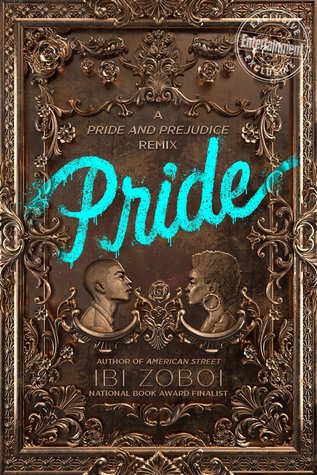
Pride by Ibi Zoboi

Share

Pride
Author: Ibi Zoboi
Published: September 18, 2018 by Balzer + Bray

Summary: Pride and Prejudice gets remixed in this smart, funny, gorgeous retelling of the classic, starring all characters of color, from Ibi Zoboi, National Book Award finalist and author of American Street.

Zuri Benitez has pride. Brooklyn pride, family pride, and pride in her Afro-Latino roots. But pride might not be enough to save her rapidly gentrifying neighborhood from becoming unrecognizable.

When the wealthy Darcy family moves in across the street, Zuri wants nothing to do with their two teenage sons, even as her older sister, Janae, starts to fall for the charming Ainsley. She especially can’t stand the judgmental and arrogant Darius. Yet as Zuri and Darius are forced to find common ground, their initial dislike shifts into an unexpected understanding.

But with four wild sisters pulling her in different directions, cute boy Warren vying for her attention, and college applications hovering on the horizon, Zuri fights to find her place in Bushwick’s changing landscape, or lose it all.

In a timely update of Jane Austen’s Pride and Prejudice, critically acclaimed author Ibi Zoboi skillfully balances cultural identity, class, and gentrification against the heady magic of first love in her vibrant reimagining of this beloved classic.

Teaching Pride

I love retellings of classics, and I would argue that this retelling is far superior to the original. Ibi presented at the NCTE convention, and she is absolutely brilliant. She talked about how she values the inclusion of the pantheon in literature and how she does so in her own texts. She also shared how different poems within Pride are retellings of classic poems. I love her work and will read anything she writes.

Love stories are tricky. They can get sappy quickly. This book is so much more than a love story. It interrogates themes related to economics, race, education, and gender.

Gentrification

“It’s a truth universally acknowledged that when rich people move into the hood, where it’s a little bit broken and a little bit forgotten, the first thing they want to do is clean it up. But it’s not just the junky stuff they’ll get rid of. People can be thrown away too, like last night’s trash left out on sidewalks or pushed to the edge of wherever all broken things go. What those rich people don’t always know is that broken and forgotten neighborhoods were first built out of love” (p. 1).

Teaching Idea: As a class, explore the impacts of gentrification and displacement. Using this knowledge develop your own form of political art (https://youtu.be/JMVd5k2a2IM) to make a statement.

Culture

If Madrina’s basement is where the tamboras, los espíritus, and old ancestral memories live, the roof is where the wind chimes, dreams, and possibilities float with the stars, where Janae and I share our secrets and plan to travel all over the world, Haiti and the Dominican Republic being our first stop” (p. 23).

Teaching Idea: Pick a place in your life, and Use Zoboi’s writing as a mentor text to share that place with others (e.g. “If [place] is where_________, [another place] is where__________, where________.”

Equity

“Sometimes love is not enough to keep a community together. There needs to be something more tangible, like fair housing, opportunities, and access to resources” (p. 33).

Teaching Idea: As a class, discuss whether love is enough and whether tangible aspects must exist in order to keep a community together. Generate a concept or brain map that depicts tangible aspects that can impact communities.

Male/Female Gender Roles

I don’t need no knights in shining armor

Ain’t no horses in the hood

I killed chivalry myself with a pocketknife…” (p. 243).

Teaching idea: The teachers finds materials/advertisements that are gender-specific, and students rewrite the materials to remove gender from the text. Students evaluate how the meaning or the impact has changed.

Education

“There is more to learn

about my old, old self, and black and brown girls like me

from hoods all over this country want to

take over the world,

but there’s something missing

in our history books the public schools give us” (p. 147).

Teaching idea: Consider the school curricula. Whose voices are honored? Whose are missing? Rewrite a course to be more inclusive.

Home

“I have always thought of Bushwick as home, but in that moment, I realize that home is where the people I love are, wherever that is” (p. 270).

Teaching idea: Where is home? Create a visual depiction of your own home, and below it, write, “Home is…” How do our interpretations of home differ? What do they have in common?

Read This If You Loved: American Street by Ibi Zoboi, Pride and Prejudice by Jane Austen, Piecing Me Together by Renée Watson

Recommended For: 

classroomlibrarybuttonsmall 

RickiSig

The Astonishing Color of After by Emily X. R. Pan

Share

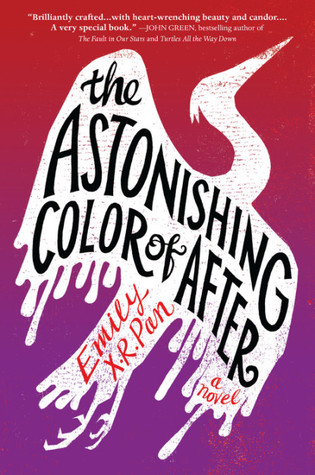
The Astonishing Color of After
Author: Emily X. R. Pan
Published: March 20, 2018 by Little, Brown

Goodreads Summary: Leigh Chen Sanders is absolutely certain about one thing: When her mother died by suicide, she turned into a bird.

Leigh, who is half Asian and half white, travels to Taiwan to meet her maternal grandparents for the first time. There, she is determined to find her mother, the bird. In her search, she winds up chasing after ghosts, uncovering family secrets, and forging a new relationship with her grandparents. And as she grieves, she must try to reconcile the fact that on the same day she kissed her best friend and longtime secret crush, Axel, her mother was taking her own life.

Alternating between real and magic, past and present, friendship and romance, hope and despair, The Astonishing Color of After is a novel about finding oneself through family history, art, grief, and love.

My Review: I just finished discussing this book with my class, and they loved it. It is a bit of a longer book and moves somewhat slowly, but even my students who didn’t finish it in time insisted that I should use it again next year. The writing is absolutely stunning. Pan depicts humanity in ways that are very powerful. She integrates color and emotion to connect readers to the characters. We had two one-hour class periods to discuss this book, and there were so many things to talk about. Discussion was easy, and students made meaningful connections with the book. This book is simply unforgettable. I recommend it highly and hope it wins some awards in January!

Teachers’ Tools for Navigation: My students said that they Googled the colors within the text as they read. We spent a lot of time talking about the colors as an effective writing tool. I asked students to think of a moment in their lives that they’d be willing to share. Then, I asked them to attach a color with the moment. They shared beautiful stories of working at drive-ins, meeting their SOs, visiting places with friends, etc. The colors they attached with the images were fascinating and made the stories come alive.

Discussion Questions: 

  • How does the author incorporate magical realism in the text? Is it effective?
  • Did Leigh and Axel’s relationship feel realistic to you? Why or why not?
  • Which scenes are beautifully written, and how do they demonstrate excellent writing?
  • Should we forgive Leigh’s father? Why might he make the decisions he makes?

We Flagged: “Once you figure out what matters, you’ll figure out how to be brave.”

Read This If You Loved: Goodbye Days by Jeff Zentner, When the Moon Was Ours by Anna-Marie McLemore, Miles Away From You by A. B. Rutledge, All the Bright Places by Jennifer Niven, Looking for Alaska by John Green, Forgive Me, Leonard Peacock by Matthew Quick

Recommended For:classroomlibrarybuttonsmall

  RickiSig

Vincent and Theo by Deborah Heiligman

Share

Vincent and Theo: The Van Gogh Brothers
Author: Deborah Heiligman
Published April 18th, 2017 by Henry Holt and Co.

Summary: The deep and enduring friendship between Vincent and Theo Van Gogh shaped both brothers’ lives. Confidant, champion, sympathizer, friend, Theo supported Vincent as he struggled to find his path in life. They shared everything, swapping stories of lovers and friends, successes and disappointments, dreams and ambitions. Meticulously researched, drawing on the 658 letters Vincent wrote to Theo during his lifetime, Deborah Heiligman weaves a tale of two lives intertwined and the love of the Van Gogh brothers.

About the Author: Deborah Heiligman has written many books for children, including National Book Award Finalist Charles and Emma: The Darwins’ Leap of Faith and The Boy Who Loved Math. She lives with her family in New York City.

AccoladesMichael L. Printz Award – Honor, School Library Best Books of the Year, CPL: Chicago Public Library Best of the Best, NYPL Books for the Teen Age, Booklist Editors’ Choice, YALSA Award for Excellence in Nonfiction Finalist, YALSA Award for Excellence in Nonfiction Winner, BCCB Blue Ribbon Award, Boston Globe – Horn Book Award, Kirkus Best Teen Books of the Year, Publishers Weekly Best Books of the Year, Texas TAYSHAS High School Reading List, Horn Book Magazine Fanfare List

Praise: 

“A remarkably insightful, profoundly moving story of fraternal interdependence and unconditional love.” —Kirkus, starred review

“A breathtaking achievement that will leave teens eager to learn more.” —School Library Journal, starred review

“In fittingly painterly language, Heiligman offers vivid descriptions of Vincent’s artwork and life, which grow more detailed and colorful as Vincent’s own artistic style becomes richer and more refined . . . This illuminating glimpse into the van Goghs’ turbulent life and historical period will add compelling depth to readers’ understanding of the iconic painter. ” —Booklist, starred review

“A unique and riveting exploration of art, artists, and brotherly love.” —The Horn Book, starred review

“An intensive exploration of their turbulent lives” —Publishers Weekly, starred review

“This title is a treasure for readers who want to immerse in a roiling domestic drama and who don’t back away from a good cry” —The Bulletin, starred review

Review: I could not stop talking about this book while I was listening to it. That, and that I couldn’t stop listening to the book–I would listen whenever I could, show me what a fabulous book it was. Hieligman does an amazing job making Vincent and Theo’s story come to life through such emotional narrative that the reader cannot help but feel as if we are living alongside the Van Gogh brothers. As someone who loves learning about history and art as well as an interest in brain health, this was a story that was more fascinating than I can even describe.

Also, I feel personally connected to this book in a fun way. In November, 2016 Deborah Heiligman and I had a dinner at NCTE, and we got talking about art since she had just finished Vincent and Theo. If you didn’t know, my dad has a BA in Art History and a MFA in Museumology and runs art museums (currently the LSU Museum of Art), so I have grown up around art museums my whole life and with art as a big part of it. One of the things we spoke about is the new information that a painting thought to be a self-portrait (right below) was actually the only known painting of Theo Van Gogh that Vincent painted. One thing that made it hard to determine this was that Theo is wearing the straw hat that Vincent is known to wear while Vincent is wearing Theo’s business felt hat. And this is where Deborah’s question came in: “The hats on the cover matched the hats the men are wearing in the photo although those are not actually their hats. Does it matter?” Now although I love art, I am not the expert, so I offered to ask my dad, and he responded with, “I like the cover as it is. I think it causes a questioning that evidences the new research in an interesting way. It defies previous thoughts and expectations.” Thus the cover stayed as is with an explanation on the jacket (below).

But I think what can show you about the book more than just me raving is all of the awards it received, ⇑ see above, and all of the amazing information about how Deborah researched for the book, ⇓ see below, and of course an excerpt from the book, ⇓ also below.

Teachers’ Tools for Navigation: View Deborah Hieligman’s research for Vincent and Theo and view all the articles & interviews about the book to use with students when reading this nonfiction text. There is so much that can be done with this story and the author’s writing process; use this amazing text in your classrooms, have it in your libraries, read it yourself–however you see fit, but read and share it!

Discussion Questions: 

  • How were Vincent and Theo’s life parallel with each other?
  • In what way were Vincent and Theo’s view of love part of their downfall emotionally?
  • Looking at the two portraits above and after reading the article about the portrait being of Theo, what do you believe? What similarities and differences do you see between the two?
  • How did Deborah Hieligman take all of the letters and research she did and turn them into a narrative?
  • I described this book to my sister as “A love story about two brothers.” Why would I call it a love story?
  • How did Theo’s short but mighty marriage set up for the current popularity of Vincent Van Gogh?
  • Why did it take so long for Vincent to find art?
  • In what way did finding friends in the impressionist art community help Vincent as an artist?

Flagged Passages: 1. TWO BROTHERS, ONE APARTMENT, PARIS, 1887

There was a time when I loved Vincent very much, and he was my best friend, but that’s over now. —Theo van Gogh to his sister Willemien, March 14, 1887

THEO’S BROTHER VINCENT has been living with him for just over a year, and Theo cannot take it anymore.

It is “almost intolerable for me at home,” he writes to their sister Wil in March 1887. Even though Theo has moved them to a larger apartment, this one still feels too small to hold Vincent’s outsized personality and Theo’s desperate need for quiet. He’s dying to tell Vincent to move out, but he knows if he does, Vincent will just be more determined to stay.

Dogged. Contrary. Stubborn. Vincent.

Theo van Gogh is the manager of Goupil & Cie, a successful art gallery on the fashionable Boulevard Montmartre in Paris. Theo is good at his job, but it’s terrifically frustrating for him right now. The owners of the gallery want him to sell paintings in the traditional style because they’re popular and bring in money. Though Theo certainly needs to make money—he has to support himself and Vincent and help their mother—he wants to sell art that is truly exciting to him, paintings by the Impressionists and their crowd, friends of his and Vincent’s: Émile Bernard, Paul Gauguin, Claude Monet, and Henri de Toulouse-Lautrec. Soon, maybe even paintings by Vincent himself.

But these modern painters don’t bring in enough money, so it’s a constant battle with his bosses. Theo haspersuaded them to let him set up a little display of Impressionists on the entresol. The entresol is not the ground floor, and it’s not the first floor. It’s the floor in between. It’s as if the paintings are there, but not quite yet, a glimpse into the future. It’s a start. But he spends his days working hard and comes back to the apartment at 54 Rue Lepic exasperated and exhausted. What he needs at home is rest and peace, but instead he gets VINCENT.

Theo loves his brother’s brilliant mind, his gregariousness, even his fiery temperament. Vincent can be a good antidote to Theo’s own inwardness and tendency to melancholy.

But after so many months of the cold Parisian winter spent indoors with Vincent, Theo is a wreck both mentally and physically. A few months back, in December, he was actually paralyzed—he couldn’t move at all for a few days. Although Theo knows he can’t blame his bad health on his brother, to get better he needs a break from Vincent’s gusts, his squalls, his constant talking and lecturing.

And, to make matters worse, lately Vincent has been furious at him. “He loses no opportunity to let me see that he despises me and I inspire aversion in him,” Theo tells Wil.

A portrait done of the brothers at this time would be sizzling with streaks of red-orange paint.

* * *

WHEN VINCENT AND THEO were young, growing up in the village of Zundert in the Netherlands, their father, a pastor, had written a special prayer. All the Van Gogh children had to memorize it and recite it when they left home:

“O Lord, join us intimately to one another and let our love for Thee make that bond ever stronger.”

Theo has valiantly been living up to that prayer. He’s been Vincent’s best friend for most of the last fifteen years, ever since they made a pledge to each other on a walk. And through many ups and downs and storms, for the past seven years, Theo has been giving Vincent money for paint, pencils and pens, ink, canvases, paper, clothing, food, and, until he moved in, rent.

On March 30 Vincent turns thirty-four; on May 1 Theo will be thirty. They’ve made it this far in their journey together—how can Theo kick him out now?

* * *

VINCENT AND THEO VAN GOGH look a lot alike: They both have red hair, though Vincent’s is redder, Theo’s more reddish blond. Vincent has freckles; Theo does not. They are both medium height—around five feet seven—but Vincent is broader, bigger; Theo slighter, thinner. They have pale blue eyes that sometimes darken to greenish blue. They are definitely brothers.

But they couldn’t give more different impressions.

Vincent in his workman’s clothes spends his days painting, outside if it’s not too cold, or inside the apartment. He is covered with Parisian soot and grime, overlaid with splatters and spatters of paint: ochre, brick red, orange, lemon chrome, cobalt blue, green, black, zinc white.

He doesn’t bathe often, which is typical for a nineteenth-century man, but it’s even less often than he should. He stinks—of body odor, dirt, food, paint, turpentine, wine, and tobacco. He usually has a pipe in his mouth, though he has very few teeth left, and those that are left are rotten.

And yet Vincent looks healthy: he’s robust, sturdy, and vehemently alive. Passion pours from him, as if the world he’s trying to capture is inside him, bursting to come out.

Theo is tidy, well dressed in a suit, looking very much the proper Parisian businessman. His features are finer, more refined. He would be handsome if he weren’t so sick: he’s thin and pale; he looks as though the life is being sucked out of him. He feels that way, too.

* * *

IN MANY WAYS, Vincent’s move to Paris has been good for both brothers. Thanks to Theo’s influence, to the artists he’s met, and to his own tenacious work, Vincent’s paintings are better than ever: they are imbued with color and light and Vincent’s own particular style.

And Vincent has given Theo more of a life. He’d been lonely in Paris, so lonely, and now, even though he doesn’t have a wife and family, Theo at least has a circle of friends through Vincent. For that he is grateful. So even though he’s desperate, Theo doesn’t kick out his brother. Yet.

In April, Theo acknowledges to another sister, Lies, that he’s been ill, “particularly in my spirit, and have had a great struggle with myself.” If he were well, he could deal with Vincent.

In fact both brothers do better with sun and warm air and hours spent outside. The Parisian days are getting longer—by minutes, anyway. If only spring would arrive! But there’s still too much gloom outside and in.

Gloom and fire.

It’s as if there are two Vincents, Theo has told Wil. He knows both sides of his brother very well. Sometimes Vincent is ebulliently happy and kind, sometimes furiously angry and difficult. He has a huge heart, but he’s stubborn and argumentative.

Vincent argues not only with Theo, and with himself, but also with friends and people he admires. One cold and fiery night in the near future, Vincent will fight with another roommate. And that argument will end in blood.

Read This If You Love: History, Art, Brain health, Van Gogh, Heiligman’s writing

Recommended For: 

classroomlibrarybuttonsmall 

Signature

When the Moon Was Ours by Anna-Marie McLemore

Share

When the Moon Was Ours
Author: Anna-Marie McLemore
Published October 4, 2016 by Thomas Dunne

Goodreads Summary: To everyone who knows them, best friends Miel and Sam are as strange as they are inseparable. Roses grow out of Miel’s wrist, and rumors say that she spilled out of a water tower when she was five. Sam is known for the moons he paints and hangs in the trees, and for how little anyone knows about his life before he and his mother moved to town. But as odd as everyone considers Miel and Sam, even they stay away from the Bonner girls, four beautiful sisters rumored to be witches. Now they want the roses that grow from Miel’s skin, convinced that their scent can make anyone fall in love. And they’re willing to use every secret Miel has fought to protect to make sure she gives them up.

My Review: This book appears again and again on English department lists for courses about gender and sexuality. After I saw it for the dozenth time, I realized that I had to read it. I loved it so much that I adopted it for my course, and my students read it along with three other texts when we talked about gender and sexuality as they pertain to adolescence. I will admit that a few of my students had difficulty with the magical realism of the book, but overall, they found this book to be incredibly powerful and recommended I continue to use it in the course. There is so much to discuss, and it offers beautiful insight. I attach so many emotions to this book, which proves how much I cared deeply for the characters and content. If you missed this one, you should read it. I promise it will be different than any other book that you’ve read.

Teachers’ Tools for Navigation: The third of my class that read this book developed a great activity to inspire their peers to want to read it. They asked the students: “If an egg could cure your heartsickness, what color would it be? If a flower grew from your wrist, what type of flower would it be? If you could hang a moon from the trees to help you sleep at night, what would it look like? Or, pick another object to connect with.” We had a lot of fun discussing the great possibilities.

Discussion Questions: 

  • Why is this book used often in college English courses? What makes it so impactful?
  • What does this book teach you about people, places, life, and quite frankly, humanity as a whole?
  • There are a very many magically realistic objects in the text. If you examine them closely, what does each mean? For example, why are glass pumpkins growing in the town?

We Flagged: “Miel was a handful of foil stars, but they were the fire that made constellations” (p. 12).

Read This If You Love: Magical realism, books that make you think, books that push binary traditions of gender

Recommended For: 

closereadinganalysisbuttonsmall classroomlibrarybuttonsmall litcirclesbuttonsmall

RickiSig

Ape Quartet #4: Orphaned by Eliot Schrefer

Share

Orphaned
Author: Eliot Schrefer
Published September 25th, 2018 by Scholastic Press

Summary: Before humans, and before human history, there were the apes.
Snub is a young gorilla, living in the heart what will eventually be known as Africa. She is jealous of her mother’s new baby . . . and restless in her need to explore. When a natural disaster shakes up her family, Snub finds herself as the guardian of her young sibling . . . and lost in a reshaped world.

Snub may feel orphaned, but she is not alone. There are other creatures stalking through the woods — a new form of predator, walking on two legs. One of their kind is also orphaned, and is taken in by Snub. But the intersection of the human world and the gorilla world will bring both new connections and new battles.

In his boldest work yet, two-time National Book Award finalist Eliot Schrefer shows us a riveting, heartbreaking early encounter between ape and man — told from the ape’s point of view. It is a journey unlike any other in recent literature.

About the Author: Eliot Schrefer is a New York Times-bestselling author, and has twice been a finalist for the National Book Award. In naming him an Editor’s Choice, the New York Times has called his work “dazzling… big-hearted.” He is also the author of two novels for adults and four other novels for children and young adults. His books have been named to the NPR “best of the year” list, the ALA best fiction list for young adults, and the Chicago Public Library’s “Best of the Best.” His work has also been selected to the Amelia Bloomer List, recognizing best feminist books for young readers, and he has been a finalist for the Walden Award and won the Green Earth Book Award and Sigurd Olson Nature Writing Award. He lives in New York City, where he reviews books for USAToday.

Praise: “Scientific accuracy paired with lyrical, subjective language describing the young gorilla’s impressions of her surroundings and bodily needs make this book an imaginative, eloquent evocation of a little-known era in prehistory from an animal’s viewpoint. A plausibly authentic account skillfully avoiding risk of excessive anthropomorphism.” – Kirkus Reviews

Review: What a fascinating book! Orphaned is so different than Schrefer’s other novels but in a way that is new and so well done. Where Endangered, Rescued, and Threatened were about humans interacting with apes in a contemporary setting, Orphaned is about apes interacting with early humans in a pre-historic setting. There is no book like this! And it is done beautifully.

When we visited virtually with Eliot Schrefer he shared with us that the story was originally told in prose but his editor, David Levithan, pointed out to him that apes, though intelligent, would not think the way that Eliot writes prose. That their thoughts would be focused on immediate needs and would lack in descriptive and fluffy language. He then completely rewrote the story in verse and WOW! Snub’s voice is perfect.

While I originally thought that the point of view and setting would make the story a challenge, but it was the contrary–it made it just that more interesting!

Teachers’ Tools for Navigation: What a great mentor text for point of view and setting! Have students write a story with an animals main character in an interesting setting. Then have them change from prose to verse to hone in on the point of view of the animal and make sure they are including the setting as a main aspect of the story.

Discussion Questions: 

  • How does the inclusion of the ape “language” help with the realism of the story?
  • Why do you think the author included the illustrations of what apes were currently in the story at the top of the page?
  • How did the change from prose to verse storytelling impact the way the story was perceived?
  • How do you think the early humans perceived the gorillas when they interacted with them?
  • How does the point of view shape this story?
  • How did the eruption change the life of the gorillas and early humans?
  • How are gorillas and early humans similar and different?

Flagged Passages: 

Central Eastern Africa
600,000 Years Ago

Until this time, gorillas lived by the millions in a broad band of jungle across Africa. Then a series of volcanic eruptions, many times more foreful than any the modern world has experience, occurred in the Great Rift Valley. The shift in landscape allowed tribes of early humans to travel south into this area for the first time. 

It would be the first meeting between ape and human.

Part One: Home

Rock. Nut.
Snub looks between the two, thinking.
This tree keeps its nuts high in its branches–
a fallen one is a lucky treat.
She imagines rolling the inside nugget in her mouth,
biting its oily flesh.
Tongue between her teeth, brow scrunched,
she raps the rock on top of the nut.
It does not crack.
She licks the rock.
The rock tastes like rock.
She licks the nut.
The nut tastes like dirt.
Snub twists the woody halves.
They will not part.
Opening nuts is Mother’s job,
but Mother let Snub go off alone.

                                                                              mrgh. 

Fresh fury surges.
Snub hurts the nut, aiming
at a pair of magpies.
It goes wide and disappears into the foliage.
Worthless nut.
Snub looks to see if anyone has
been impressed by her rage.
But this only reminds her:
Her family is not here.”

Read This If You Love: The Ape Quartet books #1-3, Early humans, Gorillas

Recommended For: 

classroomlibrarybuttonsmall 

Signature

The Girl with More Than One Heart by Laura Geringer Bass

Share

The Girl With More Than One Heart
Author: Laura Geringer Bass
Published April 17th, 2018 by Abrams Books

Summary: There are times we all feel we need more than one heart to get through. When Briana’s father dies, she imagines she has a new heart growing inside her. It speaks to her in her Dad’s voice. Some of its commands are mysterious.

Find Her!  it says. Be Your Own!  

How can Briana “be her own” when her grieving mother needs her to take care of her demanding little brother all the time? When all her grandpa can do is tell stories instead of being the “rock” she needs? When her not-so-normal home life leaves no time to pursue her dream of writing for the school literary magazine? When the first blush of a new romance threatens to be nipped in the bud? Forced by the loss of her favorite parent to see all that was once familiar with new eyes, Briana draws on her own imagination, originality, and tender loving heart to discover a surprising path through the storm.

About the Author: Laura Geringer Bass is the author of over 20 highly acclaimed books for children, tweens, and teens. Her new novel for middle graders about friendship, love, and loss — The Girl with More Than One Heart — is the lyrical story of a courageous girl who imagines she needs an extra heart to navigate her grief after the death of her dad. It will be published by Abrams this Spring. Laura serves on the National Advisory Board of First Book, a non-profit organization that has delivered over 170 million books to children in need and as a mentor for Girls Write Now and Prison Writes, teaching teens at risk.

Review: This book looks at the struggle of grief when life keeps moving on around you. And like another book I love, Courage for Beginners, it shows the struggle a child has if a parent is suffering and they have to step up in a way that is not what their peers have to. Briana doesn’t know how to deal with the grief and with her mother incapacitated with grief also, Briana finds that she needs a second heart to help guide her through this huge bump in her life. Briana’s story also shows the struggle yet love of being a sibling to a child with special needs.

Written beautifully in a way that will pull at your heartstrings, Bass’s story shows how one girl uses art, love, and courage to make her way through a loss that is unimaginable for most of us.

Teachers’ Tools for Navigation: The Girl With More Than One Heart needs to be in classroom, school, and public libraries. There are so many readers that need this book. There are other readers that will want this book. There are definite readers for this book.

Another way in the classroom that it could be used is a mentor text for writing about memories. Briana’s second heart shares memories with her, one of the ways we get to know her dad, and the memories are so full of imagery. There are many sections that could be read for a mentor text when asking students to write a personal narrative.

Discussion Questions: 

  • How did Briana use art to help her through her grief?
  • How did Briana’s life change after the loss of her dad?
  • Aaron is described in the summary as her demanding little brother, but Briana loves him. What are some examples in the story that show this love?
  • How does Grandpa Ben help guide Briana?
  • Briana’s second heart is only figurative. What does it represent?

Flagged Passage: “The day my father’s heart stopped, I discovered an extra heart deep in my belly, below my right rib. It talked to me. I wasn’t crazy. Before that day, I had just one heart that never said a word.” (p. 1)

Read This If You Love: Courage for Beginners by Karen Harrington, Rules by Cynthia Lord, How to Speak Dolphin by Ginny Rorby, Be Light Like a Bird by Monika Schröder, Snicker of Magic by Natalie Lloyd, Some Kind of Happiness by Claire Legrand, Far from Fair by Elana K. Arnold

Recommended For: 

classroomlibrarybuttonsmall

Signature

**Thank you to Casey at Media Masters Publicity for providing a copy for review!**