Review and Giveaway!: Like Bug Juice on a Burger and Like Carrot Juice on a Cupcake by Julie Sternberg

Share

bug juice

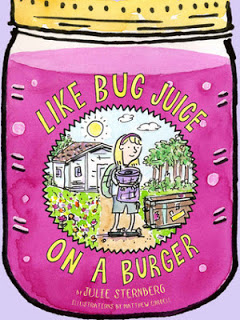
Like Bug Juice on a Burger (Eleanor #2)
Author: Julie Sternberg
Illsutrator: Matthew Cordell
Published April 2nd, 2013 by Amulet Books

Goodreads Summary: I hate camp. I just hate it. I wish I didn’t. But I do. Being here is worse than bug juice on a burger. Or homework on Thanksgiving. Or water seeping into my shoes. In this sequel to the critically acclaimed Like Pickle Juice on a Cookie, Eleanor is off to summer camp. At first she’s excited to carry on the family tradition at Camp Wallumwahpuck, but when she gets there she finds icky bugs, terrible food, and worst of all: swim class, where she just can’t seem to keep up with everyone else. But as the days go on, Eleanor realizes that even the most miserable situations can be full of special surprises and that growing up is full of belly flops. 

Review and Teachers’ Tools for Navigation: This book definitely brought back memories! I loved the idea of summer camp and many of the activities, but I hated the bugs and the food and the changing in front of other people. There are many times when I was away that I just wanted to go home; however, there were things that saved me- specifically, like Eleanor, the animals. I loved working in the barn with the horses and it is what saved me and then got me going back year after year. I remember walking into the barn and being able to be part of these horses’ lives and the scene where Eleanor meets Cornelius the goat brought me right back to that moment. 

This book would be a wonderful read aloud for right before summer because even if students are not going to summer camp, there is probably something new and scary that they will try this summer and this book will definitely cause discussion about how something new may be scary, but that doesn’t mean you won’t like it eventually. Julie Sternberg’s writing also lends itself to some amazing discussions about free verse poetry and, in this one, letter writing. Maybe use the letter writing part of the book to segue into writing a letter to next year’s class. 

Finally, I love the idea of the Wall of Feelings! The Wall of Feelings is where the campers put up how they feel about camp; however, Eleanor is given the job of writing about how she used to feel about camp and then how she feels about camp now. What a great way for students to express themselves! This would be a great formative assessment for looking at how students feel about reading or school or some other topic at the beginning of the year vs. the end. 

Discussion Questions: Think about a time in your life when you did something you were scared to do. How did you overcome your fear/nervousness? How did it turn out in the end?  

We Flagged: “The bus was bumping
down a gravel road
with bushes and trees and weeds all around. 
This isn’t beautiful
I thought. 
This is creepy
I missed sidewalks full of people
checking their phones
and walking their cute dogs. 
I missed paved roads, too, 
filled with taxis and bik riders.” (Chapter 5) 

Like Carrot Juice on a Cupcake_cover (1)

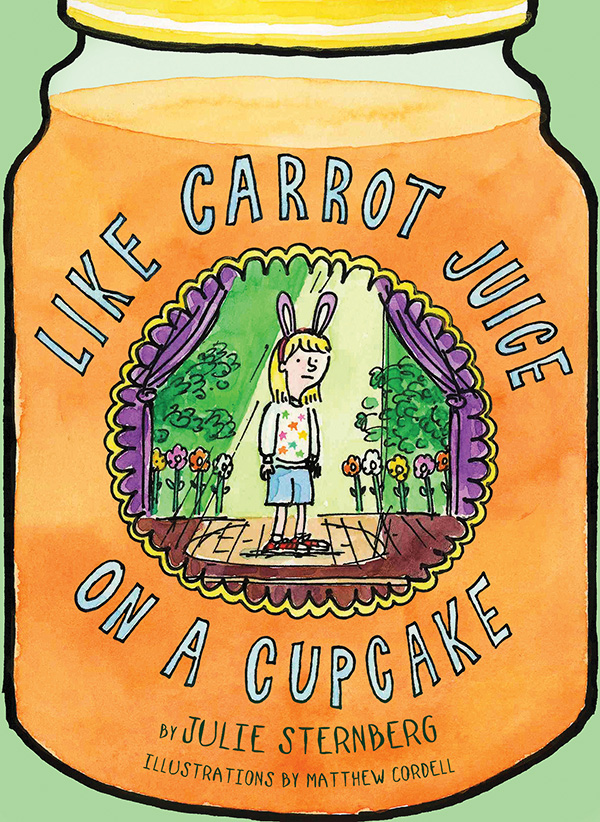
Like Carrot Juice on a Cupcake
Author: Julie Sternberg
Illustrator: Matthew Cordell
Published March 18th, 2014 by Amulet Books

Goodreads Summary: I did a mean thing.
A very mean thing.
I HATE that I did it.
But I did.
This is worse than
carrot juice on a cupcake
or a wasp on my pillow
or a dress that’s too tight at the neck.
In the third installment from the team who created Like Pickle Juice on a Cookie and Like Bug Juice on a Burger, Eleanor’s relationship with her best friend, Pearl, experiences its first growing pains. When a glamorous new student transfers to school, at first Eleanor’s excited about the possibility of a new friend. But when Pearl is assigned to be the new girl’s buddy, Eleanor fears she can’t compete. To make matters worse, Eleanor’s been chosen for the lead role in the springtime musical, which means she has to sing a solo in front of the entire school!
From overcoming stage fright to having a secret crush, young readers will relate to Eleanor as she navigates the bittersweet waters of growing up.

Review and Teachers’ Tools for Navigation: This book has multiple levels going on at the same time. There is the story of Eleanor and Pearl’s friendship and their first speed bump. Then there is Eleanor getting the lead in the play, and dealing with the fear of singing a solo. Eleanor dealing with her puppy having trouble getting house trained. And finally, the Eleanor and Nicholas story. But Sternberg balances it all because it is just all part of Eleanor’s life. Julie Sternberg is so great at writing in an elementary student’s voice. It is so authentic and well done!

What I love so much about all of the “Eleanor” books are that they are written in verse, and Eleanor is an amazing poet. I love that it is free verse and includes such beautiful language, but it never comes off as anything but authentic. Teachers could definitely take Eleanor’s writing and use it as a mentor text for students to write about their own experiences.

Discussion Questions: Have you ever hurt a friend’s feelings? What did you do to make it better?; How was Eleanor able to overcome her stage fright?; Why was Eleanor so scare and jealous of Ainsley?; Do you think Eleanor likes Nicholas?


Read These If You Loved: Like Pickle Juice on a Cookie by Julie Sternberg, Marty McGuire and Marty McGuire Digs Worms by Kate Messner, Where I Live by Eileen Spinelli, Go Out and Play! by KaBoom!, Lunch Lady and the Summer Camp Shakedown by Jarrett Kroscozka, Camp Babymouse by Jenni and Matt Holm, Bink and Gollie by Kate DiCamillo, Ramona books by Beverly Cleary

Curriculum Guide for All of the “Eleanor” Books Can be Found Here.

Both Books Recommended For: 

classroomlibrarybuttonsmall closereadinganalysisbuttonsmall readaloudbuttonsmall

GIVEAWAY

a Rafflecopter giveaway

Signature

**Thank you to Barbara at Blue Slip Media for providing copies for review**

Annika Riz, Math Whiz by Claudia Mills

Share

annika riz math whiz

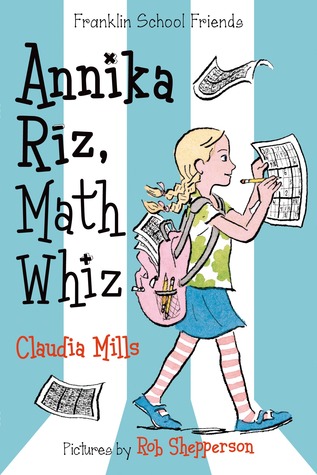
Annika Riz, Math Whiz (Franklin School Friends series)

Author: Claudia Mills

Pictures by: Rob Shepperson

Published: May 13th, 2014 by Farrar, Strous, and Giroux

Summary: (Grades 2-4) Annika Riz loves math more than anything. She’s trying to teach her dog, Prime, to count. She’s determined to beat fellow math whiz Simon Ellis in a Sudoku contest at the public library. She even sleeps under number-patterned sheets. But Annika’s best friends Kelsey and Izzy think math is boring. All they care about is the upcoming school carnival: their principal is going to be dunked in a dunking tank and their class is going to have a booth selling home-baked cookies. But then disaster foils the friends’ cookie-baking plans. Can math save the day?

Review: Each of the books in the Franklin School Friends series tells the story of a different third-grade student with a passion for a school subject.  I was excited to read Annika Riz’s story because she is a math whiz—and I love math! Annika looks at the world through math-tinted glasses, and she wants everyone to love the subject as much as she does. She even attempts to teach her dog, Prime, how to count. I found the story to be so very charming. Annika is an endearing character who will resonate with many kids (and adults). Her energy and enthusiasm is refreshing. I suspect that readers will appreciate math much more by the end of this book. This series would be a great addition to elementary school classrooms. Series books are a big step in many students’ journey to becoming avid readers. Most adult readers list series books as a major part of their reading identities, so I am a strong advocate of having these texts available to students.

Teacher’s Tools for Navigation: Annika looks at the world through a math mind. Teachers might ask students to pick a school subject and show how that subject is important in many of their everyday activities. This would teach students to apply what they are learning in school to their world.

Check out the downloadable curriculum guide for the Franklin School Friends here!

Discussion Questions: How does Annika approach the sudoku contest? Do you think she does a good job preparing for it?; What role do Annika’s friends play in her life? Because the girls have such varying interests, are you surprised they are friends? Why or why not?; Why do the girls decide to make lemonade? Do you think this was a good choice?; In what ways does Annika use math to examine aspects of her world?

We Flagged: “Kelsey loved reading and Izzy loved running the same way that Annika loved math. But Annika didn’t hate reading and running the same way that the others hated math. It was hard when your two best friends hated the thing in the world that you loved the most” (4).

Read This If You Loved: Clementine by Sara Pennypacker, Judy Moody by Megan McDonald, and Ivy and Bean by Annie Barrows

Recommended For:

litcirclesbuttonsmall classroomlibrarybuttonsmall

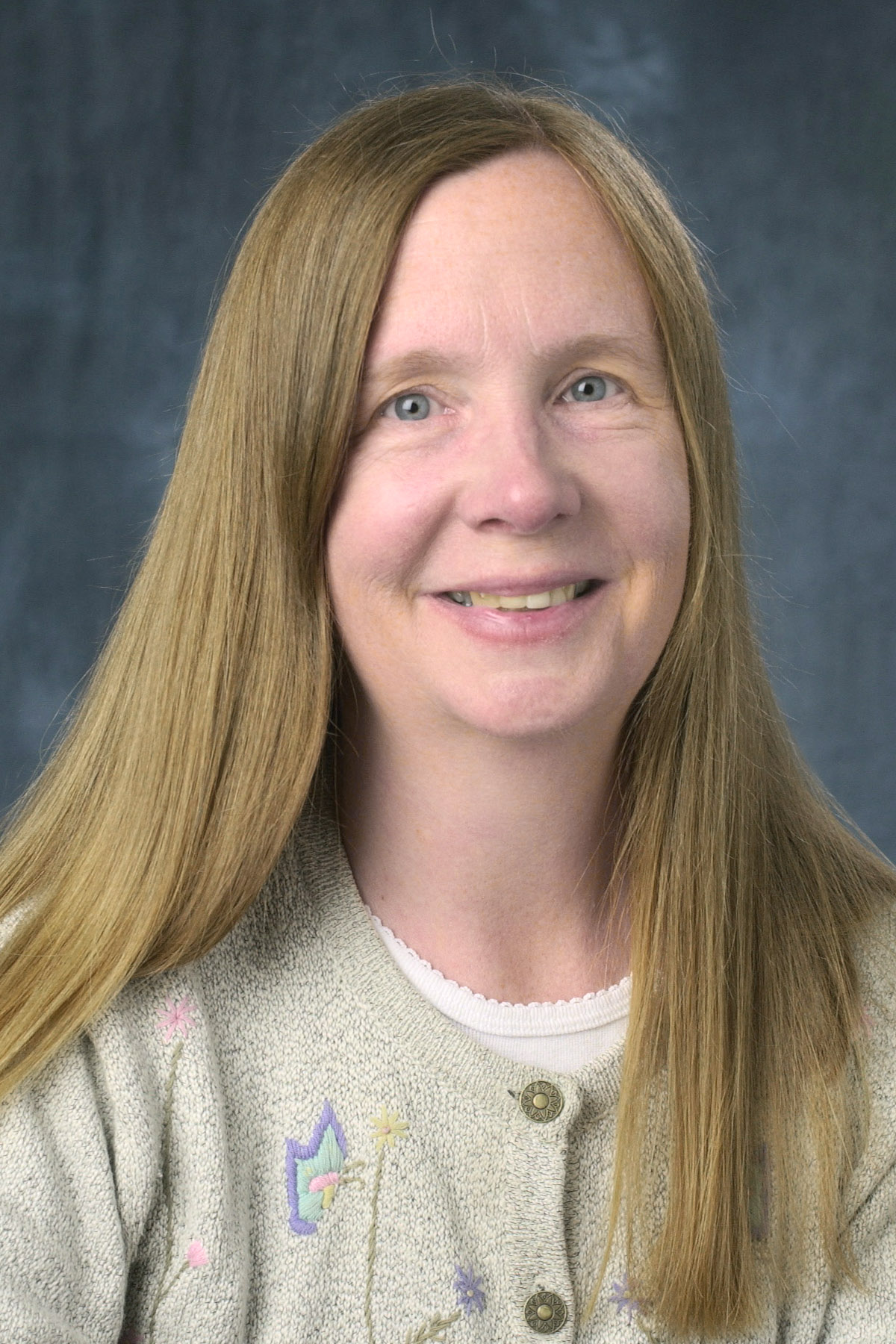
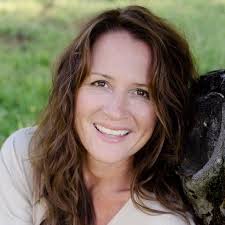
Claudia Mills, Philosophy claudia.mills@colorado.edu photo by: Larry Harwood

Claudia Mills is the acclaimed author of fifty early-chapter and middle-grade books, including 7 x 9 = Trouble!, How Oliver Olson Changed the World, and Zero Tolerance. Claudia was a professor of philosophy for over twenty years at the University of Colorado at Boulder, where she received many teaching awards, before leaving the university to write full time. She has two sons. To learn more, visit her website at claudiamillsauthor.com.

RickiSig

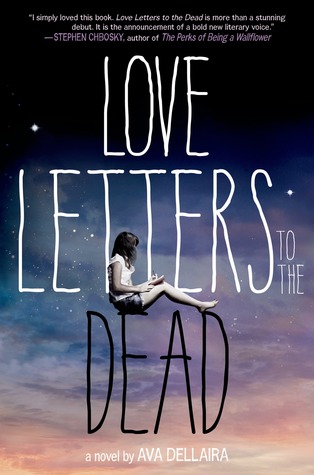
Love Letters to the Dead by Ava Dellaira

Share

love letters to the dead

Love Letters to the Dead
Author: Ava Dellaira
Published: April 1st, 2014 by Farrar, Strous, and Giroux

Summary: It begins as an assignment for English class: Write a letter to a dead person. Laurel chooses Kurt Cobain because her sister, May, loved him. And he died young, just like May did. Soon, Laurel has a notebook full of letters to people like Janis Joplin, Amy Winehouse, Amelia Earhart, Heath Ledger, and more; though she never gives a single one of them to her teacher. She writes about starting high school, navigating new friendships, falling in love for the first time, learning to live with her splintering family. And, finally, about the abuse she suffered while May was supposed to be looking out for her. Only then, once Laurel has written down the truth about what happened to herself, can she truly begin to accept what happened to May. And only when Laurel has begun to see her sister as the person she was; lovely and amazing and deeply flawed; can she begin to discover her own path.

Review: Fans of The Perks of Being a Wallflower will fall in love with this story. After her sister’s death, Laurel feels broken. I just wanted to reach in the book and give her a big squeeze. As she writes letters to the dead, she grows and learns more about herself. While most high schoolers may not have experienced a loss like Laurel’s, I think every teen will be able to see themselves in her. Her characterization is authentic and honest. I am including several passages (below) from the book. Rather than describe the power of this book, I want you to get lost in Dellaira’s words.

Teacher’s Tools for Navigation: It may seem a rather obvious assignment for this book, but I think students would truly learn about themselves by writing letters to the dead. I would probably pair this with a mini-research assignment. For example, Laurel knows background information about the people she writes to. She uses this knowledge to make connections to her life.

Discussion Questions: How does Laurel grieve? How does this differ from her parents’ grieving processes?; What commonalities exist across the people Laurel writes to? What specific connections does she make with them?; Do you think Laurel is ready for a romantic relationship? Why or why not?

We Flagged: I can’t help myself. Enjoy the beautiful quotes below. I apologize that there aren’t page numbers, but I wrote the location in the e-book!

“Maybe if I can learn to be more like her, I will know how to be better at living without her.” (Loc 185, 5%)

“I think a lot of people want to be someone, but we are scared that if we try, we won’t be as good as everyone imagines we could be.” (Loc 1651. 43%)

“When we are in love, we are both completely in danger and completely saved.” (Loc 1763, 46%)

“Truth is beautiful, no matter what the truth is. Even if it’s scary or bad. It is beauty simply because it’s true. And truth is bright. Truth makes you more you. I want to be me.” (Loc 1969, 51%)

“I have found that sometimes, moments get stuck in your body. They are there, lodged under your skin like hard seed-stones of wonder of sadness or fear, everything else growing up around them.” (Loc 2153, 56%)

“A friend is someone who gives you total freedom to be yourself—and especially to feel, or not feel. Whatever you happen to be feeling at any moment is fine with them. That’s what real love amounts to—letting a person be what he really is.” (Loc 3117, 81%).

Read This If You Loved: The Perks of Being a Wallflower by Stephen Chbosky, If I Stay by Gayle Forman, Twenty Boy Summer by Sarah Ockler, The Sky is Everywhere by Jandy Nelson

Recommended For:

litcirclesbuttonsmall classroomlibrarybuttonsmall

026F3FBCC8C3913BD3A4D3F6920340D5

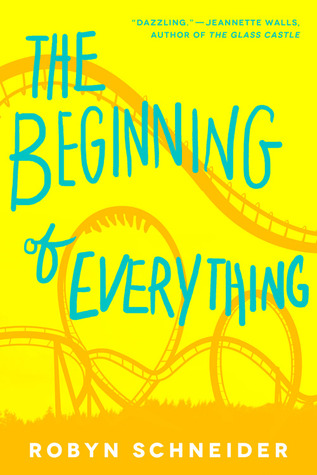
The Beginning of Everything by Robyn Schneider

Share

beginning

The Beginning of Everything
Author: Robyn Schneider
Published August 27, 2013 by Katerine Tegen

Goodreads Summary: Golden boy Ezra Faulkner believes everyone has a tragedy waiting for them—a single encounter after which everything that really matters will happen. His particular tragedy waited until he was primed to lose it all: in one spectacular night, a reckless driver shatters Ezra’s knee, his athletic career, and his social life.

No longer a front-runner for Homecoming King, Ezra finds himself at the table of misfits, where he encounters new girl Cassidy Thorpe. Cassidy is unlike anyone Ezra’s ever met, achingly effortless, fiercely intelligent, and determined to bring Ezra along on her endless adventures.

But as Ezra dives into his new studies, new friendships, and new love, he learns that some people, like books, are easy to misread. And now he must consider: if one’s singular tragedy has already hit and everything after it has mattered quite a bit, what happens when more misfortune strikes?

Robyn Schneider’s The Beginning of Everything is a lyrical, witty, and heart-wrenching novel about how difficult it is to play the part that people expect, and how new beginnings can stem from abrupt and tragic endings.

My Review: Another novel filled with smart high schoolers—that makes me so happy!! I hope this is a trend because I love seeing brainy characters in my book and not stereotypical ones. The Beginning of Everything is described as witty, and it is very much so. The sarcasm and wit just bleeds out of this book. I found myself laughing out loud at parts, and usually just because a character had the audacity to say something they shouldn’t have.

In The Beginning of Everything, I actually connected more with the secondary characters than the protagonist. They were so well established and had such unique voices while Ezra sounded like any good-0le boy; however, I will say that by making his voice less distinct allowed for him to grow even in his prose. As he found his new, true identity, his voice became to ring out more true. I am not sure if the author did this on purpose or not, but either way it worked!

Oh, and the final pages. Guys, they were so good! Although it felt a bit rushed to me, the lyrical writing got me in the end. Perfect.

Teachers’ Tools for Navigation: Although this book’s main home is in teens’ hands from a classroom, school, or public library, there are definitely parts that can be pulled out to be used in a classroom.

Since the characters are intelligent, many of the conversations have allusions to literature (Mary Oliver, Shakespeare, Fitzgerald, Frost) or their topics are quite deep (connecting organic chemistry to life, panopticon, Banksy, German insults). Also, there are debate topics that would be so interesting to look into such as imperialism, capitalism, and the economy.

One fun activity that I would definitely pull out of this book is fake debates. When Ezra, Toby, Cassidy, etc. were at their debate tournament, they had fake debates where they had to choose a side of quite silly topics like “Should vampires be allowed to vote?” This would be a great activity to do in classes to work on persuasion and arguments. (However, be careful about actually reading aloud the scene this is in as they also make it a drinking game.)

Discussion Questions: Do you feel like we live in a society similar to the panopticon? [If you don’t know what this is, it is quite fascinating: http://en.wikipedia.org/wiki/Panopticon]; Do you think Cassidy made the right choice in the end?; Ezra truly connects with The Great Gatsby because of all the changes his life is going through. What book to you connect with and why?

Flagged: “Her face was inches from mine. I could see the freckles that dusted her nose and the gold flecks in the disquieting blue of her eyes.” (p. 111)

“My admirable opponent argues that vampires do not deserve suffrage, as many great yet misinformed politicians have done before her while calling for the continued marginalization of women, or other minorities.” Cassidy began. “Yet vampires were, at some point human. At what point can a man’s voting rights be revoked, if he is proven to be of rational mind?” (p. 157)

Read This If You Loved: Life in Outer Space by Melissa Kiel, Stargirl by Jerry Spinelli, Paper Towns by John Green

Recommended For: 

classroomlibrarybuttonsmall closereadinganalysisbuttonsmall

Signature

Author Guest Post!: The Sum of Our Parts by Tracy Holczer, author of The Secret Hum of a Daisy

Share

“The Sum of Our Parts” by Tracy Holczer

I’ve been thinking a lot lately as to how I became a writer. I used to have it down. I was a writer because I read Little Women and had the run of the library, both at just the right age. But I have come to realize those are just two of many pieces. Once I really reflected, I found so much more, both light and dark. I feel we try so hard to focus on the light, especially those of us who write for kids. But we are who we are because of both. There is no contrast without darkness, and contrast, I believe, is where we find the answers for ourselves. So here is a very incomplete list of the parts of this writer:

  • Loneliness. I was a lonely kid. An only child born at the tail end of the “children should be seen and not heard” era, I had tremendous space to read books and otherwise look to inanimate objects for comfort and camaraderie. I didn’t have any experience with other kids until I went to Kindergarten and was hugely surprised and disappointed when no one wanted me to teach them how to tell time in Roman numerals. I mean, we were there to learn, right? Even the nuns treated me like I was a little off my nut.
  • Sensitivity. I took things hard. Like in second grade when Ms. Parsons got married and would become Mrs. Harrison half way through the year (I abhorred change), or in third grade when Sister Michael Anne read us Martin Luther King, Jr.’s “I Have a Dream” speech. There were several times over my school career that I thought I would die from sadness.
  • Librarians. After my parents told me I couldn’t read anymore because reading was “anti-social”, we moved across the street from a library when I was twelve. I snuck over there every weekend as though my life depended on it. Because it did. Those librarians took me under their wing and always had books to recommend as well as knew when I needed to be left alone to my imaginings. A piece of the writer I have become was conceived in the smelly bean bag chair in the Cupertino Public Library, most likely while reading The Hobbit.
  • Flightiness – otherwise known as Creativity. I was a flighty kid. If one of my teachers read us a book about plants, maybe talking about photosynthesis, but there was a bug on one of the leaves of the plant, and it had strange spots, I would be that kid asking why the bug had spots. My mind never seemed to travel down the right channels. At least not the ones my teachers wanted it to travel down. Every report card I ever received in elementary school pointed out my flightiness and “if she would only apply herself”. I never quite understood what that meant. I get it now, but I so wish they had pointed out my creativity, too. Maybe it wouldn’t have taken me so long to recognize it in myself.
  • Stubbornness.  Holy tamales but I am stubborn. Because I wasn’t a brilliant student, and didn’t finish college, I never really fell into anyone’s spotlight. Teachers liked me, but no one ever singled me out. I floated down the stream of public school with my mostly B’s, sometimes A’s, not causing any trouble. No one expected very much of me and I didn’t expect very much of myself. It wasn’t until I decided I would teach myself to write that I truly found my stubbornness to be useful.
  • BOOKS. All the books.

As a writer for children, I find myself in the incredible position to be able to possibly, maybe, in my wildest dreams, make a difference. I hope my books will bring both light and dark to kids so they get the whole spectrum of what it feels like to be alive and in charge of their destinies. I hope to be able to share my journey with those children so they really get the fact that they are a work in progress and even the most lonely, sensitive, and flighty of us can do great things if we set our stubborn minds to it. We are the sum of our parts in the best possible way.


tracy

About the Author: At eleven years old, Tracy Holczer read Little Women, and decided she wanted to be a writer. Feathered ball-point pen in hand, she wrote short blood-curdling stories and long, angst-ridden poems through the rest of her childhood. When she was a teen, her family moved to Grass Valley, California where she convinced her mother to get her glasses, even though she didn’t need them, so she would look smart. This is where Tracy decided she would be the next John Steinbeck and write about the glory of trees.

When she grew up, she took a few detours and worked as a sales clerk, a credit analyst, and a waitress in a honky-tonk bar. Somewhere in there, single momhood happened, so she added impersonating Santa Claus and Spider Assassin to her list of jobs. Eventually, she ended up in Southern California, married a General Contractor and lived happily ever after where she doesn’t have to sell ties, crunch numbers or wear a long white beard. Instead, Tracy gets to raise her three daughters from home, plan things like the Halloween Carnival for the PTA, and write stories.

Tracy Holczer is the author of The Secret Hum of a Daisy due out May 1, 2014. Hum was written in praise of both the imperfection of family, the perfection of nature and all that can be found if you’re willing to learn from your detours.

Tracy’s blog: http://tracyholczer.wordpress.com/
Tracy’s website: http://tracyholczer.com/

Exciting News!
The Secret Hum of a Daisy is an ABA 2014 Indies Introduce New Voices pick for Summer/Fall!
“Holczer presents a tender, transformative exploration of family, loss and reconciliation. The phrasing and the images are beautiful and rich.”—Kirkus Reviews
Starred Review —Publisher’s Weekly

This is definitely a MUST READ this summer!

Signature

**Thank you to Tracy Holczer for her amazing guest post!!**

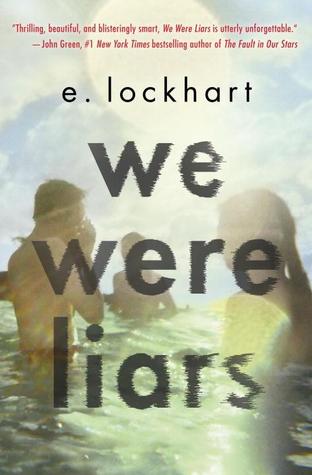
We Were Liars by e. lockhart

Share

we were liars

We Were Liars
Author: e. lockhart
Expected Publication: May 13th, 2014 by Delacorte

Summary: A beautiful and distinguished family.
A private island.
A brilliant, damaged girl; a passionate, political boy.
A group of four friends—the Liars—whose friendship turns destructive.
A revolution. An accident. A secret.
Lies upon lies.
True love.
The truth.

We Were Liars is a modern, sophisticated suspense novel from National Book Award finalist and Printz Award honoree e. lockhart.

Read it.
And if anyone asks you how it ends, just LIE.

Review: I can’t tell you anything about this book without giving anything way, and I would never do that to you, so let me just say this—this is a book that I will remember forever. It is haunting and sent chills up my spine. I was sucked into the story of this beautifully screwed up family with too much money for its own good.

Teacher’s Tools for Navigation: This would bridge beautifully with The Great Gatsby. There are so many parallels, and I can’t write them here, or I will give away too much of the plot. The figurative language in this title is also stunning. English teachers will go gaga over the pages upon pages of text that can be used for close reading. It made me want to go back to teaching English!

Discussion Questions: What does this story teach us about humanity?; What drives each of the family members?; What does Gat’s character add to the story?; How does lockhart unravel the plot? What makes her an effective writer?; What is the message of this complex text?

We Flagged: “If you want to live where people are not afraid of mice, you must give up living in palaces” (Chapter 40).

Please note: The above quote is from the Advanced Reader Copy. The chapter numbers is included instead of page numbers because the e-reader did not provide page numbers. The quotes may change when the book is published.

Read This If You Loved: The Great Gatsby by F. Scott Fitzgerald, I Will Save You by Matt de la Peña, If I Stay by Gayle Forman

Recommended For:

closereadinganalysisbuttonsmall litcirclesbuttonsmall classroomlibrarybuttonsmall

RickiSig

Bruised by Sarah Skilton

Share

bruised

Bruised
Author: Sarah Skilton
Published March 5, 2013 by Amulet/Abrams

Goodreads Summary: Imogen has always believed that her black belt in Tae Kwon Do made her stronger than everyone else–more responsible, more capable. But when she witnesses a holdup in a diner, she freezes. The gunman is shot and killed by the police. And it’s all her fault.

Now she’s got to rebuild her life without the talent that made her special and the beliefs that made her strong. If only she could prove herself in a fight–a real fight–she might be able to let go of the guilt and shock. She’s drawn to Ricky, another witness to the holdup, both romantically and because she believes he might be able to give her the fight she’s been waiting for.

But when it comes down to it, a fight won’t answer Imogen’s big questions: What does it really mean to be stronger than other people? Is there such a thing as a fair fight? And can someone who’s beaten and bruised fall in love?

My Review and Teachers’ Tools for Navigation: Imogen is broken and she must overcome this feeling of hopelessness that surrounds her constantly. What an intense way to introduce us to a character? We then go on a journey with Imogen as she tries to rebuild her life, her memories, her friendships, and her family.

At first I struggled with this book because the timeline was choppy, and Imogen was hard to pinpoint. But then, through the flashbacks, Imogen starts to become clearer to us, the reader, and Imogen’s memories start to become clearer to her. Then you are so sucked into wanting to know everything, and you can only know everything if you stick with the book and see Imogen’s memories as they are revealed. This is a pretty brilliant tactic in making the reader feel like they are in the protagonist’s brain.

Bruised actually reminds me a lot of Speak by Laurie Halse Anderson. Both young ladies are thrown into a tragedy, let that tragedy eat away at their hearts and souls, and have to figure out how to find themselves again. Truly a remarkable journey to go on with a character.  And, like Speak, there are some intense topics/themes dealt with in Bruised that will definitely grab a teen’s attention: sibling rivalry, a disabled parent, disconnected family, friendship, sex, love, survival, and martial arts. It is one of those books that teens need to read, so they can learn to become resilient and to overcome whatever is in their path.

Discussion Questions: Is it ever okay to lie?; Would you have been able to forgive your best friend if she’d done what Shelly did?; Was it right of Imogen to call Grant down during the demonstration?; Why was having Ricky there such an important part of Imogen’s recovery?

We Flagged: “Don’t you recognize me?” says Ricky after a moment.
Confused, I force myself to look up from the floor, up his legs and along his body, until I’m looking him in the eyes.
I hear gunshots, the cashier crying, and the police sirens, but I don’t look away.
He’s my friend from under the table.” (p. 60)

“Today, eleven days later, I slide down the wall of my own shower and curl up in a ball, tuck my knees under my chin, and wrap my arms around my head. I’ve taken showers since the diner, but this one’s different. Get smaller. Small as you can be. Low to the ground is comforting, standing up is bad. Why is standing up bad? What happins if you stand up? (You don’t want to know.) Reset button. Start at the beginning. Gretchen’s in the bathroom when the gunman comes in. I see the glint of his gun, and I hide under the table. There’s Ricky, under a different table, he brings his finger to his lips. Shh…” (p. 95-96)

Read This If You Loved: Speak by Laurie Halse Anderson, Stained by Cheryl Rainfield, Rape Girl by Alina Klein

Recommended For: 

classroomlibrarybuttonsmall

Signature