Nonfiction Picture Book Wednesday is hosted by Kid Lit Frenzy and was started to help promote the reading of nonfiction texts. Most Wednesdays, we will be participating and will review a nonfiction text (though it may not always be a picture book).
Be sure to visit Kid Lit Frenzy and see what other nonfiction books are shared this week!
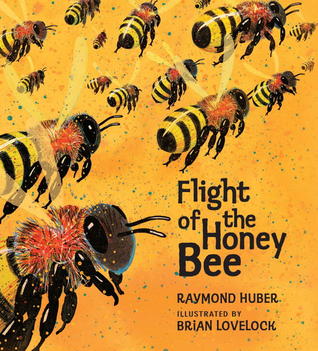
Flight of the Honey Bee Author: Raymond Huber
Illustrator: Brian Lovelock
Published September 10th, 2013 by Candlewick Press
Goodreads Summary: Follow the flight of a honey bee as she searches for nectar to sustain her hive and, along the way, pollinates flowers to produce seeds and fruits.
A tiny honey bee emerges from the hive for the first time. Using sunlight, landmarks, and scents to remember the path, she goes in search of pollen and nectar to share with the thousands of other bees in her hive. She uses her powerful sense of smell to locate the flowers that sustain her, avoids birds that might eat her, and returns home to share her finds with her many sisters. Nature lovers and scientists-to-be are invited to explore the fascinating life of a honey bee.
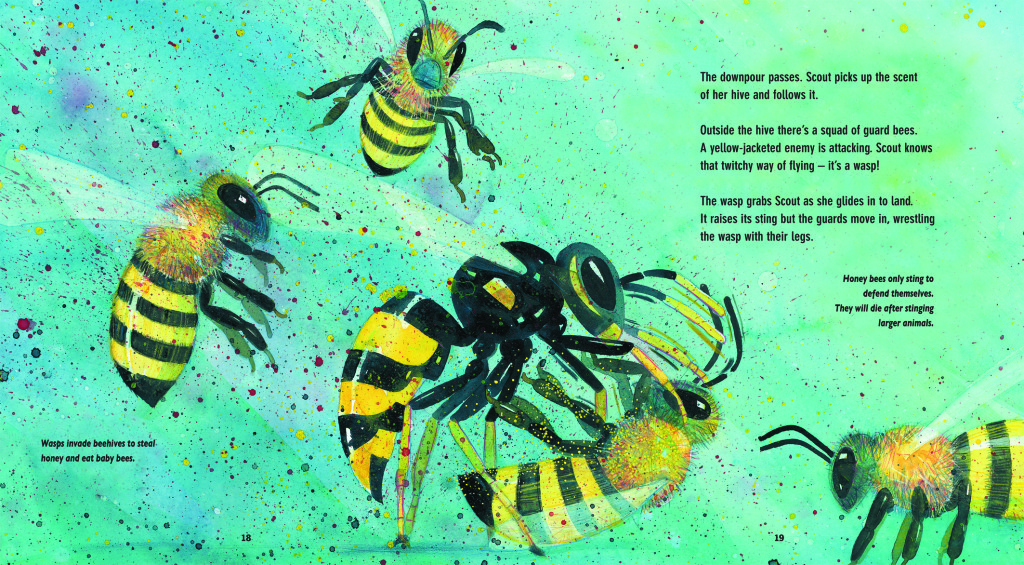
Kellee’s Review and Teachers’ Tools for Navigation: I love books that mix narrative and information nonfiction within one book. This text introduces Scout as she exits the hive and goes about her bee-siness (hehe!). This part of the story is told as a story. Then on each page, there is information about bees in general to help the reader understand Scout’s journey. This unique text structure mixed with the realistic yet artistic illustrations really makes Flight compelling to read. In addition to learning about bees and the vocabulary included in the book, this book could be a great addition to a lit circle inquiry group about insects or as a mentor text to create student narrative and informational mixed writing about a animal after researching.
Ricki’s Review and Teachers’ Tools for Navigation: I read this book aloud to my son while he was eating breakfast, and he was captivated by the illustrations and story. I immediately texted Kellee and told her we had to schedule a day to review it! I had a lot of fun following Scout on her adventure, and I know kids will become so engaged in this story that they will forget they are learning. I thought I knew a lot about bees, but I was surprised by how much information is packed into this text. Readers will cheer for Scout as she encounters obstacles. I try to integrate nonfiction into every unit, and this would be a great book to show students just how accessible nonfiction can be. Then, they could pick a creature or object in nature, conduct research, and write their own narrative nonfiction texts.
Discussion Questions: How do bees help the environment and humans?; How can we help save the bees?; What are the different types of bees? Why are they all important?
Nonfiction Picture Book Wednesday is hosted by Kid Lit Frenzy and was started to help promote the reading of nonfiction texts. Most Wednesdays, we will be participating and will review a nonfiction text (though it may not always be a picture book).
Be sure to visit Kid Lit Frenzy and see what other nonfiction books are shared this week!
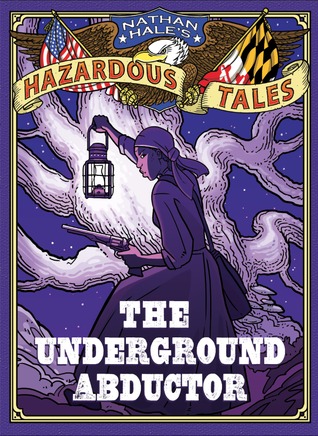
The Underground Abductor
Author and Illustrator: Nathan Hale
Published April 21st, 2015 by Amulet Books
Goodreads Summary: Araminta Ross was born a slave in Delaware in the early 19th century. Slavery meant that her family could be ripped apart at any time, and that she could be put to work in dangerous places and for abusive people. But north of the Mason-Dixon line, slavery was illegal. If she could run away and make it north without being caught or killed, she’d be free. Facing enormous danger, Araminta made it, and once free, she changed her name to Harriet Tubman. Tubman spent the rest of her life helping slaves run away like she did, every time taking her life in her hands. Nathan Hale tells her incredible true-life story with the humor and sensitivity he’s shown in every one of the Hazardous Tales—perfect for reluctant readers and classroom discussions.
My Review: I love this entire series! Nathan Hale has taken history and made it accessible (with a dash of humor!). If you don’t the concept of the series, it revolves around Nathan Hale the Revolutionary War spy who, in the first book, was eaten by a history book so now knows all that has happened in history and is sharing it with the hangman and British officer who are guarding him before he is executed. The first book is Hale’s own story and then each of the following are his telling of different times in history.
This installment of Hale’s graphic novel series may be my favorite so far. I found it to be the most intense of his stories even though it is up against stories of wars, but Harriet Tubman’s story is one of one person’s resilience in the face of pure doom. Although it is evident through any story you hear of Harriet how truly brave she was, Nathan Hale’s story immerses you into Harriet’s life and shows you how much she truly did and faced.
Teachers’ Tools for Navigation: This book is written to start discussions (in reading/language arts OR social studies)! I was lucky enough to write the teaching guide for The Underground Abductor (as well as the rest of the series!), and I have included some of my discussion questions below.
I could also see Hale’s Hazardous Tales being used in lit circles with each group reading a different one of the tales. This could lead to wonderful discussions about each time in history. Students could then present their history to the rest of the class.
Discussion Questions:
When Araminta heard the story of Moses and the pharaoh, she envisioned Moses as a slave and the pharaoh as an owner (page 15). How does Moses’s story compare to a traditional story of a slave? Harriet is later called “Moses” or “Black Moses.” How does Harriet’s story compare to Moses’s?
How did Nat Turner’s rebellion affect slave laws (page 21)? He meant to make a positive change, but it actually turned negative. How? Why?
On page 44, Nathan Hale personifies debt as the ghosts and men Minty had been dreaming about. Why is debt shown as a terrifying thing? How did Mr. Brodess’s debt affect Mindy and her family?
Complete a character web with adjectives describing Harriet Tubman. What type of person was she that allowed her to overcome a debilitating injury and slavery?
Book Trailer:
Read This If You Loved: Hazardous Tales series by Nathan Hale, March by John Robert Lewis, Stolen Into Slavery by Judith Bloom Fradin, Elijah Buxton by Christopher Paul Curtis
Recommended For:
**Thank you to Morgan at Abrams Books for providing a copy of the book!**
Nonfiction Picture Book Wednesday is hosted by Kid Lit Frenzy and was started to help promote the reading of nonfiction texts. Most Wednesdays, we will be participating and will review a nonfiction text (though it may not always be a picture book).
Be sure to visit Kid Lit Frenzy and see what other nonfiction books are shared this week!
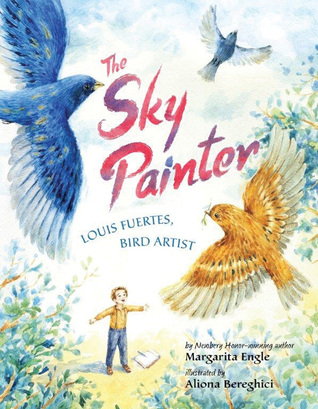
The Sky Painter: Louis Fuertes, Bird Artist Author: Margarita Engle
Illustrator: Aliona Bereghici
Published April 28th, 2015 by Two Lions
Goodreads Summary: Louis loves to watch birds. He takes care of injured birds and studies how they look and how they move. His father wants him to become an engineer, but Louis dreams of being a bird artist. To achieve this dream, he must practice, practice, practice. He learns from the art of John James Audubon. But as Louis grows up, he begins to draw and paint living, flying birds in their natural habitats.
Louis Agassiz Fuertes (1874–1927) is now known as the father of modern bird art. He traveled with many scientific expeditions all over the world. His best-known works—paintings for habitat exhibits at the American Museum of Natural History in New York—are still beloved by visitors today. His art helped to encourage wildlife conservation, inspiring people to celebrate and protect the world of wings.
Poems by Newbery Honor–winning author Margarita Engle and illustrations by Aliona Bereghici capture the life of Louis Fuertes and the deep sense of wonder that he felt when he painted the sky.
About the Author: Margarita Engle is a Cuban American poet and novelist whose work has been published in many countries. Her books include The Poet Slave of Cuba, winner of the Pura Belpré Award for narrative and the Américas Award; The Surrender Tree, a Newbery Honor book; Summer Birds: The Butterflies of Maria Merian, a Kirkus Best Book for Children; and The Lightning Dreamer, Cuba’s Greatest Abolitionist, winner of the 2014 PEN Center USA Literary Award for Young Adult/Children’s Literature. Margarita lives in California, where she enjoys bird-watching and helping her husband with his volunteer work for wilderness search-and-rescue dog training programs. To learn more, and to download a free activity kit for The Sky Painter, visit: www.margaritaengle.com
Kellee’s Review:Louis Fuertes is an inspirational man, and Engle’s biography of him is perfect. I think what I enjoyed most was how Fuertes was not only an artist, but an animal activist, family man, and educator. He is a role model for any kid that wants to grow up to be happy. Like Ricki shares below, this book shares an important lesson about how there are so many different special things out there to be observed. Nature is phenomenal.
I loved learning not only of Fuertes and his journey to live his passion, I loved the beautiful poetry and watercolor that were used to craft his story. Both the poetry and the artwork do Fuertes’s story justice like no other format would have. The format also gives the reader a chance to look at each poem as a stand alone and also part of the whole biography which gives each poem two different purposes and two different ways they can be analyzed.
Ricki’s Review:Louis Fuertes is a remarkable man, and this book not only pays homage to his extraordinary life, but it teaches young people important lessons. He nurtures and cares for birds in ways that children can emulate in many aspects of their lives. The book shows he devoted his life to birds and wanted others to see their beauty. I’ve seen Fuertes’ artwork in a variety of places, but I never considered him as an artist. This book reminded me that sometimes I go about life, not considering something very important and special. I am so glad I learned about Fuertes’ story and will think about him whenever I read or learn about birds. This book would be an excellent gift to give to a child. The poetry is gorgeous, and the illustrations are breath-taking.
Teachers’ Tools for Navigation: As a teacher, we can think of a plethora of ways to use this text in the classroom. We love to offer our students options, so we might provide them opportunities to read different biographies of different people who are following their passion. Students the could get in lit circles to discuss the biography then come back together to share what they learned. They could also choose any artist or person in history and write poems reflecting this individual’s biography. It would be fun to illustrate and bind these books to share them with others. We can imagine a class sitting in a circle, reading their poetry and learning about lesser-known individuals in history.
Discussion Questions: How did Fuertes change animal painting/drawing forever?; How do you feel that some artists kill animals to draw or paint them?; How did following his passions help make Fueres’s life happier?
Book Trailer:
Interview with Margarita Engle
Unleashing Readers: What inspired you to write about Fuertes?
Margarita Engle: I became fascinated by Fuertes while I was researching rain forest ecology and visiting wildlife preserves, during the process of writing a historical verse novel called Silver People: Voices From the Panama Canal. In many references, Fuertes was mentioned as the bird artist for all the great geographic expeditions of the early twentieth century. When I learned that he was a conservationist who pioneered the painting of living birds in flight—instead of killing and posing them like Audubon—I was astonished. Why wasn’t he a household name, like Audubon? Instantly, Fuertes became the most important link in my ongoing quest for biographical picture books about great Latino naturalists who have been forgotten by history. I hope The Sky Painter helps teachers, librarians, and parents introduce children from all backgrounds to this amazing Puerto Rican/American scientist. Fuertes is a fantastic role model because he was a creative thinker who decided to learn how to paint faster, to save the lives of birds.
UR: What did your research process look like? Do you have any recommendations for students who are doing research?
ME: I try to read every book I can find, in addition to online sources. Many historical studies simply have not yet been digitized, so interlibrary loan is really helpful. I rely on bibliographies to help me move farther and farther back in time, until I discover first person narratives. Diaries, letters, field notes, etc. are incredibly helpful. Fortunately, Fuertes and the scientists he worked with on expeditions recorded fascinating details!
UR: Was there any information that you found interesting that you decided not to include in the book?
ME: Yes, because this book is for young children, I decided not to include the tragic way he died. Soon after he returned from his expedition to Africa, he was driving to show new paintings to another ornithologist. His car was hit by a train. The paintings survived, but he did not.
UR: Because we are a blog devoted to teachers, do you have any ideas about how you envision your book in classrooms?
ME: The Sky Painter can fit into science, art, poetry, or multicultural programs. One of the really clever cartoon exercises Fuertes taught children who visited his studio was simply sketching three circles, then deciding how to connect them. Two circles could become arms or wings, depending on how they’re connected. One circle is always the head. Children decide whether to create a person, a bird, or some sort of funny hybrid.
For older children, I think The Sky Painter can also be used to teach history, if a teacher discusses the way important accomplishments are sometimes omitted from textbooks. Because there’s a tendency for each generation of textbooks to include material from past editions, incredibly important topics may be gradually forgotten.
Fuertes was not only a great artist and scientist, he was also a groundbreaking conservationist. It would make me very happy to see The Sky Painter featured during Hispanic Heritage Month in September–October, as well as on Earth Day, which happens to fall during National Poetry Month in April. It would be especially thrilling to see The Sky Painter used by a teacher preparing students for a field trip, whether it’s a video or a virtual trip on a nature website, an outdoor nature walk on the school-grounds, a walk in a nearby park, or a visit to the Natural History Museum in New York to see the murals Fuertes painted as backgrounds for habitat displays. The possibilities are incredible!
Perhaps most important, The Sky Painter can be used to teach about creative thinking. Are there old attitudes we might try changing—just as Fuertes did—to promote conservation of wildlife and natural habitats?
Read This If You Loved: Feathers: Not Just For Flying by Melissa Stewart, A Boy and a Jaguar by Alan Rabinowitz, Manfish by Jennifer Berne, Look Up!: Bird-Watching In Your Own Backyard by Annette LeBlanc Cate
Rain Reign
Author: Ann M. Martin
Published October 7th, 2014 by Feiwel & Friends
Goodreads Summary: In her most powerful novel yet, Newbery Honor author Ann M. Martin tells the story of girl with mental/emotional challenges and the dog she loves.
Rose Howard has OCD, Asperger’s syndrome, and an obsession with homonyms (even her name is a homonym). She gave her dog Rain a name with two homonyms (Reign, Rein), which, according to Rose’s rules of homonyms, is very special. Rain was a lost dog Rose’s father brought home. Rose and Rain are practically inseparable. And they are often home alone, as Rose’s father spends most evenings at a bar, and doesn’t have much patience for his special-needs daughter.
Just as a storm hits town, Rain goes missing. Rose’s father shouldn’t have let Rain out. Now Rose has to find her dog, even if it means leaving her routines and safe places to search. Rose will find Rain, but so will Rain’s original owners.
Hearts will break and spirits will soar for this powerful story, brilliantly told from Rose’s point of view.
My Review and Teachers’ Tools for Navigation: Rose reminded me of a dear student I had when I was teaching. Because I had this strong connection with her character, I felt very attached to the story, in general. Rose is a passionate, caring young girl, and I think students will learn much from her.The story line is well-done, and I appreciated that it wasn’t a problem novel that only focused on her disorder. Her bond with her dog, her bravery, and her relationship with her uncle teach great lessons. This book reminded me of Wonder by R.J. Palacio because it teaches empathy quite well. It is one of those books that makes me want to be a better person. While Rose’s repetition may feel overdone, it is her reality, and Ann M. Martin hits that home. Rose pushes and pushes her father and teachers (at the same time as she pushes and pushes the reader) in ways that are a hallmark of Asperger’s. It shows the realities of individuals who live with this disorder. I think it is incredibly important for students to read books about people who are different from them, so they can see the similarities despite the differences in characters. I would love to use this book as a read-aloud.
Discussion Questions: Was Rose’s dad an evil man? What can we learn from him?; Do you think Rose made the right choice about Rain?; How does Rose make friends in school? What can we learn from her?
We Flagged: “I’m going to tell you a story. It’s a true story, which makes it a piece of nonfiction.”
Read This If You Loved: Rules by Cynthia Lord, Wonder by R.J. Palacio, Mockingbird by Kathryn Erskine, Out of my Mind by Sharon Draper, Each Kindness by Jaqueline Woodson; The Curious Incident of the Dog in the Night-Time by Mark Haddon
Nonfiction Picture Book Wednesday is hosted by Kid Lit Frenzy and was started to help promote the reading of nonfiction texts. Most Wednesdays, we will be participating and will review a nonfiction text (though it may not always be a picture book).
Be sure to visit Kid Lit Frenzy and see what other nonfiction books are shared this week!
Winter Bees & Other Poems of the Cold
Author: Joyce Sidman
Illustrator: Rick Allen
Published November 4th, 2014 by HMH Books for Young Readers
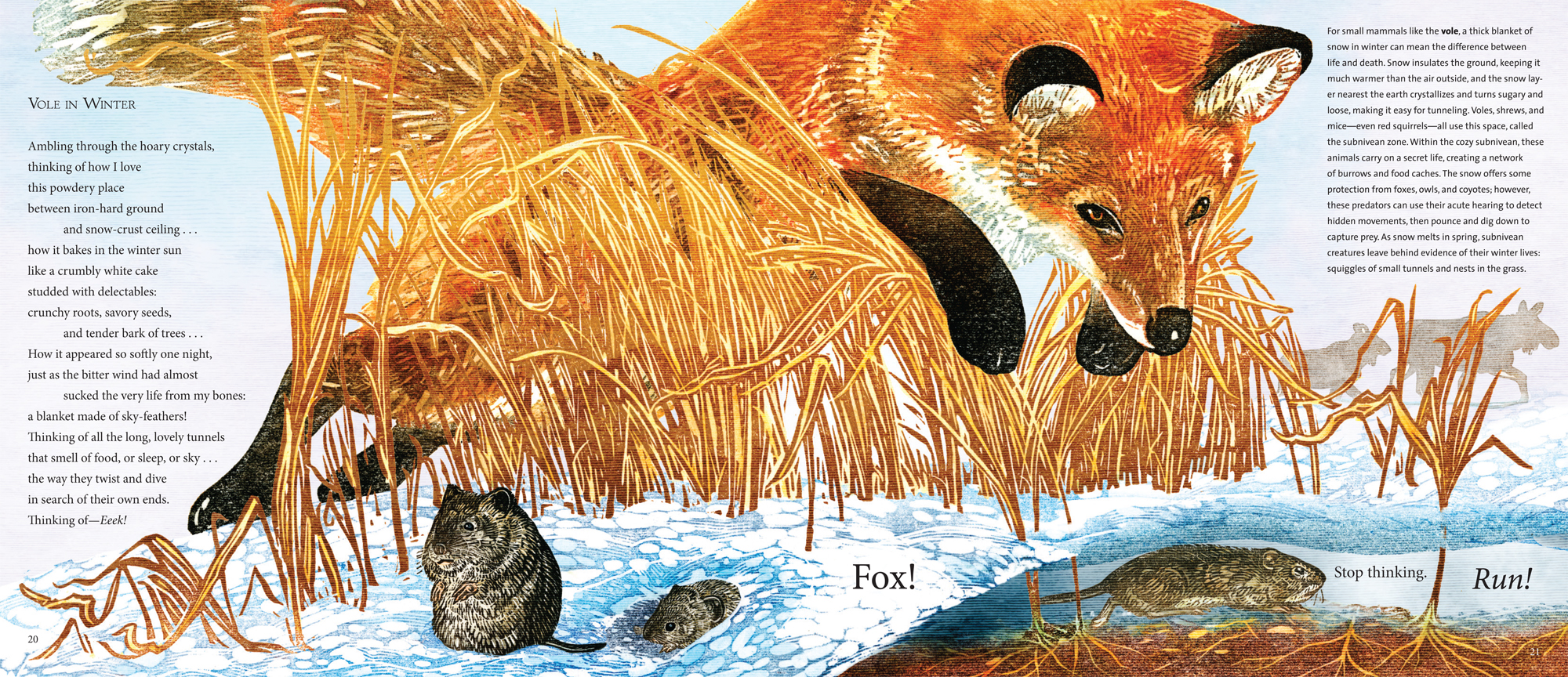
Goodreads Summary: In this outstanding picture book collection of poems by Newbery Honor-winning poet, Joyce Sidman (Song of the Water Boatman, Dark Emperor and Other Poems of the Night), discover how animals stay alive in the wintertime and learn about their secret lives happening under the snow. Paired with stunning linoleum print illustrations by Rick Allen, that celebrate nature’s beauty and power.
My Review: Alyson and Carrie both nominated this book for our Mock Sibert Award, so I knew it was a book I had to read. After requesting that my library purchase it, I was so happy to finally receive the book. This book is beautiful. Each aspect of the book can stand alone: the poetry is full of imagery and figurative language, the informational aspects are interesting and fact-based, and the illustrations are exceptional and bring the animals to life.
Teachers’ Tools for Navigation: First, this book can be used as a mentor text for poetry. Many different types of poetry are represented and each poem is different. Second, I think this book can be a great jumping off point for an inquiry-based project where students research an animal, write a poem about it, and also write an informational piece of text to accompany the poem. This book is also a great companion to Kate Messner’s Over and Under Snow and other animal survival books which would cause for a great unit as well.
Discussion Questions: Which of the winter animals has the best plan for survival?; What fact in Winter Bees surprised you the most about how an animal survives during the winter?
We Flagged:
Read This If You Loved: Firefly July by Paul Janeczko, Feathers by Melissa Stewart, Born in the Wild by Lita Judge, Forest Has a Song by Amy Ludwig VanDerwater, Over and Under Snow by Kate Messner
Henry Aaron’s Dream Author: Matt Tavares
Published January 12th, 2010 by Candlewick Press
Goodreads Summary: Matt Tavares hits one out of the park with this powerful tale of a kid from the segregated south who would become baseball’s home-run king.
Before he was Hammerin’ Hank, Henry Aaron was a young boy grow ing up in Mobile, Alabama, with what seemed like a foolhardy dream: to be a big-league baseball player. He didn’t have a bat. He didn’t have a ball. And there wasn’t a single black ball player in the major leagues. B ut none of this could stop Henry Aaron. In a captivating biography of Henr y Aaron’s young life – from his sandlot days through his time in the Negro Leagues to the day he played his first spring training game for the Braves – Matt Tavares offers an inspiring homage to one of baseball’s all-time greats.
There Goes Ted Williams: The Greatest Hitter Who Ever Lived Author: Matt Tavares Published February 14th, 2012 by Candlewick Press
Goodreads Summary: A lively picture book biography of Ted Williams from a master of the genre — just in time for Fenway Park’s centennial.
Ted Williams lived a life of dedication and passion. He was an ordinary kid who wanted one thing: to hit a baseball better than anyone else. So he practiced his swing every chance he got. He did fingertip push-ups. He ate a lot of food. He practiced his swing again. And then practiced it some more. From his days playing ball in North Park as a kid to his unmatched .406 season in 1941 to his heroic tours of duty as a fighter pilot in World War II and Korea, the story of Teddy Ballgame is the story of an American hero. In this engrossing biography, a companion to Henry Aaron’s Dream, Matt Tavares makes Ted Williams’s life story accessible to a whole new generation of fans who are sure to admire the hard work, sacrifice, and triumph of the greatest hitter who ever lived.
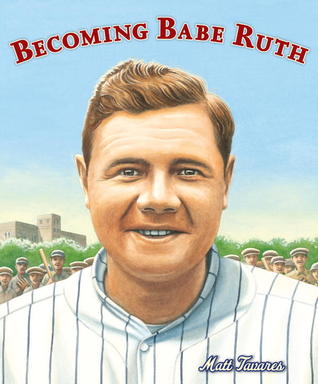
Becoming Babe Ruth Author: Matt Tavares Published February 12th, 2013 by Candlewick Press
Goodreads Summary: Matt Tavares’s striking homage to one of baseball’s legends offers a rare view into Babe Ruth’s formative years in “the House that built Ruth.”
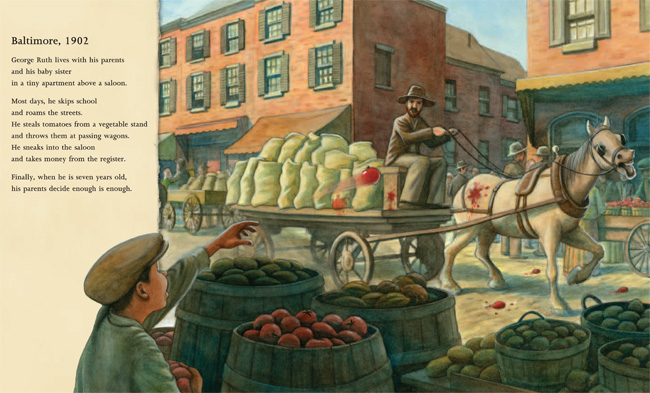
Before he is known as the Babe, George Herman Ruth is just a boy who lives in Baltimore and gets into a lot of trouble. But when he turns seven, his father brings him to the gates of Saint Mary’s Industrial School for Boys, and his life is changed forever. At Saint Mary’s, he’s expected to study hard and follow a lot of rules. But there is one good thing about Saint Mary’s: almost every day, George gets to play baseball. Here, under the watchful eye of Brother Matthias, George evolves as a player and as a man, and when he sets off into the wild world of big-league baseball, the school, the boys, and Brother Matthias are never far from his heart. With vivid illustrations and clear affection for his subject, Matt Tavares sheds light on an icon who learned early that life is what you make of it — and sends home a message about honoring the place from which you came.
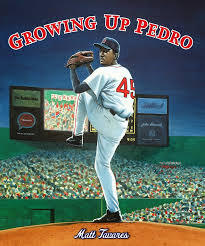
Growing Up Pedro: How the Martinez Brothers Made it From the Dominican Republic All Way to the Major Leagues Author: Matt Tavares Published February 10th, 2015
Goodreads Summary: The love between brothers is key to Matt Tavares’s tale of Dominican pitcher Pedro Martinez, from his days of throwing rocks at mangoes to his years as a major-league star.
Before Pedro Martinez pitched the Red Sox to a World Series championship, before he was named to the All-Star team eight times, before he won the Cy Young three times, he was a kid from a place called Manoguayabo in the Dominican Republic. Pedro loved baseball more than anything, and his older brother Ramon was the best pitcher he’d ever seen. He’d dream of the day he and his brother could play together in the major leagues—and here, Matt Tavares tells the story of how that dream came true. In a fitting homage to a modern day baseball star, the acclaimed author-illustrator examines both Pedro Martinez’s improbable rise to the top of his game and the power that comes from the deep bond between brothers.
My Review: These four superbly crafted biographies take a look at the life of each man, but as more than a baseball player. We learn about their childhoods, where they came from, and their dreams and hopes. Each book includes aspects of the history surrounding them including the Depression, wars, and racism. Additionally, these books are crafted beautiful with lyrically written prose. These books are must reads for lovers of baseball, history, and biographies in general.
Teachers’ Tools for Navigation: I was lucky enough to be asked to write a teachers’ guide for each of these books. For each book, I created discussion questions and activities (including cross-curricular activities). I plan on using this guide in my own classroom with the books in a lit circle type of setting. Each group will be given one of the biographies, will complete the discussion questions and activities, and then become experts on their player before presenting. These biographies are asking to be in classrooms, and I hope the guide helps show how they can fit into a language arts/reading class.
Becoming Babe Ruth
News spread differently in the early twentieth century. Discuss with your students the way news about Babe Ruth was spread during his lifetime and have students find examples in the text. Then have them discuss the way news is spread digitally nowadays. Invite the class to debate the pros and cons of digital news.; How did Babe Ruth’s life change when he left Saint Mary’s to play for the Orioles?
There Goes Ted Williams Have students write down Ted Williams’s batting average and home run stats as well as those of two other Hall of Famers. After comparing the players’ stats, have students write a paragraph discussing whether or not they believe that Ted Williams is the best hitter ever.; How did Ted Williams’s childhood perseverance help him become a professional baseball player?
Henry Aaron’s Dream Baseball began integrating before all cities in the United States had ended segregation. As a class, discuss how this reality affected black players on major-league baseball teams and how black players’ trips to segregated cities differed from those of their white teammates. Then, with your students, complete a graphic organizer comparing and contrasting the life of white and black baseball players during Hank Aaron’s lifetime. Invite students to write an essay about how life has changed for players of color over time.; How did Jackie Robinson influence Henry Aaron? What did Jackie Robinson’s accomplishments mean for other black baseball players?
Growing Up Pedro Pull up a map of North America. Have students mark all the different places that Pedro played: the Dominican Republic, Montana, Montreal, and so on. Ask students to determine the miles between each location. Which place was the farthest from Pedro’s home? Which place was the closest?; Have students write a journal entry as Pedro Martínez. Invite them to write, from Pedro’s point of view, what it feels like to move so far away from home when he is so young. Does he miss his family? Is he sad, happy, or excited to be in Montana.
Discussion Questions: Examples of discussion questions and activities for each of the biographies can be found in my teachers’ guide; however, after reading all four of the books, two discussion questions could be: Most of the baseball players had a mentor or idol that he looked up to and learned from. How did these mentors or idols help guide the players into becoming the greats they are?; Each of the baseball players helped a charity that was close to his heart. Who did each player help? Why did players choose the charity they did?
We Flagged:
http://www.matttavares.com/becomingbaberuth.html from Becoming Babe Ruth
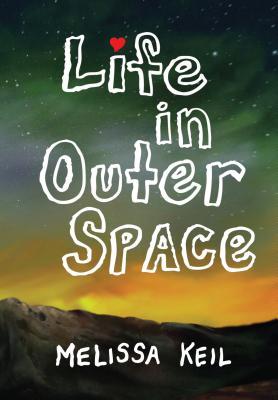
Life in Outer Space
Author: Melissa Keil
Published August 1st, 2013 by Peachtree Publishers
Goodreads Summary: Sam is a geek movie-buff with a ragtag group of loser friends who have been taking abuse from the popular kids for years. But when the super-cool Camilla moves to town, she surprises everyone by choosing to spend time with Sam’s group. Suddenly they go from geek to chic, and find that not everything boils down to us and them. With their social lives in flux, Sam and Camilla spend more and more time together. They become the best of friends, and Sam finds that he’s happier and more comfortable in his own skin than ever before. But eventually Sam must admit to himself that he’s fallen in love. If he confesses his true feelings to Camilla, will everything change again?
My Review: Kellee wrote her review almost a year ago, and after reading her review, I laughed because my notes about this book are so similar to her thoughts.
While reading this book, I thought about its connections to Stargirl by Jerry Spinelli and Paper Towns by John Green, and the narrator reminded me of Charlie from The Perks of Being a Wallflower by Stephen Chbosky. But while this book is similar to others, it is very different.
Sam makes being geeky feel cool. I am geeky, so I appreciated this. He experiences tough life issues that many teenagers face, and he doesn’t lie about his lack of knowledge about dealing with these issues or understanding girls. The book contains scenes with World of Warcraft and there is a lot of information about horror movies (both of which aren’t interesting to me), yet I remained very engaged in the story and the characters. Keil writes the male narrator very well, and I think all types of adolescents will identify with the themes of this book. This is one of Kellee’s favorite books, and I see why. Thank you for nagging me to read it, Kel. It is one that will stick with me forever.
Teachers’ Tools for Navigation: Why hasn’t this book received more press? It belongs in classrooms. As a teacher, I would use it as a mentor text for characterization. The scenes with Camilla are written breathtakingly well. If students read these scenes, they would want to read the entire book.
Discussion Questions: Did you find Camilla to be realistic? Could a student walk in and change the entire dynamic at the school in such a powerful way?; Why does Camilla like Sam? Is this realistic?; In what ways are media used by Keil to engage readers?; What does this book teach us about friendship?; How does Sam’s family life add to the complexity of this book?
We Flagged: “I guess some people enter your orbit and get stuck, and there’s nothing either of you can do about it” (p. 70).
And I loved the quote Kellee picked out. It is the scene I remember the most in the book:
“She is wearing a yellow dress that looks like it belongs to a 1950s housewife, and a pair of flat red boots. Her hair is longer than I’d imagine would be practical; it’s parted in the middle and hangs in brown waves almost to her waist. She peers around the room impassively. She doesn’t look terrified. She doesn’t look insanely overconfident, like Adrian that time in year seven when he performed a song as his book report for The Outsiders. Mike and I mark that event as ground zero for the downward social spiral of our group.” (p. 11)
Read This If You Loved:The Perks of Being a Wallflower by Stephen Chbosky, Stargirl by Jerry Spinelli, Paper Towns by John Green, Eleanor and Park by Rainbow Rowell




 and
and