From Kellee’s (Huge) Library Pile Part Eleven: Nonfiction Picture Books | Pink is for Blobfish by Jess Keating, Hillary Rodham Clinton by Michelle Markel, Two Friends by Dean Robbins, Freedom in Congo Square by Carole Boston Weatherford, & The Great Monkey Rescue by Sandra Markle

Share

NFPB2016

Nonfiction Wednesday

Nonfiction Picture Book Wednesday is hosted by Kid Lit Frenzy and was started to help promote the reading of nonfiction texts. Most Wednesdays, we will be participating and will review a nonfiction text (though it may not always be a picture book).
Be sure to visit Kid Lit Frenzy and see what other nonfiction books are shared this week!

From My (Huge) Library Pile

Because of It’s Monday! What Are You Reading? posts, I find myself often with huge piles of picture books from the library that were highly recommended by fellow bloggers. I celebrate many of the nonfiction pictures books on Wednesdays, but I want to share some of the fiction picture books I have enjoyed. So, I decided to start series here on UR where I can pass on the love for these books sporadically as I read them. Here is a list of some great pictures books that I’ve read recently from my huge library pile (part 11!).

pink is for

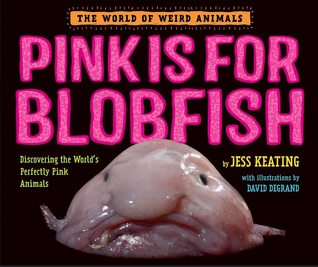
Pink is for Blobfish: Discovering the World’s Perfectly Pink Animals
Author: Jess Keating
Illustrator: David Degrand
Published February 2nd, 2016

Goodreads Summary: Pinkalicious meets National Geographic in this nonfiction picture book introducing the weirdest, wildest, pinkest critters in the animal kingdom!

Some people think pink is a pretty color. A fluffy, sparkly, princess-y color. But it’s so much more.
Sure, pink is the color of princesses and bubblegum, but it’s also the color of monster slugs and poisonous insects. Not to mention ultra-intelligent dolphins, naked mole rats and bizarre, bloated blobfish.

Isn’t it about time to rethink pink?

Slip on your rose-colored glasses and take a walk on the wild side with zoologist Jess Keating, author of How to Outrun a Crocodile When Your Shoes Are Untied, and cartoonist David DeGrand.

My Thoughts:  I loved how Keating set up the book. The information that was included was fascinating, there were many text features that added interesting tidbits throughout, and there was some hilarity thrown in. Such a great read! I also was told that it is going to be a series, and that is such great news!

hillary rodham clinton

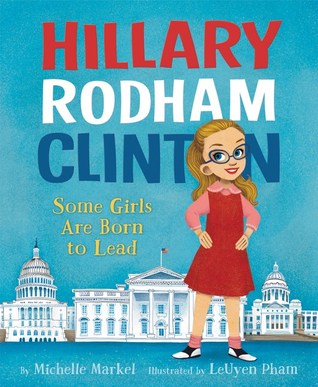
Hillary Rodham Clinton: Some Girls Are Born to Lead
Author: Michelle Markel
Illustrator: LeUyen Pham
Published January 5th, 2016 by Balzer + Bay

Goodreads Summary: In the spirit of Barack Obama: Son of Promise, Child of Hope andAmelia and Eleanor Go for a Ride comes an inspiring portrait of Hillary Rodham Clinton: a girl who fought to make a difference—and paved the way for women everywhere—from Michelle Markel and LeUyen Pham.

In the 1950s, it was a man’s world. Girls weren’t supposed to act smart, tough, or ambitious. Even though, deep inside, they may have felt that way. And then along came Hillary. Brave, brilliant, and unstoppable, she was out to change the world.

They said a woman couldn’t be a mother and a lawyer. Hillary was both. They said a woman shouldn’t be too strong or too smart. Hillary was fearlessly herself.

It didn’t matter what people said—she was born to lead.

With illustrations packed full of historical figures and details, this gorgeous and informative picture book biography is perfect for every budding leader. Includes a timeline, artist’s note, and bibliography.

My Thoughts:  Alyson Beecher shared with me that Pham did a tremendous amount of research for this book though she had no issues researching because Hillary is so fact-checked. I think the idea of how much research LeUyen did for this book is fascinating and is also evident in the book. I am also a huge fan of Pham’s illustrations (she does Princess in Black also), and it was so much fun to see Hillary being represented so brightly. I loved learning about Hillary’s journey to the current presidential race. Right now so much is focused on negativity, it is nice to see why she is such an inspirational woman.

two friends

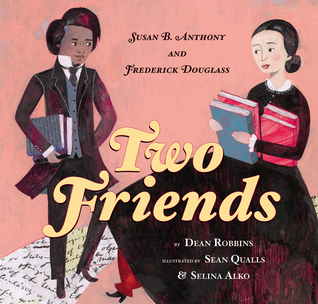
Two Friends: Susan B. Anthony and Frederick Douglass
Author: Dean Robbins
Illustrator: Sean Qualls and Selina Alko
Published January 5th, 2016 by Orchard Books

Goodreads Summary: Some people had rights, while others had none.
Why shouldn’t they have them, too?

Two friends, Susan B. Anthony and Frederick Douglass, get together for tea and conversation. They recount their similar stories fighting to win rights for women and African Americans. The premise of this particular exchange between the two is based on a statue in their hometown of Rochester, New York, which shows the two friends having tea.

My Thoughts: I loved learning about this friendship! I am a great admirer of both Anthony and Douglass; however, I did not know anything about the relationship they had. I love that they were both visionaries within two a civil rights movement though they also realized how their goals were connected, so they fought the prejudice together. Although I really would have loved this story to be longer to learn more about how they worked together, learning about their histories and imagining their tea party was a perfect way to introduce the friendship. I am also a huge fan of Qualls’s artwork, and I loved how this book incorporated his work with the written words of both reformers.

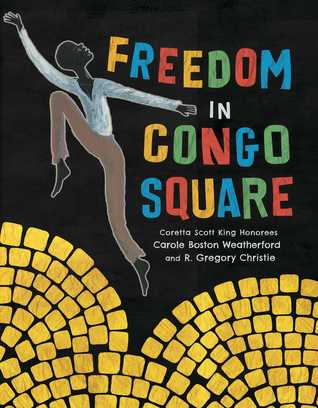
freedom in congo

Freedom in Congo Square
Author: Carole Boston Weatherford
Illustrator: R. Gregory Christie
Published January 5th, 2016 by little bee books

Goodreads Summary: This poetic, nonfiction story about a little-known piece of African American history captures a human’s capacity to find hope and joy in difficult circumstances and demonstrates how New Orleans’ Congo Square was truly freedom’s heart.

Mondays, there were hogs to slop,
mules to train, and logs to chop.
Slavery was no ways fair.
Six more days to Congo Square.

As slaves relentlessly toiled in an unjust system in 19th century Louisiana, they all counted down the days until Sunday, when at least for half a day they were briefly able to congregate in Congo Square in New Orleans. Here they were free to set up an open market, sing, dance, and play music. They were free to forget their cares, their struggles, and their oppression. This story chronicles slaves’ duties each day, from chopping logs on Mondays to baking bread on Wednesdays to plucking hens on Saturday, and builds to the freedom of Sundays and the special experience of an afternoon spent in Congo Square. This book will have a forward from Freddi Williams Evans (freddievans.com), a historian and Congo Square expert, as well as a glossary of terms with pronunciations and definitions.

My Thoughts:  I found this book to be touching and beautiful and sad. Books about slavery always make me so ashamed of our past, so they are hard to read yet so important. I think Weatherford’s story really captures the brutal conditions of slavery in the South but also the freedom that was felt on the one free day in Louisiana.  Also, I personally like rhyming couplets, so I thought it had a great sing-songy quality. And let’s not forget the illustrations. They are pieces of art. They could each be framed and put in a museum.

great monkey

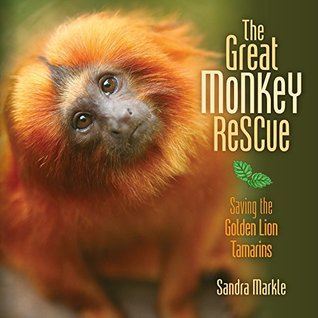
The Great Monkey Rescue: Saving the Golden Lion Tamarins
Author: Sandra Markle
Published October 1st, 2015 by Lerner Publishing Group

Goodreads Summary: Golden lion tamarins are found only in Brazilian forests. These small, remarkable monkeys once had plenty of space to roam and claim family territories. But years of deforestation caused their numbers to shrink. They were in serious danger of becoming extinct.

To help, scientists studied the animals in zoo settings. But they faced several mysteries. Why weren’t golden lion tamarins reproducing in zoos? If scientists reintroduced zoo-raised tamarins to the wild, would those monkeys survive? And how could scientists give tamarins enough forest area for the population to grow? Find out how scientists and concerned citizens worked together to give golden lion tamarins a hopeful future.

My Thoughts: It is always sad to learn about an endangered animal I didn’t know about before, this story was inspiring because it showed how a team working together could, and hopefully will continue, reverse the loss of a species. This book is so hopeful in that if we all work together to help save species that are struggling to survive. I really want to read more of Markle’s work now because she really is quite brilliant about turning information into narrative nonfiction.

All Recommended For: 

classroomlibrarybuttonsmall readaloudbuttonsmall closereadinganalysisbuttonsmall

Signature

Want to see Part One? You can view it HERE.
Want to see Part Two? You can view it HERE.
Want to see Part Three? You can view it HERE.
Want to see Part Four? You can view it HERE.
Want to see Part Five: We Need Diverse Books (NF)? You can view it HERE.
Want to see Part Six: We Need Diverse Books (F)? You can view it HERE.
Want to see Part Seven? You can view it HERE.
Want to see Part Eight: 2015 Nonfiction Titles? You can view it HERE.
Want to see Part Nine: 2015 Nonfiction Titles? You can view it HERE.
Want to see Part Ten: 2015 Fiction Titles? You can view it HERE.

Animal Planet’s Animal Bites: Ocean Animals and Polar Animals

Share

NFPB2016

Nonfiction Wednesday

Nonfiction Picture Book Wednesday is hosted by Kid Lit Frenzy and was started to help promote the reading of nonfiction texts. Most Wednesdays, we will be participating and will review a nonfiction text (though it may not always be a picture book).
Be sure to visit Kid Lit Frenzy and see what other nonfiction books are shared this week!

animal planet 2

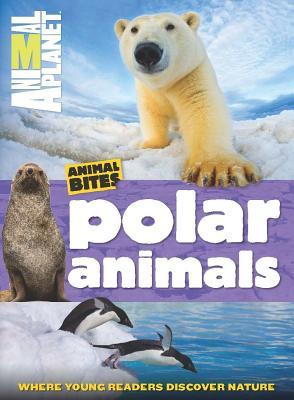
Polar Animals

animal planet 1

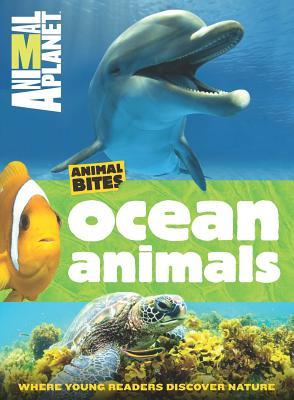
Ocean Animals

Animal Planet
Published March 1st, 2016 by Animal Planet

Polar Animals Summary: With more than 200 gorgeous animal photos of penguins, polar bears, sea lions, walruses, reindeer and others, Animal Planet Polar Animals is a fun, habitat-by-habitat guide that provides kids in the first years of schooling with the perfect bite-sized view of their favorite animals living in both polar climates. Arranged thematically with focus on animal behavior and family relationships, young readers will explore sections about animal bodies, baby animals, food, play time, conservation, and more. Special book features designed for this age group include Quick Bites sidebars with cool animal facts, simple infographics, and illustrated maps of the coldest places on Earth.

Ocean Animals Summary: With more than 200 gorgeous animal photos of sharks, whales, clown fish, jelly fish, dolphins, and others, Animal Planet Ocean Animals is a fun, habitat-by-habitat guide that provides kids in the first years of schooling with the perfect bite-sized view of their favorite ocean-dwelling animals. Arranged thematically with focus on animal behavior and family relationships, young readers will explore sections about animal bodies, baby animals, food, play time, conservation and more. Special book features designed for this age group include Quick Bites sidebars with cool animal facts, simple infographics, and illustrated maps of Earth’s watery environments.

A portion of the proceeds will benefit Animal Planet’s R.O.A.R. (Reach Out. Act. Respond.) project which partners with leading animal organization to make the world a better place for domestic and wild animals.

Kellee’s Review: Like National Geographic nonfiction books for kids, Animal Planet’s books have some of the most stunning photographs of animals that I’ve ever seen. They take the reader to the animals’ home and shows the reader the ins and outs of the animal and how and where they live.   

Ricki’s Review: My toddler adores these books. My husband was watching him when I started this post, and he said, “Henry have those! Henry have those!” They are intended for an older audience, but that doesn’t stop him. The pictures are gorgeous and there is so much to learn. Each page is brimming with facts! These are great books for readers of all ages.

Teachers’ Tools for Navigation: The Animal Bites series uses colorful tabs and other text features to organize the information throughout the book. The tabs are: Where They Live, How They Live, Vista (awesome photos that show the places animals live), Big Data, Animal Gallery, Living/working, Conservation, and specific animal tabs. They also have Just Like Mes thrown throughout the book showing how the animals are similar to humans. The way the book is set up is perfect to discussing biology and zoology. While you use these books in science, you can do comparisons/contrasts and text features in language arts, and find the animals’ habitats in geography. These are perfect books for cross-curricular lessons and inquiry projects.

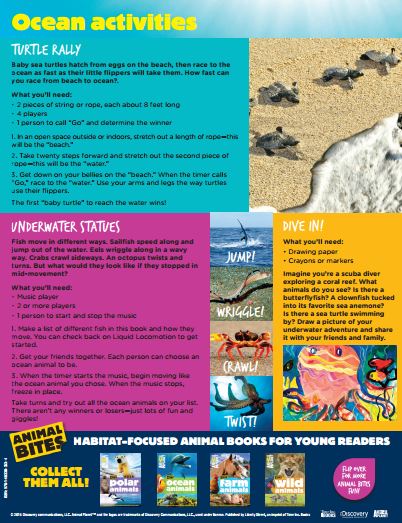
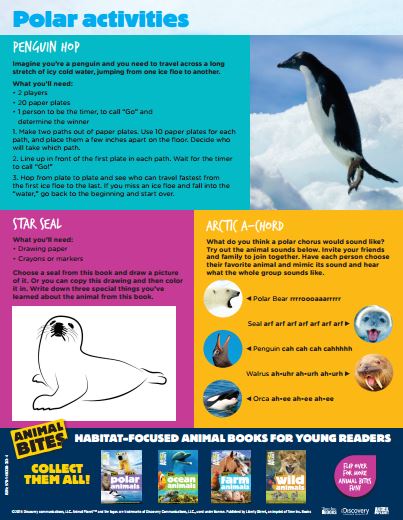
Activities Created by Time Inc.: 

ocean activitiespolar activities

Ocean and Polar Animals Activity Sheets PDF

Discussion Questions: What other Animal Bites books would you like to see?; What are some examples of ways that some animals are like us?; Which animal that you learned about is the best at camouflaging? Fastest? Best predator? etc.; What text features does the author use to help you understand the text?; How did the author structure the text?; What are the differences/similarities of some of the animals within the books?

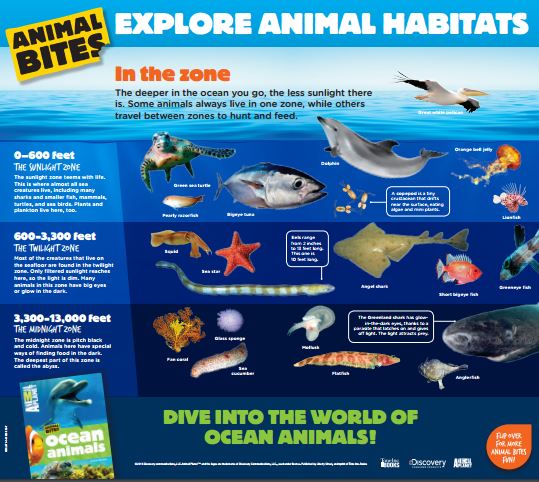
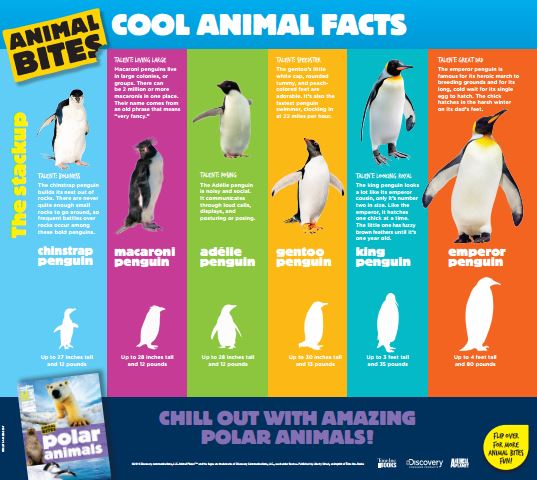
We Flagged: 

ocean poster polar poster

Ocean and Polar Animals Posters PDF

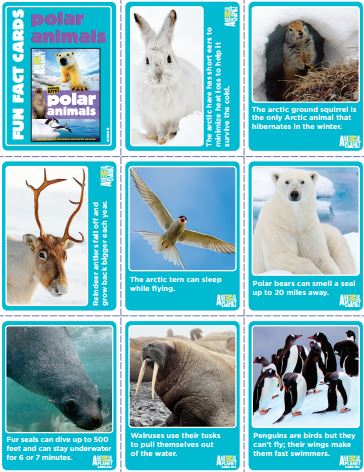
Animal Planet has also created FUN FACT cards for each of their Animal Bites books that can be accessed fore free HERE.

animal-fun-fact-cards-2

Read This If You Loved: National Geographic nonfiction texts, Seymour Simon animal texts, Extreme Ocean Records by Seymour Simon 

Recommended For: 

classroomlibrarybuttonsmall closereadinganalysisbuttonsmall

SignatureandRickiSig

Earth Day Recommended Reads: Gaia Warriors by Nicola Davies & 31 Ways to Change the World by 4,386 Children, We Are What We Do, and YOU!

Share

NFPB2016

Nonfiction Wednesday

Nonfiction Picture Book Wednesday is hosted by Kid Lit Frenzy and was started to help promote the reading of nonfiction texts. Most Wednesdays, we will be participating and will review a nonfiction text (though it may not always be a picture book).
Be sure to visit Kid Lit Frenzy and see what other nonfiction books are shared this week!

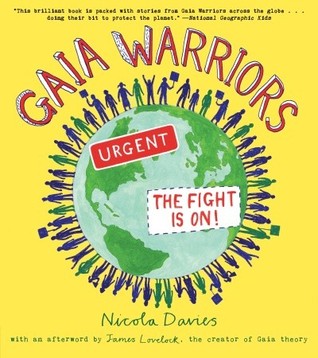
gaia warriors

 Gaia Warriors
Nicola Davies
Published March 22nd, 2011 by Candlewick Press

Goodreads Summary: A book on global warming like no other, merging key concepts with firsthand accounts from people of all ages who have found ways to help.

Inspired by the work of outstanding scientist and thinker James Lovelock and written by acclaimed author Nicola Davies, here is a book that takes a clear look at how and why Earth’s climate is changing and the ways we can deal with it. Its style is simple and its explanations are compelling, illuminating not only hard facts but also the opinions and potential solutions of scientists all over the world. But there are other voices too, those of people young and old — lawyers, food producers, fashion designers, scientists, rock stars, architects, conservationists, kids, campaigners, and more — who are trying to change the way they (and we) live on the planet. At once comprehensive and accessible, this galvanizing call to arms includes web links and resources that make it easy to join the cause.

My Thoughts: This is a text that takes the narratives of some global warming books and the information of others and combines them. I did not know what Gaia Theory was before this text, but now I know that it is the idea that we need to take care of our Mother Earth. “The Gaia Paradigm describes a productive confluence between scientific understandings of Earth as a living system with cultural understandings (ancient and new) of human society as a seamless continuum of that system.” Gaia Warriors is a text that shares why this idea makes sense, why it is up to us to make changes, and stories of those who have. I appreciated how it was set up with the climate change basics in Section One then the people stories in Section Two. It makes it even more inspiring because Davies makes sure you have all the facts before hitting us with emotional appeal.

Discussion Questions: Which of the Gaia Warriors inspires you the most?; How could you live differently to help climate change?; What could you do to become a Gaia Warrior?

And the chapter titles: What is climate change?; How do we know that climate change is happening?; What’s causing climate change? Is climate change our fault?

We Flagged: 

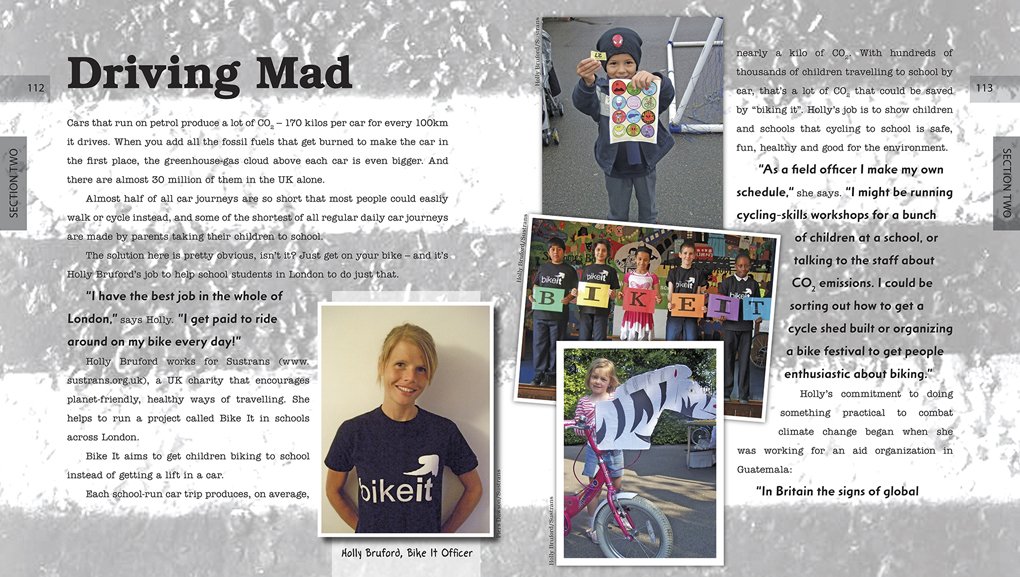
Gaia Warriors Spread


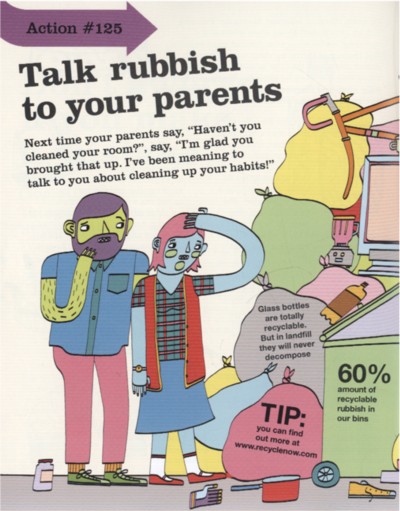
31 ways to change

31 Ways to Change the World
Author: 4,386 Children, We Are What We Do©, and YOU!
Published March 9th, 2010 by Candlewick Press

Goodreads Summary: Children have lots of ideas for changing the world — and here are thirty-one fun and simple ways to get started.

Small actions multiplied by lots of people equals big change! That’s the driving belief behind the social change movement We Are What We Do — and it infuses this lively, motivating book packed with action steps for younger readers. Incorporating the suggestions of thousands of children, tips range from stirring (stand up for something) to silly (walk your dad); from earth-friendly (don’t charge your phone overnight) to eye-opening (where is that Waldo?); from social (teach your granny to text) to downright surprising (speak soccer!). These thirty-one creative, original ideas are contributed by kids for kids — and each is guaranteed to have a clear and positive impact. Of course, the book would not be complete without a final question to the reader: what’s the one thing you would do to change the world?

My Thoughts: What I really liked about this book vs. other “change the world” books was that there are so many different options and something that everyone could do. It would be so easy to go through and do most of these. Although this book doesn’t focus completely on global warming/climate change, I think it fits perfectly on Earth Day because one way to make our Earth better is to make humans nicer.

Discussion Questions: Which of these activities have you done?; Which of these activities could you do and help others do as well?; What other activities could you do to help our Earth, your school, your friends, your family, etc.?

We Flagged: 

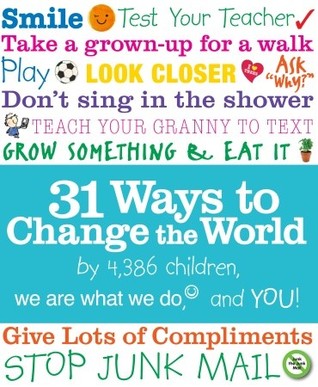
31 ways spread


Teachers’ Tools for Navigation: I think talking about climate change and changing our ways to help is so important with our youth. These books, along with other Earth Day friendly books, can help kids understand the importance of our decisions every day.

Read These Books If You Loved: The Lorax by Dr. Seuss, The Down-to-Earth Guide to Global Warming by Laurie David and Cambria Gordon, An Inconvenient Truth by Al Gore

Both Recommended For: 

classroomlibrarybuttonsmall closereadinganalysisbuttonsmall

Signature

**Thank you to Candlewick Press for providing copies for review!**

Blog Tour, Character Interview, Giveaway, and Review!: The Mechanical Mind of John Coggin by Elinor Teele

Share

Mechanical Mind Blog Tour Banner

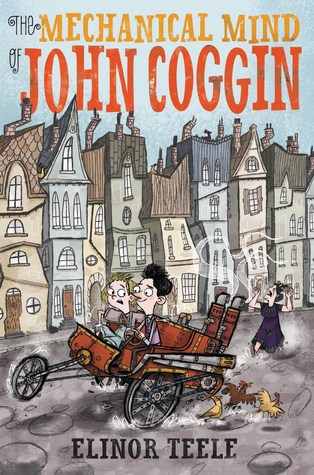
mechanical mind

The Mechanical Mind of John Coggin
Author: Elinor Teele
Illustrator: Ben Whithouse
Published April 12th, 2016 Walden Pond Press

Goodreads Summary: A quirky, humorous, whimsical, and heartwarming middle grade debut about a young boy who runs away from home with his sister to escape working in the family coffin business—and discovers even more adventure than he bargained for.

John Coggin is no ordinary boy. He is devising an invention that nobody has ever seen before, something that just might change the world, or at least make life a little bit better for him and his litter sister, Page. But that’s only when he can sneak a break from his loathsome job: building coffins for the family business under the beady gaze of his cruel great-aunt Beauregard. Having lost their parents when Page was a baby, how else are they supposed to survive?

Perhaps by taking an enormous risk—a risk that arrives in the form of a red-haired scamp named Boz. When Great-Aunt Beauregard informs John that she’s going to make him a permanent partner in Coggin Family Coffins—and train Page to be an undertaker—John and Page sign on with Boz and hit the road. Before long, they’ve fallen in with a host of colorful characters, all of whom, like John and Page, are in search of a place they can call home. But home, they realize, isn’t something you find so much as something you fight for, and John soon realizes that he and Page are in for the fight of their lives.

Elinor Teele’s picaresque debut is a rollicking tale filled with wild adventures, daring escapes, and—thanks to Boz—more than a little catastrophe.

My Review: One thing I’ve noticed is that so many orphans in stories seem to always get into some sort of trouble and then go on amazing adventures. Like Annie, Grubb from Alistair Grim, and Peter Nimble before him, John Coggin, a recent orphan, finds himself in quite a predicament of a situation when he is forced to work for his great aunt’s funeral home. It is the last straw when Great Aunt Beauregard tries to force Page, John’s sister, to go to work with them, and that begins the adventure! Elinor Teele takes us on quite a journey! With Boz, the comic relief with an amazing vocabulary, our three main characters meet some unique characters along the way.

Teele’s ability to weave such an odd story together and make it seem seamless is remarkable. John, Page, and Boz have about 5 stops along their journey all with a wide-variety of characters who all are a bit quirky but also relatable and you end up loving all of them. Although everything that happens is quite farfetched, you end up believing it all because you just want John and Page to be successful!

Teachers’ Tools for Navigation: In the classroom, I think this book would be a perfect opportunity to discuss ways to determine unknown vocabulary within a text. Boz has QUITE a vocabulary and uses words that will be unknown to many of the middle grade readers the book is aimed for; however, the author does a fabulous job of having context clues or restatements of what the words mean. I would love to use passages of this book for vocabulary instruction.

It could also be used as a mentor text for imagery, specifically character description. Like I said, throughout the book we meet some very odd characters, but they are all described so well you can picture them. Same with John’s contraptions and the setting. Elinor Teele’s specific word choice really brings the story to life.

Lastly, I think it would be fun to compare/contrast the orphans within middle grade novels and discuss why orphans are chosen for so many adventurous books. Peter Nimble and Alistair Grim along with John Coggin would definitely be a great place to start, and you could even tie it in with “Annie.”

Also check out the Educational Activity Kit based on the book for more ways to use the book in the classroom or library.

We Flagged: “”Up and at ‘em, troops! The back of a new day is already broken, and time marches on!’

Boz blew into the barn like a category five hurricane and came to rest at John’s feet. ‘Where are the foundations of your perambulation?’ His baffled face collapsed even further into itself.

‘Where are the what?’ John asked blearily. The bright summer sun was making fireflies of the dust around Page’s hair.

‘Your shoes, young man, your shoes.’

‘I threw them outside.’

‘Well, find them! We go, we see, we conquer!’” (p. 58)

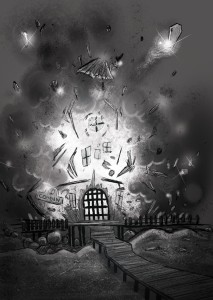
Special Guest! Q&A with Boz (by Elinor Teele): Boz may, in fact, be the worst interviewee on the planet. It was barely possible to get him into a hotel lounge and almost impossible to keep him there. And his hair! It seemed to have a life of its own. After this experience, I am firmly convinced his only future is a career as a human firework.  
mechanical illustration

Q. So, first I’d like to ask… Boz? Boz! Could you please stop swinging from the chandelier?
A. Of course, profuse apologies my Fallonesque friend. I was merely trying to pump some blood to my knee joints. I ingested a box of sugar-coated hookoo grubs yesterday and I fear they have inflamed my rheumatics.

Q. Where did you get a box of hookoo grubs?
A. A gift from the Queen of Samarrand. She says she misses my winsome ways.

Q. How did you become friends with a Queen?
A. Oh, I have roamed the bureaus and boards of many a parliament. From the sweat-soaked slums to the blasted heaths, I have crisscrossed this great globe itself in eighty days and under. “A wandering minstrel, I…”

At this point in the interview, Boz yanked open the door to the lobby and vaulted onto the hotel’s front desk. From there, he sang operettas to incoming guests until security guards brought him back into the lounge. 

Q. I don’t think the concierge enjoyed your singing.
A. It’s a waste of vitriol trying to please critics. Besides, it gave me an opportunity to relieve him of his time commitments.

Q. You stole his watch?!
A. You may say that, but I couldn’t possibly clarify.

Q. Well, what can you comment on?
A. Anything that tickles your pearly whites.

Q. Okay, how about this? Some people have said that your way of speaking is far too complicated to understand. They point out many kids have enough trouble with basics, so why make it harder?
A. I grant you that my vocabulary may be a little bewildering, but why not be wild? There are so many beautiful words in this world that go a’begging. As my dear friend Dodo Dodgson often opines, “Look after the senses and the sounds will look after themselves.”

Q. Yes, I noticed you tend to appropriate phrases from famous writers.
A. Who was it that said that bad artists copy and great men steal? Or was it that the immature youth imitates and the mature matron plagiarizes? I can’t remember. 

At this point in the interview, Boz once again made a grab at the chandelier. This time – thanks to the force of his liftoff – he was hurled round and round the room like a demented tornado.

Q. Are you insane? Should I call the fire brigade?
A. Wouldn’t do that, my dear boy. They’re still irked about the incident with the propane and the propellers.

Q. What did that involve?!
A. A gaggle of insurance investigators, apparently.  

Q. I give up. I don’t know how John Coggin put up with you.
A. But John and I are friends! Buddies of the bosom. Compadres of the cabana. Say what you will about my ethical standards, but I always believe in my friends!

This was a revealing comment, and I would have liked to ask Boz more about it. Unfortunately, he had let go of the chandelier and was already rocketing skyward through one of the open windows. I last saw him passing a goshawk.

Walden TV Features John Cogginhttp://waldentv.com/video/rtwt-john-coggin/

elinor-teele

Find Elinor Teele at her website.

Recommended For: 

classroomlibrarybuttonsmall closereadinganalysisbuttonsmall litcirclesbuttonsmall

Giveaway!
Enter to win!

a Rafflecopter giveaway

Don’t miss out on the other blog tour stops!

April 11 – Bluestocking Thinking
April 12 – Novel Novice
April 13 – This Kid Reviews Books
April 14 – Maria’s Melange
April 15Unleashing Reader
April 18Next Best Book
April 19Foodie Bibliophile
April 20For Those About to Mock
April 21 – Walden Media Tumblr
April 22Charlotte’s Library
April 25Flashlight Reader
April 26Teach Mentor Texts
April 27Librarian’s Quest
April 28Kid Lit Frenzy
April 29Novel Novice

Kellee Signature

**Thank you to Walden Pond Press for providing a copy for review and giveaway!!**

National Parks Week (April 16th-24th) Recommended Reads: A Weird and Wild Beauty by Erin Peabody and National Geographic’s National Parks Guide U.S.A.

Share

NFPB2016

Nonfiction Wednesday

Nonfiction Picture Book Wednesday is hosted by Kid Lit Frenzy and was started to help promote the reading of nonfiction texts. Most Wednesdays, we will be participating and will review a nonfiction text (though it may not always be a picture book).
Be sure to visit Kid Lit Frenzy and see what other nonfiction books are shared this week!

National Parks Guide

 National Parks Guide USA Centennial Edition: The Most Amazing Sights, Scenes, and Cool Activities from Coast to Coast!
National Geographic Kids
Published February 9th, 2016 by National Geographic Children’s Books

Goodreads Summary: Happy 100th Birthday, National Parks! Join the centennial celebration by reading all about these greatest of American treasures — from Acadia to Zion — in preparation for a parks visit sometime soon. Filled with color photos, information on animals, fascinating lists, fun facts, maps, cool things to do, conservation tips, and much more — think of this book as your trusted guide to these most majestic of places.

My Thoughts: This book makes me want to go on a road trip! As you all know, I am a huge fan of National Geographic books because of their brilliant graphics, text features, easy-to-follow text structure, and interesting information. This text is no different. Like the title states, it goes through many of the USA National Parks from the east to the west and gives the reader not only history about the national park but also beautiful photos, fun facts, visiting tips, a map, excursions within the park, and must-do activities. This text will be a great companion to any trip to these amazing parks.

Discussion Questions: Which national park do you want to visit?; What activity looks like the most fun to you at that park?; What national parks are near you?

We Flagged: 

yellowstone

Giveaway and National Parks Video by National Geographic

Celebrate the beauty and wonder of America’s national parks during this centennial year with an amazing outdoor adventure! Climb mountains, hike trails, see wildlife, explore the country, and plan it now with National Geographic books as your inspiration and guide. Be sure to enter for the chance to win a National Geographic Expeditions family trip for four to Grand Canyon, Bryce, and Zion National Parks at nationalparkssweeps.com.


weird and wild

A Weird and Wild Beauty: The Story of Yellowstone, the World’s First National Park
Author: Erin Peabody
Published February 2nd, 2016 by Sky Pony Press

Goodreads Summary: The summer of 1871, a team of thirty-two men set out on the first scientific expedition across Yellowstone. Through uncharted territory, some of the day’s most renowned scientists and artists explored, sampled, sketched, and photographed the region’s breathtaking wonders—from its white-capped mountain vistas and thundering falls to its burping mud pots and cauldrons of molten magma. At the end of their adventure, the survey packed up their specimens and boarded trains headed east, determined to convince Congress that the country needed to preserve the land from commercial development. They returned with “stories of wonder hardly short of fairy tales,” to quote the New York Times.

With the support of conservationists such as Ralph Waldo Emerson, Henry David Thoreau, Frederick Law Olmsted, and John Muir, the importance of a national park was secured. On March 1, 1872, Ulysses S. Grant signed the Yellowstone Park Bill into law. It set aside over two million acres of one-of-a-kind wilderness as “a great national park for the benefit and enjoyment of people.” This important and fascinating book will introduce young adults to the astonishing adventure that led to “the best idea America ever had.” Today over 130 countries have copied the Yellowstone model, and billions of acres of critical habitat and spectacular scenery are being preserved for all of us to enjoy.

This book has a wonderful ecological and historical message for readers ages 12 and up. No book about Yellowstone’s founding has been written for this age group before, yet Yellowstone National Park is a major destination for many families, so many readers will likely have heard of Yellowstone or even have visited there. This is a great book for any school library or for history or science classrooms in middle and high school, where information can be used for research projects.

My Thoughts: Many of us take advantage of the national parks that have been preserved throughout the United States without knowing the history of the National Park Program or realizing how important it is to preserve these parks. This book will help middle grade and teen readers learn about this history and the beautify of a park they’ve probably heard of or been to but may not know everything about. Peabody does a good job making the history readable and interesting.

Discussion Questions: Why did President Grant pass the Yellowstone Park Bill? How did this bill change the direction of parks in the U.S.? If you went to Yellowstone, what would you most be looking forward to?

We Flagged: “J.G. Holland sat at his desk, staring wide-eyed at the pages spread before him. Holland was an editor at Scribner’s Monthly, a popular magazine and source of news for Americans in the mid- to late 1800s.

Holland had just received the most bizarre-sounding account. It spoke of a strange land where the ground gurgled and hissed. A land where scalding waters blew from craters and vats of steaming pink mud threatened to swallow a man whole. The place, according to the man who’d recently traveled through the region, abounded with ‘boiling springs,’ ‘mud volcanoes,’ and ‘huge mountains of sulphur.’

Incredulous, Holland tried to absorb the dazzling imagery. The author, clearly spellbound by what he saw, gushed about the brilliant turquoise pools and hot-water fountains. The mud volcano, the man wrote, erupted with the force of thundering cannons. Its boiling broth scalded trees hundreds of yards away.

This world of absurdities, the traveler informed Holland, was not some far-off land. It belonged to the United States.” (Prologue)


Teachers’ Tools for Navigation: The National Geographic book gives such a wonderful overview of all of the major national parks and would be a great introduction to these parks. Then, the students could choose to learn more about a specific national park. Erin Peabody’s book would be a fabulous resource for the students who choose Yellowstone. It is so thorough and it, combined with the National Geographic book, would give a detailed overview of Yellowstone.

Both Recommended For: 

classroomlibrarybuttonsmall closereadinganalysisbuttonsmall

Signature

**Thank you to Karen at Media Masters Publicity and Cheryl at Skyhorse Publishing for providing copies for review!**

The SLOWEST Book EVER by April Pulley Sayre

Share

NFPB2016

Nonfiction Wednesday

Nonfiction Picture Book Wednesday is hosted by Kid Lit Frenzy and was started to help promote the reading of nonfiction texts. Most Wednesdays, we will be participating and will review a nonfiction text (though it may not always be a picture book).
Be sure to visit Kid Lit Frenzy and see what other nonfiction books are shared this week!

slowest book ever

The SLOWEST Book EVER
Author: April Pulley Sayre
Illustrator: Kelly Murphy
Published April 5th, 2016 by Boyds Miller Press

Goodreads Summary: April Pulley Sayre’s wry, quirky storytelling tone shines from the warning on the first page (“This is a S-L-O-W book. Do not read it while surfing, water skiing, or running to escape giant weasels.”) right through to the glossary at the end. In between, readers will explore an astounding variety of information about all things slow—in nature, geology, art, outer space, etc. Throughout, The SLOWEST Book EVER playfully encourages readers to slow down and savor everything. As Sayre shows: “If you think slowly enough, the entire world is amazing.” This innovative nonfiction work is a treasure trove of information that begs for multiple readings.  

Kellee’s Review: Anyone who teaches knows that the most popular nonfiction books are the ones that have a ton of information in short segments with fun pictures. Well, Sayre’s The SLOWEST Book EVER is exactly that but even better than you are picturing. Sayre does such a great job of having a small amount of information that packs a very big punch. Although each fact is over only a 2-page spread, the information is thorough, interesting, and specific. I loved the wide range of topics that were all covered under the big idea of SLOW, and I think students will be fascinated with all of the information.

Ricki’s Review: I read a lot of books, and I don’t think I’ve read a book that is quite like this one! It is a compilation of fascinating information that will compel readers to want to learn more about their world. It is apparent that a lot of thought and care went into the crafting and production of this book. Each page is a bit different, so if a reader is uninterested in a topic, he or she can flip the page and find something else entirely different. This book would make a great gift because all children will find sections that intrigue them, regardless of their interests. I’d look forward to going to a class where a teacher used this book used as a read-aloud, reading a few sections each day. This book makes learning fun!

Teachers’ Tools for Navigation: Since The SLOWEST Book EVER includes tidbits of information on many different topics, each spread could easily be used as a jumping off point for an inquiry project. Students browse through the book to determine which spread of information interests them the most then they do more research (using the back matter as a place to start) then share the extra information with their classmates.

The SLOWEST Book EVER also does an amazing thing by looking at all the different ways that SLOW can be defined. After finishing the book as a class, revisit all of the different ways slow was used then brainstorm different meanings of other subjective adjectives such as fast, large, and small. Then student, as a class, could write their own fact book using a different adjective but showing different meanings of that word.

Discussion Questions: Which fact surprised you the most?; The book doesn’t only focus on slow speeds–what ever definitions of slow did the author focus on?; What topics would you like to learn more about? Where could you go to get more information?

We Flagged: “Chewy Nature Thoughts
Read them. Think about them. S l o w l y.
Slow thoughts are often big thoughts. So don’t fret if it takes a while to understand them. Don’t worry if you need to read them twice. -Traveling in a circle is, after all, still traveling.” (p. 8-9)

“How long does a minute feel to a mayfly…?
It’s About Time

Does time fly for a fly? Biologists wonder about this. So you can, too! How long does a minute feel to a mayfly, which may live only one day? How long does a minute feel to a 70-year-old Galápagos Tortoise?” (p. 16-17)

SLOWESTBOOK_16-17

Read This If You Loved: Nonfiction books such as Weird but True by National Geographic, Lifetime by Lola M. SchaeferExtreme Oceans and Extreme Earth Records by Seymour SimonIsland by Jason Chin, The Guinness Book of World Records

Recommended For: 

classroomlibrarybuttonsmall readaloudbuttonsmall closereadinganalysisbuttonsmall

Signatureand RickiSig

Blog Tour, Author Guest Post, Giveaway, and Review!: Maybe a Fox by Kathi Appelt and Alison McGhee

Share

maybe a fox

Maybe a Fox
Author: Kathi Appelt and Alison McGhee
Published: March 8, 2016 by Atheneum/Caitlyn Dlouhy Books

Goodreads Summary: A tale about two sisters, a fox cub, and what happens when one of the sisters disappears forever.

Sylvie and Jules, Jules and Sylvie. Better than just sisters, better than best friends, they’d be identical twins if only they’d been born in the same year. And if only Sylvie wasn’t such a fast—faster than fast—runner. But Sylvie is too fast, and when she runs to the river they’re not supposed to go anywhere near to throw a wish rock just before the school bus comes on a snowy morning, she runs so fast that no one sees what happens…and no one ever sees her again. Jules is devastated, but she refuses to believe what all the others believe, that—like their mother—her sister is gone forever.

At the very same time, in the shadow world, a shadow fox is born—half of the spirit world, half of the animal world. She too is fast—faster than fast—and she senses danger. She’s too young to know exactly what she senses, but she knows something is very wrong. And when Jules believes one last wish rock for Sylvie needs to be thrown into the river, the human and shadow worlds collide.

Writing in alternate voices—one Jules’s, the other the fox’s—Kathi Appelt and Alison McGhee tell the tale of one small family’s moment of heartbreak.

Ricki’s Review: I read this entire book in one sitting because, quite simply, I could not put it down. I sobbed through the entire book because I connected so strongly with these characters. As a mom, I couldn’t imagine my son experiencing the pain that these sisters felt from the loss of their mother. As a sister, I can’t imagine my own sister disappearing. These two connections, along with the stunning portrayal of character and story, made this book feel deeply personal for me. While younger students won’t be moms, and thus, won’t have this personal connection I had with the text, they will be sons and daughters. Regardless of a reader’s point of view, they will connect with this book because it is written so beautifully. I won’t forget this book, and I don’t think other readers will forget it, either.

Kellee’s Review: This book is one I’ll be talking about for a while. I will say it is probably the saddest book that I’ve ever read; however, it is beautiful. It is very hard to explain unless you’ve experienced because it gives hope while also being so terribly sad. The characters, animal and humans, are so thought out and detailed that as you read you feel with them and for them. I was also in awe of the way Kathi and Alison were able to tell such a unique story without the reader ever feeling like it was an odd scenario. Whenever I try to describe this book to someone, they give me quite a weird look, so I just stop trying and tell them they should read it because it is a heart print book. There is no other way to describe it. Like Ricki said, every reader will feel for someone in the book. And every reader won’t be able to deny how beautifully written the prose is. 

Teachers’ Tools for Navigation: As you will read in Kathi and Alison’s guest post below, point-of-view makes this story quite powerful. Teachers might ask students to consider the varying perspectives of this story and how they work together to form a cohesive whole. The teacher might provide other examples of texts that feature different points-of-view to compare and contrast authors’ styles. Students might then try their hand at writing in various, connected points-of-view and subsequently analyze how this enhances a narrative.

Discussion Questions: How do the authors unfold the plot in the narrative?; What predictions did you make while reading this story? How might the story have turned out quite differently?; How does Senna’s point-of-view enhance the story for you?; Were there any allusions within the text?; What theme do you take away from Maybe a Fox?

We Flagged: “The baby girl fox, Senna, came into the world in darkness, thirty feet below ground in the end dug out of cool brown earth. She was the middle child, born between her older and younger brothers, the three of them separated by minutes.

The first thing she knew was the feel of her mother’s tongue. Shhh shhh shhh, cleaning her off, licking her into life and warmth and love and safety.

The second thing she knew was the feel and smell of her brothers’ bodies pressed against hers as their mother nursed them, their front paws kneading her belly.

The third thing she knew was that there was someone waiting for her, someone she needed to find.” (p. 75-76)

Read This if You Loved: The House of Purple Cedar by Tim TinglePax by Sara PennyPacker, Counting Crows by Kathi Appelt

Recommended For: 

litcirclesbuttonsmall closereadinganalysisbuttonsmall readaloudbuttonsmall classroomlibrarybuttonsmall

Giveaway!
A Guest Post from Kathi and Alison about Point-of-View

Finding the best possible point of view for a story is one of the most important choices that a writer can make. The point of view, more than any other aspect of literature, dictates the distance created between the character and the reader. When we embarked upon this story, Alison chose to write from the fox’s story and she decided early on that she wanted to write from an omniscient point of view. This allowed her to place Senna deeply within the pocket of her fox family, and to give our readers an intimate sense of their world. It gave her a way to present the fox-world via the senses of all five members of their family, and put the readers squarely inside of the natural landscape.

When we were first drafting, Kathi chose to write Jules from a first person point of view. However, it didn’t take long before she realized that the first person was too limiting. Yes, first person is quite intimate and there are good reasons to use it, but in this case it felt as though it created too many blind spots. Jules needed a bigger canvas and so Kathi switched to third person. That allowed her to broaden the scope of Jules’ experience, and to let Jules, as well as the omniscient narrator, experience the events as they unfolded.

We always knew that Sam’s point of view would be from the third person too, and he stepped into the story in a way that let the reader get a more objective perspective. We also hoped to show that even though Sylvie’s death primarily impacted Jules and her dad, her loss was felt strongly by the entire community. As well, Sam’s earnest desire for the return of the catamount helped to create a sense of possibility that the other characters couldn’t, simply because of their closeness to Sylvie.

The landscape also gave us a perspective. The woods and rocks, and of course the Slip itself with its local legends, provided not only a backdrop, but its own wild voice, a voice that spoke to each of our characters—fox, Jules, Sam, Elk, Sylvie, Zeke, Dad, and the catamount—in a way that only a wild place can speak.

All this to say that the multiple points of view hopefully helped to create stories within stories that, when woven together, made a single story that was enriched by the viewpoints of each character.

Kathi and Alison.

About the Authors:

Kathi Appelt photo 2015_credit Igor Kraguljak

Kathi Appelt is the New York Times best-selling author of more than forty books for children and young adults. Her picture books include Oh My Baby, Little One, illustrated by Jane Dyer, and the Bubba and Beau series, illustrated by Arthur Howard. Her novels for older readers include two National Book Award finalists: The True Blue Scouts of Sugar Man Swamp and The Underneath, which was also a Newbery Honor Book. In addition to writing, Ms. Appelt is on the faculty in the Masters of Creative Writing for Children and Young Adults at Vermont College of Fine Arts. She lives in College Station, Texas. To learn  more, visit Kathi’s website at kathiappelt.com.
Alison McGhee photo 2015 credit Dani Werner
Alison McGhee is the New York Times bestselling author of Someday, as well as Firefly Hollow, Little Boy, So Many Days, Bye-Bye Crib, Always, A Very Brave Witch, and the Bink and Gollie books. Her other children’s books include All Rivers Flow to the Sea, Countdown to Kindergarten, and Snap. Alison is also the author of the Pulitzer Prize–nominated adult novel Shadowbaby, which was also a Today show book club selection. She lives in Minneapolis, Minnesota, and you can visit her at AlisonMcGhee.com.

MaybeAFox_banner

Follow the blog and book tour!

See Another Guest Post by Kathi Appelt Here!

RickiSigandSignature

**Thank you to Barbara at Blue Slip Media for providing copies for review and the giveaway. Also, thank you to Kathi and Alison for the wonderfully insightful guest post!**