Review and Giveaway!: Journey Trilogy by Aaron Becker

Share

journey quest return

Journey Trilogy
Author and Illustrator: Aaron Becker
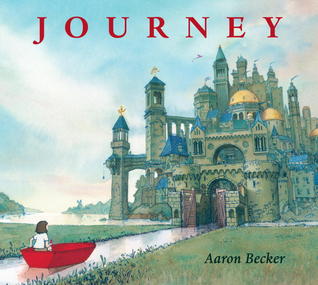
Journey Published August 6th, 2013
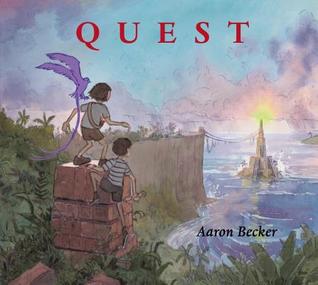
Quest Published August 26th, 2014
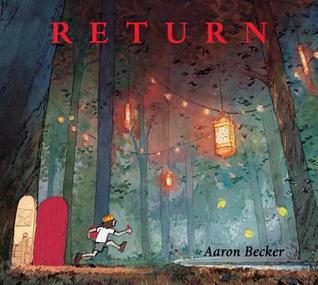
Return Published August 2nd, 2016
By Candlewick Press

Journey Summary: Follow a girl on an elaborate flight of fancy in a wondrously illustrated, wordless picture book about self-determination — and unexpected friendship.

A lonely girl draws a magic door on her bedroom wall and through it escapes into a world where wonder, adventure, and danger abound. Red marker in hand, she creates a boat, a balloon, and a flying carpet that carry her on a spectacular journey toward an uncertain destiny. When she is captured by a sinister emperor, only an act of tremendous courage and kindness can set her free. Can it also lead her home and to her heart’s desire? With supple line, luminous color, and nimble flights of fancy, author-illustrator Aaron Becker launches an ordinary child on an extraordinary journey toward her greatest and most exciting adventure of all.

Journey Review: This book is very hard to explain the magic of it. Lorna (@notforlunch) described it the best, I think: “a wonderful mashup of a David Wiesner book and Harold and the Purple Crayon.” I think this is perfect. It has the illustration beauty and magic of a wordless David Wiesner picture book and it is about creativity (and a crayon) like Harold. The beauty of the castle she visited also reminded me of Cathedral by David Macaulay. This book is just full of amazing!

Originally published at: https://www.unleashingreaders.com/?p=1765 (10/5/2013)

Quest Summary: A king emerges from a hidden door in a city park, startling two children sheltering from the rain. No sooner does he push a map and some strange objects into their hands than he is captured by hostile forces that whisk him back through the enchanted door. Just like that, the children are caught up in a quest to rescue the king and his kingdom from darkness, while illuminating the farthest reaches of their imagination. Colored markers in hand, they make their own way through the portal, under the sea, through a tropical paradise, over a perilous bridge, and high in the air with the help of a winged friend. Journey lovers will be thrilled to follow its characters on a new adventure threaded with familiar elements, while new fans will be swept into a visually captivating story that is even richer and more exhilarating than the first.

Quest Review: Quest is a beautiful continuation of Journey. Aaron Becker starts where the first book left off, but Quest is as unique as Journey was. The kids we met in the first book are swept into an adventure to save a king who has armed them with the tools to save the kingdom. I read this book over and over again because there are so many different little nuances in this adventure that promotes creativity, imagination, and teamwork. To be honest, I almost like Quest better than journey because the kids work together.

First published at: https://www.unleashingreaders.com/?p=4666 (11/12/2014)

Return Summary: Welcome the much-anticipated finale of Caldecott Honoree Aaron Becker’s wordless trilogy—a spectacular, emotionally satisfying story that brings its adventurer home.

Failing to get the attention of her busy father, a lonely girl turns back to a fantastic world for friendship and adventure. It’s her third journey into the enticing realm of kings and emperors, castles and canals, exotic creatures and enchanting landscapes. This time, it will take something truly powerful to persuade her to return home, as a gripping backstory is revealed that will hold readers in its thrall. Caldecott Honor winner Aaron Becker delivers a suspenseful and moving climax to his wordless trilogy, an epic that began with the award-winning Journey and continued with the celebrated follow-up Quest.

Return Review: You will adore the conclusion to the trilogy. Becker does an amazing job of tying the beginning of Journey to the end of Return. To think that all the books happened in a day! The girl had quite an amazing journey, quest, and return in only one day! It is amazing what can go on when magic is involved. I don’t want to give away much else about the finale, but I will say it is as much a must read as the first two. 

Teachers’ Tools for Navigation: In my classroom, the first thing I would do is project the book and just have the students read it with me. No talking; just looking. Then we’d go back and discuss what is going on in the book, talk about some of the smaller parts of the illustrations, relive the journey. If I wanted to include a writing activity, we could add words to the book (although, I think this book’s illustrations stand alone). We could also discuss what we’d do if we had a magic crayon. I think this book would be a great addition to Dot Day and discussing creativity. Finally, I think a discussion of observing your surroundings would be appropriate as what the girl wanted the most was right in front of her at the beginning of the book. (From 10/5/13 post)

Additionally, this trilogy would be a wonderful mentor text to discuss narrative elements because Becker has given us a perfect plot arc filled with conflict, suspense, and resolution. It would also be interesting to talk to students about characterization in a wordless picture book because the characters still have very evident traits though it is through illustration and actions that we have to determine them. Although, I would be careful in taking the magic away from these books. I don’t want to analyze and dig into them too much because they are beautiful pieces of art that should be enjoyed first and foremost.

Journey Trilogy Activity Kit: https://www.scribd.com/document/312916399/Aaron-Becker-s-The-Journey-Trilogy-Activity-Kit

 Q&A with Aaron Becker: https://www.scribd.com/document/132634414/Journey-by-Aaron-Becker-Q-A-with-the-Creator

Discussion Questions: What would you do with a magic crayon?; Why did the girl have to turn to a magical land instead of remaining at home?; Were you surprised about who finally saved the day?; What is happening on the final page of Return? How do you feel about this resolution to the story?; How did the story progress through each book?

Return Book Trailer:

Journey Book Trailer: https://www.youtube.com/watch?v=SxUs41jB4Ts

Quest Book Trailer: https://www.youtube.com/watch?v=BO774UmBjQc

Read This If You Loved: Shy by Deborah Freedman, The Uncorker of Ocean Bottles by Michelle Cuevas, The Typewriter by Bill Thomson The Whisper by Pamela ZagarenskiFloat by Daniel Miyares, Sidewalk Flowers by JonArno Lawson, Sam and Dave Dig a Hole by Mac BarnettHarold and the Purple Crayon by Crockett Johnson, Blackout by John Rocco, David Weisner wordless picture books, Cathedral by David Macaulay, Where the Wild Things Are by Maurice Sendak, Henri Mouse by George Mendoza, Chalk by Bill Thomson, Art & Max by David Weisner, Weslandia by Paul Fleishman, Narnia (series) by C.S. Lewis

Recommended For:

  classroomlibrarybuttonsmall readaloudbuttonsmall closereadinganalysisbuttonsmall

Giveaway!

a Rafflecopter giveaway

Kellee Signature

**Thank you to Raquel at Candlewick for providing copies for review and giveaway!!**

All American Boys by Jason Reynolds and Brendan Kiely

Share

All American Boys

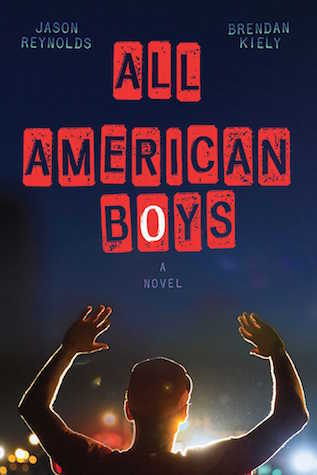
All American Boys
Authors: Jason Reynolds and Brendan Kiely
Published: September 29, 2015 byAtheneum/Caitlyn Dlouhy Books

GoodReads Summary: Rashad is absent again today.

That’s the sidewalk graffiti that started it all…

Well, no, actually, a lady tripping over Rashad at the store, making him drop a bag of chips, was what started it all. Because it didn’t matter what Rashad said next—that it was an accident, that he wasn’t stealing—the cop just kept pounding him. Over and over, pummeling him into the pavement. So then Rashad, an ROTC kid with mad art skills, was absent again…and again…stuck in a hospital room. Why? Because it looked like he was stealing. And he was a black kid in baggy clothes. So he must have been stealing.

And that’s how it started.

And that’s what Quinn, a white kid, saw. He saw his best friend’s older brother beating the daylights out of a classmate. At first Quinn doesn’t tell a soul…He’s not even sure he understands it. And does it matter? The whole thing was caught on camera, anyway. But when the school—and nation—start to divide on what happens, blame spreads like wildfire fed by ugly words like “racism” and “police brutality.” Quinn realizes he’sgot to understand it, because, bystander or not, he’s a part of history. He just has to figure out what side of history that will be.

Rashad and Quinn—one black, one white, both American—face the unspeakable truth that racism and prejudice didn’t die after the civil rights movement. There’s a future at stake, a future where no one else will have to be absent because of police brutality. They just have to risk everything to change the world.

Cuz that’s how it can end.

Ricki’s Review: I read this book a few months ago, and frankly, I can’t stop thinking about how important this story is. We read so many books in our lifetimes, and some just take our breath away. This is one of those books. I can’t recommend this book highly enough. I believe it belongs in every classroom. The strength of the two voices in this book is remarkable, and it makes for an excellent teaching tool—about heroism; about doing what is right and true; and about being a good, decent human being. The acts within this book are all-to-common, and I believe this book promotes genuine change. The book is literary at the same time that it is engaging. It will pull (and has pulled) readers of all ages and backgrounds. I typically don’t review books long after they have been published, but this book feels too important to leave out. If you haven’t read it already, I recommend it move to the top of your TBR list. It’s and incredible story.

Kellee’s Review: I too read this book a few months ago. It was a choice for our Faculty Book Club, and it was a perfect book to discuss with a bunch of educators. All American Boys is a book that is going to be a classic because it highlights modern history in a thoughtful and truthful way. This is a book that I would recommend to everyone to read. It is a perfect jumping off point to discuss race relations, Black Lives Matter, and We Need Diverse Books. The way the book is set up, with two voices, will help readers have permission to talk about what is happening in our country, the Civil Rights movement and its tie into modern times, and the racial tension currently happening in our country.

Jason & Brendan

I’d like to also add that I recently was lucky enough to see Jason Reynolds and Brendan Kiely accept their Coretta Scott King Author Honor Award at the ALA Annual Conference here in Orlando, and they both moved me to tears. Jason actually gave two speeches since he won an honor for All American Boys and Boy in the Black Suit. His second speech was a brilliant advocacy poem titled Machetes which can be viewed here or read here. His first speech and Brendan’s speech are not available yet. Brendan says School Library Journal will be publishing his, and I am not sure about Jason’s; however, I did tweet some quotes as I sat and listened:

  • I hope The Boy in the Black Suit gives young men permission to feel and be human and sometimes need a hug. – Jason Reynolds
  • Memory in of itself is life. -Jason Reynolds
  • If you are doing this work, this award is yours too. -Jason Reynolds
  • Jason Reynolds talking about his mama made me cry. I hope my son’s love can be as true as his is.
  • There are bodies missing, and I cannot bring them back. It is time for action. -Brendan Kiely
  • Revolution begins in the heart. -Brendan Kiely
  • Love is art. Love is education. Love is accountability. And it needs repeating love is love is love is love. -Brendan Kiely
  • I want to reckon w whiteness…speak truth to myself. -Brendan Kiely

Teachers’ Tools for Navigation: This book begs to be taught in classrooms. If I was still teaching it would be the first book that I would request to be added to curriculum. I think it would be particularly fascinating to use this book as a read-aloud while simultaneously doing literature circles with by Ilyassah Shabazz and Kekla Magoon, The Rock and the River by Kekla Magoon, and How it Went Down by Kekla Magoon. These books all deal with civil rights issues, as well, and it would be interesting to look at civil rights across time and history and also within other relevant contexts.

The Simon & Schuster Reading Group Guide gives some discussion questions, journal responses, and research ideas.

Discussion Questions: How do Rashad’s and Quinn’s voices shine differently in the text?; Did Quinn do the right thing? Would you have done the same?; What would you have done if you had been in Rashad’s circumstance? Would you have done anything differently?; How is racism present both in obvious and nuanced ways in the plot events of this text?

Flagged Passage: “If you are neutral in situations of injustice, you have chosen the side of the oppressor.”

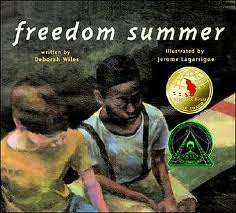
Read This If You Loved: by Ilyassah Shabazz and Kekla Magoon; The Rock and the River by Kekla Magoon; How it Went Down by Kekla Magoon; Freedom Summer by Deborah Wiles; Audacity by Melanie Crowder; The Boy in the Black Suit by Jason Reynolds

Recommended For:

readaloudbuttonsmall litcirclesbuttonsmall closereadinganalysisbuttonsmall classroomlibrarybuttonsmall

RickiSig andKellee Signature

Whose Story Is This, Anyway? by Mike Flaherty

Share

whose story is this anyway

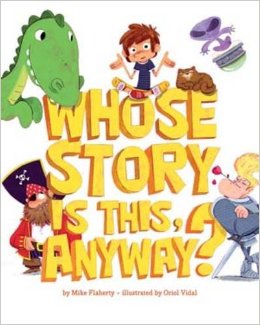
Whose Story Is This, Anyway?
Author: Mike Flaherty
Illustrator: Oriol Vidal
Published May 3rd, 2016 by Sterling Children’s Books

Summary: What’s this book about? That depends on who you ask. Our humble narrator thinks he’s got a great story for you, but he barely begins before he’s interrupted . . . by a scallywag pirate with a thrilling legend of mermaids and sea monsters! Soon an entire cast of colorful characters—including a hungry dinosaur, an alien bent on world domination, and a heroic knight—derails the boy’s saga. Everyone has a tale to tell—but if they can all get on the same page, this might turn out to be the best story ever!

About the Author: Mike Flaherty is an author and occasional hockey coach trying to keep up with his two kids and rather voracious cats. His secret lair is hidden somewhere in New Albany, OH, and he would be the world’s greatest super-villain if he could figure out how to get his Doomsday Device working. Until then, he’ll just keep writing stories.

About the Illustrator: Oriol Vidal is an illustrator and storyboard artist based in Barcelona, Spain. He graduated from UB Barcelona with a degree in Fine Arts. Including illustrating books and magazines, Oriol has worked in animation where he developed character designs and storyboards for clients in the US, France, UK, South Korea, and Spain. He happily works and lives with his little daughter, his wife, his cat, and his rowdy budgie.

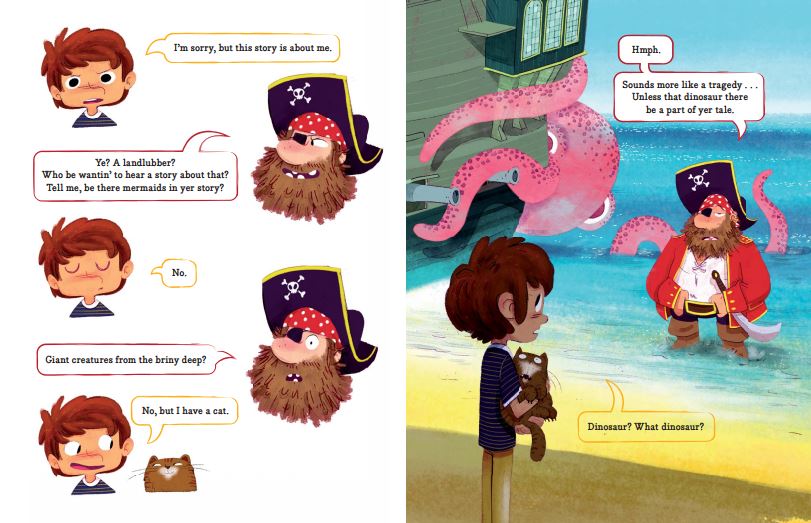
Kellee’s Review: This book made me laugh out loud. The characters are zany, the premise is fun, and the outcome is perfect. I also loved the comic-esque layout of the book with dialogue bubbles and colorful illustrations. Trent and I were enthralled with the cast of characters–the author really made sure to include all kids’ favorites.

Ricki’s Review: This is a book that somehow manages to cram in almost all of my son’s favorite things—and in an interesting, humorous way! With each page, my son says, “Ooooh!” because he is so excited by the characters. I particularly like how the narrator has a cat. Too often, male narrators always hold dogs and female narrators always hold cats. My son, who loves cats, is catching on to this, and it frustrates me. The creativity in this book is admirable, and kids will love it.

Teachers’ Tools for Navigation: This book will be such a fun addition to the classroom. It can be used for writing activities and for discussions (or as a mentor text) for point of view, voice, dialogue, humor, or narration. First, it would be really fun to rewrite this story from different points of view. Since each character thinks it is their story, their view of how things went down would be very different than the boys. It is also so great how the author gives each character their own voice and personality which would lend it to be a good mentor text for distinguishing voice and using dialogue. Also, students would have so much fun writing their own story about how each character ended up on this particular beach with this boy.

Discussion Questions: Why does the boy change is mind at the end of the book?; Which character would you want a whole story about?; How do you think each character ended up at this beach?; How would you have reacted if you were the boy?

Flagged Passages: 

Whose Story Spread

Read This If You Loved: Faraway Friends by Russ Cox, By Mouse & Frog by Deborah Freedman, Little Red Writing by Joan Holub, Nibbles by Emma Yarlett, Journey by Aaron Becker

Recommended For:

  classroomlibrarybuttonsmall readaloudbuttonsmall closereadinganalysisbuttonsmall

Kellee Signatureand RickiSig

**Thank you to Sterling Publishing for providing copies for review!**
Review and Giveaway!: Can You Canoe? and Other Adventure Songs by The Okee Dokee Brothers

Share

can you canoe

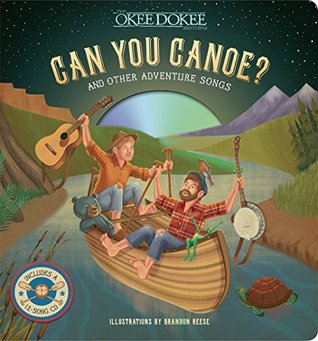
Can You Canoe? And Other Adventure Songs
Author: The Okee Dokee Brothers
Illustrator: Brandon Reese
Published April 19th, 2016 by Sterling Children’s Books

Summary: Can You Canoe? invites you to journey cross-country with The Okee Dokee Brothers through twelve of their irresistible, boot-stompin’ tunes. You’ll encounter hungry black bears and tall-tale spinners; quiet canoes and cozy camping tents; a jumpin’ jamboree and a bullfrog opera. As you listen to the songs and follow along with the illustrated lyrics in this collection, you might even be inspired to head out on some outdoor adventure of your own!

Kellee’s Review: We love music in my house, so anytime a book and music can be connected really makes me happy. I think the Okee Dokee Brothers’ music is catchy, knee-slapping, sometimes funny, and have great messages. I love how they all promote the out doors and adventure. And just when you think it cannot get any better, you see the illustrations. Brandon Reese’s illustrations are perfect! They are so colorful and loud and cartoon-ish. Just the type of fun you think would be in a book by the Okee Dokee Brothers. 

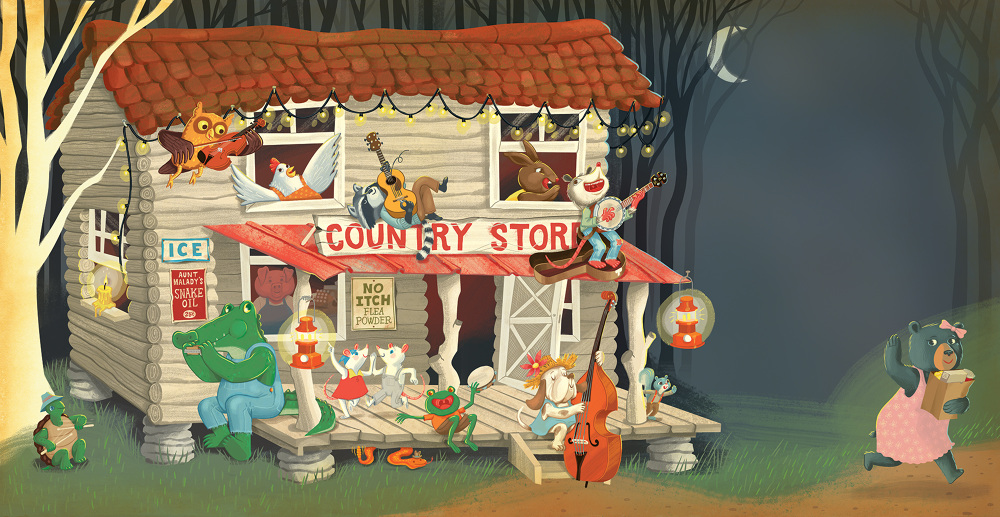
Ricki’s Review: This book is pure fun. My toddler was bouncing around the room as I played the CD. My husband is an outdoorsy guy, so he particularly liked the messages within the songs. The rhymes are great, and they will help my son learn the lyrics as we listen/read. I’ve never been to an Okee Dokee concert, and now I want to go to one! We’ll be bringing this CD along for long car rides. Below, we include an illustration, and you can see the pure beauty of this text. I will be buying it as a gift for my music-loving friends.

Teachers’ Tools for Navigation: We love using music during my poetry lessons because it helps students hear poetry and not be as afraid of it like they are with classics. Starting with music and lyrics allows you to help them understand how to read poetry differently than prose while using something they can easily understand. Can You Canoewould be a perfect text to use this for because you can analyze for poetic elements and meaning, but the Okee Dokee Brothers also have a field journal in the back which help give background information about each song making analyzing them less of a guessing game.

Can You Canoe? would also be a wonderful poetry mentor texts. The authors talk about how they find ideas for their songs and many of their songs have a format that could be emulated (like Jack in Love that Dog) if you wanted to go that route in class.

Discussion Questions: How do the authors use rhythm and rhyme in their lyrics?; What is a time that the authors used descriptive language to help the reader imagine the scene they are describing?; What is a time the authors used figurative language to add imagery to their songs?

Flagged Passages:

“There’s a country store
In a country town.
Every Friday night
The people dance around.
It don’t look like much
And it ain’t no chore,
But while they’re dancin’
They polish that floor.

They play this song
Right on key.
They play this song –
It’s called JAMBOREE.”

Okee_Jamboree_1000
(c) http://www.brandonreese.com/

Check out their You Tube channel to hear some of their music:
https://www.youtube.com/user/OkeeDokeeBros

Read This If You Loved: Goodnight Songs by Margaret Wise BrownFresh Delicious by Irene Latham

Recommended For:

  readaloudbuttonsmall closereadinganalysisbuttonsmall

Enter to win your own copy!

a Rafflecopter giveaway

Kellee Signatureand RickiSig

**Thank you to Lauren at Sterling Publishing for providing a copy for review!**

What Do You Do with a Problem? by Kobi Yamada

Share

what do you do with a problem

What Do You Do with a Problem?
Author: Kobi Yamada; Illustrator: Mae Besom
Published: July 1, 2016 by Compendium Inc.

GoodReads Summary: From the same author and illustrator as our #1 nationally best-selling What Do You Do With an Idea? comes a new book to encourage you to look closely at problems and discover the possibilities they can hold.

What do you do with a problem? Especially one that follows you around and doesn’t seem to be going away? Do you worry about it? Ignore it? Do you run and hide from it?

This is the story of a persistent problem and the child who isn’t so sure what to make of it. The longer the problem is avoided, the bigger it seems to get. But when the child finally musters up the courage to face it, the problem turns out to be something quite different than it appeared.

This is a story for anyone, at any age, who has ever had a problem that they wished would go away. It’s a story to inspire you to look closely at that problem and to find out why it’s here. Because you might discover something amazing about your problem… and yourself.

What are problems for? They challenge us, shape us, push us, and help us to discover just how strong and brave and capable we really are. Even though we don’t always want them, problems have a way of bringing unexpected gifts.

So, what will you do with your problem? Now that’s up to you.

Review: There is something so magical about the combination of writer Kobi Yamada and illustrator Mae Besom. When I saw that these creators of What Do You Do with an Idea? had another book, I jumped at the chance to read it. It’s no secret that I am in love with this first book. I have gifted it to many friends and children, and I include it on many of my favorites and Top Ten Tuesday lists. I was pleased that What Do You Do with a Problem? is just as stunning. These two books are a teacher’s dream. They utilize many literary elements and are perfect for close analysis. I would use them at all grade levels. What Do You Do with a Problem? is a great text to teach readers how to reconsider a problem (or problems) that they might have. They can compare the problem with illustrations and consider how that problem may, for example, be all-encompassing. I like how the book balances both the weight of the problem and the proverbial light at the end of the tunnel. By looking at this problem in a new light, readers will be able to take more of an outside perspective of the conflict—and hopefully/potentially work toward a resolution.

Teacher’s Tools for Navigation: To start, teachers might ask students to consider the symbolism within the text. They might even grapple with the definition of an allegory and discuss ways the definition might be connected with the text and illustrations. Then, students could think of an abstract idea and try to associate an object with that idea. They might even consider writing their own picture book that connects the object and abstract idea. I also think it would be great for teachers to read both this text and What Do You Do with an Idea? to students. Then, they might compare and contrast the stories and their messages.

Discussion Questions: What do you do with a problem? How do we deal with problems in different ways? How do others in our lives deal with problems in ways that differ from us?; How do the author and illustrator work together to create a compelling story? What symbols do they use to convey their message?

Flagged Passage: 

what do you do with a problem spread

Image from: www.amazon.com

Read This If You Loved: What Do You Do with an Idea? by Kobi Yamada; The Most Magnificent Thing by Ashley Spires; The Dot by Peter H. Reynolds, The Noisy Paint Box by Barb Rosenstock, Lost and Found by Oliver Jeffers, Journey by Aaron Becker

Recommended For:

  readaloudbuttonsmall closereadinganalysisbuttonsmall classroomlibrarybuttonsmall

RickiSig

Rescued by Eliot Schrefer

Share

rescued

Rescued
Author: Eliot Schrefer
Published April 26th, 2016 by Scholastic

Goodreads Summary: The third entry in the taut, heart-wrenching quartet that made Eliot Schrefer a two-time National Book Award finalist introduces us to an orangutan held captive in suburban America.

John grows up with everything he could possibly want. His father is a businessman who travels far and wide. One day, he comes home with a rare gift for his son, a baby orangutan, and the two become inseparable friends. But as the orangutan gets older, stronger, less cute, the family relegates the animal to a locked trailer in the backyard. Until John’s father finally decides to sell the ape to a roadside zoo. Coming to the defense of his childhood friend, John resolves to smuggle the orangutan back to Indonesia, and the two set out on a journey far more dangerous than John bargained for.

My Review: I think out of the three Ape Quartet books published so far, this is the one that is going to hit closest to home for many. It will make many readers uncomfortable and want to make a change. First, it takes place in the United States unlike Africa like the first two. Second, it really digs into an issue that is still very much prominent here–animal injustice.

I find Schrefer’s writing to be so beautiful yet so easy to read. He can pull you into his stories and makes you feel for not only his human characters but also his animal characters. He does such a tremendous amount of research for all of his books and with this one it brings the injustice of Raja alive.

I am a sucker for ape books. I find apes to be the most fascinating animals, and orangutans may be my favorite because they have these amazing eyes that just show me that they are so intelligent and deep thinkers. They are also introverts; I think I just relate to them in that way. This book brings orangutans to life through Raja.

Teachers’ Tools for Navigation: As evident from Schrefer’s status as a two-time National Book Award finalist, his books can be used as a mentor text for just about any aspect of writing that you are looking for: characterization, imagery, voice, conflict, etc. Read any of his books, and you can pull out so much to discuss and use within the classroom. Additionally, there are some amazing ape books, including Schrefer’s other Ape Quartet books, that would make for an amazing lit circle opportunity or text set.

Discussion Questions: Why does John feel obligated to help Raja?; What would you have done if you were John or John’s mom when the divorce happened? Or when John’s father showed up with Raja?; Why is it better for wild animals to be in the wild?

Flagged Passages: “Every family’s got something weird about it, and mine was no different. We just had to try harder than most to hide it. All it took was someone to walk in the door to see that we had an orangutan. A real-live, orange-brown, TV-obsessed, drinking-grapefruit-juice-from-the-carton orangutan.” (p. 11)

“The truck’s engine rumbled, and the trailer pulled away. I watched it go, stunned.

You did this, I scolded myself. You let this happen.

Sweat had soaked my shirt, ran from the pits down my arms. The heat radiating up from the pavement made me dizzy, even though the perspiration on my brow was chill. I bent over, hands on my knees. I could feel the cords of my neck stand out, straining. Getting ready to start my stomach, at least, back at zero.

I heaved in air, and it sounded like a sob. Then it was a sob. Something huge and dark and terrible came out of me, something that had tamped down for so long that it had become even more huge and dark and terrible.

One last sob came out of me, then all was quiet.

There, slumped in the dirt, was Raja’s old blue elephant. (p. 69-70)

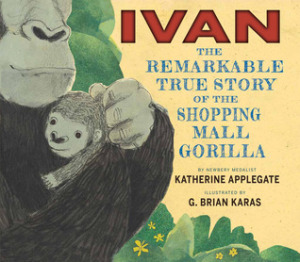
Read This If You Loved: Endangered and Threatened by Eliot Schrefer (Ape Quartet #1 and #2 yet are all stand alone novels), Hurt Go Happy by Ginny Rorby, One and Only Ivan by Kathering Applegate, Ivan: The Remarkable True Story of the Shopping Mall Gorilla by Katherine Applegate, Top Ten Ape Book list from Nerdy Book Club (I’ll be updating here on Unleashing Readers soon)

Recommended For: 

classroomlibrarybuttonsmall closereadinganalysisbuttonsmall litcirclesbuttonsmall

Signature

Blog Tour, Author Guest Post, and Review!: Cici Reno #MiddleSchoolMatchmaker by Kristina Springer

Share

cici reno

Cici Reno #MiddleSchoolMatchmaker
Author: Kristina Springer
Published April 16th, 2016 by Sterling Children’s Books

Goodreads Summary: Middle school is a test, but Cici Reno has all the answers. She’s the go-to girl for advice. She’s cool, she’s funny, and she’s enlightened (thanks to yoga classes at her mom’s studio). So when her pretty BFF, Aggie, is too shy to speak to the boy she’s crushing on, Cici goes online and does the talking for her. The only problem is, Cici starts to fall for the guy herself! For the first time in her life. she doesn’t have a clue.

My Review: Cici Reno is a refreshing addition to middle grade romance. As a middle school teacher, I am always happy when there is a romance novel that actually features middle school kids instead of high schoolers. The thinking and feelings differ so much between 6th and 9th grade that sometimes the YA romance novels are a bit mature for the middle schoolers that want to read about crushes and dating. And Cici Reno is a book that middle schoolers will flock to not only because of the romance but because of the humor, Cici’s true voice, and the story of friendship.

Teachers’ Tools for Navigation (Teachers’ Tools for Navigation):
“Using Classic Retellings in the Middle Grade Classroom” by Kristina Springer

As readers, we love a good classic retelling. Renée Ahdieh reimagined The Arabian Nights in her #1 NYT Bestseller, The Wrath and the Dawn. The Coming of the Dragon by Rebecca Barnhouse was inspired by Beowulf. The Real Boy by Anne Ursu offered a new look at Pinnocchio. My first young adult novel, The Espressologist, was a twist on Jane Austen’s Emma. (In my book, the main character is a coffee shop barista who discovers a talent for matchmaking her customers based on their favorite coffee drinks.) And of course, Romeo and Juliet has been remade again and again and again (my favorite being Gnomeo and Juliet!).

With my newest middle grade book, Cici Reno #MiddleSchoolMatchmaker, I decided to do a modern twist of the Cyrano de Bergerac story, set in middle school and with Twitter instead of balconies and bushes.

Cici Reno, is the 12 ¾-year old enlightened daughter of a Yogi. When she’s not helping out at her mom’s beloved Peony Lane Yoga Studio or taking a class herself, she’s solving all of the 7th grade’s problems, be it boy trouble or BFF drama. When her shy best friend Aggie asks for Cici’s help in getting the attention of the boy she likes, Cici goes online and does the talking for her. Only the more they talk, the more she falls for him herself. What’s a girl to do?

Studying a classic story and some of its retellings could be a fun and creative activity for middle grade classrooms. Here’s a suggestion of how you can approach this:

  • Start with talking about the original classic tale. Let’s say you choose Cyrano de Bergerac as I did. Talk about the original play written by Edmond Rostand in 1897. Show pictures of the real Cyrano de Bergerac for which the play is based on. More info here: https://en.wikipedia.org/wiki/Cyrano_de_Bergerac_(play) And show this really cute 1 minute, 35 second YouTube Last Minute Book Report clip of Cyrano de Bergerac to get an overall sense of the story. https://www.youtube.com/watch?v=-u52OLtAws8
  • Have your class read through a bit of the play together out loud to get a sense of the relationship between Roxane, Christian, and Cyrano. Perhaps the balcony scene in Act 3, Scenes 6 and 7 where we see Christian bumbling for his words and Cyrano stepping in to rescue him. You can find the play this here: http://www.poetryintranslation.com/PITBR/French/Cyranoact3.htm
  • Talk about some of the movie adaptions of Cyrano de Bergerac over the years like Roxanne and The Truth about Cats and Dogs. If time and interest allows, show the 2012 Disney Original Movie, Let it Shine. https://en.wikipedia.org/wiki/Let_It_Shine_(film)
  • Read my book, Cici Reno #MiddleSchoolMatchmaker, and discuss the similarities and differences between the original and this modern retelling. Consider having the students use a Venn Diagram to do this. Have them discuss why they think I, as the author, made certain changes and if those changes improved the story or not.
  • Have the students try writing their own modern short story re-telling of Cyrano de Bergerac. And have fun sharing them with each other!

About the Author: Kristina Springer is the author of Cici Reno #MiddleSchoolMatchmaker (Sterling Children’s/April 19, 2016), My Fake Boyfriend Is Better Than Yours (Macmillan/FSG), a Scholastic Bestseller and 2012 YALSA Quick Pick book; The Espressologist (Macmillan,/FSG), a 2010 Society of School Librarians International Honor Book and 2014 Illinois Reads Book that has been purchased for film by Michael Eisner’s Vuguru; and Just Your Average Princess (Macmillan/FSG). She has a Masters in Writing from DePaul University and resides in a suburb of Chicago with her husband and children. Learn more about Kristina on her website: http://KristinaSpringer.com.

Flagged Passages: “‘Wow, you think of everything,’ Aggie says. ‘It sounds completely perfect. Only one thing.’

‘What’s that?’

‘I can’t talk to him, Cici! You heard me at the bonfire. I go from zero to dork in 2.3 seconds.’

‘But you’ll be online,’ I tell her. ‘You can take your time typing, really form your thoughts.’

‘Yeah. I guess.’ She pauses. ‘Or you could talk to him for me. Please? You’re so much better around guys than I am. Always so relaxed and cool. And funny,’ she adds.” (p. 35)

Read This If You Loved: Cyrano de Bergerac, Camp Rolling Hills by Stacy Davidowitz, Audition & Subtraction by Amy Fellner Dominy, Drama by Raina Telgemeier

Recommended For: 

classroomlibrarybuttonsmall closereadinganalysisbuttonsmall

Kellee Signature