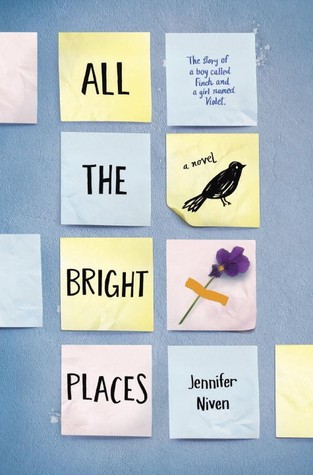
All the Bright Places by Jennifer Niven

Share

all the bright places

All the Bright Places
Author: Jennifer Niven
Published: January 6, 2015 by Knopf

Goodreads Summary: The Fault in Our Stars meets Eleanor and Park in this compelling, exhilarating, and beautiful story about a girl who learns to live from a boy who intends to die.

Theodore Finch is fascinated by death, and he constantly thinks of ways he might kill himself. But each time, something good, no matter how small, stops him.

Violet Markey lives for the future, counting the days until graduation, when she can escape her Indiana town and her aching grief in the wake of her sister’s recent death.

When Finch and Violet meet on the ledge of the bell tower at school, it’s unclear who saves whom. And when they pair up on a project to discover the “natural wonders” of their state, both Finch and Violet make more important discoveries: It’s only with Violet that Finch can be himself—a weird, funny, live-out-loud guy who’s not such a freak after all. And it’s only with Finch that Violet can forget to count away the days and start living them. But as Violet’s world grows, Finch’s begins to shrink.

This is an intense, gripping novel perfect for fans of Jay Asher, Rainbow Rowell, John Green, Gayle Forman, and Jenny Downham from a talented new voice in YA, Jennifer Niven.

Ricki’s Review: A publishing representative who I deem to be a friend pressed this book into my hand. “Read it,” she insisted. She told me I would want to curl up into a ball in my bed and fall into this book. I fell hard. The writing is incredible. I hate to compare books with others because it creates a sense of expectation that often goes unfulfilled for future readers, but I couldn’t help but consider comparisons with my all-time favorite YA texts. The quirky nature of the characters reminded me of Pudge, Alaska, Charlie, Eleanor, and Park. The direction of the plot reminded me of other titles (which will remain unnamed to prevent spoilers). But I cannot compare this book to others because while it allowed to me reminisce about my favorite titles, it was quite different. The deep, honest, hard-hitting depiction of mental illness was enough to take my breath away. I felt rage that made me want to punch my mattress; I felt sadness that made me feel a hopeless sense of emptiness; but above all, I felt the power of love, loyalty, and friendship that made my heart both ache and swell. This is an unforgettable book. I suspect it will be the book that everyone will be talking about this year and for years to come.

Teacher’s Tools for Navigation: Mental illness and bullying are pervasive in our schools. We can’t teach enough books about these themes because they are incredibly relevant for young people. As a former teacher, I was jealous of the teacher who created the assignment for Violet and Finch, and I wanted to do it with my former students. It would be so neat to duplicate this project while students read the book. Additionally, I think students would benefit from creating their own version of the post-it collages that Violet and Finch make. As an alternative, I would consider having students research the warning signs of suicide and finding these instances in the text. There are so many themes for the students to consider, the teaching categories at the top and tags at the bottom of this post show a variety of different directions a teacher might take with the instruction of this text.

Access the book’s website to share your bright place or read Germ MagazineThe educator guide also has CCSS tie-ins.

Discussion Questions: What is the end message of this book? What is the author’s purpose?; What foreshadowing does Niven provide?; How do Violet’s family members show their grief in different ways?; Do you agree with the ending? Would you change it? Why do you think Niven ended the book in the way she did?

We Flagged: “It’s my experience that people are a lot more sympathetic if they can see you hurting, and for the millionth time in my life I wish for measles or smallpox or some other easily understood disease just to make it easier on me and also on them.”

**Please note: The above quotation is from an advanced reader copy. The quotation may change in the final published form of the text.**

Read This If You Loved: Looking for Alaska by John Green, Eleanor and Park by Rainbow Rowell, Dr. Bird’s Advice for Sad Poets by Evan Roskos, The Fault in Our Stars by John Green, Forgive Me, Leonard Peacock by Matthew Quick, It’s Kind of a Funny Story by Ned Vizzini, The Perks of Being a Wallflower by Stephen Chbosky, Twisted by Laurie Halse Anderson, Everybody Sees the Ants by A.S. King, Burn by Suzanne Phillips

Recommended For:

 closereadinganalysisbuttonsmall litcirclesbuttonsmall classroomlibrarybuttonsmall

RickiSig

Rain Reign by Ann M. Martin (Kellee’s Review)

Share

rain

Rain Reign
Author: Ann M. Martin
Published October 7th, 2014 by Feiwel & Friends

Goodreads Summary: In her most powerful novel yet, Newbery Honor author Ann M. Martin tells the story of girl with mental/emotional challenges and the dog she loves.

Rose Howard has OCD, Asperger’s syndrome, and an obsession with homonyms (even her name is a homonym). She gave her dog Rain a name with two homonyms (Reign, Rein), which, according to Rose’s rules of homonyms, is very special. Rain was a lost dog Rose’s father brought home. Rose and Rain are practically inseparable. And they are often home alone, as Rose’s father spends most evenings at a bar, and doesn’t have much patience for his special-needs daughter.

Just as a storm hits town, Rain goes missing. Rose’s father shouldn’t have let Rain out. Now Rose has to find her dog, even if it means leaving her routines and safe places to search. Rose will find Rain, but so will Rain’s original owners.

Hearts will break and spirits will soar for this powerful story, brilliantly told from Rose’s point of view.

My Review and Teachers’ Tools for Navigation: If you have read A Corner of the Universe,  you know what an emotionally-charged author Ann M. Martin can be, and she once again tells a heart-wrenching story with a voice that will not leave your head. In Rain Reign, Martin tackles Rose’s story. Rose is such a true character. A brilliant young girl with OCD and Asperger’s syndrome who is obsessed by homonyms. She is a girl that is so unique and intriguing. As a teacher, I very much connected with her and how I would nurture her gifts within my classroom; however, I also saw the challenges that Rose faces as well.

What makes this book truly stand out is the first person point of view. You, as the reader, are in Rose’s mind and living her life. You experience the neglect of her father, the love of Reign, the obsessiveness, the homonyms, the outbursts, and the support of her uncle. Because I was IN her life, I just couldn’t put down the book. I had to know that Rose and Rain were going to be okay.

As a teacher, I want kids to read this book because they will fall in love with Rose and Rain. Through this love, they will build empathy in their hearts because they will just want to know that Rose and Rain will be okay.

Ricki’s Review: Check out Ricki’s Review here!

Discussion Questions: How do you feel about Rose’s dad?; Can you think of homonyms that weren’t mentioned in the book?; Do you think it was right of Rose’s dad to take Rain?; How would you feel if your dog disappeared?

We Flagged: “I’m going to tell you a story. It’s a true story, which makes it a piece of nonfiction.

This is how you tell a story: First you introduce the main character. I’m writing this story about me, so I am the main character.

My first name has a homonym, and I gave my dog a homonym name too. Her name is Rain, which is special because it has two homonyms–rein and reign. I will write more about Rain in Chapter Two. Chapter Two will be called “My Dog, Rain (Rein, Reign).”

Something important about the word write is that is has three homonyms–right, rite, and wright. That’s the only group of four homonyms I’ve thought of. If I ever thing of another four-homonym group, it will be a red-letter day.” (Chapter One)

Read This If You Loved: Rules by Cynthia Lord, Wonder by R.J. Palacio, Mockingbird by Kathryn Erskine, Out of my Mind by Sharon Draper, Each Kindness by Jaqueline Woodson

Recommended For: 

classroomlibrarybuttonsmall readaloudbuttonsmall litcirclesbuttonsmall

Signature

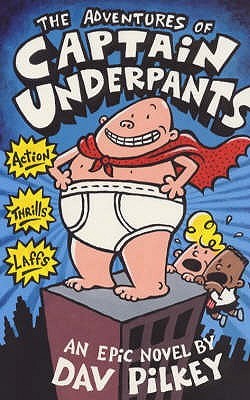
Captain Underpants Series by Dav Pilkey

Share

captain1 captain11

Captain Underpants series
Author: Dav Pilkey
#1: Adventures of Captain Underpants published September 1st, 1997 by Scholastic, Inc.
#11: Captain Underpants and the Tyrannical Retaliation of the Turbo Toilet 2000 published August 26th, 2014 by Scholastic Inc.

Goodreads Summary #1: Pilkey plays with words and pictures, providing great entertainment. The story is immediately engaging – two fourth-grade boys who write comic books and love to pull pranks find themselves in big trouble. Mean Mr. Krupp, their principal, videotapes George and Harold setting up their stunts and threatens to expose them. The boys’ luck changes when they send for a 3-D Hypno-Ring and hypnotize Krupp, turning him into Captain Underpants, their own superhero creation.

Goodreads Summary #11: When the Incredible Robo-Plunger defeated the evil Turbo Toilet 2000, George and Harold thought their toilet troubles were over. Unfortunately, their porcelain problems were only beginning . . . Just when you thought it was safe to flush . . . The Turbo Toilet 2000 strikes back! The carnivorous commode known for devouring everything in its path has built up a real appetite . . . for REVENGE! Join Captain Underpants for another epic showdown of Wedgie Power vs. Potty Power as our tighty-whitey-wearing superhero GOES TO ELEVEN!

My Review and Teachers’ Tools for Navigation: Ever since I started teaching I have had Captain Underpants fans in my classroom. Readers (especially boys though, like all books, it is not exclusive) love these books. When I started teaching intensive reading, my students loved that I read so much but were astonished that I had never read a Captain Underpants book. So, during the summer of 2012, I read the entire series that was out at the time.  And suprsingly, I am happy I did. I enjoyed the books so much, and I found many different ways that I could use in the series in classroom. As I read I not only enjoyed the stories (well most of them; the booger one was quite gross), but I kept notes on different ways each book could be a mentor text.  I know that students already love the books so I would love to be able to use them in the classroom. I think that part of what makes Pilkey’s humor work is that he never talks down to his reader. The humor is intelligent and witty, and he makes sure to have his books be as entertaining as possible to keep the reader’s attention.

Teachers’ Tools for Navigation: Some of my favorite things that are addressed in the series are spelling, grammar, vocabulary, and puns. The spelling is not directly addressed; however, Harold and George misspell a lot of words and it would be good to use to talk about phonics and spelling.  Also, each book begins with an anagram which is great word play.  The grammar is sporadic only showing up in some books, but the vocabulary is in all of them.  Some vocabulary I found was billowing, narratively convenient, fizzled, improbability, jubilant, mock, scurried, and merciless and that is just in book 3! Also the puns in each book are really quite clever (check out p. 34 in #11 and any of the flip-o-ramas to see what I mean). Each book also has some great alliteration (#11, p. 29, 27, 208)- each title alone has alliteration in them. There are also allusions and onomatopoeias!

Additionally, I love the set up of the novels. They are a great mix of novel, graphic novel, comics, and picture books. It is a great transition between picture books and Diary of a Wimpy Kid. I especially like the flip-o-ramas. They are unique to the Captain Underpants books and I think it puts a great interactive and kinesthetic feel to the books.

One thing I do not understand is why these books are challenged. Yes, they have some potty humor. Yes, the adults aren’t the best representation of teachers. Yes, it is silly. But they are harmless and actually have some really great qualities to them.

Discussion Questions: In the first Captain Underpants, Harold and George brainstorm a superhero including his name and then create a comic based on their superhero. With a partner, brainstorm a name for a superhero and then complete a story to go along with your superhero. To expand it even more, complete a comic for your superhero.; In #11 novel, time travel plays a large part of in the plot. What event could you go back in time to try to change?; In some of the Captain Underpants books, there are grammar, convention, and spelling mistakes. Why do you think Dav Pilkey makes the choice to use incorrect grammar? What mistakes idd you find?; In #11, Harold and George end up being cloned (kind of). What would you do if there were two of you?

We Flagged (#11): 

Read These If You Loved: Diary of a Wimpy Kid series by Jeff Kinney, Big Nate series by Lincoln Peirce, Charlie Joe Jackson series by Tommy Greenwald, The Adventures of Ook & Gluk and Super Diaper Baby series by Dav Pilkey, Lunch Lady series by Jarrett Krosoczka, Frankie Pickle series by Eric Wight, Knights of the Lunch Table series by Frank Cammuso 

Recommended For: 

readaloudbuttonsmall classroomlibrarybuttonsmall

Signature

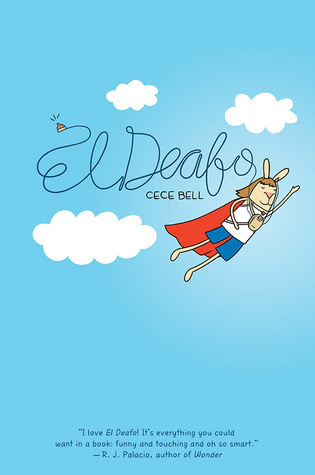
Review and Teaching Guide!: El Deafo by Cece Bell

Share

NF PB 2014

Nonfiction Picture Book Wednesday

Nonfiction Picture Book Wednesday is hosted by Kid Lit Frenzy and was started to help promote the reading of nonfiction texts. Most Wednesdays, we will be participating and will review a nonfiction text (though it may not always be a picture book).
Be sure to visit Kid Lit Frenzy and see what other nonfiction books are shared this week!

deafo

El Deafo
Author: Cece Bell
Published September 2nd, 2014 by Abrams

Publisher Summary: Going to school and making new friends can be tough. But going to school and making
new friends while wearing a bulky hearing aid strapped to your chest? That requires superpowers! In this funny, poignant graphic-novel memoir, author/illustrator Cece Bell chronicles her hearing loss at a young age and her subsequent experiences with the Phonic Ear, a very powerful—and very awkward—hearing aid. The Phonic Ear gives Cece the ability to hear—sometimes
things she shouldn’t—but also isolates her from her classmates. She really just wants to fit in and find a true friend, someone who appreciates her as she is. After some trouble, she is finally able to harness the power of the Phonic Ear and become “El Deafo, Listener for All.” And more importantly, declare a place for herself in the world and fi nd the friend she’s longed for.

Author: Cece Bell has written and illustrated several books for children, including the Geisel Honor book Rabbit & Robot: The Sleepover. She lives in Virginia with her husband, author Tom Angleberger.

My Review: There are times that you read a book and when you are done, you just know that it is a special book. El Deafo is one of those books. As you all know, I am a huge fan of Hurt Go Happy by Ginny Rorby, and one of the reasons I am is because it looks at disabilities in a positive light and shows that a disability is not an end, but just a change. El Deafo is another novel that does this. Although Cece, like Joey in Hurt Go Happy, finds herself deaf at a young age, we see her overcome this blow and turn it into a superpower. But this book is about more than deafness; it is about being a kid, about growing up, about friendship, about ackwardness, about school, about crushes, about family, about life. This book is truth.

Teachers’ Tools For Navigation: There is so much you can do with this graphic novel. Many activities can be found in the teaching guide that I wrote for Abrams. This book is perfect for independent reading, for lit circles  with other graphic novel memoirs, for jigsawing, for read alouds, and for looking deeply into the text.

(Also, and I didn’t want to harp on this because they are both such unique books, but this book will be loved by the readers of Smile. They both look at such an important part of life.)

Discussion Questions: Language Arts:  Cece uses many different kinds of clues to help her lip-read. (pages 30–31) What are the 4 types of clues? How do they help with lip-reading? In what other ways can these clues be helpful?; On page 60, Cece shares an analogy of her friendship with Laura. She feels like a baited fish that is caught on Laura’s hook. What analogies could we make to
describe Cece’s friendship with Ginny? Martha? Emma?; Science: What is meningitis? How can it cause deafness?;  What is an audiologist? What would you have to study to become one?; History/Social Studies: Many deaf and hard of hearing individuals have made history, including Helen Keller, William Ellsworth Hoy, and Juliette Gordon Low. Research these or other deaf or hard of
hearing individuals throughout history and today. How did being deaf affect their lives? What were their accomplishments?

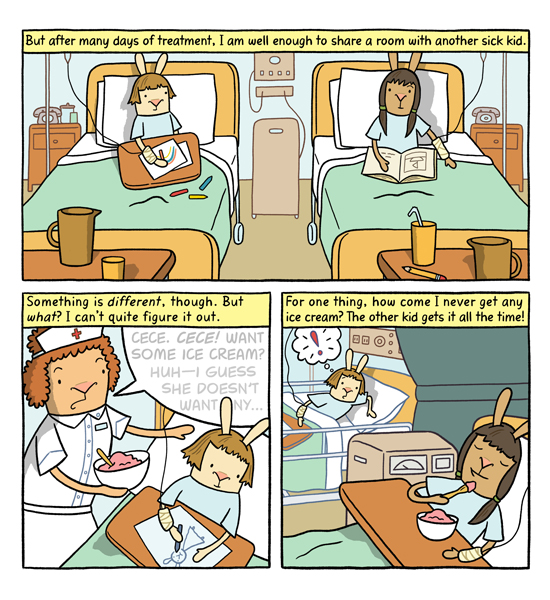
We Flagged: 

01ORIGINSPanelsREVISED
**From Cece Bell’s blog**

Read This If You Loved: Smile and Sister by Raina Telgemeier, The Dumbest Idea Ever! by Jimmy Grownley, I Remember Beirut by Zeina Abirached, Odd Duck by Cecil Castellucci

Recommended For: 

classroomlibrarybuttonsmall readaloudbuttonsmall closereadinganalysisbuttonsmall litcirclesbuttonsmall

Signature

Blog Tour, Review, Giveaway, and Author Guest Post!: The Top-Secret Diary of Cecile Valentine: Friendship Over by Julie Sternberg

Share

topsecretdiary

The Top-Secret Diary of Celie Valentine: Friendship Over
Author: Julie Sternberg
Illustrator: Johanna Wright
Published October 1st, 2014 by Boyds Mills Press

Goodreads Summary: Ten-year-old Celie has quite a few things on her mind — fights with her sister Jo, secrets at school, an increasingly forgetful grandmother, and worst of all, a best friend who won’t speak to her. How can a girl who hates change survive, when everything in her life is changing? By writing, of course! Celie’s often comical and always heartfelt diary entries include notes, e-mails, homework assignments, and pages from her top-secret spy notebook.

My Review: I am a very big fan of Julie Sternberg’s Eleanor books. What I enjoy the most about these books is that Julie Sternberg has a way to get into 10 year old’s heads and make her narrator’s voice sound so spot on. As someone who teaches middle school, I am always so impressed when a first person narrative sounds like the students I teach. When I found out that Julie Sternberg had a new series coming out and it would be a diary, I was super excited, and this book did not disappoint.

Celie fills her journal with her deepest thoughts, her art, and other items that help tell her story. Readers will connect with Celie while she deals with her grandmother’s declining health, her best friend’s sudden silence, and her older sister’s identity issues. Great discussions will start with questions such as “Have you and your best friend ever gotten into a fight?”

I asked Julie to share with us how she find her inner 10-year-old voice so effectively. Here is her answer: 

I’m fixated on voice in writing. It’s problematic. I tend to spend weeks—sometimes months—on the first thirty or so pages of a novel, trying and trying to get the voice right. I cannot move forward until I believe I’ve succeeded.

I recognize that this is a silly way to write. I tell myself, Turn off your internal editor! Knock out a terrible first draft! Revising is so much easier than confronting a blank page. Just KEEP GOING! 

But I never can. Because without the right voice, I don’t have a book.

When I think about voice, I think about not just who is telling the story, but also to whom. Audience makes a difference. A child, for example, will relate an anecdote differently to a teacher than to a best friend. So, for my first series, Like Pickle Juice on a Cookie and its sequels, I imagined the main character, Eleanor, telling stories to a friend her age. And, for my latest series, The Top-Secret Diary of Celie Valentine, I imagine Celie pouring her uncensored thoughts into a diary.

Voice is most shaped by the narrator’s personality and background. When I need a brilliant reminder of this, I re-read Voices in the Park, a picture book by Anthony Browne. In it, four separate narrators tell their version of the same story (one shared afternoon in the park). We get a staggeringly clear sense of each character just from the voice they use to relate that simple story.

voices in the park cover

When I’m trying to define a voice, I pay particular attention to the rhythm and structure of sentences. In The Top-Secret Diary of Celie Valentine, for example, feisty Celie uses simpler and more pointed sentences than her chattier and messier older sister, Jo. For instance, here’s the first sentence in a long note that Jo writes to Celie: “Mom says I’m not allowed to talk to you (I’m supposed to ‘give you your space’) until the end of your timeout, so I can’t just go in there and tell you this, which is what I really want to do.” Celie responds in three sentences, not one of which has more than four words.

A compelling voice can compensate for a host of sins. I learned this as a reader. Some of my favorite books could have better plots, for example. I don’t care. I love the voice in those books, and I want to spend my days with their narrators.

Of course I don’t write perfect books, either (though I want to). If readers nonetheless want to spend their days with Eleanor or Celie or my other narrators because of their voices, then I’m ecstatic.

Author: Julie Sternberg is the author of the best-selling Like Pickle Juice on a Cookie and its sequels, Like Bug Juice on a Burger and Like Carrot Juice on a Cupcake. Like Pickle Juice on a Cookie is a Gryphon Award winner and a Texas Bluebonnet Award finalist; Like Bug Juice on a Burger is a Gryphon Honor Book, a Pennsylvania Young Reader’s Choice Awards Nominee, and an Illinois Monarch Award Finalist. Formerly a public interest lawyer, Julie is a graduate of the New School’s MFA program in Creative Writing, with a concentration in writing for children. She lives with her family in Brooklyn, New York. For more information about her life and work and to download free activity materials based on her books, visit her website: juliesternberg.com.

We Flagged: 

Johanna Wright illustration_Celie and Jo in bed image-on-swing-set-with-words

From Julie Sternberg’s website

Read This If You Loved: Eleanor series by Julie Sternberg, Middle School is Worse than Meatloaf by Jennifer L. Holm, Where I Live by Eileen Spinelli, The Popularity Papers by Amy Ignatow, Mackenzie Blue by Tina Wells

Recommended For: 

classroomlibrarybuttonsmall

Also don’t forget to check out the other stops on Julie’s blog tour: 

Mon, Sept 29
Mother Daughter Book Club
Tues, Sept 30
5 Minutes for Mom
Wed, Oct 1
Sharpread
Thurs, Oct 2
KidLit Frenzy
Fri, Oct 3
The Hiding Spot
Sat, Oct 4
Booking Mama
Mon, Oct 6
Ms. Yingling Reads
Tues, Oct 7
GreenBeanTeenQueen
Wed, Oct 8
Great Kid Books
Thurs, Oct 9
Teach Mentor Texts
Fri, Oct 10
Unleashing Readers
Sat, Oct 11
Bermuda Onion

GIVEAWAY

a Rafflecopter giveaway

Signature

**Thank you to Barbara at Blue Slip Media for providing a copy for review and having us be part of the blog tour!!**

The Most Magnificent Thing by Ashley Spires

Share

magnificent

The Most Magnificent Thing
Author: Ashley Spires
Published April 1, 2014 by Kids Can Press

Goodreads Summary: Award-winning author and illustrator Ashley Spires has created a charming picture book about an unnamed girl and her very best friend, who happens to be a dog. The girl has a wonderful idea. “She is going to make the most MAGNIFICENT thing! She knows just how it will look. She knows just how it will work. All she has to do is make it, and she makes things all the time. Easy-peasy!” But making her magnificent thing is anything but easy, and the girl tries and fails, repeatedly. Eventually, the girl gets really, really mad. She is so mad, in fact, that she quits. But after her dog convinces her to take a walk, she comes back to her project with renewed enthusiasm and manages to get it just right. For the early grades’ exploration of character education, this funny book offers a perfect example of the rewards of perseverance and creativity. The girl’s frustration and anger are vividly depicted in the detailed art, and the story offers good options for dealing honestly with these feelings, while at the same time reassuring children that it’s okay to make mistakes. The clever use of verbs in groups of threes is both fun and functional, offering opportunities for wonderful vocabulary enrichment. The girl doesn’t just “make” her magnificent thing — she “tinkers and hammers and measures,” she “smoothes and wrenches and fiddles,” she “twists and tweaks and fastens.” These precise action words are likely to fire up the imaginations of youngsters eager to create their own inventions and is a great tie-in to learning about Science, Technology, Engineering and Math.

My Review: Ashley Spires did an amazing job with this book. Her illustrations seem so simple, but really there is so much detail in each one. Amazing digital art. Also, Girl is a character after my own heart as a mom and a teacher. We need more kids like her. Kids who explore, invent, play outside, imagine, etc. I hope my son is like her.

Teachers’ Tools for Navigation: The summary says a lot for me. This is a book that promotes innovation, imagination, perseverance, and experimenting. All things that are so important for kids to have and too often they are not nurtured. Innovation: Girl wants to make something new and magnificent. Imagination: Some of the odd items she makes actually do have a purpose, you just have to use your imagination. Perseverance: Girl almost gives up, but begins to realize that what she made may be exactly what she wanted to make in the first place. Experimenting: She tries to make so many different things for a variety of purposes. All of these themes could be discussed while reading the book with kids.  The book also has amazing vocabulary, many of which are shared in the summary. A great way to discuss synonyms, descriptive language, and imagery.

Discussion Questions: Why did the girl never give up?; What are some of the words that the author uses to help you “see” and “hear” what the girl is doing?; Which of her inventions was your favorite? And what other ways could you use some of them?; Girl plans out her invention. What steps did she take to plan? What else could she have done?

We Flagged: “This is a regular girl and her best friend in the whole wide world. They do all kinds of things together. They race. They eat. They explore. They relax. She makes things. He unmakes things. One day, the girl has a wonderful idea. She is going to make the most MAGNIFICENT thing!”  (p. 6-7)

Book Trailer: 

Fun With The Author: 

Read This If You Loved: The Invisible Boy by Tracy Ludwig, The Dot by Peter H. Reynolds, Noisy Paint Box by Barb Rosenstock, Lost and Found by Oliver Jeffers, Matilda by Roald Dahl, Journey by Aaron Becker

Recommended For: 

readaloudbuttonsmall classroomlibrarybuttonsmall

Signature

**Thank you to Kids Can Press and Netgalley for providing a copy for review**

Coyote Summer by J.S. Kapchinske

Share

coyote

Coyote Summer
Author: J.S. Kapchinske
Published March 17, 2013 by Moon Halo Books

Goodreads Summary: Heath always looked forward to summer visits at Grandpa’s—long days in the wild Rocky Mountains, fishing with Dad on the Piedra River, and nights sleeping on the screened-in porch. Plus this summer, Dad promised to finally tell him the secret about old Mrs. Baylis—a mysterious Native American woman living down the dusty dirt road… But now, after Dad’s accident, it can never happen that way. Heath and his mother go to Grandpa’s, but only to spread Dad’s ashes in the river. 

In the beginning, Heath feels like he’s been swallowed by the raging Piedra, held upside down in some dark and unforgiving eddy. But one day, wandering along the riverbank, he meets Annie, a wild-eyed tomboy who shows him a hidden cave with a litter of orphaned coyote pups. Together they discover the cave holds another secret—one that might help them figure out the mystery of old Mrs. Baylis. During that summer in the mountains, Heath comes to realize there is both beauty and ugliness in the world, sometimes all tangled together. By opening himself up to Annie and the coyotes, he rediscovers hope and joy in this big, beautiful, mixed-up world.

My Review: You have never heard of this book have you? That makes me so sad. How do such wonderful books fly under so many people’s radars? This is a special book that should be in the hands of middle schoolers everywhere! Heath is a character that so many kids will connect with, and his journey would definitely touch them like it did me.

Heath recently lost his father senselessly when he was hit by a drunk driver. The sudden loss of a man that Heath looked up to affects him tremendously, and he is struggling to find himself. Everything he does at his Grandpa’s house reminds him of his dad, and his mom and Grandpa are dealing with the death in a way that makes Heath feel alone.  But during this summer, his coyote summer, he finds his own identity, makes an everlasting friend, and begins to figure out how to deal without his dad. And there are other subplots that run throughout he book that just add to the depth of the narrative such as Annie’s story and the story of Mrs. Baylis.

Teachers’ Tools for Navigation: This book just needs to be shared. It could definitely be read as a read aloud, but it will probably find its home the best in the right students’ hands either through the classroom library or lit circles. Students who love nature, have suffered a loss, or enjoy identity books will find this one is perfect for them.

Discussion Questions: How does finding Annie and the coyotes change Heath’s summer?; Why is Grandpa acting the way he is?; Why was it important for Heath to spend the summer with the coyotes? How did it affect him?

We Flagged: “As we sat there, a heron swooped down on the far bank and began stalking the shallows for fish. He moved slowly and hardly made a ripple when he walked. Then he stretched his long neck over the water, cocked his head, and froze.

“He’s pretty,” the girl said under her breath, as if talking to herself.

Somehow, her saying that made me feel better. “Herons were my dad’s favorite. He told me we should all learn to be patient like one of them.”

“Your dad sounds nice.”

I looked down at my hands and felt that horrible lump in my throat.” (Location 196, Kindle book)

Read This If You Loved: Hoot, Flush, Chomp, or Scat by Carl Hiassen, Lost in the River of Grass by Ginny Rorby, My Side of the Mountain by Jean Craighead George, Hatchet by Gary Paulsen

Recommended For:

classroomlibrarybuttonsmall litcirclesbuttonsmall

Signature

**Thank you to the author for providing a copy for review**