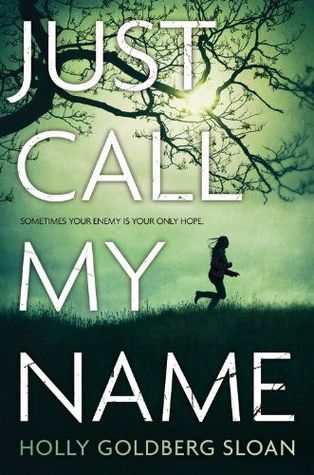
Just Call My Name by Holly Goldberg Sloan

Share

Just Call My Name

Just Call My Name
Author: Holly Goldberg Sloan
Published: August 5, 2014 by Little, Brown Books for Young Readers

Summary: The happily-ever-after of Holly Goldberg Sloan’s acclaimed debut, I’ll Be There, is turned on its head in this riveting, emotional sequel about friends, enemies, and how those roles can shift in a matter of moments.

Emily Bell has it all. She’s in love with a boy named Sam Border, and his little brother has become part of her family. This summer is destined to be the best time of their lives–until a charismatic new girl in town sets her sights on Sam. Now Emily finds herself questioning the loyalty of the person she thought she could trust most.

But the biggest threat to her happiness is someone she never saw coming. Sam’s criminally insane father, whom everyone thought they’d finally left behind, is planning a jailbreak. And he knows exactly where to find Emily and his sons when he escapes…and takes his revenge.

Review: Holly Goldberg Sloan is an incredible writer. I enjoyed the first book in the series, but I liked this one even more. I appreciate the great depth of her characters. Often, coincidences are categorized as poor writing, but Sloan uses them intentionally and in a clever way—defying literary assumptions about quality writing. The book is quite suspenseful, and readers will have the urge to race through it to learn how the plot unravels. The way Sloan builds the plot details is very thoughtful and meticulous, and I found myself constantly reflecting about how intelligent she is. This sequel is well worth the read. It is a difficult one to put down! It reads like a very literary mystery and would be a great text for teachers to have in their classrooms. One aspect that I love about this series is it turns our concept of family on its head; it will teach readers about the power of a strong family unit—traditional or not.

Teacher’s Tools for Navigation: This would be a fantastic resource for teachers teaching plot, suspense, and foreshadowing. The way Sloan builds the events and details is admirable, and students would learn a lot from her design. While it is a sequel, I think this book could certainly stand alone. The ominous mood made my heart race! Check out more curricular connections here: Curricular Connections.

Discussion Questions: How does Sloan thoughtfully use coincidence to build her story?; What is Destiny’s role in the novel? How does Sam perceive her? Is he right? What does this tell us about Sam? Why does the author name her, “Destiny”?; How do the shifts in point-of-view add to your reading of the text?

We Flagged: “That happens to really happy people. They don’t notice the little things” (p.81).

Read This If You Loved: I’ll Be There by Holly Goldberg Sloan, We Were Liars by e. lockhart, YA Suspense/Mystery

Recommended For:

  litcirclesbuttonsmall classroomlibrarybuttonsmall

RickiSig

Boys of Blur by N. D. Wilson

Share

boys of blur

Boys of Blur
Author: N. D. Wilson
Published: April 8, 2014 by Random House

Ricki’s Summary and Review: 12-year-old Charlie Reynolds’ family travels to town of Taper to attend the funeral of a beloved football coach. When Charlie’s stepfather is given the opportunity to coach the town’s football team, Charlie is not thrilled to learn that they will be living in this creepy town filled with ancient stories of runaway slaves, native tribes, and monsters that rise organically from the murky swamps. He tries to fit into this mysterious place, where boys chase rabbits through burning sugarcane and everything seems to revolve around football. As he comes to learn about this town of secrets, Charlie wonders if he has the courage to uncover the mysteries that surround him.

Set deep in the heart of the Florida Everglades, this text is sure to grip readers with its muck, swords, blood, and gore. Wilson integrates complex allusions to Beowulf, which will compel readers to uncover all of the parallels with the classic legend. The beautifully complex language of this fast-paced story inspires close readings while also teaching readers lessons about evilness, heroism, and family.

Kellee’s Review: What I found most intriguing about this book is that Wilson was able to allude to Beowulf in a middle grade book without completely scaring away the reader.  Although I have read in multiple reviews that this book will grab reluctant readers’ attention, I think that some of the allusions are hard to grasp without prior knowledge, so reluctant readers may need some assistance understanding thus making the book a great read aloud as it will grab attention and start deep discussion (see Tools for Navigation).  In addition to the allusions, there are opportunities to discuss hero’s quest, abuse, and loyalty.

You will also find some beautiful writing in this novel. Wilson has a way with words that made this novel lyrical yet easy to read. From the very first line: “When the sugarcane’s burning and the rabbits are running, look for the boys who are quicker than flame.” I was impressed with how literary the novel was.  

Teacher’s Tools for Navigation: There are obvious parallels between this novel and  the legend of Beowulf, and pairing these two texts for discussion would prove very rewarding. Perhaps, teachers could use this Boys of Blur in conjunction with Gareth Hinds’ graphic novel of Beowulf. Then, the class could compare and contrast both the story lines and the differing formats authors might employ to convey a story and message.

Discussion Questions: How is Charlie characterized? Do you find him to be a strong character?; What role does Cotton play in the story?; What role does Charlie’s father play in the story? Can he be forgiven?; How does the author use language effectively?

We Flagged: “‘Yes,’ Mrs. Wisdom said, ‘you are. You’re made of tiny spinning bits as fast as light. But those bits aren’t all of you. They fly off. They get lost, and new ones come on and join the swirling Charlie-shaped dance that is your body. And dwelling in that dance, woven through every racing bit, heating it all with life and guiding it, there is a fire, a soul—you. It takes a dream to see something like that, something closer to the way things really are” (110).

Read This If You Loved:  Beowulf by Unknown, 100 Cupboards by N. D. Wilson, Maniac Magee by Jerry Spinelli, Holes by Louis Sachar, Ophelia and the Marvelous Boy by Karen FoxleeRaining Sardines by Enrique Flores-Galbis

Recommended For:

 readaloudbuttonsmall litcirclesbuttonsmall closereadinganalysisbuttonsmall classroomlibrarybuttonsmall 

RickiSigand Signature

Review and Teaching Guide!: Frank Einstein and the Antimatter Motor by Jon Scieszka, Illustrated by Brian Biggs

Share

frank

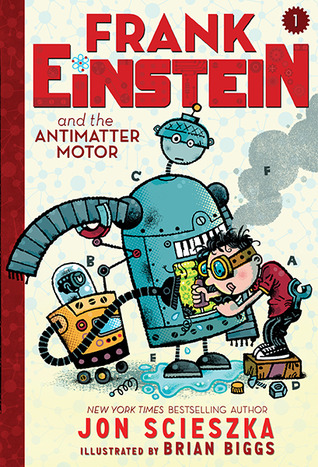
Frank Einstein and the Antimatter Motor
Author: Jon Sciezska
Illustrator: Brian Biggs
Published August 19, 2014 by Amulet Books

Goodreads Summary: Frank Einstein loves figuring out how the world works by creating household contraptions that are part science, part imagination, and definitely unusual. After an uneventful experiment in his garage-lab, a lightning storm and flash of electricity bring Frank’s inventions—the robots Klink and Klank—to life! Not exactly the ideal lab partners, the wisecracking Klink and the overly expressive Klank nonetheless help Frank attempt to perfect his Antimatter Motor . . . until Frank’s archnemesis, T. Edison, steals Klink and Klank for his evil doomsday plan! Using real science, Jon Scieszka has created a unique world of adventure and science fiction—an irresistible chemical reaction for middle-grade readers.

My Review: In the world of illustrated novels, we have many a class clown: Greg, Nate, George & Harold. But now we have our very own genius, and he is a genius that kids are going to love! This book combines the humor and fun plot that Diary of a Wimpy Kid, Big Nate, and Captain Underpants have, but adds in science (though the kids reading it will be none the wiser). The way that Sciezska combines humor, adventure, twists & turns, and science is perfection that will have a whole slew of readers waiting for the next Frank Einstein book.

Teachers’ Tools for Navigation: This book has so much that a teacher could touch on while reading it. It would be a perfect book for a read aloud in reading with cross-curricular activities based on the book in science.  I was very lucky to once again be able to write a teaching guide, this time for Frank Einstein. To see more specific class activities and discussion questions, view my teaching guide at the Abrams website. (I also wrote the teaching guide for Frank Einstein and the Electro-Finger!)


Discussion Questions: 

  • Frank has a double helix DNA slide. What would this look like?; Grandpa Al uses the phrase “Blow this pop stand” (p. 112). This is an idiom meaning “Let’s get out of here.”
  • What are idioms? What are some idioms you use in your daily life?
  • Frank’s parents are in Antarctica, where the ozone is getting a hole in it (p. 110). What is causing this hole? Frank mentions CFCs. What are they? How do they affect the ozone?
  • In Fig 1.1, Frank shows us that every second between light and sound equals 1/5 of a mile, because of the difference between the speed of light and the speed of sound. So, if there are 5 seconds between thunder and lightning, that means the storm is 1 mile away. What if there are 10 seconds between? 15 seconds? 12 seconds? 100 seconds?; On page 109, we learn that corn flakes were an accidental invention. Are there other accidental inventions?

We Flagged: “Night. Darkness. Flash! A bright bolt of lightning splits the dark and flickers over the skylight. Frank Einstein looks up from his work. He counts out loud, “One thousand one. One thousand two. One thousand three. One thousand four. One thousand five–” Craack boom! The sound-wave vibration of the thunder rattles the old iron-framed windows of Frank’s workshop and science laboratory. “Five seconds between light and sound for every mile. . . One mile away,” Frank calculates, using the difference between the almost-instant speed of light and the much slower speed of sound. “Right on time.”

Read This If You Loved: Series: Frankie Pickle by Eric Wight, Diary of a Wimpy Kid by Jeff Kinney, Captain Underpants by Dav Pilkey, Big Nate by Lincoln Peirce

Recommended For:

classroomlibrarybuttonsmall readaloudbuttonsmall closereadinganalysisbuttonsmall

Signature

**Thank you to Abrams Books for providing a copy for review**

Yaqui Delgado Wants to Kick Your Ass by Meg Medina

Share

Yaqui Delgado

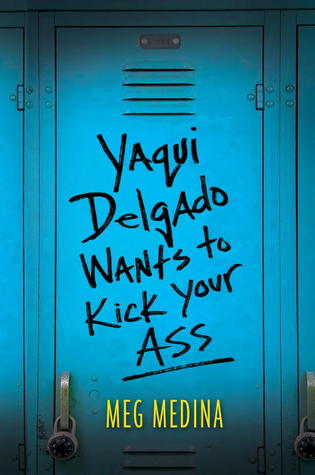
Yaqui Delgado Wants to Kick Your Ass
Author: Meg Medina
Published: March 26, 2013 by Candlewick Press

Summary: In Meg Medina’s compelling new novel, a Latina teen is targeted by a bully at her new school — and must discover resources she never knew she had.

One morning before school, some girl tells Piddy Sanchez that Yaqui Delgado hates her and wants to kick her ass. Piddy doesn’t even know who Yaqui is, never mind what she’s done to piss her off. Word is that Yaqui thinks Piddy is stuck-up, shakes her stuff when she walks, and isn’t Latin enough with her white skin, good grades, and no accent. And Yaqui isn’t kidding around, so Piddy better watch her back. At first Piddy is more concerned with trying to find out more about the father she’s never met and how to balance honors courses with her weekend job at the neighborhood hair salon. But as the harassment escalates, avoiding Yaqui and her gang starts to take over Piddy’s life. Is there any way for Piddy to survive without closing herself off or running away? In an all-too-realistic novel, Meg Medina portrays a sympathetic heroine who is forced to decide who she really is.

Ricki’s Review: There are many books about bullying, but it is rare to read a text that makes you truly feel frighted for the character being bullied. This text felt very real to me, and it will surely resonate with teenagers. There are many lessons about bullying, but there are also some phenomenal examples of family and friendship. Piddy’s mother isn’t perfect and like all parents, she makes mistakes, but she is a single mother who tries her best. The ups and downs of this mother-daughter relationship offer much to ponder and discuss. As adolescents go through high school, they form new bonds and often, they also grow apart from childhood friends. Piddy’s circumstances of a new school with new friendships will absolutely connect with teens.

Kellee’s Review: Like Ricki stated above, this book makes you feel. As Yaqui fills Piddy’s world with fear, Piddy begins to lose herself and get caught up in the terror. As a reader, you find yourself afraid with Piddy whenever she leaves her house, goes to school, or even thinks about doing either. A book that can do this is brilliant. Meg Medina has a way of sucking you into the world, and I think it is her use of imagery throughout. You can see the characters, hear the music Piddy listens to, feel the fear, etc. And Piddy’s voice is so crystal clear, that is something she never loses. When you finish reading, you can still hear Piddy’s voice in your head.  I also feel that this is a wonderful diverse book in a time when the YA community is calling for diverse books. This one should be in high school classrooms, and should be discussed as it has such important themes and beautiful writing (no matter what anyone thinks about it!).

Teacher’s Tools for Navigation: This would be a great read aloud at the beginning of the school year. Bullying is a problem that is all too real in our school systems, and it must be addressed immediately, in my opinion. This book would provide rich discussions for classrooms, and it is a must-read for teens. It would be great to do several book groups (or lit circles) that are centered on bullying texts in order to compare the characters’ experiences.

Discussion Questions: Does Piddy make the right decisions? Would you make different choices than her? Why or why not?; Why does the author incorporate Spanish into the text? What does it add, stylistically?; How does Piddy’s absent father affect her?; Which individuals have a positive impact on Piddy? How do these relationships build her character?; Is Joey a good influence on Piddy? What does she learn from him?; Do you agree with the choice that Piddy makes in the end? Would you have made the same choice? Does it show weakness or strength?

We Flagged: “’Son unas cualquieras,’ [my mother] mutters. Nobodies. No culture, no family life, illiterates, she means. The kind of people who make her cross to the other side of the street if she meets them in the dark on payday. They’re her worst nightmare of what a Latin girl can become in the United States. Their big hoop earrings and plucked eyebrows, their dark lips painted like those stars in the old black-and-white movies, their tight T-shirts that show too much curve and invite boys’ touches” (p. 55). 

Read This If You Loved:  Speak by Laurie Halse Anderson, Mexican WhiteBoy by Matt de la Peña, The Secret Life of Sonia Rodriguez by Alan Sitomer, Burn by Suzanne Phillips, Thirteen Reasons Why by Jay Asher, Forgive Me, Leonard Peacock by Matthew Quick, Out of Nowhere by Maria Padian, Shine by Lauren Myracle, The Mockingbirds by Daisy Whitney

Recommended For:

  litcirclesbuttonsmall classroomlibrarybuttonsmall

SignatureandRickiSig

Winger by Andrew Smith (Kellee’s Review)

Share

winger

Winger
Author: Andrew Smith
Published May 14th, 2013 by Simon & Schuster

Goodreads Summary: Ryan Dean West is a fourteen-year-old junior at a boarding school for rich kids. He’s living in Opportunity Hall, the dorm for troublemakers, and rooming with the biggest bully on the rugby team. And he’s madly in love with his best friend Annie, who thinks of him as a little boy.

With the help of his sense of humor, rugby buddies, and his penchant for doodling comics, Ryan Dean manages to survive life’s complications and even find some happiness along the way. But when the unthinkable happens, he has to figure out how to hold on to what’s important, even when it feels like everything has fallen apart.

Filled with hand-drawn info-graphics and illustrations and told in a pitch-perfect voice, this realistic depiction of a teen’s experience strikes an exceptional balance of hilarious and heartbreaking.

My Review: Andrew Smith sure knows how to write a teenage boy’s voice. He gets inside of adolescent male’s mind, and puts it all on paper for us. (It probably has something to do with teaching high school.) Ryan Dean’s voice and his story are so authentic. This book will make you cringe, laugh out loud, shake your head, and cry.  I am also so impressed with all of the themes that are dealt with in this book without ever feeling over done. These themes include bullying, absent parents, peer pressure, identity, sexuality, prejudice, and friendship.  In addition, Smith builds his characters, setting, and plot seamlessly. You fall in love with all of the characters, main and secondary. Even the antagonist. The setting itself is a character. And finally the plot arc was perfectly done, and was so unpredictable all the way to the end.

Teachers’ Tools for Navigation: First and foremost, this book needs to read by teens. However that happens, it is the right thing. The easiest way would be to get it into libraries and classrooms. There are also parts of the book that could definitely be pulled out to be used in the classroom in may different ways. On that junps to mind right away is using Ryan Dean’s comics as mentor texts for writing comics to write narratives of everyday events. Ricki also has some great ideas for Winger in the classroom in her review.

Discussion Questions: What kind of social challenges does Ryan Dean have to overcome since he is 14 but a junior?; Were you able to predict the end of the book?; What are some traits about Ryan Dean that made him easy to connect to?; How does Opportunity Hall and the rest of the school become a character in Winger?

We Flagged: 

winger2(p. 21)

Read This If You Loved: Looking for Alaska by John Green, Openly Straight by Bill Konigsberg

Recommended For: 

classroomlibrarybuttonsmall closereadinganalysisbuttonsmall

Signature

Jumped In by Patrick Flores-Scott

Share

jumped

Jumped In
Author: Patrick Flores-Scott
Published August 27, 2013 by Henry Holt and Co.

Goodreads Summary: Sam has the rules of slackerhood down: Don’t be late to class. Don’t ever look the teacher in the eye. Develop your blank stare. Since his mom left, he has become an expert in the art of slacking, especially since no one at his new school gets his intense passion for the music of the Pacific Northwest—Nirvana, Hole, Sleater-Kinney. Then his English teacher begins a slam poetry unit and Sam gets paired up with the daunting, scarred, clearly-a-gang-member Luis, who happens to sit next to him in every one of his classes. Slacking is no longer an option—Luis will destroy him. Told in Sam’s raw voice and interspersed with vivid poems, Jumped In by Patrick Flores-Scott is a stunning debut novel about differences, friendship, loss, and the power of words

My Review: This book is about depression, friendship, poetry, music, loyalty, teachers, and family.. It is amazing that through Sam’s interactions with Luis and introduction to poetry, he goes from trying to be invisible on purpose to having a whole different view of his surroundings. Luis changes how he sees the world because Luis ends up being everything he thought he wasn’t.

This book surprised me. I didn’t know what it was about when I started, so I wasn’t sure what I was getting myself into. At first Sam seems to just be a slacker that is hard to connect with, and I thought it was going to be similar to many other books with a bully that I’ve read. But it ended up being like Luis was to Sam–everything I thought it wasn’t going to be, and it was so unpredictable. From page 1, the author had me. The images just jumped out at me. And that was just the beginning of me being thoroughly impressed with the book. Both of the voices in this book resonated with me for a long time after (As much as I end up liking Sam in this book, I think Luis may be one of my favorite characters ever. He has a beautiful voice, and I felt privileged to meet him.). It was one of those books that I had to let marinate before I could pick up another one because it was still banging around inside of my head (and I couldn’t stop hearing Sam and Luis’s voices).

Teachers’ Tools for Navigation: This is a poetry-friendly book. First, although Sam is telling the story, throughout Luis’s voice is shared through his poetry. Beautiful poetry. Also, one of the main settings of the book is an English classroom with a pretty awesome English teacher talking about poetry. There are even examples of poems that she asks her students to write such as diamantes and nonets. All of her poetry unit (and writing process) activities would be perfect to use in the classroom.

Discussion Questions: Was there ever someone you judged by looking at them, but later learned that they were not what you thought?; Have you ever just tried to be invisible? Why?; Do you ever have “brain movies” like Sam when your brain just won’t stop thinking?; How does Luis’s friendship change Sam?; How is Luis different than what Sam assumed he would be?; How does Gilbert affect Sam?

We Flagged: “I pull away from everyone, and after a while, I pretty much quit talking altogether. It’s been two years. I’m a sophmore. I shouldn’t still be stuck like this. But the pit I’ve dug for myself feels so deep, I can’t climb out of it. I want to. I want to climb out and join the world. But I can’t. I don’t know how.” (Sam, p. 32)

Callado

I’m Callado
Still waters, aguas quietas

But in school you have to speak
To be seen as running deep

To be thought of as more than
The tragic mask
I wear to put you off
I don’t know why, so don’t ask

Someday I’ll scrap the mask
I’ll let loose my new, crazy words
I’ll speak my piece
Without ceasing till you’ve learned…

That I’m as deep
As Everest is voluminous

I’m as thoughtful
As the sun is luminous

As lucid
As Casanova is amorous

As passionate
As a grizzly is carnivorous…” (Luis, p. 51)

Read This If You Loved: Dr. Bird’s Advice for Sad Poets by Evan Roskos, Rose Under Fire by Elizabeth Wein, Reality Boy by A.S. King, Wine Young Fool by Sean Beaudoin

Recommended For: 

classroomlibrarybuttonsmall closereadinganalysisbuttonsmall

Signature

brown girl dreaming by Jacqueline Woodson

Share

brown girl

brown girl dreaming
Author: Jacqueline Woodson
Published: August 28, 2014 by Nancy Paulsen Books

Summary: Jacqueline Woodson, one of today’s finest writers, tells the moving story of her childhood in mesmerizing verse. 
 
Raised in South Carolina and New York, Woodson always felt halfway home in each place. In vivid poems, she shares what it was like to grow up as an African American in the 1960s and 1970s, living with the remnants of Jim Crow and her growing awareness of the Civil Rights movement. Touching and powerful, each poem is both accessible and emotionally charged, each line a glimpse into a child’s soul as she searches for her place in the world. Woodson’s eloquent poetry also reflects the joy of finding her voice through writing stories, despite the fact that she struggled with reading as a child. Her love of stories inspired her and stayed with her, creating the first sparks of the gifted writer she was to become.
 
Praise for Jacqueline Woodson:
Ms. Woodson writes with a sure understanding of the thoughts of young people, offering a poetic, eloquent narrative that is not simply a story . . . but a mature exploration of grown-up issues and self-discovery.”—The New York Times Book Review

Ricki’s Review: This beautifully poignant book in verse captured my heart. I was swept away in the beauty of Jacqueline Woodson’s lyrical memories. This is a book that will embrace readers, wrapping them in Woodson’s childhood in the stormy 1960s. I couldn’t help but read and reread portions of the text–for every few pages that I read, I needed to flip back and relive the beauty of the previous verses. I will cherish this book, reading it again and again, for every word feels intentional and every memory vivid. brown girl dreaming is timeless, and it is universal. Above all, this book will give readers insight–unfolding the experiences of a “brown” child living during the heat of the civil rights movement; a young girl growing up in a house that identifies as Jehovah’s Witnesses; and a young writer, struggling to find the perfect words to reveal the truth. It will touch the hearts of readers of all backgrounds and ages in its messages of family, friendship, strength, and hope.

Kellee’s Review: Wow. I often worry about reading a book that has a lot of hype around it because I fear that I will not love it as much as others do. I should not have been worried about this book. It is beautiful. As Ricki said, I found myself rereading portions of the text just because of how well the verse flowed. By the end of this book, you will wish that you were Woodson’s friend and that you you could write as well as she does. The stories she tells are so true and heartfelt that you live her life along with her through the pages. You experience with her the hardship of growing up in the 1960s and 70s during the Civil Rights movement; the challenge of religion and finding the truth in it; the loss, addition, and conflict of family and everything that comes with these changes; and trying to find an identity as a person, sister, daughter, student and a writer. It is only a truly powerful, well-written book that can make you feel all of these elements.

Teacher’s Tools for Navigation: Writers will feel inspired by Woodson’s verse, and it would make an excellent mentor text for students to learn more about themselves and their own childhoods. We would suggest pairing passages with “I Am From” poems for students to be inspired to write verse memoirs of their own experiences. The figurative language and detail of this text make it a phenomenal resource for teachers, and we would find great value in close readings of Woodson’s intentional use of words and phrasing.

Discussion Questions: How does Jacqueline Woodson come to find herself? What are the strongest influences on her identity?; In what ways does Woodson show the power of family? How do Woodson’s siblings impact her decisions?; What role does history play in this book?; In what ways does Woodson manipulate words, phrasing, and white space? How does this influence your reading?

We Flagged: 

“Then I let the stories live
inside my head, again and again
until the real world fades back
into cricket lullabies
and my own dreams.” (p. 99)

“Sometimes, she pulls a chair to the window, looks
down over the yard.

The promise of glittering sidewalks feels a long time
behind us now, no diamonds anywhere to be found.

But some days, just after snow falls,
the sun comes out, shines down on the promise
of that tree from back home joining us here.

Shines down over the bright white ground.

And on those days, so much light and warmth fills
the room
that it’s hard not to believe
in a  little bit

of everything.”  (p. 285)

Please Note: The above excerpts are from advanced reader copies. The wording and punctuation may be different in the published text. Our blog interface does not allow us to accurately capture the indentions, but we wanted you to see the beauty of Woodson’s language.

Read This If You Loved: Other books by Jacqueline Woodson, The Rock and the River by Kekla Magoon, Sold by Patricia McCormick, Make Lemonade by Virginia Euwer Wolff, Mare’s War by Tanita S. Davis, Gaither Sisters (series) by Rita Williams- Garcia, Sit-In: How Four Friends Stood Up by Sitting Down by Andrea Davis Pinkney, The Silence of our Friends by Mark Long

Recommended For:

closereadinganalysisbuttonsmall readaloudbuttonsmall litcirclesbuttonsmall classroomlibrarybuttonsmall

RickiSigand Signature