How the World Was: A California Childhood by Emmanuel Guibert

Share

NFPB2016

Nonfiction Wednesday

Nonfiction Picture Book Wednesday is hosted by Kid Lit Frenzy and was started to help promote the reading of nonfiction texts. Most Wednesdays, we will be participating and will review a nonfiction text (though it may not always be a picture book).
Be sure to visit Kid Lit Frenzy and see what other nonfiction books are shared this week!

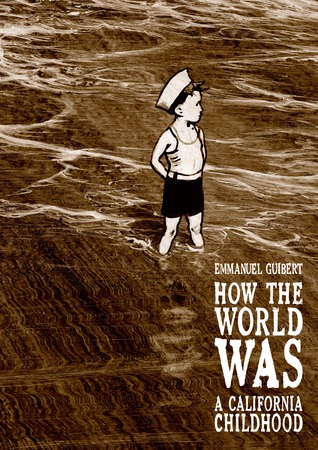
How the World Was

How the World Was: A California Childhood 
Author: Emmanuel Guibert; Translation: Kathryn Pulver
Published: July 15, 2014 by First Second

Summary: In 1994, French cartoonist Emmanuel Guibert befriended an American veteran named Alan Cope and began creating his new friend’s graphic biography. Alan’s War was the surprising and moving result: the story of Cope’s experiences as an American GI in France during World War II.

How the World Was is Emmanuel Guibert’s moving return to documenting the life of his friend. Cope died several years ago, as Guibert was just beginning work on this book, but Guibert has kept working to commit his friend’s story to paper. Cope grew up in California during the great depression, and this remarkable graphic novel details the little moments that make a young man’s life…while capturing the scope of America during the great depression.

A lyrical, touching portrait, How the World Was is a gift for a dear friend in the last moments of his life… and also a meditation on the birth of modern America.

Review: Many of you know Emmanuel Guibert’s graphic novel Alan’s War. Guibert is a French cartoonist who tells the true story of Alan Cope, an American GI in France in WWII. How the World Was: A California Childhood depicts Alan’s earlier childhood experiences, growing up during the Great Depression in California. The graphic novel is unlike others that I’ve read, and I really enjoy Guibert’s style. The chapters read like vignettes of Cope’s childhood; some of the scenes are graphic, and many are quite moving. This text would be excellent for close reading, and I don’t think readers even need to read it in its entirety to appreciate and understand each chapter.

Teacher’s Tools for Navigation: I’d love to use this text in the classroom, and I would probably use a single chapter. (This would inspire readers to take the entire book out on their own, which is a style I love to use when I am teaching.) I was particularly moved by the end of the book, where Alan’s mother goes in for surgery. I’d love to do a close reading of this section to discuss author’s purpose and Alan’s identity development.

Discussion Questions: How does this graphic novel differ from others that you’ve read?; How is the author’s writing style similar to short vignettes? Why might he have chosen to write the book in this why? Is it effective for you, the reader?; What scenes stand out to you? Why might this be?

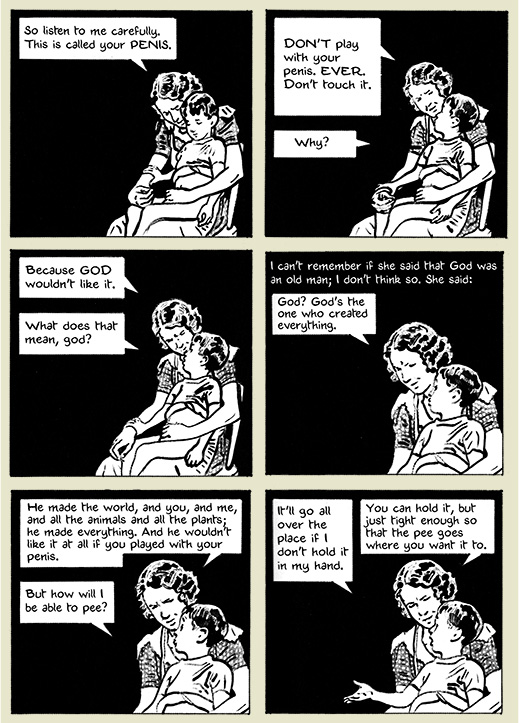
Flagged Passage: I’ve included a section that stands out to me. It is a bit peculiar to include in a graphic novel, but there is a lesson in the pages that follow. I imagine that censors would be horrified to see this page alone, but within the context of the chapter, it is a very important scene.

how the world was

Special thanks to http://goodokbad.com/index.php/reviews/how_the_world_was_review for sharing this scene in his reviews. It’s a good one.

Read This If You Love: The Photographer by Emmanuel Guibert; Alan’s War by Emmanuel Guibert; The Stranger by Albert Camus; The House on Mango Street by Sandra Cisneros

Recommended For:

closereadinganalysisbuttonsmall classroomlibrarybuttonsmall

RickiSig

Noodles’ and Albie’s Birthday Surprise by Eric Bennett

Share

noodles-and-albie

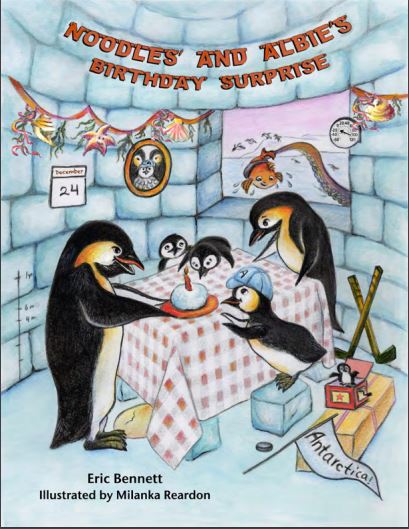
Noodles’ and Albie’s Birthday Surprise
Author: Eric Bennett
Illustrator: Milanka Reardon
Published December 9th, 2016

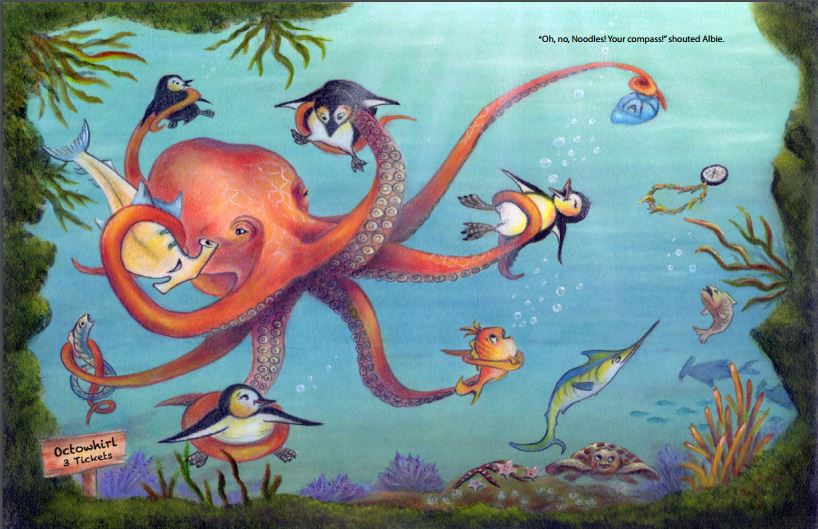
Summary: Noodles’ & Albie’s Birthday Surprise is the continuing adventures of Noodles (a penguin) and Albie (his fish friend). The story takes place on the day of Noodles birthday, which happens to be December 24th. While waiting for his party to start, Noodles and his friends play on the ice while a group of red jacket wearing tourists from a nearby cruise ship take the penguins pictures. Meanwhile, his friend Albie is under the sea searching for the perfect birthday gift for Noodles. She eventually comes across an old compass from a sunken treasure chest, which is perfect for Noodles as in the first Noodles & Albie story (2014), he had some major sense of direction issues. After giving Noodles his compass, the two friends head off for a day at Polar Kingdom, the world’s greatest undersea amusement park. After a fun day, the pair begin their journey home, but soon notice a red glow up ahead on the oceans surface. The glow it turns out is coming from the nose of one of the strange animals they come across stranded on an ice floe, along with a mysterious red jacket wearing “tourist” with a white beard, and a sled full of boxes. It turns out the mysterious tourist is lost because his assistants insisted he try a GPS devise to help guide him. Now the chubby, old man is hopelessly lost. Not only is he lost, but he’s on a deadline, and he’s in Antarctica. He can’t find his way back on track because it’s always daylight in Antarctica in December, and the poor tourist can’t even see the North Star to navigate. He needs to get North and fast. Will Noodles help the lost tourist by giving him his compass?

Review: Noodles’ and Albie’s Birthday Surprise takes readers on a second adventure of two best friends that is just as wonderful as the first and with a delightful cameo the reader doesn’t see coming. Teachers and students will find much to discuss as they read this humorous, clever tale. After reading the first of Noodles’ and Albie’s stories, we were happy to hear that Eric had written a second to allow us to go on even more adventures with these great friends. 

Teachers’ Tools for Navigation: While reading aloud Noodles’ and Albie’s Birthday Surprise, there are many opportunities for think alouds and discussions such as predicting what Noodles will do, discussing the end of the book as well as the characters’ traits, and discussing birthday and holiday celebrations.

Discussion Questions: What character traits does Noodles and Albie show throughout the story? Include evidence for each trait.; What is the best birthday you have ever had?; How did the lost traveler know where Noodles lived?

Flagged Passages: 

noodles-and-albie-bday-spread

Read This If You Loved: Noodles and Albie by Eric Bennett, Penguin series by Salina Yoon, If You Were a Penguin by Florence Minor, Your Personal Penguin by Sandra Boynton, Penguins by Seymour Simon, Tacky series by Helen Lester, A Penguin Story by Antoinette Portis, Polar Express by Chris Van Allsburg

Recommended For:

  readaloudbuttonsmall

Kellee Signatureand RickiSig

**Thank you to the author for providing copies for review!**

The Secret Side of Empty by Maria E. Andreu

Share

the secret side of empty

The Secret Side of Empty
Author: Maria E. Andreu
Published: March 11, 2014 by Running Press

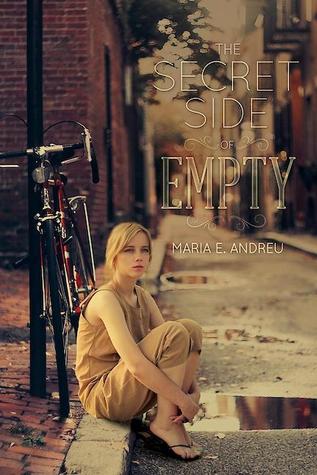
Summary: As a straight-A student with a budding romance and loyal best friend, M.T.’s life seems as apple-pie American as her blondish hair and pale skin. But M.T. hides two facts to the contrary: her full name of Monserrat Thalia and her status as an undocumented immigrant.

But it’s harder to hide now that M.T.’s a senior. Her school’s National Honor Society wants her to plan their trip abroad, her best friend won’t stop bugging her to get her driver’s license, and all everyone talks about is where they want to go to college. M.T. is pretty sure she can’t go to college, and with high school ending and her family life unraveling, she’s staring down a future that just seems empty. In the end, M.T. will need to trust herself and others to stake a claim in the life that she wants.

Author Maria E. Andreu draws from her personal experience as a (formerly) undocumented immigrant to explore an issue that affects over one million children in the U.S. But while the subject matter is timely, it is M.T.’s sharp, darkly funny voice and longing for a future that makes this story universally poignant.

My Review: In the last year, I have met many people who have told me that they were or are undocumented immigrants. Immigration reform is a hot topic in politics right now, and I can’t help but wonder if people are thinking about others in terms of their humanity. I’ve become increasingly heavy-hearted as I have listened to speeches about immigration, and I longed to learn more about the topic. After searching news articles, research studies, statistics, and government websites, I felt that I needed more story, and so I picked up this book from the library. It received excellent reviews, and I understand why. The author draws upon her personal experiences as a formerly undocumented immigrant, and the narrator, M. T., feels very real. I learned about some of the struggles undocumented immigrants experience, and I am grateful for all that I learned from this book. M. T. deals with other complex issues beyond her immigrant status—relationship issues, domestic abuse, and contemplations of suicide. There is so much to discuss regarding the text. I loved the book and am so glad I found it. I highly recommend it.

Teachers’ Tools for Navigation: This is a fantastic book to discuss undocumented immigrants with students. It would be wonderful to help students consider aspects of immigration reform and explore other perspectives. The author is featured in this article about Donald Trump.

Discussion Questions: How might the author’s perspective have influenced her work?; What do you learn about immigration? How does this influence, change, or solidify your beliefs?; How does M. T.’s relationship with Nate evolve? Do you agree with everything he did?; Did M. T. make the right decision to leave home? Why or why not?

Flagged Passage: I will always be a stranger everywhere. With my parents, I am too American. With Americans, I am a spectator with my nose pressed against their windowpanes, watching their weird rituals and rites of passage, never quite understanding them completely. A little chunk of me will always be a stranger everywhere, different chunks of stranger in different situations. (p. 98).

Read This Book If You Loved: Return to Sender by Julia Alvarez, Ask Me No Questions by Marina Budhos, Girl in Translation by Jean Kwok, Illegal by Bettina Restrepo


Recommended For: 

classroomlibrarybuttonsmall litcirclesbuttonsmall

  RickiSig

Hundred Percent by Karen Romano Young

Share

hundred-percent

Hundred Percent
Author: Karen Romano Young
Published August 9th, 2016 by Chronicle Books

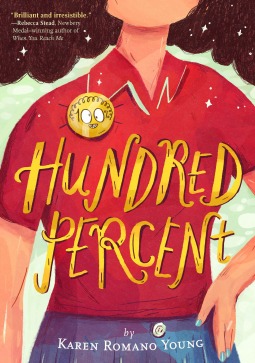
Summary: The last year of elementary school is big for every kid. Christine Gouda faces change at every turn, starting with her own nickname—Tink—which just doesn’t fit anymore. Christine navigates a year’s cringingly painful trials in normalcy—uncomfortable Halloween costumes, premature sleepover parties, crushed crushes, and changing friendships. Throughout all this, Tink learns, what you call yourself, and how you do it, has a lot to do with who you are.

This book marks beloved author Karen Romano Young’s masterful return to children’s literature: a heartbreakingly honest account of what it means to be between girl and woman, elementary and middle school, inside and out—and just what you name that in-between self.

“A lovely, lovely tale full of warmth, humor, and intelligence.”—Kirkus Reviews, starred review

“Perfectly captures the emotions of middle schoolers and their evolving friendships and familial relationships.”—School Library Journal, starred review

“Romano’s characters jump off the page in a thoughtful and realistic look at what it means to be on the precipice of adolescence.”—Publishers Weekly

“A brilliant and irresistible book about the sharp pains and joys of real life. Karen Romano Young is a writer like no other.—Rebecca Stead, Newbery Award–winning author of When You Reach Me

“Karen Romano Young must be twelve. There’s no other way she can possibly know what she knows about sixth grade in all its weirdness and glory.”—Annie Barrows, New York Times bestselling author of the Ivy & Bean series

“Karen Romano Young has an unerring feel for the shifting alliances and uncomfortable intrigues of sixth graders.” —Ellen Wittlinger, Printz Honor–winning author of Hard Love

Review: The blurbs for Hundred Percent state that the book delves into the true emotions and experiences of a sixth grader, and that it does. It actually is so realistic that it will make adults, myself included, a bit uncomfortable. Thinking back to sixth grade, it was the time where everyone was figuring out their identities: social, emotional, physical, sexual. Hundred Percent captures this. Tink is trying to figure out who her friends are, if it is worth liking boys, how to deal with changes all over the place, and so much more. I do know that there are parts of the book that some adults will be uncomfortable with their students/child reading if they are the same age as Tink. For example, there are derogatory terms used such as slut/slutty and horny skank, a lip syncing scene to “Honky Tonk Women,” and a discussion of what “sleeping together” is. Although this may be a bit uncomfortable, the more I think about the more I have come to realize that these conversations are definitely happening between 6th graders, and we can’t, as the adults in their life, pretend like they are not (though I still don’t know why the teachers let them choose “Honky Tonk Women”). With all this being said, I still think this text is for our most mature sixth graders, but those students need Tink’s story. 

Teachers’ Tools for Navigation: In addition to a classroom library book, the text could be used within the classroom during a creative writing unit. The prose of Hundred Percent is lyrical and beautifully written. Karen Romano Young is able to take the most mundane of thoughts or activities and make them sing on the page. Because of this, some parts of the story could definitely be used as a mentor text for writing.

Flagged Passages: “Tink could have cried, but instead she smiled. She was thinking about the moment when she’d held the dishpan down to the surface of the water and turned it sideways to let the lobster slosh out of it. Its clause had sprung wide open, as if it was looking for something to grab on to. The Sound was so cool and blue and clear. She hung over the water to watch the lobster sinking down into the gloom. Back where it belonged again, back home like Tink. She felt like–like crying, but also laughing, like smiling through a storm, like an ambassador of lobsters. She wondered: Does an ambassador ever forget that the foreign land he’s learned so much about isn’t the place he’s from?” p. 55

Read This If You Loved: Truth or Dare by Barbara DeeStill a Work in Progress by Jo KnowlesThe Secret Hum of Daisy by Tracy Holczer

Recommended For:

  classroomlibrarybuttonsmall

Kellee Signature

**Thank you Chronicle Books for providing a copy for review!**

Teaching Guide for Red’s Planet: A World Away From Home by Eddie Pittman

Share

reds-planet

Red’s Planet: A World Away From Home
Author and Illustrator: Eddie Pittman
Published April 19th, 2016 by Amulet Books

Summary: Red, a quirky, headstrong 10-year-old, longs to live in her own perfect paradise far away from her annoying foster family. But when a UFO mistakenly kidnaps her, Red finds herself farther away than she could have possibly imagined—across the galaxy and aboard an enormous spaceship owned by the Aquilari, an ancient creature with a taste for rare and unusual treasures. Before Red can be discovered as a stowaway, the great ship crashes on a small deserted planet, leaving her marooned with a menagerie of misfit aliens. With her newfound friend, a small gray alien named Tawee, Red must find a way to survive the hostile castaways, evade the ravenous wildlife, and contend with Goose, the planet’s grumpy, felinoid custodian. Surely this can’t be the paradise she’s looking for.

Teaching Guide: 

Pittman’s new graphic novel series will be a big hit with adventure and sci-fi lovers!

The teaching guide can also be viewed here.

Recommended For: 

classroomlibrarybuttonsmall readaloudbuttonsmall closereadinganalysisbuttonsmall litcirclesbuttonsmall

Signature

The Honest Truth by Dan Gemeinhart

Share

honest truth

The Honest Truth
Author: Dan Gemeinhart
Published: January 27, 2015 by Scholastic Press

Summary: In all the ways that matter, Mark is a normal kid. He’s got a dog named Beau and a best friend, Jessie. He likes to take photos and write haiku poems in his notebook. He dreams of climbing a mountain one day.

But in one important way, Mark is not like other kids at all. Mark is sick. The kind of sick that means hospitals. And treatments. The kind of sick some people never get better from.

So Mark runs away. He leaves home with his camera, his notebook, his dog, and a plan to reach the top of Mount Rainier–even if it’s the last thing he ever does.

The Honest Truth is a rare and extraordinary novel about big questions, small moments, and the incredible journey of the human spirit.

Ricki’s Review: In the introduction of the ARC, Dan Gemeinhart writes that this story was inspired by his friend Mark, who passed away from cancer. While the book is not about Mark, there are “smooth rocks of truth” within it. He wrote the story in hopes that Mark would enjoy reading it. With this in mind, I began the book already emotionally invested. Mark is a 12-year-old boy who has recently relapsed with cancer. He is tired of being sick, and he has set out with his dog and plans to go to Mt. Rainier to die. Much of the book is Mark’s journey to Rainier, and we slowly learn about his experiences with cancer throughout the story. Every other chapter is written by his best friend Jesse, and I found their friendship to be inspiring, particularly given the author’s introduction. This is a beautiful story that will leave a mark on readers’ hearts. I will be recommending it often.

Kellee’s Review: The Honest Truth was my first choice for my school’s faculty book club because I had only hear amazing things about it. I jumped into reading it without knowing anything about it, but by the end of the first page, I knew that all my friends who recommended it to me were right. Mark has a voice that is so full of hurt and sorrow that it jumps off the page and into your heart. The obstacles he faces and overcomes while also making his way to die alone show the strength of his character. I also was a big fan of the two points of view because it allows the reader to see what was going on at home and maybe get some more truth than what Mark was telling us (though he swears it all is the honest truth).

For our book club meeting, I tabbed up my book with passages I loved (I’ll list all the pages below), haikus that Mark wrote, and descriptions of all of the photographs he took along the way.

Teachers’ Tools for Navigation: This would make a fantastic read-aloud. It has so much to discuss! The richly realized themes would make for fantastic conversations in the classroom. I would love to hear students’ thoughts about the story, particularly in relation to the discussion questions below. There are many debatable points in the story—which makes it all the more interesting to use as a read aloud!

Additionally, The Honest Truth would be a good introduction to haiku and visual story telling since Mark writes haiku and takes photographs to help tell his story. The haiku (in chronological order) are found on pages 120, 8, 22, 78, 79, 130. The photos Mark took are explained on pages 226-227. Using these as mentor texts, students can create their own story using poetry and photography.

More discussion ideas can be found at http://www.scholastic.com/teachers/lesson-plan/honest-truth-discussion-guide.

Discussion Questions: Was Mark selfish to leave home? Do you think he should have told his parents? Do you think what he did was fair? Were his actions fair to his dog?; If you were Jesse, would you have told authorities? Was she wrong to keep a secret? Do you think Mark had the ability to make such a big decision?; How did Gemeinhart use personification to help make the setting a character (see pages 34, 124, and 196)?; How much pressure do sick children have to act like adults?; How was Mark’s journey selfish? How was is selfless?; Who called? Wesley or Jess?; Why didn’t the mom ever look at her credit card report to see the train ticket?; Were you angry at Mark? Scared? How do you think students will feel?; Is a 12-year-old old enough to decide you want to die? Is it reasonable for adults to expect a kid to keep on going through treatment after treatment?

Flagged Passage: “Dogs die. But dogs live, too. Right up until they die, they live. They live brave, beautiful lives. They protect their families. And love us. And make our lives a little brighter. And they don’t waste time being afraid of tomorrow.”

Kellee’s favorite passages can be found on page 5 (“Here’s…”), 19 (“I bit…”), 21 (“I closed…”), 46 (“I was…”), 70 (“She knew…), 82 (“I like…), 97 (“Here’s…”), 179 (“They would…”), 212 (“And then…”), 228 (“There’s more…)

Read This Book If You Loved: “To Build a Fire” by Jack London; Hatchet by Gary Paulsen; The Call of the Wild by Jack London; Wonder by R.J. Palacio, The Fault in Our Stars by John Green

Recommended For: 

classroomlibrarybuttonsmall readaloudbuttonsmall litcirclesbuttonsmall

  RickiSigand Kellee Signature

The Unlikely Hero of Room 13B by Teresa Toten

Share

the unlikely hero of room 13b

The Unlikely Hero of Room 13B
Author: Teresa Toten
Published: March 10, 2015 by Delacorte

GoodReads Summary: Deep, understated, and wise, this engaging YA novel, winner of the Governor General’s Award in Canada, is about more than the tough issue of teens dealing with obsessive-compulsive order. It also has romance, and a whodunit element that will keep readers guessing. Perfect for readers who love Eleanor & Park as well as All the Bright Places.

Adam Spencer Ross is almost fifteen, and he’s got his hands full confronting the everyday problems that come with having divorced parents and a stepsibling. Add to that his obsessive-compulsive disorder and it’s just about impossible for him to imagine ever falling in love. Adam’s life changes, however, the instant he meets Robyn Plummer: he is hopelessly, desperately drawn to her. But is it possible to have a normal relationship when your life is anything but?

Filled with moments of deep emotion and unexpected humor, The Unlikely Hero of Room 13B explores the complexities of living with OCD and offers the prospect of hope, happiness, and healing.

Review: Fourteen-year-old Adam Spencer Ross is coping with many struggles—his obsessive compulsive disorder, his mother’s troubles, and his step-brother’s reliance on him. Adam joins a support group and connects deeply with Robyn, a fellow group member. All of the group members adopt superhero alter egos, but Adam finds it difficult to hide the fact that his rituals are increasingly getting worse. Adam wonders how he can have a normal relationship amidst the chaos he feels. Emotionally-charged, raw story with complex characters.

Teachers’ Tools for Navigation: Similar to my post about Kids of AppetiteI’d love to include this book in a group of literature circle books that all reflect disability and friendship. It would be interesting for students to examine and conceptualize their definitions of normal. The ALAN Review‘s Fall 2016 issue is about (Re)Defining Normal, and many of the articles would be very useful for this very topic.

Discussion Questions: What struggles does Adam face? How do each of them impact his life?; What role does Adam’s mother play in his life? His father? Sweetie? Robin? Chuck? How do they all impact him positively and/or negatively?; How does Adam change throughout the novel?; What do the superhero personas offer the characters?; What is the role of family in the text? How may family be examined by traditionally and untraditionally within the context of the characters?

We Flagged: “I believe that I am a liar because I have to hide all the things I have to hide. It’s hard to remember where one lie ends and another begins. I believe lying that much changes you, makes you sick” (p. 12).

Read This If You Loved: Eleanor & Park by Rainbow Rowell, All the Bright Places by Jennifer Niven, The Fault in Our Stars by John Green, Not If I See You First by Eric Lindstrom

Recommended For:

litcirclesbuttonsmall classroomlibrarybuttonsmall

RickiSig