Thunderhead by Neal Shusterman

Share

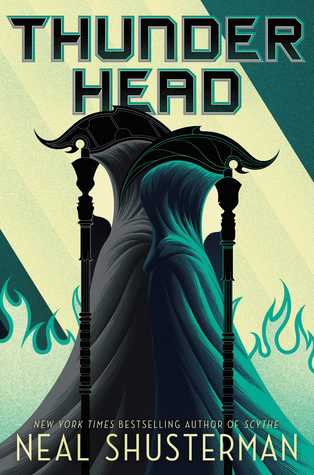
Thunderhead
Author: Neal Shusterman
Published: January 9, 2018 by Simon & Schuster

Guest Review by Natalia Sperry

Summary: Rowan and Citra take opposite stances on the morality of the Scythedom, putting them at odds, in the second novel of the chilling New York Times bestselling series from Neal Shusterman.

Rowan has gone rogue, and has taken it upon himself to put the Scythedom through a trial by fire. Literally. In the year since Winter Conclave, he has gone off-grid, and has been striking out against corrupt scythes—not only in MidMerica, but across the entire continent. He is a dark folk hero now—“Scythe Lucifer”—a vigilante taking down corrupt scythes in flames.

Citra, now a junior scythe under Scythe Curie, sees the corruption and wants to help change it from the inside out, but is thwarted at every turn, and threatened by the “new order” scythes. Realizing she cannot do this alone—or even with the help of Scythe Curie and Faraday, she does the unthinkable, and risks being “deadish” so she can communicate with the Thunderhead—the only being on earth wise enough to solve the dire problems of a perfect world. But will it help solve those problems, or simply watch as perfection goes into decline?

Review: Thunderhead packs a punch as a conceptually compelling and action-packed follow up to award-winning Scythe. While at times it moves slowly and teeters on the precarious edge of “middle book syndrome.” Its expansion of the world of the Scythdome helps the book feel more well-rounded. Despite the action, Thunderhead shines most in its explorations of democracy and the implications of AI technology.

Citra’s questioning of identity, though immediately rooted in her struggle between her civilian past and scythedom, provides a good example of identity searching for teen readers. For Citra and Rowan, the stakes are high– despite the novel’s focus on the guiding AI of the Thunderhead, the fate of the world rests not on the shoulders of the political technology or the Scythe’s government, but on the teenage protagonist’s shoulders. Though Thunderhead didn’t invent the trope of teens saving the world, in 2018 it feels all the more prevalent.

Teacher’s Tool For Navigation: As a sequel, Thunderhead will primarily be useful in addition to classroom libraries. However, in discussing the Arc of a Scythe series as a whole, Thunderhead raises interesting questions of power dynamics in politics, democracy, and the role of AI technology. If Scythe is already a text you’ve considered using in literature circles, a discussion about the themes raised in the sequel could provide an interesting supplement to the unit.

Discussion Questions:  Is the Thunderhead justified? Is the Scythedom?  In what ways is the world of the Scythes in MidMerica and beyond a dystopia or utopia?

Flagged: “You may laugh when I tell you this, but I resent my own perfection. Humans learn from their mistakes. I cannot. I make no mistakes. When it comes to making decisions, I deal only in various shades of correct.” (Chapter 4).

Read This If You Loved: Scythe by Neal Shusterman, Illuminae by Amie Kaufman, Jay Kristoff, This Savage Song by Victoria Schwab

Recommended For: 

classroomlibrarybuttonsmall 

RickiSig

Teachers’ Guide for Louisiana’s Way Home by Kate DiCamillo

Share

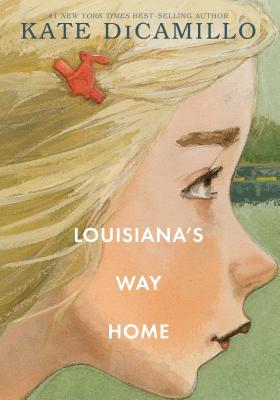
Louisiana’s Way Home
Author: Kate DiCamillo
Published: October 2nd, 2018 by Candlewick Press

Summary: From two-time Newbery Medalist Kate DiCamillo comes a story of discovering who you are — and deciding who you want to be.

When Louisiana Elefante’s granny wakes her up in the middle of the night to tell her that the day of reckoning has arrived and they have to leave home immediately, Louisiana isn’t overly worried. After all, Granny has many middle-of-the-night ideas. But this time, things are different. This time, Granny intends for them never to return. Separated from her best friends, Raymie and Beverly, Louisiana struggles to oppose the winds of fate (and Granny) and find a way home. But as Louisiana’s life becomes entwined with the lives of the people of a small Georgia town — including a surly motel owner, a walrus-like minister, and a mysterious boy with a crow on his shoulder — she starts to worry that she is destined only for good-byes. (Which could be due to the curse on Louisiana’s and Granny’s heads. But that is a story for another time.)

Called “one of DiCamillo’s most singular and arresting creations” by The New York Times Book Review, the heartbreakingly irresistible Louisiana Elefante was introduced to readers in Raymie Nightingale — and now, with humor and tenderness, Kate DiCamillo returns to tell her story.

Teachers’ Tools for Navigation and Discussion Questions: 

Please view and enjoy the teachers’ guide I created for Louisiana’s Way Home: 

You can also access the teaching guide here.

You can learn more about Louisianaon Candlewick Press’s Louisiana’s Way Home page.

Recommended For: 

readaloudbuttonsmall classroomlibrarybuttonsmall litcirclesbuttonsmall closereadinganalysisbuttonsmall

Kellee Signature

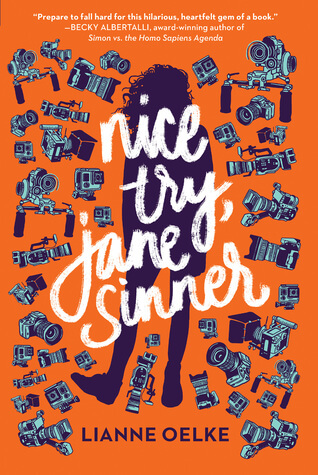
Nice Try, Jane Sinner by Lianne Oelke

Share

Nice Try, Jane Sinner
Author: Lianne Oelke
Published: January 9, 2018 by Clarion

Guest Review by Natalia Sperry

Summary: The only thing 17-year-old Jane Sinner hates more than failure is pity. After a personal crisis and her subsequent expulsion from high school, she’s going nowhere fast. Jane’s well-meaning parents push her to attend a high school completion program at the nearby Elbow River Community College, and she agrees, on one condition: she gets to move out.

Jane tackles her housing problem by signing up for House of Orange, a student-run reality show that is basically Big Brother, but for Elbow River Students. Living away from home, the chance to win a car (used, but whatever), and a campus full of people who don’t know what she did in high school… what more could she want? Okay, maybe a family that understands why she’d rather turn to Freud than Jesus to make sense of her life, but she’ll settle for fifteen minutes in the proverbial spotlight.

As House of Orange grows from a low-budget web series to a local TV show with fans and shoddy T-shirts, Jane finally has the chance to let her cynical, competitive nature thrive. She’ll use her growing fan base, and whatever Intro to Psychology can teach her, to prove to the world—or at least viewers of substandard TV—that she has what it takes to win.

Review: I’ll admit, I’m always a sucker for a strong, sarcastic, and somewhat troubled YA protagonist, and Jane Sinner did not disappoint. Nice Try, Jane Sinner is psychological and philosophical, a little crass and silly, sometimes downright strange, and always full of tremendous heart—but then, isn’t that college? It was refreshing to read an older YA: Jane is right on that cusp of “not really a teenager anymore, but definitely not a full a full-fledged adult.” As she navigates her senior year in high school, taking classes at the local community college, I felt that, even beyond its obvious and intentional quirks, Jane’s story is startlingly unique in how it captures the whirlwind of  emotions felt during that transitional time. It also offered a healthy balance of relationships, featuring Jane’s loving yet tense parents, adoring but annoying little sister, and a cast of friends too diverse to affix any one guiding set of adjectives to.

Written in diary-format, the book is told exactly as Jane wants it to be, which adds an interesting dimension of questionability to her narration. Dialogue is captured in script format, which prompts readers to question at times what’s reality and what’s for show, on House of Orange and beyond. What Jane does and doesn’t tell the narrator about her past, her genuine feelings, and her motivation leads to some interesting twists.  In particular, Jane’s “Doctor/Self” internal dialogues were really compelling. Like the eponymous Jane Sinner herself, however, the book at times deflects the greater thematic issues at hand through its sarcasm and humor. Jane’s story revolves around a personal crisis—one that I wish the book would have delved in deeper to by the end. I did enjoy Jane’s exploration of religion and the expectations young people are sometimes held to, which is a topic I’ve yet to see be fully explored in YA.

For all its quirks and flaws, Jane Sinner has a heart of gold. It conjures up all the emotions of a teen on the brink of “adulthood,” while still maintaining a sarcastic yet thoughtful spark throughout. It’s refreshing to remember that being a young adult doesn’t end at high school, and life doesn’t have to either.

Teacher’s Tool For Navigation: I’ll admit, I’m always a sucker for a strong, sarcastic, and somewhat troubled YA protagonist, and Jane Sinner did not disappoint. Nice Try, Jane Sinner is psychological and philosophical, a little crass and silly, sometimes downright strange, and always full of tremendous heart — but then, isn’t that college? It was refreshing to read an older YA: Jane is right on that cusp of “not really a teenager anymore, but definitely not a full a full-fledged adult.” As she navigates her senior year in high school, taking classes at the local community college, I felt that, even beyond its obvious and intentional quirks, Jane’s story is startlingly unique in how it captures the whirlwind of  emotions felt during that transitional time. It also offered a healthy balance of relationships, featuring Jane’s loving yet tense parents, adoring but annoying little sister, and a cast of friends too diverse to affix any one guiding set of adjectives to.

Written in diary-format, the book is told exactly as Jane wants it to be, which adds an interesting dimension of questionability to her narration. Dialogue is captured in script format, which prompts readers to question at times what’s reality and what’s for show, on House of Orange and beyond. What Jane does and doesn’t tell the narrator about her past, her genuine feelings, and her motivation leads to some interesting twists.  In particular, Jane’s “Doctor/Self” internal dialogues were really compelling. Like the eponymous Jane Sinner herself, however, the book at times deflects the greater thematic issues at hand through its sarcasm and humor. Jane’s story revolves around a personal crisis–one that I wish the book would have delved in deeper to by the end. I did enjoy Jane’s exploration of religion and the expectations young people are sometimes held to, which is a topic I’ve yet to see be fully explored in YA.

For all its quirks and flaws, Jane Sinner has a heart of gold. It conjures up all the emotions of a teen on the brink of “adulthood,” while still maintaining a sarcastic yet thoughtful spark throughout. It’s refreshing to remember that being a young adult doesn’t end at high school, and life doesn’t have to either.

Discussion Questions:  Even in the context of the book, Jane is quite the controversial character to those around her — did you “like” Jane? How might this shape your perception of the book as a reader? Does “likability” matter in protagonists? Think about if Jane was gender-swapped: would this change how we view some of her more questionable decisions or characteristics?

Flagged: “I need to psychoanalyze myself for Intro Psych. I’m not sure how that’s possible; the prof was rather vague on the specifics in class today. I was also caught up in a doodle of my hand. I outlined my hand on my notes because the notes were ugly and otherwise useless. I layered the inside with different-colored gel pens until the outline was fairly thick. In the middle of the hand I drew toasters and toast. The whole thing came together really well. One of my better efforts. But I’m not sure how to psychoanalyze myself. I suppose I’ll have to be both the doctor and patient. Maybe the two of me can come up with some profoundly insightful insight.

A middle-aged man with thinning brown hair and a cozy sweater vest motions for Jane to lie down on the sofa. He takes a seat on the overstuffed leather armchair and crosses his legs like a girl.

THE DOCTOR

Hello, Ms. Sinner.

JS

                          Hi.” (Page 46-47).

Read This If You Loved: Anything by John Green (Turtles All the Way Down in particular),  Highly Illogical Behavior by John Corey Whaley, Fangirl by Rainbow Rowell, The Hunger Games by Suzanne Collins

Recommended For: 

classroomlibrarybuttonsmall 

RickiSig

The Forest Queen by Betsy Cornwell

Share

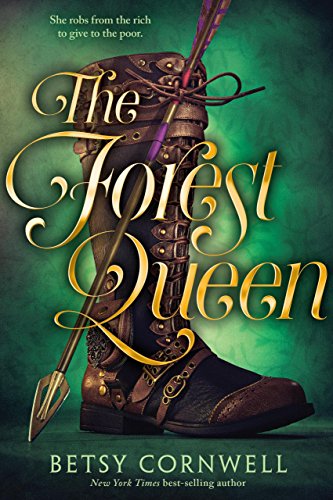
The Forest Queen
Author: Betsy Cornwell
Published: August 7, 2018 by Houghton Mifflin Harcourt

Guest Review by Rachel Krieger

Summary: When sixteen-year-old Sylvie’s brother takes over management of their family’s vast estates, Sylvie feels powerless to stop his abuse of the local commoners. Her dearest friend asks her to run away to the woods with him, and soon a host of other villagers join them. Together, they form their own community and fight to right the wrongs perpetrated by the king and his noblemen.

Review: Anyone familiar with the tale of Robin Hood likes the idea of stealing from the rich and giving to the poor. Betsy Cornwell’s twist on this idea changes it just enough to give the story some flavor and novelty. The characters were compelling and the relationships were truly touching, but everything felt a little too convenient to me. There were several times when characters all but died and ended up making it out without a scrape. In a world where all of the favorable characters are on the lamb, there was a fair amount of luck and inaction that saved nearly every one of them. As a gender bent twist on a fairytale and a lively retelling of an old story, this novel had merit, but there wasn’t quite enough to it to call it a masterpiece.

However, as far as representation goes, Betsy Cornwell hit it on the head. The Forest Queen, as the title lets on, has a female leading things. The role of Robin Hood was usurped by a woman and amplified by the fact that the woman is stealing from her own family to give to the poor. The other females in the novel show strength in the face of things like rape and a shocking lack of agency. There are even LGBTQ characters that add to the sense that women in this world are the epitome of overcoming their circumstances.

Teacher’s Tool For Navigation:This novel is a great outlet in which to discuss rape culture. Although it is not the most prominent part of the story, it plays a part and is represented in an ideal way in relation to discussion. Because this subject is extremely difficult to discuss in general, let alone in a classroom, talking about it within the realm of this fantastical society may make it a bit easier. It would be interesting to reflect upon the similarities between the culture in the novel and our own culture in this society. It is so incredibly important to discuss difficult subjects in the classroom, but when it is in reference to a novel like The Forest Queen, it can be looked at in a more academic way.

Discussion Questions: 

  • Did Sylvie have a right to encourage the village people to rebel against her brother?
  • What do the ties to the story of Robin Hood do for this novel?
  • How do women take power in this story and how does that differ from classic fantasy?

Read This If You Loved: Cinder by Marissa Meyer, Six of Crows by Leigh Bardugo, Shadow and Bone by Leigh Bardugo, The Paper Magician by Charlie N. Holmberg

Recommended For: 

classroomlibrarybuttonsmall 

RickiSig

Blog Tour with Review, Educators’ Guide, and Giveaway!: Finding Orion by John David Anderson

Share

The Lost Girl
Author: Anne Ursu
Published February 12th, 2019 by Walden Pond Press

Summary: Sometimes you need to lose something in order to find yourself.

Beloved author John David Anderson returns with a heartwarming, heartbreaking and unforgettable story of the true power and limits of family.

    Ron Kwirk comes from a rather odd family. His mother named him and his sisters after her favorite constellations, and his father makes funky-flavored jelly beans for a living. One sister acts as if she’s always onstage, and the other is a walking dictionary. But no one in the family is more odd than Rion’s grandfather, Papa Kwirk.

    He’s the kind of guy who shows up on his motorcycle only on holidays, handing out crossbows and stuffed squirrels as presents. Rion has always been fascinated by Papa Kwirk, especially since his son—Rion’s father—is the complete opposite. Where Dad is predictable, nerdy, and reassuringly boring, Papa Kwirk is mysterious, dangerous, and cool.

    Which is why, when Rion and his family learn of Papa Kwirk’s death and pile into the car to attend his funeral and pay their respects, Rion can’t help but fell that that’s not the end of the story. That there’s so much more to Papa Kwirk to discover.

    He doesn’t know how right he is.

About the Author:John David Anderson is the author of some of the most beloved and highly acclaimed books for kids in recent memory, including the New York Times Notable Book Ms. Bixby’s Last Day, Posted, Granted, Sidekicked, and The Dungeoneers. A dedicated root beer connoisseur and chocolate fiend, he lives with his wonderful wife and two frawsome kids in Indianapolis, Indiana. He’s never eaten seven scoops of ice cream in a single sitting, but he thinks it sounds like a terrific idea. You can visit him online at www.johndavidanderson.org.

Praise: 

“Readers will be happily swept along by Rion’s first-person narration, which is often amusing, sometimes bemused, and occasionally even tender as he shows how his family was unwittingly drawn together by their shared experience. Anderson offers another original novel written with wit and compassion.” – Booklist

“Humor, plot twists, and quirky characters abound in this earnest middle grade tale of self-discovery.” – School Library Journal

“Eccentric yet believable characters and Rion’s perceptive narration prevent Anderson’s unpredictable tale from feeling overwrought as the relationships between three generations of fathers and sons are rewritten anew.” – Publisher’s Weekly

Review: The characters’ last name says it all: Kwirk. This book is full of quirks. I found the beginning so funny that I had to read it out loud to my son and husband while we were driving, and that was literally and figuratively just the beginning. I have read all but one of Anderson’s books, and reading Finding Orion reminded me again why I enjoy his writing so much: that Anderson does so brilliantly, when he tackles humor, is that he can combine a serious topic (death) with humor and it doesn’t seem far fetched or cheap. It seems perfect. 

The cast of characters, though over the top at times, added so much to the story. They are extravagant, a bit weird, and very entertaining. While Rion sometimes found himself just along for the ride, the other characters took the wheel and drove us through the story.

Another winning book for Anderson that I cannot wait to share with my students.

Educators’ Guide: 

Discussion Questions: 

  • When was a time that you felt like an outcast in your family?
  • What jelly bean flavor would you want to try? Would never try?
  • How did Papa Kwirk’s personality affect how different his son is?
  • Rion and his sisters are more alike than he wants to admit. Create only a comparison chart showing how they are alike with text evidence to support it.
  • How did the fun-neral change Rion’s perspective on his grandfather?
  • How did learning about the whole other life his grandfather have affect Rion?
  • What roles did the animals play in the story?
  • How is the author’s ability to create quirky characters change the trajectory of the story?

Flagged Passages: Read an excerpt here! It is the first few pages that had me actually laughing out loud while reading it.

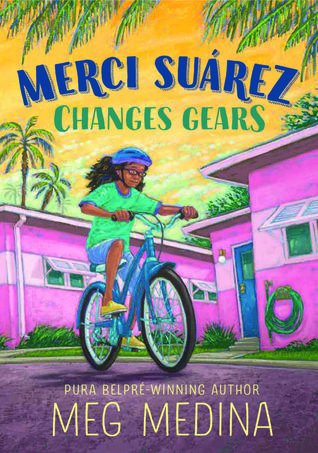
Read This If You Love: The Schwa Was Here by Neal Shusterman, Merci Suarez Changes Gears by Meg Medina, Just Like Jackie by Lindsey Stoddard, Death and Douglas by JW Ockler, Ms. Bixby’s Last Day by John David Anderson

Recommended For: 

classroomlibrarybuttonsmall 

Giveaway!

a Rafflecopter giveaway

Don’t miss out on the other stops in the blog tour!

Blog Tour May 6-14, 2019

May 6 Nerdy Book Club
May 7 Bluestocking Thinking
May 8 The Book Monsters
May 9 Maria’s Melange
May 13 This Kid Reviews Books
May 14 Kirsti Call

Signature

**Thank you to Walden Pond Press for providing a copy for review and giveaway!**

Blog Tour with Reviews and Giveaway!: We Are (Not) Friends by Anna Kang and Christopher Weyant

Share

We Are (Not) Friends
Author: Anna Kang
Illustrator: Christopher Weyant
Published May 1st, 2019 by Two Lions

Summary: Two fuzzy friends are having a fun playdate when a new pal hops in. As the day continues, each friend feels left out at times. It isn’t so easy to figure out how to act when everything seems to change. With humor and heart, the beloved characters from Theodor Seuss Geisel Award winner You Are (Not) Small navigate a friendship triangle as only they can.

About the Creators: Anna Kang and Christopher Weyant are the creators of Theodor Seuss Geisel Award winner You Are (Not) Small as well as series titles That’s (Not) Mine, I Am (Not) Scared, and We Are (Not) Friends. They also wrote and illustrated Eraser, which was recently honored with The Christopher Award, Can I Tell You a Secret?, and Will You Help Me Fall Asleep? Christopher’s work can also be seen in The New Yorker, and his cartoons are syndicated worldwide. This husband-and-wife team lives in New Jersey with their two daughters and their rescue dog. Visit them at www.annakang.com and www.christopherweyant.com.

Twitter: @annakang27 @christophweyant
Instagram: annakangbooks; christopherweyant
Facebook: Anna Kang – Author; Christopher Weyant

Praise for You Are (Not) Small:

Winner of the 2015 Theodore Seuss Geisel Award
ALA Notable Children’s Book
Parents’ Choice Awards Silver Honor
NPR Best Books of 2014

Kellee’s Review: When I first read this series to my son, he had a hard time because so much of it has to do with reading facial expressions and understanding dialogue; however, now that he is five (vs. three), this series is a favorite! The conversations we have around the two aspects that made this book better for a pre-k kid instead of a preschooler are phenomenal. And although I loved the series as a reader when I first was introduced, now as a mom I appreciate it so much more. The newest one is definitely a perfect one to read with someone Trent’s age as it is about playing nice, sharing friends and toys, and just overall being a kind person. 

Ricki’s Review: I absolutely love this series, and my kids love it, too. I have gifted a few copies of the books to friends with young kids. The messages are wonderful, and they allow for discussions about important topics in age-appropriate ways. For instance, when I was reading it to my two-year-old, I pointed to the picture of the character who was sad and asked questions like, “How does he feel? Why does he feel sad? Have you ever felt sad? Have you ever felt left out? What do you do when you see a friend who is sad?” I particularly liked this book because it focuses on issues of friendship. Sometimes, kids feel like they need to claim other kids as their best friends, and this makes other kids feel left out. Also, sometimes, kids get excluded from play. This is an issue I see in both my two-year-old’s and five-year-old’s classes. The book is accessible for kids of many ages, and the lessons are important. If you haven’t read the books in this series, I recommend them highly!

Teachers’ Tools for Navigation: Read this series with kids! Read it to them, discuss it with them, let them navigate it on their own, and let them love it. Each book has a different lesson without being didactic. And they are just so much fun and have fantastic illustrations!

Discussion Questions: 

  • How does ____ feel? How can you tell?
  • Why do you think ____ feels this way?
  • What could ____ have done to make the situation different?
  • How is what happened in the book like something in your life?

Flagged Passages: 

Read This If You Love: Anything by the Kang and Weyant team

Recommended For: 

classroomlibrarybuttonsmall 

Giveaway!

a Rafflecopter giveaway

Signatureand

**Thank you to Blue Slip Media and Two Lions for copies for review and giveaway!!**

Picture Us in the Light by Kelly Loy Gilbert

Share

Picture Us in the Light
Author: Kelly Loy Gilbert
Published: April 10, 2018 by Disney-Hyperion

Guest Review by Rachel Krieger

Summary: Danny has been an artist for as long as he can remember, and it seems his path is set, with a scholarship to RISD and his family’s blessing to pursue the career he’s always dreamed of. Still, contemplating a future without his best friend, Harry Wong, by his side makes Danny feel a panic he can barely put into words. Harry and Danny’s lives are deeply intertwined and as they approach the one-year anniversary of a tragedy that shook their friend group to its core, Danny can’t stop asking himself if Harry is truly in love with his girlfriend, Regina Chan.

When Danny digs deeper into his parents’ past, he uncovers a secret that disturbs the foundations of his family history and the carefully constructed facade his parents have maintained begins to crumble. With everything he loves in danger of being stripped away, Danny must face the ghosts of the past in order to build a future that belongs to him.

Review: This book is filled to the brim with interesting plot points. While most novels would focus on one to two major things that are going on in a character’s life, this one has several. I found this to be both engaging and chaotic. Some of the time I felt that if Danny was a real person, he would simply explode during the course of events in the book. Danny was dealing with things well beyond what most people his age experience and manages to mostly keep it together despite. There are entire novels that deal with immigration, adoption, death of a loved one, suicide, sexual orientation, poverty, college preparedness, or love, but this one contains all of these ideas, among others. Though it felt like too much at times, this became one of the great aspects of the novel as well.

Throughout the story, Danny struggles with his morality at the same time as struggling with everything that life is dragging him through. Even though he is dealing with more than any human should have to, he still has time to feel the things that remind the reader that he is a person. So many of Danny’s feelings are perfectly reflective of what I and many others feel at points in life. The best part is that no matter who you are or what you have been through, you can connect with one of the topics addressed in this book. Gilbert’s inclusion of so many salient issues substantially increases the relatability.

Teacher’s Tool For Navigation: There are so many great things to talk about in the classroom in relation to this book. Although most reviews look at this novel as an exploration of sexuality, there are several other lenses with which to look through to spur great discussion. The issue that comes to mind first and foremost is immigration and the effect that it can have on a family and especially children in a family. Although Danny himself never went through the process of immigration, his parents did, and this has a huge effect on their family. Through the normal ups and downs of the life of a high schooler, Danny also discovers many things throughout the story that are connected to his family’s immigration and it only adds to his strife.

Many young students know little to nothing about the process of immigration—having never immigrated themselves—and Picture Us in the Light can do a lot to change that. It would be such a beneficial discussion to address the immigration experience that this family has and to even talk about the danger of a single story: that no family or persons story of immigration is exactly alike. It could also be interesting to teach this book alongside a classic tale of immigration such as Upton Sinclair’s The Jungle. There is a lot of material that can be taken from this book and I can see it being a very helpful tool in the classroom for discussing pertinent issues.

Discussion Questions: 

  • Is this novel hypercritical of students dealing with the suicide of a peer?
  • Does this novel reaffirm too many stereotypes?
  • How does this novel do well in talking about the exploration of sexuality?
  • How does it do poorly?
  • Do you believe Danny was as immoral a person as he thought he was?
  • What do the second person, in-between chapter bits do for the story?

We Flagged: “But in that instant, the one where you saw that flash of recognition strike him like lightning, you felt what you came here to see if you’d feel: the same strike at the same time, an atomic pull you can’t explain.”

Read This If You Loved: Aristotle and Dante Discover the Secrets of the Universe by Benjamin Alire Sáenz, I’ll Give You the Sun by Jandy Nelson, Simon Vs. The Homo Sapiens Agenda by Becky Albertalli, American Street by Ibi Zoboi, It’s Kind of a Funny Story by Ned Vizzini, Thirteen Reasons Why by Jay Asher

Recommended For: 

classroomlibrarybuttonsmall 

RickiSig