The Salem Witch Trials: An Unsolved Mystery from History by Jane Yolen & Heidi Elisabet Yolen Stemple

Share

NF PB 2013

Nonfiction Picture Book Wednesday

Nonfiction Picture Book Wednesday is hosted by Kid Lit Frenzy and was started to help promote the reading of nonfiction texts. Most Wednesdays, we will be participating and will review a nonfiction text (though it may not always be a picture book).
Be sure to visit Kid Lit Frenzy and see what other nonfiction books are shared this week!
salem

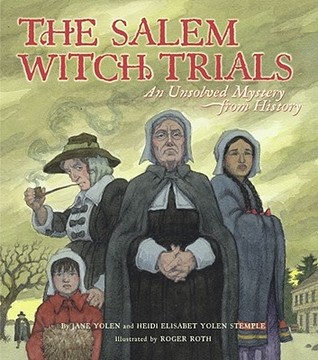
The Salem Witch Trials: An Unsolved Mystery from History
Authors: Jane Yolen & Heidi Elisabet Yolen Stemple
Illustrated by: Roger Roth
Published September 7th, 2004 by Simon & Schuster Books for Young Readers

Goodreads Summary: In 1692 Salem, Massachusetts, witnessed one of the saddest and most inexplicable chapters in American history. When a group of girls came down with a horrible, mysterious bout of illness, the town doctor looked in his medical books but failed to find a reasonable diagnosis. Pretty soon everyone in town was saying the same thing: The girls were ill because they were under a spell, the spell of witchcraft! And still, the question remains: Why did the hysteria occur? The townspeople had many things to worry about back then: smallpox, strife with the local Indians, a preacher demanding higher wages, and the division of land in the community. But did all of those problems justify a witch hunt?

Become a detective as you read this true story, study the clues, and try to understand the hysteria! The Unsolved Mystery from History series is written by acclaimed author Jane Yolen and former private investigator Heidi Elisabet Yolen Stemple. This is an innovative history lesson that’s sure to keep kids thinking throughout.

Review: The mystery of the Salem Witch Trials is one that has haunted the United States for over 3oo years now and is one that students love to read about (and I do, too!). Most of my thoughts about this book are about how awesome this book is for the classroom. The Yolens seemed to have written it specifically for teachers to use.

Teacher’s Tools For Navigation: This book promotes studying history, inquiry, and vocabulary. The book begins with an introduction to a young girl who enjoys unsolved mysteries from history and then the book is set up like her case notebook. Each page of the case notebook includes a narrative nonfiction section about what was going on in Salem, an informational nonfiction section where facts about the story are explained even more in detail, and then there are vocabulary words from the two sections defined for the reader. Finally, in the back of the book the different theories about what could be the answer to the unsolved mystery are shared and briefly discussed. The set up of this book leads to infinite possibilities of being used in the classroom. Students could debate, write research papers, could do their very own case notebook about a different mystery, etc. Another option is to get all of the Unsolved Mystery from History books and have students get into lit circle groups and have each group read a different mystery then research and share.

Discussion Questions: What do you think happened in Salem? [Could be a wonderful debate or cooperative research presentation/paper in class. Have each students, after reading the different theories, decide which they believe is true. Then within their groups come up with evidence that supports the theory that they believe in.]

We Flagged: Narrative Nonfiction Section: One bitterly cold day in February, Betty and Abigail both fell ill, collapsing onto their small rope beds. They convulsed. They contorted. Their arms and legs jerked about. They shouted bizarre, unintelligible words. They crouched under chairs and cowered as if frightened. In other houses in Salem Village several of their friends began to act the same way.

Informational Nonfiction Section: The other sick girls in Salem village included Ann Punam Jr. (age 12), Mercy Lewis (age 19), Mary Walcott (age 16), Elizabeth Hubbard (age 17), and Mary Warren (age 20). Like Abigail, Elizabeth and Mercy were orphans; Mercy may have witnessed her parents being killed in an Indian attack three years earlier in Main. Mary Walcott had lost her mother when she was eight. Ann and Betty were daughters of landowners, but Marry Warren, Elizabeth, and Mercy were maidservants.

Vocabulary: Convulsed: shook violently, Contorted: Twisted into unusual shapes, Unintelligible: Impossible to understand” (p. 12-13)

Read This If You Loved: I Walk in Dread by Lisa Rowe Fraustino, The Sacrifice by Kathleen Benner Duble, Witch Child by Celia Rees, The Witch of Blackbird Pond by Elizabeth George Speare, Witches: The Absolutely True Tale of Disaster in Salem by Rosalyn Schanzer and other nonfiction books about Salem

Recommended For: 

closereadinganalysisbuttonsmall readaloudbuttonsmall

classroomlibrarybuttonsmall litcirclesbuttonsmall

Signature

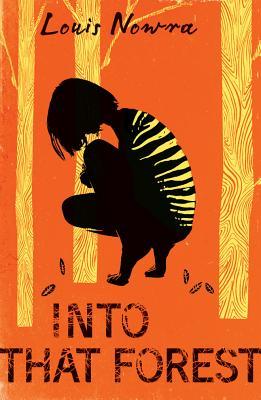
Into That Forest by Louis Nowra

Share

17870105
Title: Into That Forest
Author: Louis Nowra
Expected Publication: September 3th, 2013 by Amazon Children’s Publishing

Summary: Hannah and Becky are traveling down a river in Tasmania, Australia with Hannah’s parents when a storm erupts. Their boat overturns, and Hannah and Becky are left to survive in the wild. Two Tasmanian tigers are nearby, and because they’ve recently lost their pups, the tigers adopt Hannah and Becky as their own children. The two girls slowly adapt to the tigers’ ways, adopting their habits and forgetting words. It isn’t long before they become feral children, acting only as animals would.

Review: I have never read a book quite like this one. When I tried to compare it to other books I’ve read, I immediately thought of Endangered (Eliot Schrefer), which describes bonobos rather than tigers. With both books, I developed a fondness for the animals and their habits. Also, they both roped me into their beautiful settings and imagery. The only other books I could compare this to were those about abuse and neglect, as the children slowly developed animalistic ways, as abandoned children do.

The language is a bit peculiar at first, as Hannah is writing the story as an elderly woman, and she admits her language isn’t very good. I found myself slipping into the beautiful wording by the third or fourth page, and I didn’t find that it distracted my reading, and instead, it added to the experience. If I could change anything, I might alter the ending a bit, but perhaps, I am being too particular. I loved learning about the tigers’ lifestyle, and I was hooked to this survival story from the very first page. The sisterly bond that develops between Hannah and Becky is remarkable, and the story teaches themes of loyalty and companionship. Readers will be left pondering humanity and the differences between animals and humans.

Teacher’s Tools for Navigation: Students may find the language to be a bit difficult to understand at first, so the teacher may need to provide some close readings at first. I suspect most students quickly adjust to the language and will no longer be distracted by the wording after the first few pages, and they will likely find that it adds a lot of color to the text. Teachers could have students select their favorite descriptions of the setting and imagery, as these elements are very well-developed and would serve as a great model for students. Upon completion of the text, students might research topics like Tasmania, feral children, and tigers. I was left wanting to learn more about the Tasmanian wilderness and lifestyle, and I imagine that students will also find this book to pique their curiosity.

Discussion Questions: What does it mean to be human? How do the girls lose their humanity?; What are some of the patterns of the tigers’ behavior that the girls adopt? Why is this necessary?; How do you imagine Hannah’s life today? How has this experience changed her?

We Flagged: “As the water boiled and foamed, we bounced along with me father, unable to steer the boat toward the shore. The river were so wild that all we could do were to cling on tight to the sides of the boat or each other as we were flung back and forward like puppets with no strings. The rain chucked down and we were soaked, so soggy it were like the rain were drilling through our skin into our marrow.”

“The more I looked at its black eyes, the more I seen kindness […] I knew it were saying to us, Come, I’ll take you home.”

Please note: The above quotes are from the Advanced Reader Copy. The e-book (a galley) did not provide page or chapter numbers. The quotes may change when the book is published.

Read This If You Loved: Endangered by Eliot Schrefer, Never Fall Down by Patricia McCormick, Dog Boy by Eva Hornung, Second Nature by Alice Hoffman, Into the Wild by Jon Krakauer

Recommended For:

readaloudbuttonsmall litcirclesbuttonsmall closereadinganalysisbuttonsmall classroomlibrarybuttonsmall

026F3FBCC8C3913BD3A4D3F6920340D5

Thank you to NetGalley and Amazon Children’s Publishing for sending me the Advanced Reader Copy!

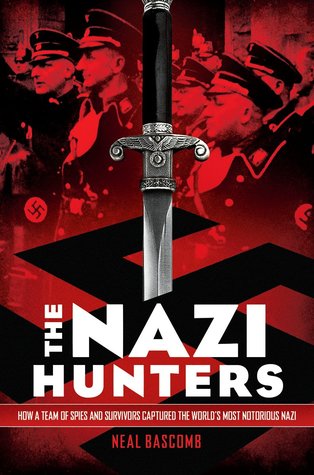
The Nazi Hunters by Neal Bascomb

Share

17168240

The Nazi Hunters: How a Team of Spies and Survivors Captured the World’s Most Notorious Nazi
Author: Neal Bascomb
Expected Publication: August 27th, 2013 by Arthur A. Levine

Summary: Adolf Eichmann was one of the world’s most notorious Nazis as the head of operations for the Nazis’ Final Solution. Essentially, he organized the transportation of the Jewish people to ghettos and concentration camps. This work of narrative nonfiction begins with the background of Eichmann’s role in the genocide. Then, in 1945, Eichmann disappeared from Germany and went into hiding. Due to the bravery of more than a dozen individuals, Eichmann is captured and put on trial for the world to view.

Review: This is an excellently researched work of nonfiction. I was amazed at the number of intricate details that went into the investigation and capture of this criminal. Neal Bascomb (who is also the author of Hunting Eichmann, the adult-marketed version of this book) was extraordinarily honest in this text. At times, I had to slap myself when I felt pity for Eichmann, as I tend to be too empathetic in my search for humanity in murderers. Bascomb doesn’t glorify the details—his account is genuine and based on numerous interviews of individuals who were connected to this hunt. I find that, in general, I become a bit disengaged when I read nonfiction, but this book kept me hooked; I wanted to read more about the courage and bravery of the Nazi Hunters. I highly recommend this text for all readers.

Teacher’s Tools for Navigation: Nonfiction is, arguably, absent from many classrooms. English curricula tend to focus more on fiction, and I am interested to see if the Common Core will truly shift this reality (err, as much as the creators think it will, anyways). This text bridges the gap between fiction and nonfiction because it is written in narrative form. For students who despise nonfiction texts, this book will have appeal because Bascomb weaves in great characterization and detail. Teachers who enjoy employing literature circles in their classrooms might consider a nonfiction focus for the circles, and this book would make for a fantastic choice for students. Alternatively, it would pair very well with other texts from the Holocaust, such as Night by Elie Wiesel. When I finished reading this book, I couldn’t help but scour the internet for more details about other Nazi criminals and their captures/trials. I imagine that students will feel this same curiosity after reading this text, so I envision it would work well at the center of a research project.

Discussion Questions: Was Eichmann just following orders or is he a murderer? At what point does the excuse of “I was just following orders” become baseless and unreasonable?; Does Eichmann give up? Do you see him as a strong individual by the end of the text?; Do you think Eichmann’s wife was truly ignorant to his crimes? Do you think she should have turned him in?; How do Eichmann’s children’s views reflect on his character and views?

We Flagged: “‘For the first time in history the Jews will judge their assassins, and for the first time the world will hear the full story of the edict of annihilation against an entire people'” (Chapter 10).

Please note: The above quotes are from the Advanced Reader Copy. The e-book (a galley) did not provide page numbers. The quotes may change when the book is published.

Read This If You Loved: Night by Elie Wiesel, Hunting Eichmann by Neal Bascomb, Nuremberg: Infamy on Trial by Joseph E. Persco, books in the The Real Justice seres, or other works of nonfiction that concern WWII, Crime, Police Investigation, War, and Justice

Recommended For:

litcirclesbuttonsmall classroomlibrarybuttonsmall

026F3FBCC8C3913BD3A4D3F6920340D5

Thank you to NetGalley and Arthur A. Levine books for sending me the Advanced Reader Copy!

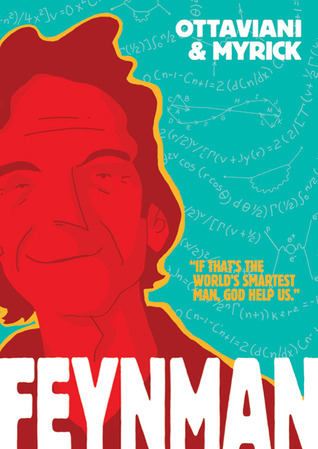
Feynman by Jim Ottaviani

Share

9844623

Feynman
Author: Jim Ottaviani
Art by: Leland Myrick
Coloring by: Hilary Sycamore
Published August 30th, 2011 by First Second

Goodreads Summary: Richard Feynman: physicist . . . Nobel winner . . . bestselling author . . . safe-cracker. In this substantial graphic novel biography, First Second presents the larger-than-life exploits of Nobel-winning quantum physicist, adventurer, musician, world-class raconteur, and one of the greatest minds of the twentieth century: Richard Feynman. Written by nonfiction comics mainstay Jim Ottaviani and brilliantly illustrated by First Second author Leland Myrick, Feynman tells the story of the great man’s life from his childhood in Long Island to his work on the Manhattan Project and the Challenger disaster. Ottaviani tackles the bad with the good, leaving the reader delighted by Feynman’s exuberant life and staggered at the loss humanity suffered with his death. Anyone who ever wanted to know more about Richard P. Feynman, quantum electrodynamics, the fine art of the bongo drums, the outrageously obscure nation of Tuva, or the development and popularization of the field of physics in the United States need look no further than this rich and joyful work.

Review: This book definitely showed me that I have HUGE gaps in knowledge in history, science, and math. Reading this book was so challenging for me – probably one of the hardest books I’ve read in a very, very long time. It took me 10 days because most days I didn’t read much because I’d find myself rereading or going online to research or just overwhelmed by the little bit I read. Makes me feel for our struggling readers who are given text that are too hard for them and not given scaffolding. If anyone ever tells you that graphic novels are not complex or challenging texts, hand them this book.

Now, all of this is saying things about myself, not about the book. The book itself was fascinating. I learned so much! I’ll be honest. Physics is still so over my head and most of the physics stuff talked about in the book (and that I researched) just didn’t make sense to me; however, this book also includes a great story of Feynman’s life and history about the atomic bomb, NASA, and the Nobel Prize. All of which I did truly enjoy and learn something from. It was also quite funny at times- Feynman was a character!

Teacher’s Tools for Navigation: I cannot wait to show this text to the physical science teachers at my school. It is a great text to show content area teachers that there are wonderful texts out there that can be used in the classroom. This book then can expand to even more instruction on Feynman and all of his physics. You can even view Feynman’s lectures online!!

Discussion Questions: When Feynman was working on the atomic bomb, some of his colleagues felt that it was a devastating invention while others continued working on it without thinking of the destruction it would cause. How do you feel about the construction of the atomic bomb? Were the use/construction of them justified?; After watching one of Feynman’s lectures, why was he better at explaining physics than other lecturers?

We Flagged: “But then a miracle occurred. And it’s occurred again and again in my life, and it’s very lucky for me. The moment I start to think about physics and concentrate on what I’m explaining, I’m completely immune to being nervous. No worries about the audience and the personalities. I was calm, everything was good. My talk wasn’t good because I wasn’t used to giving lectures, but there was no nervousness until I sat down. Einstein appreciated that things might be different from his famous theory of relativity – very nice, and very interesting. Pauli had more objections, but Wheeler kept his promise and answered all of them.” (p. 48-49)

Read This If You Loved: Surely Your Joking, Mr. Feynman! and other books by Richard P. Feynman On a Beam of Light by Jennifer Berne, Who Was Albert Einstein? by Jess M. Brallier, Nonfiction physics books

Recommended For: 

classroomlibrarybuttonsmall closereadinganalysisbuttonsmall

Signature

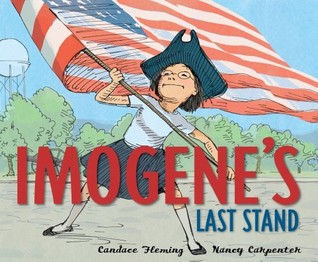
Imogene’s Last Stand by Candace Fleming

Share

6399414

Imogene’s Last Stand
Author: Candace Fleming
Illustrator: Nancy Carpenter
Published October 13th, 2009 by Schwartz & Wade

Goodreads Summary: Meet Imogene, a plucky heroine with a passion for history.

As a baby, Imogene’s first words were “Four score and seven years ago.” In preschool, she fingerpainted a map of the Oregon Trail. So it’s not surprising that when the mayor wants to tear down the long-neglected Liddleton Historical Society to make room for a shoelace factory, Imogene is desperate to convince the town how important its history is. But even though she rides through the streets in her Paul Revere costume shouting, “The bulldozers are coming, the bulldozers are coming!” the townspeople won’t budge. What’s a history-loving kid to do?

Filled with quotes from history’s biggest players—not to mention mini-bios on the endpapers—and lots of humor, here’s the perfect book for budding historians.

Review: Imogene is awesome! Her whole life she has loved history and has promoted history. History is her passion. When she finds out that the Liddleville Historical Center is up for demolition, she does everything in her power to save the history center. This, in a nutshell, is what makes her awesome: she is intelligent, passionate, and willing to stand up for her passion. Because of this, and the history allusions throughout the book, make this such an excellent book to use in classrooms. Imogene is such a great role model for any child.

The history aspects of this book were done so cleverly. Throughout Imogene’s story, she uses famous historical quotes to express how she feels at certain points. For example, when she was trying to get others to stop the bulldozing of the historical center dressed in her Paul Revere costume, she rode around Main Street (on her stick horse) yelling, “The bulldozers are coming! The bulldozers are coming!” These clever quotes are throughout the book. Then in the back and front end sheets Imogene’s historical tidbits are shared explaining all of the quotes.

Teacher’s Tools for Navigation: Like I said in the review, this book is a great for promoting history, intelligence, and passion. Like many of the amazing picture books I’ve been reading lately, it also promotes inquiry because it makes history interesting and fun.

Discussion Questions: What is a historical landmark in your city? Find out about what made it a landmark.; Imogene is passionate about history. What are you passionate about? Share the essentials of your passion.

We Flagged: “Imogene loved history. When she was a baby, her first words were “Four score and seven years ago.” As a preschooler, she finger-painted an accurate map of the Oregon Trail. And as a kindergartner, she used her show-and-tell time to give a series of lectures on important woman in history.” (p. 6)

To see a preview of the illustrations, visit Amazon’s “Look Inside” for Imogene’s Last Stand.

Read This If You Loved: Abe Lincoln’s Dream and John, Paul, George, & Ben by Lane Smith, Of Thee I Sing by Barack Obama,  Looking at Lincoln by Maira Kalman, Nonfiction books about the historical figures mentioned

Recommended For: 

readaloudbuttonsmall classroomlibrarybuttonsmall

Signature

Brave Girl by Michelle Markel

Share

NF PB 2013

Nonfiction Picture Book Wednesday

Nonfiction Picture Book Wednesday is hosted by Kid Lit Frenzy and was started to help promote the reading of nonfiction texts. Most Wednesdays, we will be participating and will review a nonfiction text (though it may not always be a picture book).
Be sure to visit Kid Lit Frenzy and see what other nonfiction books are shared this week!

brave

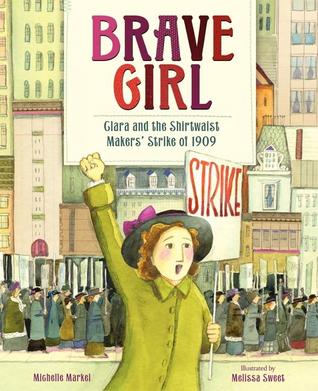
Brave Girl: Clara and the Shirtwaist Makers’ Strike of 1909
Author: Michelle Markel
Illustrator: Melissa Sweet
Published January 22nd, 2013 by Balzer + Bray

Summary: Clara and her family immigrated to New York. They were searching for the American dream. When her father could not find a job, Clara quit school and became a garment worker to support her family. The conditions at her factory were appalling: low wages, unfair rules, and locks on the door. After discussions between the workers, Clara helps urge the girls to fight for their rights.

Review: I am sucker for this biographical picture book for two reasons: 1) I had not known about the Shirtwaist Makers’ Strike of 1909 before and I love learning about new historical moments. I know that it interested me (as I know it would for kids), because after I read the additional information about the garment industry I was on the internet searching for more information. 2) Clara is such a great example of girl power! AND she is a historical figure that shows girls (and boys) that girls can stand up for themselves when they are not being treated well (in real life). I love that she overcame so much to not only stand up for her rights, but also to get an education and take care of her family. What an amazing person to learn about.

Teacher’s Tools for Navigation: The main way that I would use this book is as a read aloud. It will definitely cause a great discussion and may push students to do further research. It would also be a perfect read aloud for a unit on women’s rights, immigration, overcoming obstacles, girl power, labor laws, or the early 1900s to help make connections to history. 

Discussion Questions: Do you think that Clara continuing her education helped her in being able to fight for her labor rights?; Clara made a tough decision between continuing school during the day or working. Do you agree or disagree with her decision? Why or why not? How did her decision affect her life?; What caused the garment workers to strike?

We Flagged: “But Clara is uncrushable. She wants to read, she wants to learn! At the end of her shift, though her eyes hurt from straining in the gaslight and her back hurts from hunching over the sewing machine, she walks to the library. She fills her empty stomach with a single glass of milk and goes to school at night. When she gets home in the late evening, she sleeps only a few hours before rising again.” (p. 12-13)

To see a preview of the illustrations, visit Amazon’s “Look Inside” for Brave Girl.

Read This If You Loved: Here Comes the Girl Scouts! by Shana Corey, The Price of Freedom by Dennis Brindell Fradin, Boycott Blues by Andrea Davis Pinkney, Annie and Helen by Deborah Hopkinson

Recommended for: 

readaloudbuttonsmall closereadinganalysisbuttonsmall classroomlibrarybuttonsmall

Who is a female historical figure who shows as much girl power as Clara that you believe should be talked about more?

Signature

Real Justice: Convicted for Being Mi’kmaq: The Story of Donald Marshall Jr. by Bill Swan

Share

NF PB 2013

Nonfiction Picture Book Wednesday

Nonfiction Picture Book Wednesday is hosted by Kid Lit Frenzy and was started to help promote the reading of nonfiction texts. Most Wednesdays, we will be participating and will review a nonfiction text (though it may not always be a picture book). Be sure to visit Kid Lit Frenzy and see what other nonfiction books are shared this week!

17198555

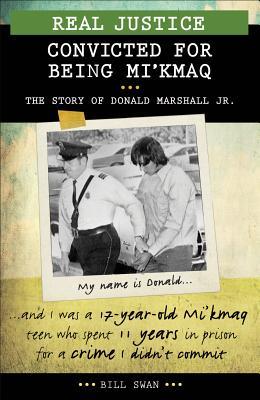
Real Justice: Convicted for being Mi’kmaq: The Story of Donald Marshall Jr.
Author: Bill Swan
Expected Publication: September 1st, 2013 by James Lorimer & Company

Summary: This book is part of the Real Justice series by James Lorimer & Company that shed light on young people who are wrongfully convicted of crimes. Donald Marshall Jr. spent eleven years in prison for a crime he never committed. He was the eldest son of the Grand Chief of the Mi’kmaw Nation, and racism certainly played a role in his conviction. It was a late night in Wentworth Park when Sandy Seale, a black teen, and Donald Marshall Jr. are waved over by two drunk men wanting cigarettes. One of the men stabs Sandy Seale in the side, and Donald Marshall Jr. runs for help. What he doesn’t know is that the police won’t believe his story, and they will do anything they can to convict him of the Seale’s death.

Review: I enjoyed the journalistic format of this book. Swan does an excellent job researching and depicting the facts of the case. He goes into depth when in his description of each witness’s story, and the reader gets a comprehensive background of the crime scene, investigation, and trial. As a Micmac Indian (the American version of this tribe), I was very interested in this story. Admittedly, I was a bit disappointed that aside from the comments about racism and a brief note toward the end of the book, there wasn’t much information about the Mi’kmaq Indians. I completely understand this, as the author chose to focus more on the investigation and trial, but I was secretly craving more information about Donald Marshall Jr.’s life background and customs. This text would make for a great nonfiction text to use in the classroom.

Teacher’s Tools for Navigation: I love teaching nonfiction units because there is so much variety. Teachers can offer myriad choices of memoirs and informational nonfiction for students to do research. After reading this story, students might research more about the case (if any other information is available) or they could compare and contrast this case with another example of injustice, particularly one that was impacted by racism. I have a feeling that students, like me, will want to research more about Marshall’s culture or the racial imbalance that existed at the time of the crime. I could also see this being paired with Black and White by Paul Volponi, an example of realistic fiction that also deals with injustice due to racism.

Discussion Questions: Does racism still exist today? In what ways did it impact the crime, investigation, and trial? What injustices did you see?; Do you think Marshall should have been compensated more for his eleven years in jail?; How does Marshall show incredible strength throughout his ordeal?

We Flagged: “‘Know what I think?’ MacIntyre added, as though on cue. ‘I think Marshall’s description of some old guy is a crock. The whole thing likely happened when that Indian, fueled up with fire water, got in an argument with the black kid'” (Chapter 5).

“When the reality hit [Donald Marshall Jr.], he cried the tears of childhood” (Chapter 15).

Please note: The above quotes are from the Advanced Reader Copy. Chapter numbers are included instead of page numbers because the e-reader did not provide page numbers. The quotes may change when the book is published.

Read This If You Loved: Hole in my Life by Jack Gantos, Black and White by Paul Volponi, other books in the Real Justice series, other books about Law and Order

Recommended For:

classroomlibrarybuttonsmall

RickiSig