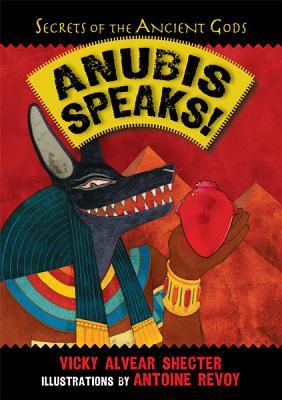
Anubis Speaks! by Vicky Alvear Shecter

Share

Halloween

NF PB 2013

Nonfiction Picture Book Wednesday

Nonfiction Picture Book Wednesday is hosted by Kid Lit Frenzy and was started to help promote the reading of nonfiction texts. Most Wednesdays, we will be participating and will review a nonfiction text (though it may not always be a picture book).
Be sure to visit Kid Lit Frenzy and see what other nonfiction books are shared this week!

anubis

Anubis Speaks! A Guide to the Afterlife by the Egyptian God of the Dead
Author: Vicky Alvear Shecter
Illustrator: Antoine Revoy
Published October 1st, 2013 by Boyd Mills Press

Goodreads Summary: Anubis, the ancient Egyptian god of death and mummification, takes the reader on a personal tour of the “Dark Lands”–the Egyptian afterworld. While touring, Anubis explains ancient Egyptian death practices and escorts the reader onto Ra’s “Night Boat,” where they must battle the evil demon of destruction, Apophis, so that Ra can be reborn in the morning as the sun disk.

Based on Egyptology research–particularly the Book of the Dead, The Book of Apophis, the Book of Caverns and others–Anubis Speaks gives middle-grade readers a fun yet factual look at ancient Egyptian beliefs, rituals and practices.

My Review: I was introduced to Vicky Alvear Shecter when I read Cleopatra’s Moon and was struck by her way to intertwine fact, mythology, and fiction into a fascinating story. I’ve recently (once I started teaching it) become a very hug fan of mythology though mostly Greek and Roman; however, with my reading of Cleopatra’s Moon (then the Kane Chronicles by Rick Riordan), I jumped into Egyptian mythology head first and began learning more and more thus realizing how fascinating all mythology is.

Now to Anubis Speaks! What I enjoyed most about this book was how it was put together. It isn’t just another nonfiction book that lists facts and myths and hope that students find it interesting. Instead Shecter made sure to make the book entertaining and different and intertwined myths with a fun narrative from the Egyptian god of the dead. (YES! The whole book is told from the point of view of Anubis making it quite hilarious at points and making it more interesting than just an informational nonfiction book.)

Teacher’s Tools for Navigation: This book fits perfectly into a mythology unit. It can be used as a whole or parts taken out. It is a great resource for any teacher teaching Egypt or Egyptian mythology. Also, because it is written so entertainingly, it can definitely be used as a read aloud.

Discussion Questions: Which other Egyptian god/dess’s point of view would you like to read a book by?; Which myth that Anubis shared was your favorite?; What part of Egyptian history that Anubis shared did you find to be the most interesting?

We Flagged: “Allow me to introduce myself. I am Anubis—the Egyptian god of the “Mysteries of Embalming,” the “Guardian of the Veil of Death,” “Opener of the Ways of the Dead,” and if you are “bad” . . . Your. Worst. Nightmare.

But do not fear. I will not snatch your beating heart from your chest and toss it to my good friend, crocodile-headed Amut the Destroyer for a squishy snack . . . not today anyway. Instead, I will guide you through my world of deep magic, strange gods, and gruesome monsters. I will show you how my people, the ancient Egyptians, prepared the dead for eternal and evil—every night—to keep you safe.” (p. 8)

Read This If You Loved: The Kane Chronicles (series) by Rick Riordan, Percy Jackson and the Olympians (series) by Rick Riordan, Cleopatra’s Moon by Vicky Alvear Shecter, Aphrodite the Diva by Joan Holub, Who Was King Tut? by Roberta Edwards and other nonfiction King Tut books, Athena’s Son by Jeryl Schoenbeck, The Gruesome Truth about the Egyptians by Jillian Powell and other nonfiction Egyptian books

Recommended For: 

classroomlibrarybuttonsmall readaloudbuttonsmall closereadinganalysisbuttonsmall

Signature

**Thank you to Vicky Alvear Shecter and Teresa Rolfe Kravtin for sending me a copy!**

Blog Tour, Review, and Author Interview: Double Vision: Code Name 711 by F.T. Bradley

Share

17331282

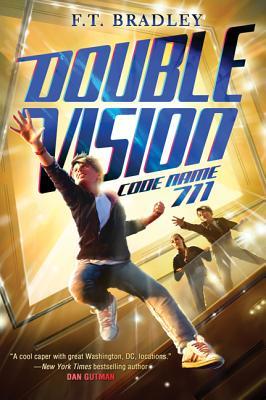
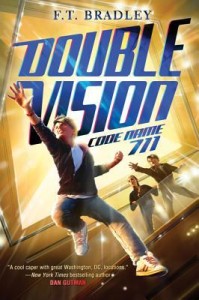
Double Vision: Code Name 711
Author: F. T. Bradley
Published: October 15th, 2013 by HarperCollins

Summary: Twelve-year-old Lincoln Baker isn’t a great student, and he often gets into trouble, but one thing is for sure—he is a great spy. In his last adventure, Linc went on an undercover mission in Paris and saved the world, but this time, Washington D.C. needs his help. A dark car pulls up to his road, and Pandora tells him they need his help. The president and her family have received a death threat, and they need Linc to help save her life. Worse, George Washington’s coat, which is believed to protect the wearer from harm is missing. Unfortunately for Lincoln, his doppelganger, Ben Green is also asked to help with the mission, and Lincoln wants to solve the crime first.

Review: Readers will enjoy this adventure through Washington D.C. and learn about the different museums and pieces of America’s history. Linc’s journey is action-packed and is sure to engage reluctant readers. I was actually visiting Washington D.C. while I read this book, so it was fun for me to learn more about the museums as I visited them. I haven’t read the first book in this series yet, but I was able to follow along with the details of this second book very easily. I enjoyed the hooks at the end of each chapter and was engaged in this detective story.

Teacher’s Tools for Navigation: Middle school students will have a lot of fun with this book. I’d love to see it in American history classes, where teachers might use the book side-by-side with units about our history. Many schools take field trips to Washington D.C., and this would make for a great read-aloud on the bus ride! Or perhaps, teachers might assign it as required reading for the trip. As another alternative, teachers might make a Webquest for students to learn more about our country’s history as they read this book. The great foreshadowing at the end of chapters would be great to teach students how to make predictions.

Discussion Questions: How do 12-year-olds make for great spies?; Why does Linc’s nemesis, Ben Green, play an important role in the story?; Which characters were suspicious? Cite reasons why you found each of them to be suspicious.; How does the setting add to the color of the story? Pick a different setting and tell how the story might the story be different if it were in this setting.

We Flagged: 

“Agent Stark got out of the car and gave me a little nod. And I knew my gut was spot-on: Pandora was back.

I got off my board and carried it as I walked toward her. ‘Hey, Agent Stark. You must be here for my mom’s spaghetti dinner'” (Chapter 1).

Please note: The above quote is from the Advanced Reader Copy. The quote may change when the book is published.

Read This If You Loved: The 39 Clues series published by Scholastic, Artemis Fowl by Eoin Colfer, The Alex Rider series by Anthony Horowtz, or detective/spy middle grade novels

Recommended For:

readaloudbuttonsmall classroomlibrarybuttonsmall


Interview with F.T. Bradley!

F.T. Bradley--photo

Websites: www.ftbradley.com and www.doublevisionbooks.com

Twitter: @FTBradleyAuthor

How did you become interested in writing detective/spy novels?

I’ve always loved mysteries, from when I was young, and was given an Enid Blyton Secret Seven paperback. When I was a kid, there wasn’t a YA section in my library, so I moved on to Agatha Christie novels after that. I love the puzzle in mysteries. My interest in all things spy didn’t come until later, when I watched movies like Sneakers. Spies are cool.

When did this story come to you? When did you realize that you wanted it to be a series?

The Double Vision trilogy really started with Linc: what if a regular kid (and a troublemaker with a sense of humor to boot) had to take the place of a lookalike spy? Linc really drives the story; when I sit down to write, I just let him take a run with it and hope for the best. So far, the story is a hit with kids—but that’s all Linc, I swear.

Some of the stories developed as I worked with my agent and editor, once it was sold to Harper Children’s as a three-book series. For the second book, Double Vision: Code Name 711, we started with the Washington D.C. location, which is the center of the spy world. From there, I began researching George Washington, since Linc would be on the hunt for a mysterious double of Washington’s coat.

Once I found out George Washington was a spy, the pieces just fell into place. The history of Washington as having the code name 711 in the Culper Ring during the Revolutionary War is just so awesome, it fueled Double Vision: Code Name 711 from there.

Tell us a little bit about your writing process.

For each book in the Double Vision trilogy, I usually start with a cool location (like Paris for the first book, Washington D.C. for the second), and then try to think of an interesting historical figure and magical artifact. Next, I’ll think of my bad guy/lady: who is the antagonist, and what is at stake? Since it’s a thriller I’m writing, I try to make the stakes as high as I can. I’m putting Linc’s life on the line on these missions after all.

Once I have those elements nailed down, I plot the book as best as I can, trying to think of the most daring things Linc can do on his quest. Like jumping from an airplane onto the Eiffel Tower’s gardens in the first book.

And once that plot gets the thumbs up from my editor, I start writing, and brace myself for what Linc will do. I never quite know, and that’s the best part. Linc is a cool and funny dude.

How did you settle on Lincoln’s age for your book? Did you always know it would be a middle-grade book?

Linc is twelve, which is a solid age for middle-grade. It’s important that he’s not too old, but not so young that he can’t go on his missions.

From the start, I wanted the Double Vision books to appeal to reluctant readers, especially boys who might give up on reading by the time they hit the double digit birthdays. Although I love award-winning children’s books, mysteries and thrillers kind of get forgotten, or are looked at as less somehow. I want to write MG thrillers that mirror the great books written for adults, those that hit the bestseller list because they’re entertaining, moving, sweep you away on a mysterious quest. I want kids to read for fun, and keep reading into adulthood. It’s important that this type of reading—reading for entertainment, whatever the book is—gets more respect.

What were your favorite books as a child and middle schooler?

I was a huge Roald Dahl fan–the BFG was my favorite book. Pippi Longstocking I loved because she did exactly what she wanted. Once I hit middle-school, I moved to the Agatha Christies. As a kid, I loved going to the library, and devoured books.

During my teens, I became a bit of a reluctant reader. There was so much required reading (I grew up in Europe, where there’s a lot of it in high school), and I stopped reading for fun. It wasn’t until my mid-twenties that I got back to reading when someone gave me a paperback thriller. That reignited the passion for books in me, and eventually I worked on writing them (for many years…).

You could say I came full circle: I’m now back at my library every week, leaving with a stack of books.

What are your current favorite middle grade or young adult books?

I’m all over the place with my reading… In MG, I recently loved Wonder, and Eion Colfer’s latest The Reluctant Assassin. In YA, I loved Rat Life by Tedd Arnold, Seconds Away by Harlan Coben.

I’m forgetting titles, I’m sure of it. 🙂 There are so many books, I wish I could just read all day sometimes…

Tell us a little bit about your family.

My husband is in the Air Force, which makes us professional nomads. The cool part about this is that I get to meet new people all the time, and that I have friends all over the globe. My two girls are tweens, and they keep me sharp. My family is so amazingly supportive of my crazy writing career, I thank my lucky stars every day.

Also, I have four cats, so there’s always one to keep me company as I write. The secret to my success is cats, honest.

Is there any reason you chose to use F.T. Bradley instead of Fleur Bradley as the specified author name for your books?

Because the Double Vision books are meant to appeal to boys, we decided to play it safe and go with initials instead of my (sort-of-girly) first name. To be honest, I think I sold today’s boys short. When I do book signings or go on school visits, they couldn’t care less if my hair was green or my name was Bob. We talk about our favorite books, donuts, and what would make a good spy gadget. And the girls join right in.

Kids today are amazing, funny, smart, open-minded, and utterly inspiring in their enthusiasm. They’re why I love to write middle-grade.

Thank you to F.T. Bradley for providing me with a copy of Double Vision: Code Name 711 to review and for this wonderful interview!

026F3FBCC8C3913BD3A4D3F6920340D5


History News: Greek News by Anton Powell and Philip Steele

Share

NF PB 2013

Nonfiction Picture Book Wednesday

Nonfiction Picture Book Wednesday is hosted by Kid Lit Frenzy and was started to help promote the reading of nonfiction texts. Most Wednesdays, we will be participating and will review a nonfiction text (though it may not always be a picture book).
Be sure to visit Kid Lit Frenzy and see what other nonfiction books are shared this week!

greeknews

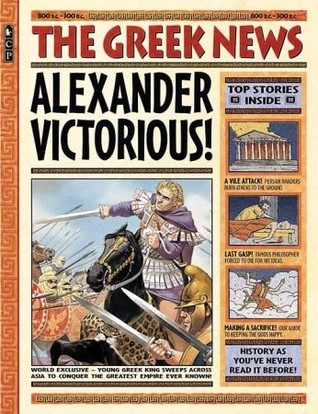
History News: The Greek News
Author: Anton Powell and Philip Steele
Illustrator: Various
Published March 10th, 2009 by Candlewick Press

Goodreads Summary: At home or at school, these innovative titles make history come alive

Read all About it Now, with The Greek News and The Roman News, life in ancient Greece and Rome is presented in the form of a daily newspaper written at the time. As accessible as your morning paper, The Greek News and The Roman News will give young readers the unforgettable sense of actually being a citizen of an ancient nation.

Stop the presses! What if ancient civilizations had daily newspapers? And they were amusing and compellingly informative? They might just look like this innovative series of historical nonfiction, presented in a unique, kid-friendly format.

Presents a “special edition” of a Greek newspaper which spans the years 1500 to 146 B.C. and contains articles about history, politics, feasts, fashions, theater, gods, and wars.

My Review: Set up like a Greek newspaper, The Greek News takes important events from the history of Greece and transcribes them as articles. The articles range in topics including Sparta, Alexander the Great, politics, army/navy life, trades, sports, woman, mythology, arts, education, philosophy, and traditions.

Teacher’s Tools For Navigation: The book is so well done with each page including a main article as well as other features including sidebars, maps, advertisements, diagrams, illustrations and political cartoons. I think students will like reading/learning about Greece more from this text than other because the unique format shares the information as if it was happening in the present and puts the reader in the middle of Greece. It also throws in some humor which students will love. This text can lead to such great discussions about not only Greece, but war, philosophy, mythology, propaganda, and so many other things.

Discussion Questions: [Writing prompt] Use The Greek News as a guide to create your own newspaper-esque piece sharing the history of a historical fiction book which you have read.

We Flagged: “In 415 B.C., Athens tried to add to its territory by conquering the island of Sicily. The results were disastrous – thousands of Athenian soldiers and hundreds of warships were lost. The Spartans leaped on Athens’s weakness and cut off the city’s supply of wealth from its silver mines…” (“Sparta Attacks!” p. 6)

“You know what it’s like. One minute your life is going smoothly, then, just when you least expect it, the gods turn their back on you and disaster strikes! Don’t panic – The Greek News will tell you everything you need to know about keeping the gods on your side.” (Lead paragraph for “Pleasing the Gods” p. 20-21)

“Socrates is to die! The jury of 501 men has made its decision – Socrates is guilty of not believing in the state-approved gods and of leading young people astray with his teaching.” (“Death by Poison, pg. 27)

Read This If You Loved: Any non-fiction or fiction text about Greece

Recommended For: 

classroomlibrarybuttonsmall closereadinganalysisbuttonsmall

Signature

The Mary Celeste: An Unsolved Mystery from History by Jane Yolen and Heidi Elisabet Yolen Stemple

Share

NF PB 2013

Nonfiction Picture Book Wednesday

Nonfiction Picture Book Wednesday is hosted by Kid Lit Frenzy and was started to help promote the reading of nonfiction texts. Most Wednesdays, we will be participating and will review a nonfiction text (though it may not always be a picture book).
Be sure to visit Kid Lit Frenzy and see what other nonfiction books are shared this week!

122102

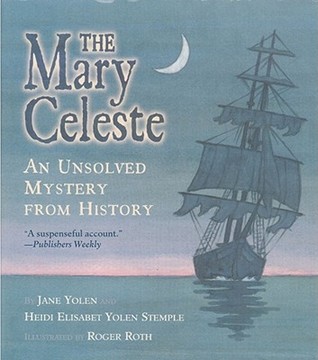
The Mary Celeste: An Unsolved Mystery from History
Author: Jane Yolen and Heidi Elisabet Yolen Stemple
Illustrator: Roger Roth
Published July 1st, 2002 by Simon & Schuster Books for Young Readers

Goodreads Summary: The Mary Celeste was discovered adrift on the open sea by another ship in 1872 — with no sign of captain or crew. What happened? Did the crew mutiny? Were they attacked by pirates? Caught in a storm? No one ever found out.

Inside this book are the clues that were left behind and the theories of what people think happened aboard that ship. Become a detective, study the clues, and see if you can help solve this chilling mystery from history.

My Review: This is the final book in the Unsolved Mystery from History series and I think it may be my favorite yet. Like The Wolf Girls, I had not heard about the Mary Celeste before this book, but this mystery was just so enthralling! A crew that just disappears?!?! How?!?! After reading the book, I spent hours online reading about the Mary Celeste and it is so interesting. There are so many websites and opinions and theories—all which would be so much fun to share with students.

Teacher’s Tools for Navigation: Like the other books in this series, I would love to see these books used in classrooms (history or language arts/reading). These books promote studying history, asking questions, inquiry, and vocabulary. Each book begins with an introduction about a young girl who enjoys unsolved mysteries from history and then the books are set up like her case notebook. Each page of the case notebook includes a narrative nonfiction section, an informational nonfiction section where facts about the story are explained even more in detail, and then there are vocabulary words from the two sections defined for the reader. Finally, in the back of the books the different theories about what could be the answer to the unsolved mystery are shared and briefly discussed. The set up of this book leads to infinite possibilities of being used in the classroom. Students could debate, write research papers, could do their very own case notebook about a different mystery, etc. Another option is to get all of the Unsolved Mystery from History books and have students get into lit circle groups and have each group read a different mystery then research and share. The other books in the series are about the Salem Witch Trials, the Wolf Girls, and Roanoke.

Discussion Questions: Which of the theories do you think happened?; Do you trust Captain Morehouse? Why or why not?; One theory mentions a kraken. Do you think sea monsters exist?; Study the weather of the Pacific during the time period the ship disappeared. Is weather an option for the crew’s disappearance?

We Flagged: Narrative Nonfiction “The last place the men looked was in the ship’s hold where her cargo- 1,700 barrels of raw alcohol- was well stowed. Not a single barrel had been opened. All in all, Deveau and Wright looked around the Mary Celeste for over half an hour. They found no sign of anyone on board, no signs of struggle.”

Informative Nonfiction “The cargo was alcohol stored in red oak barrels. Red oak is a porous wood that lets alcohol fumes escape. When the barrels were examined, some of the alcohol was found to be gone, but that was entirely due to evaporation. According to reports, the barrels were “in good order” and not “in any way injury.” Besides, the alcohol was was raw alcohol which was to be used for fortifying Italian wines. Anyone drinking it unprocessed would not become drunk, but would rather lapse into a coma or die. Only one hatch was found open, but there was no sign of smoke damage or an explosion in the unventilated hold.”

Vocabulary “Hold: the area inside the ship where cargo is stored; Cargo: the goods being transported by the ship” (p. 20-21)

Read This If You Loved: The other Unsolved Mystery from History books

Recommended For: 

closereadinganalysisbuttonsmall readaloudbuttonsmall

classroomlibrarybuttonsmall litcirclesbuttonsmall

I’m so sad that I am done reviewing the Unsolved Mystery from History series, but I hope you have enjoyed learning about them as I enjoyed reading them. 

Signature

Review and Interview!: Star Challengers: Moonbase Crisis by Rebecca Moesta and Kevin J. Anderson

Share

moonbase

June Scobee Rodgers presents
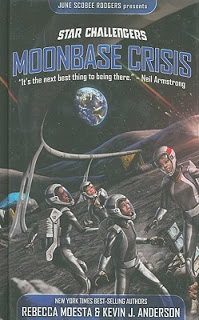
Star Challengers: Moonbase Crisis
Authors: Rebecca Moesta and Kevin J. Anderson
Published October 22nd, 2010 by Catalyst Game Labs

Goodreads Summary: After an exhilarating space simulation field trip at the local Challenger Center, a group of students are hand-picked by the mysterious Commander Zota for a special adventure: to travel to the future and a real moonbase in trouble, where they will learn skills to save the human race.

My Review: Since I live in Florida, I am right in the middle of the NASA debate. Some feel that the science behind NASA and space exploration is not worth the money where others completely disagree. There are others who are somewhere in the middle, not knowing. To me, losing the space program is terrifying and the authors of this book take the same stance as me.

Moonbase Crisis is a book written by Rebecca Moesta and Kevin J. Anderson but it is presented by June Scobee Rodgers, the widow of a commander on the Challenger, and endorsed by many NASA legends such as Buzz Aldrin, Neil Armstrong and Sally Ride. It is also a direct endorsement for Challenger Centers which are centers across the US that teach kids about space and hope to inspire them by letting them experience simulated space missions. That is where this book begins.

JJ and Dylan Wren are invited to a special space simulation after going on a field trip to the Challenger Center. When they arrive the find out that they are 2 of 4 young people chosen to be part of this mission. They are taught how to use actual communication devices and even put on real space suits. Then Commander Zota, the man who invited them, asks them to step into a room and next thing they know they find themselves on a Moonbase. In the future.

Then on top of all of this, it is a pretty good story with some major suspense. I look forward to the 2nd book as this was obviously an exposition for more to come.

Teacher’s Tools For Navigation: Throughout this book, science is definitely a main topic. It is sprinkled throughout discussing astronomy, botanical sciences, chemistry, and more I am sure. Though the book is science fiction, the science within in pure fact. The book shows a future where science and space exploration are not priorities and hopes to promote science by showing how important it is.

My father gave me this book as a gift and was kind enough to connect me with Ms. June Scobee Rodgers who helped make this book happen. Ms. Scobee Rodgers is the widow of Challenger Space Shuttle Commander Dick Scobee and has spent her life making sure his legacy and NASA continue for years to come. I was lucky enough to be given an opportunity to interview her about the Star Challengers series and the Challenger Center programs:

Kellee: After the Challenger tragedy, yourself and other family members of lost Challenger astronauts opened the Challenger Center to honor them. Why was it decided to use their memory to focus on the education of children?

Ms. Scobee Rodgers: The Challenger 51-L mission soon became the “Teacher in Space” mission. The teacher Christa McAuliffe and I had a great deal in common as teachers. My husband Dick Scobee the Commander had always been mission oriented.  So after we lost the “mission” the other family members of the shuttle crew joined with me to create an opportunity to reach the students and teachers around the globe still waiting for their lessons from the beloved school teacher who died along with my husband.

Kellee: What is your goal when it comes to the Challenger Centers?

JSR: Our board of directors and staff as well as all the Challenger Learning Centers all want to continue to reach students to inspire them with the importance of STEM education and the pursuit of careers with a tremendous shortage in those fields.

Kellee: How did the Star Challengers books come about?

JSR: Introduced through a mutual friend to famous author Kevin Anderson and his wife Rebecca, we explored opportunities to tell the Challenger story and STEM education with real science fiction that would both entertain and teach as well as inspire our youth across the country.

Kellee: As an educator and advocate for children’s education, what do you say to those who don’t believe that NASA and space exploration is beneficial for the future?

JSR: The largest concerns facing us as citizens right now are jobs and the economy. Job and economy growth is the direct outcome of new businesses, products and processes which since the end of World War II were created from our focus and investments in technology, engineering, research and science. And that can only happen when you have a citizenry and workforce with the talent to perform this vital role. Since 50% of all potential future scientists, engineers, technicians and similar key workforce tend to decide by the early age of 10-13 years that they either cannot do it or do not want to, we need to continue to expand our efforts to inspire and engage all of them. Even if they choose not to enter those fields. We need a STEM literate citizenry to ensure we hold the correct values for our society.

Kellee: What do you hope comes from the publication of the Star Challenger books?

JSR: I hope to inspire a whole new generation of “Star Challengers” – young people like our main characters who want to make a difference for our planet and who will reach for the stars no matter their circumstances.

Kellee: How do you hope they are used in the classroom? With children?

JSR: Students are now creating book reports and reading the books for pleasure. It would be terrific if the books could be made available in classroom sets to allow for classroom discussion.

Kellee: I loved Moon Base Crisis and cannot wait to read the second one- how many books are planned in the series?

JSR: The second book is titled Space Station Crisis, and the third is Asteroid Crisis. We need students to write the follow on books.  For example, Mars City Crisis is waiting to be written by an enterprising young person.

 **Thank you so much to Ms. Scobee Rodgers for taking part in this interview!**
Links to information about the Challenger Centers and NASA For Educators:


Discussion Questions: 

  • Currently, there is a search for a young writer to write Mars City Crisis for the Star Challengers series- what would you make the book about?
  • If you had the chance to go live on the space station, would you? 

We Flagged: “Also,” the commander pointed out, “the Moon is near a quarter of a million miles from Earth, while the speed of our signal – the speed of light – is a mere 186,282 miles per second. Therefore it takes 1.3 seconds for a message to travel from Earth to the Moon, which will produce a noticeable lag when you talk to anyone at Moonbase Magellan.” (p. 26)

“Zota continued as if he hadn’t heard. “Because of the Moon’s lack of atmosphere, walking on its surface will be like stepping out into a hard vacuum  Your spacesuit maintains your body’s integrity. If your suit fails, your tissues explode and freeze. We wouldn’t want that now, would we?” The cadets shook their heads.” (p. 37)

Read This If You Loved: Zita the Spacegirl by Ben Hatke, The Softwire by PJ Haarsma, C.H.A.O.S. by Jon S. Lewis, Nonfiction books about space

Recommended For: 

readaloudbuttonsmall classroomlibrarybuttonsmall litcirclesbuttonsmall

 I think this book is a great resource for the classroom;
I hope you fill find a way to use it!

Signature

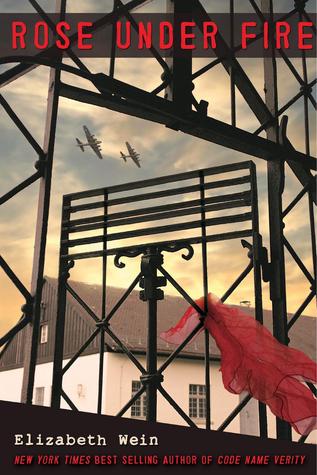
Rose Under Fire by Elizabeth Wein

Share

17262236
Title: Rose under Fire
Author: Elizabeth Wein
Expected Publication: September 10th, 2013 by Miramax (Disney)

Summary: While flying an Allied fighter plane from Paris to England, American ATA pilot and amateur poet, Rose Justice, is captured by the Nazis and sent to Ravensbrück, the notorious women’s concentration camp. Trapped in horrific circumstances, Rose finds hope in the impossible through the loyalty, bravery and friendship of her fellow prisoners. But will that be enough to endure the fate that’s in store for her?

Elizabeth Wein, author of the critically-acclaimed and best-selling Code Name Verity, delivers another stunning WWII thriller. The unforgettable story of Rose Justice is forged from heart-wrenching courage, resolve, and the slim, bright chance of survival.

Review: Out of the thousands of books I’ve read, this one is going to sit among my all-time favorites. There is a phenomenal balance of history and narrative that will engage readers while offering harrowing lessons in history. I am not an air and space girl. My husband loves planes, and he was giddy when we went to the Smithsonian Air and Space Museum in Washington D.C. As much as I want to love planes, I don’t find them to be interesting. This book changed my outlook.

Rose under Fire has many similarities with Wein’s Code Name Verity. They are both written in an epistolary format, involve pilots/airplanes, and are set during World War II. Both offer wonderfully complex themes about friendship, loyalty, and the strength of women. However, Rose under Fire focuses more on concentration camps, while Code Name Verity dealt more with the interrogation techniques used during World War II. Neither of these two elements drove the novels, but they are two plot features that make the texts quite different from one other. I found CNV to be a bit slow in the beginning (which isn’t the case with all readers), but I was hooked to Rose under Fire from the very first page. Wein writes characters so vividly that I still feel their presence in my life, long after I finish the books. I recommend this book to everyone. It will appeal to readers of all ages, backgrounds, genders, and interest levels.

Teacher’s Tools for Navigation: Teachers, this is a MUST-HAVE book. It is phenomenally written and shows the truly complexity of young adult literature. It can be used to teach elements like setting, character, dialogue, the epistolary format, imagery, voice, and theme. Students might write letters back to Rose, or they could analyze one of the many well-developed characters in this story. It would also make for a great research unit of topics like the Nuremberg Trials, female WWII pilots, flying bombs, or the experimentation on Holocaust prisoners. History teachers will also find this text to be invaluable.

Discussion Questions: What loyalties did the Holocaust prisoners have for each other? What are some examples of incidents that showed this loyalty?; Why were the Rabbits so important to the concentration camp? What did they add to the story as a whole?; How does Maddie’s friendship with Rose differ from her friendship with Julie?; Why was Nick’s character important throughout the story? How does his level of importance change, and why?; Rose has very different friendships with many of the characters. Describe how three of these friendships differ from one another.; Does the novel end in a hopeful way? Why or why not?

We Flagged: I marked so many passages that it is hard to choose just a few, so I selected two longer quotes that show the quality of Wein’s writing.

Incredible Imagery:

“…and the reason everyone in there was trying to get out in the rain was because they were dying of thirst.

Really dying of it, I think.

Hands and arms and heads stuck out anywhere there was a gap—cupped hands collecting rainwater, some holding bowls or even just a piece of cloth to collect moisture—I saw one woman lying on her back with her hair in the black cinder mud at the tent’s edge, her mouth open, letting a rivulet of water stream down the canvas and into her mouth.”

And Beautiful Figurative Language:

“Hope—you think of hope as a bright thing, a strong thing, sustaining. But it’s not. It’s the opposite. It’s simply this: lumps of stale bread stuck down your shirt. Stale gray bread eked out with ground fish bones, which you won’t eat because you’re going to give it away, and maybe you’ll get a message through to your friend. That’s all you need.

God, I was hungry.”

Please note: The above quotes are from the Advanced Reader Copy. The e-book (a galley) did not provide page or chapter numbers. The quotes may change when the book is published.

Read This If You Loved: Code Name Verity by Elizabeth Wein, Between Shades of Gray by Ruta Sepetys, Nazi Hunters by Neal Bascomb, Night by Elie Wiesel

Recommended For:

 litcirclesbuttonsmall closereadinganalysisbuttonsmall classroomlibrarybuttonsmall

026F3FBCC8C3913BD3A4D3F6920340D5

Thank you to NetGalley and Disney for sending me the Advanced Reader Copy!

Barbed Wire Baseball by Marissa Moss

Share

NF PB 2013

Nonfiction Picture Book Wednesday

Nonfiction Picture Book Wednesday is hosted by Kid Lit Frenzy and was started to help promote the reading of nonfiction texts. Most Wednesdays, we will be participating and will review a nonfiction text (though it may not always be a picture book).
Be sure to visit Kid Lit Frenzy and see what other nonfiction books are shared this week!

barbed

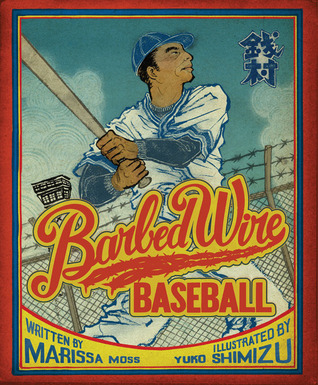
Barbed Wire Baseball
Author: Marissa Moss
Illustrated by: Yuko Shimizu
Published April 9th, 2013 by Harry N. Abrams

Goodreads Summary: As a boy, Kenichi “Zeni” Zenimura dreams of playing professional baseball, but everyone tells him he is too small. Yet he grows up to be a successful player, playing with Babe Ruth and Lou Gehrig! When the Japanese attack Pearl Harbor in 1941, Zeni and his family are sent to one of ten internment camps where more than 110,000 people of Japanese ancestry are imprisoned without trials. Zeni brings the game of baseball to the camp, along with a sense of hope.

This true story, set in a Japanese internment camp during World War II, introduces children to a little-discussed part of American history through Marissa Moss’s rich text and Yuko Shimizu’s beautiful illustrations. The book includes author and illustrator notes, archival photographs, and a bibliography.

Review: World War II is the most infamous war and it is taught to all students at some point in their career. They learn about Pearl Harbor and the Atomic Bomb and the Holocause and Hitler, but way too often what happened here in the US is not discussed. All of the Japanese Americans living on the West Coast of the US (62% were US citizens) were interned because our fear overwhelmed us so much that it was the only solution that seemed plausible. I felt that the fear that was felt after the Pearl Harbor bombings is very similar to what was felt 12 years ago today.

Barbed Wire Baseball does discuss the internment camps, but I think that the theme of this book is not about the camps but about how a love of something can turn a poor situation into something else if you are determined.

The story is just one part of the book. What moves it to a higher level is the author and illustrator. Marissa Moss has someone captured the tone of the story. It begins with hopefulness then to hopelessness and finally back to joyousness. Her ability to manipulate the tone throughout makes the story touch the reader even more. Yuko Shimizu’s illustrations are done with a Japenese calligraphy brush and ink adding to the connection the reader will feel with the story. Just beautiful.

Teacher’s Tools for Navigation: I think this book mostly leads to a discussion about the historical event that is shared in the book. In my classroom, I would share it as a read aloud and then jump into a discussion about Zeni, baseball, the internment camps, and World War II. The bibliography in the back of the book gives great websites to visit to continue the discussion.

Discussion Questions: Zeni doesn’t listen to his parents and went for what he wanted: baseball. He overcame his height and those who didn’t believe in him and was able to work towards his dreams. What is something that you’ve overcome even though others didn’t believe in you?; How can you compare/contrast how US citizens responded to Japanese Americans after Pearl Harbor to how US citizens responded to American Muslims after 9/11?

We Flagged: “Zeni stood staring at the dry earth, which was broken up every now and then by a few scrubby bits of green. In all the brown and gray, with a dull, coppery sky overhead, he felt as if he were shrinking into a tiny hard ball.

There was only one thing that could make the desert camp a home – baseball. Zeni unpacked his favorite photo, the one that showed him in uniform, lined up with baseball legends Babe Ruth and Lou Gehrig towering like redwood trees beside him. He had played with the Yankee stars in an exhibition game back home in Fresno, and he hadn’t felt small at all. He pinned the picture up over his bed. He was going to play baseball again. Here, in the desolate middle of nowhere.” (p. 9-10)

Read This If You Loved: Something to Prove by Robert Skead, Silent Star by Bill Wise, Brothers at Bat by Audrey Vernick, Keeping Score by Linda Sue Park, Nonfiction books about World War II or Japanese Internment Camps

Recommended For: 

readaloudbuttonsmall classroomlibrarybuttonsmall closereadinganalysisbuttonsmall

Signature