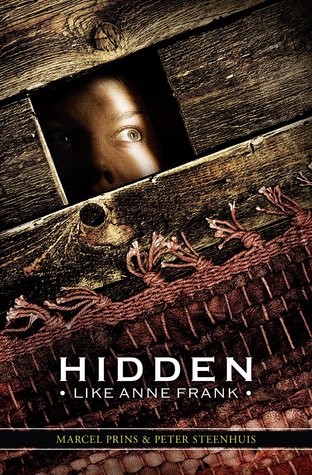
Hidden Like Anne Frank: 14 True Stories of Survival by Marcel Prins and Peter Henk Steenhuis

Share

hidden like anne frank

Hidden Like Anne Frank: 14 True Stories of Survival
Authors: Marcel Prins and Peter Henk Steenhuis
Published: March 25, 2014 by Arthur A. Levine Books

Summary: Fourteen unforgettable true stories of children hidden away during World War II

Jaap Sitters was only eight years old when his mother cut the yellow stars off his clothes and sent him, alone, on a fifteen-mile walk to hide with relatives. It was a terrifying night, one he would never forget. Before the end of the war, Jaap would hide in secret rooms and behind walls. He would suffer from hunger, sickness, and the looming threat of Nazi raids. But he would live.

This is just one of the incredible stories told in HIDDEN LIKE ANNE FRANK, a collection of eye-opening first-person accounts that share what it was like to go into hiding during World War II. Some children were only three or four years old when they were hidden; some were teenagers. Some hid with neighbors or family, while many were with complete strangers. But all know the pain of losing their homes, their families, even their own names. They describe the secret network of brave people who kept them safe. And they share the coincidences and close escapes that made all the difference.

Review: This collection showed me the misconceptions I had about those who hid during the Holocaust. These fourteen brave, young people showed me the diversity of experiences that existed among the hidden. For example, I didn’t know that it was common that they were beaten. Many people agreed to hide Jews because they were paid money by the Resistance. They didn’t always do it because they were being morally good people, so they did not have favorable feelings toward the people they hid. Also, I wasn’t aware that many of those who hid during the Holocaust moved from house to house and were frequently uprooted. These are just some of the many lessons I learned from this text, and I think readers will truly appreciate the insight it provides.

Teacher’s Tools for Navigation: I don’t know many school systems that don’t teach a book that is set during the Holocaust. If teachers are unable to use this whole text, I would highly recommend they select a few stories to show students how different the experiences were.

Discussion Questions: How did the Holocaust impact those who hid? After the war was over, how did it affect them emotionally?; What dangers did the Jews face when they hid? Would you accept the danger and work with the Resistance?

We Flagged: “My feelings from back then are very distant. I can still see myself as a boy of six, seven, roaming around Amsterdam, ringing doorbells, getting into mischief. I can think about that boy, about his relationship with his father, with his mother, and with his grandfather. But I can’t feel the emotions I had back then—it doesn’t work. I just can’t reach them anymore. Maybe I’ve automatically kept the past at a distance because I had to hide away for years and deny my background. Or maybe it’s just that impossible to relive those feelings from the past, and so I have to make do with memories.” (Chapter: “Older than my Father”)

Please Note: This quotation is from an advanced reader copy. It may be different in the published text.

Read This If You Loved: The Diary of Anne Frank by Anne Frank; The Nazi Hunters by Neal Bascomb; Hidden: A Child’s Story of the Holocaust by Loïc Dauvillier; Night by Elie Wiesel 

Recommended For:

readaloudbuttonsmall litcirclesbuttonsmall classroomlibrarybuttonsmall

RickiSig

A Home for Mr. Emerson by Barbara Kerley

Share

NF PB 2014

Nonfiction Picture Book Wednesday

Nonfiction Picture Book Wednesday is hosted by Kid Lit Frenzy and was started to help promote the reading of nonfiction texts. Most Wednesdays, we will be participating and will review a nonfiction text (though it may not always be a picture book).
Be sure to visit Kid Lit Frenzy and see what other nonfiction books are shared this week!

emerson

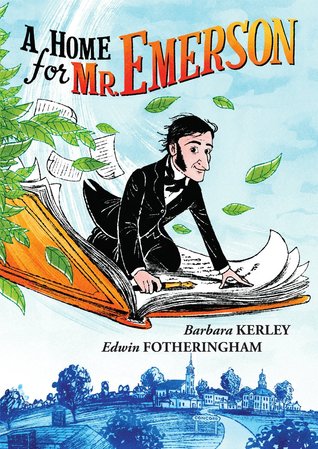
A Home for Mr. Emerson
Author: Barbara Kerley
Illustrator: Edwin Fotheringham
Published February 25, 2014 by Scholastic Press

Goodreads Summary: From the award-winning creators of Those Rebels, John & Tom, a joyful portrait of an American icon and an inspiring blueprint for how to live your life.

“All life is an experiment.
The more
experiments you make
the better.”

Before Ralph Waldo Emerson was a great writer, he was a city boy who longed for the broad, open fields and deep, still woods of the country, and then a young man who treasured books, ideas, and people. When he grew up and set out in the world, he wondered, could he build a life around these things he loved?

This moving biography–presented with Barbara Kerley and Edwin Fotheringham’s inimitable grace and style–illustrates the rewards of a life well-lived, one built around personal passions: creativity and community, nature and friendship.

May it inspire you to experiment and build the life you dream of living.

My Review: I knew of Emerson’s work, but I didn’t know much about him. This picture book is a perfect introduction into learning about Emerson as a man. And you know what? If this picture paints his personality correctly, he was a wonderful man. He was an intellectual, but also cared about everyone around him. He wanted to listen and learn and be the best neighbor, friend, husband, father, writer, thinker, etc. he could be. Kerley does a great job of showing and sharing with us Emerson’s life.

Also, check out Alyson’s review of this book to see her visit to Mr. Emerson’s home: http://www.kidlitfrenzy.com/kid-lit-frenzy/2014/7/15/nonfiction-picture-book-wednesday-a-home-for-mr-emerson

Teachers’ Tools for Navigation: Since the book is about Emerson, my first thought would be to look at some of Emerson’s work and discuss his life and work including the quotes that are shared throughout the book. Journaling is also a theme throughout the book. Have students start a journal which they think about the world and other thoughts they have throughout the day. Finally, using Barbara Kerley’s website, students could look at how to write a extraordinary biography then pick their own historic person to write about.

However, the author’s afterword gives another suggestion. Use Emerson’s love of life to make your life the best it can be! Have students exam their lives (using the questions in the afterword), and talk about how to live a fulfilling life.

Discussion Questions: (Just some of the questions from the afterword “Build a World of your Own”) Think about your favorite room. What do you like about it?; Design your perfect home. What rooms would you include? etc.; Mr. Emerson created a job out of his love of reading, thinking, and exploring ideas. What kind of job would you enjoy?; List your three favorite community activities. Why do you like them?

We Flagged: 

Read This If You Loved: The Extraordinary Mark Twain by Barbara Kerley, The Noisy Paint Box by Barb Rosenstock, The Tree Lady by H. Joseph Hopkins, Marvin Makes Music by Marvin Hamlisch, A Splash of Red by Jen Bryant, On a Beam of Light by Jennifer Berne

Recommended For: 

readaloudbuttonsmall classroomlibrarybuttonsmall

Signature

The Star-Spangled Banner illustrated by Peter Spier

Share

spangled

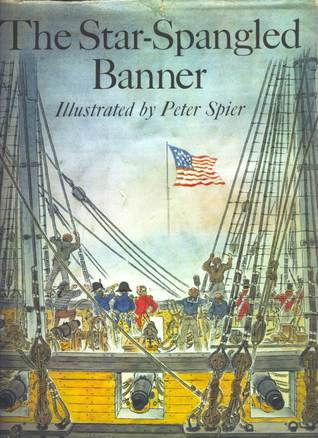
The Star-Spangled Banner
Author: Francis Scott Key
Illustrator: Peter Spier
Published September 19, 1973 by Doubleday Books for Young Readers

Goodreads Summary: Due to careful research, Spier’s artwork depicts “the dawn’s early light” and “the rocket’s red glare” with remarkable authenticity and detail in this celebratory book. Among the highlights: a brief history of the anthem, a reproduction of Francis Scott Key’s original manuscript, music for guitar and piano chords and many photographs.

My Review and Teachers’ Tools for Navigation: Peter Spier’s illustrations bring our national anthem to life. Spier carefully researched all lines of them poem as well as other facts about the War of 1812 when the anthem was written and used all of this knowledge to help show the meaning behind Key’s words. In the afterword, Spier shares much of the research to help tie it all together. 

In the past, as a school, we actually had students do something very similar. They each received a line from the first verse, and they had to research what it meant and then draw an illustration to share with their classmates the meaning. These were then put together as a book, so that the entire national anthem could be read with illustrations showing the meaning. Students loved the activity, and I really think it helped make history mean more to them than just dates.

Discussion Questions: What is Key trying to say in The Star-Spangled Banner?; What caused Key to write this poem?; Had you ever heard the second or third verse before? What did you think of it?; For some of the lines, Spier chose to draw a modern setting–why do you think he chose these specific places? 

We Flagged: 

Recommended For: 

readaloudbuttonsmall classroomlibrarybuttonsmall closereadinganalysisbuttonsmall

Happy Fourth of July!

Signature

The Noisy Paint Box: The Colors and Sounds of Kandinsky’s Abstract Art by Barb Rosenstock

Share

NF PB 2014

Nonfiction Picture Book Wednesday

Nonfiction Picture Book Wednesday is hosted by Kid Lit Frenzy and was started to help promote the reading of nonfiction texts. Most Wednesdays, we will be participating and will review a nonfiction text (though it may not always be a picture book).
Be sure to visit Kid Lit Frenzy and see what other nonfiction books are shared this week!

noisy

The Noisy Paint Box: The Colors and Sounds of Kandinsky’s Abstract Art
Author: Barb Rosenstock
Illustrator: Mary Grandpré
Published February 11th, 2014 by Alfred A. Knopf

Goodreads Summary: In this exuberant celebration of creativity, Barb Rosenstock and Mary Grandpre tell the fascinating story of Vasily Kandinsky, one of the very first painters of abstract art. Throughout his life, Kandinsky experienced colors as sounds, and sounds and colors–and bold, groundbreaking works burst forth from his noisy paint box.

Review: I love the visual arts. Growing up with a father that ran an art museum, going to visit museums and learning about art was part of my life. Throughout all of this exploration, I found that I loved modern art more than any other: Seurat, Rauschenberg, Picasso, etc. Kandinsky is one of the artists whose art I really enjoyed. This book let me see into Kandinsky’s mind, and see how abstract art came to be through his synesthesia. Fascinating!

Teachers’ Tools for Navigation: This is a perfect introduction to Kandinsky and abstract art. Abstraction is a hard concept to understand (though kids seem to get it more than kids), and this book helps explain how abstract art came to be. I can see this book being used in a lit circle/jig saw type fashion where kids learn about different creative people through narrative nonfiction biographies and research, write an evidence-based biography, and then share them with the other groups.

Discussion Questions: How did Kandinsky change art?; Have you ever had teachers/parents who didn’t understand you? What happened?; What is synesthesia? How did it affect the art Kandinsky made?

Book Trailer: 

We Flagged: “His artist friends understood. They too were tired of painting pretty landscapes and pretty ladies. They thought art needed to change.
‘Art should make you feel,’ Vasya told them. ‘Like music.’
‘Exactly!’ said his friends. But none of them knew how to paint feelings…
until the day Vasya grew brave enough…
and invited the world to see the paintings roaring from his noisy paint box.”

Read This If You Loved: Linnea in Monet’s Garden by Christina Björk, Sky Color by Peter H. Reynolds, Sandy’s Circus: A Story About Alexander Calder by Tanya Lee Stone, Art by Patrick McDonnell, Art & Max by David Wiesner, Concerning the Spirituality in Art by Wassily Kandinsky

Recommended For: 

readaloudbuttonsmall classroomlibrarybuttonsmall litcirclesbuttonsmall

Signature

A Long Walk to Water by Linda Sue Park

Share

longwalk

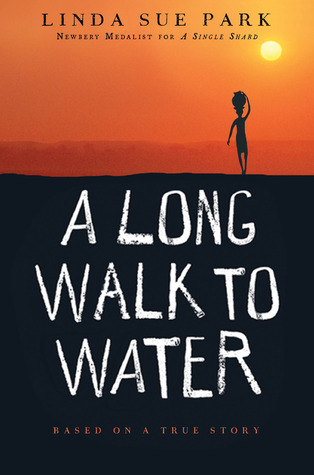
A Long Walk to Water
Author: Linda Sue Park
Published November, 2010 by Houghton Mifflin Harcourt

Goodreads Summary: A Long Walk to Water begins as two stories, told in alternating sections, about a girl in Sudan in 2008 and a boy in Sudan in 1985. The girl, Nya, is fetching water from a pond that is two hours’ walk from her home: she makes two trips to the pond every day. The boy, Salva, becomes one of the “lost boys” of Sudan, refugees who cover the African continent on foot as they search for their families and for a safe place to stay. Enduring every hardship from loneliness to attack by armed rebels to contact with killer lions and crocodiles, Salva is a survivor, and his story goes on to intersect with Nya’s in an astonishing and moving way.

My Review and Teachers’ Tools for Navigation: The wars in Sudan and Darfur are the most violent and long lasting wars in the world; however, most Americans are unaware that they are even occurring. Linda Sue Park took a true story of a lost boy’s survival (watch a video about the true story here) after being chased from his village because of war and transformed it into a novel that will leave the reader with a feeling of awe. Awe of the bravery and pure fearlessness of Salva and the other Lost boys of Sudan and awe of the world of riches and blindness we live in while a horrendous war wages on the other side of the world. I love this book because it is very accessible to children, it won’t bog them down with too much history; however, it will definitely make them aware of the situation in Sudan.

Discussion Questions: What is a way that you could share what you learned about the Lost Boys of Sudan? How can you help? 

We Flagged: “Salva took a few steps towards the men.
‘Hey!’
A soldier approached Salva and raised his gun.
Salva froze. All he could see was the gun’s huge barrel, black and gleaming, as it moved toward his face.
The end of the barrel touched his chin.
Salva felt his knees turn to water. He closed his eyes.
If I die now, I will never see my family again.
Somehow, this thought strengthened him enough to keep him from collapsing in terror.
He took a deep breath and opened his eyes.” (p. 11)

“Going was easy.
Going, the big plastic container held only air… There was little weight, going. There was only heat, the sun already baking the air, even though it was long before noon. It would take her half the morning if she didn’t stop on the way.
Heat. Time. And thorns…
Nya filled the container all the way to the top. Then she tied the gourd in back in place and took the padded cloth doughnut from her pocked. The doughnut went on her head first, followed by the heavy container of water, which she would hold in place with one hand.
With the water balanced on her head, and her foot still sore from the thorn, Nya knew that going home would take longer than coming had. But she might reach home by noon, if all went well.” (p. 1, 14-15)

Read This If You Loved: The Queen of Water by Laura Resau, Now is the Time for Running by Michael Williams, Sold by Patricia McCormick, Diamonds in the Shadows by Caroline B. Cooney, Shabanu by Suzanne Fisher Staples, So Long a Letter by Mariama Ba

Recommended For: 
readaloudbuttonsmall closereadinganalysisbuttonsmall
classroomlibrarybuttonsmall litcirclesbuttonsmall
Signature

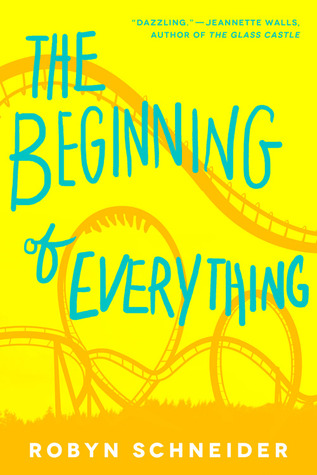
The Beginning of Everything by Robyn Schneider

Share

beginning

The Beginning of Everything
Author: Robyn Schneider
Published August 27, 2013 by Katerine Tegen

Goodreads Summary: Golden boy Ezra Faulkner believes everyone has a tragedy waiting for them—a single encounter after which everything that really matters will happen. His particular tragedy waited until he was primed to lose it all: in one spectacular night, a reckless driver shatters Ezra’s knee, his athletic career, and his social life.

No longer a front-runner for Homecoming King, Ezra finds himself at the table of misfits, where he encounters new girl Cassidy Thorpe. Cassidy is unlike anyone Ezra’s ever met, achingly effortless, fiercely intelligent, and determined to bring Ezra along on her endless adventures.

But as Ezra dives into his new studies, new friendships, and new love, he learns that some people, like books, are easy to misread. And now he must consider: if one’s singular tragedy has already hit and everything after it has mattered quite a bit, what happens when more misfortune strikes?

Robyn Schneider’s The Beginning of Everything is a lyrical, witty, and heart-wrenching novel about how difficult it is to play the part that people expect, and how new beginnings can stem from abrupt and tragic endings.

My Review: Another novel filled with smart high schoolers—that makes me so happy!! I hope this is a trend because I love seeing brainy characters in my book and not stereotypical ones. The Beginning of Everything is described as witty, and it is very much so. The sarcasm and wit just bleeds out of this book. I found myself laughing out loud at parts, and usually just because a character had the audacity to say something they shouldn’t have.

In The Beginning of Everything, I actually connected more with the secondary characters than the protagonist. They were so well established and had such unique voices while Ezra sounded like any good-0le boy; however, I will say that by making his voice less distinct allowed for him to grow even in his prose. As he found his new, true identity, his voice became to ring out more true. I am not sure if the author did this on purpose or not, but either way it worked!

Oh, and the final pages. Guys, they were so good! Although it felt a bit rushed to me, the lyrical writing got me in the end. Perfect.

Teachers’ Tools for Navigation: Although this book’s main home is in teens’ hands from a classroom, school, or public library, there are definitely parts that can be pulled out to be used in a classroom.

Since the characters are intelligent, many of the conversations have allusions to literature (Mary Oliver, Shakespeare, Fitzgerald, Frost) or their topics are quite deep (connecting organic chemistry to life, panopticon, Banksy, German insults). Also, there are debate topics that would be so interesting to look into such as imperialism, capitalism, and the economy.

One fun activity that I would definitely pull out of this book is fake debates. When Ezra, Toby, Cassidy, etc. were at their debate tournament, they had fake debates where they had to choose a side of quite silly topics like “Should vampires be allowed to vote?” This would be a great activity to do in classes to work on persuasion and arguments. (However, be careful about actually reading aloud the scene this is in as they also make it a drinking game.)

Discussion Questions: Do you feel like we live in a society similar to the panopticon? [If you don’t know what this is, it is quite fascinating: http://en.wikipedia.org/wiki/Panopticon]; Do you think Cassidy made the right choice in the end?; Ezra truly connects with The Great Gatsby because of all the changes his life is going through. What book to you connect with and why?

Flagged: “Her face was inches from mine. I could see the freckles that dusted her nose and the gold flecks in the disquieting blue of her eyes.” (p. 111)

“My admirable opponent argues that vampires do not deserve suffrage, as many great yet misinformed politicians have done before her while calling for the continued marginalization of women, or other minorities.” Cassidy began. “Yet vampires were, at some point human. At what point can a man’s voting rights be revoked, if he is proven to be of rational mind?” (p. 157)

Read This If You Loved: Life in Outer Space by Melissa Kiel, Stargirl by Jerry Spinelli, Paper Towns by John Green

Recommended For: 

classroomlibrarybuttonsmall closereadinganalysisbuttonsmall

Signature

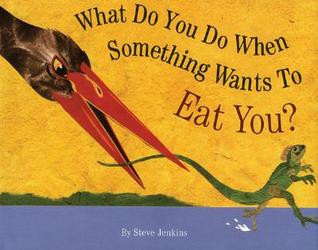
What Do You Do When Something Wants To Eat You? by Steve Jenkins

Share

NF PB 2014

Nonfiction Picture Book Wednesday

Nonfiction Picture Book Wednesday is hosted by Kid Lit Frenzy and was started to help promote the reading of nonfiction texts. Most Wednesdays, we will be participating and will review a nonfiction text (though it may not always be a picture book).
Be sure to visit Kid Lit Frenzy and see what other nonfiction books are shared this week!

eatyou

What Do You Do When Something Wants To Eat You?
Author and Illustrator: Steve Jenkins
Published October 27th, 1997 by HMH Books for Young Readers

Goodreads Summary: What would you do if something wanted to eat you? Walk on water? Stick out your tongue? Play dead? Animals in the wild use all kinds of methods to protect themselves from their enemies. Using dynamic and intricate cut-paper collages, Steve Jenkins explores the many fascinating and unique defense mechanisms creatures use to escape from danger.

My Review: Steve Jenkins just has a way of making nonfiction more interesting than other authors, and this book is no different than his others. This book takes different animals and shows the different ways they protect themselves: from squirting ink to camouflage.  The illustrations are done in Steve Jenkins’s paper-cut style and are done as well as his other books. The text, though simple, is full of information and definitely makes the reader want to learn more.

Teachers’ Tools for Navigation: This book can definitely be used in reading and science class. It is a good introduction to animal defenses and animal adaptations. It can lead to inquiry and research of each of these animals. It would be a great first research project for students to choose one of the animals and learn more about them. It is also a good introduction to cause and effect. What causes _____ to need to defend themselves? What is the effect of ____ being attacked?

Discussion Questions: What type of defenses do animals use to keep themselves from being harmed?; How does camouflage work?; What causes animals to need to defend themselves? What are the effects of them being attacked?

We Flagged: “A flying fish escapes danger by leaping from the water, spreading its winglike fins, and gliding as far as a thousand feet.”

Read This If You Loved: Any Steve Jenkins book, Any Seymour Simon animal book, Lifetime by Lola M. Schaefer, Frog Song by Brenda Z. Guiberson

Recommended For: 

readaloudbuttonsmall closereadinganalysisbuttonsmall
classroomlibrarybuttonsmall litcirclesbuttonsmall

Signature