Earthrise: Apollo 8 and the Photo that Changed the World by James Gladstone

Share

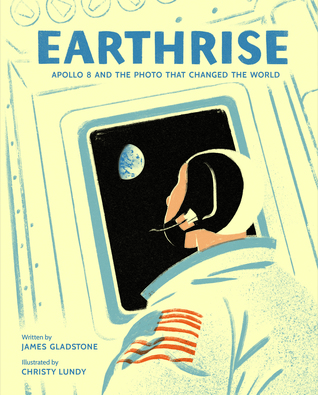
Earthrise: Apollo 8 and the Photo that Changed the World
Author: James Gladstone
Illustrator: Christy Lundy
Published October 15th, 2018 by OwlKids

Summary: 1968 was a year of unrest: many nations were at war. People marched for peace, fairness, and freedom. At the same time, the Apollo 8 crew was about to go farther into space than anyone had gone before–to the moon.

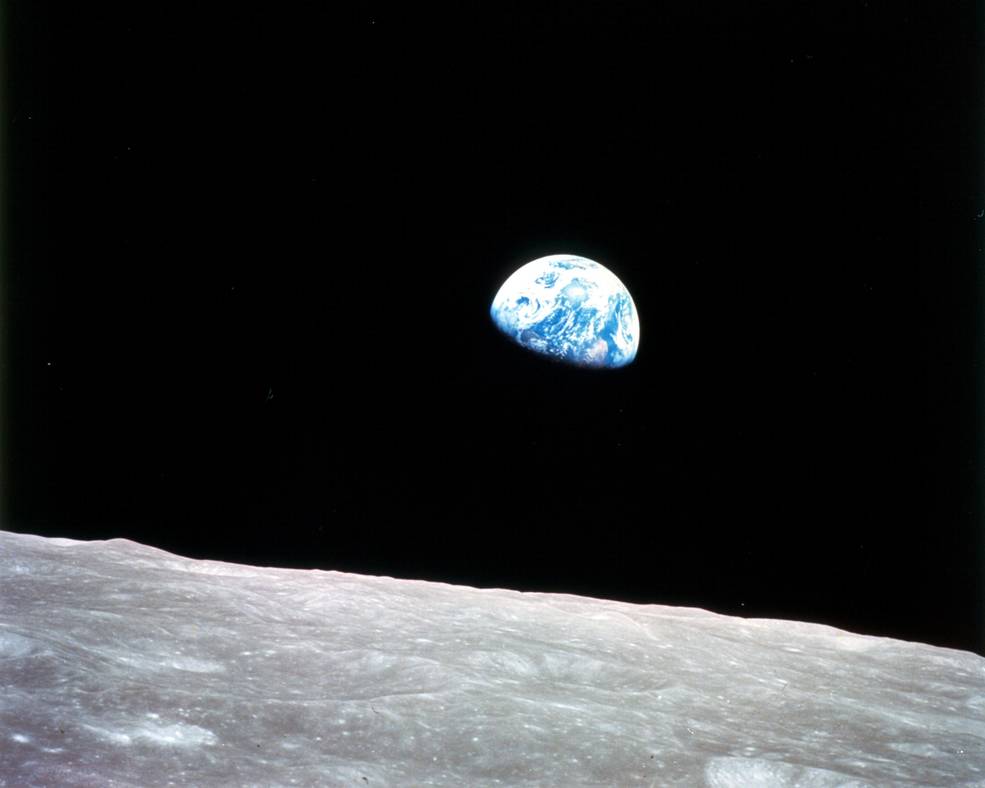
As they surveyed the moon’s surface, astronauts aboard Apollo 8 looked up just when Earth was rising out of the darkness of space. They saw the whole planet–no countries, no borders. The photograph they took, Earthrise, had a profound effect when published widely back on Earth, galvanizing the environmental movement, changing the way people saw our single, fragile home planet, and sparking hope during a year of unrest.

This important and timely picture book is publishing to coincide with the 50th anniversary of the Apollo 8 mission, telling the story behind the photograph, both inside the spaceship and back on Earth. Text includes dialogue pulled from NASA’s Apollo 8 transcript, drawing readers into the moment Earth was first photographed in color from space. An author’s note at the end explains more about the photograph, the Apollo 8 mission, and how Earthrise went on to inspire Earth Day.

About the Author: JAMES GLADSTONE is an editor and author of books for children. His great fondness for planet Earth inspired him to write Earthrise. James is also the author of When Planet Earth Was New and Turtle Pond. James lives in Toronto, Ontario.

About the Illustrator: CHRISTY LUNDY enjoys exploring the relationship between characters and their environment in her work. She designs locations and creates background paintings for children’s animated shows, as well as doing editorial illustrations for a wide variety of clients. Earthrise is her first children’s book.

Praise: A Junior Library Guild Selection, 2018; Starred Review, Kirkus Reviews

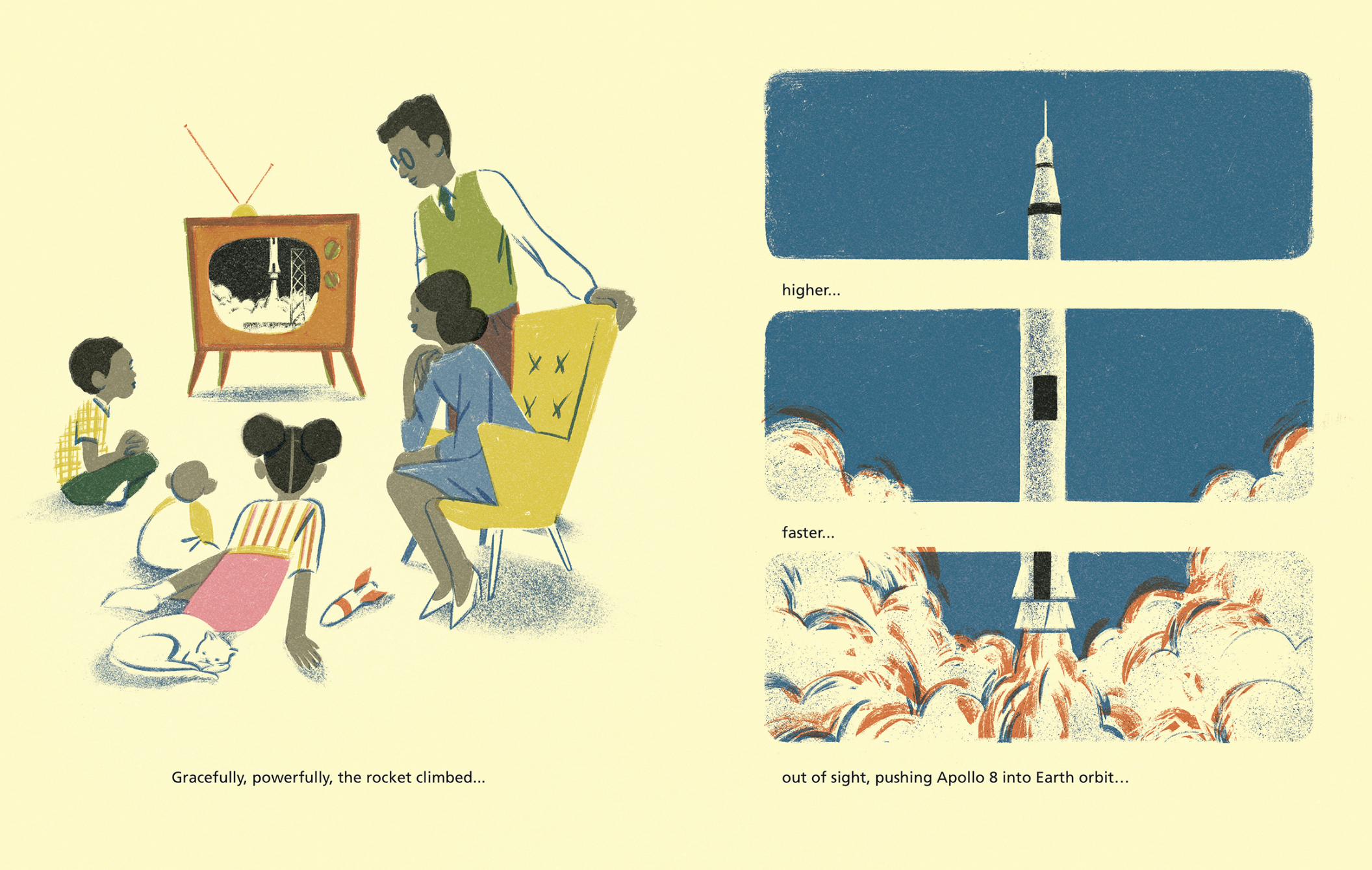
Review: My son wants to be an astronaut, so I have read many space books; however, I never tire of them because there is just so much to learn about when it comes to our space history, space future, and space in general. I, of course, had seen the Earthrise photograph, but I did not know its story nor did I know about the importance of Apollo 8, so I enjoyed learning about the voyage (and going on a bit of a Google spiral after learning more). Gladstone did a great job incorporating the mission with life on Earth in 1968 as well as getting specific about the mission but without getting so specific that readers will be lost. I also am a huge fan of Lundy’s illustrations which are purposeful in their use of line and color and have a huge impact on the book.

Teachers’ Tools for Navigation: There are many photographs that can be used in conjunction with the picture book including the original Earthrise and photographs of the astronauts, the rocket, and 1968.

This year is the 50th anniversary, so it would be fantastic to introduce students to this mission as many may not know it, and Earthrise is a perfect way to introduce it, and there are many aspects of the text that can be applied to standards in addition to its ability to be a perfect read aloud.

Discussion Questions: 

  • How did the image taken from the Apollo 8 spacecraft effect civilians when they saw it?
    • How was this different than the live feed that was sent earlier in the mission?
  • Based on the book, what has changed over the last 50 years?
  • Saturn V and Apollo 8 took off together–how was the rocket/space craft set up?
  • The author seems to have two purposes in writing this story–what do you think they are?
  • How did the images back on Earth help tell the story of the Apollo 8 mission?

Flagged Passages: 

Read This If You Love: Space, Learning about History, Astronauts, Photography/Art Impact

Recommended For: 

classroomlibrarybuttonsmall 

Signature

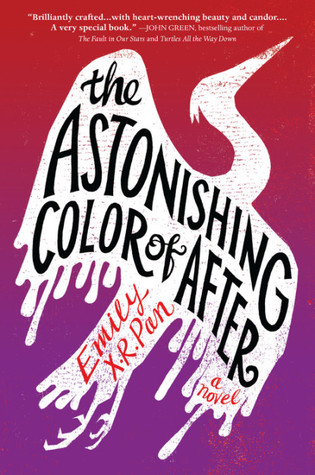
The Astonishing Color of After by Emily X. R. Pan

Share

The Astonishing Color of After
Author: Emily X. R. Pan
Published: March 20, 2018 by Little, Brown

Goodreads Summary: Leigh Chen Sanders is absolutely certain about one thing: When her mother died by suicide, she turned into a bird.

Leigh, who is half Asian and half white, travels to Taiwan to meet her maternal grandparents for the first time. There, she is determined to find her mother, the bird. In her search, she winds up chasing after ghosts, uncovering family secrets, and forging a new relationship with her grandparents. And as she grieves, she must try to reconcile the fact that on the same day she kissed her best friend and longtime secret crush, Axel, her mother was taking her own life.

Alternating between real and magic, past and present, friendship and romance, hope and despair, The Astonishing Color of After is a novel about finding oneself through family history, art, grief, and love.

My Review: I just finished discussing this book with my class, and they loved it. It is a bit of a longer book and moves somewhat slowly, but even my students who didn’t finish it in time insisted that I should use it again next year. The writing is absolutely stunning. Pan depicts humanity in ways that are very powerful. She integrates color and emotion to connect readers to the characters. We had two one-hour class periods to discuss this book, and there were so many things to talk about. Discussion was easy, and students made meaningful connections with the book. This book is simply unforgettable. I recommend it highly and hope it wins some awards in January!

Teachers’ Tools for Navigation: My students said that they Googled the colors within the text as they read. We spent a lot of time talking about the colors as an effective writing tool. I asked students to think of a moment in their lives that they’d be willing to share. Then, I asked them to attach a color with the moment. They shared beautiful stories of working at drive-ins, meeting their SOs, visiting places with friends, etc. The colors they attached with the images were fascinating and made the stories come alive.

Discussion Questions: 

  • How does the author incorporate magical realism in the text? Is it effective?
  • Did Leigh and Axel’s relationship feel realistic to you? Why or why not?
  • Which scenes are beautifully written, and how do they demonstrate excellent writing?
  • Should we forgive Leigh’s father? Why might he make the decisions he makes?

We Flagged: “Once you figure out what matters, you’ll figure out how to be brave.”

Read This If You Loved: Goodbye Days by Jeff Zentner, When the Moon Was Ours by Anna-Marie McLemore, Miles Away From You by A. B. Rutledge, All the Bright Places by Jennifer Niven, Looking for Alaska by John Green, Forgive Me, Leonard Peacock by Matthew Quick

Recommended For:classroomlibrarybuttonsmall

  RickiSig

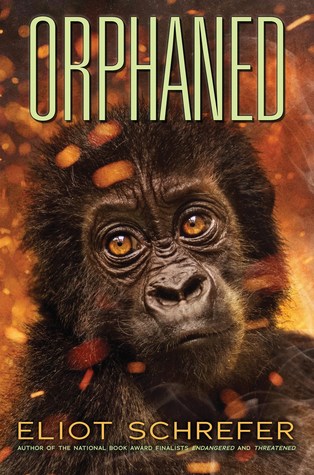
Ape Quartet #4: Orphaned by Eliot Schrefer

Share

Orphaned
Author: Eliot Schrefer
Published September 25th, 2018 by Scholastic Press

Summary: Before humans, and before human history, there were the apes.
Snub is a young gorilla, living in the heart what will eventually be known as Africa. She is jealous of her mother’s new baby . . . and restless in her need to explore. When a natural disaster shakes up her family, Snub finds herself as the guardian of her young sibling . . . and lost in a reshaped world.

Snub may feel orphaned, but she is not alone. There are other creatures stalking through the woods — a new form of predator, walking on two legs. One of their kind is also orphaned, and is taken in by Snub. But the intersection of the human world and the gorilla world will bring both new connections and new battles.

In his boldest work yet, two-time National Book Award finalist Eliot Schrefer shows us a riveting, heartbreaking early encounter between ape and man — told from the ape’s point of view. It is a journey unlike any other in recent literature.

About the Author: Eliot Schrefer is a New York Times-bestselling author, and has twice been a finalist for the National Book Award. In naming him an Editor’s Choice, the New York Times has called his work “dazzling… big-hearted.” He is also the author of two novels for adults and four other novels for children and young adults. His books have been named to the NPR “best of the year” list, the ALA best fiction list for young adults, and the Chicago Public Library’s “Best of the Best.” His work has also been selected to the Amelia Bloomer List, recognizing best feminist books for young readers, and he has been a finalist for the Walden Award and won the Green Earth Book Award and Sigurd Olson Nature Writing Award. He lives in New York City, where he reviews books for USAToday.

Praise: “Scientific accuracy paired with lyrical, subjective language describing the young gorilla’s impressions of her surroundings and bodily needs make this book an imaginative, eloquent evocation of a little-known era in prehistory from an animal’s viewpoint. A plausibly authentic account skillfully avoiding risk of excessive anthropomorphism.” – Kirkus Reviews

Review: What a fascinating book! Orphaned is so different than Schrefer’s other novels but in a way that is new and so well done. Where Endangered, Rescued, and Threatened were about humans interacting with apes in a contemporary setting, Orphaned is about apes interacting with early humans in a pre-historic setting. There is no book like this! And it is done beautifully.

When we visited virtually with Eliot Schrefer he shared with us that the story was originally told in prose but his editor, David Levithan, pointed out to him that apes, though intelligent, would not think the way that Eliot writes prose. That their thoughts would be focused on immediate needs and would lack in descriptive and fluffy language. He then completely rewrote the story in verse and WOW! Snub’s voice is perfect.

While I originally thought that the point of view and setting would make the story a challenge, but it was the contrary–it made it just that more interesting!

Teachers’ Tools for Navigation: What a great mentor text for point of view and setting! Have students write a story with an animals main character in an interesting setting. Then have them change from prose to verse to hone in on the point of view of the animal and make sure they are including the setting as a main aspect of the story.

Discussion Questions: 

  • How does the inclusion of the ape “language” help with the realism of the story?
  • Why do you think the author included the illustrations of what apes were currently in the story at the top of the page?
  • How did the change from prose to verse storytelling impact the way the story was perceived?
  • How do you think the early humans perceived the gorillas when they interacted with them?
  • How does the point of view shape this story?
  • How did the eruption change the life of the gorillas and early humans?
  • How are gorillas and early humans similar and different?

Flagged Passages: 

Central Eastern Africa
600,000 Years Ago

Until this time, gorillas lived by the millions in a broad band of jungle across Africa. Then a series of volcanic eruptions, many times more foreful than any the modern world has experience, occurred in the Great Rift Valley. The shift in landscape allowed tribes of early humans to travel south into this area for the first time. 

It would be the first meeting between ape and human.

Part One: Home

Rock. Nut.
Snub looks between the two, thinking.
This tree keeps its nuts high in its branches–
a fallen one is a lucky treat.
She imagines rolling the inside nugget in her mouth,
biting its oily flesh.
Tongue between her teeth, brow scrunched,
she raps the rock on top of the nut.
It does not crack.
She licks the rock.
The rock tastes like rock.
She licks the nut.
The nut tastes like dirt.
Snub twists the woody halves.
They will not part.
Opening nuts is Mother’s job,
but Mother let Snub go off alone.

                                                                              mrgh. 

Fresh fury surges.
Snub hurts the nut, aiming
at a pair of magpies.
It goes wide and disappears into the foliage.
Worthless nut.
Snub looks to see if anyone has
been impressed by her rage.
But this only reminds her:
Her family is not here.”

Read This If You Love: The Ape Quartet books #1-3, Early humans, Gorillas

Recommended For: 

classroomlibrarybuttonsmall 

Signature

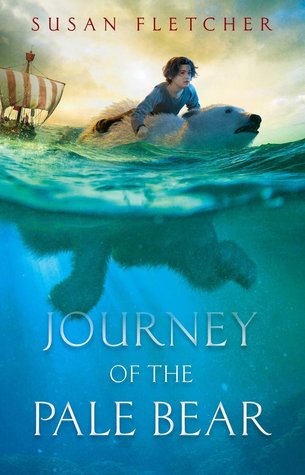
Review and Giveaway!: Journey of the Pale Bear by Susan Fletcher

Share

Journey of the Pale Bear
Author: Susan Fletcher
Publication Date: October 2nd, 2018 by McElderry Books

Summary: The polar bear is a royal bear, a gift from the King of Norway to the King of England. The first time Arthur encounters the bear, he is shoved in her cage as payback for stealing food. Restless and deadly, the bear terrifies him. Yet, strangely, she doesn’t harm him—though she has attacked anyone else who comes near. That makes Arthur valuable to the doctor in charge of getting the bear safely to London. So Arthur, who has run away from home, finds himself taking care of a polar bear on a ship to England.

Tasked with feeding and cleaning up after the bear, Arthur’s fears slowly lessen as he begins to feel a connection to this bear, who like him, has been cut off from her family. But the journey holds many dangers, and Arthur knows his own freedom—perhaps even his life—depends on keeping the bear from harm. When pirates attack and the ship founders, Arthur must make a choice—does he do everything he can to save himself, or does he help the bear to find freedom?

About the Author: SUSAN FLETCHER is the acclaimed author of the Dragon Chronicles as well as the award-winning Alphabet of Dreams, Shadow Spinner, Walk Across the Sea, and Falcon in the Glass. Ms. Fletcher lives in Bryan, Texas. To read about the fascinating story behind the inspiration for Journey of the Pale Bear, visit her website, SusanFletcher.com

Praise: ★”A stupendous coming-of-age tale stuffed with adventure and laced with deeper questions.” — Kirkus Reviews (starred review)

Review: When I first read about this book it sounded pretty good, enough for me to pick it up, but it was SO GOOD! Like so good that even though it was a school week, I read it in 2 days!

First, it takes place in a time period that is hardly ever in books which is fascinating. I found myself looking up some of the history that was mentioned in the book, but the author did a great job of making sure that not knowing about the details of the time period wouldn’t effect the reading experience.

Second, it looks at animal treatment and truly makes you think about how an animal feels when it is put in captivity. Although told only in a realistic manner, the animal is such an integral part of the story that its behaviors are shared in detail allowing it to become a full character within the book.

Third, did you know there used to be a menagerie in the Tower of London? Me neither! But that took me down a suck hole of Google research. So fascinating!

Fourth, wow! The adventure is EPIC: sailing, bullies, pirates, shipwrecks, storms. It never stops!

So in review: Fascinating, thought-provoking, curious, and action-packed. All in all, a book I truly recommend and enjoyed.

Teachers’ Tools for Navigation: The main home for this book will be in libraries; however, I can definitely see portions of it being used in classrooms.

  • First, I could see it being used during a history lesson to discuss the politics and war shared in the book.
  • Second, there are so many scenes that could be pulled out as mentor texts for writing. I’ll share some of my favorites below.
  • Third, I would love to see some creative writing done from the bear’s point of view.
  • Fourth, it is a fascinating look at animal treatment and how it has (and has not) changed over the years.

But in the end, it belongs in kids’ hands! Get it there!

Discussion Questions: 

  • Why did Arthur agree to take care of the bear?
  • What examples throughout the book show that the bear loved and trusted Arthur?
  • What does the whole story of a polar bear being sent from Norway to England show you about the respect of animals during the time period of the novel?
  • How did Arthur’s involvement make the bear’s life better?
  • Do you believe that the doctor cared about Arthur as he said he did? Explain.
  • How did Arthur earn the respect of the sailors on the ship?

Flagged Passages: 

“Its eyes, small and dark, were alert, curious, aware. I felt the faint stirring of its breath against my cheeks. I drew in the rich, ripe scent of bear until I seemed to sink down below the surface of it, drowning. From somewhere far away I heard Hauk and the lantern boy arguing, but the sounds fell away behind the throbbing in my ears and the thrill of the running-hum in my limbs.

The bear rumbled deep in its throat.

I rose to my feet, stepped back, and felt the iron bars press cold against me. I kept my eyes fixed on the pale, wide face, as if the force of my gaze could prevent the bear from lunging at me with its enormous paws or raking me with is claws–claws that I could see out of the corner of my eyes, massive claws, claws from a nightmare of monsters.” (Chapter 3)

“Before we saw the bear, we heard her—a heavy rhythmic read, a thump, a clang. Beyond the reek of fish, I sniffed out the feral musk of her.

We crept through the dark warehouse–the doctor, the captain, and I–until I made out a large, pale, moving form in the deep gloom ahead. The doctor motioned us to stop, and we watched from behind a stack of crates and bales. The bear was as tall as a pony, longer than a caribou, and as wide as two bulls. Back and forth she paced in her cage, and back and forth again, her head swinging side to side on her long neck, the convex bow of her snout lending her an air of nobility. The bear-smell now filled the air, and the stench of dung as well. A surge of fear rose up in me, turning my bones and sinews to liquid.” (Chapter 6)

Read This If You Love: Seekers by Erin Hunter, The Vanishing Islands by Barry WolvertonPirates! by Celia Rees, The Ravenmaster’s Secret by Elvira Woodruff

Recommended For: 

classroomlibrarybuttonsmall 

Giveaway!: 

a Rafflecopter giveaway

Signature

**Thank you to Barbara at Blue Slip Media for providing a copy for review and McElderry Books for providing a copy for giveaway!**

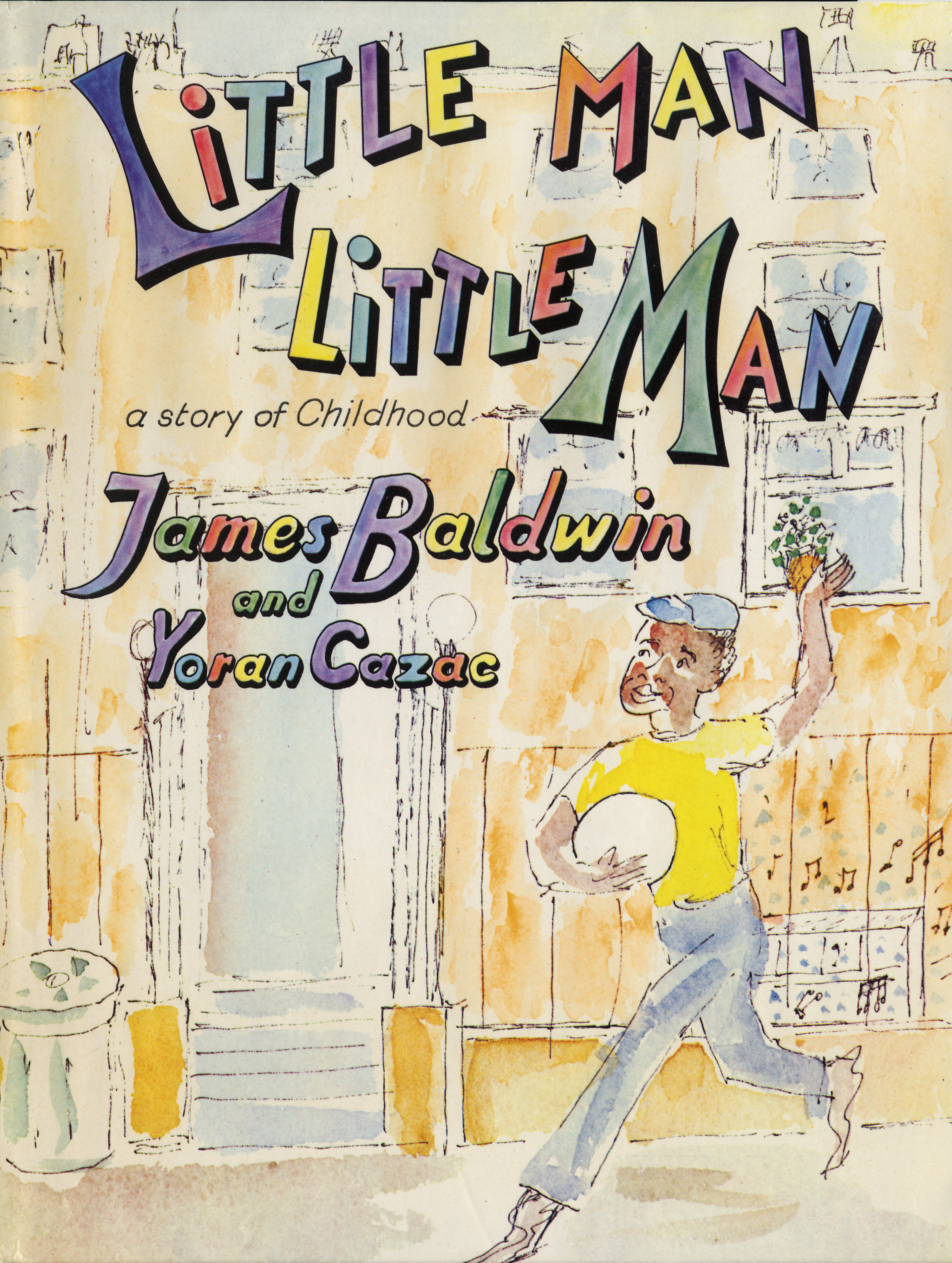
Little Man, Little Man: A Story of Childhood by James Baldwin and Yoran Cazac

Share

Little Man, Little Man: A Story of Childhood
Authors: James Baldwin and Yoran Cazac
Published August 27, 2018 by Duke University Press

Summary: Four-year-old TJ spends his days on his lively Harlem block playing with his best friends WT and Blinky and running errands for neighbors. As he comes of age as a “Little Man” with big dreams, TJ faces a world of grown-up adventures and realities. Baldwin’s only children’s book, Little Man, Little Man celebrates and explores the challenges and joys of black childhood.

Now available for the first time in forty years, this new edition of Little Man, Little Man—which retains the charming original illustrations by French artist Yoran Cazac—includes a foreword by Baldwin’s nephew Tejan “TJ” Karefa-Smart and an afterword by his niece Aisha Karefa-Smart, with an introduction by two Baldwin scholars. In it we not only see life in 1970s Harlem from a black child’s perspective, but we also gain a fuller appreciation of the genius of one of America’s greatest writers.

Ricki’s Review: When I was asked to review this book, I jumped at the opportunity. I am a huge fan of James Baldwin’s work, and I was completely unaware that this book existed! It lived up to my high expectations. The illustrations are beautiful, and the message is powerful. It is harshly realistic and difficult to read, and the book cuts deeply. It will serve as both windows and mirrors for children. This book took me to 1970s Harlem, and I am grateful for the experience. It is a must-read for fans of Baldwin, for those with interest in historical perspectives, and for those seeking a compelling story that will endure.

Kellee’s Review: In the 1970s, Harlem was a different place. TJ is 4 and roams with his friends, and we get to see his community from his point of view. Even the plot felt like his point of view as the story is very focused on events and is almost liked different episodes of his life. Although TJ is quite young, the story is anything but immature. TJ is an active participant in his community: the good and the bad. Mixed with Cazac’s slightly abstract, colorful and emotion-filled art, Baldwin’s story is overall a fascinating historical look at Harlem in the 1970s.

Teachers’ Tools for Navigation: This book is certainly written for younger children, but high schoolers would also find value in a close examination of the text. We’d love to pair this book with some of Baldwin’s texts for adults. High schoolers would have rich conversations if they examined Little Man, Little Man through the lens of some of Baldwin’s other works.

Teacher Resource Guide

Aisha Karefa-Smart, Tejan’s sister, is interviewed today on The Takeaway.

Discussion Questions: 
  • This is a book that has been reprinted from several decades ago. How does the book feel different from other picture books?
  • What did you learn about 1970s Harlem?
  • What did you notice about the phrasing of the book? How does this support your reading?
  • What is the mood of the text?
  • What lessons did you learn?

Flagged Passage: “Music all up and down this street, TJ runs it every day” (p. 2-3).

Book Trailer (Tejan [the character “TJ” is modeled after him] narrates it!):


Read This If You Love: Books by James Baldwin, Matt de la Peña, Coe Booth, Nikki Grimes, or Jacqueline Woodson

Recommended For: 

classroomlibrarybuttonsmall closereadinganalysisbuttonsmall

andSignature

**Thank you to Barbara at Blue Slip Media for providing copies for review!**

Teaching Guide and Review!: Water in May by Ismée Amiel Williams

Share

Water in May
Author: Ismée Amiel Williams
Published September 12th, 2017 by Abrams Books

Summary: Fifteen-year-old Mari Pujols believes that the baby she’s carrying will finally mean she’ll have a family member who will love her deeply and won’t ever leave her—not like her mama, who took off when she was eight; or her papi, who’s in jail; or her abuela, who wants as little to do with her as possible. But when doctors discover a potentially fatal heart defect in the fetus, Mari faces choices she never could have imagined.

Surrounded by her loyal girl crew, her off-and-on boyfriend, and a dedicated doctor, Mari navigates a decision that could emotionally cripple the bravest of women. But both Mari and the broken-hearted baby inside her are fighters; and it doesn’t take long to discover that this sick baby has the strength to heal an entire family.

Inspired by true events, this gorgeous debut has been called “heartfelt, heartbreaking and—yes!—even a little heart-healing, too” by bestselling YA novelist Carolyn Mackler.

About the Author: Ismée Williams is a pediatric cardiologist who practiced at the Columbia University Medical Center in the Washington Heights neighborhood of New York City for fifteen years. She currently sees patients at Montefiore Hospital in the Bronx. As the daughter of a Cuban immigrant, partially raised by her abuelos, her background helped her understand the many Maris she met along the way. Water in May is her first novel.

Praise: 

“Full of spot-on cultural texture and packing an emotional punch, this is an unusual take on the teen-pregnancy problem novel… Williams presents her experience in a way that demands not pity but respect while also reminding readers of Mari’s heartbreaking youth and innocence at unexpected times…Fierce and tender—and absolutely worth reading.” — Kirkus, STARRED REVIEW

“Mari is a deeply credible character, a girl who’s always spoiling for a fight, usually a physical one, but who’s turning that impulse into fighting for her baby. Williams, formerly a pediatric cardiologist at Columbia, brings vivid authenticity to the medical side of things, including the details of life with a baby in the NICU and the varying personalities of health care personnel.” — Bulletin of the Center for Children’s Books

“This novel is realistic and compelling, heartfelt and heartbreaking all at the same time. The author’s experience as a pediatric cardiologist brings authenticity to her writing as much as does her experience of navigating cultural barriers. Young adult readers will connect with Mari’s feisty personality, strength, and vulnerability.” — VOYA Magazine

Review: Mari’s story is one that isn’t often told. Mari is someone most people would see on the streets and would try to ignore because getting to know her would be getting to know how hard life in America can be. But Mari is also someone who is stronger than many of us will ever be. Her story is one that will make readers think about assumptions OR will help readers see a mirror into struggles they may be having in life. Although I hope teens don’t see Mari’s story as an invitation for a teenage pregnancy, I believe the truth of her hardships show the tremendous change a baby brings to life and will show that Mari’s decisions are made out of desperation when there are other paths she could have taken. Some who read the book have said they don’t like Mari as a character, but I found that when Mari was frustrating, it was because she was acting like what she is: a fifteen-year-old girl trying to find her place in this crazy world.

Teachers Guide with Activities and Discussion Questions written by me: 

Guide can also be accessed through Abrams Books’s Resource Page.

Recommended For: 

classroomlibrarybuttonsmall 

Signature

**Thank you to Ismée Williams for finding me and allowing me to complete this guide!**

Blog Tour with Reviews and Teaching Tools: Adrian Simcox Does NOT Have a Horse by Marcy Campbell & Corinna Luyken

Share

Adrian Simcox Does NOT Have a Horse
Author: Marcy Campbell
Illustrator: Corinna Luyken
Published August 14th, 2018 by Dial Books

Summary: A classic in the making, this heartwarming story about empathy and imagination is one that families will treasure for years to come.

Adrian Simcox tells anyone who will listen that he has a horse–the best and most beautiful horse anywhere.

But Chloe does NOT believe him. Adrian Simcox lives in a tiny house. Where would he keep a horse? He has holes in his shoes. How would he pay for a horse?

The more Adrian talks about his horse, the angrier Chloe gets. But when she calls him out at school and even complains about him to her mom, Chloe doesn’t get the vindication she craves. She gets something far more important.

Written with tenderness and poignancy and gorgeously illustrated, this book will show readers that kindness is always rewarding, understanding is sweeter than judgment, and friendship is the best gift one can give.

About the Creators:


Marcy Campbell lives in Ohio with her family and menagerie of rescued pets. Her writing for adults has been published widely in journals and magazines, including Salon. She grew up on a farm filled with cows, chickens, cats, and dogs, but she never had a horse. Adrian Simcox Does NOT Have a Horse is her debut picture book. You can visit her at www.marcycampbell.com.

Corinna Luyken grew up in different cities along the West Coast, and after studying at Middlebury College, she settled in Washington State, where she draws inspiration from nature, her family, and the human form. Her debut picture book, The Book of Mistakes, received four starred reviews and has been praised by Entertainment WeeklyThe Wall Street Journal, Nerdy Book Club, and more.

Kellee’s Review: 43.1 million Americans (as of 2016) live below the poverty line. Adrian Simcox represents one of those kids while Chloe represents too many peers. But what made this book for me was Chloe’s transformation. It wasn’t Adrian who needed to change! Adrian is a wonderful kid that too many people judge based on his circumstances when really it is all about who he is, and I am so thankful for Chloe finding the truth out in the end. This book will make kids rethink how they judge others and really does emote empathy and kindness. And I couldn’t review this book without giving a shout out to the beautiful illustrations. They are ART.

Ricki’s Review: I loved this book so much that I bought a copy for my son’s preschool teacher. I love that it can be read from a multitude of angles, and it provides so much fodder for classroom conversations. The illustrations are magical, the story is magical—everything about this book is magical. My son’s preschool teacher told me that the kids asked her to read it four times in a row. Although I am not sure if they spent time discussing poverty, I do know that those children (at the very least) received implicit messages about the truth of poverty and the power of imagination. I suspect this book will receive some major awards. It is one of my favorites of the year.

Teachers’ Tools for Navigation: Read this book aloud and talk about it with kids. Period. The illustrations can also definitely be visually analyzed. First, if you didn’t notice, there is a horse hiding in many of the illustrations. Second, so much of the story is told in the illustrations–don’t forget to analyze them!

Discussion Questions: 

  • Why did Chloe judge Adrian without knowing him?
  • Why do you think Chloe cares so much about Adrian’s horse?
  • How did Chloe’s mom help her realize that she is not being compassionate?
  • How did the illustrator tell more of a story in the artwork?
  • Why do you believe the author wrote Adrian’s story?

Flagged Passages: 

Read This If You Love: Each Kindness by Jacqueline Woodson, I Walk with Vanessa by Kerascoët

Recommended For: 

classroomlibrarybuttonsmall 

Don’t miss other stops on the blog tour: 

August 6 – Lost in Storyland
August 7 – The Readathon
August 8 – Happily Ever Elephants
August 9 – Read. Learn. Repeat
August 10 – Kid Lit Frenzy
August 13 – Here Wee Read
August 14 – DoodleMom
August 15 – Eastern Sunset Reads
August 16 – Critter Lit
August 17 – Unleashing Readers

Signatureand 

**Thank you to Friya at Penguin Young Readers for setting up the blog tour!**