YALSA Morris Finalists’ Blog Hop: Gabi, a Girl in Pieces by Isabel Quintero

Share

gabit

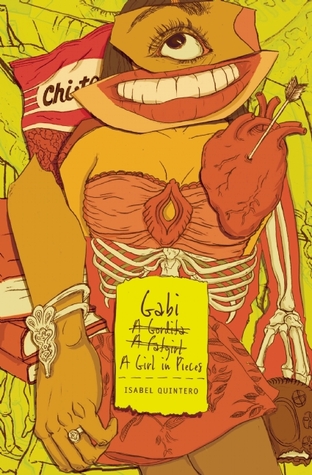
Gabi, A Girl in Pieces
Author: Isabel Quintero
Published October 14th, 2014 by Cinco Puntos Press

Goodreads Summary: For all the gorditas, flaquitas, and in-between girls trying to make their space in the world. Don’t worry, you got this.

Gabi Hernandez chronicles her last year in high school in her diary: college applications, Cindy’s pregnancy, Sebastian’s coming out, the cute boys, her father’s meth habit, and the food she craves. And best of all, the poetry that helps forge her identity.

Author Bio: Isabel Quintero is a library technician in the Inland Empire. She is also the events coordinator for Orange Monkey and helps edit the poetry journal Tin Cannon. Gabi is her debut novel.

Kellee’s Review: What I found in this book was a book of truth. While I normally find a book that has so many topics in it to be cumbersome (just some of the topics hit were: pregnancy, abortion, meth, family, religion, ethnicity, school, homosexuality, sex, death, poetry, college, rape, and gender expectations), I felt that Gabi was just truthful. Her story was just a story full of real life which just happens to be messy. I enjoyed the unique format, the diversity (not just race/ethnicity, but lbgt, body size, class, ELL, etc.), and the amazing cast of characters. Gabi’s voice rang true throughout, and even got stronger as she became more independent within the story. Well done.

Teacher’s Tools for Navigation: Parts of Gabi’s story could easily be pulled out to be a mentor text for many different literary elements; however, I feel like one of the best ways it could be used is to have students emulate Gabi’s writing. For example, Gabi writes letters to her father sharing how she really feels. Students could write to someone sharing something with them that they are keeping from them. You could also use Gabi’s magazine and poetry the same way. Gabi’s writing is very raw, and I think that students will definitely connect with it.

Discussion Questions: Gabi makes a choice towards the end of the book that makes Cindy be upset with Gabi. Do you agree with what Gabi did?; Gabi’s mother is very protective of her. Why do you think she is so hard on Gabi?; Gabi deals with body issues throughout the book. How do you think our society affects how she pictures herself?; Sebastian and Cindy’s parents are both disappointed in their kids for different reasons and deal differently with their disappointment. Do you agree with how they treat their children?

We Flagged: “My brother is fifteen. He knows many things. He knows how to make a pipe out of an apple, and he knows how to make beautiful murals on public property. He likes wresting and biking and skateboarding but doesn’t like school because school doesn’t understand kids like us. My brother–the brat, the crybaby, the quite one, the brown one, Mami’s favorite: where will he go? I ask myself the question over and over. Y no se. I don’t know where he will go, but I hope wherever it is it’s better than here.” (p. 94)

Read This If You Loved: Yaqui Delgado Wants To Kick Your Ass by Meg Medina, Jumped In by Patrick Flores-Scott, What Can(t) Wait by Ashley Hope Perez, Under the Mesquite by Guadalupe Garcia MacCall, Bridget Jones Diary by Helen Fielding

Recommended For:

 litcirclesbuttonsmall classroomlibrarybuttonsmall

Make sure to stop by Cinco Puntos Press blog to see the other stops on the tour!

Signature

**A special thank you to Jessica Powers at Cinco Puntos Press for organizing this blog hop!**

How It Went Down by Kekla Magoon

Share

how it went down

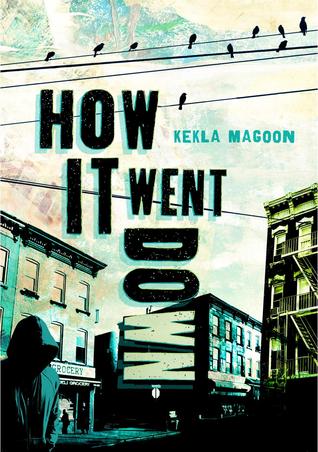
How It Went Down
Author: Kekla Magoon
Published: October 21, 2014 by Henry Holt and Co.

Goodreads Summary: When sixteen-year-old Tariq Johnson dies from two gunshot wounds, his community is thrown into an uproar. Tariq was black. The shooter, Jack Franklin, is white.

In the aftermath of Tariq’s death, everyone has something to say, but no two accounts of the events line up. Day by day, new twists further obscure the truth.

Tariq’s friends, family, and community struggle to make sense of the tragedy, and to cope with the hole left behind when a life is cut short. In their own words, they grapple for a way to say with certainty: This is how it went down.

Ricki’s Review: In light of the recent protests, this is an incredibly insightful book that is very important. The point-of-view shifts every 2-3 pages, which was very thought-provoking. Too often, books depict stereotypical portrayals of members of cultures, and the gamut of characters within this text felt very realistic. For some, this book may be too gritty and too uncomfortable. There is nothing comfortable about discussions regarding inequities and privilege in society. But if you walk down the halls of my high school, there is nothing in the book that is not a concern in schools. This is not a feel-good read, but it made me think. And thinking…is a very good thing.

Teacher’s Tools for Navigation: There is much to discuss in this book. Teachers could use it to start conversations about power and privilege. There are a lot of discrepancies between the characters’ perceptions of the shootings, and I imagine students would disagree about what happened. Teachers might elect to hold a verbal or silent debate. Also, I would love to discuss the structure of the text. The creativity in the form is purposeful, and it would be interesting for students to investigate why Magoon structured it in the way she did.

Discussion Questions: Why does Magoon structure the novel with alternating voices? How is the novel structured as a whole?; Does this story serve as a counter-narrative? If so, how? If not, why not?; Did Tariq have a gun in his hand? Why do/don’t you think so?; How does the story evolve as time passes?

We Flagged: “As a black man, you have to keep your head down. You have to keep yourself steady. You have to follow every rule that’s ever been written, plus a few that have always remained unspoken.”

Read This If You Loved: The Outsiders by S.E. Hinton, On the Run by Alice Goffman, The New Jim Crow: Mass Incarceration in the Age of Colorblindness by Michelle Alexander, Monster by Walter Dean Myers, The Brothers Torres by Coert Voorhees, Autobiography of my Dead Brother by Walter Dean Myers

Recommended For:

 litcirclesbuttonsmall classroomlibrarybuttonsmall

RickiSig

All the Bright Places by Jennifer Niven

Share

all the bright places

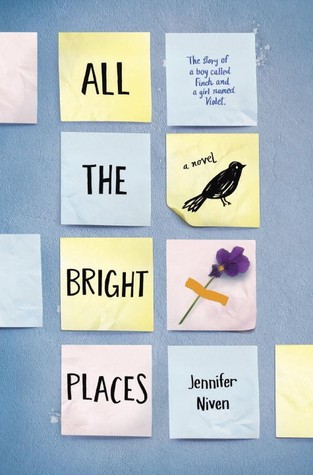
All the Bright Places
Author: Jennifer Niven
Published: January 6, 2015 by Knopf

Goodreads Summary: The Fault in Our Stars meets Eleanor and Park in this compelling, exhilarating, and beautiful story about a girl who learns to live from a boy who intends to die.

Theodore Finch is fascinated by death, and he constantly thinks of ways he might kill himself. But each time, something good, no matter how small, stops him.

Violet Markey lives for the future, counting the days until graduation, when she can escape her Indiana town and her aching grief in the wake of her sister’s recent death.

When Finch and Violet meet on the ledge of the bell tower at school, it’s unclear who saves whom. And when they pair up on a project to discover the “natural wonders” of their state, both Finch and Violet make more important discoveries: It’s only with Violet that Finch can be himself—a weird, funny, live-out-loud guy who’s not such a freak after all. And it’s only with Finch that Violet can forget to count away the days and start living them. But as Violet’s world grows, Finch’s begins to shrink.

This is an intense, gripping novel perfect for fans of Jay Asher, Rainbow Rowell, John Green, Gayle Forman, and Jenny Downham from a talented new voice in YA, Jennifer Niven.

Ricki’s Review: A publishing representative who I deem to be a friend pressed this book into my hand. “Read it,” she insisted. She told me I would want to curl up into a ball in my bed and fall into this book. I fell hard. The writing is incredible. I hate to compare books with others because it creates a sense of expectation that often goes unfulfilled for future readers, but I couldn’t help but consider comparisons with my all-time favorite YA texts. The quirky nature of the characters reminded me of Pudge, Alaska, Charlie, Eleanor, and Park. The direction of the plot reminded me of other titles (which will remain unnamed to prevent spoilers). But I cannot compare this book to others because while it allowed to me reminisce about my favorite titles, it was quite different. The deep, honest, hard-hitting depiction of mental illness was enough to take my breath away. I felt rage that made me want to punch my mattress; I felt sadness that made me feel a hopeless sense of emptiness; but above all, I felt the power of love, loyalty, and friendship that made my heart both ache and swell. This is an unforgettable book. I suspect it will be the book that everyone will be talking about this year and for years to come.

Teacher’s Tools for Navigation: Mental illness and bullying are pervasive in our schools. We can’t teach enough books about these themes because they are incredibly relevant for young people. As a former teacher, I was jealous of the teacher who created the assignment for Violet and Finch, and I wanted to do it with my former students. It would be so neat to duplicate this project while students read the book. Additionally, I think students would benefit from creating their own version of the post-it collages that Violet and Finch make. As an alternative, I would consider having students research the warning signs of suicide and finding these instances in the text. There are so many themes for the students to consider, the teaching categories at the top and tags at the bottom of this post show a variety of different directions a teacher might take with the instruction of this text.

Access the book’s website to share your bright place or read Germ MagazineThe educator guide also has CCSS tie-ins.

Discussion Questions: What is the end message of this book? What is the author’s purpose?; What foreshadowing does Niven provide?; How do Violet’s family members show their grief in different ways?; Do you agree with the ending? Would you change it? Why do you think Niven ended the book in the way she did?

We Flagged: “It’s my experience that people are a lot more sympathetic if they can see you hurting, and for the millionth time in my life I wish for measles or smallpox or some other easily understood disease just to make it easier on me and also on them.”

**Please note: The above quotation is from an advanced reader copy. The quotation may change in the final published form of the text.**

Read This If You Loved: Looking for Alaska by John Green, Eleanor and Park by Rainbow Rowell, Dr. Bird’s Advice for Sad Poets by Evan Roskos, The Fault in Our Stars by John Green, Forgive Me, Leonard Peacock by Matthew Quick, It’s Kind of a Funny Story by Ned Vizzini, The Perks of Being a Wallflower by Stephen Chbosky, Twisted by Laurie Halse Anderson, Everybody Sees the Ants by A.S. King, Burn by Suzanne Phillips

Recommended For:

 closereadinganalysisbuttonsmall litcirclesbuttonsmall classroomlibrarybuttonsmall

RickiSig

Rain Reign by Ann M. Martin (Kellee’s Review)

Share

rain

Rain Reign
Author: Ann M. Martin
Published October 7th, 2014 by Feiwel & Friends

Goodreads Summary: In her most powerful novel yet, Newbery Honor author Ann M. Martin tells the story of girl with mental/emotional challenges and the dog she loves.

Rose Howard has OCD, Asperger’s syndrome, and an obsession with homonyms (even her name is a homonym). She gave her dog Rain a name with two homonyms (Reign, Rein), which, according to Rose’s rules of homonyms, is very special. Rain was a lost dog Rose’s father brought home. Rose and Rain are practically inseparable. And they are often home alone, as Rose’s father spends most evenings at a bar, and doesn’t have much patience for his special-needs daughter.

Just as a storm hits town, Rain goes missing. Rose’s father shouldn’t have let Rain out. Now Rose has to find her dog, even if it means leaving her routines and safe places to search. Rose will find Rain, but so will Rain’s original owners.

Hearts will break and spirits will soar for this powerful story, brilliantly told from Rose’s point of view.

My Review and Teachers’ Tools for Navigation: If you have read A Corner of the Universe,  you know what an emotionally-charged author Ann M. Martin can be, and she once again tells a heart-wrenching story with a voice that will not leave your head. In Rain Reign, Martin tackles Rose’s story. Rose is such a true character. A brilliant young girl with OCD and Asperger’s syndrome who is obsessed by homonyms. She is a girl that is so unique and intriguing. As a teacher, I very much connected with her and how I would nurture her gifts within my classroom; however, I also saw the challenges that Rose faces as well.

What makes this book truly stand out is the first person point of view. You, as the reader, are in Rose’s mind and living her life. You experience the neglect of her father, the love of Reign, the obsessiveness, the homonyms, the outbursts, and the support of her uncle. Because I was IN her life, I just couldn’t put down the book. I had to know that Rose and Rain were going to be okay.

As a teacher, I want kids to read this book because they will fall in love with Rose and Rain. Through this love, they will build empathy in their hearts because they will just want to know that Rose and Rain will be okay.

Ricki’s Review: Check out Ricki’s Review here!

Discussion Questions: How do you feel about Rose’s dad?; Can you think of homonyms that weren’t mentioned in the book?; Do you think it was right of Rose’s dad to take Rain?; How would you feel if your dog disappeared?

We Flagged: “I’m going to tell you a story. It’s a true story, which makes it a piece of nonfiction.

This is how you tell a story: First you introduce the main character. I’m writing this story about me, so I am the main character.

My first name has a homonym, and I gave my dog a homonym name too. Her name is Rain, which is special because it has two homonyms–rein and reign. I will write more about Rain in Chapter Two. Chapter Two will be called “My Dog, Rain (Rein, Reign).”

Something important about the word write is that is has three homonyms–right, rite, and wright. That’s the only group of four homonyms I’ve thought of. If I ever thing of another four-homonym group, it will be a red-letter day.” (Chapter One)

Read This If You Loved: Rules by Cynthia Lord, Wonder by R.J. Palacio, Mockingbird by Kathryn Erskine, Out of my Mind by Sharon Draper, Each Kindness by Jaqueline Woodson

Recommended For: 

classroomlibrarybuttonsmall readaloudbuttonsmall litcirclesbuttonsmall

Signature

Blog Tour, Review, and Author Q&A!: Bramble and Maggie Series by Jessie Haas

Share

bramble1 bramble2 bramble3

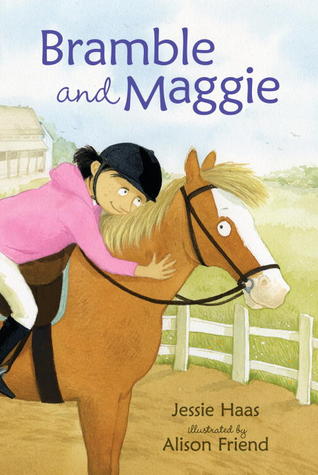
Bramble and Maggie: Horse Meets Girl
Published March 27th, 2012 by Candlewick Press
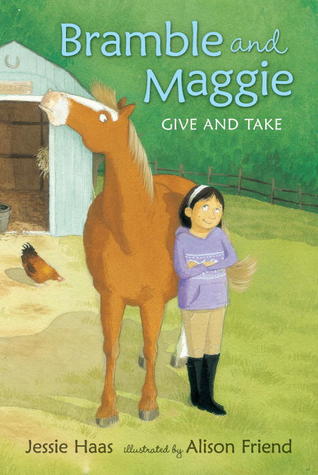
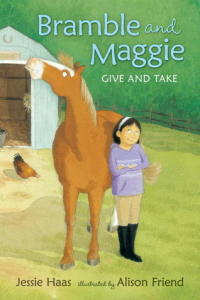
Bramble and Maggie: Give and Take
Published April 23, 2013 by Candlewick Press
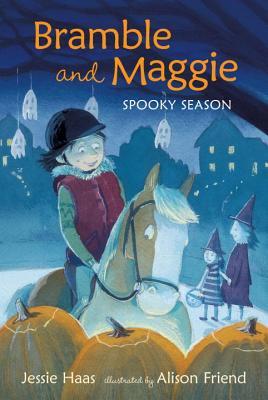
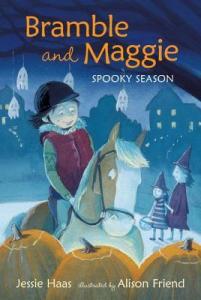
Bramble and Maggie: Spooky Season
Published August 12th, 2014 by Candlewick Press
Author: Jessie Haas
Illustrator: Alison Friend

Bramble and Maggie: Horse Meets Girl Goodreads Summary: Come along for a spirited ride as Bramble – a horse with interesting “little ways”- and her devoted girl, Maggie, make their debut in this inviting early reader.

Maggie wants a pony to ride and take care of, and to prepare she’s been reading a big book on horse care. Meanwhile, Bramble is bored with giving riding lessons and walking in circles. She’s looking for just the right person to take her away from her routine. Is it a perfect match? Maggie loves Bramble as soon as she sees her, but there are some things Bramble has to be sure of. Will Maggie let Bramble venture into new places? Will she protect Bramble from strange objects in the yard? Will she, most importantly, know when Bramble needs her undivided attention? This charming and funny early reader is an ideal match for young animal lovers and anyone who has ever longed for a friend who truly understands.

Bramble and Maggie: Give and Take Goodreads Summary: Maggie and her mischievous horse, Bramble, are back for another spirited romp through the ins and outs of friendship.

Maggie loves introducing her new horse, Bramble, to the neighborhood, the beach, and the backyard. Bramble has fun too, once she is cajoled into participating by a well-timed carrot or two. But when Maggie has to go to school, Bramble is bored and lonely and gets into some trouble with Mr. Dingle next door. A misbehaving hen and a midnight visitor finally help to turn Bramble into a good neighbor. This charming and funny early reader flows at just the right pace for kids who are learning that others don’t always do exactly what you want, but that friends find a way to give and take.

Bramble and Maggie: Spooky Season Goodreads Summary: Bramble, a persnickety but lovable horse, and Maggie, her patient owner, build an even stronger friendship as they brave the surprises of autumn.

In their third adventure, Bramble and Maggie explore a new season together — fall! Leaves crunch underfoot. Acorns ping off rooftops. It all makes Bramble feel wonderfully spooky. But Bramble’s frisky-pretend-scary gait makes Maggie jumpy, and soon Bramble really is nervous. There are alarming new sights and sounds everywhere, like Mr. Dingle’s scarecrow. When Maggie takes a fall, will she want to get back in the saddle? And when Halloween comes, can Maggie trust Bramble to brave the tricks and lead them both safely to the treats?

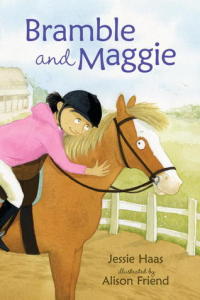
Kellee’s Review: There is a very specific time in a kid’s life where they are ready to begin reading longer books, but not ready to tackle chapter books yet. This is where Bramble and Maggie fits. These early chapter books will are perfect texts to help lead kids to longer chapter books. The work well for their targeted age level in that they never speak down to readers and have excellently paced stories that hold readers’ attention and will help them feel successful.  On top of all this, the Bramble and Maggie stories are just so sweet! I love all the different adventures they go on and the lessons they learn like overcoming fear, conquering loneliness, and gaining responsibility. Readers will adore these books. 

Ricki’s Review: Kellee hit the nail on the head. As I was reading, I thought to myself, “Why didn’t I have these books available to me when I was transitioning to chapter books?” I remember being devastated that my books no longer had pictures in them, and I resisted the longer texts for this reason. This series is engaging, educative, and fun! The words repeat in ways that will help students learn the vocabulary, particularly the more difficult words that relate to horses. Each book delivers a strong message, and the bond between Bramble and Maggie is one which will connect with readers. When I think about these books, I will always remember Maggie dragging her sleeping bag to the stable to sleep beside Bramble. I can’t wait to share these books with my pre-service elementary school teachers. They will have a special place in classrooms.

Teachers’ Tools for Navigation: Readers would be wise to explore how Haas develops theme in these texts. Each individual book has a different theme, and the content beautifully incorporates the messages. These books would be great models for students to learn about implicit versus explicit themes.

Discussion Questions: What lessons has Maggie learned since she has gotten Bramble? What lessons has Bramble learned since he’s met Maggie?; How has Bramble changed since he went to live with Maggie?; In what ways does the author show the bond of friendship throughout the books?

We Flagged: “Bramble lowered her head. Maggie gave her a carrot, and Bramble took it. She let Maggie put on the bridle. This was better. Give and take” (p. 9 of Bramble and Maggie: Give and Take)

Read This If You Loved: The Franklin School Friends series by Claudia Mills, The Pony Mysteries series by Jeanne Betancourt, and The Pony Scout series by Catherine Hapka

Recommended For:

  litcirclesbuttonsmall classroomlibrarybuttonsmall

Q & A with Jessie Haas

What inspired you to write this series? What inspired you to write about a horse?

I was inspired by two things in writing the Bramble and Maggie books. First, I had a story rejected by Candlewick, but with a request attached. The editor had girls who loved horses and horse books and had read some of mine and they noticed that they were always checked out of the public library. So Candlewick asked if I would like to write a couple of books for beginning readers.

At the time I had just gotten a new horse, Robin. She has a somewhat prickly personality, which I think inspired Bramble’s name, and the way horses and people mesh with each other was on my mind. Of course, I knew my version of events, but I’m always aware that horses have their own points of view, so the story would need to be told from both Bramble’s and Maggie’s perspectives.

What was it like to work with an illustrator? What does the process look like?

Like most authors, I don’t actually “work with” the illustrator. The editor and I work until we have a solid draft. Then the text is sent to the illustrator and she sends sketches. When the editor and I see them, it becomes obvious where we need to add or drop words (usually drop) to make space on the page. A lot of times, the art is telling the story already, and that makes some of the words unnecessary.

Alison Friend lives in England, so we did have one big change she needed to make in the first book. The wonderful picture at the beginning of Chapter Two, with Maggie and her family in the car, had the steering wheel on the right, as in British cars. I must admit, it took me a few times looking at the pictures to spot that. The pencil sketches are always funny and energetic, but the magic happens when Alison begins to paint, and it is always tremendously exciting to see the finished pages. And I got to see the original art for Spooky Season, which was thrilling. I think Spooky Season is one of the most beautiful books I have ever had published.

How do you envision your texts being taught in classrooms? Do you have any suggestions for our viewers who are teachers?

I’m usually stumped by that question. Now, though, I have a great new curriculum guide (it’s a free download on my website) I love some of the ideas there. Spooky Season, the newest book, explores the theme of fear—how we pretend to be afraid (for fun), how we scare ourselves (for fun), and how we sometimes get really scared—and that’s not fun! Bramble is truly afraid of some Halloween decorations like Mr. Dingle’s scarecrow—until she finds out it’s good to eat

Maggie runs into the situation every horseman faces sooner or later. You fall off, and you know you’re supposed to get right back on, or the fear will grow and you might not be able to. That’s easier said than done, of course. But Bramble takes care of Maggie the way good horses do, and Maggie has the experience that I remember from my own life as my very first time confronting and overcoming fear. These are great discussions to have around Halloween.

For Give and Take, the discussion is more about a truly basic issue in children’s—indeed, everyone’s—lives: power. Bramble feels that no one should be the boss all of the time. There should be some give and take. As well as story sequencing discussions, this is a chance for children to talk about—and draw—a time in their own lives when they learned to share, and give a little.

And Horse Meets Girl has a wonderful activity where children are encouraged to imagine, describe and draw their ideal pet. I also love the idea of Maggie needing a babysitter for Bramble, which could be a springboard for kids writing their own stories. The curriculum guide was created for me by Blue Slip Media, working with an educational consultant who’s also an elementary school teacher, and it’s keyed to Common Core curriculum standards—so it’s educationally sound as well as fun.
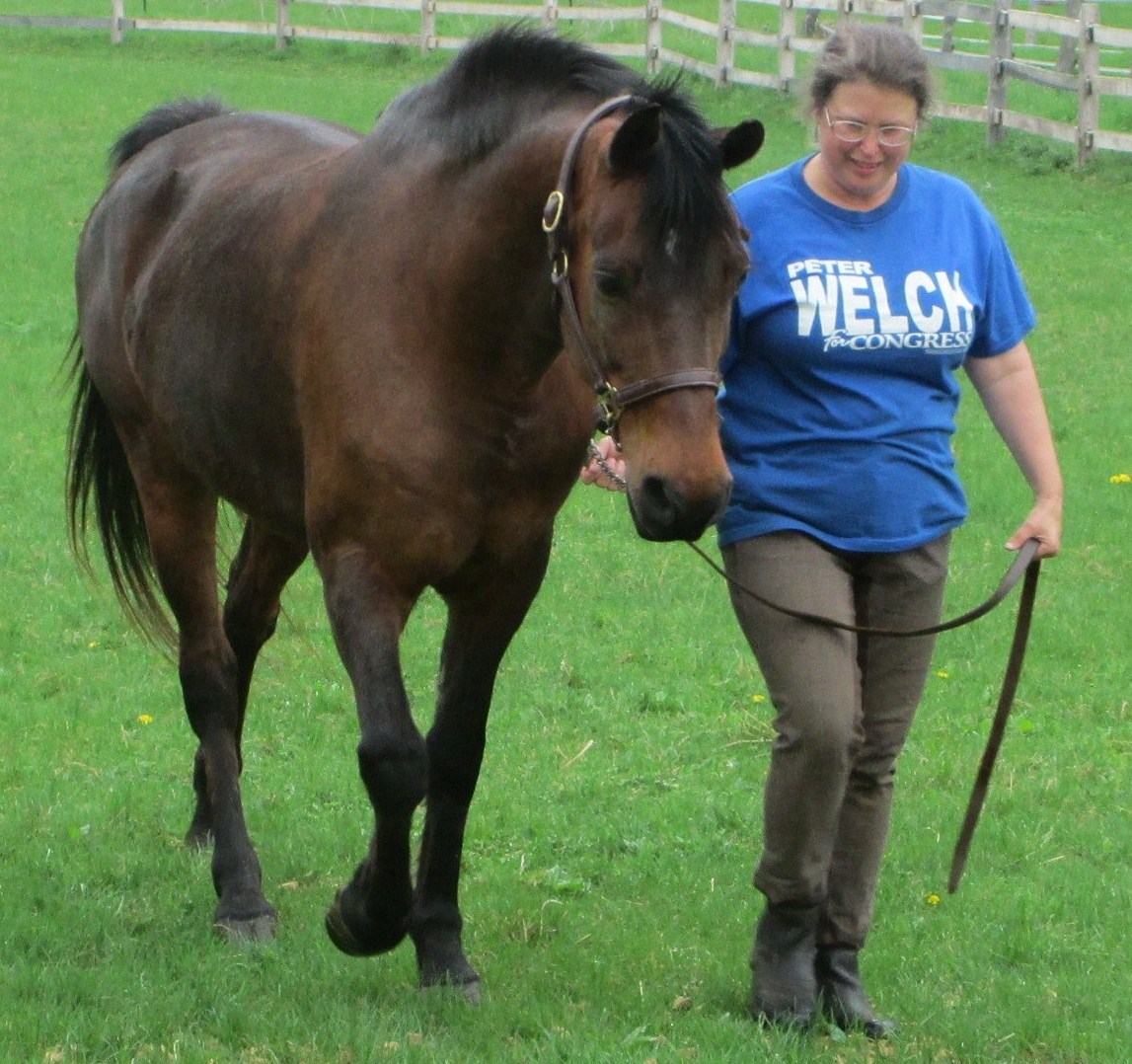
Jessie Haas 2 Jessie Haas w horse

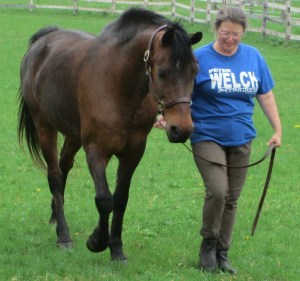
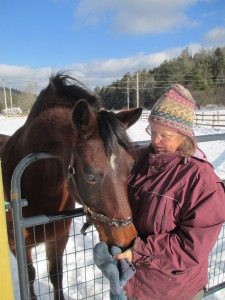
Jessie Haas has always loved horses and has written more than thirty books, most of them about horses, including the first two books ab out Bramble and Maggie. She says, “Horses love pretending to be scared, just like us, and fall is the perfect season for that. Why do they call it fall?” Jessie Haas lives in Vermont with her husband, writer Michael J. Daley; her horse; two cats; a dog; and a hen. For more information, and to download a free curriculum guide, visit her website: http://www.jessiehaas.com/.

RickiSigand Signature

**Thank you to Barbara at Blue Slip Media and Jessie Haas for having us as part of the blog tour!**

Blog Tour, Review, Giveaway, and Author Guest Post!: The Top-Secret Diary of Cecile Valentine: Friendship Over by Julie Sternberg

Share

topsecretdiary

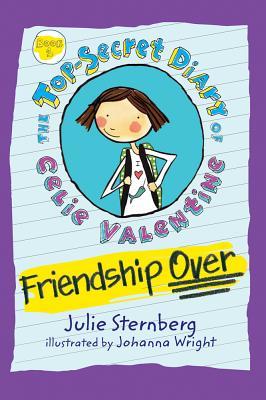
The Top-Secret Diary of Celie Valentine: Friendship Over
Author: Julie Sternberg
Illustrator: Johanna Wright
Published October 1st, 2014 by Boyds Mills Press

Goodreads Summary: Ten-year-old Celie has quite a few things on her mind — fights with her sister Jo, secrets at school, an increasingly forgetful grandmother, and worst of all, a best friend who won’t speak to her. How can a girl who hates change survive, when everything in her life is changing? By writing, of course! Celie’s often comical and always heartfelt diary entries include notes, e-mails, homework assignments, and pages from her top-secret spy notebook.

My Review: I am a very big fan of Julie Sternberg’s Eleanor books. What I enjoy the most about these books is that Julie Sternberg has a way to get into 10 year old’s heads and make her narrator’s voice sound so spot on. As someone who teaches middle school, I am always so impressed when a first person narrative sounds like the students I teach. When I found out that Julie Sternberg had a new series coming out and it would be a diary, I was super excited, and this book did not disappoint.

Celie fills her journal with her deepest thoughts, her art, and other items that help tell her story. Readers will connect with Celie while she deals with her grandmother’s declining health, her best friend’s sudden silence, and her older sister’s identity issues. Great discussions will start with questions such as “Have you and your best friend ever gotten into a fight?”

I asked Julie to share with us how she find her inner 10-year-old voice so effectively. Here is her answer: 

I’m fixated on voice in writing. It’s problematic. I tend to spend weeks—sometimes months—on the first thirty or so pages of a novel, trying and trying to get the voice right. I cannot move forward until I believe I’ve succeeded.

I recognize that this is a silly way to write. I tell myself, Turn off your internal editor! Knock out a terrible first draft! Revising is so much easier than confronting a blank page. Just KEEP GOING! 

But I never can. Because without the right voice, I don’t have a book.

When I think about voice, I think about not just who is telling the story, but also to whom. Audience makes a difference. A child, for example, will relate an anecdote differently to a teacher than to a best friend. So, for my first series, Like Pickle Juice on a Cookie and its sequels, I imagined the main character, Eleanor, telling stories to a friend her age. And, for my latest series, The Top-Secret Diary of Celie Valentine, I imagine Celie pouring her uncensored thoughts into a diary.

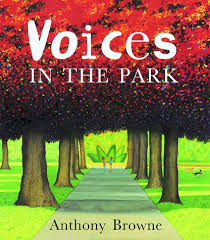
Voice is most shaped by the narrator’s personality and background. When I need a brilliant reminder of this, I re-read Voices in the Park, a picture book by Anthony Browne. In it, four separate narrators tell their version of the same story (one shared afternoon in the park). We get a staggeringly clear sense of each character just from the voice they use to relate that simple story.

voices in the park cover

When I’m trying to define a voice, I pay particular attention to the rhythm and structure of sentences. In The Top-Secret Diary of Celie Valentine, for example, feisty Celie uses simpler and more pointed sentences than her chattier and messier older sister, Jo. For instance, here’s the first sentence in a long note that Jo writes to Celie: “Mom says I’m not allowed to talk to you (I’m supposed to ‘give you your space’) until the end of your timeout, so I can’t just go in there and tell you this, which is what I really want to do.” Celie responds in three sentences, not one of which has more than four words.

A compelling voice can compensate for a host of sins. I learned this as a reader. Some of my favorite books could have better plots, for example. I don’t care. I love the voice in those books, and I want to spend my days with their narrators.

Of course I don’t write perfect books, either (though I want to). If readers nonetheless want to spend their days with Eleanor or Celie or my other narrators because of their voices, then I’m ecstatic.

Author: Julie Sternberg is the author of the best-selling Like Pickle Juice on a Cookie and its sequels, Like Bug Juice on a Burger and Like Carrot Juice on a Cupcake. Like Pickle Juice on a Cookie is a Gryphon Award winner and a Texas Bluebonnet Award finalist; Like Bug Juice on a Burger is a Gryphon Honor Book, a Pennsylvania Young Reader’s Choice Awards Nominee, and an Illinois Monarch Award Finalist. Formerly a public interest lawyer, Julie is a graduate of the New School’s MFA program in Creative Writing, with a concentration in writing for children. She lives with her family in Brooklyn, New York. For more information about her life and work and to download free activity materials based on her books, visit her website: juliesternberg.com.

We Flagged: 

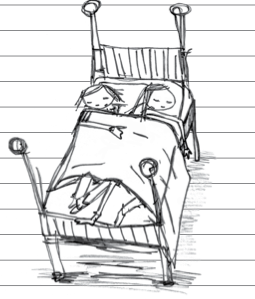
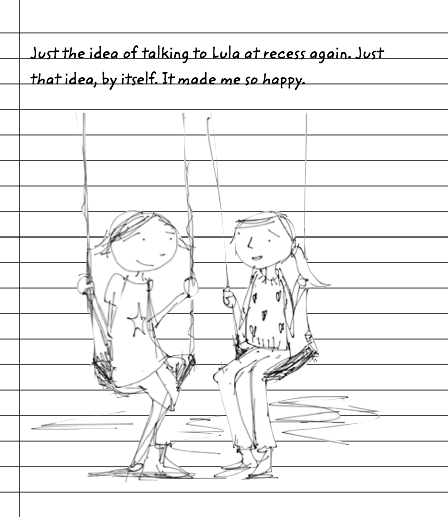
Johanna Wright illustration_Celie and Jo in bed image-on-swing-set-with-words

From Julie Sternberg’s website

Read This If You Loved: Eleanor series by Julie Sternberg, Middle School is Worse than Meatloaf by Jennifer L. Holm, Where I Live by Eileen Spinelli, The Popularity Papers by Amy Ignatow, Mackenzie Blue by Tina Wells

Recommended For: 

classroomlibrarybuttonsmall

Also don’t forget to check out the other stops on Julie’s blog tour: 

Mon, Sept 29
Mother Daughter Book Club
Tues, Sept 30
5 Minutes for Mom
Wed, Oct 1
Sharpread
Thurs, Oct 2
KidLit Frenzy
Fri, Oct 3
The Hiding Spot
Sat, Oct 4
Booking Mama
Mon, Oct 6
Ms. Yingling Reads
Tues, Oct 7
GreenBeanTeenQueen
Wed, Oct 8
Great Kid Books
Thurs, Oct 9
Teach Mentor Texts
Fri, Oct 10
Unleashing Readers
Sat, Oct 11
Bermuda Onion

GIVEAWAY

a Rafflecopter giveaway

Signature

**Thank you to Barbara at Blue Slip Media for providing a copy for review and having us be part of the blog tour!!**

Touched by Paul Maurer

Share

touched

Touched
Author: Paul Maurer
Published February 6th, 2013 by New Libri Press

Goodreads Summary: Landmines. Quicksand. Class warfare. Now if Jimmy Parker could only find high school that simple. It only gets more complicated when a mysterious female classmate with a special gift enters his life. Jimmy finds out quickly that a simple touch of her hand allows her unwanted clairvoyance into his most sacred thoughts. Soon after the revelation adolescent sparks fly in directions that culminate in Jimmy’s admittance into the sinister Gritch Club. There he is confronted with social and sexual dilemmas that shake his very core. It is only when his classmate’s mental frailties bubbles to the surface he realizes seemingly harmless actions have powerful consequences that end one life and transform another.

My Review: This book’s ending was so shocking. I sat with my mouth hanging open, just shocked. It was so sudden and really caught me off guard.  The emotion I felt starts with the characters. Jimmy is a nobody in his high school until Renee enters his life. Renee is special. She doesn’t care about what others think, she stands up to the bullies, and she actually befriends Jimmy. Renee is who propels our plot. She gets Jimmy to get out of his comfort zone, she is mysterious so I was always trying to figure her out, and she was smart and beautiful.

Teacher Tools’ For Navigation: There is almost a sub-genre of books that Touched fits in, though I don’t know if it has a name yet. They all have smart or outcast main characters, and another character enters their life who helps them realize their identity. Teens who like those book will enjoy Touched as well.

Discussion Questions: How does Renee change Jimmy’s life?; What events caused the surprising ending to happen? Did you see it happen? Was their foreshadowing that could have given away the ending?

We Flagged: “Most of high school was about as thrilling as getting a Slushee brain-freeze. But in my first class after lunch a thin vein of gold appeared within the red bricks of the building. English Composition was taught by Clarice Weatherspoon, a wrinkly lady that just about everybody called Mrs. Spoon. She was about eighty years old and one of those teachers who probably probably taught during the depression and was never going to die. I could see her in a coma maybe, but not dead. I never cared much for writing but Mrs. Spoon was supposed to be different. Fun was too strong a word for her class, but at least it wasn’t supposed to bore the living crap out of you. She only weighted a hundred pounds caring a backpack full of Big Macs, but when she spoke she came on as tough as a leather boot. Probably tougher.” (Location 335, Kindle ebook)

Read This If You Loved: The Beginning of Everything by Robyn Schneider, Speak by Laurie Halse Anderson, Jumped In by Patrick Flores-Scott

Recommended For: 

classroomlibrarybuttonsmall

Signature