Rain Reign by Ann M. Martin (Ricki’s Review)

Share

rain

Rain Reign
Author: Ann M. Martin
Published October 7th, 2014 by Feiwel & Friends

Goodreads Summary: In her most powerful novel yet, Newbery Honor author Ann M. Martin tells the story of girl with mental/emotional challenges and the dog she loves.

Rose Howard has OCD, Asperger’s syndrome, and an obsession with homonyms (even her name is a homonym). She gave her dog Rain a name with two homonyms (Reign, Rein), which, according to Rose’s rules of homonyms, is very special. Rain was a lost dog Rose’s father brought home. Rose and Rain are practically inseparable. And they are often home alone, as Rose’s father spends most evenings at a bar, and doesn’t have much patience for his special-needs daughter.

Just as a storm hits town, Rain goes missing. Rose’s father shouldn’t have let Rain out. Now Rose has to find her dog, even if it means leaving her routines and safe places to search. Rose will find Rain, but so will Rain’s original owners.

Hearts will break and spirits will soar for this powerful story, brilliantly told from Rose’s point of view.

My Review and Teachers’ Tools for Navigation: Rose reminded me of a dear student I had when I was teaching. Because I had this strong connection with her character, I felt very attached to the story, in general. Rose is a passionate, caring young girl, and I think students will learn much from her.The story line is well-done, and I appreciated that it wasn’t a problem novel that only focused on her disorder. Her bond with her dog, her bravery, and her relationship with her uncle teach great lessons. This book reminded me of Wonder by R.J. Palacio because it teaches empathy quite well. It is one of those books that makes me want to be a better person. While Rose’s repetition may feel overdone, it is her reality, and Ann M. Martin hits that home. Rose pushes and pushes her father and teachers (at the same time as she pushes and pushes the reader) in ways that are a hallmark of Asperger’s. It shows the realities of individuals who live with this disorder. I think it is incredibly important for students to read books about people who are different from them, so they can see the similarities despite the differences in characters. I would love to use this book as a read-aloud.

Kellee’s Review: Check out Kellee’s Review here!

Discussion Questions: Was Rose’s dad an evil man? What can we learn from him?; Do you think Rose made the right choice about Rain?; How does Rose make friends in school? What can we learn from her?

We Flagged: “I’m going to tell you a story. It’s a true story, which makes it a piece of nonfiction.”

Read This If You Loved: Rules by Cynthia Lord, Wonder by R.J. Palacio, Mockingbird by Kathryn Erskine, Out of my Mind by Sharon Draper, Each Kindness by Jaqueline Woodson; The Curious Incident of the Dog in the Night-Time by Mark Haddon

Recommended For: 

classroomlibrarybuttonsmall readaloudbuttonsmall litcirclesbuttonsmall

RickiSig

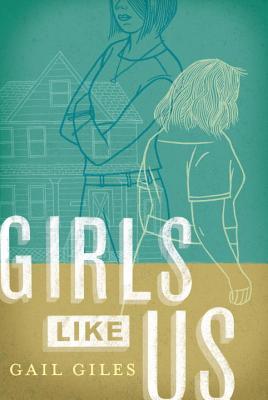
Girls Like Us by Gail Giles

Share

girls like us

Girls Like Us
Author: Gail Giles
Published May 27th, 2014 by Candlewick Press

Goodreads Summary: With gentle humor and unflinching realism, Gail Giles tells the gritty, ultimately hopeful story of two special ed teenagers entering the adult world.

We understand stuff. We just learn it slow. And most of what we understand is that people what ain’t Speddies think we too stupid to get out our own way. And that makes me mad.

Quincy and Biddy are both graduates of their high school’s special ed program, but they couldn’t be more different: suspicious Quincy faces the world with her fists up, while gentle Biddy is frightened to step outside her front door. When they’re thrown together as roommates in their first “real world” apartment, it initially seems to be an uneasy fit. But as Biddy’s past resurfaces and Quincy faces a harrowing experience that no one should have to go through alone, the two of them realize that they might have more in common than they thought — and more important, that they might be able to help each other move forward.

Hard-hitting and compassionate, Girls Like Us is a story about growing up in a world that can be cruel, and finding the strength — and the support — to carry on.

My Review: While reading this book, I had no question that it deserved the Schneider Teen Award. The Schneider Family Book Award honors a “book that embodies an artistic expression of the disability experience for adolescent audiences,” and Girls Like Us take us into Quincy and Biddy’s worlds as they learn to transition from a special-ed classroom in high school to real life in such a true matter, it definitely meets the criteria for the award. In many ways, the book is like any book about girls who just graduated from high school: learning to live with a roommate you don’t understand, learning to be responsible, etc. However, the challenges that these young ladies face because of their disabilities  puts the book on a whole different level. Although the book is primarily about Quincy and Biddy’s life, it does illuminate some serious issues towards the treatment of differently abled individuals. (P.S. I love the ending very much!)

There is so much to talk about with this book! Because it impacted myself and a few of my friends, we decided to have a Twitter chat focused around it (#GLUChat). If you have read the book (because there are spoilers) check out our conversation: https://storify.com/trkravtin/girls-like-us-twitter-chat. Thank you to Teresa for archiving and Michele, Carrie, Alyson, and Leigh for taking part in it with me!

Teachers’ Tools for Navigation: The characters in this book are so complex! Even the secondary characters are fleshed out and have a presence. Girls Like Us is a wonderful example of character building and voice and how that can make (or break) a novel. It is especially fascinating to compare the voice and tone of the two girls’ sections. Extremely well crafted.

Discussion Questions: How do Quincy and Biddy complement each other?; How does Miss Lizzy help Quincy and Biddy overcome the challenges they face leaving school?; How did you (and Miss Lizzy) underestimate Quincy and Biddy? Why did you/she do so?; If you were going to record your feelings like Biddy and Quincy do, what would your recording say?; Did you predict why Biddy didn’t like males correctly? Did you predict the ending?

We Flagged: “My name is Biddy. Some call me other names. Granny calls me Retard. Quincy call me White Trash sometimes and Fool most of the time. Most kids call me Speddie. That’s short for Special Education.

I can’t write or read. A little bit, but not good enough to matter. There’s a lot of stuff I don’t know. If I could write I could make a long list. List might reach lal the way through Texas to someplace like Chicago. I don’t know where Chicago is. That’s another thing for the list.

But there’s some things I do know. And once I know a thing, I hold it tight and don’t let it stray off. Granny shouldn’t call me Retard. I know that. It ain’t nice. It hurts my feelings. I know it’s a wrong thing to hurt somebody’s feelings. I know that I ain’t White Trash. Trash is something you throw away. You don’t throw nobody away. That’s wrong. Even if my mama done it to me.” (p. 1)

Recommended For: 

classroomlibrarybuttonsmall

Signature

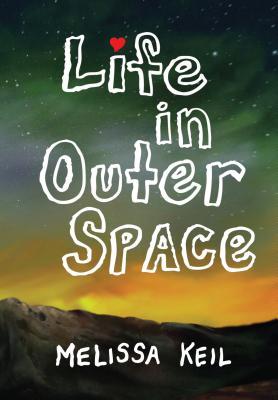
Life in Outer Space by Melissa Keil (Ricki’s Review)

Share

outerspace

Life in Outer Space
Author: Melissa Keil
Published August 1st, 2013 by Peachtree Publishers

Goodreads Summary: Sam is a geek movie-buff with a ragtag group of loser friends who have been taking abuse from the popular kids for years. But when the super-cool Camilla moves to town, she surprises everyone by choosing to spend time with Sam’s group. Suddenly they go from geek to chic, and find that not everything boils down to us and them. With their social lives in flux, Sam and Camilla spend more and more time together. They become the best of friends, and Sam finds that he’s happier and more comfortable in his own skin than ever before. But eventually Sam must admit to himself that he’s fallen in love. If he confesses his true feelings to Camilla, will everything change again?

My Review: Kellee wrote her review almost a year ago, and after reading her review, I laughed because my notes about this book are so similar to her thoughts.

While reading this book, I thought about its connections to Stargirl by Jerry Spinelli and Paper Towns by John Green, and the narrator reminded me of Charlie from The Perks of Being a Wallflower by Stephen Chbosky. But while this book is similar to others, it is very different.

Sam makes being geeky feel cool. I am geeky, so I appreciated this. He experiences tough life issues that many teenagers face, and he doesn’t lie about his lack of knowledge about dealing with these issues or understanding girls. The book contains scenes with World of Warcraft and there is a lot of information about horror movies (both of which aren’t interesting to me), yet I remained very engaged in the story and the characters. Keil writes the male narrator very well, and I think all types of adolescents will identify with the themes of this book. This is one of Kellee’s favorite books, and I see why. Thank you for nagging me to read it, Kel. It is one that will stick with me forever.

Teachers’ Tools for Navigation: Why hasn’t this book received more press? It belongs in classrooms. As a teacher, I would use it as a mentor text for characterization. The scenes with Camilla are written breathtakingly well. If students read these scenes, they would want to read the entire book.

Discussion Questions: Did you find Camilla to be realistic? Could a student walk in and change the entire dynamic at the school in such a powerful way?; Why does Camilla like Sam? Is this realistic?; In what ways are media used by Keil to engage readers?; What does this book teach us about friendship?; How does Sam’s family life add to the complexity of this book?

We Flagged: “I guess some people enter your orbit and get stuck, and there’s nothing either of you can do about it” (p. 70).

And I loved the quote Kellee picked out. It is the scene I remember the most in the book:

“She is wearing a yellow dress that looks like it belongs to a 1950s housewife, and a pair of flat red boots. Her hair is longer than I’d imagine would be practical; it’s parted in the middle and hangs in brown waves almost to her waist. She peers around the room impassively. She doesn’t look terrified. She doesn’t look insanely overconfident, like Adrian that time in year seven when he performed a song as his book report for The Outsiders. Mike and I mark that event as ground zero for the downward social spiral of our group.” (p. 11)

Read This If You Loved: The Perks of Being a Wallflower by Stephen Chbosky, Stargirl by Jerry Spinelli, Paper Towns by John Green, Eleanor and Park by Rainbow Rowell

Recommended For: 

closereadinganalysisbuttonsmall classroomlibrarybuttonsmall litcirclesbuttonsmall

RickiSig

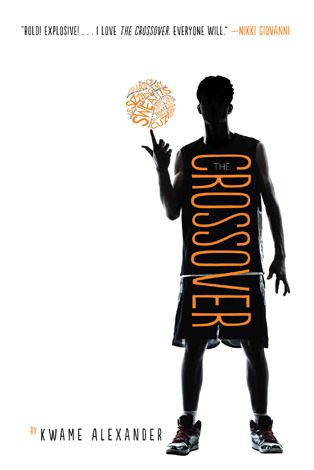
The Crossover by Kwame Alexander

Share

the crossover

The Crossover
Author: Kwame Alexander
Published March 18th, 2014 by Harcourt Brace and Company

Goodreads Summary: “With a bolt of lightning on my kicks . . .The court is SIZZLING. My sweat is DRIZZLING. Stop all that quivering. Cuz tonight I’m delivering,” announces dread-locked, 12-year old Josh Bell. He and his twin brother Jordan are awesome on the court. But Josh has more than basketball in his blood, he’s got mad beats, too, that tell his family’s story in verse, in this fast and furious middle grade novel of family and brotherhood.

Josh and Jordan must come to grips with growing up on and off the court to realize breaking the rules comes at a terrible price, as their story’s heart-stopping climax proves a game-changer for the entire family.

My Review: Wow. What a powerful piece of narrative and poetry. Any poem from Josh’s story could easily be taken out of context and used as a piece of exemplar poetry writing. In addition to the amazing writing, Josh is a kid that is so easy to connect with. He is so real. You love him (even if he is a little cocky). By the end of the book, you feel like you are part of Josh’s family, and you don’t want to leave.

And to top it all off: one of my reluctant readers grabbed this book and zoomed right through it. It quickly became one of his favorite books! I love when the Newbery Medal winner is accessible to students. Now to just get more students to read it and experience the awesomeness.

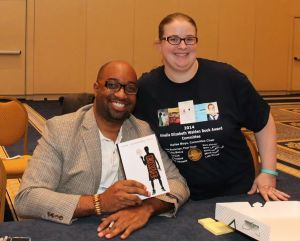
(Also, Kwame was one of my favorite presenters at ALAN, and he was such a pleasure to meet!)

kwame

Teachers’ Tools for Navigation: I cannot wait to have my students make vocabulary poems like Josh does. Such a fun way to play with words. Additionally, like I stated above, any poem in this novel could be used in a poetry unit. I’d also love to have students come up with rules like Josh’s dad did for basketball and have them write them in verse.

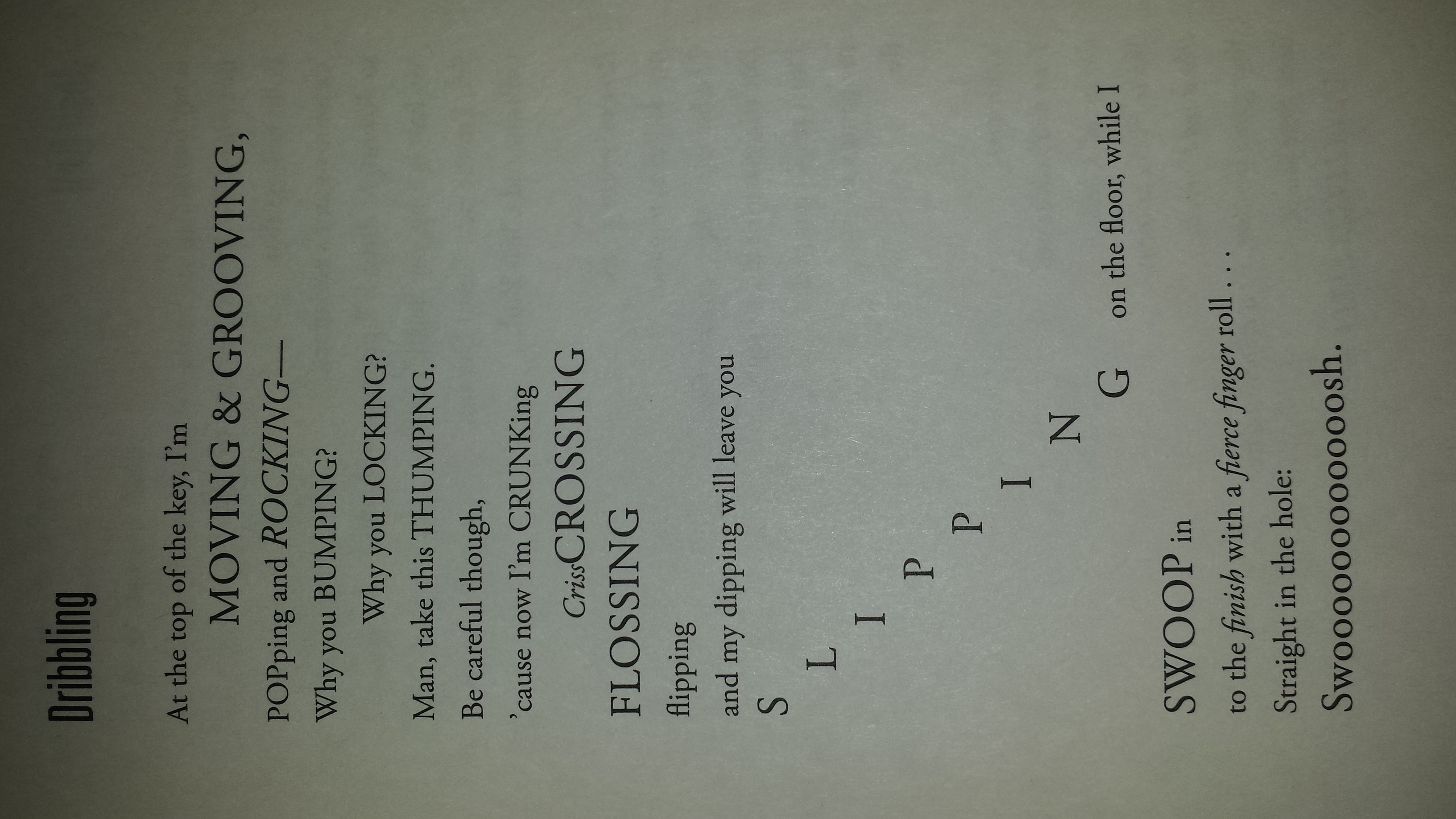
Discussion Questions: Why is Josh so impacted by Jordan getting a girlfriend?; Who do you think influences Josh more: his dad or his mom? Explain.; Within his poems, Josh uses formatting, bolding, and different fonts to put emphasis on certain words. Why does he do this?; Josh uses figurative language throughout his poems. Find an example and share why you think Josh used it.; How are Josh and Jordan similar? Different?

We Flagged: 

20150216_141647

Read This If You Loved: Jumped In by Patrick Flores-Scott (YA), The Sports Pages edited by Jon Sciezska, The Moves Make the Man by Bruce Brooks, Summer Ball by Mike Lupica

Recommended For: 

classroomlibrarybuttonsmall readaloudbuttonsmall closereadinganalysisbuttonsmall

Signature

Two Must Have Early Chapter Books: The Princess in Black by Shannon Hale & Dean Hale and Leroy Ninker Saddles Up by Kate DiCamillo

Share

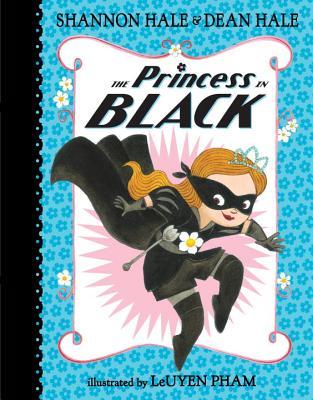
princessinblack

The Princess in Black
Authors: Shannon Hale and Dean Hale
Illustrator: LeUyen Pham
Published October 14th, 2014 by Candlewick Press

Goodreads Summary: Who says princesses don’t wear black? When trouble raises its blue monster head, Princess Magnolia ditches her flouncy dresses and becomes the Princess in Black!

Princess Magnolia is having hot chocolate and scones with Duchess Wigtower when . . . Brring! Brring! The monster alarm! A big blue monster is threatening the goats! Stopping monsters is no job for dainty Princess Magnolia. But luckily Princess Magnolia has a secret —she’s also the Princess in Black, and stopping monsters is the perfect job for her! Can the princess sneak away, transform into her alter ego, and defeat the monster before the nosy duchess discovers her secret? From award-winning writing team of Shannon and Dean Hale and illustrator LeUyen Pham, here is the first in a humorous and action-packed chapter book series for young readers who like their princesses not only prim and perfect, but also dressed in black.

My Review and Teachers’ Tools for Navigation: I am a sucker for girl power books. So much, I was part of writing three Nerdy Book Club Girl Power posts (here, here, and here). Princess in Black fits right in this these books. Although Princess Magnolia must live up to society’s expectations of a proper princess, in secret she fights crime, isn’t afraid of anything, and doesn’t wear pretty dresses. I love the idea that Magnolia can be a princess and all kick some butt. (I wish she could do it not in secret, but that wouldn’t fit the societal views of princesses in most fairy tales.) I know that the Hales wrote this book for their daughters, and I can see why they did: a great heroine, lots of action, funny, and colorful, fun illustrations. Princess in Black would actually be a perfect first introduction to the narrative elements and plot arc. It also just enough complex vocabulary that you could start a discussion about some of the words.

We Flagged: Chapter Two: “Princesses do not run. Princesses do not stuff frilly pink dresses into broom closets. Princess do not wear black. And princesses most definitely do not slide down secret chutes and high-jump castle walls. But then, most princess do not live near an entrance to Monster Land. Stopping monsters was no job for prim and perfect Princess Magnolia. But fortunately Princess Magnolia did have a secret. She was secretly the Princess in black! And stopping monsters was the perfect job for the Princess in Black.”

Read This If You Loved: Salem Hyde (series) by Frank Cammuso, Battle Bunny by Jon Sciezska, Fairy Tales

Recommended For: 

readaloudbuttonsmall classroomlibrarybuttonsmall

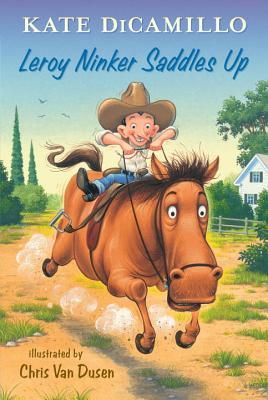
leroy ninker
Leroy Ninker Saddles Up
Author: Kate DiCamillo
Illustrator: Chris Van Dusen
Published August 26th, 2014 by Candlewick Press

Goodreads Summary: Yippie-i-oh! Saddle up for the first in a spin-off series starring favorite characters from Kate DiCamillo’s New York Timesbest-selling Mercy Watson books.

Leroy Ninker has a hat, a lasso, and boots. What he doesn’t have is a horse — until he meets Maybelline, that is, and then it’s love at first sight. Maybelline loves spaghetti and sweet nothings, and she loves Leroy, too. But when Leroy forgets the third and final rule of caring for Maybelline, disaster ensues. Can Leroy wrestle fate to the ground, rescue the horse of his heart, and lasso loneliness for good? Join Leroy, Maybelline, and a cast of familiar characters — Stella, Frank, Mrs. Watson, and everyone’s favorite porcine wonder, Mercy — for some hilarious and heartfelt horsing around on Deckawoo Drive.

My Review and Teachers’ Tools for Navigation: I must be honest: I have not read the Mercy Watson books, but luckily it does not matter because Leroy is just so darn loveable. His personality shines through the pages and you just are so happy that Leroy and Maybelline found each other. Also, Kate DiCamillo has a way with voice! I can always hear her characters talking in my head, and they each are so very distinct. I also love her use of vocabulary and humor–perfect! This one is going to be loved by many!

Discussion Questions: Why do you think that Maybelline is the perfect horse for Leroy?; Was Leroy truly prepared to have a horse? How do you know?; Why does Leroy want to be a cowboy?

We Flagged: Leroy Ninker said ‘Yippie-i-oh’ because Leroy Ninker had a dream. He wanted to be a cowboy.

On Wednesday nights, the Bijou Drive-In Theater ran a Western double feature, and Leroy Ninker Stood and watched in wonder as the great white expanse of the Bijou screen filled with purple mountains, wide-open plains, and cowboys.

The cowboys wore ten-gallon hats. The wore boots. They carried lassos. The cowboys were men who cast long shadows and knew how to fight injustice. They were men who where never, ever afraid.

‘Yippie-i-oh,’ Leroy Ninker whispered to the screen. ‘That is the life for me. A cowboy is who I was meant to be.'” (p.2)

Read This If You Loved: Lulu and the Brontosaurus (series) by Judish Viorst, Frankie Pickle (series) by Eric Wight, Bramble and Maggie (series) by Jessie Haas

Recommended For: 

readaloudbuttonsmall classroomlibrarybuttonsmall

Signature

**Thank you to Candlewick Press for providing copies for review**

How To Speak Dolphin by Ginny Rorby

Share

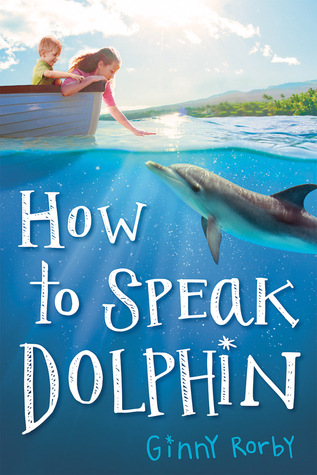
howtospeakdolphin

How to Speak Dolphin
Author: Ginny Rorby
Expected Publication May 26th, 2015 by Scholastic Press
(Though available in Spring Scholastic Book Fairs)

Goodreads Summary: Schneider Family Book Award-winning author Ginny Rorby has created an irresistible dolphin story about a girl’s struggle to help her autistic brother and herself.

Lily loves her half-brother, Adam, but she has always struggled with him, too. He’s definitely on the autism spectrum–though her step-father, Don, can barely bring himself to admit it–and caring for him has forced Lily to become as much mother as sister. All Lily wants is for her step-father to acknowledge that Adam has a real issue, that they need to find some kind of program that can help him. Then maybe she can have a life of her own.

Adam’s always loved dolphins, so when Don, an oncologist, hears about a young dolphin with cancer, he offers to help. He brings Lily and Adam along, and Adam and the dolphin–Nori–bond instantly.

But though Lily sees how much Adam loves Nori, she also sees that the dolphin shouldn’t spend the rest of her life in captivity, away from her family. Can Adam find real help somewhere else? And can Lily help Nori regain her freedom without betraying her family?

My Review: How to Speak Dolphin is a tale that looks at the struggles and triumphs of growing up with an autistic family member. Lily has lost her mom and is still mourning when we meet her, yet she is being expected to pretty much be her brother Adam’s caretaker. Because of this, Lily has very few friends and finds herself lonely and sad often. Her stepfather is lost in fantasy thinking that Adam is less work and less autistic than he really is. Lily is lost and tired though knows something needs to be done. She just wants her brother to be taken care of correctly, and she needs her stepfather to see it as well. It is through Lily’s guiding, and a bit of help from Adam’s new caretaker Suzanne, that Don finally seeks getting treatment for Adam through DAT, dolphin-assisted therapy, with a young dolphin named Nori recovering from cancer. During Lily’s journey through helping her brother (and herself), she becomes friends with Zoe, a young girl who lost her sight due to retinoblastoma, who also helps her realize that her life may not be what she’d expected, but it can still be good. This book, like all of Ginny’s, is quite a ride and makes the reader think about animal and human issues that are often ignored. Ginny Rorby has done it again.

Teachers’ Tools For Navigation: There are many books that look at autism or animal rights. I can definitely see this book being in a lit circle set (with the titles listed below) where students in groups can each read a book about the topic then share what they have learned from their book at the end. This could be done beautifully with most of Ginny’s titles (Hurt Go HappyOutside of a Horse, and Dolphin Sky) because they each look at a human and animal struggle. Additionally, this book is going to be loved by students who love RulesOut of My MindWonder, and other books that look at overcoming differences.

I could also see inquiry projects blossoming out of the lit circles or a whole-class read of How to Speak Dolphin. In Dolphin alone, students could find themselves questioning animal captivity, DAT, autism, retinoblastoma, sign language, oil spill, and more.

Discussion Questions: Do you agree with the choice that is made with Nori at the end of the book?; Zoe was quite pushy with Lily when they disagree. Do you agree with how Zoe dealt with the situation?; Do you think it was Lily’s responsibility to care for Adam after her mother died?; Practice walking using echoing like Zoe does. How easy/hard is it?; Zoe is a very positive person. How does how she is dealing with her blindness help Lily be more optimistic about Adam and her life?; Why do you think Don had such a hard time admitting to himself that Adam may need help outside what he and Lily could give?

We Flagged: “Don holds Adam pressed to his chest, one arm around his legs and the other pinning his arms to his sides as I test the water temerature and start filling the tub. Don’s eyes are closed. I think from the pain of Adam’s screaming in his ear, but decided maybe it’s because his heart is broken. I was seven and a half when Mom and Don found out she was pregnant and that the baby would be a boy. Don was so over-the-top thrilled that Mom looked at me and said she’d wanted another girl. She was trying to make sure my feelings weren’t hurt, but it made me wonder if my real father had wished fora  boy, too.” (p. 8)

Read This If You Loved: Rules by Cynthia Lord, Rain Reign by Ann M. Martin, Mockingbird by Kathryn Erskine, Dolphin Sky by Ginny Rorby, Wonder by RJ Palacio, Hurt Go Happy by Ginny Rorby

Recommended For: 

readaloudbuttonsmall litcirclesbuttonsmall classroomlibrarybuttonsmall

Signature

YALSA Morris Finalists’ Blog Hop: The Carnival at Bray by Jessie Ann Foley

Share

carnival at bray

The Carnival at Bray
Author: Jessie Ann Foley
Published: October 1, 2014 by Elephant Rock Books

Goodreads Summary: It’s 1993, and Generation X pulses to the beat of Kurt Cobain and the grunge movement. Sixteen-year-old Maggie Lynch is uprooted from big-city Chicago to a windswept town on the Irish Sea. Surviving on care packages of Spin magazine and Twizzlers from her rocker uncle Kevin, she wonders if she’ll ever find her place in this new world. When first love and sudden death simultaneously strike, a naive but determined Maggie embarks on a forbidden pilgrimage that will take her to a seedy part of Dublin and on to a life- altering night in Rome to fulfill a dying wish. Through it all, Maggie discovers an untapped inner strength to do the most difficult but rewarding thing of all, live.

The Carnival at Bray is an evocative ode to the Smells Like Teen Spirit Generation and a heartfelt exploration of tragedy, first love, and the transformative power of music. The book won the 2014 Helen Sheehan YA Book Prize.

Ricki’s Review: When I read the back of this book, I thought, “Hmm.” It felt like a (recent) historical fiction with its emphasis on ’90s grunge music and the highlights of Kurt Cobain’s life. Because my teen years spanned through part of the ’90s, I was intrigued.

My favorite aspect of this book was the fact that the writing felt effortless. Too often, books’ messages or prose feel forced, and with this book, I felt as if I was whisked along for the (very bumpy) ride. As a former high school teacher, I enjoyed the myriad, richly realized themes. The reader feels a wild sense of adventure, the uneasiness that comes with living in a new environment, the loyalty that is tied with love, the heartbreak that emerges with loss and grief, and the utter purity that comes with finding oneself. At times, YA texts feature absent (or horrid) parents, but the complexity of Maggie’s mother was realistic to many parents, I believe. This will leave teens (and adults!) pondering their own relationships with their parents. The intricacies of this text will allow for book groups, students, and readers to have much to ponder and discuss.

Teacher’s Tools for Navigation: This would be a great novel to discuss theme. As stated in my review above, there are many themes to ponder. I would put butcher paper around the room and write a different theme on each paper. Students could travel around the room, discussing each theme, placing post-it notes with evidence from the text. Or, the teacher might discuss a different theme on each day. Beyond the classroom setting, I think this would be an excellent selection for book clubs.

Download the comprehensive study guide (from Elephant Rock Books) here.

Discussion Questions: How does Maggie handle the challenges she faces? Do you think she makes the right choices? Is she brave?; What does her uncle teach her? Was he an admirable character?; What role does the setting (both time and place) play in this novel?; Is Maggie’s mother a positive or negative role in her life?

We Flagged: “But don’t you think that never suffering at all—is its own form of suffering?” (p. 150).

I am not sure whether or not I agree with this quote, but weeks later, I am still thinking about it.

Read This If You Loved: Love Letters to the Dead by Ava Dellaira, Timely Persuasion by Jacob LaCivita, Five Flavors of Dumb by Antony John, The Perks of Being a Wallflower by Stephen Chbosky, Time Between Us by Tamara Ireland Stone, The Future of Us by Jay Asher and Carolyn Mackler, Get Happy by Mary Amato

Recommended For:

 litcirclesbuttonsmall classroomlibrarybuttonsmall

Make sure to stop by Cinco Puntos Press blog to see the other stops on the tour!

RickiSig

**A special thank you to Jessica Powers at Cinco Puntos Press for organizing this blog hop and to Elephant Rock Books for providing this book for review!**