Battle Bunny by Jon Scieszka and Mac Barnett

Share

battle

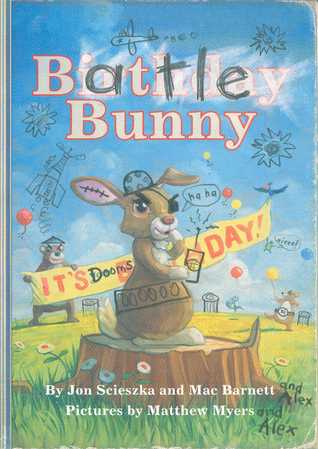
Battle Bunny
Authors: Jon Scieszka and Mac Barnett
Illustrator: Matthew Myers
Published October 22nd, 2013 by Simon & Schuster Books for Young Readers

Goodreads Summary: Alex has been given a saccharine, sappy, silly-sweet picture book about Birthday Bunny that his grandma found at a garage sale. Alex isn’t interested; until he decides to make the book something he’d actually like to read. So he takes out his pencil, sharpens his creativity, and totally transforms the story!

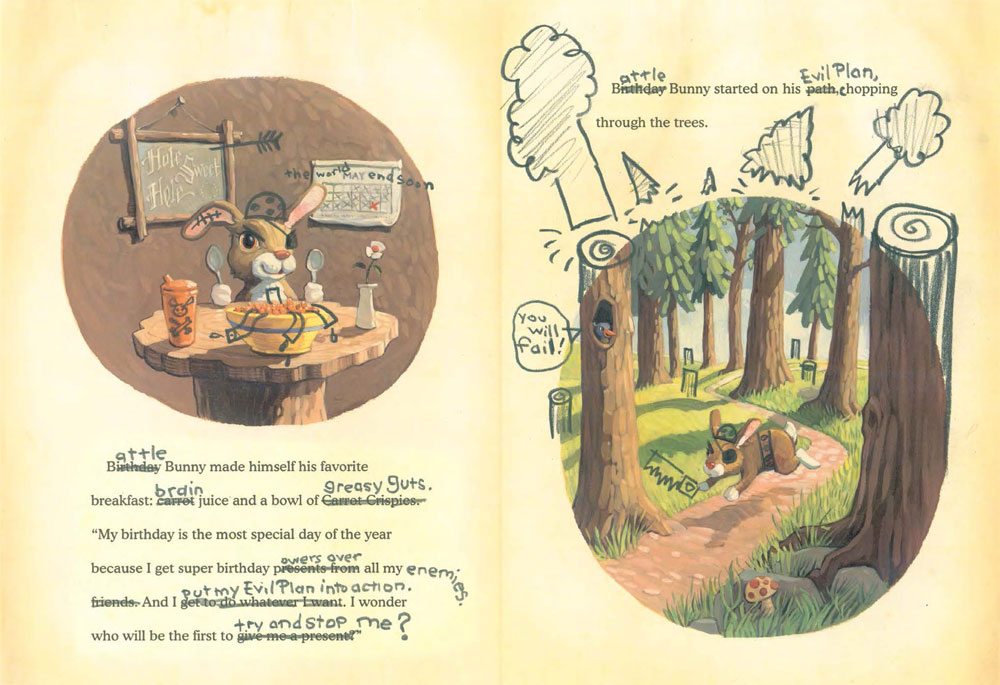
Birthday Bunny becomes Battle Bunny, and the rabbit’s innocent journey through the forest morphs into a supersecret mission to unleash an evil plan; a plan that only Alex can stop.

Featuring layered, original artwork that emphasizes Alex’s additions, this dynamic exploration of creative storytelling is sure to engage and inspire.

My Review: This book made me laugh out loud! What a perfect insight into the mind of a young boy (reminds me of so many doodles I’ve seen on papers over the year!).  Also, I was blown away by the creativity of Sceiszka and Barnett.  I wish I was teaching in a classroom because it would have been a book that I would have brought into the classroom to share with kids (yes, even my middle schoolers. Actually, definitely my middle schoolers.) because it is just so awesome!

Teachers Tools for Navigation: This picture book would be so much fun as a read aloud (original story than the modified one). Also, I can also picture bringing in picture books (maybe older ones or bought at a used book store) and letting the students modify their own! And so much creativity, vocabulary, cleverness, imagination, etc. are needed to transform a text the way Alex did–it’d be such a fun yet tough activity.

There is even a Battle Bunny website (http://mybirthdaybunny.com) where you can make your own story. They give you the original Birthday Bunny text and let you make your own. They actually provide PDFs of the entire text!  Also on the website are educators information that includes a curriculum guide.

Discussion Questions: What other stories could you build around Birthday Bunny?; (Writing activity) Using the picture book you were given, create a new story by changing words and adding photos.

We Flagged: 

Read This If You Loved: Scaredy Squirrel books by Melanie Watts, Bananas in my Ears by Michael Rosen, The Stinky Cheese Man by Jon Scieszka, You Will Be My Friend by Peter Brown

Recommended For: 

classroomlibrarybuttonsmall readaloudbuttonsmall closereadinganalysisbuttonsmall

Signature

Exclamation Mark by Amy Krouse Rosenthal

Share

exclamation

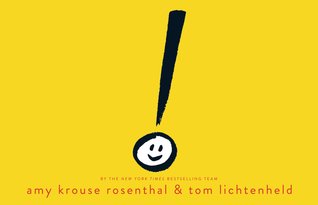
Exclamation Mark
Author: Amy Krouse Rosenthal
Illustrator: Tom Lichtenheld
Published March 1st, 2013 by Scholastic Press

Goodreads Summary: From the bestselling creators of Duck! Rabbit!, an exciting tale of self-discovery!

He stood out here.

He stood out there.

He tried everything to be more like them.

It’s not easy being seen. Especially when you’re NOT like everyone else. Especially when what sets you apart is YOU.

Sometimes we squish ourselves to fit in. We shrink. Twist. Bend. Until — ! — a friend shows the way to endless possibilities.

In this bold and highly visual book, an emphatic but misplaced exclamation point learns that being different can be very exciting! Period.

My Review and Teacher’s Tools for Navigation: Rosenthal and Lichtenheld have given us a little piece of gold in this book. Not only would it be so much fun to read aloud (I would love to change my emphasis depending on the punctuation), but what a great introduction to ending punctuation! It wold be one of those “trick” books where students learn really enjoying themselves because the story and humor will win them over.

Discussion Questions: When are periods used vs. exclamation marks and question marks?

We Flagged: 

Read This If You Loved: Duck! Rabbit! by Amy Krouse Rosenthal, Cloudette by Tom Lichtenheld, Other grammar game/story books

Recommended For: 

classroomlibrarybuttonsmall readaloudbuttonsmall closereadinganalysisbuttonsmall

Signature

Helping our Students Achieve the Reading and Writing Flow

Share

Achieving Flow-page0001

Kelly Gallagher stresses balance in his book, Readicide. We, as teachers, try our best not to tear apart texts for students. We want to study author’s craft, but if we overanalyze and nitpick at every detail, it becomes terribly boring for students (and us!). So where is the balance? How do we help students come to appreciate the minute details of an author’s writing without committing this act of readicide? Gallagher also discusses the “reading flow.” It is important for teachers to understand when to stop students and when to allow them to find the flow—to get into the groove of reading. It makes sense, thinking of my own reading habits. If I was forced to stop at every page (or even every ten pages) to analyze an author’s writing, I would throw the book at the wall.

 How do you help your students achieve reading flow?

As a teacher, what works best for me (and this may not work best for you), is to analyze the first few pages of a text. I have my students do a close reading, and we try to examine elements like voice, writing style, form, and manipulation of language, among others. Then, I let them explore. I try to assign them enough reading so they can hit the flow but not too much reading that they don’t do the assignment. For me, this is the most effective way to help students find this “reading flow” that Gallagher discusses. Once I have helped my students grapple with and (hopefully) appreciate the language of an author, I set them free from the nest. This approach doesn’t work well with every text. For example, much more complex texts may require more analysis and comprehension techniques before I can set my students free.

But how do we find the flow for writing? Recently, I read a section of Murray’s Write to Learn. He made me think more about how this “reading flow” concept might be applied to writing. From my experience, my students feel like stuttering cars when they begin to write. Often, they can’t even get their cars to start. Some of the techniques that Murray offers are interesting when I look at them through the lens of the writing flow.

We need our students to connect to their writing. One way to start is by having students write down their territories. Murray starts this in a brainstorming list, where students make a list of topics. He suggests connect elements on their lists to try to find ideas for writing. Murray also describes other methods that won’t be new to most teachers like freewriting about topics or brainstorming in the form of a map or tree. With the map, students can show the way their thoughts emerge from and digress to each other. With the tree, students can brainstorm about a more focused topic. Murray also suggests interviewing ourselves.

How do you help your students achieve writing flow?

One technique I have found to be useful to help students start writing short stories is by providing the first sentence for them. I write a series of evocative sentences like “He was a most peculiar boy.” Or, “As his name was called, he knew his life would drastically change.” Or, “She woke up barefoot, lost, and with something unusual beside her.” My students brainstorm the second sentence for a dozen or so of these sentence starters. Then, I set them free to expand one of the starters a bit further. We don’t look at grammar, and instead, we focus on just keeping the flow. I remind them that authors often discuss how their first draft is terrible, and this is okay. We are getting ideas onto paper and finding our flow. We’ll worry about the revision and editing later, right?

Let’s share!

How do we get our students to hit this reading and/or writing flow?

Do any activities work well for you?

RickiSig

Seymour Simon’s Extreme Oceans and Extreme Earth Records

Share

NF PB 2013

Nonfiction Picture Book Wednesday

Nonfiction Picture Book Wednesday is hosted by Kid Lit Frenzy and was started to help promote the reading of nonfiction texts. Most Wednesdays, we will be participating and will review a nonfiction text (though it may not always be a picture book).
Be sure to visit Kid Lit Frenzy and see what other nonfiction books are shared this week!
oceans earth

Extreme Oceans and Extreme Earth Records
Author: Seymour Simon
Published April 2nd, 2013 and August 29th, 2012 by Chronicle Books

Extreme Oceans Goodreads Summary: Join Seymour Simon, the “dean” of children’s science nonfiction, as he investigates the most extreme environments, animals, plants, and weather in the ocean. Imagine exploring the most extreme parts of our amazing oceans—riding the tallest waves, diving to the darkest depths, and encountering the largest and most dangerous sea creatures on Earth. These mind-bending facts and stunning photographs make for an exciting, and sometimes unbelievable, underwater expedition!

Extreme Earth Records Goodreads Summary: Imagine exploring the most extreme parts of our amazing planet—trekking though the driest desert, climbing the snowiest mountaintops, and diving to the deepest regions of the ocean floor. Seymour Simon, the dean of children’s science nonfiction, investigates Earth’s biggest, smallest, deepest, and coldest environments, animals, plants, and most severe weather. These mind-bending facts and photographs invite readers on an exciting, and sometimes unbelievable, scientific expedition of Earth’s most amazing records!

My Review: These books take the other Seymour Simon books I read and just pushes them to the extreme (pun intended). Both books take on different topics and gives the readers extreme facts and information about the topics. Topics range from “Big Waves and Giant Tides”, “Dangerous Sea Animals”, and “Climate Change” in Extreme Oceans and “The Coldest Place on Earth”, “The Biggest Earthquake on Earth”, and “The Largest Volcanic Eruption on Earth” in Extreme Earth Records. In each section, there are bits of information, photographs, sidebars, and text boxes all which add to the topic. All of the information is fascinating and by the end of each section definitely gives insight into the topic. Also, the photographs in these books are just breathtaking!

Teacher’s Tools For Navigation: Like other Simon books, students will definitely love to just read these as they include some fascinating information. Teachers can use them in a couple of different ways: as supplemental materials when teaching a topic, as a research source, or to discuss text features (and I’m sure a bunch of other different ways that I have not even thought of).

Discussion Questions: Would you rather live in the coldest or hottest place on Earth?; Which of the most dangerous ocean animals scares you the most? Why?; Many other discussion questions based on the topics

We Flagged: “Stormy Seas: Imagine being caught at sea in a small ship in the middle of a monster storm that stretches for hundreds of miles in all directions. That’s what happened to a fishing ship, the Andrea Gail, on October 30, 1991. The storm was so big that there was no way to get out. Huge waves and howling winds sampled and sank the boat. It was called the ‘perfect storm’ because all the different factors that can make up a huge storm came together at one time and one place.” (Extreme Oceans p. 25)

“The Largest Volcanic Eruption on Earth: As you read this book, somewhere around the world there are approximately twenty volcanoes erupting. Three-quarters of volcanic eruptions occur unseen beneath the oceans, and no one knows when they happen.” (Extreme Earth Records p. 49)

Read This If You Loved: National Geographic Kids Weird But TrueDangerous Animals of the Sea by Samantha Flores,  Pompeii by Mary Pope Osborne, Discovery Channel’s Top 10 Deadliest Sharks, 50 Climate Questions by Peter Christie, Giant Squid by Mary M. Cerullo, The Top of the World by Steve Jenkins

Recommended For: 
classroomlibrarybuttonsmall closereadinganalysisbuttonsmall

Signature

The Misadventures of Salem Hyde by Frank Cammuso

Share

salem1

Spelling Trouble
Author and Illustrator: Frank Cammuso
Published October 1st, 2013 by Harry N. Abrams

salem2

Big Birthday Bash
Author and Illustrator: Frank Cammuso
Published May 20th, 2014 by Amulet Books

Spelling Troubles Goodreads Summary: Salem Hyde just isn’t like other kids. For one thing, she’s stubborn, independent, and impulsive. For another, she’s a witch. Salem acts first and thinks later—which means most of her thinking involves coming up with excuses!

Good thing she’s been assigned an animal companion, Lord Percival J. Whamsford III. This over-anxious cat doesn’t like Salem calling him “Whammy,” and Salem doesn’t like listening to his long-winded explanations as to why she shouldn’t do something . . . like enter the class spelling bee.

Salem knows she can beat all her classmates at spells, no problem. Too late, she realizes the competition is about spelling words, not magic. And there’s nothing like a misspelled spell to cause all kinds of havoc!

Big Birthday Bash Goodreads Summary: Young witch Salem Hyde is stubborn, impulsive, and loves flying. Her cat companion, Whammy, is nervous, careful, and loves staying on the ground. Somehow, though, they’re best friends. In this second book in the series, Salem is invited to a birthday party, and she wants to make sure everything goes perfectly. But from the invitations to the presents, party games, and spells gone awry, nothing happens exactly the way it should, and she’ll need Whammy’s help to sort it all out. 

My Review: I made sure to pick this up at NCTE from Abrams because Frank Cammuso is a big hit in my classroom. His series, Knights of the Lunch Table (great allusion to King Arthur!) is loved by many a reader (so much so that I think my copy of the first in the series just bit the dust and I’ll need to replace it). Although they did tell me that readers of TKotLT are older than the intended audience for Salem Hyde I wanted to make sure to read it because I was sure I was going to enjoy it—and I did! I’m also so pleased with the embracing of graphic novels that have been happening over the last 5 years and even graphic novels for young readers. The amount of graphic novels for young readers is really starting to accumulate and I have been impressed with most of the ones I’ve read, Salem Hyde included. I feel that many of the juvenile graphic novels are well done, multi-layered, and truly respectable just like the YA graphic novels.

Salem Hyde reminds me of Sabrina the Teenage Witch, but a bit more of a trouble maker. Salem made me laugh and made me shake my head. She is one headstrong, independent little lady who, mixed with trying to figure out all of her match powers as she grows up as a witch, is a great main character.

Teacher’s Tools for Navigation: These books will find most of its success in children’s hands; however, it could definitely be used as a read aloud. Also, in both of these books Whammy, at one point, tells Salem a story to help teacher her a lesson and they are both based off of classics. In Spelling Trouble it is Moby Dick and in Big Birthday Bash it is Gift of the Magi. Salem Hyde would be a perfect introduction to these two stories for young readers.  Another aspect of Salem Hyde that I, as a teacher, may use in the classroom are the character introductions that were included. Each new character got a “Getting to know ____” with their likes, dislikes, and other fun facts (magic powers, etc.). This would be a fun activity to do when writing a narrative and trying to develop characters.

Discussion Questions: How does Whammy use stories to help Salem understand?; How is Salem a better friend to Edgar than Shelly?; Why was Whammy exactly what Salem needed?

We Flagged: 

Or “Look Inside” Spelling Troubles on Amazon

Read This If You Loved: Babymouse and Squish series by Jennifer and Matthew Holm, Gabby and Gator by James Burk, Luz Makes a Splash by Claudia Davila, Sadie and Ratz by Sonya Hartnett, Lulu series by Judith Viorst, Bink and Gollie series by Kate DiCamillo, Franny K. Stein series by Jim Benton, Marty McGuire series by Kate Messner, Giants Beware by Jorge Aguirre

Recommended For: 

classroomlibrarybuttonsmall readaloudbuttonsmall closereadinganalysisbuttonsmall

Signature

Explorer: The Lost Islands edited by Kazu Kibuishi

Share

explorer

Explorer: The Lost Islands
Edited by Kazu Kibuishi
Published October 15th, 2013 by Harry N. Abrams

Goodreads Summary: The highly anticipated second volume to the critically acclaimed Explorer series, The Lost Islands is a collection of seven all-new stories written and illustrated by an award-winning roster of comics artists, with each story centered around the theme of hidden places. Edited by the New York Times bestselling comics creator Kazu Kibuishi, this graphic anthology includes well-written, beautifully illustrated stories by Kazu (the Amulet series), Jason Caffoe (the Flight series), Raina Telgemeier (Drama and Smile), Dave Roman (the Astronaut Academy series), Jake Parker (the Missile Mouse series), Michel Gagné (The Saga of Rex), Katie and Steven Shanahan (the Flight series), and up-and-coming new artist Chrystin Garland.

My Review and Teacher’s Tools for Navigation: I am a huge fan of Kazu Kibuishi. His artwork and his stories are so beautiful, so I know when he pulls together an anthology it is going to be phenomenal and this one does not disappoint. Each story revolves around an island although every story is very different. And I’ll be honest for a second, most of the time when I read short story anthologies, there is at least one story that is just “EH” for me, but I really liked each of these and they all fit a different purpose: Rabbit Island by Jake Parker was fun but had a great message, Loah by Michel Gagne was an artistic masterpiece, Radio Adrift by Katie and Steven Shanahan is so different from the others, etc.

Teacher’s Tools for Navigation: What I love about anthologies is that each story is different and can be used to discuss different narrative aspects. For example, Kazu Kibuishi’s story can be compared to Moby Dick and can also be used for cause and effect, Raina Telgemeier’s story would be great to use for inferencing and Carapace by Jason Caffoe can be compared to other fantasy stories (and these are just what I thought of off the top of my head). And, of course, on top of all of this, it will be read and loved by kids.

Discussion Questions: Which story out of the anthology is your favorite and why?; Which island out of the anthology would you like to live on? Which would you avoid?; How is the captain in Kazu Kibuishi’s story similar to Captain Ahab?; In Carapace, the boy lands on a fantastical island. What fantastical island does it remind you of?

We Flagged: 

(Desert Island Playlist by Dave Roman and Raina Telgemeier, p. 58)
Shared by Raina Telegemeier on Goodreads: https://www.goodreads.com/author_blog_posts/5048366-explorer-the-lost-islands-out-now

Read This If You Loved: Flight series edited by Kazu Kibuishi, Explorer: The Mystery Boxes edited by Kazu Kibuishi, Teen Boat! by Dave Roman, Smile and Drama by Raina Telgemeier, Amulet by Kazu Kibuishi

Recommended For: 

classroomlibrarybuttonsmall closereadinganalysisbuttonsmall

Signature

Seymour Simon: Animal books

Share

NF PB 2013

Nonfiction Picture Book Wednesday

Nonfiction Picture Book Wednesday is hosted by Kid Lit Frenzy and was started to help promote the reading of nonfiction texts. Most Wednesdays, we will be participating and will review a nonfiction text (though it may not always be a picture book).
Be sure to visit Kid Lit Frenzy and see what other nonfiction books are shared this week!

gorillaspenguinscats

Various Animals including Gorillas, Penguins, and Cats
Author: Seymour Simon
Published: Varies

Gorillas Goodreads Summary: Classic movies show giant gorillas scaling tall buildings and swatting planes from the sky, but actual gorillas are gentle social animals that live together in family groups like humans. In fact, gorillas are one of the closest genetic matches to people. And just like humans, gorillas can shriek, chuckle, hiccup, and even burp!

Award-winning science writer Seymour Simon has teamed up with the Smithsonian Institution to bring you an updated edition of his classic full-color photographic introduction to these fascinating animals.

Penguins Goodreads Summary: Did you know that: Penguins are champion swimmers. They spend 75 percent of their lives in water. They are birds, but they can’t fly. Penguins are classified as birds because they have feathers.

Now you can explore a penguin’s world by finding out how they can swim so fast, what they eat, and why people need to protect their habitats. Acclaimed science writer Seymour Simon has teamed up with the Smithsonian Institution to take you on a journey to the Antarctic region for a close-up look at one of nature’s most beloved and sociable animals.

Cats Goodreads Summary: Cats are fascinating, complex creatures. Since cats were first tamed about 5,000 years ago, they have enchanted people with their elegant beauty and mysterious manner. But cats can also be playful and cuddly pets, death-defying acrobats, or ruthless hunters. Come along as celebrated science writer Seymour Simon explores the many faces of this beloved animal with striking full-color photographs and engaging prose.

My Reviews and Teacher’s Tools For Navigation: Seymour Simon’s books have been a hit in my classroom (I even put them on my Top Books for Struggling and Reluctant Readers list); however, I, hypocritically, had never read any of his books. I decided a couple of weeks ago that I needed to remedy this and you will see that I did based on my next couple of weeks of Wednesday reviews.

After reading the three animal books pictured/mentioned above, I can see why Simon is a favorite informational nonfiction author. His books are friendly to read yet include essential information about the animals that they are about. The books are easy to navigate and the photographs that are included are beautiful. These books are written to engage and educate the reader.

There are such a plethora of ways to use Simon’s books in the classroom. They will find love in the classroom library, they can be used in conjunction with science or social studies to get more information about a topic, or they can be used in a lit circle type environment where each group has a different Simon book and then they come together to share what they learned. They can also be used for researching as well as academic vocabulary (and even just vocabulary) instruction. Simons books are made to be used in classes and to be in students’ hands.

Discussion Questions: What was the most interesting fact you learned about _____’s habitat? Diet? Parenting? Behavior? Types?

We Flagged: “Penguins are champion swimmers and divers. But they are not fish and they are not aquatic mammals such as dolphins. Penguins are birds because they have feathers, and only birds have feathers. Like birds, they lay their eggs and raise their chicks on land. But they don’t look or fly like most other birds. Instead they seem to fly through the water, and they spend much of their lives at sea.” (Penguins p. 5)

“All cats are hunting animals. They use claws and teeth to seize their prey. When you watch a cat play with a ball or piece of yarn, it is almost like watching a tiger or a leopard stalk its prey in the wild. Even well-fed pet cats will try to catch mice or birds or insects.” (Cats p. 5)

“Gorillas are sometimes called anthropoid (manlike) apes. A gorilla has two arms and two legs, and a head and body much like a human’s head and body. A gorilla has five fingers and five toes, and thirty-two teeth. You have all of those too, and twenty-eight teeth, in about the same positions. Of course, gorillas are much harrier than people. An adult gorilla has hair all over its body except its face, its chest, and the palms of its hands and soles of its feet.” (Gorillas p. 5)

Read This If You Loved: Any informational nonfiction about animals

Recommended For: 

classroomlibrarybuttonsmall readaloudbuttonsmall litcirclesbuttonsmall closereadinganalysisbuttonsmall

Signature