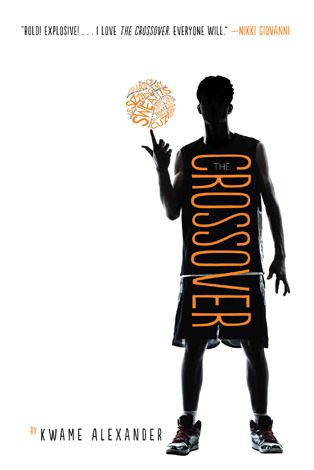
The Crossover Author: Kwame Alexander
Published March 18th, 2014 by Harcourt Brace and Company
Goodreads Summary: “With a bolt of lightning on my kicks . . .The court is SIZZLING. My sweat is DRIZZLING. Stop all that quivering. Cuz tonight I’m delivering,” announces dread-locked, 12-year old Josh Bell. He and his twin brother Jordan are awesome on the court. But Josh has more than basketball in his blood, he’s got mad beats, too, that tell his family’s story in verse, in this fast and furious middle grade novel of family and brotherhood.
Josh and Jordan must come to grips with growing up on and off the court to realize breaking the rules comes at a terrible price, as their story’s heart-stopping climax proves a game-changer for the entire family.
My Review: Wow. What a powerful piece of narrative and poetry. Any poem from Josh’s story could easily be taken out of context and used as a piece of exemplar poetry writing. In addition to the amazing writing, Josh is a kid that is so easy to connect with. He is so real. You love him (even if he is a little cocky). By the end of the book, you feel like you are part of Josh’s family, and you don’t want to leave.
And to top it all off: one of my reluctant readers grabbed this book and zoomed right through it. It quickly became one of his favorite books! I love when the Newbery Medal winner is accessible to students. Now to just get more students to read it and experience the awesomeness.
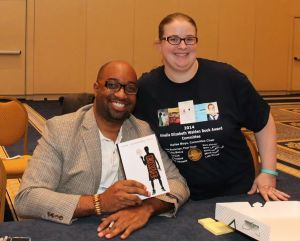
(Also, Kwame was one of my favorite presenters at ALAN, and he was such a pleasure to meet!)
Teachers’ Tools for Navigation: I cannot wait to have my students make vocabulary poems like Josh does. Such a fun way to play with words. Additionally, like I stated above, any poem in this novel could be used in a poetry unit. I’d also love to have students come up with rules like Josh’s dad did for basketball and have them write them in verse.
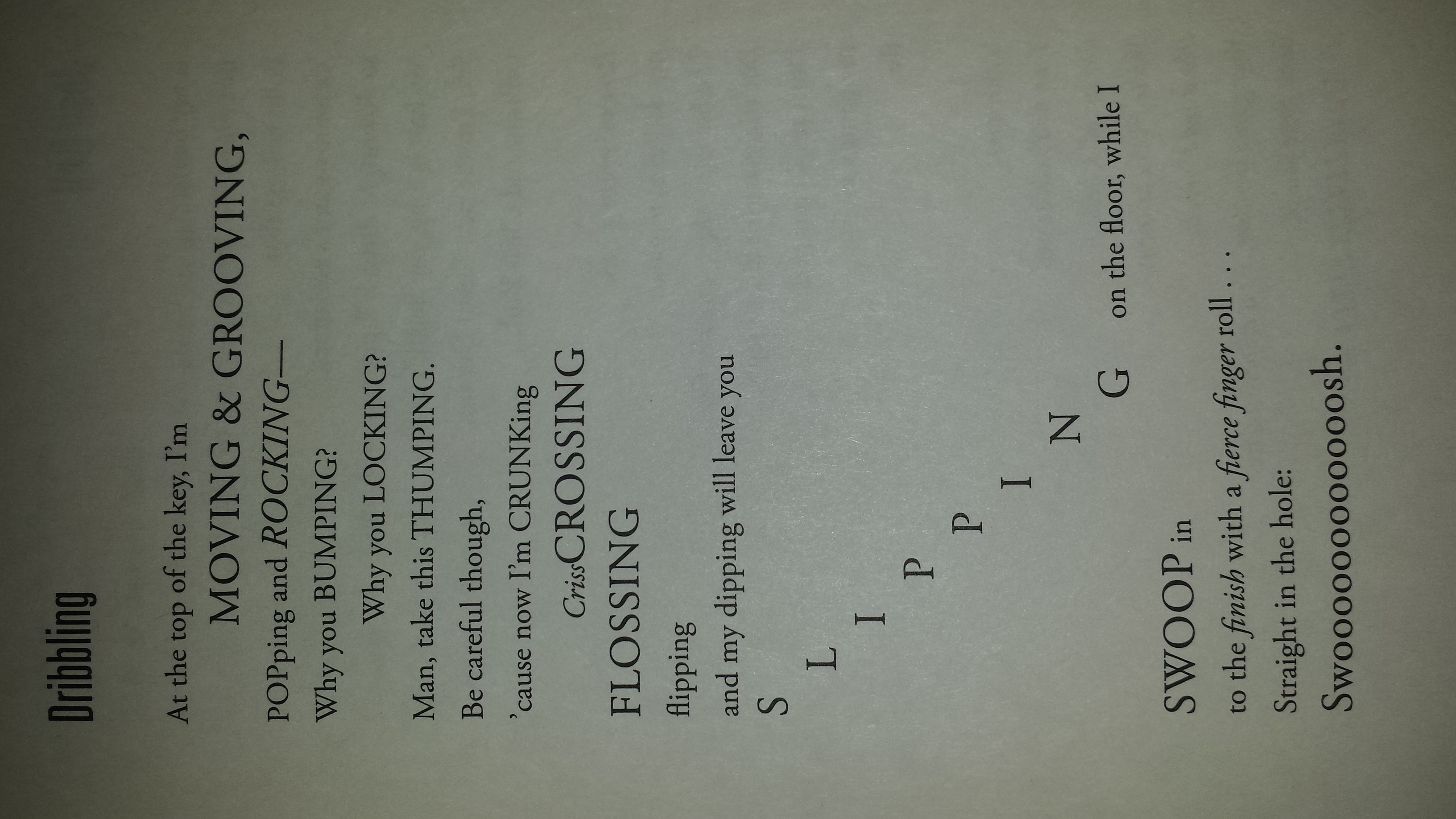
Discussion Questions: Why is Josh so impacted by Jordan getting a girlfriend?; Who do you think influences Josh more: his dad or his mom? Explain.; Within his poems, Josh uses formatting, bolding, and different fonts to put emphasis on certain words. Why does he do this?; Josh uses figurative language throughout his poems. Find an example and share why you think Josh used it.; How are Josh and Jordan similar? Different?
We Flagged:
Read This If You Loved: Jumped In by Patrick Flores-Scott (YA), The Sports Pages edited by Jon Sciezska, The Moves Make the Man by Bruce Brooks, Summer Ball by Mike Lupica
Nonfiction Picture Book Wednesday is hosted by Kid Lit Frenzy and was started to help promote the reading of nonfiction texts. Most Wednesdays, we will be participating and will review a nonfiction text (though it may not always be a picture book).
Be sure to visit Kid Lit Frenzy and see what other nonfiction books are shared this week!
**This book is technically historical fiction, but I felt it was pretty darn close to nonfiction**
Never Fall Down Author: Patricia McCormick
Published May 8th, 2012 by Balzer + Bray
Goodreads Summary: This National Book Award nominee from two-time finalist Patricia McCormick is the unforgettable story of Arn Chorn-Pond, who defied the odds to survive the Cambodian genocide of 1975-1979 and the labor camps of the Khmer Rouge.
Based on the true story of Cambodian advocate Arn Chorn-Pond, and authentically told from his point of view as a young boy, this is an achingly raw and powerful historical novel about a child of war who becomes a man of peace. It includes an author’s note and acknowledgments from Arn Chorn-Pond himself.
When soldiers arrive in his hometown, Arn is just a normal little boy. But after the soldiers march the entire population into the countryside, his life is changed forever.
Arn is separated from his family and assigned to a labor camp: working in the rice paddies under a blazing sun, he sees the other children dying before his eyes. One day, the soldiers ask if any of the kids can play an instrument. Arn’s never played a note in his life, but he volunteers.
This decision will save his life, but it will pull him into the very center of what we know today as the Killing Fields. And just as the country is about to be liberated, Arn is handed a gun and forced to become a soldier.
My Review: When I started Never Fall Down, I had no idea what I was getting myself into. I began it because Ricki recommended it to me, but I didn’t read the back or have any prior knowledge about the book. So, when I began, I had no idea how tough this book was going to be.
I also have to preface with my ignorance of the Cambodian Genocide. I blame my lack of world history education because this is a time of history that should be taught. It, along with the Holocaust and Armenian Genocide, was based in racism and the attempt to purify a country. Reading Arn’s story throws you right in the middle of the genocide, and Patricia McCormick doesn’t hold anything back. Every time you think nothing can get worse for Arn and the Cambodians, something does, but you also have such hope for Arn’s survival as you seen him overcome every obstacle he faces. Even though death actually stares him in the face throughout the book, this young boy somehow continues. He continues through starvation, excessive work, lack of sleep, and murder surrounding him. Arn stated in interviews with McCormick that music saved his life, but I think it was more about his willingness to do whatever was needed to survive and especially anything to help those he cared for to survive.
Patricia McCormick tells our story in a broken English dialect that was influenced by “Arn’s own beautiful, improvised English” that McCormick heard in her head after interviewing him and traveling with him to Cambodia over a couple of years. The extent that Ms. McCormick went to ensure that Arn’s story was a true representation of his trials and heroism is honorable.
Teachers’ Tools For Navigation: This would be a perfect cross-curricular text! It could be read in a world history class in full or in parts. Although it is McCormick’s writing, it is definitely Arn’s story, and Arn’s story is one that needs to be shared. This book could also be used in lit circles where each group has a different book about a piece of history or an individual who/that is not usually learned about (maybe with Between Shades of Gray by Ruta Sepetys, Sold,Caminar by Skila Brown, The Glass Collector by Anna Perera, Son of a Gun by Anne de Graaf, Inside Out & Back Again by Thanhha Lai, Guantanamo Boy by Anna Perera, A Long Walk to Water by Linda Sue Park, The Queen of Water by Laura Resau, orNow is the Time for Running by Michael Williams).
One of my amazing 8th grade students read this book recently, and she was as enthralled with it as I was. Immediately after finishing, she got online and started learning more about Arn and Cambodia. She came across an amazing video with both Patricia McCormick and Arn in it. It is 27 minutes long, but it is so worth watching:
Discussion Questions: What do you think ultimately helped Arn survive?; How did Sombo save Arn’s life at the orphan camp? When the war with the Vietnamese started? At the killing fields?; Do you think music is what saved Arn?; How were the Khmer Rouge able to make their prisoners do whatever they wanted them to?; Why did the Khmer Rouge kill all the educated Cambodians?; Why was Sombo so unsure about the Coca Cola?
We Flagged: “All the time now we hear girl screaming, girl running, girl crying. At night but also sometime in the daytime. All the tie, the Khmer Rouge they chase the girl, cut the hair. Sometime with scissor, sometime with knife. Chop short, to the chin, like boy. The girl, they cry and sometime they run. They run, it’s no good. The Khmer Rouge may shoot them, maybe take them to the bushes, do whatever they want. A lot of the girl afterward, they pull on their hair, pull like maybe they can stretch it, make it long, make it beautiful again.
My number two big sister, Maly, her hair like silk. Most proud thing about her, her hair. Shiny black, like blue, like a crow has. Every night she brush her hair, every morning. Sometime even she brush her hair not thinking, just dreaming maybe about the boy she love. One morning I wake up before everyone and see her making rice. Her neck, it’s bare now, her skin there is pale, never saw the sun, her long hair gone. Last night while I was asleep, the soldier, they cut her beauty. So now when she give me a bowl of rice soup, her eyes stay on the ground.” (p. 29-30)
Read This If You Loved: Titles listed above in Teachers’ Tools for Navigation
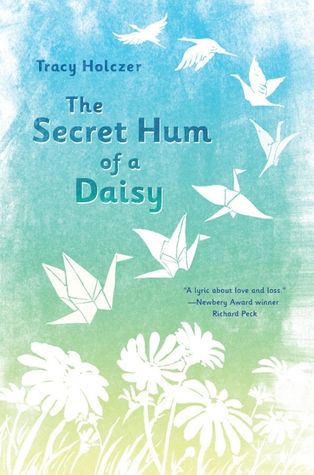
The Secret Hum of a Daisy Author: Tracy Holczer
Published: July 24, 2014 by Annick Press
Summary: Twelve-year-old Grace and her mother have always been their own family, traveling from place to place like gypsies. But Grace wants to finally have a home all their own. Just when she thinks she’s found it her mother says it’s time to move again. Grace summons the courage to tell her mother how she really feels and will always regret that her last words to her were angry ones.
After her mother’s sudden death, Grace is forced to live with a grandmother she’s never met. She can’t imagine her mother would want her to stay with this stranger. Then Grace finds clues in a mysterious treasure hunt, just like the ones her mother used to send her on. Maybe itis her mother, showing her the way to her true home.
Lyrical, poignant and fresh, The Secret Hum of a Daisy is a beautifully told middle grade tale with a great deal of heart.
Ricki’s Review:The Secret Hum of a Daisy truly pulled my heartstrings. Readers of this blog know that I am a slightly critical reader of middle grade texts, and I often prefer high school texts, but my oh my, this one is beautiful. Having lost loved ones and friends, I know that grief hits you at random times. Holczer captured this reality beautifully. This book feels melancholy at the same time as it feels hopeful and lyrical. Young people will learn strength and resilience in Grace. Holczer’s thoughtful pacing makes this poignant coming of age story quite beautiful.
Kellee’s Review: This is one of those books that grabs you and sucks you in. I mostly love our main character. She has had to grow up too quickly thus making her a bit rough around the edges, but the way that friendship, family, history, poetry, and stories smooth her out is just so well done. Although at times I felt Grace came off older than she is, I realized, after talking to Carrie G., that it is because of the hardships she has endured. And the cast of characters, family and friends, who play a role in Grace’s transformation all are so well crafted. The Secret Hum of Daisy is a beautiful book because of Holczer’s word choice, Grace’s story, and the look at grief, family, and friendship.
Teacher’s Tools for Navigation: The Robert Frost references in this book easily lend themselves to instructional supplements for teachers. The sadness of this novel is important to discuss with students. They might consider poetry or journaling as an outlet for their emotions. Additionally, teachers my show students the stages of grief to help them better understand Grace’s emotions. Grace says that she gathers “every bit” she can of her Mama. Teachers might consider asking students to gather bits of people they love and sharing these with the class. Curriculum Guide from Penguin.
Discussion Questions: Does Grace’s mom make mistakes in her parenting? What might she have done differently?; Do you agree with Grace’s decision to live in the shed? Do you consider this to be immature or strong of her? Why?
We Flagged: “Mama pulled me into her lap and her yellow chair creaked under our weight. ‘You have to trust me, Grace. We don’t need anyone else.'” (p. 8)
“Trying to ignore the blasts of rain against the tin roof, I dug a flashlight out of one of the boxes and laid my sleeping bag and pillow on our flower-garden sofa. I took my latest notebook out of my duffel and climbed into the sleeping bag.
I hadn’t written anything in the six days since Mama died, and the words were scratching at me in the way they always did. I hoped to find the end of that string inside of myself–the string that tended to work into knots–and pull it straight. That was how the words felt sometimes as I wrote them down. Like I was taking something scrambled and unscrambling it.” (p. 24)
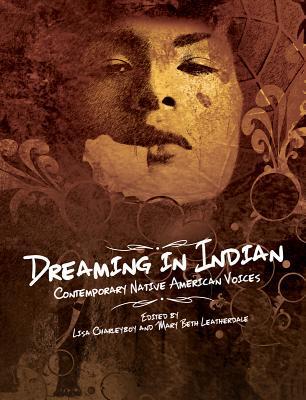
Dreaming in Indian: Contemporary Native American Voices Editors: Lisa Charleyboy and Mary Leatherdale
Published: July 24, 2014 by Annick Press
Summary: A powerful and visually stunning anthology from some of the most groundbreaking Native artists working in North America today.
Truly universal in its themes, “Dreaming In Indian” will shatter commonly held stereotypes and challenge readers to rethink their own place in the world. Divided into four sections, ‘Roots, ‘ ‘Battles, ‘ ‘Medicines, ‘ and ‘Dreamcatchers, ‘ this book offers readers a unique insight into a community often misunderstood and misrepresented by the mainstream media.
Emerging and established Native artists, including acclaimed author Joseph Boyden, renowned visual artist Bunky Echo Hawk, and stand-up comedian Ryan McMahon, contribute thoughtful and heartfelt pieces on their experiences growing up Indigenous, expressing them through such mediums as art, food, the written word, sport, dance, and fashion. Renowned chef Aaron Bear Robe, for example, explains how he introduces restaurant customers to his culture by reinventing traditional dishes. And in a dramatic photo spread, model Ashley Callingbull and photographer Thosh Collins reappropriate the trend of wearing ‘Native’ clothing.
Whether addressing the effects of residential schools, calling out bullies through personal manifestos, or simply citing hopes for the future, “Dreaming In Indian” refuses to shy away from difficult topics. Insightful, thought-provoking, and beautifully honest, this book will to appeal to young adult readers. An innovative and captivating design enhances each contribution and makes for a truly unique reading experience.
Review: I fell in love with the stunning illustrations and beautiful language of this book. I read two to three pages per night because I wanted to leave time to absorb the authors’ words and artists’ work. The eclectic mix of forms makes for a very powerful anthology that will prove enduring for readers. It features a variety of tribes, and the differing formats and content give readers a sense of both a unity across tribes and a distinctness of individuals from the different tribes. I found it to be truly inspiring and wish I could donate this book to every middle and high school classroom.
Teacher’s Tools for Navigation: This text is obviously a great resource for teachers. It need not be used in its entirety because this text would be excellent for close readings. Whatever the format, it would be preferable to avoid using this book solely during the month of November—“Native American Heritage Month.” I align with scholars who believe that diverse cultures should be highlighted year-round and integrated within curricula, rather than solely within designated months.
Discussion Questions: In what ways are the themes of this book universal? In what way are they distinct?; What themes can you find across the works?; How does this book shed light on Indian culture?; How is the text structured? Do you find the style to be effective?
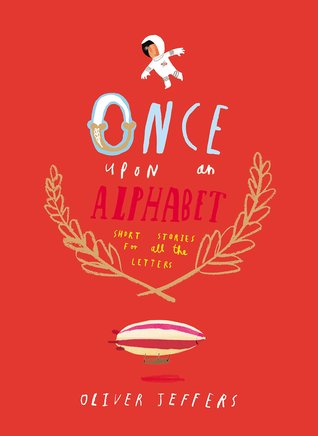
Once Upon an Alphabet: Short Stories for all the Letters Author: Oliver Jeffers
Published October 14th, 2014 by Philomel
Goodreads Summary: If words make up the stories and letters make up the words, then stories are made up of letters. In this menagerie we have stories made of words, made FOR all the letters.
The most inventive and irresistible book of the year spans a mere 26 letters (don’t they all!) and 112 pages. From an Astronaut who’s afraid of heights, to a Bridge that ends up burned between friends, to a Cup stuck in a cupboard and longing for freedom, Once Upon an Alphabet is a creative tour de force from A through Z. Slyly funny in a way kids can’t resist, and gorgeously illustrated in a way readers of all ages will pour over, this series of interconnected stories and characters explores the alphabet in a way that will forever raise the bar.
In Once Upon an Alphabet, #1 New York Times bestseller Oliver Jeffers has created a stunning collection of words and artwork that is a story book, alphabet book, and gorgeously designed art book all in one.
Kellee’s Review and Teachers’ Tools for Navigation: Oliver Jeffers is just brilliant. Everything he does is unique, and he actually keeps surprising me with each new book. And he makes me laugh out loud, which is always such a treat. This book has 26 quirky short stories, each corresponding with a letter. Each story has characters, plot, theme, and conflict, and each is quite clever and funny. It is just so well done!
I’d love to see this book used as a read aloud for 26 days. Each day as a different letter. With every letter, teachers could focus on different things: the letter, illustrations, voice, characterization, plot arc, conflict, theme, mood, figurative language, etc. It would be a great opener to the day and would also be a lot of fun to ask students to write their own stories for the letters. This pushes an alphabet book to a whole different level!
Ricki’s Review and Teachers’ Tools for Navigation: I agree with Kellee. Decades from now, children will still be enjoying Jeffers’ books. For me, he is comparable to the greats in children’s literature. My favorite part about this book was the way he connected the letters. It made me excited when he returned to some of the previous short stories.
This book begs for students to write. The short stories teach literary skills in an engaging way. Kellee’s idea was similar to my own. I would love to see a classroom book of these letters. Each student could be assigned a letter or two. With some funding, perhaps the students could bring a bound version home. It would be much more fun for students to practice letters when they can read their classmate’s stories! The way Jeffers flexes his creative muscles would also be inspiring to high school students.
Discussion Questions: Which letter’s story was your favorite? Why?; In what ways was Oliver Jeffers creative in his storytelling?; Can you think of other stories for each letter?
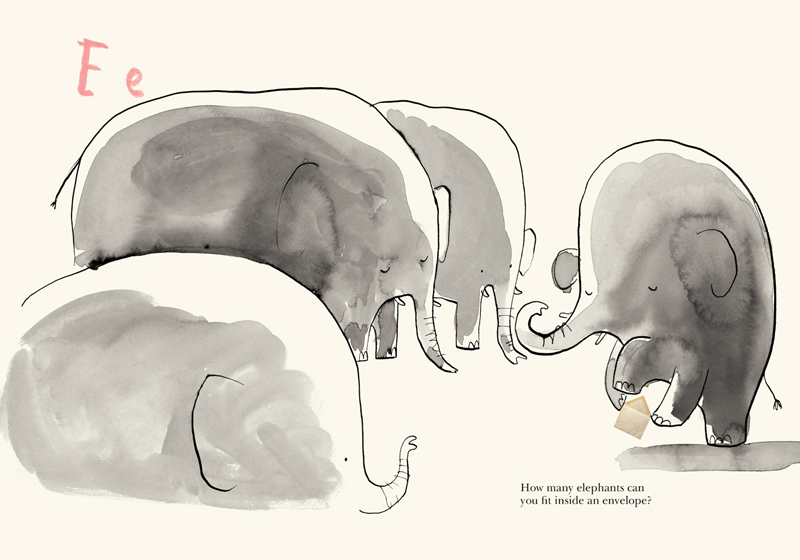
We Flagged:
http://www.oliverjeffers.com/media/5-e-2-web.jpg
Read This If You Loved: Any books by Oliver Jeffers, Eric Carle, or Dr. Seuss
Recommended For:
and
**Thank you to Penguin Young Readers Group for providing copies for review!**
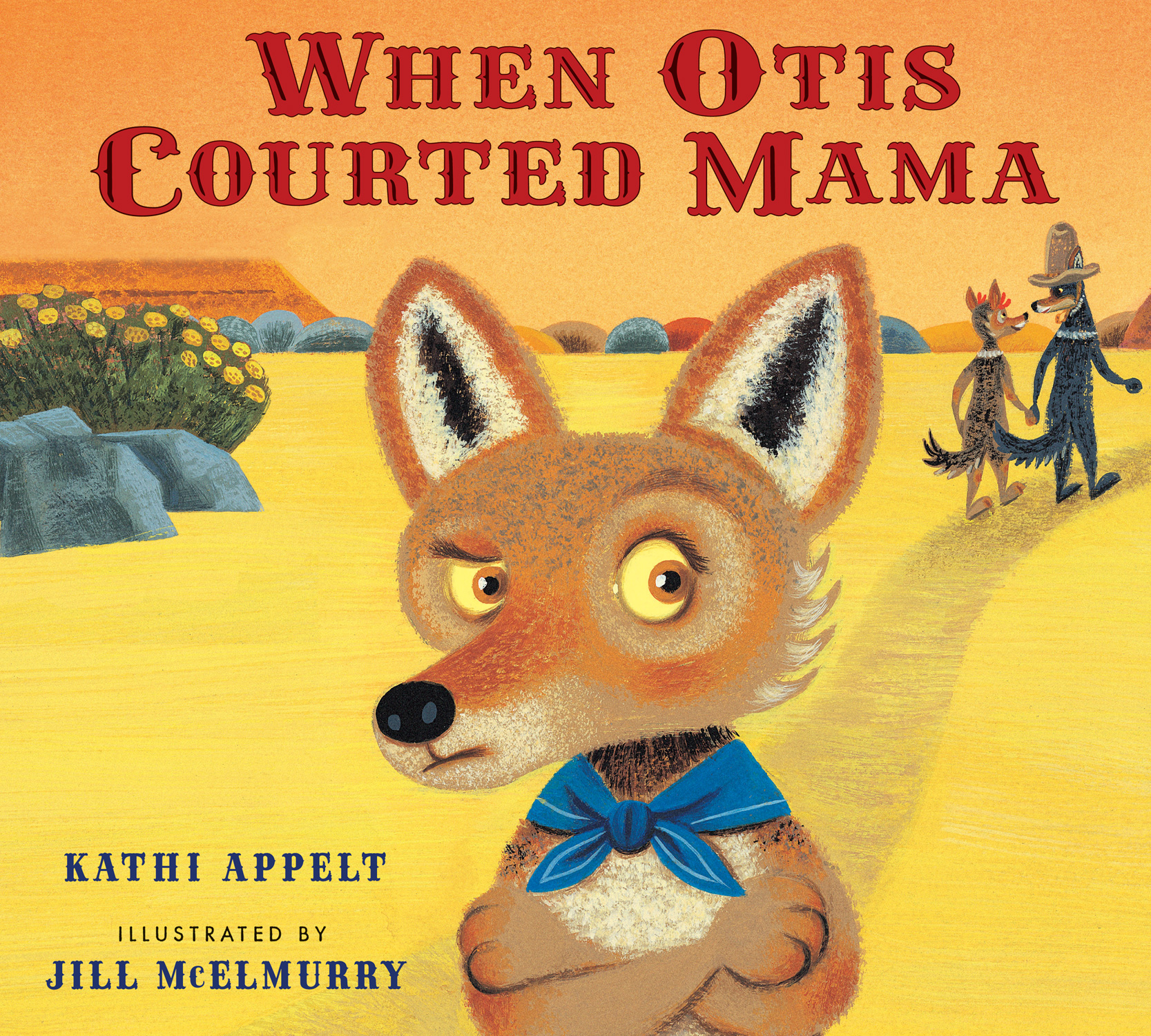
When Otis Courted Mama Author: Kathi Appelt
Illustrator: Jill McElmurry
Published: January 6, 2015 by HMH Books for Young Readers
Goodreads Summary: Apart from sticker burrs and sand fleas, Cardell’s life is mostly wonderful. He knows he’s loved through and through by his perfectly good mama and his perfectly good daddy. They live in different parts of the desert, but that’s okay—Cardell is mostly used to it. Then Otis comes calling, and Cardell feels a grrr form in his throat. Otis can’t make jalapeño flapjacks or play Zig-the-Zag anything like Cardell’s daddy. And so Cardell waits for Mama to say “Adiós, Otis.” But what will happen if she doesn’t?
Ricki’s Review and Teachers’ Tools for Navigation: On a recent Top Ten Tuesday post, I wrote that I would love to see more picture books about different kinds of families. A week later, I found this gem. I absolutely adored Cardell the coyote and think kids will identify with his spunk. Cardell isn’t thrilled when his mother begins dating a new man, and he suspects Otis (the new guy) will be gone quickly, just like the others. This is a great resource to teach kids about accepting and adjusting to life with a new stepparent. I would also use it to teach setting and creative writing–the Southwest flavor adds a beautiful sense of culture that spices up both the text on the page and the illustrations. There is much to discuss with this book, and I think it would make a great read-aloud. I had a lot of fun reading it to my son.
Kellee’s Review and Teachers’ Tools for Navigation: Ricki said it so well! This is a book that was needed, and it is a good one at that. Too often, a lack of empathy occurs because one person doesn’t understand the other. I love picture books that help kids understand other people’s situations (but without being preachy), and this book does just that; however, it is also a very universal picture book because it shows a kid having to deal with a new situation. At one point or another, everyone must face the unknown or something s/he dislikes, and that is exactly what Cardell is going through.
This book will become a favorite read aloud for classroom teachers! Cardell’s voice rings true, and it will be so much fun to read aloud. I really loved Kathi Appelt’s writing as well. Her use of descriptive words is spot on and would be a great mentor text for imagery. Teachers could also discuss how her words were translated into illustrations.
Bonus!: Find a full-color door hanger and other fun downloadables at kathiappelt.com.
Discussion Questions: Do you think Cardell treated Otis fairly?; What are some of the different types of families in our world? What makes your family different?; How do you treat new people you meet?
Book Trailer:
Read This if You Loved: ABC A Family Alphabet Book by Bobbie Combs, Donovan’s Big Day by Lesléa Newman, The Family Book by Todd Parr, And Tango Makes Three by Justin Richardson, Two Cool Coyotes by Jillian Lund, Girl Who Loved Wild Horses by Paul Goble, A Tale of Two Daddies and A Tale of Two Mommies by Vanita Oelschlager
Recommended For:
Guest Post by Kathi Appelt
When I was in the fifth grade, my parents got divorced. It wasn’t a sudden thing, but it was a sad thing. We went from a whole family to a broken family. Moreover, my father left us—my mom and my two younger sisters and me—to start a brand new family. All at once, I had a stepmother and two stepbrothers, not to mention step-grandparents, step cousins, step uncles and aunts. Lots of steps. It was confusing.
The thing is, whenever life got to be too much, I could duck into the pages of a book and find some refuge there. It’s always been that way for me.
But in that tumultuous time, when my family was becoming something that seemed both smaller and larger, I could really have used a book that gave me some faith that life would eventually be “mostly wonderful.” I could have used a book that had non-antagonistic stepparents. There were—and still are—few picture books that celebrate step families, a notable exception being When We Married Gary, by Anna Grossnickle Hines.
In fact, for the most part, stepparents in children’s literature, are fairly villainous. (I’m reminded of the evil stepmother in Cinderella). In reality, I know that there are many stepparents in the world who are doing their best, and who are making a positive difference in the lives of their stepchildren. I had the great fortune of having George. He came into my mother’s life like a breath of fresh air. And he had the courage to marry her when my sisters and I were sixteen, fourteen, and thirteen. Imagine marrying someone who had three teenagers!
Looking back, I believe that the best thing about George was his ability to spin a yarn. He was a master at telling tales. In a matter of minutes, he’d have all of us laughing right out loud. And that felt perfectly wonderful.
So, when it comes to using my book in classrooms, I have four main hopes for it:
(1) that it can be used to feature an all-too-common modern family—divided, but working it all out; (2) that it honestly portrays a youngster who is having to make adjustments; (3) that it can serve as a way to talk about jealousy and other mixed emotions; and finally (4) with its Southwestern flora and fauna and landscape, that it can just be plain fun to read out loud. That last is my biggest hope.
And if it can offer up a character who is not a stereotype of Cinderella’s wicked stepmother, that will just be a bonus.
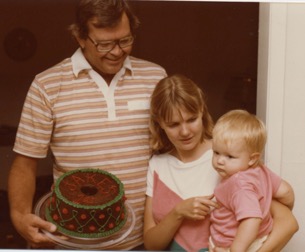
Photo of George, Kathi’s stepfather
(He’s with Kathi and her oldest child, Jacob, on his first birthday.)
About the Author: Kathi Appelt’s perfectly wonderful stepfather was a terrific storyteller, and she grew up to become a teller of stories, too. She is the New York Times best-selling author of more than forty books for children and young adults. Her picture books include Oh My Baby, Little One, illustrated by Jane Dyer, and the Bubba and Beau series, illustrated by Arthur Howard. Her novels for older readers include two National Book Award finalists: The True Blue Scouts of Sugar Man Swamp and The Underneath, which was also a Newbery Honor Book. In addition to writing, Ms. Appelt is on the faculty in the Masters of Creative Writing for Children and Young Adults at Vermont College of Fine Arts. She lives in College Station, Texas. To download a free, CCSS-aligned curriculum guide, visit Kathi’s website at kathiappelt.com.
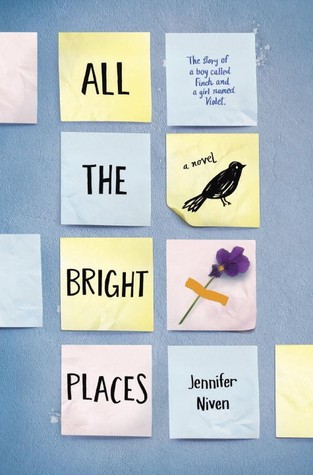
All the Bright Places Author: Jennifer Niven
Published: January 6, 2015 by Knopf
Goodreads Summary: The Fault in Our Stars meets Eleanor and Park in this compelling, exhilarating, and beautiful story about a girl who learns to live from a boy who intends to die.
Theodore Finch is fascinated by death, and he constantly thinks of ways he might kill himself. But each time, something good, no matter how small, stops him.
Violet Markey lives for the future, counting the days until graduation, when she can escape her Indiana town and her aching grief in the wake of her sister’s recent death.
When Finch and Violet meet on the ledge of the bell tower at school, it’s unclear who saves whom. And when they pair up on a project to discover the “natural wonders” of their state, both Finch and Violet make more important discoveries: It’s only with Violet that Finch can be himself—a weird, funny, live-out-loud guy who’s not such a freak after all. And it’s only with Finch that Violet can forget to count away the days and start living them. But as Violet’s world grows, Finch’s begins to shrink.
This is an intense, gripping novel perfect for fans of Jay Asher, Rainbow Rowell, John Green, Gayle Forman, and Jenny Downham from a talented new voice in YA, Jennifer Niven.
Ricki’s Review: A publishing representative who I deem to be a friend pressed this book into my hand. “Read it,” she insisted. She told me I would want to curl up into a ball in my bed and fall into this book. I fell hard. The writing is incredible. I hate to compare books with others because it creates a sense of expectation that often goes unfulfilled for future readers, but I couldn’t help but consider comparisons with my all-time favorite YA texts. The quirky nature of the characters reminded me of Pudge, Alaska, Charlie, Eleanor, and Park. The direction of the plot reminded me of other titles (which will remain unnamed to prevent spoilers). But I cannot compare this book to others because while it allowed to me reminisce about my favorite titles, it was quite different. The deep, honest, hard-hitting depiction of mental illness was enough to take my breath away. I felt rage that made me want to punch my mattress; I felt sadness that made me feel a hopeless sense of emptiness; but above all, I felt the power of love, loyalty, and friendship that made my heart both ache and swell. This is an unforgettable book. I suspect it will be the book that everyone will be talking about this year and for years to come.
Teacher’s Tools for Navigation: Mental illness and bullying are pervasive in our schools. We can’t teach enough books about these themes because they are incredibly relevant for young people. As a former teacher, I was jealous of the teacher who created the assignment for Violet and Finch, and I wanted to do it with my former students. It would be so neat to duplicate this project while students read the book. Additionally, I think students would benefit from creating their own version of the post-it collages that Violet and Finch make. As an alternative, I would consider having students research the warning signs of suicide and finding these instances in the text. There are so many themes for the students to consider, the teaching categories at the top and tags at the bottom of this post show a variety of different directions a teacher might take with the instruction of this text.
Discussion Questions: What is the end message of this book? What is the author’s purpose?; What foreshadowing does Niven provide?; How do Violet’s family members show their grief in different ways?; Do you agree with the ending? Would you change it? Why do you think Niven ended the book in the way she did?
We Flagged: “It’s my experience that people are a lot more sympathetic if they can see you hurting, and for the millionth time in my life I wish for measles or smallpox or some other easily understood disease just to make it easier on me and also on them.”
**Please note: The above quotation is from an advanced reader copy. The quotation may change in the final published form of the text.**
Read This If You Loved: Looking for Alaska by John Green, Eleanor and Park by Rainbow Rowell, Dr. Bird’s Advice for Sad Poets by Evan Roskos, The Fault in Our Stars by John Green, Forgive Me, Leonard Peacock by Matthew Quick, It’s Kind of a Funny Story by Ned Vizzini, The Perks of Being a Wallflower by Stephen Chbosky, Twisted by Laurie Halse Anderson, Everybody Sees the Ants by A.S. King, Burn by Suzanne Phillips