Teachers’ Guide for Merci Suárez Changes Gears by Meg Medina

Share

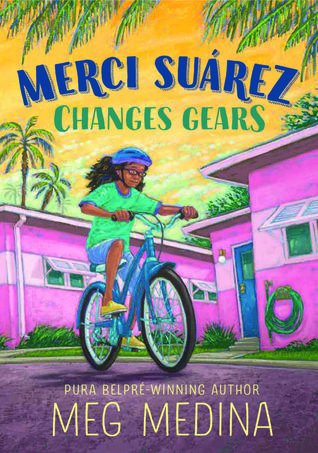
Merci Suárez Changes Gears
Author: Meg Medina
Published: September 11th, 2018 by Candlewick Press

Summary: Thoughtful, strong-willed sixth-grader Merci Suárez navigates difficult changes with friends, family, and everyone in between in a resonant new novel from Meg Medina.

Merci Suárez knew that sixth grade would be different, but she had no idea just how different. For starters, Merci has never been like the other kids at her private school in Florida, because she and her older brother, Roli, are scholarship students. They don’t have a big house or a fancy boat, and they have to do extra community service to make up for their free tuition. So when bossy Edna Santos sets her sights on the new boy who happens to be Merci’s school-assigned Sunshine Buddy, Merci becomes the target of Edna’s jealousy. Things aren’t going well at home, either: Merci’s grandfather and most trusted ally, Lolo, has been acting strangely lately — forgetting important things, falling from his bike, and getting angry over nothing. No one in her family will tell Merci what’s going on, so she’s left to her own worries, while also feeling all on her own at school. In a coming-of-age tale full of humor and wisdom, award-winning author Meg Medina gets to the heart of the confusion and constant change that defines middle school — and the steadfast connection that defines family.

Teachers’ Tools for Navigation and Discussion Questions: 

Please view and enjoy the teachers’ guide I created for Merci Suárez Changes Gears:

You can also access the teaching guide here.

You can learn more about Merci on Candlewick Press’s Merci Suárez Changes Gears page.

Recommended For: 

readaloudbuttonsmall classroomlibrarybuttonsmall litcirclesbuttonsmall closereadinganalysisbuttonsmall

Kellee Signature

Teachers’ Guide for Louisiana’s Way Home by Kate DiCamillo

Share

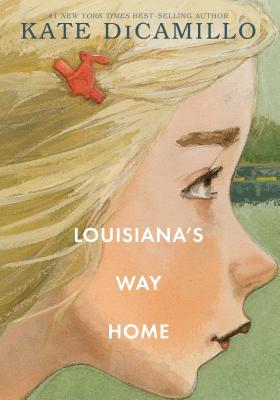
Louisiana’s Way Home
Author: Kate DiCamillo
Published: October 2nd, 2018 by Candlewick Press

Summary: From two-time Newbery Medalist Kate DiCamillo comes a story of discovering who you are — and deciding who you want to be.

When Louisiana Elefante’s granny wakes her up in the middle of the night to tell her that the day of reckoning has arrived and they have to leave home immediately, Louisiana isn’t overly worried. After all, Granny has many middle-of-the-night ideas. But this time, things are different. This time, Granny intends for them never to return. Separated from her best friends, Raymie and Beverly, Louisiana struggles to oppose the winds of fate (and Granny) and find a way home. But as Louisiana’s life becomes entwined with the lives of the people of a small Georgia town — including a surly motel owner, a walrus-like minister, and a mysterious boy with a crow on his shoulder — she starts to worry that she is destined only for good-byes. (Which could be due to the curse on Louisiana’s and Granny’s heads. But that is a story for another time.)

Called “one of DiCamillo’s most singular and arresting creations” by The New York Times Book Review, the heartbreakingly irresistible Louisiana Elefante was introduced to readers in Raymie Nightingale — and now, with humor and tenderness, Kate DiCamillo returns to tell her story.

Teachers’ Tools for Navigation and Discussion Questions: 

Please view and enjoy the teachers’ guide I created for Louisiana’s Way Home: 

You can also access the teaching guide here.

You can learn more about Louisianaon Candlewick Press’s Louisiana’s Way Home page.

Recommended For: 

readaloudbuttonsmall classroomlibrarybuttonsmall litcirclesbuttonsmall closereadinganalysisbuttonsmall

Kellee Signature

The Forest Queen by Betsy Cornwell

Share

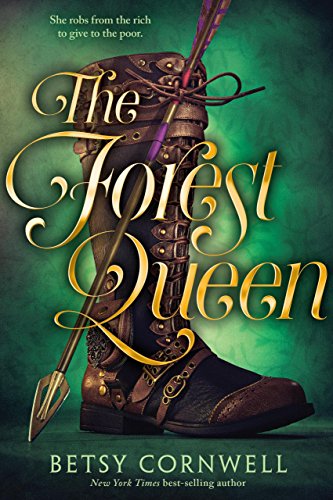
The Forest Queen
Author: Betsy Cornwell
Published: August 7, 2018 by Houghton Mifflin Harcourt

Guest Review by Rachel Krieger

Summary: When sixteen-year-old Sylvie’s brother takes over management of their family’s vast estates, Sylvie feels powerless to stop his abuse of the local commoners. Her dearest friend asks her to run away to the woods with him, and soon a host of other villagers join them. Together, they form their own community and fight to right the wrongs perpetrated by the king and his noblemen.

Review: Anyone familiar with the tale of Robin Hood likes the idea of stealing from the rich and giving to the poor. Betsy Cornwell’s twist on this idea changes it just enough to give the story some flavor and novelty. The characters were compelling and the relationships were truly touching, but everything felt a little too convenient to me. There were several times when characters all but died and ended up making it out without a scrape. In a world where all of the favorable characters are on the lamb, there was a fair amount of luck and inaction that saved nearly every one of them. As a gender bent twist on a fairytale and a lively retelling of an old story, this novel had merit, but there wasn’t quite enough to it to call it a masterpiece.

However, as far as representation goes, Betsy Cornwell hit it on the head. The Forest Queen, as the title lets on, has a female leading things. The role of Robin Hood was usurped by a woman and amplified by the fact that the woman is stealing from her own family to give to the poor. The other females in the novel show strength in the face of things like rape and a shocking lack of agency. There are even LGBTQ characters that add to the sense that women in this world are the epitome of overcoming their circumstances.

Teacher’s Tool For Navigation:This novel is a great outlet in which to discuss rape culture. Although it is not the most prominent part of the story, it plays a part and is represented in an ideal way in relation to discussion. Because this subject is extremely difficult to discuss in general, let alone in a classroom, talking about it within the realm of this fantastical society may make it a bit easier. It would be interesting to reflect upon the similarities between the culture in the novel and our own culture in this society. It is so incredibly important to discuss difficult subjects in the classroom, but when it is in reference to a novel like The Forest Queen, it can be looked at in a more academic way.

Discussion Questions: 

  • Did Sylvie have a right to encourage the village people to rebel against her brother?
  • What do the ties to the story of Robin Hood do for this novel?
  • How do women take power in this story and how does that differ from classic fantasy?

Read This If You Loved: Cinder by Marissa Meyer, Six of Crows by Leigh Bardugo, Shadow and Bone by Leigh Bardugo, The Paper Magician by Charlie N. Holmberg

Recommended For: 

classroomlibrarybuttonsmall 

RickiSig

The Atlas of Monsters: Mythical Creatures from Around the World by Sandra Lawrence and Stuart Hill

Share

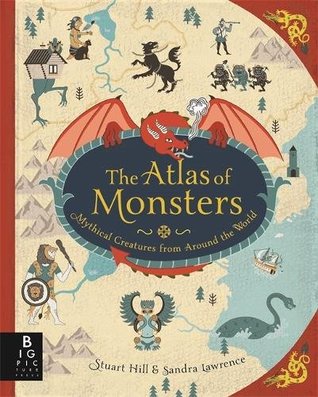
The Atlas of Monsters: Mythical Creatures from Around the World
Creators: Sandra Lawrence and Stuart Hill
Published April 23rd, 2019 by Running Press

Summary: A whimsical and imaginative catalog of fantastical beasts and creatures of myth and legend from around the world-complete with a code that needs cracking to uncover the mystery of the monster atlas!

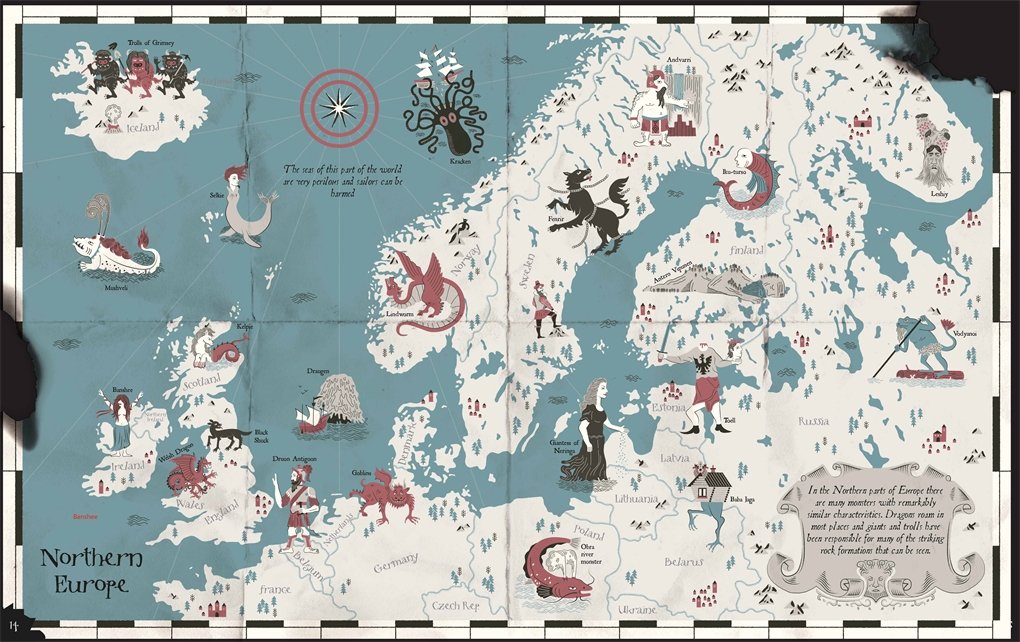
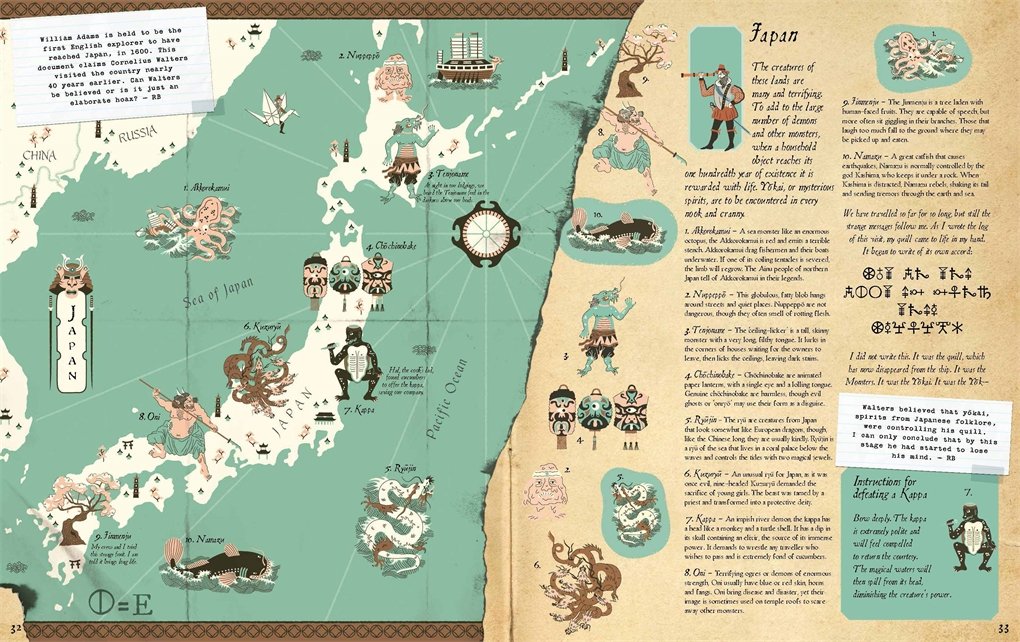
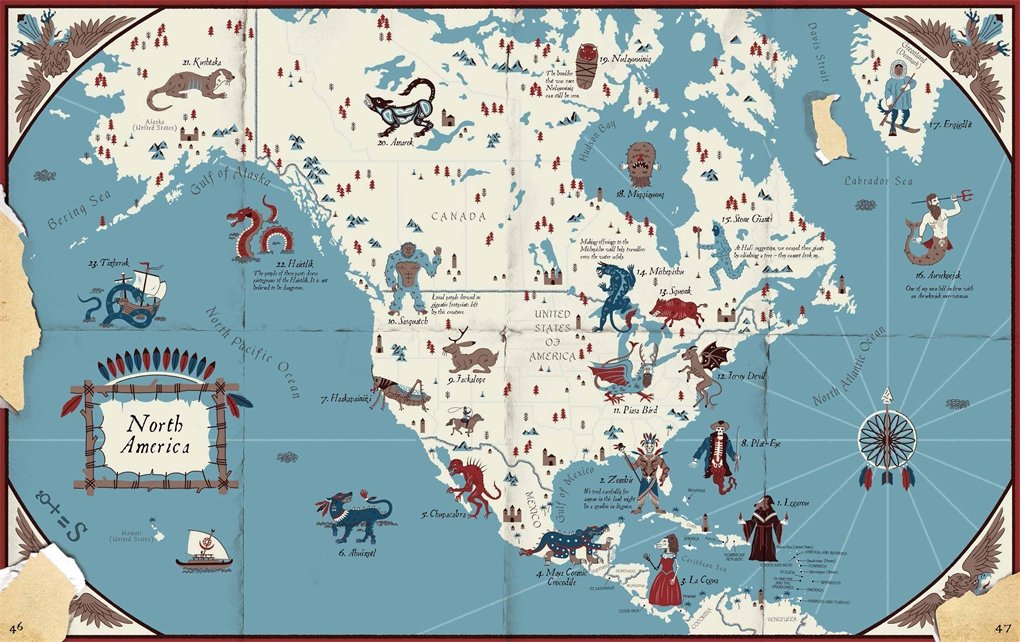
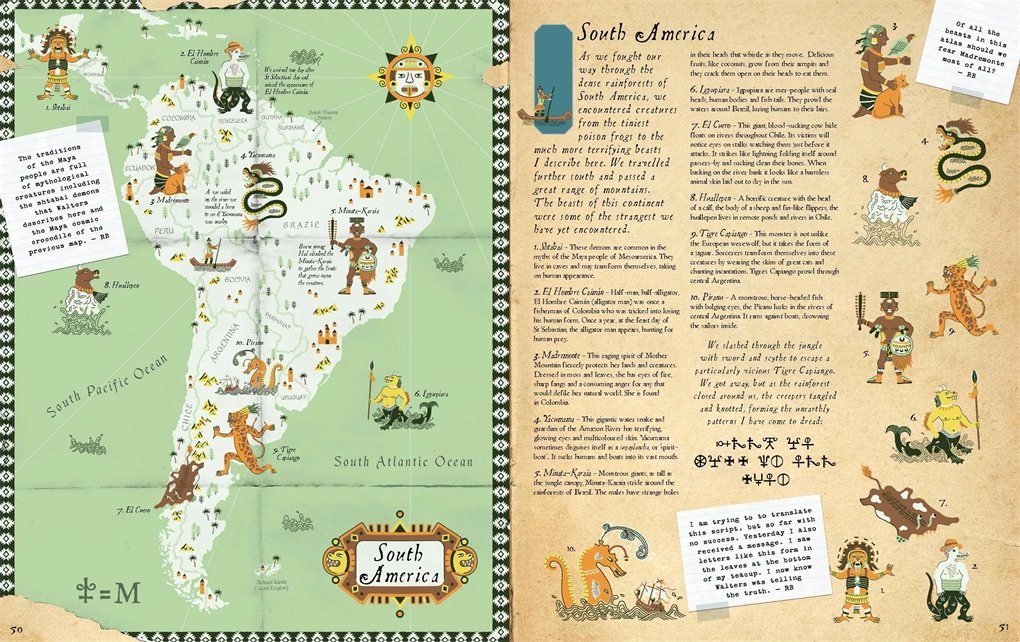
One day a collection of very old maps is found in a dusty library. They show where in the world monsters and creatures from mythology and folklore can be found. According to the notes left with the maps, they were made by Cornelius Walters, an intrepid explorer from the 15th century. But did Walters really make these elaborate maps, or is it all a hoax? The librarian who discovered them is not certain . . . and what are the strange messages in a cryptic code that Walters records in his ship’s log? The codes throughout, once cracked, may indeed lead to something sinister that will happen should the atlas ever be published!

This is a gorgeously illustrated and comprehensive catalog of monsters, beasts, and mythical creatures from around the globe, with an easy-to-read format and incredible detail on each spread. It is many things, all at once:

  • A reference guide: Grouped by continent, this illustrated atlas lists and defines magical creatures from folklore around the world. Readers will find creatures from stories they’ve heard–like leprachauns, manticores, zombies–and learn about lesser-known creatures like the squonk, the tatzelwurm, and the fengu.
  • A journal: Presented as a record created by a fifteenth-century voyager named Cornelius Walters, the book includes Cornelius’s personal anecdotes about encountering monsters during his journey.
  • A mystery: The book also includes notes from a librarian who supposedly found the atlas and is trying to figure out whether Cornelius was making up stories for the monsters…or whether monsters are real.
  • A code: A mysterious code appears on each page and is referred to by both Cornelius and the librarian, encouraging readers to crack it…before it’s too late.

For kids (and adults) who love mythology, the supernatural, mysteries, or code-breaking, this whimsical blend of folklore and fiction provides both a joy and a surprise on every page.

About the Creators: 

Sandra Lawrence is an author and journalist. She is the author of two middle grade history books: Grisly History: Death and Destruction and Grisly History: Trials and Treachery. She lives in London, England.

Stuart Hill is an illustrator and designer. He is especially interested in printed textures, hand-lettering, and map illustration. He lives in England.

Review: This book is really everything that the summary states. It is fascinating! And beautiful! There is some humor because of the voyager’s anecdotes and the librarian’s notes, too, which is always nice. And the addition of the code adds an interactive element to the text. Highly recommended for any teacher teaching mythology or any traditional stories with monsters/creatures.

Teachers’ Tools for Navigation: This text would be perfect for teaching and discussing the Literacy.RL.9 standard which discusses how modern texts uses traditional text. Using The Atlas of Monsters, students can get an introduction to allusion around a discussion of where they have heard of the monsters before. And this is just the beginning! It would be so much fun to make your own Atlas of Monsters!

Discussion Questions: 

  • Find the clues throughout each page, and crack the codes in the book.
  • How many different points of view are shared in the book? How does this affect the reading experience?
  • Pick one of the creatures and do further research and create a longer profile about them.
  • Before reading about one of the continents, do your own research and try to predict which mythical creatures will be mentioned.
  • What are some similarities/differences between what you knew about ____ and what is in the text?

Flagged Passages: 

Read This If You Love: Mythology, Cryptozoology, Folklore, the supernatural, code breaking

Recommended For: 

classroomlibrarybuttonsmall 

Signature

**Thank you Running Press Kids for providing a copy of the book to review!**

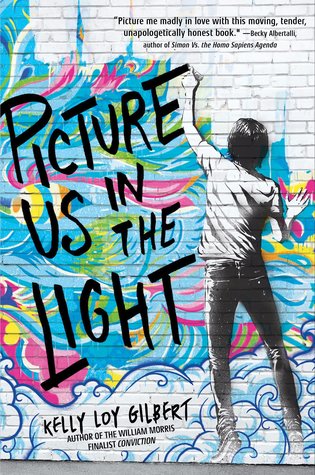
Picture Us in the Light by Kelly Loy Gilbert

Share

Picture Us in the Light
Author: Kelly Loy Gilbert
Published: April 10, 2018 by Disney-Hyperion

Guest Review by Rachel Krieger

Summary: Danny has been an artist for as long as he can remember, and it seems his path is set, with a scholarship to RISD and his family’s blessing to pursue the career he’s always dreamed of. Still, contemplating a future without his best friend, Harry Wong, by his side makes Danny feel a panic he can barely put into words. Harry and Danny’s lives are deeply intertwined and as they approach the one-year anniversary of a tragedy that shook their friend group to its core, Danny can’t stop asking himself if Harry is truly in love with his girlfriend, Regina Chan.

When Danny digs deeper into his parents’ past, he uncovers a secret that disturbs the foundations of his family history and the carefully constructed facade his parents have maintained begins to crumble. With everything he loves in danger of being stripped away, Danny must face the ghosts of the past in order to build a future that belongs to him.

Review: This book is filled to the brim with interesting plot points. While most novels would focus on one to two major things that are going on in a character’s life, this one has several. I found this to be both engaging and chaotic. Some of the time I felt that if Danny was a real person, he would simply explode during the course of events in the book. Danny was dealing with things well beyond what most people his age experience and manages to mostly keep it together despite. There are entire novels that deal with immigration, adoption, death of a loved one, suicide, sexual orientation, poverty, college preparedness, or love, but this one contains all of these ideas, among others. Though it felt like too much at times, this became one of the great aspects of the novel as well.

Throughout the story, Danny struggles with his morality at the same time as struggling with everything that life is dragging him through. Even though he is dealing with more than any human should have to, he still has time to feel the things that remind the reader that he is a person. So many of Danny’s feelings are perfectly reflective of what I and many others feel at points in life. The best part is that no matter who you are or what you have been through, you can connect with one of the topics addressed in this book. Gilbert’s inclusion of so many salient issues substantially increases the relatability.

Teacher’s Tool For Navigation: There are so many great things to talk about in the classroom in relation to this book. Although most reviews look at this novel as an exploration of sexuality, there are several other lenses with which to look through to spur great discussion. The issue that comes to mind first and foremost is immigration and the effect that it can have on a family and especially children in a family. Although Danny himself never went through the process of immigration, his parents did, and this has a huge effect on their family. Through the normal ups and downs of the life of a high schooler, Danny also discovers many things throughout the story that are connected to his family’s immigration and it only adds to his strife.

Many young students know little to nothing about the process of immigration—having never immigrated themselves—and Picture Us in the Light can do a lot to change that. It would be such a beneficial discussion to address the immigration experience that this family has and to even talk about the danger of a single story: that no family or persons story of immigration is exactly alike. It could also be interesting to teach this book alongside a classic tale of immigration such as Upton Sinclair’s The Jungle. There is a lot of material that can be taken from this book and I can see it being a very helpful tool in the classroom for discussing pertinent issues.

Discussion Questions: 

  • Is this novel hypercritical of students dealing with the suicide of a peer?
  • Does this novel reaffirm too many stereotypes?
  • How does this novel do well in talking about the exploration of sexuality?
  • How does it do poorly?
  • Do you believe Danny was as immoral a person as he thought he was?
  • What do the second person, in-between chapter bits do for the story?

We Flagged: “But in that instant, the one where you saw that flash of recognition strike him like lightning, you felt what you came here to see if you’d feel: the same strike at the same time, an atomic pull you can’t explain.”

Read This If You Loved: Aristotle and Dante Discover the Secrets of the Universe by Benjamin Alire Sáenz, I’ll Give You the Sun by Jandy Nelson, Simon Vs. The Homo Sapiens Agenda by Becky Albertalli, American Street by Ibi Zoboi, It’s Kind of a Funny Story by Ned Vizzini, Thirteen Reasons Why by Jay Asher

Recommended For: 

classroomlibrarybuttonsmall 

RickiSig

In-Class Book Clubs with Kellee’s Classes

Share

In-Class Book Clubs are one of my favorite units that I do in my classes. They are my version of lit circles but with the only job of all students is to read, analyze, and discuss. These book clubs build community, stamina, and reading love in my classroom.

I’ve shared a few times about these in-class book clubs. First in April, 2018 where I went over the basic procedures of the book clubs and then in November, 2018 where I shared my students’ choices for this year’s clubs. Now, I am happy to share how this school year’s clubs went!

I did things a little bit differently this year. I had noticed that students were understanding the basics of the narrative and loving the reading but weren’t meeting the standards. I had to make sure to help guide their thinking but also I didn’t want to make the act of reading tedious. It is a slippery slope that I know I am always going to be reflecting about.

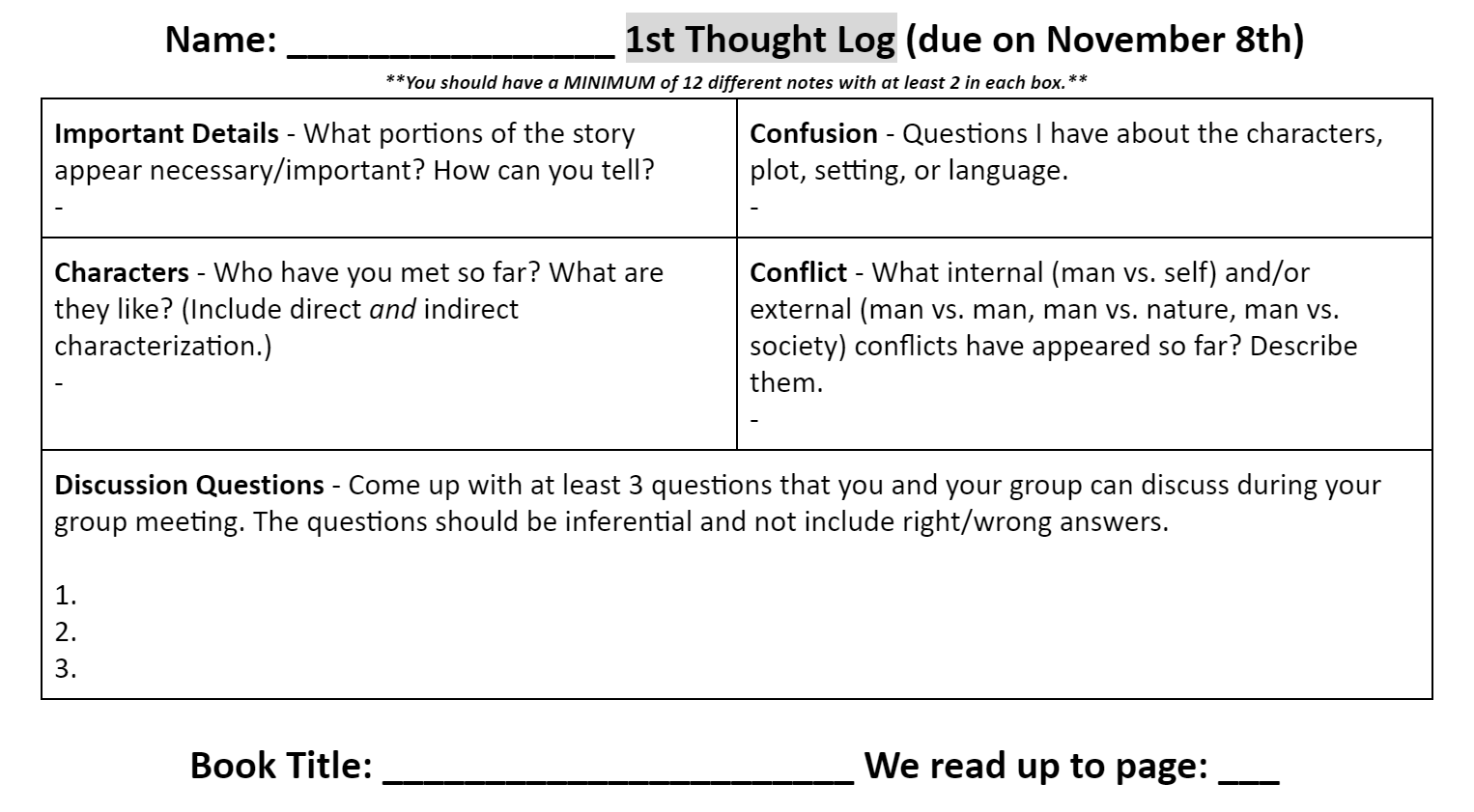
Because of this, I went with thought logs this year. A thought log was a strategy I was introduced to by my teacher friend Sarah Krajewski. Thought logs have four boxes for students to take notes while reading. My thought logs had two constant boxes: 1) Important details & 2) Conflict. Important details allowed them to just take notes on anything important that happened and the conflict box had them track the progress of the conflict. The other two boxes changed for each thought log: Confusion, Characters, Setting, My Feelings, Change, & Theme/Impact. Additionally, I added a bottom to my thought log that asked the students to come up with three open-ended discussion questions. Here’s our first thought log, so you can see an example:

Other than the new thought logs, everything else stayed the same: Students chose their books, I made their groups, we came up with class book club norms, they created their schedule, they met once a week, at the end of the unit I gave an individualized standards-focused assessment, and the kids LOVED it.

Well, everyone stayed the same until the end. At NCTE 2018, I went to one of Kelly Gallagher’s sessions and he shared a way he connects nonfiction and fiction when his students are reading novels: He has the students find nonfiction text features that connect to their novel. I decided to try this with my students, and I loved it!

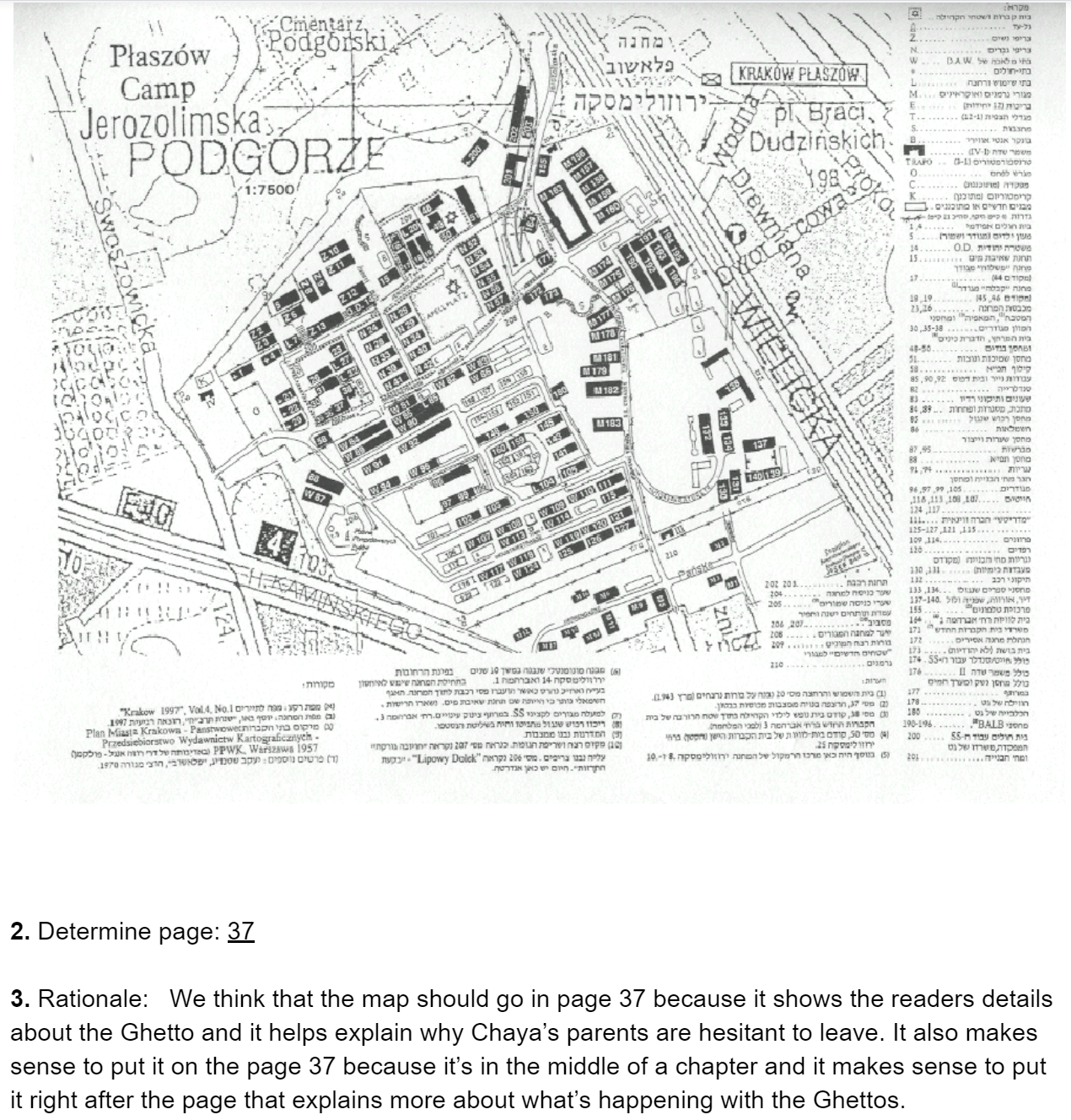
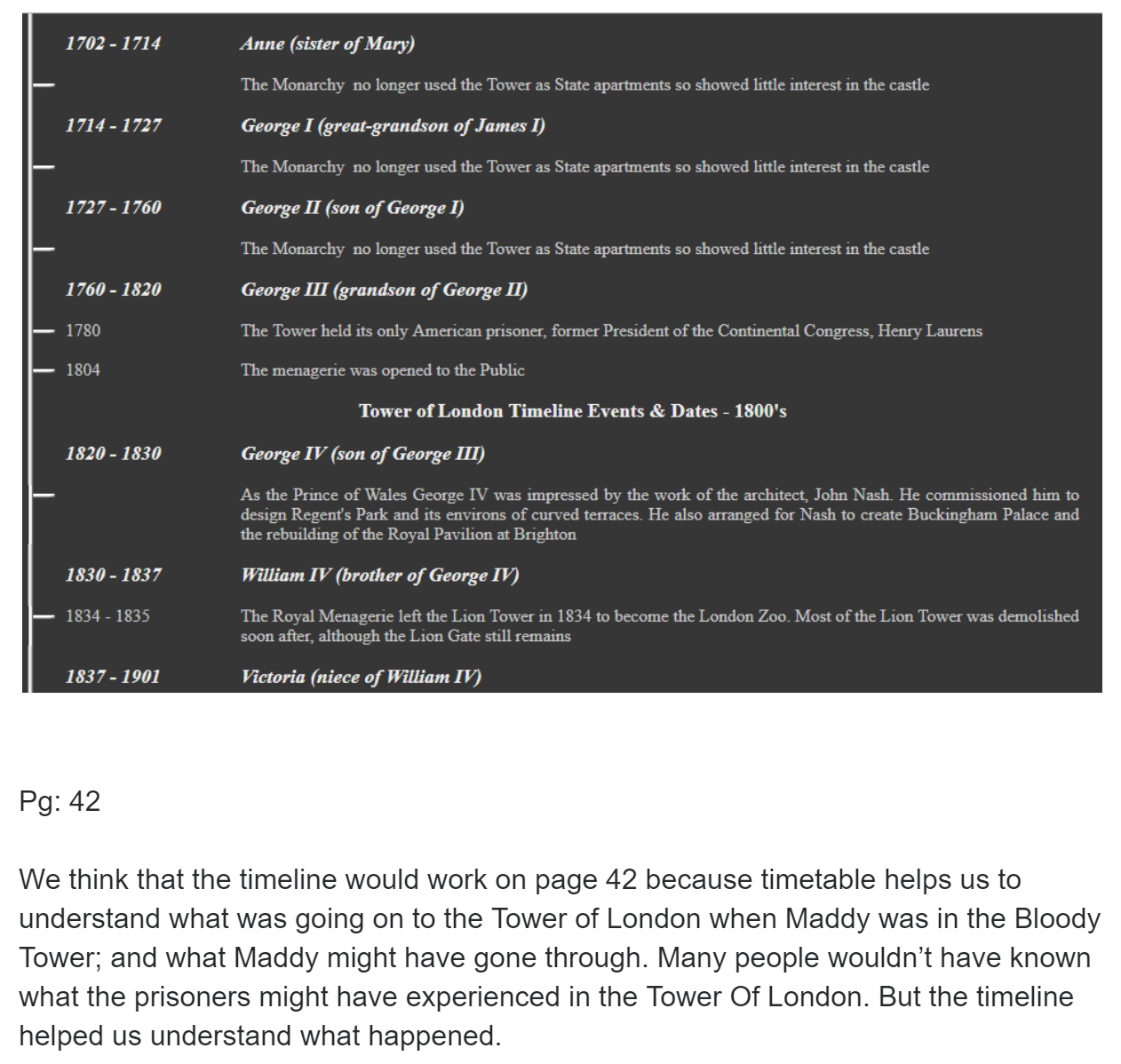
As a book club, my students found two nonfiction elements (maps, graphs, images, etc.) that would help the reader of their book have their experience enhanced. They then said what page they would place the element and explain why it is important.

Here are some of my favorites:

The Honest Truth by Dan Gemeinhart

Rules by Cynthia Lord

Resistance by Jennifer Nielsen

Ravenmaster’s Secret: Escape from the Tower of London by Elvira Woodruff

Reflection: I’m not completely sold on the Thought Logs yet. I don’t want to kill the joy of reading. Ever. But my job is to teach standards, too. Always a conflict within me, and we’ll see what I decide next year! I will say that I loved the nonfiction element, so I think that will stay. Until next year!

Signature

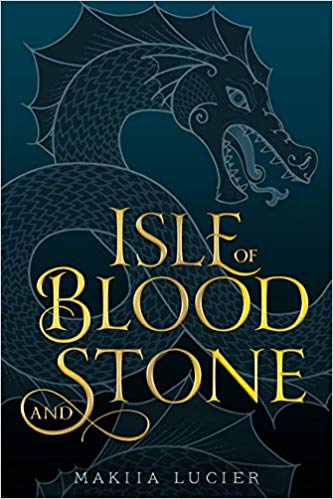
Isle of Blood and Stone by Makiia Lucier

Share

Isle of Blood and Stone
Author: Makiia Lucier
Published: April 10, 2018 by Houghton Mifflin Harcourt

Guest Review by Rachel Krieger

Summary: Nineteen-year-old Elias is a royal explorer, a skilled mapmaker, and the new king of del Mar’s oldest friend. Soon he will embark on the adventure of a lifetime, an expedition past the Strait of Cain and into uncharted waters. Nothing stands in his way…until a long-ago tragedy creeps back into the light, threatening all he holds dear.

The people of St. John del Mar have never recovered from the loss of their boy princes, kidnapped eighteen years ago, both presumed dead. But when two maps surface, each bearing the same hidden riddle, troubling questions arise. What really happened to the young heirs? And why do the maps appear to be drawn by Lord Antoni, Elias’s father, who vanished on that same fateful day? With the king’s beautiful cousin by his side—whether he wants her there or not—Elias will race to solve the riddle of the princes. He will have to use his wits and guard his back. Because some truths are better left buried…and an unknown enemy stalks his every turn.

Review: I absolutely adore this book. Makiia Lucier did an excellent job of incorporating strong characters, resistance to discrimination, mystery, romance, and interesting elements of the fantastic all in one novel. The plot had me completely riveted and I spent a lot of time while not reading thinking about the big reveal I knew was coming. Lucier had strong female characters who consistently proved to be as independent and capable as their male counterparts. The quest narrative was something new and fascinating that will certainly have all readers sticking around until the end. And best yet, this was the first book I have ever read about map-making. The incredible world building required no info dump, nor unrealistic exposition, because Lucier’s characters are often seen either drawing or studying maps. The issues discussed, the characters created, and the world formed came together to make a wonderfully mysterious and incredibly fun novel to read.

Teacher’s Tool For Navigation: This book is a great way for students to look at discrimination. Although the races represented in this novel are of a fantastical nature, they are still ripe for discussion. You can ask your students to think about the real-life connections to the way that Mercedes is treated, being of mixed race. There are many books that address this type of racism directly, making it one of the main aspects of the story. Lucier addresses the issue a few times but does not make it a major plot point. It would be really interesting to discuss this as a plot element but not a form of social commentary.

It could also be interesting to look at and start a discussion on the treatment of illness in our society. There is an island in this novel where lepers are quarantined, often against their will. Although we have nothing exactly like this in society, there are certainly loose parallels in the ways that we treat people with diseases and disorders. It would be really beneficial to start a conversation with students about this form of social imprisonment that is rarely discussed.

Discussion Questions: 

  • What parts of this novel reaffirm gender stereotypes, and which break away?
  • Can you think of any ways that Mercedes’s treatment in the novel is reflected in the real world?
  • What does this novel say about the way that illness is treated in society?

We Flagged: “It was not the first time someone had spat at Mercedes, or even the fifth, but it had been some years since Elias had witnessed the insult.”

Read This If You Loved: Who Fears Death by Nnedi Okorafor, Miss Peregrine’s Home for Peculiar Children by Ransom Riggs, The Night Circus by Erin Morgenstern, Graceling by Kristin Cashore, Scythe Scythe by Neal Shusterman

Recommended For: 
classroomlibrarybuttonsmall 

RickiSig